ASEAN, Still Toothless, Is Losing Its Faith in the U.S.
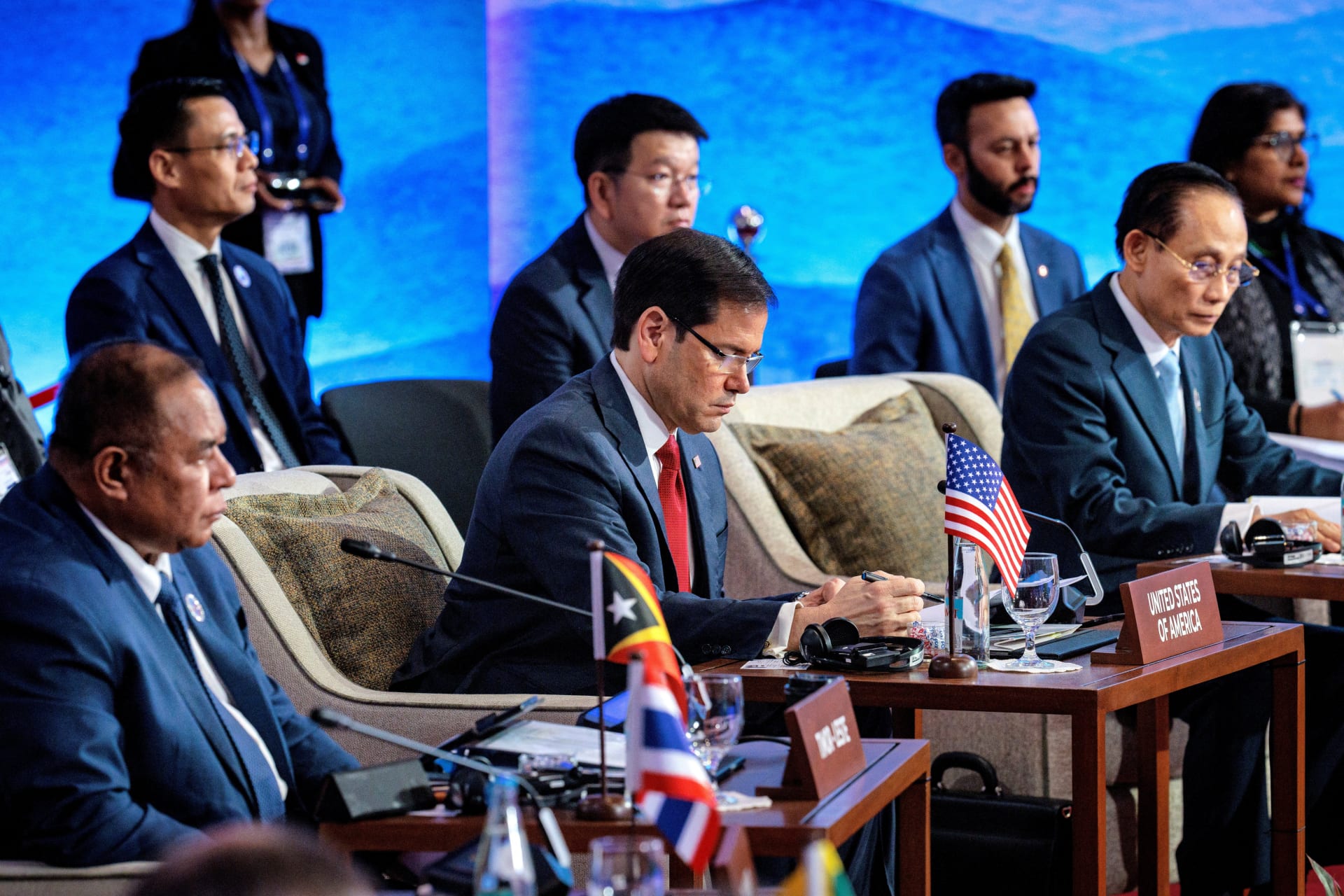
At the July meeting of Association of Southeast Asian Nations (ASEAN) foreign ministers, most of whom were already furious at the United States, U.S. Secretary of State Marco Rubio did little to lower the temperature. But ASEAN also continued its trend of saying much while doing almost nothing.
By experts and staff
- Published
 Joshua KurlantzickCFR ExpertSenior Fellow for Southeast Asia and South Asia
Joshua Kurlantzick focuses on the growing global ties among illiberal states and their impacts on the world. He also examines the militarization of politics, China’s relations with Southeast Asia and other developing regions, China’s influence and information efforts, U.S.-China relations, and Southeast Asian politics and economics.
In late July, U.S. Secretary of State Marco Rubio arrived in Manila for the annual ASEAN Foreign Ministers’ Meeting with a message Southeast Asian officials have heard, in one form or another, for a decade. The United States, he assured them, remains a committed Indo-Pacific partner—devoted to Southeast Asia, dependable, and invested in the region’s security and prosperity. “I believe very much that the future and the story of the twenty-first century will be written in this region,” Rubio said.
Rubio’s message was designed to convince the region that despite the resumed war in Iran, the United States would not just ignore Southeast Asia—or regional flash points such as the South China Sea, China’sgrowing pressure on Taiwan, and Beijing’s increasing assertiveness farther out into the Pacific Ocean.
But despite Rubio’s efforts, it was clear to most ASEAN officials that his words had little meaning, and that maybe he too was out of sync with the White House. While the summit was taking place, the Trump administration imposed new tariffs on the Philippines—a treaty ally and the strongest U.S. supporter in the region—as well as six other ASEAN members. Although the tariffs were supposedly based on findings of forced labor and nonadherence to certain reciprocal commitments with Washington, in reality they seemed almost arbitrary.
The new levies provided regional leaders with further evidence that negotiating with the United States over tariffs, as many ASEAN members had done the year before, makes no sense. After all, recent years have shown that U.S. tariffs are subject to revision whenever Washington finds a fresh rationale.
The same week of the ASEAN summit, fighting between the United States and Iran reignited, with Trump considering and then putting off a ground invasion. Those choices sent energy prices skyrocketing, which is a big problem for Southeast Asia.
Anger toward Washington spilled out at the meeting, with ASEAN ministers and lower-ranking officials outraged at the possibility that renewed war with Iran would again close the Strait of Hormuz. Southeast Asia is perhaps the region most dependent on oil and liquefied natural gas from the Persian Gulf, and has already faced one massive energy shock during the first part of the war.
ASEAN foreign ministers released a joint statement [PDF] asking for assurances that the Strait of Hormuz would remain open, and pleading for all parties in the Iran war to exercise restraint. Near the end of the meeting, they issued a joint communiqué [PDF] that was more explicit. In it, they begged for peace in the Middle East and warned that a return to war could again decimate Southeast Asia’s access to energy supplies, worsen poverty, impede trade, and harm food production, as energy shortages severely disrupt fertilizer supply.
Many Southeast Asian officials, in private conversations I had, were incensed about the Trump administration’s handling of the war. They were furious, too, that Rubio arrived at the meeting with so little to offer, particularly in comparison to the aid and investment they are getting from China. Rubio’s most tangible offering was roughly $100 million in military financing for the Philippines, plus money to expand a coast guard pier on Palawan (an archipelagic province of the Philippines), near contested South China Sea waters.
Shifting Views of the United States
Attitudes toward the United States had already been curdling in Southeast Asia (and around the world) before Rubio and his entourage landed in Manila. In mid-July, the Pew Research Center published a survey of more than forty-two thousand people in thirty-six countries showing that China is now seen more favorably than the United States in most of them—a reversal of a pattern that had held for nearly two decades.
The poll hardly came out of the blue. As my colleague Yanzhong Huang noted, “In Gallup’s global ratings for 2025, China’s median approval rating (36 percent) edged past that of the United States (31 percent) across more than 130 countries—the widest margin in China’s favor that Gallup has recorded in nearly twenty years.” A separate regional poll [PDF] this spring by the ISEAS–Yusof Ishak Institute in Singapore found that ASEAN respondents, forced to choose between the two powers, picked China over the United States, 52 percent to 48 percent.
The Pew poll showed that countries across Asia were among those that now see China more favorably, including ASEAN members Indonesia, Malaysia, Singapore, and Thailand. (Not every ASEAN country was included in the poll.) In many cases, the numbers are not even close. The Pew study found that in Singapore, long one of the closest U.S. partners in the region, respondents now favor China over the United States by a whopping thirty-nine points. In Thailand, the gap is thirty-three points; in Indonesia, it is forty-three points; and in Malaysia, it is a staggering fifty-six points.
Silence on Myanmar and the Usual Inaction on the South China Sea
Against this moody backdrop, the summit again confirmed that ASEAN is an increasingly toothless organization that can do little about the crises on its own doorstep. It has continued to do nothing about Myanmar, even as the civil war there has become the deadliest conflict in Asia, as the country has become a de facto failed state, and as its problems—refugees, drugs, disease—spill out across the region. In addition, ASEAN has at multiple meetings, including the most recent foreign ministers’ summit, done little to condemn the “election” stage-managed by the Myanmar junta last winter that was entirely unfree, and which created a supposedly civilian government led by former junta head Min Aung Hlaing.
With ASEAN mostly silent, the election has given Myanmar’s junta-turned-civilian government significant legitimacy, even as it makes major military gains in the civil war due to an increase in military assistance from a range of autocratic countries, including Belarus, China, and Russia. Nonetheless, in July, ASEAN ministers met with Myanmar’s leaders for the first time in five years, reversing recent policy and granting a further sign of legitimacy.
The meeting failed to yield any commitments from the country’s generals, who continue to ignore the five-point peace plan ASEAN created in the wake of the 2021 coup. Leaders in the Philippines—this year’s ASEAN chair—still insist that the plan could be enacted. But ASEAN’s calls for a ceasefire, dialogue between the regime and anti-regime forces, and other measures have gone nowhere. At this point, ASEAN seems to have simply accepted the Naypyidaw regime.
As at every ASEAN meeting, the organization also remained deadlocked on how to respond to China’s increasingly aggressive approach toward the South China Sea, which has several ASEAN claimants. Even the fact that Chinese and Philippine forces had several clashes in disputed South China Sea waters during the foreign ministers’ meeting could not bring ASEAN to any consensus statement about recent maritime incidents between Manila and Beijing.
Neither was any progress made toward a South China Sea code of conduct, which has been discussed for years. The reason for the lack of unity is obvious: China has several de facto client states in ASEAN, such as Cambodia and Laos, and through them can block consensus on anything it dislikes.
A Grim Outlook
The foreign ministers’ meeting was bleak in its implications for the United States and ASEAN itself. The organization remains what it has long been: a consensus body that cannot compel its own members toward a shared position, even when it faces serious strategic or economic threats, such as the energy crisis caused by the Iran war. The United States, despite its offer of warm sentiments, spent the week making itself look unreliable, while antagonizing Southeast Asian officials with the tariffs and Iran conflict—and alienating publics as well.
For years, Southeast Asian governments have tried to hedge between the United States and China, often relying on the U.S. security guarantee while boosting trade with Beijing. But Washington, showing ever-increasing unreliability, is making some Southeast Asian states abandon hedging altogether—even U.S. treaty ally Thailand is now clearly leaning toward China. Other states that still want to hedge, such as Singapore, are finding it harder to do so as public sentiment turns against the United States and Chinese soft power becomes more impressive. Rubio’s visit did little to reverse this shift.
This work represents the views solely of the author(s). The Council on Foreign Relations is an independent, nonpartisan membership organization, think tank, and publisher, and takes no institutional positions on matters of policy.