Campaign 2012 Roundup: Bachmann on Foreign Policy, Perry on Iran, Pundits on Romney
By experts and staff
- Published
 James M. LindsayCFR ExpertMary and David Boies Distinguished Senior Fellow in U.S. Foreign Policy
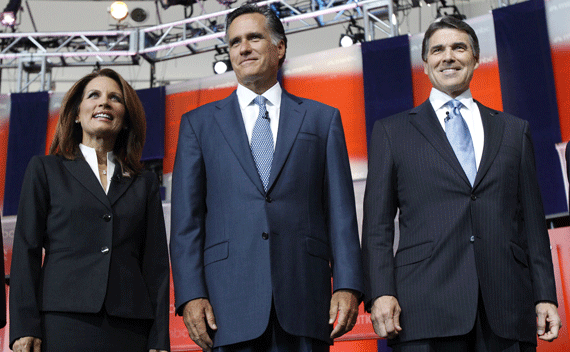
Protestors disrupted Michele Bachmann’s major foreign policy speech yesterday, so news coverage has focused on the protests rather than what she said. The Bachmann campaign has yet to post a copy of the speech on its website. The Charleston Post and Courier summarizes the substance of the speech as follows:
She criticized President Barack Obama for reducing military resources during wartime and noted she understands the nation’s threats as a member of the House Intelligence Committee.
She said the military budget can be trimmed strategically by such steps as changing from cost-plus contracting to fixed-price contracting.
Bachmann also traced the nation’s conflicts with the Muslim world, from the Iran hostage crisis onward, saying, “Make no mistake the United States is at war with radical Islamic extremism.” She criticized Obama for telling Israel to give back land, adding, “I’ll stand on the side of Israel and will ensure that Iran never has a nuclear weapon.”
Rick Perry issued a statement in the response to new IAEA report alleging that Iran continues to pursue a nuclear weapons program. The statement contains the standard criticism of Obama’s foreign policy and then goes on to say what the United States should do:
The U.S. should also act with renewed vigor to support those seeking freedom in Syria, Iran’s critical Arab ally, as well in Iran itself, where millions were repressed in 2009 when President Obama tragically ignored the Green Movement to pursue the folly of engagement.
The implied call for regime change in Damascus is the novel aspect of the statement.
The New Yorker’s Evan Osnos discusses an upcoming Joe Klein piece in Time on why China is a “pain-free target” for U.S. presidential candidates—at least until they enter the Oval Office. The “Danger Room” argues that Romney’s op-ed in yesterday’s Wall Street Journal indicates that “Mitt 2.0” has pivoted “away from neoconservatism, and toward something more reversed.”
Sen. Lindsey Graham (R-SC) writes in the National Review that “President Obama will sacrifice strategic thinking on national security in favor of raw political calculation.” Critics like Graham probably see The White House’s decision yesterday to delay action on the Keystone XL pipeline as further evidence for their claim.