Battleground State
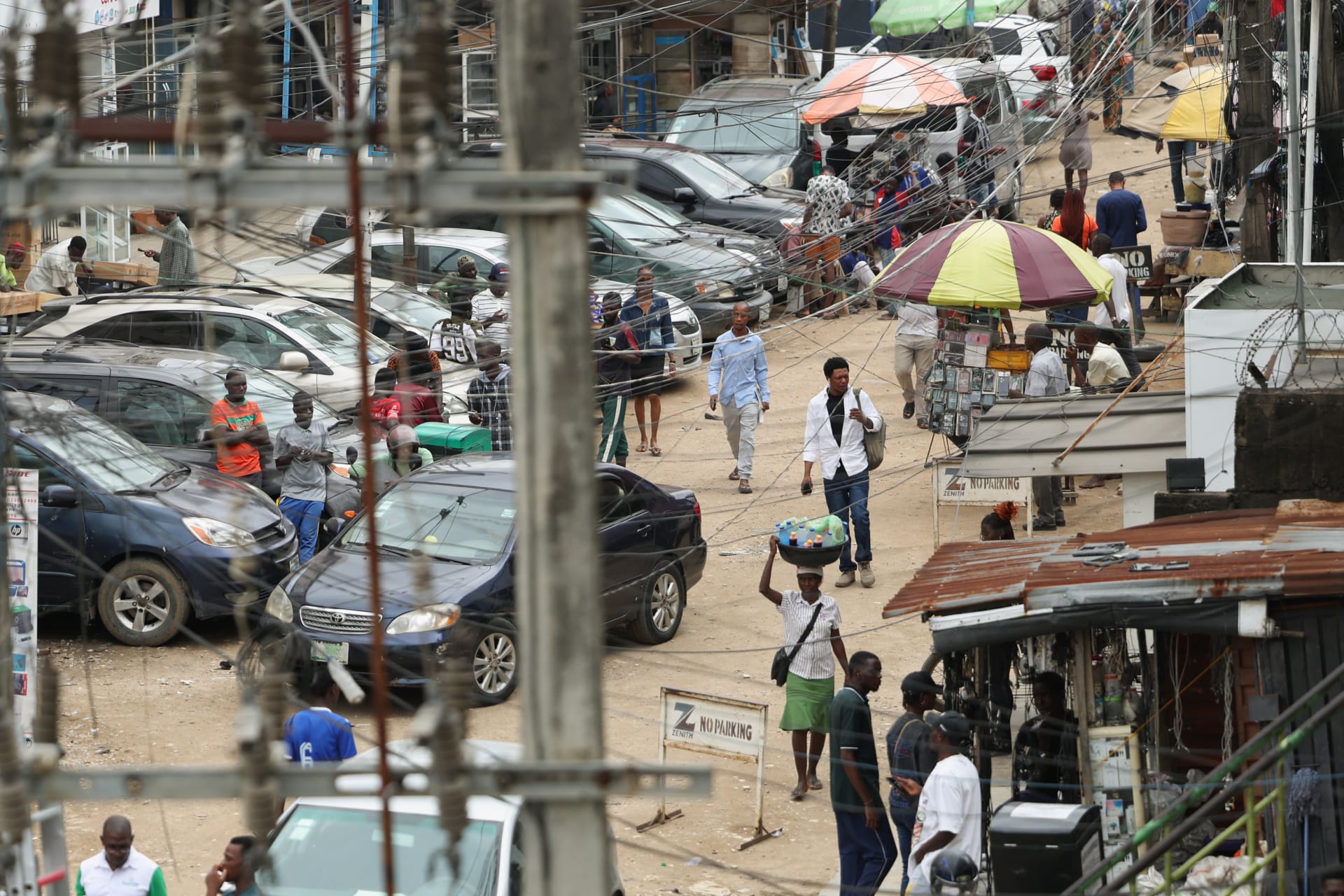
For reasons that transcend the current electoral cycle, the competition for Lagos in the January election promises to be intense.
By experts and staff
- Published
 Ebenezer ObadareCFR ExpertDouglas Dillon Senior Fellow for Africa Studies
Labor Party standard-bearer Peter Obi’s spectacular victory in Lagos state is perhaps the most astonishing aspect of the 2023 presidential election, and almost four years after, pundits continue to debate just how it came about. Yet, if there is anything more surprising than the fact that Obi won, claiming 582,454 votes to the All Progressives Congress (APC) candidate Bola Ahmed Tinubu’s 572,606 votes, it is that Tinubu lost.
It says something about the improbability of an Obi victory and the shockwave that it sent across the political landscape that even today, some commentators continue to indulge in the groundless speculation that the Tinubu campaign strategically “gave Lagos away” as a sop to the Obidient (Obi’s army of young and mostly urban-based supporters) in order to pacify them and prevent them from burning the country down.
The more one considers the hypothesis, the more implausible it sounds. In the first place, there is scant evidence that the Tinubu campaign held back resources in Lagos, and allowing your adversary to win out by a mere ten thousand votes seems a rather strange way of appeasing it. Furthermore, the theory underestimates the importance of Lagos to Tinubu. If Tinubu is, by some measure, the most dominant personality of the Nigerian Fourth Republic, it is partly on account of his control of Lagos, which he ran as its inaugural Fourth Republic governor (1999–2007), and whose chief executive and other major political functionaries he has singlehandedly handpicked ever since. Being therefore the center of his political and financial gravity (the popular story about Tinubu once turning in for the night and announcing to those seated in his living room that “Lagos is going to bed” is telling), it is difficult to imagine Tinubu agreeing to trade it away in the name of giving succor to his adversaries. Finally, not only does the idea imply that Obi did not deserve to win Lagos, it underestimates the amount of groundwork that his supporters put in and, more important, the concurrent support for Obi and disgust at Tinubu among the state’s cosmopolitan elite who had come to resent what they saw as his (i.e., Tinubu’s) thumb on the scale.
It would appear then that, rather than a sop to the opposition, Lagos was a hotly contested political ground where Tinubu was unexpectedly given a bloody nose.
Which sets things up rather nicely for January’s contest. For his part, it is understandable that Obi, this time on the platform of the Nigeria Democratic Congress, would welcome a similar outcome to the 2023 election. He will be hoping to cash in on support from his Igbo co-ethnics who form a sizeable and growing portion of the state’s population (just how many Igbos live in Lagos is as inscrutable as the population of Lagos, not to talk of Nigeria itself); Lagosians of all ethnicities still seething at the perceived entrenchment of the Tinubu dynasty; and a cross section of low-level salaried workers and the urban precariat who have borne the brunt of the Tinubu administration’s economic reforms. (For a comprehensive treatment of Obi’s chances in the presidential election and the moves he has made to overcome the political and demographic handicaps to his ambition, see a previous installment in the series here.)
Tinubu, on the other hand, would be counting on a different outcome for some of the reasons adumbrated above. I know from conversations with those close to him the level of his disappointment at losing Lagos—the first time in his political career that that had happened—in 2023, and it stands to reason that he would pull out all the stops in a bid to undo that stain and restore order at the earliest opportunity. (For a corresponding assessment of Tinubu’s chances, see here.)
In Obi versus Tinubu, then—at least as far as Lagos is concerned—the irresistible would appear to be standing firmly in the way of the immovable. Yet, it would be naïve, if not totally misleading, to reduce the struggle for supremacy in Lagos to a straightforward clash of personalities.
At issue in Lagos, and as any observer of Nigerian politics would readily attest, is lingering contention over its “ownership,” a contention enfolded within the broader historical contestation over identity, citizenship, and belonging in Nigeria. When, back in April 2015 (to take just one of the more recent flashpoints), the Oba of Lagos, Rilwan Babatunde Akiolu, threatened a contingent of Eze Ndigbos (Igbo traditional rulers) on a goodwill visit to his palace that Igbos in Lagos risked perishing inside the lagoon if they did not vote en masse for the APC’s Akinwunmi Ambode, his preferred candidate in the state’s then-upcoming gubernatorial election, he starkly exposed this unresolved tension. The following excerpt from Oba Akiolu’s statement to the visiting Eze Ndigbos points to the particularities of this strain and the many questions it raises about the Igbos in Lagos:
“On Saturday, if anyone of you goes against Ambode who I picked, that is your end. If it doesn’t happen within seven days, just know that I am a bastard and it is not my father who gave birth to me. Jonathan is my son and I speak to him every day. By the grace of God, I am the owner of Lagos for the time being. This is an undivided chair. The palace belongs to the dead and those coming in the future. On Saturday, if anyone of you, I swear in the name of God, goes against my wish that Ambode will be the next governor of Lagos state, the person is going to die inside this water.”
To say that Oba Akiolu was unchivalrous is an understatement, yet the obvious lack of consideration is the least of the problems raised by his remarks, over which the errant monarch was instantly, if justly, raked over the coals by critics along the ideological and ethnic spectrum. From a purely civic standpoint, it is disappointing enough that a monarch would treat the leaders of one of Nigeria’s three main ethnic groups and, ipso facto, the ethnic group itself, like legal minors unable to think and decide for themselves, a disregard that, instructively, the Oba would not even extend to his own Lagos-Yoruba co-ethnics. More telling—and this is the rub—is that Oba Akiolu treated Igbos in Lagos as his traditional subjects, rather than full and independent members of a political community (Lagos state) where even he, the Oba, is subject to a higher authority (i.e., the governor of the state). In other words, Oba Akiolu acted as if he were the traditional overlord of the Igbos and any other resident of Lagos, and as though he had the power of life and death over them, powers that his ancestors may once have had, but which colonial modernity, for good or for ill, has effectively stripped him of.
But Oba Akiolu is not the only one apparently struggling to stay within bounds in this matter. The Igbos are as Lagosian as any of the rainbow of ethnicities—domestic or foreign—which has given the city its unique vibrancy, and their advocates make an unimpeachable argument when they insist that Lagos would not be what it is without their singular entrepreneurial drive, and therefore it “belongs to everybody,” or at least that they have as much entitlement as any other group, Yoruba or not, to the city’s political symbols and material resources.
Yorubas do not so much deny this as take strong exception to what they see as the implication that Lagos is “no man’s land.” Understandably perhaps, they find the latter jarring, especially insofar as it comes across as a denial of what they see as the supreme proof of Yoruba cultural pragmatism, and compelling evidence that Nigerians of all ethnic and religious backgrounds can coexist peacefully. What members of other ethnic groups in the country often casually attribute to the physical location of Lagos as a coastal city-state, Yorubas, pointing to the comparative lack of dynamism in other coastal cities across the country, submit as a cultural achievement made possible and underwritten solely by Yoruba liberalism. For them, it takes much more than the presence of many random ethnicities to make a city like Lagos; it takes the software of Yoruba pragmatism to knead that dough into a desirable whole.
The reader will be relieved to know that none of this “indigene” versus “settler” kerfuffle is new. As University of Pennsylvania political scientist Wale Adebanwi documents in his study of the press in colonial Nigeria, the newspaper media of the time was perennially pressed into service amid “rival claims to ‘ownership’ and ‘primacy’ in spatial politics between the Yoruba and the Igbo ethnic nationalities” in Lagos. In other words, contention over Lagos is almost as old as its existence as a modern city. All of which would seem to indicate that a low wattage rancor will be the soundtrack of the forthcoming election in the city, in which case we should not be at all surprised if election day is punctuated by sporadic violence.
From a historical perspective, though, the election itself is doomed to be writ in water. What will perdure is the undercurrent of the struggle for precedence and prestige in Nigeria’s most energetic and most commercially successful city.
This is the latest installment in a series in which I attempt to excavate the underlying forces shaping the struggle for power in Nigeria as we head into the 2027 presidential election. The most recent installment can be found here.
This work represents the views solely of the author(s). The Council on Foreign Relations is an independent, nonpartisan membership organization, think tank, and publisher, and takes no institutional positions on matters of policy.