Europe Could Be Walking Into a Trap Over Ukraine Talks
It makes sense for European leaders to have a seat at the negotiating table. But tying talks to questions of broader European security creates its own risks.

Liana Fix leads the Securing Ukraine’s Future Initiative at the Council on Foreign Relations. She is the author of Germany Rearmed: The Return of War and the End of Illusions.
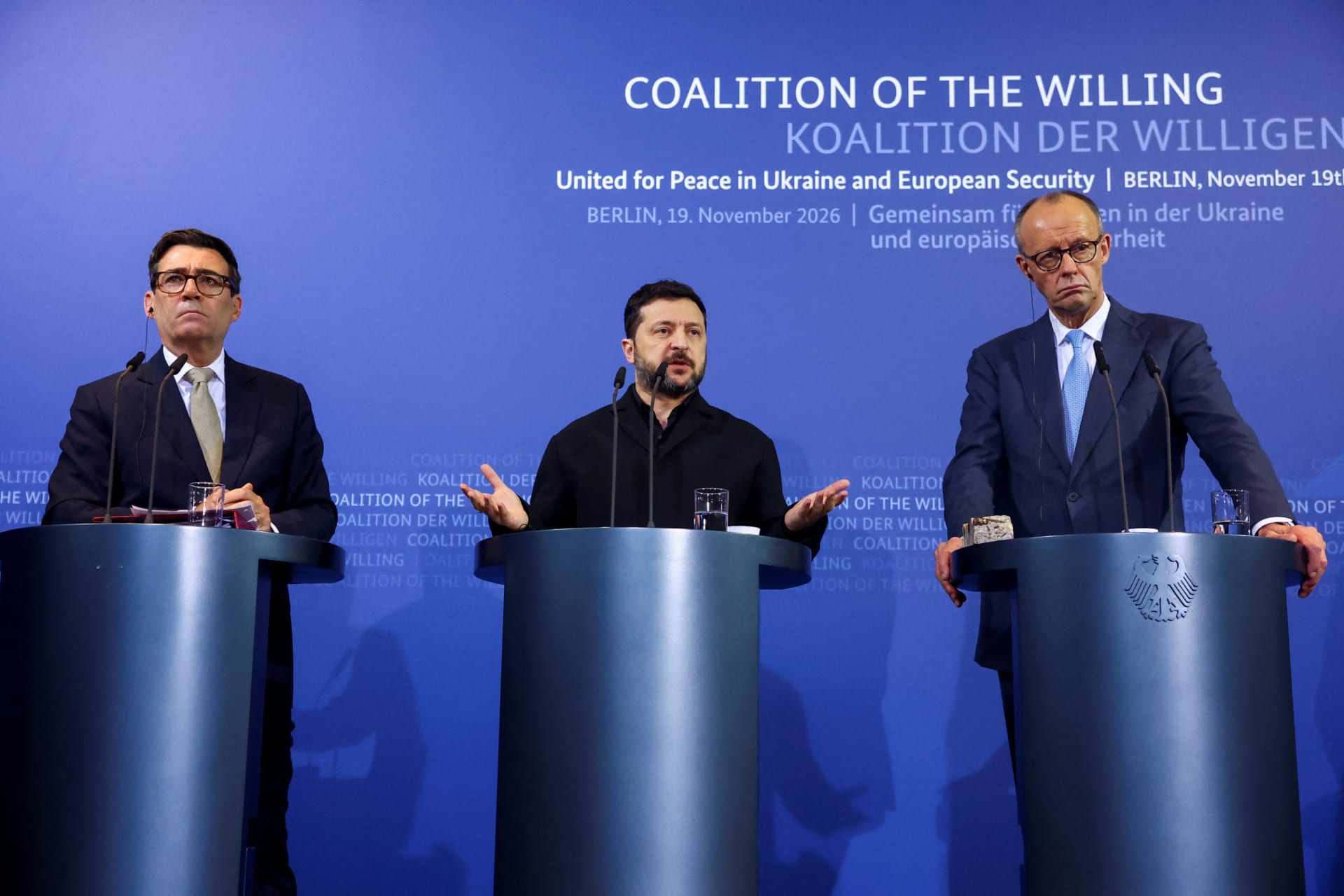
As U.S. President Donald Trump, Russian President Vladimir Putin, and Chinese President Xi Jinping met this week for trilateral talks in Shenzhen, China, more than five thousand miles away, the so-called Coalition of the Willing was gathering in Berlin to discuss Ukraine’s future.
The symbolism was impossible to miss. While President Trump engaged with the aggressor and a key enabler of the war in Ukraine, more than thirty heads of state and government, including Ukrainian President Volodymyr Zelenskyy, as well as U.S. envoys Steve Witkoff and Jared Kushner, were putting on a strong show of unity that underscored European leaders’ determination to secure, in the words of NATO Secretary-General Mark Rutte, “a just and lasting peace for Ukraine.”
Yet European leaders pushing for a seat at the table in talks about Ukraine’s future should be careful what they wish for. They could easily walk into a trap.
As Ukraine’s strongest supporter, it makes sense for Europe to have a direct role in negotiations about the country’s future. Europeans are hoping their presence will thwart efforts to push Ukraine into agreeing to a disadvantageous deal similar to the 28-point peace plan discussed by U.S. negotiators last year. But Europe’s leaders are also mindful that negotiations are not only about Ukraine’s future—Europe’s future security is increasingly bound up in the discussions.
The United States has accepted the Russian view that negotiations on Ukraine need to involve talks about broader European security. In earlier rounds, such talks were made contingent on progress toward a ceasefire. But Washington has now explicitly pushed for Europeans, ideally after agreeing on a single representative, to make progress around a European security element of the deal.
Having a single representative for Europe does not seem viable, and European leaders have instead agreed that national security advisors from France, Germany, Italy, Poland, the United Kingdom, and EU institutions will represent European interests at the negotiating table, if peace talks open up to Europe.
One of the problems is that Russia has so far not confirmed that it is open to a direct European presence at the negotiations. On the contrary: Putin has essentially ridiculed Europeans by inviting them to Moscow to “clarify their position,” after which Russia “will decide in what format to continue the dialogue with Ukraine.”
While it is unacceptable to the Europeans to be summoned to Moscow in this way, and although they do not expect Putin to alter his position in negotiations, most European leaders have accepted the need to talk to Russia directly. But there are downsides and risks to direct talks.
Speaking after his meeting with Trump and Xi, Putin said that “discussing security issues, including security in Europe, without Europeans is pointless.” The danger for the Europeans is that both Russia and the United States, the latter by bringing Europeans in, will try to place the responsibility for solving Russia’s security “concerns” on European leaders in the hopes that it provides a shortcut to a ceasefire deal that would allow President Trump to present himself as a historic peacemaker. The U.S. side has little interest in the actual details of what this would mean for Europe, leaving European leaders pressured to deliver something that is impossible for them to agree to: a diminishment of European security.
What exactly Russia means when it talks about “European security” and the “root causes of the war” becomes clear both from past Russian positions and from a paper reportedly circulated by Russian officials last week that reiterates some of the hardline positions Russia outlined in December 2021 (and adds some new ones). These include:
- Rolling back NATO’s military infrastructure to 1997 levels. This would compromise NATO protection for Poland and the Baltic states, making these countries indefensible buffer zones.
- Stopping any military support for Ukraine. This would lead to Ukraine’s defeat sooner rather than later.
- Stopping France and the United Kingdom from extending nuclear guarantees to Europeans. This comes at a time of ambiguity about U.S. commitments to Europe.
In principle, there is nothing wrong with talking about European security with Russia, if it leads to greater stability and possibly arms control measures in Europe. However, this is not what Russia wants. Putin is grieving the loss of Soviet and Russian influence over Central Europe, and looking for a redo, hoping that he can buy time to break Ukraine’s resistance over the winter. Despite nearly five years of unsuccessful fighting involving heavy casualties, Russia continues to put forward maximalist positions.
To avoid walking into a trap, Europeans should work closely with the U.S. side and explain to it why Russian demands on European security are not in the United States’ interests and why pressuring Europeans into accepting these demands would significantly undermine U.S. influence in Europe.
There is a path forward for constructive discussions of European security, and it starts by looking to the response to Putin’s December 2021 demands. Back then, in a last-minute effort to engage earnestly with Russia and try to prevent the invasion, U.S., European and NATO officials worked together and delivered a response to Russia’s ultimatum in January 2022. That response outlined where the United States and Europe could see areas of flexibility to discuss European security. The U.S. and European negotiating position included, for example, proposing reciprocal negotiations on arms control and military transparency.
This was good work, which should be the basis for what Europe and the United States put forward now. They should then wait for Russia’s response to gauge whether Putin is serious about negotiations. If it turns out he is not, then his maximalist aims and refusal to show any flexibility will mean it is Putin who has set himself up for eventual failure.
This work represents the views solely of the author(s). The Council on Foreign Relations is an independent, nonpartisan membership organization, think tank, and publisher, and takes no institutional positions on matters of policy.