For Critical Minerals, Money Isn’t the Problem. Commitment Is.
The money is finally flowing. What Washington lacks is a constituency that won’t let the next Congress walk away.
By experts and staff
- Published
- Kirsten Asdal
- Thomas J. Koch
- Chryssa Rask
- Tao Tan
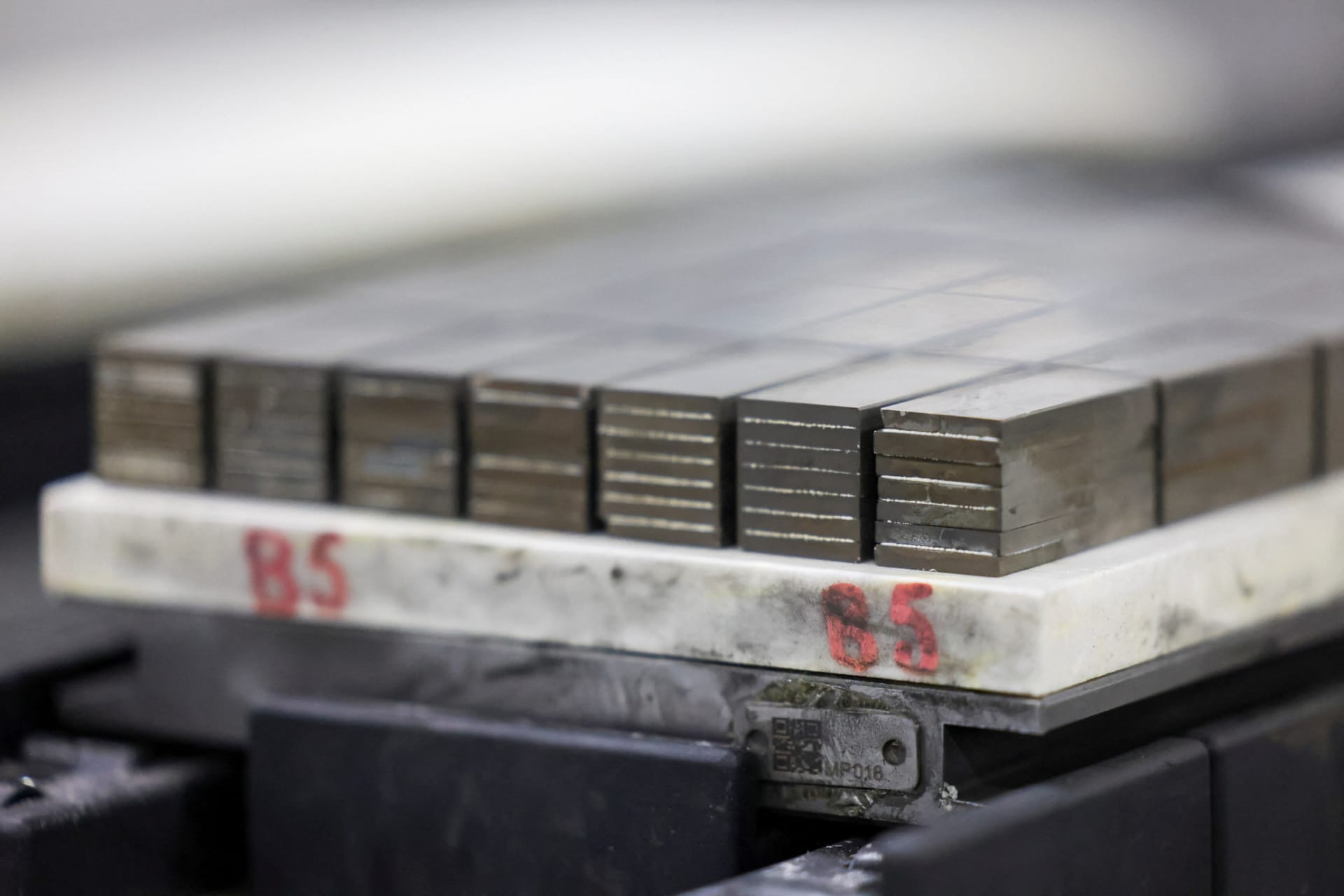
In May 2025, Ford halted its Chicago-based Explorer assembly line for a week. It wasn’t due to a strike or an equipment failure. Rather, it was China’s new licensing regime for exports of rare-earth magnets, which are used in the electric motors that operate braking and steering systems, fuel injectors, and even power seats. In ordinary times, those magnets cost perhaps a few dollars. Put another way, the inability to source a few dollars’ worth of magnets halted production of a $40,000 vehicle.
In the past few years, the United States has come to feel the costs of the Chinese Communist Party’s control of critical chokepoints in rare earths. The response of both parties has been to throw money at the problem: the Pentagon’s Office of Strategic Capital, established under President Joe Biden, was allocated $200 billion of loan authority under President Donald Trump’s One Big Beautiful Bill Act, with $100 billion earmarked specifically for critical minerals. A steady drumbeat of deals shows the office is successfully getting funds out the door.
Capital, ironically, is the easy part. Washington faces what game theorists call a commitment problem. It is a challenge of political economy: rebuilding a supply chain can take a decade or more and require consistent government support because industry fundamentals are unprofitable, and today’s Congress cannot bind tomorrow’s. Meanwhile, the Chinese Communist Party understands perfectly well that its near-monopoly market position means that it can make the same material worthless or priceless on command, providing it a wide array of tools to put pressure on rivals, extract policy concessions, or both.
Some of that pressure is already building. A lobby exists in rare earths, but unfortunately, it is pointed in the wrong direction. On January 1, 2027, a Pentagon rule (DFARS 252.225-7052) barring rare-earth magnets with any Chinese content from defense supply chains is set to take effect, already a year late. Major defense contractors have aggressively moved to push for delays and waivers because no Western source can meet their needs. And no one can blame them as their interest is in securing supply, not in where it comes from.
There is an underappreciation in national security circles that private investors are fundamentally uninterested in funding those deals because they are unprofitable and complex relative to other opportunities. Meanwhile, the danger of relying solely on government funding is political instability for a political system that works on one-year budget and two-year electoral cycles to sustain a program that will take a decade or more to bear fruit.
Washington should intentionally create a counter-constituency that will advocate for a domestic supply chain regardless of who is in office. If Congress and executive branch agencies structure the financing so that defense contractors, automakers, and semiconductor manufacturers come to depend on a domestic supply chain, then they will defend it long after today’s officials are gone. A constituency with its own money at stake becomes a commitment device that a future Congress will be hard-pressed to ignore. There are three ways to build one.
Make a Market
The first mechanism makes companies dependent on a market that does not exist today but that Washington can help create. Buying rare-earth products is hard because prices vary widely by compound, purity, and source. There is no global benchmark like West Texas Intermediate or Brent for oil. Instead, buyers face a patchwork of divergent prices, each negotiated bilaterally and shielded by nondisclosure agreements, with little of it visible to the market. Investors cannot finance, and buyers cannot rely on, projects whose output has no reliable price.
Washington could borrow a model from health care. Hospitals buy many of their supplies and drugs through group purchasing organizations (GPOs), which aggregate demand and bargain collectively. The government can either contract with an existing company or industry association or charter a new organization and pair it with the Defense Logistics Agency’s long experience in bulk procurement. Pooling demand would create both a reliable demand signal and price discovery, important indicators of bankability for would-be investors.
Several start-ups are already trying to build such marketplaces, but none can aggregate demand at scale. The government can create that overnight by requiring the producers it backs to sell a portion of their offtake through the GPO. GPO members can include related efforts such as Project Vault, the Trump administration’s $12 billion critical minerals stockpile, to further improve price discovery. Companies that source through the GPO would therefore have a stake in its survival. Over time, if the GPO consistently operates at a profit, it could be spun off or even sold, much like how the Nasdaq Stock Market spun off from its parent industry association and the New York Stock Exchange de-mutualized, both in 2006.
Both the legal authority and operational precedent for that strategy already exist. Section 708 of the Defense Production Act permits companies to coordinate through “voluntary agreements,” with a limited safe harbor against antitrust claims. The Department of Energy has used it to bring nearly one hundred nuclear fuel companies into a consortium aimed at rebuilding a domestic fuel supply chain. (Russia is the only commercial supplier of high-assay low-enriched uranium.) Critical minerals look similar in that the chokepoint is held by an adversary, and the market is too thin for scattered deals to form a demand signal.
Trade Offtake for Investment
The second mechanism incentivizes companies to coinvest their own capital. Today, in deals such as the one with MP Materials, the government allocates offtake through a waterfall: defense primes first, then the broader defense industrial base, then other U.S. companies, then companies in allied countries, and finally companies in non-embargoed countries. In effect, it gives access away without asking anything in return.
We recently proposed a contingent convertible financing mechanism that would be paired with an offtake commitment and a price floor, which could dynamically change form in response to external events such as Beijing weaponizing supply. We recommended reserving a share of the offtake, say 40 percent, for vetted strategic coinvestors (including firms from allied countries) who put capital into the project alongside the government on a pro rata basis. The rest would still flow through the waterfall, and both would price through the GPO. Such a dynamic could also crowd in capital, as no company wants to sit out while a rival locks up supply.
Institutional investors are unlikely to take part, because those projects could well fail a pure financial underwriting standard. But an automaker or a defense prime or a semiconductor manufacturer might conceive of its return less in financial terms than in terms of guaranteed access to the elements it cannot do without.
U.S. allies already think that way. After China flexed its rare-earth chokepoint against Japan during a maritime dispute in 2010, a Japanese consortium of the private Sojitz Corporation, the state-owned Japan Organization for Metals and Energy Security, with support from the Ministry of Economy, Trade, and Industry, invested $250 million into Australia’s mining company Lynas in return for priority access to the offtake. Since then, Japan’s reliance on China for rare-earth elements has fallen from 90 to 60 percent.
Beijing could still try to deter coinvestors by threatening their interests in China, which is one more reason to bring them in as a group, so no single company or country stands out. A company with skin in the game becomes a fierce defender of the program.
Keep Score
The third mechanism gives the program’s defenders a clear record they can point to. In 2011, the energy company Solyndra, backed by $528 million of taxpayer-funded loans, declared bankruptcy. Politicians of both parties rushed to hold hearings. But by 2014, the Department of Energy’s program as a whole had turned profitable. Still, the Biden-era Loan Programs Office (now the Office of Energy Dominance Financing) managed to issue only about a quarter of its $412 billion loan authority, most of it after the 2024 election, of which $83 billion has since been canceled or restructured. Fifteen years after the event, “Solyndra fear” is still real in Washington and still hamstringing policy.
Projects are most vulnerable after vast sums of taxpayer money have been spent but before they have fully ramped up to create viable alternative sources of supply. Some could fail, whether from Chinese predatory pricing or simple execution risk. The idea is not to prevent failure at all costs but to ensure that isolated failures do not imperil an entire policy.
Washington should judge its investments the way any investor judges a fund, where wins in one project offset losses in another, and communicate it as such. Specifically, the government should systematically track those wins and losses across the whole of government rather than agency by agency, so that the program’s aggregate record is easy to point to. A simple scorecard would give its supporters the data to advocate for continuing the effort.
Flip the Lobby
Today’s critical minerals lobby pushes for delays and waivers. Washington can turn that around. Pooled demand makes an industry bankable, coinvestment puts skin in the game, and portfolio perspective gives supporters ammunition. With a proper alignment of interests, defense contractors, automakers, and semiconductor manufacturers would have every reason to defend the program long after the administration that created it is gone.
A note of caution: A lobby can also outstay its welcome. The constituencies that keep subsidies alive can also keep them alive too long. Such programs should have built-in sunsets tied to output targets and performance, not fixed end dates, which would only tell Beijing how long to wait.
In the years to come, the real test will not be how Beijing acts but what Washington does in response. The questions will be whether a future member of Congress will look askance at long-term offtake agreements in a debt ceiling standoff, or whether a future U.S. trade representative will offer to quietly wind down a price floor to bank a quick win ahead of a summit. Our fear is that the absence of a constituency to answer those questions means that silence will calcify into the answer itself.
* * *
Beijing’s rare-earth chokepoint is a bet on American political dysfunction. The surest way to make Beijing lose that bet is to give American business constituencies a stake in proving it wrong.
--
Kirsten Asdal is cofounder and partner at Asdal Advisory Group, a China risk advisory firm for investors and corporations.
Tom Koch is vice president of corporate development at Principal Mineral, which focuses on supply chain resilience in critical minerals.
Chryssa Rask is executive director at JP Morgan’s Security and Resiliency Initiative.
Tao Tan is a senior managing director at a private investment firm, where he focuses on principal investments in strategic sectors.
The authors are Stephen M. Kellen Term Members at the Council on Foreign Relations.
This work represents the views solely of the author(s). The Council on Foreign Relations is an independent, nonpartisan membership organization, think tank, and publisher, and takes no institutional positions on matters of policy.