Trump Heads to the ASEAN and APEC Summits With Big Plans and Slim Prospects
Trump’s Asia visit has an ambitious agenda, but a wary region and a new Congress could leave him with little to show for the trip.
By experts and staff
- Published
 Joshua KurlantzickCFR ExpertSenior Fellow for Southeast Asia and South Asia
Fresh off the midterm elections, President Donald Trump will travel to Asia between November 16 and 19. He will first travel to Manila, where he will attend the U.S.-Association of Southeast Asian Nations (ASEAN) Special Summit and hold bilateral meetings, and then travel to Shenzhen for the Asia-Pacific Economic Cooperation (APEC) leaders’ summit and to meet with Chinese leader Xi Jinping and possibly also Russian President Vladimir Putin.
In neither place is he likely to receive a warm reception, though some Asian leaders are holding out hope that the coming change of majority in Congress could prompt shifts in the White House’s Asia policy, making it slightly more deferential. Trump’s second-term Asia policy has been broadly unpopular across the region, particularly its focus on tariffs against allies and partners, along with reductions to defense support. Visits this year by Secretary of State Marco Rubio and Secretary of Defense Pete Hegseth have drawn angry responses.
The White House’s current agenda for the trip is ambitious. For one, Trump will try to get regional states to sign on to Pax Silica, the U.S.-led coalition designed to foster collaboration on export controls and investment monitoring on issues such as chips, artificial intelligence (AI), critical minerals, and data centers. Although Pax Silica is not openly stated as an effort to prevent China from obtaining the most sophisticated chips or producing the most advanced AI models, it is effectively an attempt to achieve these goals. The administration could also attempt to get Southeast Asian states to commit to buying entire AI stacks from U.S. suppliers. The White House could further announce new trade deals with Vietnam and possibly Thailand during the trip.
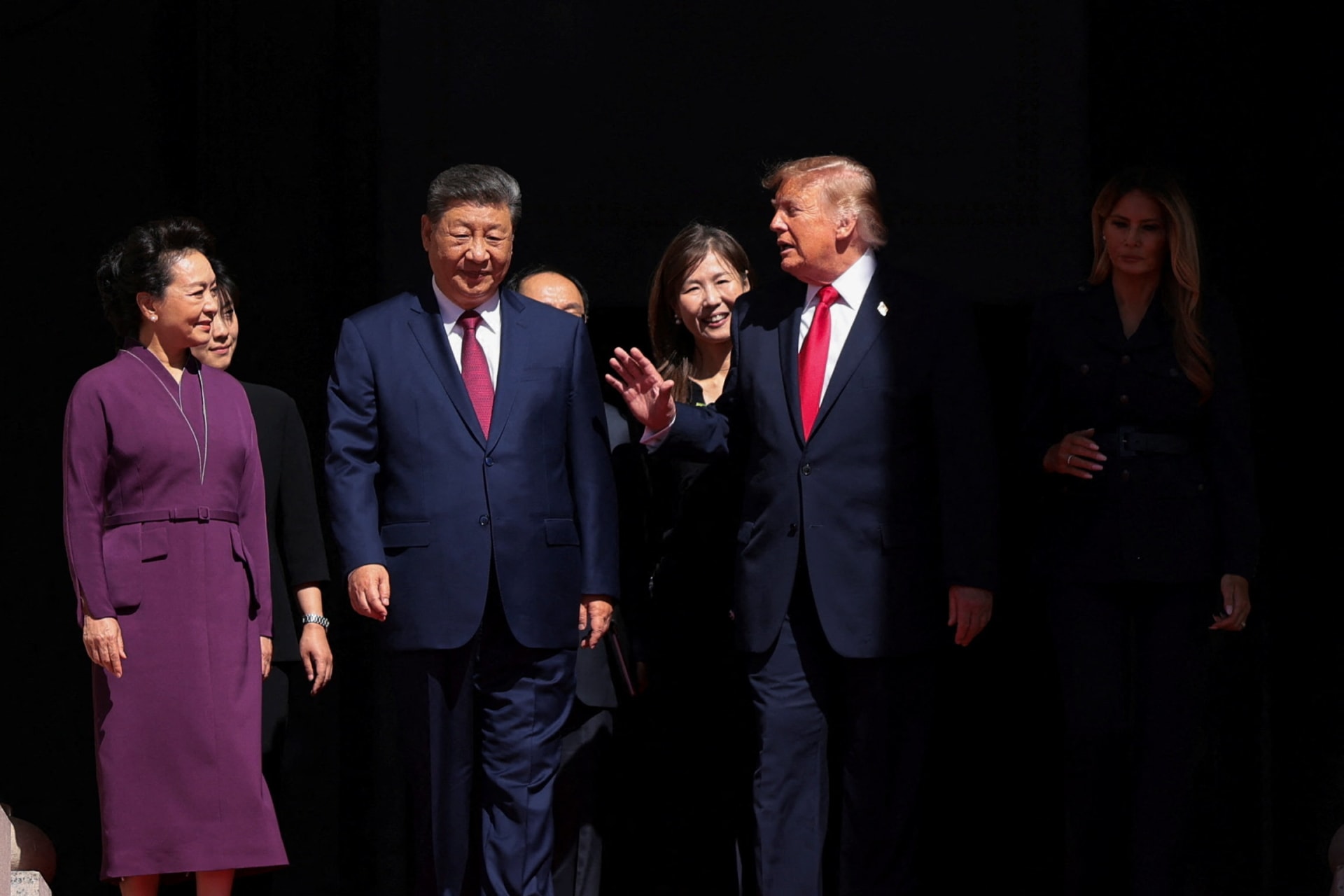
In China, Trump will want to come away from his meeting with Xi with a few promises, such as actually creating a hotline on AI issues, which the two countries have already agreed to set up, and a further extension of the bilateral trade truce and the truce on rare-earth exports. There also remains the possibility of a Trump-Xi-Putin summit on the sidelines of APEC regarding the Iran war, Ukraine, and other issues.
In reality, however, the trip is unlikely to produce major gains for the White House, and it could even be rebuffed in its modest goals. It could be difficult for Trump to get much cooperation on Pax Silica, for example, given turmoil at U.S. AI companies such as Nvidia, the White House’s previously blasé attitude toward AI regulation, and the growing importance in places such as Malaysia of creating data centers and cloud computing for Chinese companies. Five Southeast Asian states already have joined the China-led World Artificial Intelligence Cooperation Organization, a new multilateral body created by Beijing, supposedly designed to facilitate AI cooperation and to serve as a clear alternative to U.S. ideas on AI.
It also will be challenging to convince anyone in the region to buy the full U.S. AI stack. After all, China’s open models are cheaper and already attracting huge numbers of customers across Asia and the world. Even many U.S. companies are abandoning U.S. AI models for Chinese ones. (China’s Kimi K3 is about 40 percent cheaper than top American AI models and can nearly match their capability as well.) The CEO of Airbnb, for instance, has said that the company prefers fast-and-cheap Chinese models, and Coinbase, DoorDash, and many other U.S. companies are reportedly also using Chinese models.
Meanwhile, even if Trump meets with Xi and Putin, he will soon be facing a different Congress, one that would almost surely oppose this trilateral summit and any results from it. The idea of working with Xi and Putin is unpopular not only among Democrats but also among many Republican lawmakers, who are likely to be less inhibited in Trump’s last two years and, in many cases, remain strong supporters of Ukraine’s side in the Russia-Ukraine war. The American public also dislikes Russia, with 85 percent viewing the country very or somewhat unfavorably.
Taiwan similarly enjoys significant bipartisan congressional support. According to several congressional staffers, there could be enough support, now that the midterms are over, to push through an already-appropriated $14 billion arms sale to the island, even overriding a possible veto by Trump, regardless of what Trump tells Xi while in Shenzhen.
As for trade deals with Thailand and Vietnam, even if they are announced, they will still be little more than frameworks. Southeast Asia has little reason to trust that the White House will follow through on the nitty-gritty of trade deals, and not swing back toward more punitive approaches. After all, a deal that the United States made last year with Malaysia has still not really gone into effect, nor has a potential deal with Indonesia. And Vietnam believes that, in negotiations with the United States over a trade deal, it has already promised as much as it can, and yet is still being pushed to give more—too much, in the minds of Vietnamese officials I have spoken with in recent months.
The fact that Trump has not publicly suggested he will change policy course after the midterms—as exemplified by his retention of Defense Secretary Hegseth and choice of hard-liner Stephen Miller as chief of staff—makes Southeast Asian leaders even warier. Already hit repeatedly by tariffs, Asian leaders know all too well that the U.S. president retains the authority to set tariff policy, and that, once he does, it will be difficult for Congress or even the courts to stop him, at least in the short term.
Any “wins” that come out of the meeting with Xi are likely to be modest as well. Even if the two sides extend the truce on export controls, China is still stalling on allowing rare earths out of the country, so the United States is gaining little from Beijing’s promises; the United States is still desperately short of rare earths, and is even looking in unlikely places such as Myanmar, which the United States is trying to engage despite its horrendous rights record and ongoing civil war. Xi knows that Beijing has extensive leverage over the White House—on rare earths, on the Iran war, and on many other exports—and likely will push Trump to make even clearer statements than he did in prior summits regarding Taiwan, such as openly stating that he is against Taiwanese independence. (As noted above, Trump already has delayed the $14 billion in arms sales to Taiwan and, unlike prior U.S. presidents, treated the island as a bargaining chip in U.S.-China relations.) Trump, who has taken a soft approach toward China in the past year, could well bend and agree to make the statement Xi demands.
In the past two months, China has stepped up its aggressive actions in the South China Sea, including buzzing Philippine aircraft with fighter jets, ramming Philippine boats, and preventing the Philippines from resupplying its forces on the grounded BRP Sierra Madre at Second Thomas Shoal, a move Beijing has not used in years. Regional states such as the Philippines will be looking for clearer U.S. security guarantees, which they are unlikely to get, as the United States focuses on the Middle East and the Western Hemisphere.
As I noted in a recent article for World Politics Review, even Philippine President Ferdinand Marcos Jr., the most pro-U.S. leader in Southeast Asia, has become bitterly disappointed with what he has received in return for his backing of most U.S. policies. The White House has reduced freedom of navigation patrols in the South China Sea from the levels of prior administrations and is unlikely to promise Marcos Jr. that it will increase them; such patrols are important deterrents to Chinese actions against Philippine and Vietnamese vessels, planes, and forces in the sea.
Marcos Jr. could get some vague reassurances from Trump and his advisors, but little more, and not the amount of Foreign Military Financing aid he wants from the United States. As a result, Marcos Jr. already has begun a shift toward China, one that a single visit by Trump is unlikely to stop.
In Northeast Asia, U.S. allies are so alienated that Trump is unlikely to be able to say anything to convince them that the United States will remain a reliable defense partner. As a result, states are ramping up their own defense spending and even considering obtaining nuclear deterrents.
Japan and South Korea, disappointed by the first two years of the Trump administration and watching the congressional change, could also use the meetings to publicly or privately walk back promises made to invest in the United States, such as a possible South Korean investment in a gas deal in Alaska. Such a move would only add to Trump’s potential woes on his return flight home.
This work represents the views solely of the author(s). The Council on Foreign Relations is an independent, nonpartisan membership organization, think tank, and publisher, and takes no institutional positions on matters of policy.