Hunger Warfare and a Fertilizer Crisis Are Straining Global Food Supplies
Attacks on Black Sea grain infrastructure and a fertilizer shock from the Iran war are hitting global agriculture at both ends of the production cycle. Add an El Niño forecast to disrupt rainfall across major growing regions, and the damage lands hardest on the 2027 and 2028 growing seasons in places that can least absorb it.

Michael Werz’s work focuses on the nexus of food security, climate change, migration, and emerging countries. He is an international advisor at the Hamburg Sustainability Conference and a founding member of the WP Intelligence Council on Global Security.
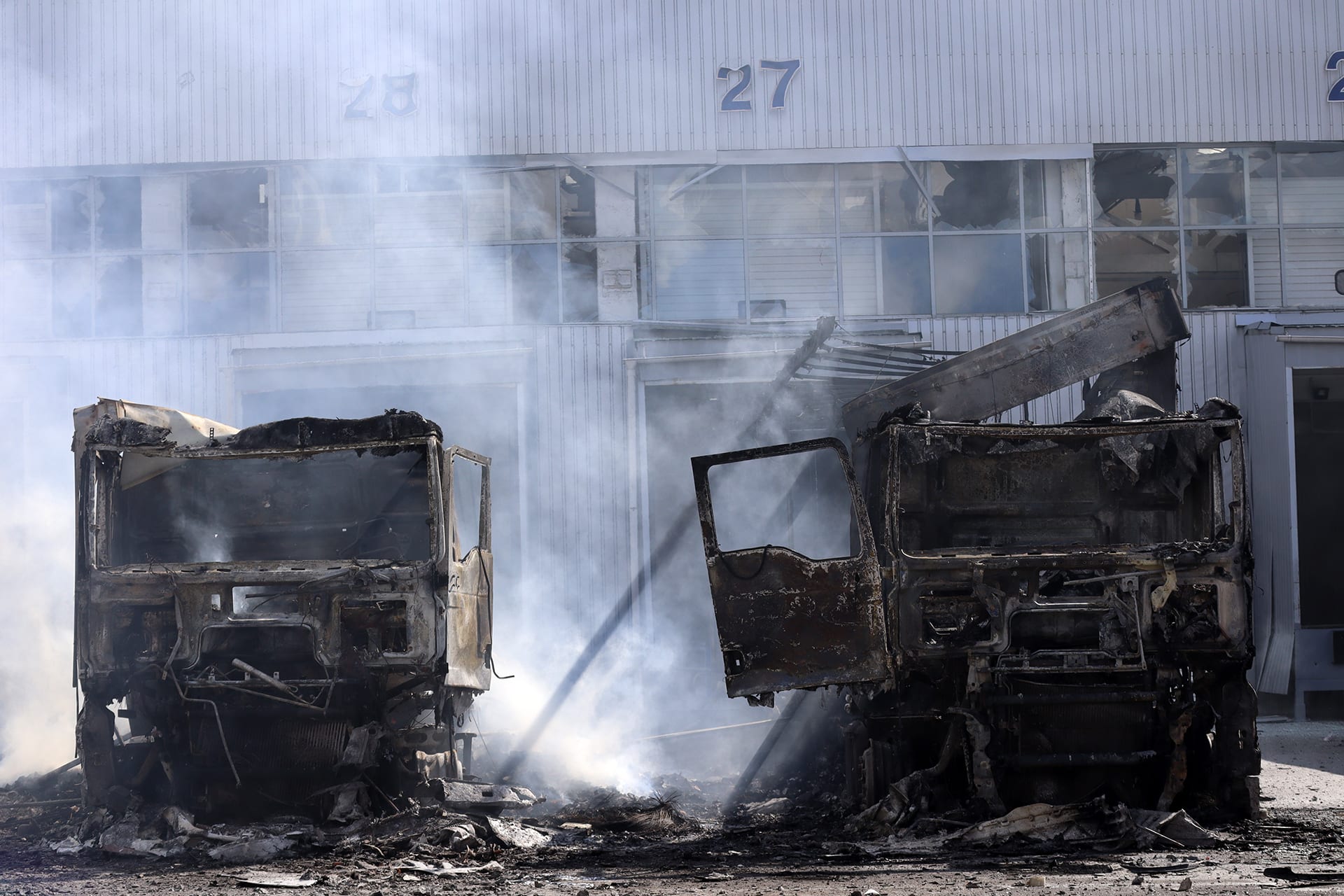
In late July, the Russian regime once again attacked Ukrainian food export facilities. The Kremlin targeted cargo vessels in Odesa port, vastly diminishing export capacities in a vital grain corridor. Irresponsibly, the Ukrainian government responded with its own missile strikes on Russia’s port of Novorossiysk, damaging two grain export terminals there. Through the attack, Ukraine chose to undermine its strong political position among European supporters by mirroring Russia’s weaponization of food and ignoring international norms.
Using food as a lever is a proven military method as old as siege warfare, now conducted at global range. Both Russia’s and Ukraine’s military missions have now illustrated how twenty-first-century warfare is increasingly boundless, asymmetric, and willing to victimize low-income populations in food import-dependent regions of the world. For hundreds of millions of people across North Africa, the Middle East, and the Horn of Africa, wheat from Russia and Ukraine isn’t just a commodity—it decides whether there is bread on the table.
What distinguishes this contemporary food weaponization strategy from historical precedents—such as the siege of Leningrad and the Holodomor—is its area of effect. Food weaponization now has transnational reach and geopolitical scope: modern actors can leverage control over global agricultural commodities and supporting supply chains to exert influence far beyond battlefield borders. Russia has worked that lever throughout the war, using wheat exports to help deepen strategic dependencies among African governments whose support it needs at the United Nations.
The use of food as a weapon of strategic warfare is a trend in military combat. It is being integrated in active conflicts, and it is now an integral part of national security planning among mostly authoritarian states. Food weaponization has different dimensions, from deliberate manipulation of food supplies to hurting or subduing a targeted group. Broadly speaking, it manifests in three distinct but often overlapping strategies.
- The manipulation of food aid and supply routes: a tactic where state and nonstate actors erect barriers to food distribution through bureaucratic obstruction, violent seizure of trucks and facilities, blockades on key supply routes, and denial of humanitarian access, as exemplified by Israel’s alleged restrictions on food delivery into Gaza and the coordinated efforts of the Ethiopian government and Eritrea to block aid to Tigray, in northern Ethiopia.
- The food insecurity itself: militant groups and insurgent organizations are exploiting existing hunger or manufacturing artificial scarcity to attract vulnerable recruits unable to meet their families’ basic needs, while simultaneously using control over food supplies as a tool for compliance and retention, as demonstrated by al-Shabaab’s selective distribution of meals in Somalia and Boko Haram’s strategic provisioning in Nigeria.
- The targeting of the infrastructure that sustains food production and distribution: the deliberate destruction of crops, livestock, farmland, storage facilities such as silos, water reservoirs, and transportation corridors along the entire supply chain, as Russia systematically executed against Ukraine’s agricultural ports and Black Sea infrastructure.
Squeezed at both ends: the input and output shocks
Over nine days in early August, Ukraine exported 463,000 metric tons (510,000 tons) of grain. That’s only about a third of the average export pace the country’s Black Sea ports handled before Russia’s renewed strikes. There is a reason for the decline. Days before, most shipping companies had suspended operations at Ukrainian ports after missiles struck a corn carrier in late July, killing ten sailors. This poses a real problem: alternative overland routes cost $50 to $70 dollars more per ton, and low water on the Danube River left that corridor unable to absorb meaningful volume.
If Russia continues its targeting of food infrastructure, it could renew a shock like 2022, when disruptions caused by the conflict affected regions across Asia and Africa. Fertilizer and food prices have remained elevated since the war began, especially in local currencies. Meanwhile, the partial closure of the Strait of Hormuz caused by the Iran war has choked fertilizer flows, and this year’s El Niño—the periodic warming of the Pacific that shifts atmospheric circulation and rainfall patterns worldwide—is expected to damage staple crop production further. Together, these pressures tighten supply and make food a more powerful weapon.
Welcome to the era of complex crisis scenarios. National security assessments now demand a range of analytical domains at once: chokepoint geopolitics, climate risk forecasting, commodity price volatility, fertilizer affordability, and long-term infrastructure investment questions.
Current conflicts have the potential to create significant cumulative ripple effects in the international food system over the next twelve to twenty-four months. The war-driven output shock in Ukraine now will combine with the continuing fertilizer scarcity on the input side due to the partial closure of the Strait of Hormuz. These dual shocks are affecting global grain supplies at both ends of the production cycle simultaneously.
Several indicators are pointing to a more severe crisis in 2027. Reduced nutrient availability, caused by high fertilizer prices, could constrain yields in the Northern Hemisphere further. Grain and crop prices have climbed in step: wheat up 24 percent from January to July 2026, rice 14 percent, soybeans 8 percent, corn 4 percent. Farmers had already cut fertilizer purchases after the April price spike, and the continued climb has not reversed those decisions.
Fertilizers that provide nitrogen and phosphate—the two nutrient inputs under the most pressure—have behaved differently since supply tightened. Urea, the most widely used nitrogen fertilizer in the world, saw its prices increase by 82 percent when the Iran war caused the partial closure of the Strait of Hormuz. Those prices then dropped below preclosure levels. The nitrogen shortfall was felt immediately, but farmers can recover somewhat via late application once supply returns.
Meanwhile, diammonium phosphate (DAP)—a compound fertilizer and a critical source of both nitrogen and phosphate nutrients for early plant growth and root development—climbed steadily rather than spiking, from $619 a ton in January to $781 in July. These prices remained elevated through mid-2026 because infrastructure underinvestment created structural supply constraints. This is a longer-term shock: phosphate depletion can damage the soil and draw down yield potential in seasons to come.
For farmers, the climb in prices runs straight into the buying season. Growers in the Northern Hemisphere, as well as those in Brazil, make their second-crop corn input purchase decisions between September and December when the soybean crop is still in the field—well ahead of their respective planting windows. With urea cheap and phosphate expensive, many could decide to buy the former and not the latter. This increases the potential for future yield depression, because soil holds a phosphate reserve that might absorb a lack of fertilizer for one growing season, but not for two. This is another contributor to a potential food crisis in 2027.
Nitrogen is up to 60 percent cheaper between April and July when measured against crop prices, but this is counterintuitive and masks deeper vulnerabilities. A potential one for urea is the fact that its production is very energy-intensive and depends on natural gas. As European gas prices eased from their March peak, urea prices fell sharply. In contrast, phosphate production did not respond significantly to energy costs because of its dependency on mining and processing of phosphate rock. The structural shortage of phosphate availability (with the most important phosphate rock concentration in Morocco) explains why its price stayed elevated.
This leaves phosphate underinvestment as the worrying legacy of the 2026 shocks. One season of skipping phosphate application can be absorbed by soil reserves; a second season of shortfall depletes those reserves, and yields fall in the third year. This means that 2026 planting has likely seen reduced phosphate application due to the April shock and continuing high prices. In the growing season of 2027, yields may hold or decline slightly with soil reserves compensating for fertilizer deficiency. In 2028, the growing season is likely to suffer under soil phosphate deficiency that could trigger significant yield losses.
Then there is the final shock: the World Meteorological Organization expects the 2026 El Niño weather phenomenon to raise temperatures above normal levels and cause significant shifts in rainfall patterns. This analysis coincides with the National Oceanic and Atmospheric Administration (NOAA) Climate Prediction Center estimating a 90 percent chance of a very strong El Niño in the Pacific region from November 2026 to January 2027. Helios AI (which produces software that is used to help predict agricultural supply-chain disruptions) has developed a climate analysis showing that these conditions present a mixed climate risk, with three of four important crop regions forecast to fall below their seasonal norms. El Niño conditions are forecast to peak this winter, with high odds of them being the most significant system since 1950.
Helios AI’s climate risk data through mid-August points to elevated risks for this year’s harvests. El Niño has historically driven Australian wheat yields 30.6 percent below trend—a pattern seen in ten of the last fifteen El Niño years since 1980. Rice in India, with the crop moving into its reproductive stage, will be exposed to extremely wet conditions on three-quarters of all days in the coming weeks, concentrated in Telangana and Andhra Pradesh. Brazil’s soybean crop, which has only just entered its growing cycle, faces an early test as well: forecasts show heat and drought potential for most days during the September planting window, with very wet conditions likely later in the reproductive stage.
Who will protect the world’s food systems?
Even without new conflict, global food systems are under strain. But now the world is seeing the convergence of unprecedented climate effects, lingering issues caused by fertilizer price increases, and pending seasonal demand peaks, with the renewed output shocks through intensified Black Sea attacks on Ukrainian grain shipments and the continued tit-for-tat conflict between the United States and Iran. Undoubtedly, this has created compounding risks for 2027 and 2028 yields.
Global competition for finite supplies—be it in grain or fertilizer—in conjunction with malign geopolitical actors willing to use food access as a weapon will increase the vulnerability of the global food system. This use of food supplies in modern warfare requires new forms of deterrence. Policymakers and military planners should treat agricultural supply-chain resilience with the urgency and strategic focus currently reserved for defense systems.
The systematic and strategic incorporation of food security into security planning is not only a twenty-first century geopolitical requirement, but it also functions as a sophisticated foresight instrument. The Hormuz closure demonstrates that a single chokepoint can create global shocks within weeks. Food supply chains require the same strategic investment and resilience planning as military systems.
Understanding food weaponization at the intersection of agriculture, climate change, human mobility and insurgencies, supply chains and trade wars provides a blueprint for new twenty-first century conflicts looming on the horizon. Simply put: if strategic planners and policymakers understand food weaponization, they are one step closer to being prepared to address multidimensional conflicts in the decades to come.
This work represents the views solely of the author(s). The Council on Foreign Relations is an independent, nonpartisan membership organization, think tank, and publisher, and takes no institutional positions on matters of policy.