The 1814 British Sack of Washington
A war that began with U.S. ambitions to seize Canada led to the burning of the White House and the Capitol Building.
By experts and staff
- Published
 James M. LindsayCFR ExpertMary and David Boies Distinguished Senior Fellow in U.S. Foreign Policy
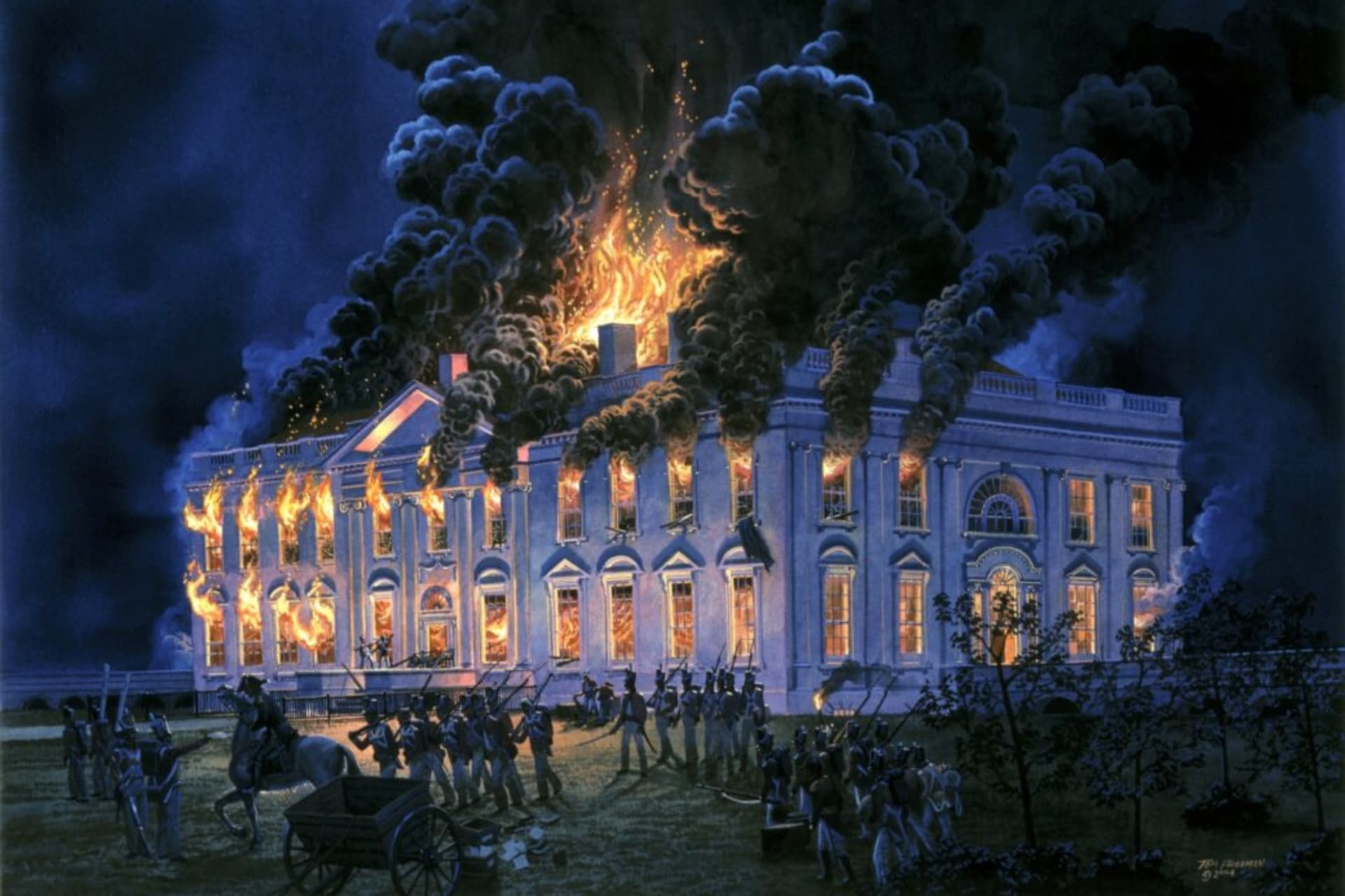
August can be a tough month in Washington, DC. Temperatures can top one hundred degrees Fahrenheit, and the humidity can make it feel even hotter. On occasion, a hurricane rolls through with damaging winds and torrential rain. August 2011 even brought a 5.8-magnitude earthquake. But the city’s single worst August day probably came on August 24, 1814. That’s when British troops set much of it on fire.
The War of 1812
When the United States declared war on Britain in June 1812, Washington was more a town than a city. It had been built out of the wilderness in the 1790s and had been the nation’s capital for just a dozen years. It had fewer than 8,000 residents and lacked any military value. It wasn’t a major seaport or merchant center, and it didn’t host a major fort or arsenal.
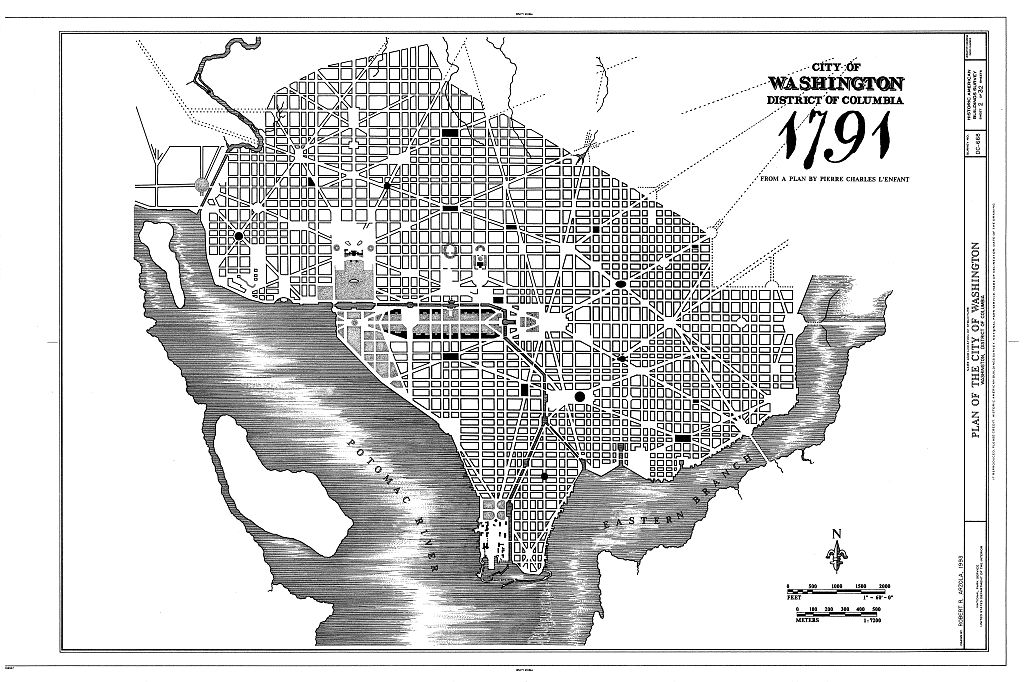
But being the national capital made Washington a valuable target. The British hoped that capturing it would inflict a deep psychological blow and possibly compel the United States to concede to Britain’s wider political demands.
The British also wanted to avenge U.S. attacks on British Canada. Many Americans believed the war would lead to the U.S. conquest of Canada; former President Thomas Jefferson contended that it would “be a mere matter of marching.” In April 1813, U.S. forces seized the capital of Upper Canada, York, Ontario, present-day Toronto. The victory initially appeared to have come easily and at little cost. However, a fire set by the retreating defenders to keep valuable stocks of gunpowder from being captured triggered a massive explosion that killed several dozen U.S. soldiers. The survivors responded by ransacking the village. A year later, U.S. troops attacked Port Dover on Lake Erie and burned much of the town.
By the summer of 1814, U.S. efforts to take Canada had largely been rebuffed. Britain’s position meanwhile had been strengthened by developments in Europe. In April 1814, Britain and other members of the so-called Sixth Coalition had defeated France and forced Napoleon Bonaparte to abdicate. With victory secured in Europe, London was free to send more troops to fight in North America.
The Battle for Bladensburg
One consequence of the British troop surge was a decision to attack Washington. On August 19, British forces began landing at Benedict, Maryland, a port on a tributary of the Chesapeake Bay. Washington lay just forty-five miles and a few days’ march to the northwest.
The Americans sought to stop the approaching British forces on the morning of August 24 at Bladensburg, Maryland, a village seven miles east of the White House. President James Madison and many senior U.S. government officials went to watch the battle.
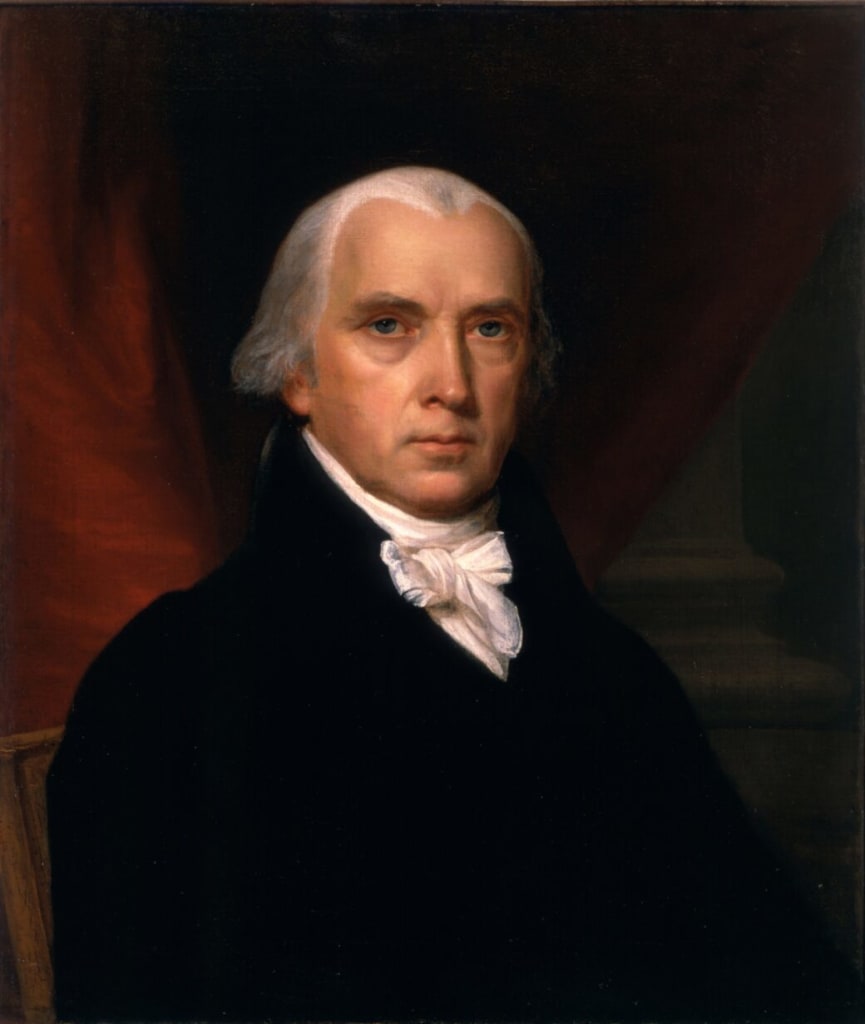
The U.S. troops enjoyed a substantial numerical advantage over the British and knew the lay of the land. Unlike the professional and battle-tested British troops, however, they were mostly poorly trained local militia. They were quickly routed. Rather than making an orderly retreat, the Americans scattered from the battlefield. Washington was now open to attack. The British seized the opportunity.
Saving White House Valuables
The news reached First Lady Dolley Madison at the White House of the British victory. She was not a person to panic. As the enslaved and free servants gathered White House valuables, she took time to write a note to her sister:
Three o’clock.—Will you believe it, my sister? we have had a battle, or skirmish, near Bladensburg, and here I am still, within sound of the cannon! Mr. Madison comes not. May God protect us! Two messengers, covered with dust, come to bid me fly; but here I mean to wait for him... At this late hour a wagon has been procured, and I have had it filled with plate and the most valuable portable articles, belonging to the house.
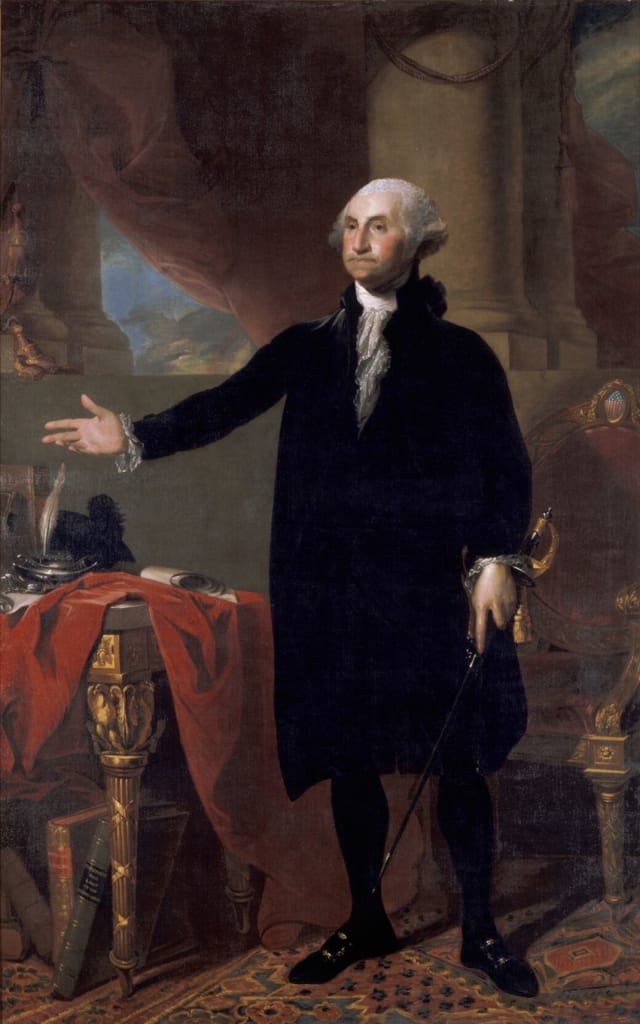
Among the valuables saved from the torch was Gilbert Stuart’s portrait of George Washington.
Thanks to a trio of State Department clerks, many valuable government documents, including the papers of the Continental Congress, the Articles of Confederation, and George Washington’s correspondence, had already been taken out of the city for safekeeping. The president and the first lady were reunited in northern Virginia on the evening of August 25.
A Capital in Flames
As the British tell the story, the sack of Washington came only after the Americans refused a truce offer. George Gleig, one of the British soldiers that day, later wrote:
Such being the intention of General Ross, he did not march the troops immediately into the city, but halted them upon a plain in its immediate vicinity, whilst a flag of truce was sent in with terms. But whatever his proposal might have been, it was not so much as heard, for scarcely had the party bearing the flag entered the street, than they were fired upon from the windows of one of the houses, and the horse of the General himself, who accompanied them, killed. You will easily believe that conduct so unjustifiable, so direct a breach of the law of nations, roused the indignation of every individual, from the General himself down to the private soldier.
All thoughts of accommodation were instantly laid aside; the troops advanced forthwith into the town, and having first put to the sword all who were found in the house from which the shots were fired, and reduced it to ashes, they proceeded, without ’a moment’s delay, to burn and destroy everything in the most distant degree connected with government.
When British troops reached the White House, they found a pleasant surprise: Madison’s servants had laid out a fine dinner in expectation that he would return that evening. Again, Mr. Gleig:
Several kinds of wine, in handsome cut glass decanters, were cooling on the sideboard; plate holders stood by the fireplace, filled with dishes and plates; knives, forks, and spoons were arranged for immediate use; in short, everything was ready for the entertainment of a ceremonious party. Such were the arrangements in the dining room, whilst in the kitchen were others answerable to them in every respect. Spits, loaded with joints of various sorts, turned before the fire; pots, saucepans, and other culinary utensils stood upon the grate; and all the other requisites for an elegant and substantial repast were exactly in a state which indicated that they had been lately and precipitately abandoned.
You will readily imagine that these preparations were beheld by a party of hungry soldiers with no indifferent eye. An elegant dinner, even though considerably overdressed, was a luxury to which few of them, at least for some time back, had been accustomed, and which, after the dangers and fatigues of the day, appeared peculiarly inviting. They sat down to it, therefore, not indeed in the most orderly manner, but with countenances which would not have disgraced a party of aldermen at a civic feast, and, having satisfied their appetites with fewer complaints than would have probably escaped their rival gourmands, and partaken pretty freely of the wines, they finished by setting fire to the house which had so liberally entertained them.
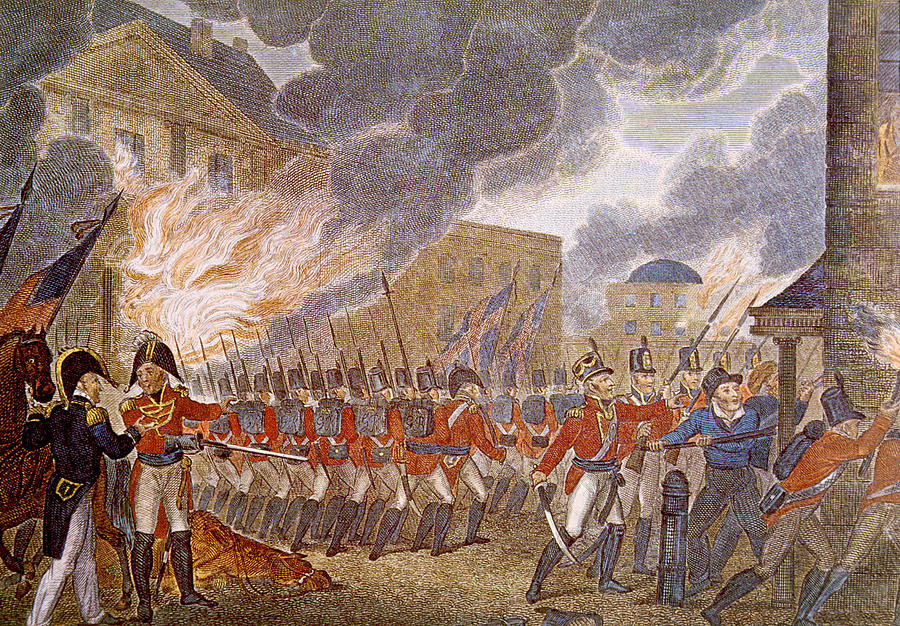
The White House was not the only target of the British troops. They also torched the Capitol, the Library of Congress, and the Treasury Building. They failed, however, to capture anyone of political significance. Much like any August today, Congress was in recess. Lawmakers were back in their home states and districts.
The Aftermath
The British had no interest in occupying Washington. Again, it had no strategic value, and in the days before air conditioning, it was undoubtedly a miserable place to be in August. The morning after setting the town on fire, they marched off.
Madison returned to Washington on August 27 to survey the damage. Only the walls of the White House still stood. Even they might have fallen if a strong thunderstorm had not drenched Washington just hours after the sack of the city began.
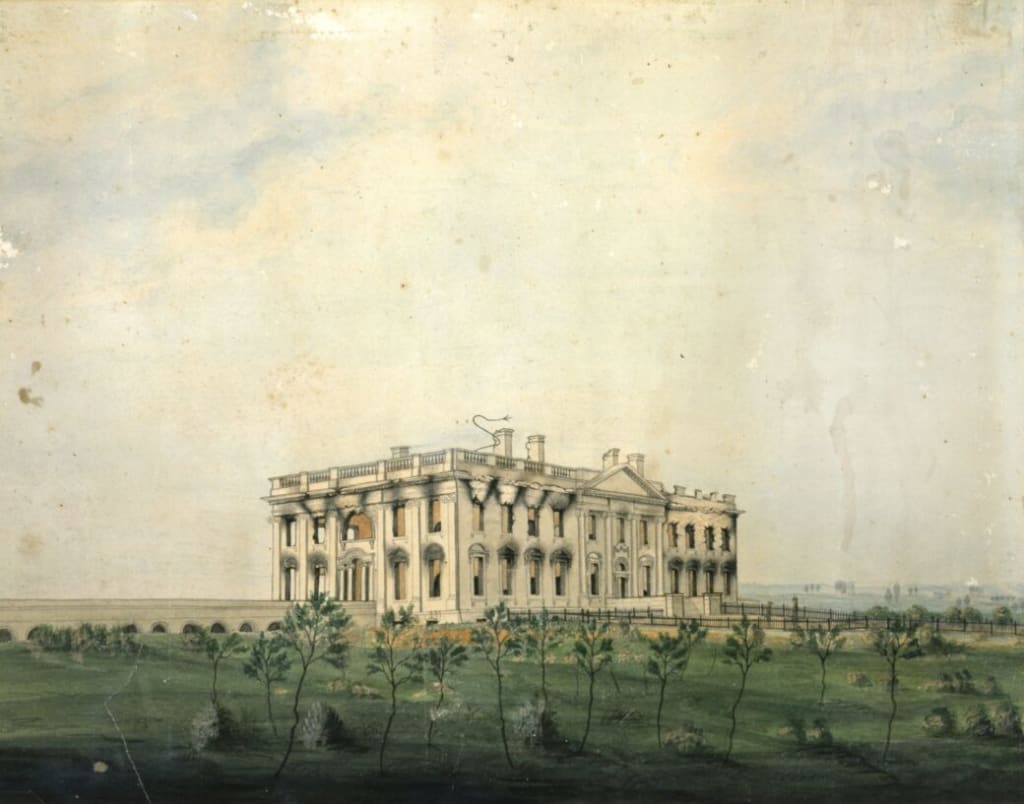
Some members of Congress proposed relocating the president’s home to another city. Madison, however, insisted that the White House be rebuilt in its original location. His presidency ended before the reconstruction was completed.
The other sacked federal buildings were also rebuilt on their original sites. In 1815, Thomas Jefferson sold his personal library, which was the largest in the United States at the time, to the U.S. government for $23,950 so it could restock the Library of Congress. Ironically, nearly two-thirds of Jefferson’s books were destroyed when the Library of Congress caught fire on Christmas Eve in 1851.
Three weeks after the sack of Washington, the British attacked the commercially significant city of Baltimore. But when the Royal Navy turned its guns on the city’s defenses, Fort McHenry survived the onslaught, prompting a young lawyer held captive on a British warship to pen the lyrics of what became the U.S. national anthem. By year’s end, the war with Britain would be over, and the United States would have little to show for a war that left its capital in ashes.
Oscar Berry and Jack Patton assisted in the preparation of this article.
The United States celebrates its 250th anniversary in 2026. To mark that milestone, I am resurfacing essays I have written over the years about major events in U.S. foreign policy. A version of this essay was published on August 24, 2011.
This work represents the views solely of the author(s). The Council on Foreign Relations is an independent, nonpartisan membership organization, think tank, and publisher, and takes no institutional positions on matters of policy.