The #EndSARS Generation Comes of Age
Its operational base may be as ebullient as ever, but members of the #EndSARS generation have been pulled in different directions.
By experts and staff
- Published
 Ebenezer ObadareCFR ExpertDouglas Dillon Senior Fellow for Africa Studies
This is the fourth installment in a series in which I excavate the underlying forces shaping the struggle for power Nigeria as we head into the 2027 presidential election. The previous installment can be found here.
A major feature of Nigerian politics, one that it mostly shares with other developing societies, is that it (i.e., politics) tends to revolve around personalities rather than issues. Where social institutions are chronically weak and political parties exhibit all the characteristics of a criminal cartel, Big Men (whether they are in or out of power is not really relevant) call the shots and distribute largesse through a mesh of patron-client networks and shadow bureaucracies. In such a context, one may be tempted to conclude that the struggle for power is about personalities and personalities alone.
Yet, such a conclusion would be mistaken, for even when personalities cast a long shadow, as is undeniably the case here, they nonetheless remain susceptible to social forces and movements that are not always within their ken. The Big Man is all-conquering until he is not. Accordingly, while, for the student (of Nigerian politics), an understanding of the role of personalities is non-negotiable, at the same time it would be unwise to do so to the exclusion of other critical forces, particularly those that shape and undergird the milieu within which personalities position themselves and mobilize resources.
Among those critical forces is the chasm between the older (analog?) and younger (digital?) generations. Overall, the story of the 2023 presidential election is incomplete without a recognition and analysis of this divide. For one thing, it was essential to the formation of (the mostly unflattering) public opinion about the eventual winner Bola Ahmed Tinubu, who was widely portrayed not just as senescent and hence out of touch, but also a symbol of the “traditional” values that the country needed to retire once and for all. For another, it was foundational to the emergence and strategic positioning of former Anambra state governor Peter Obi as a relatively fresh-faced outsider destined to slay the dragon of corruption and put Nigeria on the global pedestal where it belongs. In terms of the generational energy that it symbolized, the “Obi-dient” predated Obi; all that the then-Labor Party candidate had to do was harness its rage and give it a nomenclature.
While it may not have had its way with its preferred candidate, this younger generation nonetheless left an unmistakable stamp on the election. According to data from Nigeria’s Independent National Electoral Commission, whereas just 19 percent of registered voters were between the ages of fifty and sixty-nine, more than half of the new voters registered for the 2023 election were between eighteen and thirty-four years old. This new cohort of voters would make its impact felt across social media, where it exercised a control not all that different from the one that gatekeepers within the older generation once enjoyed within mainstream media institutions.
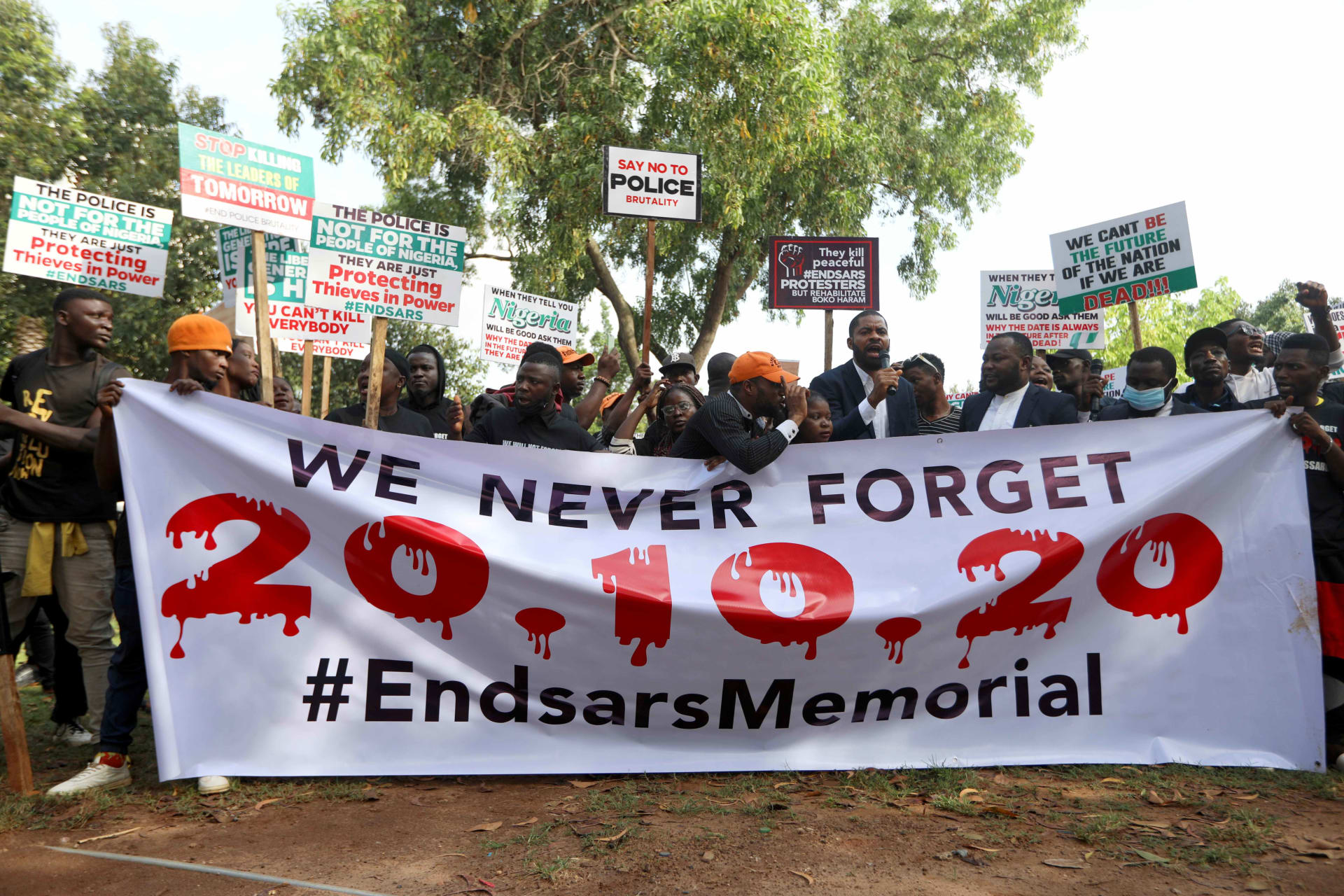
Considering its antecedents, this should not have come as a surprise. The first indication that a new generation had burst onto the scene was in October 2020 when the #EndSARS protests crippled socioeconomic activities across the country (at least a good chunk of it) and drew global attention to persistent impunity by law enforcement in the country.
As I argued at the time, what many commentators had casually characterized as a “leaderless protest” was nothing of the sort; on the contrary, a new generation schooled in an alternative tradition of protest that mobilized the crafts and affordances of the insubstantial world of the internet to galvanize and structure protest on the street was announcing its arrival on the scene. From my perspective, what many invoked as evidence of a leadership void—for instance the fact that the protesters’ list of demands to the then-Inspector General of Police Mohammed Adamu was presented by Nigerian singer David “Davido” Adeleke, twenty-seven and on the verge of turning twenty-eight at the time—was in fact proof that a new era led by a new generation was upon us. Apart from Davido, other household names in the world of entertainment who catapulted to political visibility on the back of their involvement with #EndSARS were Folarin Falana (Falz), Adebowale “Debo” Adebayo (Mr. Macaroni), and Obianuju Catherine Udeh (DJ Switch).
Lastly, #EndSARS is remembered for the exploits of businesswoman-turned-human rights activist Aisha Yesufu, whose Statue of Liberty pose has become iconic of the defiance and daring of the protesters. In terms of age, Ms. Yesufu, fifty-three next December, is not a member of this generation, and she was already a known quantity before #EndSARS, having shot into the limelight much earlier with the #BringBackOurGirls movement. That said, she shares political sympathies with the Davido set (at least she did, more on which in a moment) and is as educated a user of social media, age or no age, as any member of that generation.
If the 2023 election was the precise moment when the #EndSARS generation formally entered partisan politics under the rubric of the Obidient, in hindsight, it was also the last time it rallied around a common cause/candidate and acted in concert. As is often the case with generational cohorts over the life course (the work of the Hungarian sociologist Karl Mannheim comes highly recommended in an otherwise crowded field), the #EndSARS generation has experienced its own share of fractures and fragmentations.
Consider the representative members mentioned earlier. Davido remains politically active, but in a different register. If, back in 2020, he was viewed as the mouthpiece of the urban disaffected, these days, he is more likely to be seen using his platform to canvass support for his uncle, Ademola Nurudeen Adeleke, who was recently reelected for a second term of office as the governor of the southwestern state of Osun. Since his uncle has vowed to ensure that Tinubu wins the state in 2027, Davido may find himself in a dilemma, especially as his wife, Chioma, happens to be Igbo (she was born and raised in Owerri, capital of Imo state in the southeastern region), making her a co-ethnic of Peter Obi, the idol of #EndSARS-Obidient who has switched his allegiance to the Nigeria Democratic Congress (NDC). How will Davido, who recently said that he was willing to bet on a Tinubu victory in 2027 because of what he referred to as “the division among opposition politicians” synergize kinship obligation, ideological politics for want of a better word, and domestic harmony?
Falz and Mr. Macaroni have had a different sort of evolution. Falz, thirty-six in October, remains the “bad boy” he was back then, taking no prisoners as he continues to inveigh against a system where even police stations are forced to close by 6:00 p.m. “for security reasons.” Lawyer by training, he seems to be the only one to have been brought up on a steady diet of progressive politics: his paterfamilias, Femi Falana, has been one of Nigeria’s foremost human rights advocates of the past four decades. Mr. Macaroni may not have Falz’s familial pedigree, but he too continues to use his comedic skits and movies with satirical content to call power to account. DJ Switch seems to have gone into exile, a grim reminder of how political disillusionment continues to instigate “Japa” (escape) for members of that generation.
Of the lot, Aisha Yesufu is the only one to have considered running for public office, something she did when she threw her hat in the ring for the mayoralty of the Federal Capital Territory, Abuja, only to withdraw her candidacy abruptly. She is still a card-carrying Obidient, though it is clear that her relationship with the now-NDC candidate is strained.
If the above is any indication, the #EndSARS-turned-Obidient cadre may not be as effective, never mind cohesive, as it was in the 2023 election; which is not unrelated to a point I had made earlier about the collective mood within the Obidiency having perceptibly shifted. But the same thing cannot be said about its operational base, the space of social media, and its attendant attention economy. In Nigeria, it remains as boisterous and unruly as ever, with the same capacity for insult and insurgency that it boasted of back in 2020 when the first salvo in the generational battle was fired.
The #EndSARS generation may have come of age, but in the world of social media, reality is forever young.
This work represents the views solely of the author(s). The Council on Foreign Relations is an independent, nonpartisan membership organization, think tank, and publisher, and takes no institutional positions on matters of policy.