The National Debt Hit $40 Trillion, But It’s Not an Issue in the Midterms
Few candidates on the campaign trail are talking about the nation’s mounting debt and what should be done about it.
By experts and staff
- Published
 James M. LindsayCFR ExpertMary and David Boies Distinguished Senior Fellow in U.S. Foreign Policy
How much debt is too much debt?
That used to be a question at the forefront of congressional elections. It was only sixteen years ago that the so-called Tea Party took the country by storm pledging to tame the federal deficit. With the national debt then standing at $14 trillion, “sequestration” suddenly became Washington’s hottest buzz word as President Barack Obama and the Republican-controlled Congress temporarily slowed the growth of discretionary federal spending.
That was then. Today, the sequestration caps are a distant memory and government red ink barely gets a mention in a public debate dominated by gas prices, data centers, artificial intelligence, and claims that the Democratic Party has gone communist.
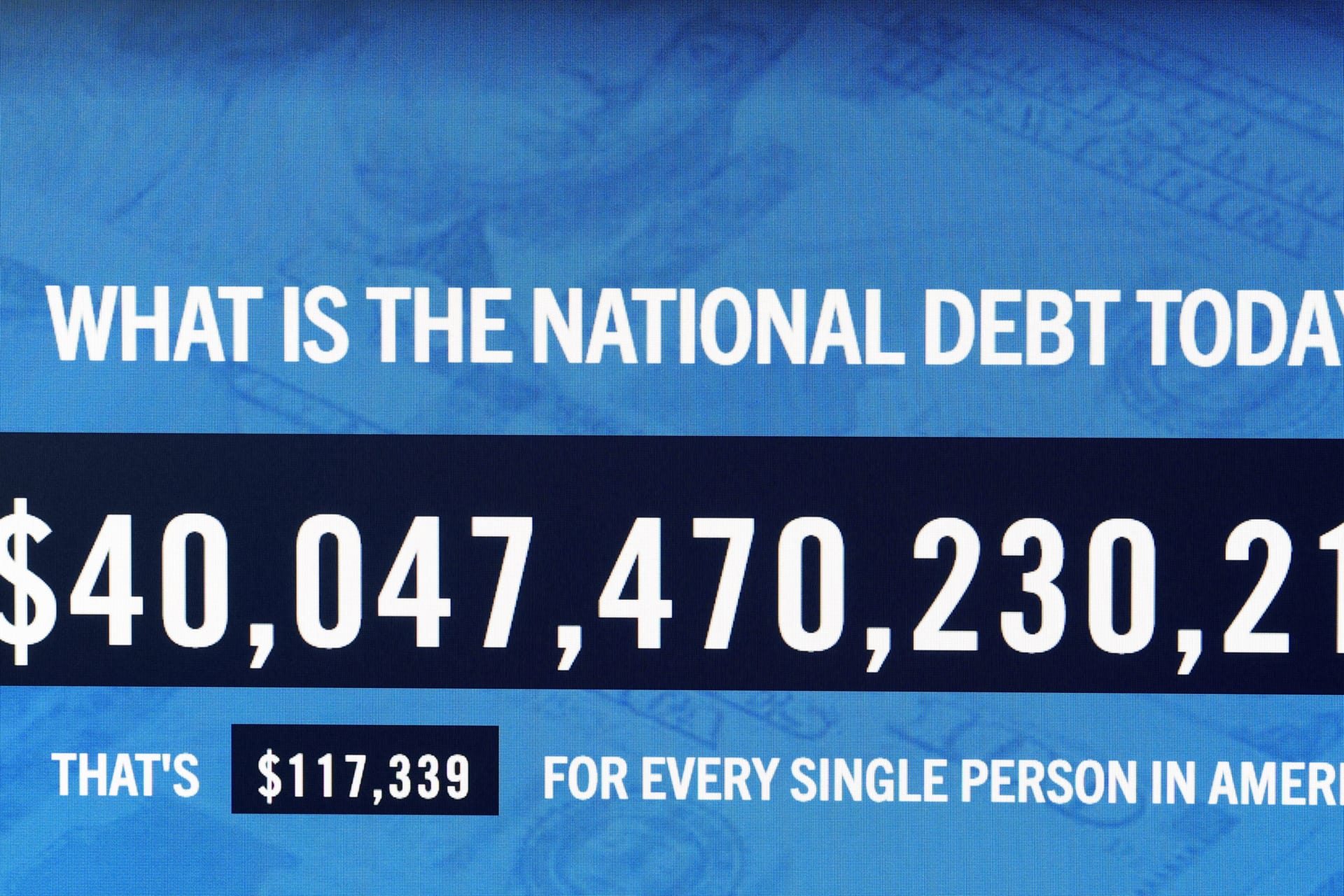
But the debt and deficit numbers are staggering. Earlier this month, the national debt hit $40 trillion. That amounts to roughly $117,000 for everyone living in the United States. The U.S. debt-to-GDP ratio now stands at 125 percent. To put that number in perspective, the massive federal borrowing needed to finance the U.S. effort in World War II only pushed the debt-to-GDP ratio to 106 percent.
The numbers get worse. The Congressional Budget Office projects that the federal budget deficit for the fiscal year, which ends on September 30, will hit $2.1 trillion. Yes, trillion with a “T.” That is a 6 percent deficit relative to GDP. This is all happening at a time of near-full employment when the government balance sheet should be improving and not deteriorating.
Large and persistent federal government deficits are why the national debt has doubled over the last decade and quadrupled in less than two. Put differently, 50 percent of the U.S. national debt has been accrued since Donald Trump was first elected, and 75 percent of it has been accrued since Barack Obama was first elected.
The harm caused by the government’s profligacy is becoming increasingly clear. The U.S. government will spend a hair over $1 trillion this fiscal year paying interest on the debt. That’s equal to what the United States will spend on national defense. Money spent paying back what has been borrowed obviously cannot be used to address the problems the country faces today.
The competition for federal dollars will only get worse in the years to come as the cost of servicing the federal debt increases. The Peterson Foundation projects that total interest payments will more than double over the next decade.
That prediction could be, if anything, optimistic. Interest rates on long-term U.S. bonds have risen in recent months, suggesting that the growing red ink is making investors nervous. Treasury Secretary Scott Bessent moved earlier this month to dampen long-term interest rates by ramping up the department’s bond-buyback program. Interest rates dipped briefly on the news before heading higher again. Bessent’s maneuver prompted his former boss and financial legend Stanley Druckenmiller to argue that “a credible fiscal package would do more for the long end of the curve than a buyback program 1,000 times this size.”
But a credible fiscal package seems unlikely to emerge anytime soon. Few candidates running for office are talking about the country’s debt problem and how they would solve it. Voters do not appear to be demanding answers. Gallup recently found that just 2 percent of Americans see the national debt and federal deficit as the most important problem facing the country.
Today’s zeitgeist is instead to assume that government spending, whether for domestic programs or national defense, can continue to grow. The increasing debt burden either won’t matter or that robust economic growth will solve the problem by generating epic government revenues sometime in the future.
Ignoring the country’s mounting debt no doubt will be fine—up to the moment it isn’t. That moment could come much sooner than we think.
Oscar Berry assisted in the preparation of this article.
This work represents the views solely of the author(s). The Council on Foreign Relations is an independent, nonpartisan membership organization, think tank, and publisher, and takes no institutional positions on matters of policy.