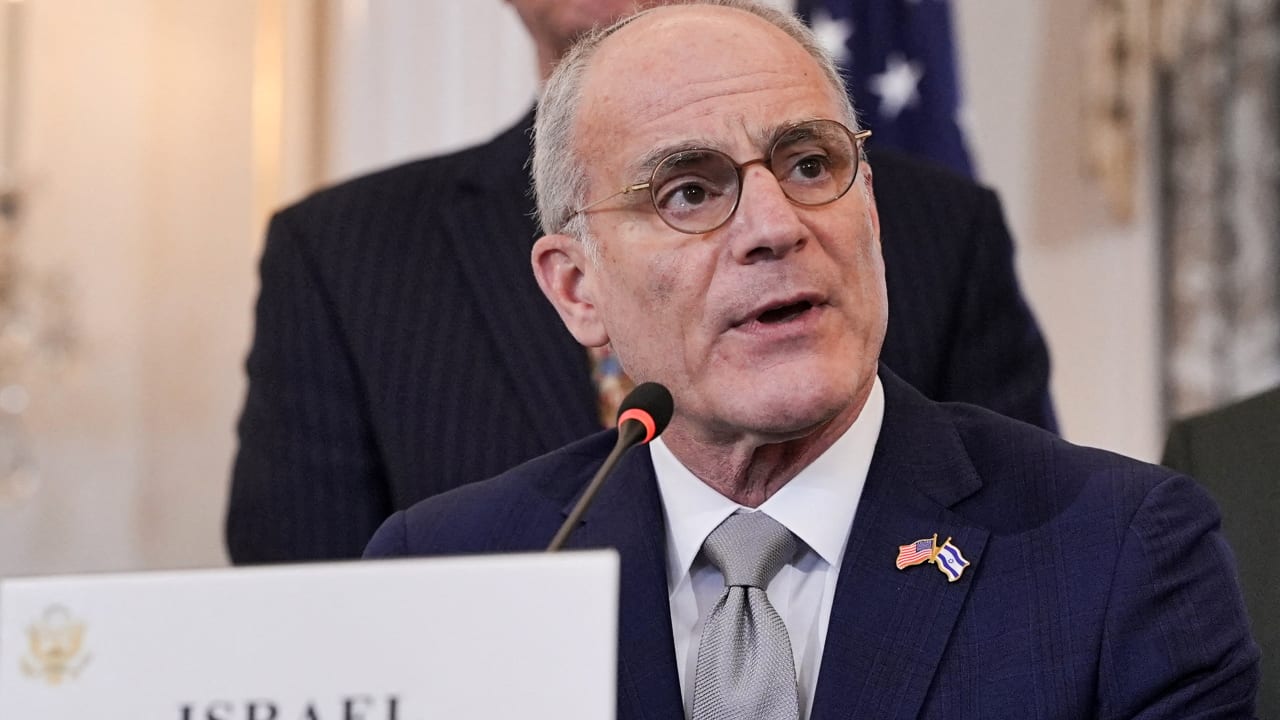
A Conversation With Ambassador Yechiel Leiter of Israel
Event date
Speaker
- Ambassador Extraordinary and Plenipotentiary, Embassy of Israel, Washington, DC
Presider
 Steven A. CookCFR ExpertEni Enrico Mattei Senior Fellow for Middle East and Africa Studies, Council on Foreign Relations
From Middle East Program.
Ambassador Yechiel Leiter discusses the recent Israel-Lebanon Trilateral Framework and the future of the U.S.-Israel relationship amidst the Iran war.
COOK: Full House. Should have done this upstairs. Good morning. It’s a pleasure to see you all. For those of you who don’t know me, I’m Steven Cook, senior fellow for Middle Eastern studies here at the Council on Foreign Relations.
And it is my great pleasure to welcome his excellency Dr. Yechiel Leiter, ambassador of Israel to the United States. Dr. Leiter has served as Israel’s ambassador to the United States since January 2025. He’s a seasoned policy expert in public service, previously held senior roles advising Prime Minister Ariel Sharon, chief of staff to then-Finance Minister Benjamin Netanyahu—I’ve heard of him—deputy director general of the Ministry of Education, and acting chairman of the Israel Ports Authority. He holds degrees in law and political science, a master’s in international relations, and a Ph.D. in political philosophy. And his postdoctoral research on the philosophy of John Locke and the Hebrew Bible was published by Cambridge University Press.
Now, I’m a political scientist as well. And when I read that, I said, that sounds like a super interesting book. So, like, the good—
LEITER: I have copies outside.
COOK: Like the good little political scientist I am, I went to Amazon. And I put in your name. The book came up, $129.99. (Laughter.)
LEITER: That’s on sale.
COOK: (Laughs.) I figured out we’ll have to do that through interlibrary loan, rather than—anyway. Ambassador Leiter is a father of eight and grandfather of many. His eldest son, Moshe Leiter, a medical doctor and IDF Special Forces officer, fell in combat in Gaza in November 2023.
Welcome back to the Council, Mr. Ambassador. It’s nice to see you again. You were here a little more than a year ago, I think, or maybe less. I can’t remember whether it was Operation Rising Lion or some other thing that we hosted you. Anyway.
LEITER: Something to do with lions.
COOK: Something to do with lions, I think. We’re going to—the ambassador and I are going to talk for about a half hour, and then we’ll open it up—open it up to questions. I’m going to—given the news, I’m going to spend a lot of time talking about Lebanon. Hopefully, that won’t scoop any of you, but really—and this—by the way, I should say, this meeting is on the record. So I see a number of you journalists out here, so you’re unrestricted.
OK, first question. Why is this time different? I have copies of U.N. Security Council 1701 in this folder. I’ve got the November 2024 ceasefire agreement, which is the announcement of a cessation of enhanced security agreements and toward the implementation of U.N. Security Council Resolution 1701. And the new trilateral framework between the United States, the State of Israel, and the Republic of Lebanon. You signed that last week. Why is this framework going to succeed when other efforts to reestablish Lebanese sovereignty and disarm Hezbollah, have not?
LEITER: Well, I don’t know if, as we move into the future, that it’s going to succeed. What has already succeeded is the fact that we’ve signed this agreement, which was impossible to sign prior to present time. Why is it different? I think we have to backtrack and take a broader view of the Middle East as a whole, and the tension that’s taking place between the accommodationists within Islam and the rejectionists within Islam. And that tension, the accommodationists, of course, led by the UAE in particular, and the rejectionists led by Iran, et al, is taking place in Lebanon as well. And we have the axis of President Aoun and Nawaf Salam, which is lining up into the accommodationist camp. And, of course, the rejectionists, led by Nabih Berri and Hezbollah.
And the accommodationist camp is getting stronger subsequent to the Abraham Accords and the weakening of Iran. What the accommodationist axis saw was, for the first time, there’s a real possibility of Hezbollah being disarmed, dismantled, and for Lebanon to regain its independence. So that’s why they were willing to sign an agreement where peace is mentioned some ten times. That would have been impossible. For example, my predecessor, Ron Dermer, negotiated November 2024. Those kinds of terms weren’t in the cards and the focus was Israel’s withdrawal. It is now clear that Israel will withdraw only when Hezbollah is dismantled. And only when Hezbollah is dismantled does Lebanon really have a chance of achieving real independence and ending this, you know, proxy occupation of an Iranian long arm. So I think that’s the difference.
COOK: Fair enough. Some Lebanese critics of the framework agreement have said that it sounds great negotiated in a room in the State Department, but it doesn’t really take into consideration the differences over this document within Lebanese society. You mentioned Nabih Berri. He has come out opposed to it. He has a different view, and has expressed that view to president Aoun and the prime minister. Hezbollah, for all that everybody believed it had been weakened, still retains a lot of influence in Lebanon. And so what these Lebanese critics suggest is that the way in which the framework agreement is laid out, two things are likely to happen. One, it’s not sensitive to the differences within Lebanese society, so there’s a real risk of civil strife. And that it is a backdoor way that allows the Israelis to continue military operations in Lebanon. How do you respond to those critiques?
LEITER: Israel’s military actions in Lebanon are not a result of whether or not the Lebanese government is united on inviting us in or not. Israeli military actions in Lebanon are intended to defend our population. There’s a hostile organization called Hezbollah on the other side of the border that has built a multitude of tunnel networks, as Hamas did in Gaza, which run straight into the border, under the border, and into our towns and villages. In addition to that, Hezbollah has—had, I should say—somewhere between 130(,000) and 150,000 short- and medium-range missiles. That’s something that any self-respecting country would not allow to exist on the other side of its border. And if any other country other than Israel would face missiles coming across its border into civilian population centers—I shudder to think what the United States would do to that entity on the other side of the border.
COOK: I think that’s fair enough.
LEITER: But somehow, there’s a narrative that’s been developed over the years that Israel just lives with it. And now we’ve chosen not to live with it. And therefore, we’re in the security zone in Lebanon until such time, only until such time, where Hezbollah is no longer a threat to Israel, where missiles can no longer fly over the border into our population centers. So Lebanon is going to have to, you know, get a hold of itself, make the choice that it’s coming down on the side of accommodationism.
And that those who have rejected the notion of Israel’s existence, and that Lebanon can be used as a conduit to fulfill Iran’s dreams of annihilating Israel, cannot succeed. And that’s an internal Lebanon debate. We will do everything we can to strengthen the Aoun/Nawaf Salam axis, but I think that the other side is being weakened dramatically. I mean, look, they called for a demonstration right after the agreement was signed. Less than a hundred people showed up. That’s a new development.
COOK: What is the government of Israel going to do to help Aoun and Nawaf Salam in this situation, given the fact that there is opposition and there is a divided government?
LEITER: Well, first of all, we’re going to do everything we can to support him with intelligence, for him to know who are the people who are threatening him and his government. We’re going to put ourselves at his disposal. We’re certainly going to support—here in the United States, I’m asked very often about whether or not we support funding LAF. And we could be a big advocate of that, be very helpful in that regard. And our response, of course, is if LAF is going to be held accountable to actually contend with Hezbollah, then double and triple the amount that you’re supporting LAF. If LAF is going to continue, as in the past, to overlook Hezbollah activities in south Lebanon, then it doesn’t pay to fund them, and you’re throwing money to the wind. But if indeed you’ve taken the choice to confront Hezbollah and end their occupation of south Lebanon, then they should actually be supported to the hilt.
COOK: And do you believe that they’ve made this choice and it’s a strategic choice, and there’s no going back?
LEITER: You’re a political scientist, Steve. And you know that in the world of political science—and, by the way, I don’t believe there’s any such thing. It’s not a science. It’s not a science.
COOK: No, if I could do it again I’d do history.
LEITER: Right, history. (Laughter.) That’s why I did political theory, not—no science here. See, if there was a science, you could say there’s no moving back, right? But there’s always a possibility of moving back. I mean, look, the rejectionist players in the Middle East are strong still. I mean, they’ve been degraded dramatically, but they still have power, and they can still try to throw a monkey wrench into the whole thing.
COOK: Speaking of monkey wrenches—
LEITER: I just—I will add one thing.
COOK: Yeah, sure.
LEITER: I think it’s very important. A symbol of how committed the government of President Aoun is. They’re not restoring direct flights between Tehran and Beirut. Now we know that those direct flights between Tehran and Beirut serve to bring bales of cash, and drugs, and weapons on those direct flights. And they’re not reinstating them. I mean, so that’s a decision by the government of Lebanon. And that’s an important decision that should be applauded and strengthened. And, look, President Aoun is on his way here. I mean, he’ll be here next week—next week? Week and a half, two weeks, twenty-first I believe. That’s very important. Sit down, have a meeting with the president, get the president’s backing for his decisions, have the full weight of the United States behind his accommodationist approach. That’s very important. And I think the potential is great.
COOK: I think they’ll also have to cancel Turkish Airlines flights too, if you want to staunch the cash flow. That’s an entirely different—well, maybe—
LEITER: Is that a segue to the next—
COOK: No, maybe—
LEITER: Would you like to talk about Turkey?
COOK: Maybe you talked about that with Hakan Fidan when he visited Israel a week or so ago. Anyway—
LEITER: No, no. I was I was busy trying to undermine humanity, so I didn’t have time to talk to Fidan at the time.
COOK: OK. You used the word “monkey wrench.” What happens if this framework agreement fails? Are Israelis prepared for kind of open-ended operations to secure the northern border?
LEITER: I think one of the big surprises—first of all, we hope it’s not necessary. We hope it works.
COOK: Of course, of course, but—hope for the best, plan for the worst.
LEITER: And over in the foreseeable time, the dismantlement of Hezbollah will begin. There will be verifiable evidence that it’s succeeding. And we’ll be able to start withdrawing. But one of the surprises of the past two and a half years is that our nemeses believed, this was a doctrine that really was part of Soleimani’s ring of fire doctrine, that Israel could be destroyed. Part of the idea of the ring of fire doctrine was that we could not sustain prolonged conflict. That Israel was only good at short-term wars. You know, six-day war, twelve-day wars. That we were not able to sustain a long-term conflict. And one of the things that we’ve proven over the past two and a half years is that we’ll do what we have to do to stay alive. And if it means our reservists having to serve 400-500 days in the past two and a half years, they’ll do it. So is there fatigue within Israeli society? Yeah, there’s fatigue. We’re a small country with a limited number of reservists. But they’ve shown resilience that I think has surprised everyone. And if we have to continue into the future, we will.
You mentioned in your introduction that I lost my oldest son. He was a fifteen-year veteran in the special forces. He actually led the forces into Gaza three weeks after the massacre. And, you know, when I got the knock on the door, I knew from the knock what it was about. I didn’t know which one of my sons, because I had four on the front, and two sons-in-law. So which one of the six? And I’m not atypical. And all of my sons have continued to serve in reserve duty, despite the fact they lost their eldest brother. That is symptomatic of Israeli society. We’re here to stay. And those who will challenge us and challenge our existence—and that’s what it boils down to.
I mean, some podcasters lately—I don’t know if any of you have heard about them. But there’s some podcasters, you know, out there. They’re experts in knowing everything about nothing, you know? And they kind of joke about Israel’s obsession with existence. Have you heard about this? Yeah, we obsess about existence because there are those who would like us not to exist, and actually make a concerted effort to eliminate our existence. So we have a generation who understand that, and fight hard to ensure that we’re going to survive.
COOK: Thank you. By the way, there’s an opening there for someone to ask about the Haredi and the draft law. Let me ask—I’ve just got a couple more questions on my list here. I want to go back to the framework agreement and how it relates to what is officially called the Islamabad Understanding, or the MOU between the United States and Iran. And in the first point of that MOU, the United States and Iran agreed to, quote, “ensuring the territorial integrity and sovereignty of Lebanon.” I think they’re talking about you guys in Lebanon and sovereignty, and not theirs. Does the framework agreement that you signed with the United States and Lebanon supersede this point one? Are they in conflict with each other? How do you—how do you view that first point and those passages in the agreement that relate to Lebanon?
LEITER: Both Israel and Lebanon clearly see our trilateral agreement superseding the first clause of the MOU. Whether or not the United States does, you’ll have to ask an administration spokesman. I believe—
COOK: That was a very diplomatic answer.
LEITER: I try from time to time. But I believe—I certainly believe that that’s the case. I mean, look, it was signed—you know, Secretary Rubio was standing over my shoulder when I signed it. It was signed by his counselor, Dan Holler, you know? So I certainly think that’s the case. And I think he made reference to that in his remarks. He said very clearly that we’re keeping Iran out. When I made my remarks at the signing, I said this document means Iran out, Hezbollah out, peace between our two countries in. And I think that’s the approach that should be taken. That’s how it should be read. Now, will the Iranians read it that way? Will their Pakistani colleagues and Qatari colleagues read it that way? I know they’re trying not to. They want to see their MOU supersede. But the MOU is a document to open the Straits of Hormuz, OK? It’s not a document—it’s not a closure of the operation against Iran and its nuclear pursuits, OK?
COOK: So the deconfliction mechanism that the United States and Iran have talked about—I think the vice president talked about hanging out in Doha and working something out—that’s null and void as a result of the framework agreement?
LEITER: I don’t know if that mechanism is null and void. That would be too, you know, presumptuous of me to assume that it’s null and void.
COOK: Another diplomatic answer.
LEITER: But what I will say is that the mechanism that we have between Israel directly with Lebanon, now directly with LAF, directly with senior LAF officers—our senior officers in Northern Command, LAF officers from their Southern Command, and our American counterparts from CENTCOM—is working very closely, very much aligned, and directly—not with anybody else involved from the region. So I think, again, our understanding supersedes anything that’s been agreed upon in Islamabad or with the Iranians.
COOK: Understood. This will be my last question and we’ll open it up. You said in your remarks just a few moments ago that the axis of resistance is still out there. They’ve been degraded, but they’re still there. Prime Minister Netanyahu has spoken over the course of these last now almost three years about total victory. Is that still something that the Israeli government is seeking, total victory? You have pounded Hamas in Gaza. You have pounded Hezbollah in Lebanon. You have gone after the Iranian regime. And all of these military operations have had extraordinary tactical successes, but they haven’t led to total victory. Is that still the policy? Is there rethinking in Jerusalem on this question of total victory?
LEITER: It’s not a yes or no answer. So excuse me—
COOK: Now you’re a political scientist. (Laughs.)
LEITER: Excuse me—yeah. I need to give some backdrop to—
COOK: The floor is yours.
LEITER: You know, it’s not yes or no. It’s actually yes and no. There is a continued pursuit of total victory. Now, what does that mean? Look, much of the misreading of the Gaza war and the present situation in Lebanon, and, of course, Operation Roaring Lion, together with Epic Fury—much of the mistake is to view these operations in a singular fashion, or in a localized fashion. That’s not the story. The story here is one of an intention by the rejectionist front to finally get their wish and destroy Israel. That’s what we saw in the literature we found in Gaza, the Hamas literature. That’s what we found in the Hezbollah tunnels. And that’s what we know from the statements made by the Iranian leadership.
Unfortunately, some of that has now been picked up by some of the Turkish leadership, right? A cancer on humanity that has to be removed, you know, that kind of stuff. But it’s not operational in that regard. We hope if there are no F-35s that it will continue not to be operational, end parenthesis. But the idea of October 7, the idea of October 7, was not a localized terror attack. That’s the big mistake, right? So Israel absorbed 1,200 dead in a single day. They responded. And then there’s the issue of Lebanon, right? And there’s also the issue of Iran and its nuclear pursuits. That’s not the issue. The idea of Soleimani was to create a ring of fire. He looked at the situation where they have an ideological, theological commitment to the destruction of Israel.
This is very difficult for people in the West, particularly Americans, to wrap their heads around, that there could actually be a theology which calls for the eradication of a people. But if you read Twelver literature, that sect of the Shi’ites, you understand that they’re talking about what they believe. And we shouldn’t be patronizing about what other people believe. We have to take it at face value. They believe in the eradication of the state of Israel. And the idea was to create—they say—they say, look at the map. It’s a tiny little country. People always say it’s the size of New Jersey. It’s not the size of New Jersey, because if you take out the Negev Desert, it’s about a third of Rhode Island.
So if we create a ring of fire, we can overcome the fact that they always win their conventional wars. Now, what’s the ring of fire? Hamas, Hezbollah, Houthis, the Assad regime, missiles in Iraq, hopefully an uprising of the Palestinian population, and ballistic missiles coming into the center of the country. So what happened on October 7, when our youth saved the country by taking personal responsibility—there was a complete breakdown. I mean, you’ve all read about this by now. There was a complete breakdown in our system for a good seven, eight hours, right? The intel didn’t work, the Air Force didn’t work. Everything was a perfect storm.
We were saved because we have youth who took personal responsibility. They took their personal weapons, went into their personal cars, and went straight into the face of danger. Which is something that is counterintuitive to the human condition. People run away from danger. Our youth—thousands, tens of thousands of them ran into danger and saved the country. Now, they would not have been able to do that if ballistic missiles came in from Iran to the center of the country. They wouldn’t have been able to get there, wouldn’t have been able to leave their community, OK?
So the reason why we call this the war to recreate the state of Israel, like 1948, is because the threat was one of annihilation. Sinwar jumped the gun. He wasn’t supposed to have acted by himself. But he jumped the gun. That was the silver lining of this attack. But what followed is an attempt to actually fulfill, to materialize this Iranian-led dream of finally doing away with the state of Israel. So a total victory means that we’ve reestablished ourselves and can once again exist. Not necessarily Nirvana, not that we’ve reached utopia and there’s no more enemies. But total victory in the sense that the attempt to eradicate us is passe.
And this brings me to the whole issue of the differences between the United States—even though you didn’t ask, somebody may—the differences that exist between U.S. foreign policy vis-à-vis Iran and Israel. Israel’s success—we have a much more limited objective when it comes to Iran. And that’s removing an existential threat. The existential threat is removed, we have had victory. We don’t have responsibility for the Straits of Hormuz. We don’t have responsibility for global recession. We don’t have responsibility on a global stage. We have responsibility for our existence. So we understand—the prime minister has mentioned this on several occasions. We understand that there are other vectors coming into the presidential decision about dealing with Iran, when and how to end the war, or where to restart it, and so on.
So we’re aligned. Our stars are aligned. But they’re not always, you know, ditto. They’re not always exactly the same, because we have different vectors coming into our decision-making process. So as things stand, we’ve won, because—you know, they call it mowing the grass. We’ve mowed the grass. We’ve degraded all of their abilities, whether it’s nuclear—pursuit of nuclear weapons, ballistic missiles, and support for proxies. They’ve all been dramatically degraded. How long has that been kicked down the road? Is it five years, or ten years, or fifteen years? Political scientists will argue about it. But it’s been dramatically changed.
Now, in the course of that time it also—we’ve also opened up the possibility, we’ve opened up the window for change within Iran. Remember, the January uprising took place six months after the June war. No one, no political scientist saw it coming. Absolutely no one. The same way that in the ’80s no one saw—if you go back to National Interest and Political Science Quarterly—nobody saw that, you know, in a matter of a few months or years the Berlin Wall was going to fall. We don’t know what’s going to happen. We’re not even six months from the end of Epic Fury. We don’t know what’s down the line.
And that’s why we weigh in with our opinion. We come in and say, look, it’s not a good idea to flood Iran with money now, because they may be able to reconstitute. They’re not going to give it to their people. This is a totalitarian regime. They don’t give a damn about 90 million people. They’re going to use it for nefarious purposes. But all we can do is weigh in. We can’t be part of that decision-making process. That’s too big for us. We know our size.
COOK: Understood. Thank you. I’m going to open it up for questions. There’ll be a microphone. And I think the first question here. Yes, I recognize very—not-well-known journalists, but very talented—to ask the first question.
Q: Thank you for that. Mr. Ambassador, Andrea Mitchell, NBC News.
Following up on what you were just discussing, which is the U.S.-Iranian relationship and the goals of the war. Today in Iran millions and millions of people are out for this week-long burial. And the opposition, the uprising, has been really suppressed. The IRGC is more powerful than ever. And the leaders that have replaced the assassinated leaders, not that anyone was anything but radical, but they are more aggressive, more alienated, the relatives—the mourning relatives of the Ayatollah, and whoever is succeeding him, are more vigilant or vigorous in their opposition to the U.S. We hear death to Israel, death to the U.S. again on the streets of Iran.
So the question is, was it a miscalculation to eliminate an aging supreme leader and others in the political sector, who are now clearly replaced by the IRGC? You know, if there was—there is bad and worse, let’s say, in your—in your framework. And does—can you overlook the exacerbation of the relationship with the U.S. with the global economy and the other political considerations that the president clearly has on his plate, since the goals are now so different? And I guess finally, is the prime minister coming? And is that going to—you know, will there be meetings with the president when he returns from NATO? If you could confirm that. Thank you so much.
LEITER: A lot to unpack there, Andrea. Thank you. Let me first publicly express my condolences. I know you’re still in a mourning period for Alan. And he was a great—he was a great man. And he will be missed. And it’s good to see you out and about, even though you’re in a mourning period right now, so. May you find—may you find consolation. (Applause.) May you find consolation in beautiful memories that you share.
COOK: Two points.
LEITER: There were those—actually, I think there were three. But firstly, was it a mistake to take out Khamenei? No, I don’t think so. The problem is perhaps that he wasn’t taken out earlier. And perhaps if that would have been done, this thing wouldn’t have festered for so long. There’s always the argument that the devil we know is better than the devil we don’t know, you know. But Nasser was removed and we got Sadat. Ceaușescu was removed by his own people, and things changed. I don’t—we don’t know. We don’t know. But we know one thing, that he was a murderous thug who used all of his income to build a ballistic missile arsenal that could threaten not only Israel, but the entire region.
That under his watch the big lie that they didn’t have missiles that could traverse the skies to Europe, no long-term—wide-ranging ballistic missiles didn’t exist. It was a big lie. It’s all under his watch. So it wasn’t only he, but forty of the leadership in forty seconds, right at the beginning of the war, which changed the course of the war entirely. So, no, I don’t think it was a mistake. And I think it opened up the possibility for the future. I mean, you see, right now even if Mojtaba is alive, he’s not appearing in public, even during this display of solidarity with him. And let’s not forget, you know, when you see a million people in the streets, it looks like, wow. Yeah, we know that there’s 20 percent of the population that supports this regime. But 80 percent, 85 percent doesn’t.
And that’s, you know, 80 million people. They can’t go out to the streets. And the same way we didn’t know what point of combustion led to January, where 40,000 people gave their lives, we don’t know when the point of combustion is going to come in the future. But history seems to indicate that there is a point of combustion. That totalitarian regimes have a shelf life that’s limited. When that’s going to happen, we have to see. And I think if we play our cards correctly and don’t flood this country with cash, there’s a very good possibility that the point of combustion will come sooner than later.
Regarding the relationship between our two countries, media—this may surprise you, Andrea—but media loves drama. So if the president and the prime minister have, you know, a hundred conversations that are pleasant, and then there’s two conversations in which the president is—you know, is having a bad day, all right? Is a little—is a little irritable, and makes that known, that becomes the tenor of the relationship between the two men. I’ve been on all those conversations. I’ve been in all the meetings. I was just on the phone call on Friday. And the tenor of the conversation is beyond cordial. These are men that go back forty years. And if there’s a spat from time to time, usually arguments happen among people who are close.
And despite some reporting in some of the more prestigious newspapers here in the United States, or considered prestigious, all right? Who have long ago lost any prestige that they might have had once. Part of the drama—part of the drama, the creating of narratives, you know, Bibi Netanyahu schlepped the president of the United States into a war he didn’t want. I mean, the sheer stupidity, the dumbing down of the minds and projecting that kind of idiocy is quite remarkable that people actually buy into it, you know? The diabolical Jew comes over from the Middle East, you know, and forces the leader of the free world to do something he doesn’t want to do. The whole thing is nonsense. We presented our case. Which we can do. Which any self-respecting country does. And it’s up to the United States to make a decision as to whether or not to embark on a war or not embark on a war.
He doesn’t do that because of AIPAC or other diabolical Jews who somehow control the heavens and the earth. So the relationship is good. The relationship is solid. And there are differences along the way. And those differences are legitimate. We have a position, we’ve made no secret about it, that Turkey should not get F-35s. Now, there’s no rancor out there. There’s no acrimony. We’ve made our position clear. We don’t believe that Turkey should have F-35s. And if what somebody would like to know the reasons for that, would be happy to offer them. But we have differences, we make them clear, but we do so respectfully. And we understand that the United States has many more vectors weighing into the decision-making process than we do, and we respect that.
COOK: Mr. Ambassador, let me interrupt you gently, because I can see you’ve gotten exercised on a couple of issues here. Sure, I’m willing to believe that President Trump will drop an F-bomb here or there, and get annoyed, and so on and so forth. But it seems fairly clear that there—Israel is having a more difficult time here in the United States in terms of the bilateral relationship than the relationship specifically between your government and the Trump administration. There’s a lot of rancor on Capitol Hill. I just wrote a piece about Turkey, in which I said, you know, talking to a congressional staffer about Turkey, they said we’re interested in Turkey but everybody up here only wants to talk about Israel and Prime Minister Netanyahu.
There’s clearly a problem, particularly among Democrats, and certainly some Republicans as well. So, yes. At the present moment the relationship is strong between the two leaders. There’s a certain institutionalization between the two. But can you say that going forward? Is that not something that you and the prime minister and others worry about in years to come?
LEITER: I worry about it every day. And that’s what consumes my twenty-four/seven, frankly. I make an effort. I’m on the Hill two days a week, two full days a week.
COOK: Should probably make it three.
LEITER: It’s always—well, well, it’s more than one.
COOK: (Laughs) Fair enough.
LEITER: I always—there are a few other things I’ve got to do as well.
COOK: Fair enough.
LEITER: But I always make it a bipartisan visit. And I’m well aware that we’re not the only issue out there. You know, the Mamdani effect is not exactly—is something that the Democratic Party is dealing with, other than Israel, right? Israel is part of a much larger social metamorphosis than what’s going on. So that, nevertheless, is of tremendous concern. And we have had to contend with fallacious, libelous accusations over starvation and genocide. When the media pounds that daily, and when podcasters shrug their shoulders and say genocides as if, you know, it’s an accomplished fact, it’s a proven fact. You know, prove you don’t have a sister. Can you prove you don’t have a sister? It takes a long time to prove you don’t have a sister, if you can at all. You know, go prove what the numbers in Gaza were. You know, go back and try to readdress all the issues we faced. You know, go and explain to someone that Gaza is an area with twenty-four miles long and eight miles wide, with 350 tunnels underneath that area that no army in the world has ever had to contend with.
And when I ask some of my colleagues on the Hill who are critical of our actions in Gaza, well, what would you do? Never got a clear answer. Would you like Hamas to remain standing? Oh, no, no, no. Well, how would you like to—what would you like to do, exactly? When you have an enemy that is not only hiding—this is often told—they hide behind children and women. That’s not the point. They maximalize the casualties of women and children. It’s not that they’re willing to have them die, it’s that part of the asymmetric warfare is the maximalization of civilians. Go contend with something like that. And yet, our numbers on casualty to non-casualty are lower than your casualties in Mosul and Fallujah. And nevertheless, again and again we’re battered over this issue. And, yes, so you have an issue with some ministers in our government who play into that, I would say irresponsibly. And I’ve been very vocal on that, both here and on the domestic home front.
COOK: OK, we’re starting to run out of time, so let’s take a couple of questions at the same time. Right here, and then right here. And then I’ll go—I see you, Elise.
Q: Thank you very much. Mr. Ambassador, as a former academic I would like you to give a grade to the MOU. And specifically, your view on its impact on Israeli security. And incomplete is not an option. So that’s question one. Then question two—
COOK: One question, because we’re running out of time.
Q: Thank you. Amy Mackinnon with the Financial Times.
The trilateral deal that you signed almost two weeks ago here in Washington was the result of, I believe, five rounds of talks. That stretch that week lasted for four days. I’m wondering if you could take us inside those discussions a little bit. You know, what were the main points of contention? During the signing ceremony you complimented your Lebanese counterpart that she fought like a lion. You know, what led her to do that? Were, you know, there any points in which you were concerned that the talks may fall apart? Just take us into those discussions if you can. Thanks.
COOK: So, grade and was Ambassador Hamadeh a good sparring partner?
LEITER: I don’t remember signing up for your course. (Laughs.) But, look, the concern, as, you know, I said before, if you’re talking about the MOU between the United States and Iran, so I certainly—it’s beyond my pay grade to give a grade to something that the United States negotiates with Iran. I can tell you what our concern is. I belong to the part of the government that is much more sanguine about the MOU than those urging some degree of panic. I’m not urging panic because I think this is clearly an agreement to get the straits open. This is not an agreement to end the nuclear weaponization of Iran. And basically, we have to wait and see what that looks like once it’s done, whether it’s sixty days, or ninety days, or after the midterms, or whenever it’s going to be.
And I’m quite sure that the administration didn’t go to war to go back into a situation where Iran has a pathway to once again try and produce nuclear weapons, to massively produce ballistic missiles. It’s important to understand what these ballistic missiles are, particularly when you have a large number of them, because together they equal a nuclear weapon. If you overwhelm the missile defense systems, it equals a nuclear bomb, OK? So that’s why we’re so concerned about the proliferation of these ballistic missiles. They had a plan after June to produce 3(00) to 400 a month and to reach 8,000 in two years. Now, during the war we were able to keep out close to 90 percent of those ballistic missiles. But a ballistic missile is, you know, something half the size of this room packed with explosives traveling four times the speeds of sound. When that hits, it’s like a small nuclear weapon. It can demolish a neighborhood.
So if you were to fire not forty or fifty at the same time, but you were to fire 400 or 500 at the same time, you’d overwhelm all of the missile defense systems. That’s why we’re so concerned about that. And I can’t imagine that any ultimate agreement with Iran would include a—would be absent a clause limiting the development of ballistic missiles. And, of course, the president said—I was in the Oval. I was standing right next to him when he was asked by journalists as to whether or not the any deal with Iran would have to curtail support for proxies. And he said, yes. So certainly, you know, we’re going to weigh in and say, Mr. President.
By the way, I must point out, in that meeting—and this touches on your question too—so it was the second round. And we were scheduled to have the second round in the State Department. And that morning we were called to the White House. And we began to—we begin our discussions in the Roosevelt Room. And within five minutes, the secretary came down said, the president would like to see you all in the Oval Office. So we marched down. And it was obviously prepared, it wasn’t so spur of the moment, because there were six chairs sitting right in front of the president in a straight line. And as we walked in, the vice president and the secretary of state were already there. So it was Ambassador Huckabee; myself; Vice President Vance; Secretary of State Rubio; Nada Hamadeh, the Lebanese ambassador to Washington; and Michel Issa, the U.S. ambassador to Beirut.
And the president first asked me about Iran. And he said, what’s a bad deal? And I said pretty much what I’ve just said here, you know a bad deal would be allowing them to pursue nuclear weapons, allowing them to mass produce ballistic missiles, and continued support for proxies. He turned to Nada, the Lebanese ambassador, and he said, well, what’s your opinion? And the Lebanese ambassador said, well, Mr. President, any deal with Iran which would allow continued support for Hezbollah would mean an end to Lebanon. And for everyone in the room, it was like one of those moments. It was an epiphany moment. And the president, I saw his reaction. He said, oh, so you’re on the same side. You’re really on the same side. And I think it was that moment when he decided to throw his entire weight behind the process. And ultimately, that’s what we tried in the course of the negotiations.
I’m sorry, I don’t—your first name? Miss Financial Times?
COOK: Amy.
LEITER: Amy. That’s basically what we tried to create in the context of the talks, where it was wherever we could place ourselves on the same side—Lebanon and Israel—and make Hezbollah the problem, that drew us closer together and enabled the kind of wording in the agreement that, until now, was impossible, OK? We began to see each other, that basically we have the same—now, they needed assurances that we have no territorial ambitions in Lebanon. OK. We need assurances that ultimately LAF is going to contend with Hezbollah and really dismantle them. And there’s an awful lot of things along the—in the context of those two ambitions that had to be clarified. So those were—that’s how really the discussions took place. If you’re talking about disarming, so what are the steps? If you’re talking about withdrawal, what are the steps? OK?
So one of the things—I think, one of the things that created the breakthrough in the whole process is that I came with a proposal, number one, I made reference to this beforehand, to help develop LAF’s capabilities so that their units would be fully vetted and trained. One of the problems LAF has right now is that many of their units are suffused with Hezbollah activists or Hezbollah sympathizers, OK? So you can’t expect a LAF division to fight with—take on a Hezbollah unit if they have sympathizers within the division. So these units need to be vetted and trained. And the Pentagon, CENTCOM, is actually helping developing a system whereby that would take place. That was the first breakthrough.
The second breakthrough, I think the most important one on a diplomatic level, I think you’ll appreciate—the political scientists out there will appreciate this. Our idea was, because the two countries have very little to argue about other than Hezbollah, I came with the proposal whereby we would create a full-fledged peace agreement. Now it’s A to Z. What would—you know, imagine for a moment there’s no Hezbollah. There’s just Lebanon and Israel. What are the points of contention? Let’s create that document and put it on the shelf. We’ll be ready with full-fledged peace, what peace would look like. The rebuilding of south Lebanon, trade between the two countries, visas, embassies, tourism, the whole nine yards. What it would look like.
We put it on the shelf so it’s ready. The moment that we have dealt with the Hezbollah problem, we have a full-fledged peace. We don’t begin negotiating then. We can’t talk because we have Hezbollah. No, let’s talk between two sovereign countries who recognize each other’s need for sovereignty and security. Which is one of the breakthroughs, Lebanon recognized our need for sovereignty and security as we recognize their sovereignty.
COOK: So is that document—does that document exist? Is it actually on your shelf?
LEITER: No, that’s what we’re going to do—that’s what we’re beginning to do. Next week we’re sitting in Rome, fourteenth and fifteenth, with—now we’re bringing teams for each issue, right? There’s—like the border issue has a number of points of contention.
COOK: So there are points of contention.
LEITER: No, no, there are points of contentions, but that would be like negotiating the Abraham Accords. Sure, I mean, there’s certainly points of contention that have to be worked out. And that’s why we need this time and working groups to actually sit down and work together over these contending points to reach that full-fledged agreement.
COOK: OK. We’re running low on time. In the back here, and then Elise Labott, also in the back. I have to call on her otherwise she’ll get really, really mad at me. No one ever wants that to happen to them. And I see Michael Gordon hiding back here as well.
Q: Thank you. Ishaan Tharoor at the New Yorker, and an incoming press fellow here at CFR.
I’ll spare you a preamble. I understand we all understand why you have complaints about podcasters and the media. But polling does show something quite tectonic happening in this country and in other parts of the world as well. You have the vice president saying quite openly that he thinks President Trump is the only sympathetic world leader to the Israeli government. I’m curious, how you react to this sense of Israel’s growing geopolitical isolation.
COOK: In the back, Elise.
Q: I can probably speak loud. Thank you. Thank you, Ambassador. And Steven, I would never be mad at you.
I want to kind of follow up and try and connect the dots on some of the things that you said, and follow up on Ishaan’s question. In the sense that I think—is this more than a narrative? You said, you know, we’re picking—where the media is, you know, perpetuating this narrative. The narrative is coming from somewhere. It’s coming from President Trump’s comments, which are reflecting what a lot—I think a lot of Americans think. They’re being reflected by his advisers that are trying to leak a certain narrative. And I’m wondering if it ties back to something that you continue to say, which is, you know, that Israel’s interests—obviously, every country has its own interests, and its own security needs, and such. But I feel like there’s this perception that we don’t care about the Strait of Hormuz, we don’t care about what happens to other nations, we just care about ourselves. Now, obviously the United States has more of a global responsibility, but I’m wondering if Israel were to say to itself—at what point does Israel say, we want to be a productive member of this community of nations, and you’ll get more support from other countries for your security needs? I think there’s this kind of Israel from the rest of the world, you know, dynamic. Thank you.
COOK: Michael Gordon.
Q: Yeah. Mr. Ambassador, a very specific, detailed, focused question. You mentioned that you came with a proposal to have a screen to lead Lebanese armed forces units go against frontline Hezbollah. And I just would like to ask you for a little more detail on this, because this is something of interest to us. Is this an Israeli idea? Is this an American idea? What’s the status of this vetting by CENTCOM? Is this going to materialize in a real-world capability anytime soon? If you could just unpack that little further, I’d appreciate it.
LEITER: OK. Is that it?
COOK: That is it.
LEITER: OK.
COOK: Then you’re off the hook, because we’re running out of time.
LEITER: No, I don’t feel on the hook. I feel very much at home. Thank you. All good questions. And I’m glad to be here.
It’s all being worked out. I mean, these are—there are all sorts of ideas. Some European countries have expressed an interest in taking part in the process. We’re a little bit hesitant, for example, about the French being involved. We have issues. But that’s something we’re going to discuss. The Pentagon is now reviewing plans, alternatives. And we’re just not there yet. There was one point in the Oval Office where the president said to the Lebanese ambassador, well, how about if Israelis do the vetting and the training? And Secretary Rubio came to the rescue. You know, and he said, well, Mr. President, they hate Hezbollah, but they’re not ready to love the Israelis yet, you know.
So that’s a little bit of a process. We’re going to see how it’s going to be done. But there are units within LAF that we can begin with that are not saturated with Hezbollah sympathizers. So we want to begin there. We don’t want to wait for this whole process. It’s being examined. CENTCOM is weighing in. The Europeans are weighing in. The Lebanese themselves are weighing in. And, of course, we hope we’re able to reach—as part of the negotiating process, part of the working team process—we hope to get there.
In terms of—you mentioned the vice president and his statement that President Trump is the only friend we have left in the world. I’ve been in dozens of meetings with the vice president. And despite some popular notions, I haven’t detected a scintilla of antipathy towards Israel or the prime minister. Had I written that speech I may have worded things a little bit differently. I just think it’s not true. I mean, we just have an invitation to India, small little country over there in Asia. We have very, very warm relations.
The relations that we have with the UAE have never been stronger. We have wonderful relations with a small Shia country by the name of Azerbaijan, which has—we have mutual exploration for oil together. We have trade in arms and tourism. We just recognize the Armenian genocide. Our relations with Armenia now are quite good, which kind of ticked off President Erdogan. Although, he doesn’t really need too much ticking off to sound off about Israel.
COOK: Don’t forget Somaliland.
LEITER: And Somaliland, you know, people laugh—
COOK: I’m serious.
LEITER: Look, it’s a country geographically located in probably one of the most important chokepoints in the world. It’s got six and a half million Muslims that have a strong democracy for thirty-five years. It’s something to be marveled at, really. So, yes, you know, Israel is not—let’s just say, the U.N. spends an inordinate amount of time dealing with Israel, but we have many friends.
And I think that—I think, you know, being at war for two and a half years and facing a narrative—and I come to your question, Elise—coming from somewhere? Yeah, it’s coming from, first of all, a natural, down-to-earth seasoned antipathy for Israel, that has ups and downs but has intensified ever since Durban, where Israel’s enemies have, you know, gone full throttle and are speaking openly about the right of Israel to exist, or the lack of it. And you’re dealing in an age of social media where, you know, you have these bots in various countries—I think we know pretty much who we’re talking about—that manufacture lies and spread them very quickly around the world. This is affecting a young generation. We talk about polling. We see the difference between the younger generation and the older generation, people who are suffused with social media and those who are not. We have an issue.
And, by the way, I think it’s an issue that we have to deal with as a society beyond the issue of Israel. People’s minds are being poisoned by all sorts of ideas, by special interests. And, again, there are social changes going on here in the United States that, if you isolated Israel, they’d still be taking place. But Israel certainly is playing into this whole—you know, the whole issue of what do we want to accomplish? We want to raise taxes, we want to, you know, erase all sorts of social issues, and free Palestine, right? Not free the Uyghurs. There are no other contests taking place in the world. But everything we’re going to do to settle locally in the United States, we’re also going to free Palestine. Why was it that on October 8, before Israel responded to October 7, you already had thousands and thousands of students streaming into the streets screaming, “from the river to the sea, Palestine will be free”? How could that be? We didn’t even respond yet.
Well, it could be because thirty years academia has been penetrated by ideas about Israel, about Israel being a colonialist state. There were those who warned about it years ago, where a fellow like Edward Said has become the Bible for humanities—a man who was a congenital liar about himself, about his own biography. A man whose academic work has been torn to shreds by people who are real experts. But he has become the Bible for the humanities and faculties around the country, OK? So there are ideas that need to be pushed back. And we’re on the receiving end right now. Hopefully we’ll push back, and ultimately be vindicated. It’s not an easy time. Let me say that. It’s not an easy time to be constantly accused.
Let me just say this one thing, and be very personal. If we were guilty of the things that we are accused of, my son would be alive today, and hundreds of other soldiers will be alive today, because we don’t strafe bomb population centers from above. And we don’t starve population centers. And we don’t commit genocide. And that big bold blood libel, of which the members of the elite media have participated in, one day will have to stand in front of their god, whoever it may be, and say: What we did was nothing short of the accusations of the Middle Ages about Jews using Christian blood for their matzahs and poisoning wells and spreading disease. Nothing short of that. Just one big bold blood libel.
And the like or dislike for a particular minister in the government who may have acted completely—who acted irresponsibly, not may or may have not acted—who act irresponsibly has absolutely nothing to do with the truth or the veracity of what I’m saying. We’re facing a modern blood libel. And we have to contend with it. We’ll contend with it and we’ll come out of it stronger than before. I’m quite convinced of that. Thank you for your time.
COOK: Thank you, Mr. Ambassador. Please join me in thanking the ambassador for his time today. (Applause.) Thank you. This was an enlightening conversation. And we hope to see you again soon.
LEITER: I look forward. Just invite me. Thank you very much.
(END)
This is an uncorrected transcript.