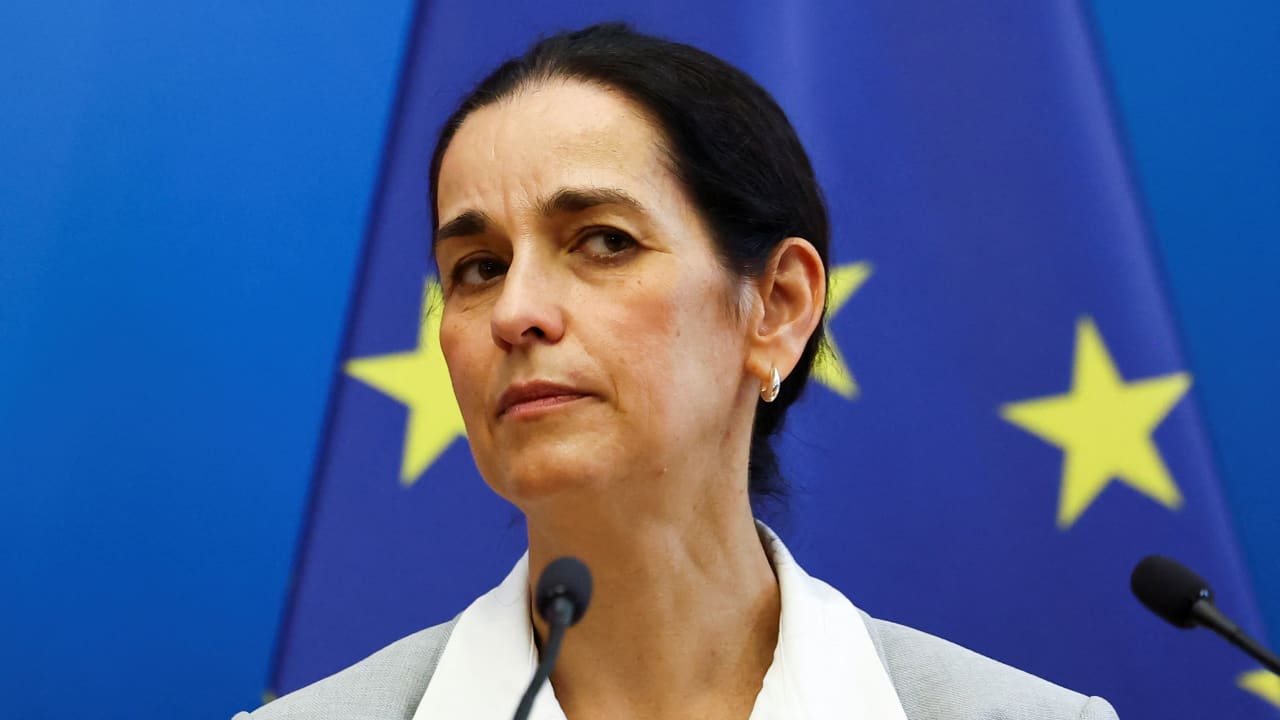
A Conversation With Deputy Prime Minister and Minister of Foreign Affairs Anita Orbán of Hungary
Event date
From Europe Program.
Speaker
- Deputy Prime Minister and Minister of Foreign Affairs, Hungary
Presider
- Liana FixCFR ExpertSenior Fellow for Europe, Council on Foreign Relations
Hungarian Deputy Prime Minister and Minister of Foreign Affairs Anita Orbán discusses Hungary’s new government, its strategic alliances with Europe, the United States, and NATO, and the impact of the Russia-Ukraine war on collective security.
FIX: Welcome, everyone, to today’s meeting and conversation with the deputy prime minister and foreign minister of Hungary Anita Orbán. It’s a pleasure to have you here with us, Foreign Minister, Deputy Prime Minister, and thank you so much for agreeing to speak at the Council.
My name is Liana Fix. I’m a senior fellow for Europe here at the Council, and I’m going to preside over today’s discussion.
Before we start, let me remind us all that this is going to be a conversation which is on the record, and let me also say a few words about our speaker today, Dr. Anita Orbán, who has been deputy prime minister and minister of foreign affairs of Hungary since May, which was the month when Hungary had a pretty landslide election over there, may I dare say so, when the Tisza Party of President Magyar really won in a historic landslide and ended Viktor Orbán’s rule in Hungary.
Dr. Anita Orbán had multiple roles before. She was an executive including at American LNG companies and also at Vodafone. She served as Hungary’s ambassador-at-large for energy security from 2010 to 2015, and she’s also the author of Power, Energy, and the New Russian Imperialism, a book you earned with a Ph.D. from the Fletcher School of Law and Diplomacy in Boston.
I’m looking forward to this conversation, and then after the first thirty minutes we will also have a conversation with you here in the room, but also with some members who are joining us virtually.
So let me perhaps start, Deputy Prime Minister, by giving you an opportunity to explain a little bit in more detail about what has really changed in Hungary and what has changed in Hungarian foreign policy after the elections in May.
The Tisza Party always said Hungary’s foreign policy will be decided by the Hungarians, not in Brussels, not in Washington, and not in Moscow. So what exactly does that mean and what has changed since May in Hungary’s foreign policy?
ORBÁN: So, first of all, thank you so much for the invitation. It is an honor to be here with you at CFR, and as I explained, I used to be a member of ECFR, which has nothing to do with CFR, but European ECFR was established after CFR and took all the notion and the idea and inspiration from the U.S. version, and it’s so nice to see familiar faces in the—in the audience.
A lot has changed. A lot has changed in May, and we had won a landslide, as you—as you said it. Out of one hundred ninety-nine seats in the parliament, on election day Tisza won a hundred forty-one seats, so it’s a solid two-thirds majority, and what we campaigned on is the rule of law—restoring the rule of law, restoring the institutions, restoring checks and balances in Hungary, and that’s what we have been working on. In the last four months, pretty heavy legislative agenda, what is behind us, and actually we are in the—in the middle of it.
In terms of foreign policy, yes, you cited it well, and when we were standing on the stage on election night after we have learned that we won, people were chanting in the—in the crowd, “Europe, Europe, Europe,” and I am not sure on how many elections in Europe today people are chanting “Europe, Europe, Europe.”
And that means that really the electorate or population wanted and wants the Tisza government to solidify Hungary’s place again in Europe, in our alliances, being at the European Union and NATO.
And when you said it that we—Tisza said that foreign policy will be driven by the Hungarians, what we mean that we are restoring the sovereignty of the country and we are defending and protecting our national interests and which we define as what’s good for the Hungarian people and what’s good for the Hungarian economy and what’s good for the security and sovereignty of the—of the country.
FIX: Yeah, and I think there was a lot of excitement in Brussels at that time, as I remember, about the change in government in Hungary, especially because some key issues were unblocked—support—financial support for Ukraine.
So perhaps let’s move directly to that topic because I think it’s one of the biggest changes in Hungary’s foreign policy, the support for Ukraine and the relationship with Russia, which was famously friendly by Viktor Orbán in the past.
How has that changed now? I know Hungary’s government, you have expelled, I think, ten Russian diplomats, the first time since the full-scale invasion of Ukraine in 2022.
How are you navigating that relationship with Ukraine, with Russia, especially when you say Europe, EU, and NATO is our home now?
ORBÁN: Mmm hmm. Yes, the expellation happened a good two and a half weeks ago, and this was the first time since 2018 in Hungary, and, as you know, it happened to be in a row after 2022 there were almost six hundred diplomats who were expert from European capitals, and Hungary literally did the very first time. We did it two and a half weeks ago.
We are aiming for a pragmatic relationship with Russia, and how do we define that? That when the legitimate interests of the two sides be respected, that we should respect each other’s sovereignty, and that’s what also this expellation of diplomats symbolized and meant.
You may also know, and you know very well because you are an expert of Hungary and Europe, that Hungary is buying a pretty big chunk of its energy resources, crude oil as well as natural gas from Russia, and also we are building a nuclear reactor also with Russia. That also necessitates us to be pragmatic in our relationship.
When it comes to Ukraine, we had the first foreign policy success stories in the first couple of weeks of the government. We have minority—Hungarian minority in Transcarpathia region so the most western region of Ukraine, and we managed to negotiate a bilateral agreement with Ukraine which secures the rights of the minority, especially in education, in culture, and in the use of the symbols.
This was a breakthrough because these rights were not granted for the last ten years. And, unfortunately, the previous government used the lack of the minority rights as an excuse for the pretty hostile relationship with our neighbor Ukraine, and when we came into the office, we managed to get an agreement within a couple of weeks, also with the involvement of the representatives of the minority in Transcarpathia, and that also led to unblocking quite many vetoes as well as the opportunity to reset the relationship.
FIX: There’s—there are still some stumbling blocks, especially when it comes to the question of should Ukraine become an EU membership country. I know your government has been a little bit more reluctant on the fast accession process of Ukraine there. Perhaps you can—you can elaborate on that.
And then, according to your book, Russian energy is a tool of Russian imperialism. That’s very much how you have written that. I know that the government has a plan to reduce Russian gas, to reduce Russian oil, until 2027, 2035.
How is that going forward, especially with regard to new U.S. sanctions which might potentially also affect Hungary?
ORBÁN: Mmm hmm. So when you want to join the EU you have to do a lot of reforms, and the process is put into six clusters and each cluster had different chapters. And the way it happens is that you are opening cluster—cluster after cluster, you start working on the reforms, and then you are closing the clusters.
So, hopefully, Montenegro will be the country which this year manages to close all the clusters, and hence will be a member of the European Union, hopefully, in 2028.
So in Ukraine what happened is that the previous government was blocking entirely the opening of the clusters, and with our government we managed to open the first cluster I think in June, and then the second cluster, which is the cluster six—it’s on common security and foreign policy—was opened in July.
And there are four more clusters which are to be opened and the discussions are around those, and our position is—it is important to understand our position—our position is for the enlargement as such.
But Hungary is saying that every single country which wants to aspire to become a member of the European Union needs to go through the same methodology which all the member states have gone through, and we are promoting and we strongly believe that it should be a merit-based approach for each applicant.
And when you look at the Western Balkans we are kind of forgetting this merit-based approach and it became a political process. So for us, it’s the enlargement. The same rules should apply for each aspiring country, being that Ukraine, Moldova, and Western Balkans. We want to be absolutely consequential.
And from a political point of view, the fact that two clusters have been opened for Ukraine, and the process has been starting, it has started and now we would like to see also some reforms be passed.
You also asked about Russia and the energy supply. Yes, I wrote—this was my Ph.D. back then, which I turned into a book and it was published by Prager in 2008, and the whole process started in 2001 when I proposed my Ph.D. topic at Fletcher, and the topic was that I proposed Russian foreign policy to west Central Europe.
And I was—and this was 2001, post-Soviet Russian foreign policy towards Central Europe. And I was researching, researching, reading, and I realized that there is no such thing as post-Soviet classic foreign policy towards Central Europe in 2001, and I was desperate, saying that how will I fill three hundred pages with a nonexistent foreign policy. (Laughter.)
FIX: Some of us can feel that, too.
ORBÁN: You can feel the pain, because literally when I was reading official Russian documents there was no mention of the word Warsaw or the capital of Budapest was not even mentioned. It was always Washington, Berlin, and sometimes Brussels.
But during this research, I discovered that the Russian energy companies are pretty active in our region, so I turned the proposal of the topic on whether Russian energy companies are a tool of foreign policy or the other way around.
And that led to the Ph.D. and then to the book 2008. And, of course, we had some energy crisis afterwards, you know, the pretty famous and I think normative experience was the 2009 energy crisis in Ukraine.
And since then, what happened in the European Union is a lot of diversification projects came on board, also from the supply point of view, especially Azerbaijan, as well as the LNG boom in the United States, which pretty much changed the whole world LNG market and LNG abundance became absolutely accessible, which also created and prompted a lot of regasification terminals all over Europe, especially in the Baltics, in Warsaw—Warsaw, or Poland, and also Croatia and Greece.
And so it created a new boom of access to natural gas, and there was also a new attitude or concept to supplying Europe, which changed the classic East-West pipeline system to a more of a spider web.
Remember in 2009 and 2010 was the time when all the interconnectors popped up, meaning that the countries’ energy systems got interconnected in Europe, and with a two-way stream—this is also important—not one-way streets but two-way streets that you can pretty much start working and going towards more an energy union, an integrated energy market.
So when it comes to Hungary, we have seven neighbors. We have quite many neighbors as a country, and out of the seven neighbors we are interconnected in terms of natural gas infrastructure with six.
So in terms of infrastructure, we have quite a lot of access to different potential sources of energy, and what the government is doing now we are working on the best energy mix for the country, which is the cheapest as, unfortunately, we inherited one of the poorest economies of the European Union.
That’s why the—and energy prices are traditionally high in Hungary and that’s one of the key goals of the government to put the prices down to make our economy more competitive. And also we inherited an economy which is traditionally much more on fossil and nuclear, so we are also looking how we can use more green energy, especially wind, which has been absolutely under indexed in the Hungarian energy mix.
And when it comes to crude oil, we have one alternative pipeline compared to the Druzhba pipeline, which comes from Russia via Ukraine, and that’s from Croatia, and that would give us—and that gives us pretty much direct access to the sea, which is the global oil market.
We are also working on how we can enhance the capacity of that pipeline as well as changing the technological conditions of our refinery to be able to process the most efficient way to non-crude oil.
So it’s a gigantic task ahead, but our goal is a sustainable, competitive, and secure supply mix.
FIX: Mmm hmm, which might be not easy because the Russian supply guarantees a very cheap supply right now, so—
ORBÁN: It is a very cheap supply, yeah.
FIX: You already mentioned U.S. LNG. Of course, there’s an opportunity for business relationships with the United States.
But also, more broadly, how do you envision the relationship with the United States and with Hungary, going forward, with the new government and the surprise change to many, I would say, in Washington but also in other capitals in Europe?
ORBÁN: Yes, I think it was a surprise change. There were a couple of people who believed—who believed that we aren’t going to make it. And there was actually one ambassador—I won’t name her—who was stationed in Hungary, and she kept sending back—she told us afterwards that she keep sending back note verbales to the capital saying that Tisza will have two-third and everybody thought that she’s crazy, and she was the one who got it right.
So the Hungarian-U.S. relationship is pretty stable, I would say, as countries and between the administration as well as the Hungarian government, and we are working already currently on quite many potential agreements and MOUs.
Our—U.S. companies are employing, like, a hundred thousand Hungarians. We have quite a huge diaspora in the U.S., as you know. Also, from 1950 up to 1956 the U.S. took the most of Hungarian refugees and also we have diaspora—a fresh diaspora in the U.S., and we have pretty solid relationships.
The most important alliance is NATO, of course, where we work together and we fully share the burden shifting in NATO. This new government pledged the 5 percent spending by 2035, and which also creates further opportunities of cooperation.
FIX: Mmm hmm. Wonderful.
I will soon open up for questions from our members so please feel free to prepare your question already.
But perhaps let me go back to how you started at the beginning with the domestic situation in Hungary because I think one of the most fascinating results of the election is that the two-third constitutional majority that allowed Viktor Orbán for a long time to stay in power is now actually working in your favor—
ORBÁN: Yes.
FIX: —and allowed this historic landslide win of the government.
What are the domestically the most dramatic projects that you’ve driven forward when it comes to media but also to justice and rule of law, and do you feel that this might be perhaps too overwhelming for the country, or is there a big desire for rapid change immediately?
ORBÁN: There is a big desire for rapid change and, of course—of course, we see both sides of the coin. Some of our electorate is very impatient. They want to see the change to take place very, very quickly, and, of course, some are leaving us more room to breathe and to go with our own pace.
So in terms of the rule of law, we are—really have to recreate the checks and balances, and I will just highlight a couple of things that we have been doing.
First of all, we joined the European Prosecutor’s Office and we absolutely declared and announced zero tolerance on corruption because, unfortunately, what we inherited that our country has been the most corrupt country based on the Transparency International Index for four years in a row.
So it’s a lot of work there which needs to be done. We are also going after money which has been publicly stolen. We created a separate and dedicated authority which task is to recover those stolen assets and public money being Hungarian or EU money.
And you mentioned the two-third majority. We are also decreasing—and, of course, it worked into our favor and right now the electoral system in Hungary is such that according to the poll which just came out today we have 64 percent of the votes we would get today, and that would mean if elections were today that out of the hundred ninety-nine seats, we would have a hundred sixty-one seats in the parliament. So it’s absolutely disproportionate.
And we are also starting that, first of all, we decrease the issues which necessitated two-third majority. So as such, we are constraining our own government, but we want to constrain every government in the future—
FIX: Just to make—(inaudible)—
ORBÁN: Exactly, so that—
FIX: —two-third wasn’t—was used as a threshold in the past for all, even minor, reform in government, right? That was—
ORBÁN: Exactly, and it constrained—it would have constrained anyone which who doesn’t have a two-third but a simple majority. So we create—we created pretty much a bigger space for governing for any future government.
And we are also starting a new constitutional process which starts now in the fall with the involvement of the population to review all those institutions and authorities, which can be there for the future and to make sure that every single power or every single government who may come into the office, including ours, has the right checks and balances and institutions to build on.
FIX: Do you face reproaches of retaliation against the past government? Is that a line that you have to walk in your reform efforts, that we are not, you know, just addressing the past government; we are preparing the (line ?) for the future?
ORBÁN: We are preparing for the future, but of course, we have a normative experience from the past government, right? That’s where we come from. And the mandate is super clear from the electorate. It’s go back on the democratic path; go back respect human rights, respect rule of law, respect multilateralism; and also be a trusted and constructive ally and partner within NATO and within Europe.
FIX: Hmm. And an interesting episode was certainly that I think the public radio and TV broadcaster went down for six weeks—
ORBÁN: Correct.
FIX: —until it was completely reset—(inaudible).
ORBÁN: Yes. Yes. Beforehand, just to give you a sense, it was a public TV, right, and for the two years since our prime minister first appeared publicly exactly two years ago, two years before the elections, and for those two years the public television has never given him access so it never invited him to speak, Orbán.
And when the public television was down for six weeks we were screening old movies, old Hungarian films and movies. I have to say it was a super popular six weeks. (Laughter.) And then we restarted it and now we have live streaming also the parliamentary sessions where we have now real debates, and a couple of friends of mine said that they gave up their Netflix subscription because the Hungarian parliamentary debate is the new Netflix. You really never know. Even when I’m sitting there, you never know what’s coming.
So I think we reintroduced the culture of debate, of politics. Also, people are talking about it a lot. People are very active on social, extremely active on social, very much opinionated, and the pace is absolutely, absolutely incredible.
FIX: Mmm hmm. Wonderful. Let’s take some first questions from our members.
Over there.
Q: Thank you. Ishaan Tharoor. I’m the Edward Murrow fellow here at CFR and a columnist at the New Yorker.
Madam Foreign Minister, you know, when Prime Minister Orbán was in office, his government, his particular party, and he himself was looked at by many in this country and in the right in the West as a template of success, as an example of illiberal nationalist victory and triumph and from whom they could derive lessons.
What lessons can we derive? I know it’s early days yet, but what lessons should we be deriving from your success and at least certainly your electoral victory? And especially as these battles are playing out elsewhere in other democracies elsewhere, what lessons and precedents do you believe you have set?
ORBÁN: Thank you for the question.
I think that, yeah, he may have seen as a success, but you need to walk the talk, right? You need to deliver for the electorate.
And how did we win the campaign? It was twofold. One, on the foot. The prime minister has visited seven hundred settlements himself—seven hundred settlements—and some of them six, seven times.
Of course, Hungary is a middle-sized country. We have, I think, like 3,500 settlements, so he has been personally in, like, 20 percent of the settlements, and on the last weeks of the campaign we had, like, eight, nine rallies per day.
So one was on the foot, effectively going and talk to the electorate, and that also—and we did the same, of course, when we joined the campaign, all of us. That means that I would like to think that we have a good understanding of the issues and the problems because we were looking at the people into the people’s eyes.
And we had quite a lot of site visits. We have visited hospitals. We have visited schools. We had had several town halls. And the other means was social media because that was our only access, and pretty much Facebook and TikTok. We did not have any access to the traditional media whatsoever.
So this was the means. But why I think we won is because we were talking about the real problems of the people. We were addressing the real domestic issues from education, through health care, through living, through people leaving the countryside, the villages.
Quite many Hungarians left the country. Several hundred thousand left the country in the last couple of years. We have—used to be a nation of 10 million, like, ten years ago. Now we are 9.5 million, and they left because of the economic situation and the political situation.
So if you hear the prime minister, he has a very straight—very straight language, very straight talk, and I think that’s how we managed to win it.
Now it means that we really need to deliver, and I—and I think it’s a super good sign that four months into the office we have bigger support now than we had on election day. But, yeah, we need to—we need to deliver to the people and we need to do systemic changes so that from one of the poorest economy, the most corrupt economy of the EU, we make again a prosperous society and a prosperous economy.
FIX: Wonderful. Oh, I see we have a lot of interest.
Oh, wait. Yes?
Q: Madam Deputy Prime Minister, Ariel Cohen, senior fellow at the Atlantic Council and member of CFR.
Madam Deputy Prime Minister, in my wildest dreams, I knew you were going to go far but I didn’t realize how far. It’s such a pleasure to see you again.
Anita and I worked together in the past.
ORBÁN: OK. To be—to be clear, I used to be his intern—(laughter)—so—
FIX: An inspiration to all of our interns in this room, certainly.
Q: There are very few things in what I accomplished I can take more pride than this.
Now to serious business. We all know and we all were very concerned about Orbán Viktor’s attitude towards Ukraine. I do believe that the Ukrainian conflict is the defining conflict in Europe now and one of the two in the world, together with Iran.
Can Hungary reconsider and reform its policy so that you become a major Ukraine supporter and, in the process, resolve those outstanding issues such as the Carpathian federation or confederation, such as to some of us who are outside of the region, sad and painful ethnic accusations on probably both sides between Hungary and Ukraine.
And on a broader and related issue, there is—there are a lot of concerns about escalating Russian hybrid warfare in Europe. Liane and I were at the briefing in Washington by one of the experts who described very disconcerting drone attacks, cyberattacks, and the discussion now, frankly, is whether Putin is going to do a conventional operation somewhere in Eastern Europe.
What can you tell us about that as well but also on the bilateral Hungarian-Ukrainian relationship? Is there a better path forward than in the past? Thank you.
FIX: Great question.
ORBÁN: Thank you so much, Ariel, and it’s incredibly nice to see you. I used to be Ariel’s intern at the Heritage Foundation. (Laughter.)
Q: No longer.
ORBÁN: And I still remember exactly what we worked on on the Index of Economic Freedom and all the countries of the post-Soviet sphere. And I also remember that you went to Turkey for a two-week trip and I was there in the summer, and you brought me a small bowl as a present and I still remember that.
So, Ukraine. What we are working on right now, we have this bilateral agreement from June and it now turns—needs to be turned into law, and our Ukrainian friends are now working on drafting the law and our experts have been just reviewing it literally in these days.
We are doing the final fine tuning, and then hopefully it can go in front of Rada and it can be accepted.
You should know that the previous—and I also go back to the previous question of—from New Yorker colleague on Viktor Orbán and the previous government. The way the previous government has been running the election campaigns that in the last two or three rounds they were always finding an external enemy and they created a hate campaign around that external enemy.
It was never about the people’s problems but, rather, creating fear and picking an external enemy, and that external enemy which the previous government picked was Ukraine. It was Ukraine and it was President Zelensky, and they really created such an enormous fear in the Hungarian population which is measurable.
Just to give you an example, we have been receiving phone calls from people during the campaign that will there be war, will there be invasion, will the Ukrainians invade us, because this was so much the impact of the propaganda.
And geographically Ukraine is to Hungary’s east, and we have the Danube River which splits the country and which was for me the most telling when I started receiving phone calls from people on the west of Danube, right.
So it was immense. It was absolutely immense what the campaign was about and what we inherited, and we are absolutely interested in regional and bilateral cooperation which benefits both countries, but it will take time to get there.
In terms of the hybrid attacks and sabotage, I think you have seen how we were responding also to the Leipzig announcement of Germany or news announced by Johann Wadephul, and yes, we see it. We see it’s happening all across—all across from the Baltics down to Romania, and that’s why I would pivot back to what we said as the cornerstone of our foreign policy.
We need to stand united being in NATO and being in EU, and that’s what the novum is that Hungarian foreign policy is bringing to the table now, that Hungary wasn’t a reliable or trusted ally, neither in EU nor in NATO.
We know that there have been also formats of discussions where we were left—the previous government—the Hungarian representative was left out from the discussions because of the lack of trust, and we cannot afford not to stand united as alliances, and that’s why I think it was also a relief for quite many of our partners that we are back.
FIX: I think you said you don’t want to be a stick in the spoke or a spoke in the—in the wheel.
ORBÁN: Exactly. That’s what we said.
FIX: But I take from what you said that you can at least imagine a future where support for Ukraine might go further than what Hungary is doing right now, depending on how you can change the society’s mindset about Ukraine.
ORBÁN: We are working with our Ukrainian partners expert level, high level, and, of course, but also what we inherited, as I said, in terms of the society is deeply, deeply embedded. That’s where we—where we come from.
FIX: OK. We will take one question from the virtual audience and then I will come back for the room. I know there are many hands up here.
First one virtual question and then we’ll—
OPERATOR: We’ll take our next question from Raffi Gregorian.
Q: Thank you, Minister. It’s really too bad that you cannot run for office in the United States. That would be great. (Laughter.) I’m former deputy undersecretary general at the U.N. for counterterrorism, but for purposes of this conversation and this question, I was also acting high representative in Bosnia and Herzegovina for a while.
My question is about your government’s attitude towards Milorad Dodik and his secessionist tendencies, which have been on display for twenty years, but also Mr. Vučić in Serbia. I think both of them noticed your victory—your government’s victory there, and what they anticipate are probably changes not in the favor of their policies in Brussels but also bilaterally. So I’d just be interested in your thoughts to the degree they’ve been formed about your relations with both Serbia and the RS part of Bosnia and Herzegovina. Thank you.
ORBÁN: Thank you for this question, and I would address it first in the context of the Western Balkans, which is where we are neighboring. We are directly neighboring, of course, Serbia, and the Western Balkans is a region which is of great importance for Hungary. It has always been, and there is a continuity in this sense with the previous government’s foreign policies that we are supporting and promoting the integration of the Western Balkan countries into the European Union.
Of course, it also needs to be based on merit and progress, and we are extremely happy. We see a great—good chance that Montenegro can finish its—all the reforms needed to close all the clusters and chapters this year and then would be the first country joining the European Union after Croatia, which has been—it’s, like, twenty years ago or so, or fifteen, sixteen years ago, or something like that. There was no enlargement.
And then Albania, hopefully. We are really hoping that Albania will be the next. This is also very much needed for Europe. Enlargement has been one of the best tools, and it would be a good sign of—of also for Europe that we could start including new members. And, of course, we don’t see necessarily the same for Bosnia as well as North Macedonia.
We have a good relationship with Serbia. Serbia is our neighbor, and what we as the Tisza government are aiming at to get to neighborly relations and regional relationships which are transcending political parties, which are transcending ideology, but based on very solid government-to-government, nation-to-nation relationships.
So on your particular question, we also said it clearly in the campaign that we are not interfering, that we will also change—we are not interfering into the domestic politics of other countries and that applies especially also for Bosnia.
In Serbia, we have been promoting very much the opening of cluster three, which would have been the third cluster opening for Croatia in terms of EU accession. It was discussed in the EU in July. It didn’t happen.
But we were among those countries which were really much pushing forward and this should be a good sign given to the Serbian people and to the Serbian government of progressing with the—with EU enlargement. Now it most likely it’s a bit off track. We shall see also the elections end of—end of October how it plays out.
So the bottom line is that we are aiming for a sovereign—for a pragmatic relationship with all the countries, and we are not going to extend our mandate or extend our role with interfering into the domestic politics of any country. That practice will cease to exist.
FIX: Mmm hmm. Thank you, Prime Minister.
The lady over there.
Q: (Speaks in Hungarian, then continues in English.) My name is Kati Marton. I’m a member of the Council and an author—and just back from Budapest, my first trip in eight years, because for eight years I was a small external enemy of the other Orbán. By the way, just to clarify that there’s no relation—
FIX: (Laughs.) There’s no relationship here. (Laughter.)
Q: —between these two Orbáns. I was a demon for the last few years and was advised not to travel in Hungary, but I can tell you that even after just four months the atmosphere is different. So I am—(speaks in Hungarian). (Laughs.)
(Continues in English.) So my question is this. I was a longtime trustee of Central European University, which, as you know, the other Orbán evicted, and we are now—evicted for being too good a university. We are now headquartered in Vienna. And I know it’s very early—it’s only been four months and you have a great deal on your plate—but would you at some future point, not too far in the future, reconsider bringing this really fine European university back to where it belongs, which is in Budapest? (Applause.) Thank you.
ORBÁN: First of all, Kati, thank you so much, and it’s really nice to see you. I think we met a few years back, and—
Q: (Off mic.)
ORBÁN: Yes, exactly. Exactly. And it’s so nice to hear that you came back to Hungary after eight years.
And we have an amazing story. András Schiff, the world-famous pianist, he hasn’t been in Hungary for sixteen years, and he came back just now in September and he gave a—he gave an absolutely stunning concert in Hungary after sixteen years.
So this speaks, I think, volumes and I’m so happy that you reinforced that you feel the atmosphere. Some people were saying that even the gravity is lighter since May. And, of course, we don’t want to do exaggerations. It’s not everything is rosy, but I think it is like that.
We haven’t discussed CEU yet. We haven’t discussed CEU yet; there is so much on our plate. So I can’t give you any more affirmative answer or anything more, but only this much. It’s so much to cover, so much to discuss, to consider, and I’m sure that we will get there sooner than later.
And thank you for raising it.
FIX: The gentleman over here has been waiting for a long time.
Q: Thanks. Rob Kushen from Porticus Foundation, and once upon a time the Open Society Foundations where I worked for many years in Hungary.
Viktor Orbán was proud of the concept of illiberal democracy and he sought to some extent to project that ideology in the foreign relations of Hungary. As you undertake reforms in rule of law, democratic institutions, civil liberties, human rights, do you see the country projecting those different values in its foreign policy? Thanks.
ORBÁN: Yes, absolutely, and I think—I think that—I believe this is the story of Hungary now, that if you really address the real needs and concerns and issues of the people, then you can win. You can win against—it’s not only that the previous prime minister was propagating illiberal democracy but he also built one, and during the election campaign we were going against an overwhelming majority of media controlled by the previous government.
Actually, according to independent analysis and sources, 80 percent—80 percent—of the media was in the hands of the previous government where we had absolutely no access to. Moreover, there was hate campaign coming from that media.
When it came to public advertisement and advertisement money spent, this is even more disproportional in favor of the—of that media, not even talking about the fact that there was a classic methodology of handing out subsidies pretty much and money to people before elections, right—some extra salaries to policemen, to servicemen, et cetera.
So but if you are not addressing the real needs of the people, people will feel in their gut that something is wrong, and I think this is the big story of the Tisza government and of Hungary.
When we were campaigning, I have been campaigning also with the diaspora. We have, as I mentioned, a pretty wide diaspora and in Hungary you can vote from abroad as well. So we were—we were also campaigning.
So when we were campaigning I campaigned in Stuttgart, in Vienna, in London, in Liverpool, because we have such a substantial diaspora, and quite many times I heard the stories that we have secondary shame, feeling—quite many people said that, I will give back my Hungarian passport if the previous government stays in power.
And we could change this overnight. We could change this overnight. We had the election on April 12 and I heard stories on April 13 there was an international consultancy which had a Hungarian branch, and on April 13 they put back the Hungary on the letterhead of the PPT presentation, which they took off for several years. And our compatriots and fellow countrymen and women who went into their workplace wherever in the world on April 13 they got applauded.
So you could change the narrative. You could change how the country is perceived overnight, and I think—I think that’s the story. That’s the narrative which Hungary brings to the table, and this is especially meaningful for us this year when we are celebrating the seventieth anniversary of the 1956 revolution this year.
And we feel like it was 1956 which was the first—pretty much the first sign that communism may not be there eternally. Then we had 1989, which is a regime change, and as you may know, we campaigned with the regime change here.
We were clear that it’s not only change of government but we need to change regimes in 2026. So we have an amazing pattern and, hopefully, this time around we will really finish it.
FIX: And 1956 is such an important—it is such an important historical anniversary.
The gentleman over here.
Q: Jó estét, Minister Orbán. My name is Jeff Laurenti with New Jersey’s Capital City Redevelopment Corporation.
Now, the new Magyar government has become a constructive player in the EU again. Could you tell us a bit about one issue that is bedeviling EU foreign policymaking? France, one of your biggest members on the Western side of the union, along with former member Britain and would-be associate member Canada, have in the past couple weeks announced measures to bar products made from the occupied Palestinian territories in the West Bank from entering their markets, and presumably this is something that could, should, what might be taken to the EU as a whole.
Could you tell us what have been any discussions within the EU so far on this or other measures regarding trying to keep a two-state solution alive in that region? And what are the internal politics in Hungary of this issue?
How does the Hungarian public, to the extent it follows distant foreign policy issues at all, see this as interesting, relevant, important?
ORBÁN: Thank you.
Yes, it has been discussed at the—at the—in EU foreign policy affairs—Foreign Affairs Council, but there hasn’t been any decision made. Their—the council asked the European Commission to come out with a study on the impact of a potential ban, and I am not aware whether this is on the agenda of the next Foreign Affairs Council meeting. I don’t think that it has been announced, but it has been inconclusive.
When it comes to Hungary, Israel is a strategic partner of Hungary and it remains so. As you know, we have a huge Hungarian diaspora in Israel and a pretty big Israeli diaspora in Hungary, and we very highly value our partnership and relationship.
We just also opened a campus in Eilat for one of the Hungarian universities. It just happened, I think, like two weeks ago.
So we are looking forward to see, of course, the elections in Israel taking place next month, and I can also tell you that President Herzog is going to visit Hungary on October 20 and 21.
FIX: The gentleman over here waiting patiently, and then the lady in the back.
Q: Thank you, Madam Foreign Minister. My name is Will Oakley. I’m a U.S. Army officer.
Earlier you spoke to Hungarian efforts to restore trust with NATO and the European Union. I wonder if you could speak to some of the specific measures you’re taking to do so and any of the tension that you’re experiencing, maybe with residual ties or reliance on Russia.
ORBÁN: Thank you. In NATO, I would separate the military cooperation and the political cooperation because it seems that militarily Hungary continued also in the last couple of years to be a trusted partner and ally.
For example, Hungary has been part of the air patrol in the Baltic Sea with its Gripen aircraft and they continue to do so—we are doing the fifth patrol in 2028—which has been less cooperative and constructive. It’s more the political level when it came to political agreement, to political unity, for example, condemning the Russian invasion, for example, standing by and respecting the sovereignty and the territorial integrity of Ukraine, and that’s what we brought back to the table, that politically we are also standing with the NATO unity.
FIX: You also—you also on the record were saying that Europe has to increase its defense capabilities, has to take on a stronger role, that, obviously, against the backdrop of fears of U.S. withdrawal, U.S. force posture review. Can you talk a little bit about that? What would you like to see within Europe as a perhaps not plan B, but perhaps as a complement to the changing strategic picture and the strategic posture of the United States and Europe?
ORBÁN: Yeah. We absolutely get it that Europe needs to have a bigger share of the pie and adding to the security more, and we are supporting hundred percent the burden-shifting concept, and already the current government pledged to get to the 5 percent.
Spending, we are already above 2 percent spending in terms of our GDP for defense capabilities and security, and then we are going to increase it to 5 percent.
FIX: The lady in the back.
Q: Thank you. I’m Arlene Getz. I’m a journalist and the former editorial director of the Committee to Protect Journalists, so this is a media freedom question.
You’ve alluded to a couple of really interesting points, and my question is, broadly, what are you doing—how are you going to try and reinstate a culture of media freedom? Your example of public—the public broadcaster and everybody watching old movies. What was happening at the station at that time? Were you trying to retrain the journalists? Are you trying to bolster independent media and to get the exiled journalists, the ones who fled the previous administration, back into the country?
ORBÁN: This is a great question. This is a great question, and I can give you a few anecdotes just to—just to illustrate and to answer.
That we had a press conference. I think it was—it was my German counterpart. No, it was the culture minister, and we were having an opening conference for the cultural institute directors of Hungary and the first part of it was open to the press. And one of the—and then we asked the press to ask the questions, and one lady who represented one of the radios she started saying—this was in the foreign ministry building. This was like three weeks ago. And she started saying, thank you for letting me in this building after sixty years, and she was, of course, opposition from a liberal media outlet.
And then—and then they were also surprised that they are not planted questions but they are allowed to ask questions, and it wasn’t pre-negotiated between my team and the journalist who is asking and what the person is asking. So we start from here.
And we also learned—I don’t like to speak backwards, but we also learned that under my predecessor there was only—only the friendly media was invited, the questions were agreed, and then the rest of the room was filled by desk officers from the Hungarian ministry so that it looks on screen full.
So we opened it to the press. We invite everybody. We allow questions. I just gave also this morning a twenty-minutes video interview to one of the news outlets, which is absolutely not pro Tisza.
So this is how we do it. But, of course—of course, we also have the experience, now that quite many, from back then opposition media now also work for Tisza because they came to work for the ministries. They are all spokespeople. They are all press officers.
So there will be an opportunity for a whole new generation of journalists to grow out and to grow and learn how—what is the role of the media. Media is supposed to ask the questions. Media is supposed to be also there for checks and balances.
And then recreating the notion of independent media is also one thing that we are—we are working on.
FIX: Thank you. Many more questions in the room. (Laughs.)
I’ll take the lady over there and then I’ll come to you, Mike.
Q: Thanks so much. Suzanne Nossel of many hats but here as a Council member, and it’s wonderful to hear this very encouraging, heartening presentation.
I wanted to ask you about migration, which I know is a challenging issue. I know your government has extended, at least temporarily, restrictive posture from the previous government. This is an issue that’s bedeviling governments throughout Europe. It’s a test, I think, for liberal democracy. You know, perhaps the European approach needs to adapt. And I’m just curious in terms of meeting the expectations of your public, sustaining the support of your government, a challenge that Poland has also faced, kind of how you see approaching this and kind of what gives and how you think your government is going to move forward. Thanks so much.
ORBÁN: Thank you. Thank you.
What I’d like to say is that there is a lot of change, a 180-degree change on quite many things and policies, but there is also those where there needs to be continuity, and when it comes to illegal and irregular migration, then the wish and the mandate which we were given by the electorate is pretty clear.
It’s pretty clear, and there will be a continuity in this sense with the previous government. A lot has changed in Europe compared to 2015 and there’s a new migration pact which came out in June, and that is promoting and giving toolkit to countries for a much, much stricter and firmer control of the borders.
And you have seen also the case of Ceuta in the middle of August where twenty-two prime ministers pretty much signed a letter out of the twenty-seven strongly against any illegal migration and very much pro defending the borders of the European Union, and this is a very big change compared to 2015.
So that’s what we stand for and, yes, we asked for a—for a provisional extension while we are working out how we are handling illegal migration, this government. We are working with the European Commission, but we—our position stays firm on this that we need to defend our borders.
And we are also having, of course, the Schengen border with Serbia and, of course, with Ukraine. So we are also on the outskirts of the—of the European Union.
FIX: (Laughter.) You know, many have had their hands up. I think, gentleman, you’ve been waiting for a long time over here.
Q: Hi. My name is Stephen Schlesinger from the Century Foundation.
The Republican Party in this country has famously endorsed your old—you prior government, the Orbán government. Has that affected your relationship with the new—with your own new government and the Trump administration, or have you sort of worked that through as things happen? (Laughter.)
ORBÁN: Thank you for your question.
No, it hasn’t affected, and yes, we worked it through. We are—this—it’s—when people see from the U.S., it’s hard to believe the composition of the Hungarian parliament, because in the U.S. you have the Democratic Party and the Republican Party, you know, left and right, if I am simplifying it.
In Hungary, pretty much you have three conservative parties in the parliament and, of course, we have a big—we are a big umbrella party, our party, which is, like, I would say mainstream conservative, and we have two conservative parties right from us.
And I don’t even want to label them. I don’t want to define them, whether it’s far right, radical. I don’t want to define it. But the point is that it’s really hard to explain to start with that when it comes to ideology, when it comes to values, we have three conservative parties in the Hungarian parliament. It’s a pretty unique composition, I guess, and I am sure that political scientists will analyze it.
But yes, thank you for your question. We worked it through and I’m really happy of our relationship with the administration.
FIX: And that helps also, I think, the—how you describe it, because often there’s a sense of government is more on the left-wing side, on the progressive side, your government, but it is fundamentally essentially a conservative party.
ORBÁN: It’s fundamentally a center-right party. We are going to join the EPP in the European Parliament, which is the mainstream conservative grouping of European parties.
FIX: (Inaudible)—the lady right here.
Q: Laura Silber, Open Society Foundations. It’s great to see you.
ORBÁN: Hi. Good to see you.
Q: Great to see you.
Prime Minister Orbán, I would like to know when we go back to accession, Hungary has been very supportive of accession and enlargement. You said that here. Would Hungary—is there an appetite in Hungary or within the European Union to consider two-speed membership so that you would have—you would enlarge but perhaps have it as a two-speed so that you can extend the European embrace to other nations?
ORBÁN: We have a pretty firm policy on this. We are not supporting any two-speeds. We are supporting one speed, which is on the existing agreed-upon methodology for each country past, present, and future.
FIX: We have four more minutes so I can take a couple of questions, and I think it speaks to the interest in your country and in your role how many questions we have here, Minister.
Over here.
Q: My name is Mahesh Kotecha. I’m a financier.
I was in Budapest just about a month ago and previously I was there in the ’80s, and what a change. I’m so amazed that things have happened the way they have. My question is regarding something you mentioned, which is the decline in population and the migration out which has led to that. It’s because of low opportunity sets in Hungary, which has been partly because of the previous administration, among other things. What is your strategy for changing that, for increasing growth, for attracting those who have left so they can come home with an opportunity set that is greater?
ORBÁN: Yes. First of all, we already have some who came home. There were also some who have been already packing before elections. I was really worried for them because what if we don’t win?
But seriously, we have a dedicated program. We are going to have a dedicated program which promotes families to come home. The biggest bottleneck for that is always the kids and the children who have been educated in the German system, English system, you know, U.S. system, and how you reintegrate them. So that’s what we are trying to work on, how we help them to speed up with the Hungarian curricula. So that’s one way that we are trying to promote.
But, of course, we need to recognize that quite a big chunk of our diaspora is very happy abroad, and we also have a dedicated person working on how we can have a live relationship with our diaspora wherever they—where they live.
So politically I think that the country for most of the people who left is appealing now, and what we need to fix is the other reason why they left is the economy, the state of the economy, of course, the education system, and the health system. This is what comes out from the surveys.
And that’s why we—one of our biggest challenges—you asked about rule of law and democracy. But one of the biggest start is to kickstart the economy because we don’t have the right figures in terms of economic growth.
We inherited a fiscal—a budget deficit of 8.3 percent, which we now moved down to 7.5 (percent). But it is super high, especially that by 2030 we would like to get to the Maastricht criteria of introducing euro, which means 3 percent.
So we have—so we need to kickstart the economy. We need the economic programs, which will bring investment. I don’t know why were you in Hungary? I hope you were—you brought us some FDI and some investment, a big factory, which we would welcome, and that’s what could attract all of our people back home.
FIX: Ladies and gentlemen, join me in thanking the deputy prime minister and foreign minister Anita Orbán.
ORBÁN: Thank you. Thank you so much.
FIX: Thank you. Please remain seated for a moment until the prime minister—deputy prime minister has left the stage.
ORBÁN: No, I would like to—I would like to meet all my friends.
FIX: And then—OK. (Laughter.)
(END)
This is an uncorrected transcript.