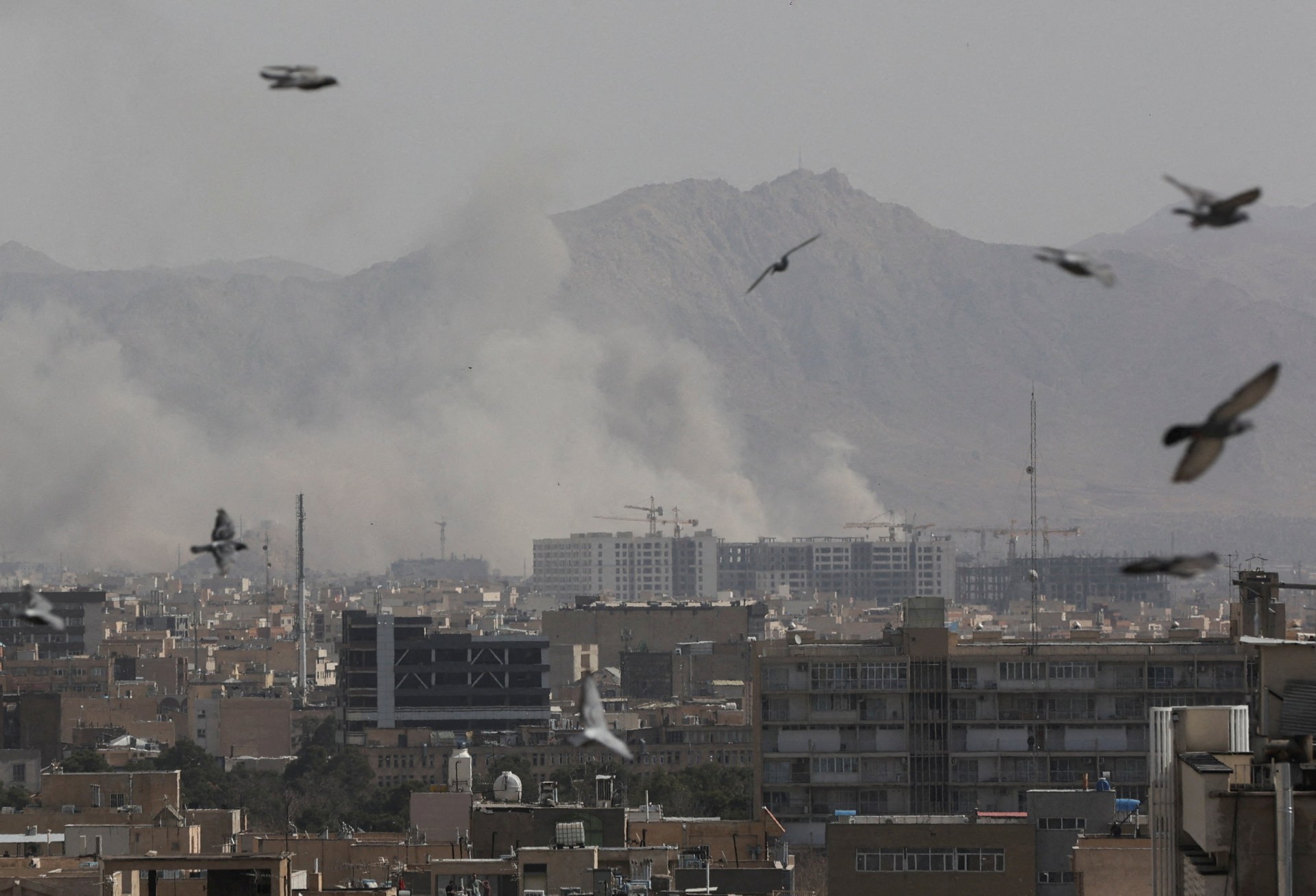
Smoke rises following an explosion, after Israel and the United States launched strikes on Tehran, Iran, on February 28, 2026.Majid Asgaripour/WANA (West Asia News Agency)/Reuters
TYPE
Interstate War
IMPACT ON U.S.
Critical
STATUS
Worsening
Related
Iran
Israel
United States
Updated September 11, 2026
RelatedIran•Israel•United States
Updated September 11, 2026
Overview
In February 2026, the United States and Israel attacked Iran, killing Supreme Leader Ali Khamenei and targeting nuclear and military infrastructure. A Pakistan-mediated ceasefire and June MOU halted large-scale fighting, but both sides have since traded strikes over alleged violations. A durable settlement remains elusive, with core disputes over Iran’s nuclear program, the Strait of Hormuz, and sanctions relief unresolved.
Smoke rises following an explosion, after Israel and the United States launched strikes on Tehran, Iran, on February 28, 2026.Majid Asgaripour/WANA (West Asia News Agency)/Reuters
United States Announces Sanctions Targeting Iranian Airline Operations
U.S. Treasury Secretary Scott Bessent announced that the United States would sanction businesses providing logistical support to Iranian airlines including airports, fuel, and ticketing (Al Jazeera).
This follows the passage of the Lindsey Graham Act over the weekend, which included provisions to prolong sanctions against Iranian energy exports and weapons manufacturing (BBC).
Iran Sparks Fears of Renewed U.S. Campaign
Tehran claimed to have received intelligence that Washington was planning a new bombing campaign; the Islamic Revolutionary Guard Corps warned that such action would make all U.S. bases and interests in the region targets of “continuous, effective, and painful attacks” (Guardian).
U.S. President Donald Trump, meanwhile, told Fox News he was in “deciding mode” over next steps in the war (Fox News).
Unidentified Projectile Strikes Second Oil Tanker in the Strait of Hormuz
The UK Maritime Trade Operations center reported that an unidentified projectile hit a second tanker, causing it to catch fire while transiting the Strait of Hormuz (Al Jazeera).
The Islamic Revolutionary Guard Corps claimed it struck a Togo-flagged ship attempting to cross the Strait of Hormuz (CBS).
As part of its blockade of the Strait of Hormuz, U.S. Central Command stated they have redirected over one hundred commercial ships traveling to and from Iranian ports (U.S. Central Command).
Trump Weighs Escalation in Iran Ahead of Meeting with Regional Leaders
In comments made to Axios, U.S. President Donald Trump said he needs to decide whether to “annihilate” the Iranian regime; his statement comes ahead of a planned meeting next Tuesday with leaders from Bahrain, Kuwait, Oman, Qatar, Saudi Arabia, and the United Arab Emirates on the sidelines of the UN General Assembly (Axios).
A UN fact-finding mission said it had “grounds to believe” that the U.S. military had struck a school and a sports facility in February—and that those actions could have been war crimes (CBC).
Unknown Projectile Hits an Oil Tanker in the Strait of Hormuz
The UK Maritime Trade Operations center reported that a fire broke out on the ship after being struck by the projectile over the weekend (CNN).
Omani authorities reported that two sailors are missing following the incident; the Iranian Revolutionary Guard Corps claimed the ship hit a naval mine, although U.S. Central Command claimed it was hit by an Iranian drone (BBC).
History of Iran’s Nuclear Program
Iran has pursued a nuclear program since at least 1957, with periods of significant interruption. Spurred by security concerns from its war with Iraq, Iran is believed to have decided to pursue nuclear weapons as early as the mid-1980s. Throughout the 1990s, Iran pursued agreements with China and Russia to advance the program. In the summer of 2002, the National Council of Resistance of Iran, an umbrella organization made up of Iranian dissident groups, exposed the existence of two Iranian nuclear sites that were hidden from the International Atomic Energy Agency (IAEA).
By 203, diplomats launched an intensive effort to halt Iran’s nuclear program. Iran agreed, insisting only on keeping its centrifuges for nuclear energy. However, it did not follow through on its commitment to transparent reporting and continued covert activities, leading to a June 2004 rebuke and a September 2005 finding of non-compliance by the IAEA, paving the way for a future referral to the UN Security Council (UNSC). In 2006, the UNSC adopted Resolution 1696, the first legally binding call for Iran to suspend its uranium enrichment program. Over the next few years, the UNSC adopted a series of resolutions imposing crippling economic sanctions on Iran for its failure to suspend its enrichment-related activities.
Between 2011 and 2015, the compounding effects of international sanctions led Iran’s economy to contract by 20 percent and unemployment to rise to 20 percent. In 2013, Hassan Rouhani, a noted pragmatist, won Iran’s presidential election, campaigning on a promise to lift sanctions and restore the economy. Over the next two years, the United States convened several rounds of bilateral talks and led the other P5+1 coalition members—China, France, Germany, Russia, and the United Kingdom—in negotiations with Iran’s new leadership. These efforts culminated in the adoption of the Joint Comprehensive Plan of Action (JCPOA) in 2015. Once key parties signed the agreement, the UNSC approved UN Resolution 2231, paving the way for sanctions relief.
The JCPOA required Iran to reduce its stockpile of enriched uranium by 98 percent for fifteen years, cut the number of operating centrifuges by two-thirds for ten years, and provide inspectors access to enrichment facilities within twenty-four days if the IAEA suspects violations. Moreover, if the IAEA confirmed violations, the JCPOA allowed for the immediate reinstatement of sanctions. After the JCPOA entered into force on January 16, 2016, Iran received sanctions relief totaling nearly $100 billion. However, Iran continued to develop ballistic missiles, which, according to the United States, violated UN Resolution 2231.
Iran’s Regional Proxies
Although the JCPOA limited Iran’s nuclear ambitions, its regional ambitions continued to grow. Iran persisted in arming and training Shiite militants through its Quds Force—the international arm of the Islamic Revolutionary Guard Corps (IRGC)—which has exacerbated sectarian divisions in the Middle East. Iran has provided years of military aid and training to the Palestinian militant group Hamas, which enabled its October 7, 2023, attack on Israel. The Quds Force has also provided advanced armed drones to Hezbollah in Lebanon, trained and funded more than one hundred thousand Shiite fighters in Syria, supplied ballistic missiles and drones to Yemen’s Houthis, and helped Shiite militias in Iraq build missile capabilities.
Because the JCPOA only addressed Iran’s nuclear program, and not its revisionism or ballistic missile programs, the first Trump administration withdrew the United States from the agreement in 2018 and reimposed sanctions, pledging to seek a more comprehensive deal. The sanctions triggered the worst economic crisis Iran had faced in forty years, cutting oil exports by more than half.
As the Trump administration pursued a maximum pressure strategy to bring Iran back to the negotiating table, Iran began contravening the JCPOA’s nuclear restrictions. Tensions escalated through mid-2019: the United States designated the IRGC a terrorist organization, deployed additional forces to the region, and blamed Iran for attacks on six oil tankers near the Strait of Hormuz. In June, Iran downed a U.S. Global Hawk drone, prompting a U.S. cyberattack and new sanctions.
Tensions peaked in early 2020 when the United States killed Quds Force commander Qasem Soleimani in a Baghdad air strike. Iran responded by abandoning its remaining JCPOA commitments and, while on high alert, accidentally shot down a Ukrainian passenger plane. Throughout the end of 2020, Trump continued imposing sanctions, while Iran further boosted uranium enrichment to levels after the assassination of a top nuclear scientist.
U.S.-Israeli Conflict With Iran
The October 2023 Hamas attack on Israel and subsequent war in Gaza triggered a regionwide escalation. In the months that followed, Iran-backed forces launched more than 170 attacks on U.S. and coalition forces in Iraq and Syria, prompting U.S. air strikes on two Iran-backed facilities in October 2023 and eighty-five more Iran-affiliated targets in February 2024. The Houthis in Yemen and Hezbollah in Lebanon—both part of Iran’s axis of resistance—simultaneously launched attacks from the Red Sea and Israel’s northern border with Lebanon, raising the prospect of a broader regional war.
In 2024, the Israel-Iran confrontation shifted from proxy-based hostilities to direct exchanges of fire. In April, an Israeli air strike on an Iranian consulate annex in Damascus killed two Iranian generals, prompting Iran to launch over three hundred drones and missiles at Israel—its first direct strike on Israeli territory. Following Israel’s killing of Hamas leader Yahya Sinwar and Hezbollah leader Hassan Nasrallah, Iran launched 180 ballistic missiles against Israel in October 2024. Israel responded with its largest-ever direct attack on Iran, targeting air defenses and missile production facilities. Coupled with the downfall of the Assad regime in Syria, the losses significantly degraded Iran’s axis of resistance.
Upon returning to office in 2025, U.S. President Donald Trump restored his maximum pressure campaign against Tehran while initiating the first direct U.S.-Iran nuclear talks since the collapse of the JCPOA. Israel, wholly opposed to the negotiations, launched a unilateral military strike against Iran on June 13—one day after the IAEA declared Iran in violation of its non-proliferation obligations for the first time in twenty years—targeting nuclear facilities, missile factories, senior military officials, and nuclear scientists. Iran declared the attack an act of war and retaliated by launching waves of drones and dozens of ballistic missiles. Despite having recently resumed nuclear negotiations, Trump voiced increasing support for Israel’s objectives and signaled openness to regime change in Tehran.
After a week of Israeli-Iranian exchanges, the United States directly intervened on June 21, striking Iranian nuclear sites in Fordow, Isfahan, and Natanz—making Trump the first U.S. president to attack another country’s nuclear program and the first to explicitly join Israel in an attack on an adversary. Although the Trump administration claimed the strikes significantly hindered Iran’s capacity to achieve weapons-grade uranium, the IAEA assessed that the program had been delayed by only a matter of months. Iran retaliated against U.S. forces stationed at the Al Udeid Air Base in Qatar on June 23; Trump announced a ceasefire later that day.
Meanwhile, widespread economic hardship and the collapse of Iran’s rial currency sparked massive anti-government protests in late December 2025. As unrest spread, the regime imposed a nationwide internet blackout, obscuring extreme violence against protestors. Estimates suggest the government’s crackdown killed over six thousand protesters, with more than seventeen thousand additional death reports under investigation.
Trump initially threatened military intervention if Iranian protesters were killed, but later backed away from immediate strike plans. Even as the United States conducted the largest military buildup in the Middle East since the 2003 invasion of Iraq, it continued nuclear talks with Iran.
When Tehran would not accede to U.S. demands to end all nuclear enrichment activity, the United States and Israel attacked Iran on February 28, 2026. Trump stated the war goals were to destroy Iran’s ballistic missile capabilities, eliminate its navy, prevent Iran from ever acquiring a nuclear weapon, and sever its support for proxy forces. Trump also called for regime change, encouraging Iranians to seize control of their government. Large-scale strikes targeted Iranian military assets and the Islamic Republic’s top leadership, killing Supreme Leader Ayatollah Ali Khamenei. Tehran’s Assembly of Experts appointed Ali Khamenei’s son, Mojtaba Khamenei, to succeed him.
Iran retaliated by launching missile and drone strikes against U.S. military facilities in Bahrain, Jordan, Kuwait, Qatar, and the United Arab Emirates, as well as against Israel and Gulf states’ energy and civilian infrastructure, including airports and oil facilities. Israel, in turn, launched a military offensive into southern Lebanon, displacing hundreds of thousands of people, after Hezbollah fired rockets at Israeli territory for the first time in over a year.
The attack quickly escalated into a regional war with widespread ramifications for critical supply chains and humanitarian aid. Iran’s effective closure of the Strait of Hormuz—one of the world’s most significant oil and natural gas chokepoints—has caused a global energy shock. The United States responded by imposing a naval blockade of Iranian ports.
Although complete casualty figures do not exist, the Human Rights Activists News Agency (HRANA) has documented 1,701 civilian deaths in Iran. A U.S. strike on an Iranian elementary school killed at least 175 people, and up to 3.2 million have been displaced. Thirteen U.S. service members have been killed.
The United States and Iran reached a two-week ceasefire on April 7, but continued to intermittently trade strikes. On June 14, the United States and Iran agreed to an interim deal mediated by Pakistan that included reopening the Strait of Hormuz, an end to fighting between Hezbollah and Israel in Lebanon, and a cessation of hostilities for sixty days. Both sides have accused each other of violating the agreement’s terms, and the prospect of a comprehensive settlement remains uncertain. Iran has continued to attack merchant ships in the Strait of Hormuz, and the United States accuses it of delaying follow-on discussions regarding the future of its nuclear program, whereas Iran blames the United States for failing to ensure a ceasefire and Israeli withdrawal in Lebanon.