Washington’s Missile Shortage, With Michael Horowitz
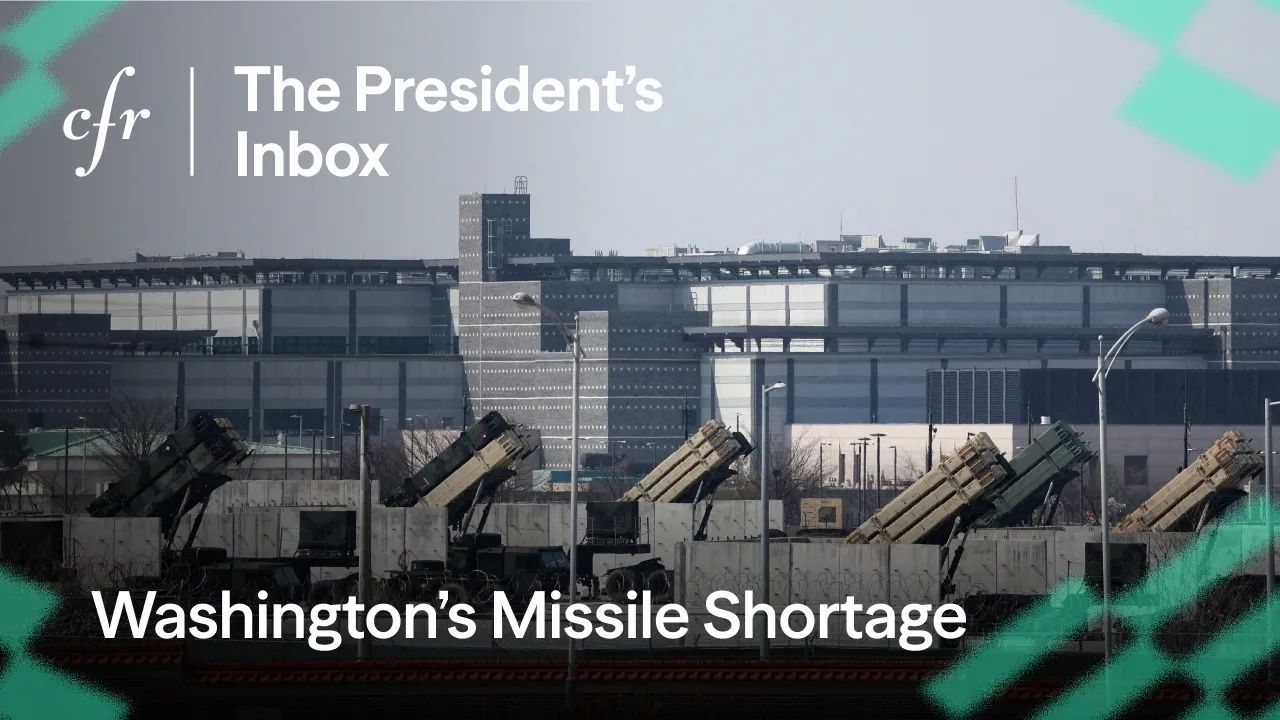
This episode unpacks reporting on U.S. munitions stockpiles are dangerously low and lays out the consequences of the shortage both for Washington’s ongoing war with Iran, and for its deterrence of adversaries.

Published
Host
 James M. LindsayCFR ExpertMary and David Boies Distinguished Senior Fellow in U.S. Foreign Policy
Guest
 Michael C. HorowitzCFR ExpertSenior Fellow for Technology and Innovation and Director of the Defense and National Security Program
[Video: https://youtu.be/zs4_0tdExwY?si=i5wuOdYkqAquGKf7]
TRANSCRIPT
HOROWITZ:
I think there’s real risk for the United States. You never want an adversary to wake up and say, hey, today’s the day. Today’s the day we think we can pull off this act of aggression because the United States doesn’t have enough to stop us.
LINDSAY:
The war in Iran has depleted the stocks of many critical, high-tech U.S. weapons.
CBS NEWS:
A new analysis finds the conflict is taking a toll on the Pentagon’s munitions stockpile.
LINDSAY:
Earlier this month, shortages of offensive and defensive weapons reportedly prompted President Donald Trump to call off a major attack on Iran. The munitions crisis is also raising questions about the ability of the United States to deter conflicts elsewhere in the world.
TAIWANPLUS NEWS:
A U.S. military official says Washington has paused arms sales to Taipei amid concerns over ammunition stockpiles due to the Iran war.
LINDSAY:
Why does the Pentagon depend so heavily on weapons that are so difficult to build and costly to replace? Is there a quick fix to replenish U.S. stockpiles? And if not, will U.S. adversaries view this moment as an opportunity for action to advance their own agendas? From the Council on Foreign Relations, welcome to the President’s Inbox. I’m Jim Lindsay. Today, I’m joined by Michael Horowitz, Senior Fellow for Technology and Innovation and Director of the Defense and National Security Program here at CFR.
Mike, thank you very much for coming back on the President’s Inbox.
HOROWITZ:
Thanks so much for having me, happy to be here.
LINDSAY:
So Mike, the newspapers have been full of stories in recent weeks about the depletion of American military stocks. Do the news stories have it right? Are we actually seeing a significant rundown of high-tech missile interceptors and offensive strike weapons?
HOROWITZ:
Unfortunately, the newspapers, not wrong in this case, Jim. The drawdown of America’s advanced weapons inventory, both on the offense and defense, has been substantial. The roots of this go back decades, and we can get into that however much you want, but the U.S. is reportedly now down to between 200 and 300 THAAD missile defense interceptors, less than 1,000 Patriot missile interceptors, the Tomahawk inventory, the main cruise missile that the U.S. military has used for decades, now below about 2,000. I mean, this is a really substantial drawdown in America’s capabilities and reflects in many ways a reliance of the United States over the last few decades, almost exclusively on exquisite, expensive, hard-to-produce weapons. That’s the entire inventory, and that’s being drawn down quickly.
LINDSAY:
Okay, so help me out here, Mike, because my guess is most people don’t walk around with encyclopedic knowledge of the various weapons in the U.S. arsenal. So just sort of go through and sort of break them in, I guess, two buckets for me, which are defensive weapons designed to shoot down other missiles, and what are offensive weapons? And give me some sense, if you can, of what the production lines are for these weapons.
How long does it take to build them?
HOROWITZ:
So for defensive weapons, imagine defending an American military installation or ship starting with the last line of defense out. The last line of defense, say, for a U.S. Navy ship is actually the Phalanx system, essentially an enormous Gatling gun. And a lot of those, a lot of things you can fire, not that expensive to fire them, but not very long range at all.
The workhorses of American missile defense, both for the United States and its allies and partners over the last decade or two have been the Patriot Missile Defense Interceptor, and then the THAAD system, the Theater Altitude Missile Defense System. And the production rates for THAAD have generally been less than 100 a year for the Patriot. The U.S. has wanted slightly more than 100 a year, but every year, essentially, industry has delivered more or less, fewer than were ordered. And now all of a sudden, of course, the administration is like pushing the go button, like now we need a lot more of these, but it’s not quite so simple. These systems were designed to be complicated. They’re designed to be the best in the world and were designed to intercept advanced Soviet and then Russian and Chinese or North Korean sorts of missiles.
They cost multiple millions of dollars each and can take a couple of years to produce each in some cases. And so when the U.S. is firing those often against $50,000 Shahed 136s that Iran is firing, what that leads to is this enormous drawdown situation. One report, for example, suggests that Saudi Arabia has used 86% of its Patriot missile arsenal since the war started.
And in almost all of those, the cost exchange ratio is favoring the offense because it’s been so much cheaper for Iran to produce these offensive strike weapons than for the U.S. and its allies and partners to defend.
LINDSAY:
Mike, I wanna get back to this cost exchange ratio because quite honestly, as you talk, imagine that you would spend a million dollars to shoot down a $50,000 weapon. Sounds, how should I say, suboptimal, as economists might put it. But let’s just sort of do a little bit more on sort of the problem side.
So you’ve talked about the missile interceptors that have been depleted. I’m hearing that or reading that the ATACMS missile system and the Precision Missile System, which are offensive weapons, have also been depleted. I’ve seen some stories suggesting that those arsenals have been nearly exhausted.
Help me understand what those weapons do.
HOROWITZ:
So couple things in this context. So ATACMS and the Precision Strike Missile are both army systems. So those are ground-launched, those are ground-launched missiles that can go a certain range, in some cases, dozens to hundreds of kilometers, depending on what you’re attacking.
And they have been drawn down a lot. Now, the Precision Strike Missile just entered the U.S. inventory. So it’s not that surprising that you might now be in the double digits of Precision Strike Missile or even lower, given how few of them were in the arsenal to begin with.
ATACMS, in some ways, were thought of as very usable because they’ve been around for a long time. The issue in some ways here is how the United States is choosing to fight. The U.S. has lots of precision weapons, say, like Joint Direct Attack Munitions, essentially guided bombs that you could drop from airplanes. But those are thousands and thousands of them. But those JDAMs, you need to get an aircraft in position, essentially near over the target to be able to launch them, which exposes, then, American aircraft and pilots to a lot of risk, which means you avoid that by launching missiles sort of over the horizon or around the horizon that can go hundreds of kilometers. And it’s that inventory, whether we’re talking about Army ground launch systems like ATACMS or the Precision Strike Missile, whether we’re talking about Tomahawks launched from ships, whether we’re talking about JASSMs, whether we’re talking about LRASMs, the Long-Range Anti-Ship Missile, the inventories of all of these were not enormous to begin with and have been really drawn down by the war because they’re what has enabled the United States to fight without putting so many American forces at risk out front.
LINDSAY:
So let me make sure I understand this, Mike. What you’re really saying is that the United States has depleted stocks of high-tech standoff weapons that allow it to fire from long distance. The United States still has ample amounts of, let’s say, more ordinary, more conventional munitions, whether they’re gravity bombs or artillery shells, mortar and the like.
This is a problem with a specific subset of the U.S. arsenal, correct?
HOROWITZ:
It’s not, yes, yes and. The yes and, it’s not just sort of gravity bombs, artillery shells. It’s also lots of guided, very precise weapon systems.
They’re just very precise weapon systems with relatively shorter ranges. And it’s not like the United States is totally out of schlitz here. There’s still an inventory of Tomahawk missiles, of JASSMs, LRASMs, et cetera.
The issue is how long it’s traditionally taken industry to build them and what the relative unit cost of them is compared to sort of what they’re being, compared to what they’re being fired against.
LINDSAY:
Okay, now Mike, the Trump administration has variously argued that the United States does not face a critical munition shortage or has argued that manufacturers are gonna speed things up and solve the problem very quickly. But President Trump himself has also said, to the extent there’s a problem, it’s because of the Biden administration, that the Biden administration gave too many high-tech U.S. weapons to Ukraine. What do you make of that argument, that this is not a problem created by Operation Epic Fury, but of the policies of the prior administration?
HOROWITZ:
This is not just an Operation Epic Fury problem, and it has very little in some ways, in my view, to do with Ukraine per se. The problem with the American system here when it comes to weapons arguably goes back to the early 1990s in the Clinton administration. The U.S. made a number of decisions at that point, for very rational reasons, it seemed, given the security environment, to consolidate America’s defense industry and to continue to invest in quality systems over quantity systems. Like, that makes sense, right?
LINDSAY:
You’re talking about Les Aspin’s famous last supper dinner?
HOROWITZ:
Yeah, last supper meeting, for example. The last supper for those that aren’t paying attention to this every moment, essentially. The then-Defense Secretary Aspin gets a bunch of defense industry executives in a room together, and says, like, hey guys, the defense budget’s coming down.
You might wanna make some choices based on that. And indeed, the U.S. was trying to reap a peace dividend after the Cold War with the Soviet Union. An effect of that was a lot of consolidation in the defense industry that made the American military essentially dependent on sole suppliers.
Well, if you combine that with a general tendency to prioritize these exquisite, expensive, hard-to-produce systems, like maximizing quality at the expense of quantity, the U.S. designed, essentially, a generation of weapons systems that were never supposed to be produced at scale, which then leads to the situation that the United States is in today, where the U.S. now needs a lot more, but the kinds of things that the U.S. has been producing for decades were never designed to be produced quickly at that amount of scale.
And so, were there weapons given to the Ukrainians? Absolutely. Were those, are those numbers decisive in thinking about the American military arsenal?
Probably not, but the roots of this go, like, way back and frankly cover decisions made by every administration since the Clinton administration, especially because the munitions are often what’s called a bill payer when it comes to the defense budget. And by that, what I mean is when the U.S. military is deciding, all right, do we give the troops a pay raise? Do we buy this new fancy platform?
Or do we, like, buy some missiles? Missiles have generally been dropped at the expense of, like, very good things, like, hey, pay the troops more, or, you know, buy more submarines, or do something like that. But what that means is then the stockpiles of all those missiles are a lot smaller.
LINDSAY:
Technical question here, Mike. I understand that right now, production of many of these systems is relatively slow. I think it was, it’s like 96 a year is current pace.
And there’s a lot of talk about speeding things up. I’ve heard a number of press releases from the Department of Defense about signing so-called framework agreements with various defense contractors to produce more. How quickly can this production be ramped up?
And what are the sort of the choke points? I’ll go back a couple, I guess, last year when the Chinese basically put the kibosh on the export of rare earth minerals. Read a spate of stories about how that was gonna cripple the U.S. military because so many of these weapons systems depend upon rare earths. So to what extent is, we simply don’t have enough plants, we don’t have enough material. These things are just too complicated to operate because you need high-tech personnel. What explains the delay?
HOROWITZ:
I mean, these delays eventually start with rare earths and go all the way down to the end of production. So you have some material inputs issues with some of the dependencies on China that you’ve mentioned. You also have, because of this defense industry consolidation over time, real choke points when it comes to what are called tier two and tier three suppliers.
Say the suppliers of the parts that you need to make a solid rocket motor, or the suppliers of the parts that you need to make an advanced gyroscope, or the supplier of the parts that you need to make sort of X, Y, and Z. It’s those suppliers also were consolidated along with the big defense industry companies that folks maybe have heard of like Lockheed, Boeing, et cetera, et cetera. And you put all of those things together.
And what it means is that even if you, you could order a thousand Patriot missiles from Lockheed, but that doesn’t mean that Lockheed’s capacity to build Patriot missiles has fundamentally changed. Now, one thing the defense industry, what defense industry can do is if you have say, five supply lines, and you could decide to maybe allocate more of them to one weapon over another weapon. The issue is that if you have a company, and because of that industry consolidation in the same company is making, say, your long range anti-ship missile and your joint standoff missile and your Patriot defensive missile, and they only have a certain number of supply lines, then you can only rob Peter to pay Paul so many times in that context.
And it really limits how well you can do that in improving. And this then gets back to some of those industrial constraints, IP issues surrounding these weapons. I mean, it’s tough.
And the root of it though goes back to the fact that when you have an arsenal exclusively based in difficult to manufacture inexpensive systems, it limits your trade space.
LINDSAY:
Okay, just so I make sure I understand this then, what I hear you telling me, Mike, is that this bottleneck exists. There are a lot of factors that account for it. In opening up that bottleneck, getting rid of that choke point to make meaningful progress in terms of the number of these very expensive, very exquisite weapons is gonna take some time and a lot of money, correct?
HOROWITZ:
Absolutely. There are options for kinds of systems that you could produce potentially at lower cost, and we can get into that if you want, but those are just different kinds of systems. You can increase things like Patriot missile production.
You can increase production of any of these kinds of systems, it’s just gonna take time. And frankly, it’s an untested hypothesis how much you can scale them given again that they were never designed to be produced at scale in the first place.
LINDSAY:
Okay, you’ve laid out for me, Mike, why the Pentagon chose the 1990s to choose this strategy of emphasizing exquisite, expensive weapons. That was for a world in which the US was the hyper power, the unchallenged superpower. It was a world in which geopolitics had died.
But it’s been at least eight years since essentially President Trump in his first term said, the holiday from history is over, we face geopolitical challenges, we have to react to it. So I guess my question is, that’s eight years on, nine years on, why is it that the Pentagon strategy seems not to have changed all that much?
HOROWITZ:
Because an aircraft carrier can’t turn on a dime. And the Pentagon’s, I mean, there are a couple of interrelated reasons here. One is that America’s weapon systems individually are generally the best in the world.
Like caveat there about some Chinese or some specific Russian capabilities, but like put that aside, put that aside for a second. And so when US capabilities are already the best in the world and you’re trying to modernize them, it’s hard to maybe think about like how to shift away from that, so that’s point one. Point two is because these systems are so expensive and exquisite, it’s really hard to increase your inventory, increase your inventory of them, especially when munitions are competing with other things within the budget, like platforms, like the troops, like maintenance for systems, all sorts of other things that the military has to pay for.
And in a world of limited budgets, there are always going to be trade-offs. And I think one of the big challenges here is like everybody, and frankly, the first Trump administration was right about the return of great power competition and specifically about the severity of the challenge that the United States faces from China in all domains, including in the military domain. But the agreement on that doesn’t necessarily tell you exactly how you want to like spend your defense dollars.
And the focus has often been on how do we improve these platforms? How do we get the next system? Not sort of how do we max inventories?
Because the model was efficiency, and maxing inventories isn’t efficient. That’s not just-in-time manufacturing. That’s not the way that we’ve generally thought about manufacturing in the world.
But if you’re planning to fight wars that might last a while, then you need much larger inventories. It’s all about the kind of conflict you’re planning for.
LINDSAY:
So right now, Congress has before it a defense supplementary bill, I think for $67 billion. President has requested for fiscal year 27 a plus up of something on the order of 42, 44% in spending. Is that money intended simply to basically replicate the existing choice set or to make a different set of choices going forward?
Because I want to come back to this question about the cost exchange ratio, which still strikes me as uneconomical and unsustainable. And generally things that aren’t sustainable don’t get sustained.
HOROWITZ:
So actually at the council, we have a study group report that’s coming out this week from a defense industrial-based study group that we’ve been running that looks at the possibilities for what you could do to the defense industrial base over a two-year period. And the study group concludes that scaling precise mass is in some ways your trade space if you want to do this quickly. With precise mass being lower cost systems, more based in commercial manufacturing, leveraging more AI, leveraging more AI and autonomy.
Think like our version of Iran’s Shahed 136, which is called the Lucas, much less expensive air defense systems, systems based more on some of the lessons learned that might be relevant from places like Ukraine, given what they’ve managed to do against Russia. Essentially systems that are less expensive and less exquisite and that are built to scale from the beginning. In some ways that is where your trade space is if you want to move in the next couple of years.
And the Trump administration to its credit has put some real money behind these systems, which they did originally in the one big, beautiful bill that passed last year. There’s been a challenge though in some ways for a bunch of internal baseball bureaucratic reasons, like getting that money on contract, getting it moving, et cetera, and putting more money toward it in some ways than is necessary but not sufficient for actually fielding those capabilities. And now if you connect that to the bigger defense budget discussion that’s been happening, the Trump administration macro, in addition to the supplementals, has requested this $1.5 trillion budget. 1.15 of it would be a sort of regular defense authorization and then appropriation. 350 billion of it would be through reconciliation, that partisan process that brought us the one big, beautiful bill act. And that money, some of it is to backfill the American military capabilities that have been drawn down in the context of the war.
Some of it is potentially to scale some of these precise mass capabilities that this report by the authors representing some of the conversations we had in the study group revealed. Some of it’s for other Trump administration defense priorities like the Golden Fleet, the Golden Dome system, like other types of, other Trump defense priorities.
LINDSAY:
So Mike, how open is the Defense Department to making these sort of changes? And I ask because there are at least two arguments I hear quite frequently. One is that the acquisition procurement system of the U.S. government for the Pentagon is basically death to innovation. It’s very, very hard for startups, companies not already in the defense space to basically be able to compete and sell to the services. The other thing I often hear is that there’s a bit of not invented here attitude in the Pentagon. There were a flood of stories when Operation Epic Fury first began that the Ukrainians had volunteered to provide the U.S. military with advice on drone war, both how to use them and how to defend against them. And the response for the Trump administration was, now we don’t need your help. So help me understand to what extent the United States has its own problem here.
HOROWITZ:
I think the United States is frankly its own worst enemy sometimes when it comes, not to innovation, which the United States excels at, but to innovation adoption. And that is for a variety of interlocking reasons, some of which have to do with acquisition processes and rules, but some of them have to do with a deeper philosophical commitment to, I mean, in some ways making the good, the enemy of the perfect to reverse the old saying in that what I mean by that is the assumption baked into the acquisition system is that the U.S. will always have a technological edge over the rest of the world. And that technological edge will deliver victory for the United States.
And because of that, the system is biased on purpose in favor of being very slow and deliberate to get outcomes in systems that will, that are designed to last decades and that we assume will be the best. And so you’d always essentially rather go a little bit slower if it gets you that thing that you could use for decades. The challenge is that if what you’re trying to do is integrate emerging technologies and fast changing technologies to buy or build systems that you might only use for years as opposed to decades, then you might think about doing that very differently.
And the Trump administration frankly deserves credit for implementing a series of acquisition reforms that are bolder than what the Biden administration did to be totally transparent. And that should over time potentially accelerate the ability to integrate emerging capabilities faster. Again, if the military services choose to do so, if that’s what they want to invest in, et cetera.
But getting that engine going requires like stripping away years and decades of institutional bias kind of against going fast and like against the 85% solution. Whereas if you want to get capabilities out the door faster and especially with some of these new relatively unproven firms, we’re never gonna find out whether they can scale capabilities until we give them a shot at it. But that requires being willing to take more risk and being willing to take more risk with taxpayer dollars.
LINDSAY:
Let me ask you about that, Mike. Is part of the problem that the Pentagon has too much money? I mean, when I talk about the sustainability of sort of American military strategy, I’ll just note the United States public debt about to touch $40 trillion.
We’re running a $2 trillion budget deficit right now on an annual basis. That seems to be something that is unsustainable. And the Pentagon seems to be banking that it’s always gonna have very deep pockets.
And that perhaps the Pentagon may be better off if its budget were shrunk and it was forced to really innovate, where you say necessity is the mother of invention.
HOROWITZ:
So it’s a great question. I’m actually starting a project looking almost exactly at some of that. I think that the challenge is that in theory, like economic theory, as much as anything, scarcity through austerity should drive innovation because you have no choice to be more efficient.
So in that context, one would imagine then that say, like if your goal is then to maximize innovation, that something like defense budget cuts might deliver you there.
LINDSAY:
And if you wanted to- Well, Ukraine seems to be a great example of innovation by desperation.
HOROWITZ:
And if, well, innovation by desperation is different than innovation under austerity. And if you wanted to make the argument for innovation at lower budgets, you in some ways would make this argument based on the interwar period, both in the United States and in other countries. And all the innovations- Which interwar period?
LINDSAY:
Just so I got my wars straight.
HOROWITZ:
Interwar period between World War I and World War II. All of the innovations in carrier warfare, tank warfare, et cetera, that in some ways come during these periods where budgets have really been… We’re banning war, like don’t worry about it.
The challenge for the United States today is that the United States military is out and about operating constantly and is likely to be out and about operating constantly even at a lower defense budget level. So while in theory, austerity can lead to innovation through prioritization, the reality is that austerity can choke innovation in the present condition because it leads to a bias in favor of readiness and proven legacy capabilities, which means you just get that exquisite, expensive, hard to produce force, just less of it under defense budget cuts, unless you’re really careful about how to maximize innovation adoption.
In some ways, you get the wrong form of prioritization rather than innovation, I think is the risk in a condition of defense budget cuts. But I think you’re absolutely right to point to the fiscal environment and say like, it might change from where we are today.
LINDSAY:
Well, on that score, perhaps if I’m reading you correctly, one of the ways to create space for the US military is to lower the operational tempo at the moment so that you’re not stuck in this trade-off between I wanna fund innovation for the future, but I need to build stuff so I can maintain my operations today.
HOROWITZ:
Incredibly difficult to do for the United States given the treaty ally relationships, extended deterrence requirements, even just the steady state things that the United States does. You could, even if the war in Iran drew down and say like operations in Southern Command drew down, you’d still have this operational tempo for the American military. That would be pretty high due to say the Navy’s commitment to command of the seas, some of those kinds of things that would still make this very challenging.
Certainly like whatever breathing space you can get, again, in theory then allows you to prioritize in favor of emerging capabilities a little bit more because you have the space to do so. In reality, it’s a lot, it’s a little more complicated than that for reasons that I think you would well understand from some of the research and writing that you’ve done over the years on the interaction between Congress and the executive branch on some of this. And that it’s not just, we can do, we can blame say like the generals or admirals all we want for being focused on the status quo over potential future capabilities, but that’s also a feature of the appropriations process when Congress edits the defense budget at $1,000 level as well.
And figuring something out there will be absolutely essential regardless of what the Pentagon’s preferences look like.
LINDSAY:
The so-called Iron Triangle is a whole nother vein of discussion. I’m not gonna go down that right now, Mike, but I do wanna close on the question of how much you worry about the current drawdown in U.S. weapons stocks. I saw former Secretary of Defense Leon Panetta on the news yesterday, maybe the day before, and he expressed a great deal of concern that because the United States has interest globally, the fact that we are in a situation in which our weapons are being drawn down raises the potential that geopolitical rivalries, rivals will get up to mischief.
And I will note that as we’re talking right now on a sort of separate issue, the USS Abraham Lincoln is finally gonna be rotated out of the Middle East. Another U.S. aircraft carrier is gonna go and replace it. But now for the first time in decades, as I understand it, the United States will not have an aircraft carrier in the Western Pacific.
HOROWITZ:
I think there’s real risk for the United States. You never want an adversary to wake up and say, hey, today’s the day. Today’s the day we think we can pull off this act of aggression because the United States doesn’t have enough to stop us.
I think I might’ve said last time we had a conversation on defense issues that the sort of lights are flashing red when it comes to how the United States, the risk that the United States military is at in an era of general purpose technologies and massive kind of transformation. Like this is the kind of situation in which great power militaries like the United States struggle. Now add to that some of these munitions, some of these munitions shortfalls.
And I think that there’s real risk here. And the United States is gonna have some work to do in sustaining the credibility needed to maintain deterrence. I think, especially in the Pacific, given the way that like every presidential administration comes in and is like, oh, the Pacific, that’s the future.
That’s our priority.
LINDSAY:
And everyone gets like drawn back into the Middle East, like drawn- Well, we have the reverse pivot happening right now, it seems.
HOROWITZ:
And, you know, this is a huge challenge and you don’t want a situation in which an adversary, whether China or somebody else wakes up and thinks that today can be the day.
LINDSAY:
Are there any quick solutions to that problem?
HOROWITZ:
I mean, there are no easy choices. As this report that I mentioned is gonna suggest when we release it later this week, scaling precise mass capabilities from a bang for the buck perspective offers, I think, the ability to revitalize capabilities, not just in the Pacific, but elsewhere within a two-year timeframe, which you could potentially do while advances in some of your more exquisite, expensive systems are like cooking in the background. And while you’re trying to do fixes to rebuild the submarine industrial base, some of those kinds of things that there’s bipartisan support for, but there’s not really a way to pull this off, I think, in terms of maximizing conventional stockpiles in the short term without a real investment in precise mass.
LINDSAY:
On that note, I’ll close up the President’s Inbox for this week. My guest has been Michael Horowitz, Senior Fellow for Technology and Innovation and Director of the Defense and National Security Program here at the Council on Foreign Relations. And I should also note a professor at the University of Pennsylvania, go Quakers.
Mike, thanks for coming on.
HOROWITZ:
Thank you very much.
LINDSAY:
Today’s episode was produced by Justin Schuster with Head of Production, Jeremy Sherlick, Senior Video Producer, Grace Raver, and Director of Podcasting, Gabrielle Sierra. Research assistance was provided by Jack Patton.
We Discuss:
- Whether news reports of a serious depletion of U.S. high-tech weapons stocks are accurate, and how far inventories have been drawn down.
- The distinction between defensive interceptors, such as Patriot and THAAD, and offensive standoff weapons, such as Tomahawks and ATACMS, and how long each takes to produce.
- How the roots of the munitions crisis trace back to decisions in the 1990s—including the “Last Supper” defense industry consolidation—that prioritized quality over quantity.
- Why President Donald Trump’s argument that the shortage stems from Biden-era weapons transfers to Ukraine misses deeper structural causes.
- How chokepoints—from Chinese rare-earth dominance to consolidated tier-two and tier-three suppliers—make ramping up production slow and costly.
- Why the Pentagon has been slow to shift its acquisition strategy despite nearly a decade of warnings about renewed great power competition, and how “not invented here” attitudes compound the problem.
- Whether budget austerity would spur innovation or choke it, and how “precise mass” could revitalize U.S. capabilities within a two-year window.
- How much the current drawdown threatens deterrence at a moment when the United States is left without an aircraft carrier in the Western Pacific.
Mentioned on the Episode:
Rush Doshi, Erin D. Dumbacher, William Henagan, Michael C. Horowitz, and Samuel Lazarus, “Out of Ammo: A Two-Year Sprint to Rebuild the American Arsenal and Deter China,” Council on Foreign Relations
“One Big Beautiful Bill Act (H.R.1),” U.S. Congress
Michael C. Horowitz, “Battles of Precise Mass: Technology Is Remaking War—and America Must Adapt,” Foreign Affairs
Erin D. Dumbacher, Michael C. Horowitz, and Lauren Kahn, “Will Trump’s ‘Big Beautiful’ Defense Spending Last?” Council on Foreign Relations
This work represents the views solely of the host(s) and guest(s). The Council on Foreign Relations is an independent, nonpartisan membership organization, think tank, and publisher, and takes no institutional positions on matters of policy.
Associate Producer, Video and Audio
- Associate Producer, Video and Audio
Head of Production
- Director of Video
Editorial Director and Producer
- Director, Podcasting
More Episodes
 33:42Podcast
 36:05Podcast
 41:07Podcast
 39:26Podcast
 35:04Podcast
 31:46Podcast