China’s $735B Trade Surplus + How Beijing Masks Its Holdings + The G7 Debates Global Imbalances
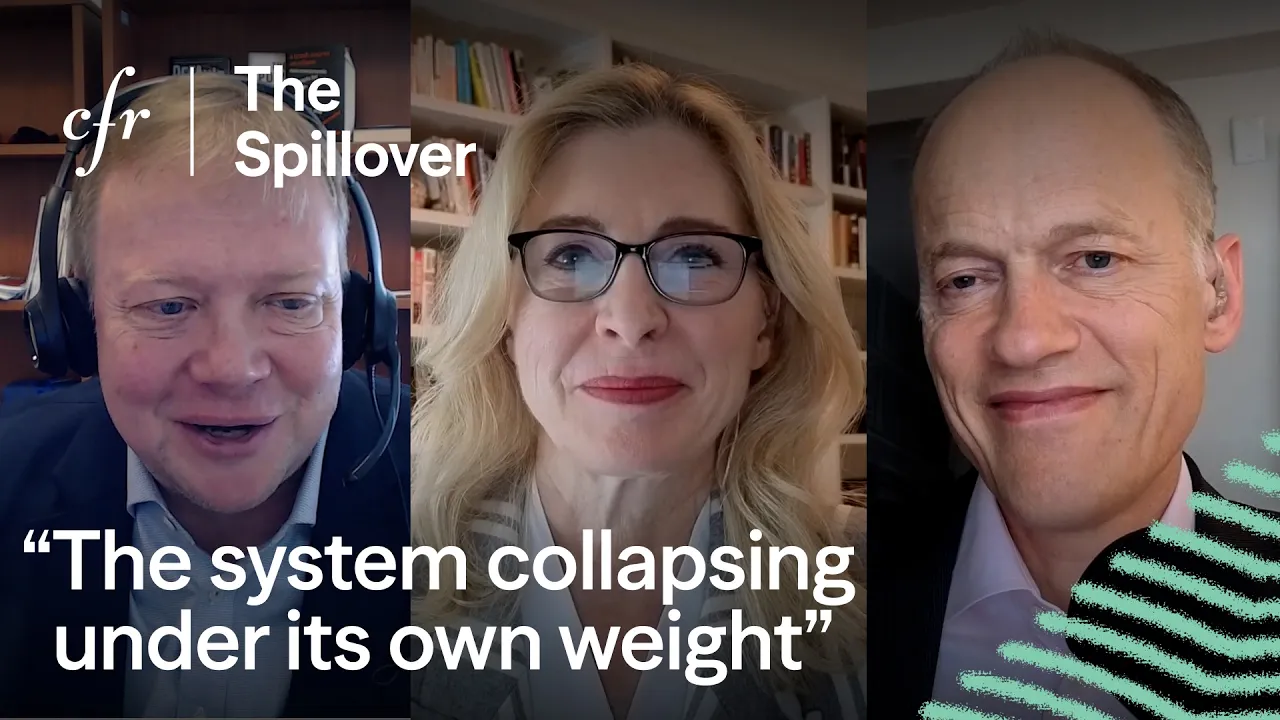
This episode unpacks why the trade and investment imbalances between the United States and China have grown to record levels despite years of pressure to correct them, and how the imbalanced system looks increasingly likely to collapse under its own weight.

Published
Hosts
 Rebecca PattersonCFR ExpertSenior Fellow
 Sebastian MallabyCFR ExpertPaul A. Volcker Senior Fellow for International Economics
Guest
 Brad W. SetserCFR ExpertWhitney Shepardson Senior Fellow
[Video: https://youtu.be/nsHgtD6410s]
Transcript
This transcript was generated using AI and may contain errors.
PATTERSON:
For years, U.S. leaders have complained that China manipulates its currency to boost its exports, resulting in the Chinese state accumulating trillions of dollars worth of foreign assets and distorting the world economy.
MALLABY:
This U.S. pressure seems to have achieved just about nothing in 2025. China’s current account surplus, that’s the trade surplus with a few adjustments, was the largest it’s ever been measured in terms of global GDP.
PATTERSON:
So why should we care about this? And is there anything we can do about it?
MALLABY:
We talked to our CFR colleague, the world guru on this subject, Brad Setser, who will help us figure out what’s going on.
PATTERSON:
I’m Rebecca Patterson.
MALLABY:
And I’m Sebastian Mallaby.
PATTERSON:
And this is The Spillover.
MALLABY:
So Rebecca, where are you this week?
PATTERSON:
Well, I’m in New York, but I’m about to head out. I have to go to Malvern, Pennsylvania for a Vanguard board meeting.
MALLABY:
So you’re heading out just as I arrived in New York, but I’m not taking you personally.
PATTERSON:
No, please don’t. Please don’t. And where did you come in from this time?
You have a different background than normal.
MALLABY:
Yeah, I’m the man of shifting backgrounds. I came in actually from Cambridge, Massachusetts, where I was having fun. I was watching my wife, Zannie, deliver a commencement address at the Harvard Kennedy School, which she herself attended maybe 30-something years ago.
And the funny thing is that, you know, there’s nothing like a commencement address to turn the most pragmatic, forward-focused individual into a sentimental nostalgic. So her speech was terrific, but so was interesting also with the effect on her personality.
PATTERSON:
I would be curious to have seen what that looked like, but maybe over a glass of wine sometime.
MALLABY:
All right. So anyway, we’re going to be talking about global imbalances of this episode. By this, we really mean the trade and investment imbalances between the United States and China.
PATTERSON:
Yeah, and it’s a really good time for the conversation, which is why Sebastian and I are doing it. There’s a G7, a group of seven meeting coming up in just a few weeks in Evian, France. And President Macron has made imbalances the focal point of this meeting.
And so I think we’re going to get more and more commentary in the media over the coming two weeks ahead of the meeting about the issue. And so we’re going to set the table today. Macron is painting imbalances as a broad issue and a big, immediate source of risk.
And I get it. You know, when you look around the world, there are a lot of countries with significant trade surpluses or deficits. Right now, South Korea and Taiwan are running big export surpluses as a percentage of their GDP.
And other countries like the UK have large deficits relative to their economies. But at the end of the day, we know that the U.S. and China are the two big elephants in the room on this front.
MALLABY:
Yeah. And we should say at the outset that there are certain ways you can look at these numbers, you can slice them different ways. And if you look at it in terms of the current account surplus of either the U.S. or China as a share of their GDP, they’re not actually at a record in that sense. So in 2025, the U.S. current account surplus was 3.6% of GDP, which is quite a bit below the 6.5% or so that you got just before the mortgage bubble imploded. And likewise, the Chinese surplus was 3.8% of Chinese GDP, which was a lot below the almost 10% that you had at the peak before the global financial crisis. But if you look at these numbers in a different way, in absolute dollar terms or as a share of the global economy, then these imbalances really are at a record.
So in 2025, in absolute dollar terms, the U.S. had a current account deficit of $1.1 trillion. That’s a smidge lower than 2024, which was the highest on record, but it’s still pretty high, very high. And then on the Chinese side, in 2025, the current account surplus came to $735 billion.
And that was a record. And it’s really worth actually emphasizing how much of a record that was. The previous record came the year before.
That was China’s current account surplus, which was $462 billion. And as I said, 2025, it goes up to $735 billion. So that’s a whopping jump of 59%.
And by the way, China’s surplus is more than twice as large as the highest ever surplus recorded by another country in all of financial history. So the runner up was Germany in 2018, which weighed in at $340 billion.
PATTERSON:
Yeah, China and the U.S. are definitely the elephants in the room. China, the world’s manufacturer and exporter, and the U.S., the world’s consumer, quite frankly. But there’s one other kind of definitional bit I want to just spend a second on here.
You know, you often hear about China’s trade surplus or the U.S.‘s trade deficit. And usually when people are talking about that, they’re just talking about goods. But really, we should be looking at trade in goods and in services and a few other adjustments.
And that makes up the current account. And then the flip side of the current account, of course, is the capital account. And the two of those things together are supposed to be in balance.
That’s the balance of payments. When we say capital account, we’re really just talking about financial flows. So things like equities, fixed income, frankly, foreign direct investment and M&A, if it’s cross-border, could also be part of the capital account.
Anyway, we’re going to try to stick to current and capital accounts in this episode, not just the trade of goods.
MALLABY:
Yeah. And of course, the two are connected. When China runs these very big current account surpluses because of the trade surplus, it’s accumulating a lot of foreign currency and has to park that foreign currency somehow somewhere.
So it starts buying up foreign assets. I remember a couple of early examples which made headlines in the U.S. One was back in 2013. China’s W.H. group paid just over $7 billion for Smithfield Foods, which is America’s biggest pork producer. And then the next year, Anbang Insurance from China weighed in with a purchase of the Waldorf Astoria Hotel, which is, of course, one of the most famous brands in America. And that really hit a sensitive spot. I remember President Obama refused to stay at the Waldorf Astoria during the U.N. General Assembly, breaking a longstanding tradition because he didn’t want to stay in a Chinese-owned hotel.
PATTERSON:
Well, I think there was a question of security and chips being planted in the chandeliers, etc. But yes, it was a break with tradition and controversial. And more recently, we’ve had more of this.
China’s been buying more consumer-friendly brands, less politically sensitive brands. But just two quick examples, Beijing’s Luckin Coffee acquired Blue Bottle. And then Everlane, which is a sustainable fashion brand, was just sold to Chinese fast fashion retailer, I have to get that out, Shein, which is definitely a very different brand image.
So yeah, the money keeps coming here one way or another.
MALLABY:
Yeah, the bottom line is when current account surpluses are massive, as China’s are, that money has to find someplace to go. And so China’s buying stuff all over the place. Another example would be, if you think Volvo is a Swedish car brand, you kind of have to update.
And that’s been untrue for 15 years because the Chinese bought Volvo. And then the biggest thing of all is these portfolio flows into foreign bonds, especially treasuries. And also the Belt and Road Initiative, which probably people are familiar with where China’s buying ports and other infrastructure all across the world.
PATTERSON:
Yeah, I’ve been thinking about the imbalances a lot lately, given the G7 meeting coming up. You know, once upon a time, Sebastian, when I was a child, and I was a journalist, I actually attended a G7 summit in Naples, Italy. And back in the day, this was pre 9-11, people were a lot more relaxed.
I’d be part of the White House press pool, and I’d get to run around. And at the time, we were trying to get pithy quotes from people like Bill Clinton. And the Secret Service would, you know, sometimes even let you play with their earpieces if you’re really kind to them.
Again, it was a kinder, gentler world. But I’ve always been intrigued with G7s. And frankly, supportive of the idea that you have leaders getting together to collaborate and try to come up with solutions on global issues that matter for everybody.
So when I think about this G7 and imbalances, you know, I agree with Macron that, you know, having large imbalances is not ideal, they can be important. At the same time, I’m sadly skeptical that they’re going to be able to get much done. You know, we had leaders coming together after the 2008-2009 GFC, and saying, hey, we all share responsibility, we need to work together to prevent future imbalances.
So you had working groups and task forces, the IMF got in the game and started an external report in 2012, I believe. So countries have been working on this for a long time. And yet, you just gave us those numbers about the records, right?
The imbalances haven’t gotten better on a sustained basis. And then you think about the environment we’re in today. You know, there’s not a lot of collaboration or eagerness to collaborate.
So I’m just not sure how much we’re going to get out of this meeting to come any closer to quote unquote, fixing the problem if it needs to be fixed.
MALLABY:
Yeah. So just as you’ve been saying, there’s two questions here. There’s like the question of whether the G7 will get anything done.
But then also the question of whether it really needs to get something done. I mean, there’s a view, of course, that these imbalances don’t really matter. And then there’s another view that they do.
I’ll just put the point that they do. I guess the complaint would be that look, if China is running these enormous trade surpluses, current account surpluses, that means by definition, it’s taken market share away from foreign competitors. Those foreign competitors have had to lay off workers.
So it’s bad for American workers or other foreign workers when China has that much of a dominant position in trade. And then on the capital account, you’ve got money flowing in from China to other markets. And if it flows in too much, as I think happened before the 08 financial crisis in the US, it basically drove bond values up, bond yields down.
There was a reach for yield by investors who were just desperate to get more than a paltry yield on their credit investments. And so that then fuels the move into subprime mortgages and the mortgage bubble. So these are some of the criticisms that people make of big global imbalances.
PATTERSON:
Let me play devil’s advocate and take the other side for a minute then. I don’t disagree with anything you’ve just said in terms of the risks that have to be monitored from the imbalances, especially if they get extreme and there’s financial leverage going on too. However, I will say that all those cheap Chinese things that Americans were buying for the last several decades have meant that their wages went further.
There is a reason that everyone could go to Walmart or Target or wherever they like to shop and get these ridiculously large flat screen TVs.
MALLABY:
Did you say Target? Isn’t it Target?
PATTERSON:
I like Target. It makes me feel fancy.
MALLABY:
Since when was it a French company?
PATTERSON:
Whatever. No, it’s still American. Anyway, yes.
A lot of us say Target. Now you’re in the know, Sebastian. So anyway, wherever you can buy your goods, the fact that you had this pressure down on prices from these cheap exports meant purchasing power went further.
Inflation was lowered. So that was a plus for the U.S. consumer or other consumers getting those goods. And then of course, the fact that China was buying all those bonds, pushing down our yields meant that our borrowing costs were lower.
It was easier for an American to get a mortgage. Mortgage rates were lower. Car loans were lower and government debt costs were lower.
So again, I don’t disagree with your points, but I think what we need to kind of land here is that there are pros and cons. This is not an easy thing to say it’s a good thing or a bad thing.
MALLABY:
Yeah, exactly. So that’s why there is a debate about this stuff, whether we should care about imbalances or not care all that much. And maybe at this point is a good time to bring in our friend, Brad Setzer, our CFR colleague and guru on all things imbalanced.
A balanced person himself, but the expert on imbalances.
PATTERSON:
Welcome to the spillover, Brad. It’s great to have you on. Listen, my sense is that most economists would agree that a world with fewer imbalances would be a more stable world.
But you tell us, again, you spend so much of your career looking at this from different angles. Why are the advantages of cheap Chinese exports and an abundance of Chinese capital looking for homes? Why are the benefits outweighed by the costs?
Why do we need to correct this? What’s so bad about it?
SETSER:
One argument is actually much more pronounced right now in Europe, which is that the expansion of China’s surplus is associated with the contraction of tradable goods producing sectors elsewhere in the global economy. And so there is a change in the composition, at least of output outside of China. China does more manufacturing, the world does less.
It’s not just an expansion of total manufacturing production. And even if there are jobs created elsewhere, you might worry about the job losses that are concentrated in some sectors. There’s an added concern right now because more and more global trade has been, quote-unquote, weaponized.
China does restrict supply once it dominates a given sector. And it expects other countries to sort of comply with its political goals if it wants access to certain Chinese goods. Or if you want to put it in a different way, it has used its control over certain supply chains as a source of leverage to limit U.S. efforts to change China. And I do think that as China has kind of returned to a pattern of growth that is driven very heavily by exports, and given that China has a unique scale in manufacturing, there is a reasonable concern that continuation of these trends leads to an over-concentration, a dependence on China. It is a little harder to make the case that the current set of imbalances is leading to financial risk comparable to those seen just before the global financial crisis.
MALLABY:
But that gets to, actually, I just wanted to ask you about that because there is a shift, I think, in the nature of the geopolitical consequences or reasons that are perceived, right? So I remember if we go back, you know, probably 15 years or something, we would be talking together about whether China’s accumulation of U.S. treasury bonds gave it some kind of financial weapon because it could either sell the bonds or just threaten to sell them and kind of crash the U.S. financial markets. And we debated this, and that debate has kind of faded in favor of other versions of the geopolitical consequences of Chinese surpluses, right?
Yeah, absolutely.
SETSER:
I mean, I think the standard geopolitical concern now is not that China will stop buying our bonds. There’s this complicated question of whether China is still buying our bonds, which I’m sure we’ll get to. But the basic debate is whether China would, to achieve its policy goals, whether to counter U.S. pressure or to pursue a more aggressive foreign policy line generally, would restrict access to its production, to its supply. You know, China actually, you know, there’s this complicated debate about whether we should or should not have worried about China’s holdings of treasuries. China, in the end, never sold treasuries. China actually did sell its agency bonds during the global financial crisis, and that did put a bit of pressure on the agency market, Freddie, Fannie, so forth and so on.
But the Fed came in and eventually started buying agency bonds, and that sort of solved the problem. We actually did see central banks selling treasuries in the early days of COVID. And again, the Fed came in and sort of solved the problem because the Fed ultimately can buy more bonds than China or other central banks can sell.
MALLABY:
Right. So, I mean, we don’t think of quantitative easing by the Fed as a geoeconomic weapon normally, but actually it did have the effect of showing that it neutralizes the Chinese threat of selling U.S. assets, right, because the Fed can just buy them.
SETSER:
Yeah. I mean, and, you know, the Fed can buy treasuries, can buy agencies. The Fed cannot buy or create rare earths, critical minerals, permanent magnets, even the kinds of permanent magnets that are need to missiles, Germanium chips, like this range of goods where there is complete, for now, hopefully change, concentration of production in China.
So there is an asymmetry there. The Fed’s capacity to step in was a source of stability to our economy, but it was also, it muted the leverage that China had.
PATTERSON:
I want to dig more into some of the stuff China controls and is buying to try to control, like ports, but before we go there, just real quick on treasuries, two quick things. One, you know, most people trying to watch these flows and understand these imbalances follow a monthly treasury report called TIC. You have written wonderfully about how that is far from perfect, and I understand some of it, but just, you know, for the sake of this conversation, what do you look at?
What’s missing? Why do people need to take the data that’s out there with a grain of salt?
SETSER:
Treasury International Capital TIC or TIC report. I mean, it’s just, it just tells you to the first approximation who holds U.S. financial assets. It actually tells you how much China holds in U.S. custodians. And I think what people forget is the caveat in U.S. custodians. It used to be that most of China’s financial assets were held by its central bank, which manages its portfolio through an institution called the State Administration of Foreign Exchange or SAFE, and most of those bonds were held in U.S. custodians. So you could just look at the China line and have a pretty good idea of what China was doing.
And you have to look pretty broadly because it’s very clear that China has not only moved out of the U.S. custodians, but it is making use of a very diverse set of custodians, and that masks its holdings. Now, all that said, China’s central bank reserves haven’t grown for 10 years, even with this increase in its current account surplus. And so, you know, when other Chinese institutions build up dollar claims, they never tend to appear cleanly in the TIC data.
And so you kind of have two things going on. One is that less and less of the holdings of the central bank are showing up in the China line item in the TIC data. And then second, more of China’s financial assets are being held by the state banks, taking the form of foreign direct investment.
And those kinds of flows very rarely appear cleanly in this data set.
MALLABY:
So on those other kinds of flows, Brad, you know, another sort of flow is the Belt and Road Initiative, right, where you have official China, I’m not sure particularly which agency specifically, you know, is the originator of the flow. But the point is, it’s going into real assets, not going into financial stuff. And so that’s where you get the ports and the other infrastructure.
My sense is that, you know, China has forked out something like a trillion dollars on these Belt and Road Initiative projects in order to kind of, you know, buy influence, make friends and influence people. And it actually ends up alienating people and making enemies half the time. I mean, it’s pretty unpopular to go off and, you know, own somebody’s infrastructure and you get blowback from the local political sentiment and all of that.
And it’s not totally clear whether this has been a geopolitical win for China, but maybe you have a different view.
SETSER:
No, I think it’s had a rather ambiguous, long run effect. It’s popular to build a road. It’s much less popular to collect tolls to use the road and send those tolls to China.
And it becomes even less popular when those loans are indexed to U.S. interest rates and U.S. of repaying that loan goes up. And then it turns out like a lot of the loans were going to projects that might pay off over 30 years, a railway. But the money was, you know, the expectation was that the country would start paying it back after five years and sometimes fully pay it back over 15, which was more than the country could generate, more required.
So some of these loans became a burden pretty quickly. And that did change sort of the political dynamics. Broadly speaking, the Belt and Road kind of drove a decent amount of the outflow out of China through the policy banks, so through China Development Bank, China XM from 2012 to roughly the pandemic 2020.
And then China pulled back a little bit on the lending through this particular channel because countries were not paying China back. And when they were paying China back, they weren’t happy about it. So it had sort of ceased to become an enormous geopolitical lever.
Now, at times, it does give China a tool. When China was handing out the loans, it meant that countries were, you know, going to China, coming back with, you know, not as famously to quote former Treasury Secretary Larry Summers, they weren’t coming back with a lecture about how they needed to improve governance. They’re coming back with a contract for a Chinese company that would build a dam or build a road.
But the terms on which China lent proved to be a bit too onerous. And I think that became a problem. Right now, you’re not seeing the kind of Belt and Road style flows to the same degree.
A lot fewer loans to countries. Now, there’s still some loans to Chinese state firms who may get a contract. So there’s some lending that flows indirectly to the Belt and Road kind of countries.
But it’s much, much slowed down. And what you really are seeing now, for a while, you just saw Chinese companies holding export proceeds in Hong Kong banks. And then now they’ve moved to money onshore because the yuan has started to appreciate.
And so you see big piles up of cash in the state commercial banks, some of which finances China’s companies buying assets. But a lot of it is just actually it’s China dollars, it’s euro dollars, it’s offshore dollars, and it’s kind of global funding for hedge funds who are buying Treasury. So it’s become much more of an indirect flow.
PATTERSON:
So the Belt and Road flow has probably been less useful than perhaps China originally thought. Meanwhile, the rare earth magnet, critical minerals card has been a more powerful one than maybe China always realized it. But they’re certainly feeling more comfortable playing that card in recent years.
There’s another point here, though, too. And I think it’s certainly a good time to discuss them. And that’s China’s the amount of reserves that they hold in treasuries, even if they haven’t gone up, even if the data is hard to totally decipher.
You know, how much strategic value is China getting out of them? Now you worry about having treasuries at all being weaponized against you, right? Just like we saw with Russia and the U.S. decided to freeze reserves in 2022. Do you think China worries about the dollar-based assets it owns? You said that you don’t think they’re selling treasuries, but what should they be doing then, right? If the U.S. could, quote unquote, weaponize dollar-based assets that China owns in the event of some conflict, what do they do about it?
MALLABY:
Yeah, I mean, maybe I can pile on there a bit and then Brad can set it straight. But I mean, I’m reminded a little bit of this analysis that people like Martin Wolf of the Financial Times would give very cogently about the Euro crisis, which is essentially that, you know, Germany was the creditor country leading up to the crisis. You had these debtor countries on the periphery.
Germany was running a massive export surplus with Greece and Spain and all that. And accumulating these claims, basically, you know, loan claims, credit claims on the periphery. The periphery then, you know, gets too much in debt.
It defaults in the case of Greece. You know, it has to be restructured elsewhere. And Germany discovers that this strategy of massive export-led growth has this problem, which is that you accumulate all this, you know, debt on the other.
I mean, you can’t accumulate all these credit claims on the other side of the ledger. And they’re not good. You know, people default.
And you kind of feel that China is in this spot where it’s accumulated all this massive amount of claims. It’s quite difficult to manage the Belt and Road Initiative in a way that, as you say, wins you real influence. And they face a kind of Germany-type problem in terms of the ability to collect on those loans.
Meanwhile, they can’t use the treasuries as a financial weapon as maybe they thought they could at one point. And so it kind of really gets to this question, like, are we in a moment now where, you know, maybe for the first time since the Second World War, you have massive surplus country with nowhere to park the resulting earnings? Because the dollar is not as safe as it used to be.
You know, it’s subject to more inflation than it used to be. It is, you know, the US is willing to freeze Russia’s reserves after the Ukraine war. There just isn’t that many, you know, it used to in the Bretton Woods era, all the currencies were fundamentally in the end linked to gold, and people thought the gold was valuable.
Then there was a long stretch of time when the dollar was the way you store your value because it was, you know, low inflation from 82 onwards and very, the capital account was open, and you relied on the openness of the US system and the fairness of it and so forth. Now, neither the Bretton Woods 1 system nor what was called the Bretton Woods 2 system really operates anymore. And yet China is making, you know, accumulating bigger and bigger surpluses and has nowhere to put them.
So I guess the thing, the big mystery to me is, you know, do people wake up and say, you know, this mercantilist style of operating your economy really will backfire in your face if you don’t change it?
SETSER:
There is absolutely no doubt that China has worried about the safety of its US investments. Our colleague Zoe Liu wrote about this and China’s concerns going back to 2010. Remember that China actually went into the global financial crisis with half of its dollar bond portfolio in agencies, and I think it was about 10% of China’s GDP was invested in agencies, Freddie and Fannie.
And so the ability of China’s, you know, government to be made whole on its investments depended on the willingness of the US to bail out Freddie and Fannie. Now, that wasn’t really in question because of their impact on the US financial system, but that was slightly uncomfortable from China’s point of view. Even before the freezing of assets in Russia, you see lots of evidence in China, which is always his document, which I’ve documented about China’s desire, you know, after the global financial crisis, they can’t stay in agencies, they go into treasuries.
It’s a massive treasury portfolio, and it’s already then problematic optically for China to be financing his geopolitical rival to put so much of his savings in the US. And remember, at the time, we were cutting rates, we were doing QE3, twos and threes. The Chinese didn’t view us as taking good care of their money, even then.
So they came up with these various concepts, the diversified use of China’s foreign exchange reserves, i.e. handed over to the policy banks, do the Belt and Road. China actually did diversify its formal foreign exchange reserves during this period. You know, the reserves are going up, so they’re still flowing to dollars, but the dollar share went from 80 to 60.
So there, it’s not like this was a new shock with Russia and the freezing of Russia’s reserves, but it was nonetheless a shock. And you do clearly see China moving out of US custodians at a much more rapid pace after this shock. So I mean, there’s no doubt that there’s an impact.
It clearly leads to the diversification in the use of custodians and a hope that if you have the custodian in the right place, you’re not going to get caught in the US sanctions. May or may not work. There’s a lot of speculation that China also starts buying more gold and that it’s already impressive efforts to build up physical stockpiles of oil and iron get an added impetus because, you know, the one thing the US cannot freeze is oil held in China.
And that, unlike gold, where actually in order to use it, you often have to swap it for dollars, you know, oil, you know, you just put on a tanker and you can exchange it for something. So I do think you’ve seen this kind of evolution, much more attention to managing the risk of diversifying the use of reserves, diversifying the currency composition of the reserves, diversifying the custodians. Now, what China hasn’t been willing to do is allow its currency to appreciate.
And what it hasn’t been willing to do is to change its growth model so that it relies less on exports. As a matter of fact, just even as all these concerns about the safety of China’s assets are growing, China’s growth model is becoming more reliant on exports. The surplus, as you mentioned, is going up.
And actually, it’s, in my view, bigger than the $730 billion because somehow China reports losing money on its investments, which really doesn’t make any sense. And if you adjust for that, the surplus, the current account will be more like a trillion. So, you know, you really do see that, you know, on one hand, China wants to avoid losing money and losing money, whether being caught up in a freeze or lending money to companies or countries that can’t pay it back.
But you also see China being caught in a context where its own economy is not generating growth and it’s relying on exports. And therefore, someone in China, whether they like it or not, has to be accumulating foreign assets. And to be honest, in recent years, they’ve been accumulating dollars.
They just haven’t been accumulating dollars at the central bank. So there’s, in my view, there’s a little bit of a game. The central bank says, we’re diversifying out of the dollar.
We’re diversifying the use of our reserves. That foreign exchange either ends up on the books of the exporters in dollars, or it ends up in the state commercial banks, overwhelmingly in dollars. So we’re seeing other parts of the Chinese economy accumulating a lot of dollars.
Those dollars don’t flow as cleanly into the bond market. And that maybe is a future source of financial risk. But it’s sort of a myth to think that China can run a 700 billion plus current account surplus, that money can be moving into Chinese state banks.
So the exporters are selling yuan for dollars. So the state banks are accumulating dollars or foreign assets. And some of that money doesn’t find its way back to the U.S. At the end of the day, someone like Martin Wolf has explained this better than anyone. You have to have the financial accounts, financial flows have to add up globally. You got a surplus, someone else has to have a deficit. If you’re running a current account surplus, you’re building up claims on someone.
And the chains of financial intermediation can be long, or they can be short. But right now, those chains of financial intermediation have to end up financing either the U.S., the U.K., or India.
PATTERSON:
Right. So I was just thinking while you were speaking a little bit about the safety of using, for example, a Canadian custodian, and if the stuff hit the fan and the U.S. wanted to go after China, hypothetically, I have a feeling Canada would side with the U.S., but hopefully we’ll never have to cross that bridge and find out. I want to circle back, Brad, to currency, because while the renminbi has been appreciating somewhat lately, there’s still a lot of arguments that it should be much, much stronger than it is currently, and also arguments that if you had a stronger renminbi, that maybe Chinese consumers would also be buying more domestically, and this could help rebalance the economy.
Just curious your thoughts on that. And given inflation in China is no longer negative, but it’s not exactly high, and if you have a strong currency and that pushes down inflation, so it works against that and creates the deflation risk again, and it hurts your exporters, and you’re trying to thread that needle, can they have a significantly stronger currency? And then on that point, too, I was surprised Treasury Secretary Bessent didn’t say boo about the currency at the last Trump-Xi summit.
So just your thoughts on the renminbi these days. You can pick and choose from my little cornucopia of questions.
SETSER:
Well, these are questions that I tend to debate a lot with the IMF, with some central banks, who have what I call the more orthodox interpretation of China’s real exchange rate, which more or less says, you can’t push the nominal exchange rate up, because then there’ll just be more deflation in China, and it won’t impact the real exchange rate. I disagree with that. China’s financial account is not generally perfectly open.
China does use currency as an independent policy variable. It is not a derivative of China’s monetary policy settings. We’ve seen that.
The interest rate differential between China and the U.S. hasn’t changed in the last 10 months, but China fixed the currency stronger, so it started to go up real, real slow. And in general, in international economics, inflation doesn’t adjust so quickly as to undo a nominal currency move. And that is generally true with China, too.
You’ve not seen any change in inflation. You’ve just managed, rather than going down the renminbi in real effective terms, the renminbi started to go up. It’s going up by less than the nominal path of appreciation because of the inflation differentials, but it’s still going up.
So, I strongly think China could move its currency up. It just sets the fix, the central point of the trading band, stronger, stronger, stronger. It’s a managed currency.
It gets stronger. That does have an impact on China’s economy. And I think the data over the past three years has supported the thesis that when the renminbi depreciates, Chinese export growth accelerates.
And therefore, we would think that if China’s currency were to appreciate meaningfully, export growth would slow. It would stop, China would stop outperforming global trade. China would stop, stop, not be gaining as much market share and market after market, you know, pretty much every global product market right now, China’s gaining market share.
So, it would have an impact. And I think that would actually be useful in putting pressure on China’s government to do more to support its consumer, to have less reliance on regressive tax, to move further on hukou reform, which is a positive step, but really provide the resources to local governments so that they can assure all the services to all the migrants who now are no longer migrants, but are residents of every major city.
And they can now have their children, you know, children in school locally, can get healthcare locally, do a bunch of things that China should have been providing before. Now it can. So, make sure that you can deliver services where people are living and working.
Stop taking so much in regressive taxes. I think there’s things that China could do and should do, but in a sense, the ease with which China has been able to grow on the back of exports, to my mind, has taken pressure off China to do these, you know, it sort of sounds strange or it’s a very difficult reform to hand out money. But in the Chinese political system, it has been a very difficult reform to just give people money.
She doesn’t want to do it.
MALLABY:
By giving people money, Brad, do you mean that the exchange rate appreciation would make people richer?
SETSER:
A little bit by increasing your external buying power. A lot more, since you’re not getting growth from net exports, you need to do more to fiscally provide support to lower income households. Whether that’s a rebate against your regressive payroll tax social contribution, whether that’s lower VAT, taking less, or whether it’s just not fully funded social insurance, so you just have higher unemployment checks, fewer co-pays on your health insurance, less out of pocket.
So, to a significant degree, it’s actually spending more and having that financed by the central government. Spending more, taxing less.
MALLABY:
Yeah. So, I think all of these conversations about China’s imbalances, their big export surplus, tend to wind up with us outside observers saying, you know, they need to switch to a more consumption driven growth model. And that’s kind of what you’re saying.
And so, I guess this leads me to what might be the last question for you, but unless Rebecca wants to ask another one, which is that, so look, why in the end is China resisting this so much, right? And is there something that the G7 could do to nudge it? I mean, just talk about the political economy, what’s blocking a shift of regime to higher consumption in China?
SETSER:
Well, President Xi is a kind of conservative guy in a lot of ways. So, I think he believes that if you hand, you know, if the central government borrows money and distributes that to provinces, so they can pay more for social services or spend more on social services without collecting tax, that undermines good incentives for work in the population, welfarism. And it undermines good incentives for fiscal management at the local level because the central government is helping them out.
And so, he’s been very reluctant to undertake that kind of reform. I think President Xi also generally has had the view, and he’s not alone amongst Chinese economists in saying that, you know, if you tell a bank to loan to build a factory, at the end of the day, you got a factory, you got an asset. And if you’re building a factory and you’re supporting a Chinese company that is going into a high-tech industry, that you’re going to expand the productive capacity of the Chinese economy, you don’t get any of that if you just borrow money and hand it, you know, send everyone a check, a rebate against your social contributions.
Then the individual decides what they spend, and they may not spend it on pushing forward China’s technological capabilities. So, I think those are factors. I think the sense that, and I disagree with this, I mean, I think the sense that China has too much domestic debt has been a barrier.
And I disagree with it because that debt is at the local and provincial level. It is not at the central level. The central government actually has as many financial assets as it has financial debts, as these enormous external assets.
I mean, I think there’s more fiscal space than some in China realize, but that has also been a barrier. And then the final point is, you know, I think the Chinese have had too easy a way of keeping growth up, which is just keeping their currency down, whether that was natural because they lowered rates after the property bubble burst, or whether it’s unnatural now because they’re using the state banks to push, you know, they’re setting, they’re allowing a managed depreciation, but at a very slow pace.
And to keep it managed and slow, the state banks have to buy a lot of foreign exchange. So, it’s very, very, very managed. So, it’s a policy choice.
You know, Chinese exports have been outperforming global trade by a factor of two for the past three or four years. You’re getting acceptable growth without having to change domestic policies. And she, you know, she’s been, I’m gonna let you in on a secret, Sebastian and Rebecca.
President Xi’s been around for a while. Uh, most policies were probably optimized to where President Xi wanted them to be, to some degree, because he’s been in power for such a long time. So, getting him to change requires a little bit of an impetus.
And that impetus hasn’t come because he’s been able, and the Chinese economy has been able, to achieve an acceptable, although still by Chinese standards low, level of growth in no small part because of this export boom. So, what can the G7 do? I think the G7, more or less, has to be less open to China until China’s more open to the world, to put it bluntly.
A world where, you know, for the past five years, Chinese export volumes have gone up 40%. Global trade’s gone up 25%. Chinese import volumes have gone up maybe 5%.
Hardly grown at all, and have not grown with China’s economy. Most countries eventually think that trade should be two-way. We sell to you, you sell to us.
Not just one way. Yeah, consumers love it. You do have to borrow to make up the difference, and maybe that causes your economy some kind of problems down the line.
But over time, trade needs to be a little bit more of a two-way street. So, I think the G7, collectively, needs to tell, should ideally tell China, hey, our markets are going to close. It’s your choice.
You can either balance by letting your currency go up, by spending more at home, starting to buy some of our products, or we’re going to just make it really, really hard for you to solve your internal problems by exporting. The odds of that happening are close to zero. As Rebecca has said, Secretary Bessent has, despite being a currency trader, has seemingly lost interest in currency.
I think he doesn’t want to do anything that would interrupt the Busan consensus. The U.S. is in a de-escalatory mode. President Trump obviously very much wants President Xi to visit the U.S. in September, and then again in Florida in December. We’re kind of in a world of symmetry, and the U.S. is pulling its punches. I’m not expecting much out of the foreign currency report. And from everything I hear, the French, in part because Europe’s really been taking it on the chin from this export wave, would really hit their industrial heartlands, the auto sector, Germany.
They thought they might have a friend and an ally in the U.S., and President Trump has just not been interested, in part because he sees the bilateral trade deficit with China going down, in part because he likes the summits. And then what we haven’t really talked about is the U.S. side, and the U.S. kind of, well, we’re probably going to run a bigger fiscal deficit. We are certainly borrowing more from the world to invest in data centers.
We are not in a phase where we are looking to borrow less from the world, or from anyone. And so the part of the imbalance that’s the U.S. side, the U.S. has not shown much interest in change. So I really think it’s actually become China versus Europe, because Europe is getting the short end of the stick from China’s manufacturing export boom.
PATTERSON:
I feel like we have at least two more episodes of the podcast right there. We deep dive on Europe, deep dive on the U.S. imbalances and our fiscal outlook. But maybe for today we should leave it there, Brad.
But thank you so much for your time, for all your perspective on this. Again, there’s no one who follows this as deeply and as for as long as you have. So we really appreciate your time.
SETSER:
I’m getting old. Thanks, Rebecca. Thanks for reminding me.
PATTERSON:
No, no, no, no, no. We all started when we were six, you know, prodigies. It’s all good.
Thanks so much.
MALLABY:
My pleasure. So, Rebecca, that was pretty interesting from Brad. Where does it leave you?
PATTERSON:
I mean, my first thought is the G7, you know, we won’t hold our breath, perhaps. If we need Europe to have consensus and then Europe consensus to agree with the U.S. to go after China feels like a lot to ask at this particular meeting. And it also seems from Brad’s comments that President Xi for now at least has zero intention of changing China’s model.
And yes, there’s the U.S. desire for summitry and to be de-escalatory at this moment in time. But there’s probably also just an acknowledgement that China has no interest in doing any big model change right now. And I think Jamieson Greer, when he spoke with Mike Froman at CFR recently, actually said as much.
He admitted it like we realize they’re not going to change. So I think all those things jumped out to me. You know, it’s just a very different place from a year ago.
It is striking to me. A year ago, every other speech from the Treasury Secretary was about China needing to change his model and that trade. And Brad said this trade needed to be two way and the U.S. would manufacture more. Maybe we’d even consume a smidge less, buy fewer dolls, what have you. And China needs to export less. And that conversation is absent a year later today.
MALLABY:
What strikes me as well is that there’s this contrast between the lack of political will, both within China and within the G7, to force any kind of change in this regime. But at the same time, the regime itself is making less and less sense, right? I mean, first because the scale of those Chinese surpluses has gone up so much, you know, 59% just in the last year, as we said at the top.
And so the scale of the problem is bigger. But also because over time, the folly of accumulating these massive financial surpluses, you know, becomes more and more evident, right? So China, you know, might have its reserves frozen as Russia did.
China cannot really turn the Belt and Road idea into a lot of useful leverage. China, you know, can’t weaponize its treasury holdings by selling them. That idea, if it ever was sensible, is certainly not sensible in an era after QE has been invented and you can just neutralize foreign sales by central bank purchases on the other side.
So none of this makes sense. And in a sense, what Brad ended up saying there was, you know, China is willing to pay a lot of money through the nose in order to maintain its current economic model and not face the hard work of trying to shift it. It would rather, you know, accumulate all these dollars, hold them in various investments that probably might go wrong, and incur that very big cost.
Because it can’t face weeding itself off exports, shifting towards more domestic consumptions. I think it’s, you know, I feel like the G7 may not do anything about this, but the likelihood of the system collapsing under its own weight in some way has gone up.
PATTERSON:
Yeah, I would agree with that. I mean, if there’s a glimmer of hope for the system, it would be, even if it’s very moderate, if the pace of renminbi appreciation continues, if you have a stronger renminbi at the margin over time, that’ll help. Cleaning up China’s property market to a degree that Chinese households start looking at that again as a place for savings and investment, which gives them confidence to consume.
I mean, that’s where they were 10 years ago. And that was destroyed. At a certain point, the property market may come back.
I would think it will eventually. Those things could turn this at least at the margin, but it’s going to be slow. And as I just said, it’s going to be incremental.
So maybe they can help a little bit, but I don’t know if they’ll help soon enough or to a big enough degree to avoid what you said, this collapsing under its own weight. Oh, okay. So we’re ending today on kind of a dark and dreary note.
I know we want to end our podcast every week with something fun or interesting. We’re reading, watching, whatever. Mine this week is courtesy of the Financial Times and it sticks with our imbalance theme.
So here we go. We’ve talked about before how one of the big deals in the last few years was Germany, one of the imbalanced countries, getting rid of its debt break, allowing the government to spend more, which was a big deal for them. So fast forward to today, some of the ministries in the German government just are not spending.
They’ve been given money to build bridges and get credit from voters, like all the good stuff they’re doing. They’re not doing it. They’re sitting on their hands to such a degree that the finance ministry is now going to them and saying, if you don’t spend this money, we’re going to penalize you.
I don’t know what that means, like no beer at Oktoberfest or financial penalties or what, but the bottom line is it’s very hard to get someone to change their stripes. That’s my takeaway from it. We’ll see if these penalties work, if they can speed up some of that government spending.
MALLABY:
Your story reminds me of the thing about the British government was very keen to get more technology forward, AI forward in terms of its defense procurement. Number 10 is back in the Rishi Sunak period. The prime minister’s office appropriated some money for the ministry of defense to get better at buying AI for its services.
Then the guy from number 10 who’s the policy goes over to the first ministry of defense meeting where they’re going to discuss how to spend this new pot of money. He looks at the list of stuff that he’s going to be financing with the money that he has drummed up. On this list, there is ladders, tall ladders, very tall ladders.
He says, that’s not AI. What are you talking about? They said, well, it’s very high tech ladder.
It’s quite lightweight. The path dependency of old thinking within government ministries and just wanting to carry on doing what is amazing. I did have another one though.
I’ll mention it quickly. I was just very struck by the way that after 23 years as Japan’s biggest company, Toyota has lost that slot in favor of SoftBank, Masayoshi-san’s technology investment vehicle. It really illustrates how the world economy has shifted from reliable auto manufacturing, the era of production lines and so on to these wild speculative bets on crazy over the horizon technology ideas.
Masayoshi-san of SoftBank, he really is quite crazy. Americans know about Elon Musk. Masa, as they call him, would tell his people to do venture investments at a rate of two a day.
Absolutely crazy. No diligence. Writing checks.
He would meet these founders and say, your mission is to be crazier.
PATTERSON:
Oh, wow.
MALLABY:
I want you to be crazier, faster, bigger. Go, go, go, go. The result was stuff like WeWork and Uber in its bad period when it just grew too fast and cut every ethical corner on the horizon.
This was very much Masa pushing them. Yet he has overtaken Toyota as the biggest company in Japan. Craziness worked.
I think that says something about the times that we live in.
PATTERSON:
I wonder how it all ends, but we will see that. We will live through it and I’m sure we’ll talk about it.
MALLABY:
If you want to stay up to date on the latest episodes of The Spillover, then sign up to receive an email alert when the new episodes drop at cfr.org slash newsletters or click on the link in the show notes. If you have an idea or you just want to chat with us, email podcasts at cfr.org. Be sure to include The Spillover in the subject line.
This episode was produced by Molly McAnany, Gabrielle Sierra and Jeremy Sherlick. Our video editor is Linus Manchester. Our sound designer and audio engineer is Markus Zakaria and research for this episode was provided by Liza Jacob.
You can subscribe to the show on Apple Podcasts, Spotify, YouTube or wherever you listen to podcasts.
We discuss:
- How China’s 2025 current account surplus shattered records at $735 billion, jumping nearly 60 percent in one year.
- Why China’s overall trade surplus looks modest as a share of its own GDP but is unprecedented in absolute dollar terms, and arguably as a share of the global economy.
- As CFR expert Brad Setser puts it: “Trade should be two way. We sell to you, you sell to us. Not just one way.”
- How cheap Chinese goods and bond-buying benefited U.S. consumers and borrowers, even as they hollowed out manufacturing and fueled financial froth.
- Why China’s real leverage has shifted from dumping U.S. Treasury holdings to controlling rare earths, critical minerals, and permanent magnets the Fed can’t print.
- How China masks its holdings by moving out of U.S. custodians, leaving official data badly understating what it actually owns.
- Why the Belt and Road Initiative backfired, turning roughly $1 trillion of influence-buying into resentment and unpaid loans.
- Why China could let its currency appreciate but won’t, since a weak renminbi keeps the export engine running.
- Why Chinese leader Xi Jinping refuses to shift toward a consumption-driven model, viewing direct cash transfers as “welfarism.”
- Why the upcoming G7 summit is unlikely to fix any of this, turning the fight into China versus Europe as the system risks collapsing under its own weight.
Mentioned on the Episode:
Anne-Sylvaine Chassany, “Germany to Punish Ministries for Failing to Spend Funds Quickly Enough,” Financial Times
Brad W. Setser, “Time to Stop Forecasting China’s Surplus Away,” CFR.org
Mark Sobel, “Global Imbalances: Grandeur and a ‘Nothingburger’,” OMFIF
Want to keep up with The Spillover? Sign up to receive an email alert when new episodes are released.
The Spillover is a production of the Council on Foreign Relations. The opinions expressed on the show are solely those of the hosts and guests, not of the Council, which takes no institutional positions on matters of policy.
Producer
- Producer, Podcasts
Supervising Producer
- Director, Podcasting
Supervising Producer
- Director of Video
Audio Producer
- Audio Producer & Sound Designer
Researcher
- Research Associate, Finance, Business, and Technology
More Episodes
 48:01Podcast
 47:25Podcast
 50:17Podcast
 47:25Podcast
 52:31Podcast
 48:40Podcast