The Looming Defense Budget Battle and the Scramble to Rebuild the U.S. Military
The Trump administration is seeking a record $1.5 trillion defense budget, despite a backdrop of rising U.S. debt. With Democratic control of the House and Senate looming, tensions over spending in the lame-duck session are likely to intensify. This week on The Spillover, Rebecca Patterson and Doug Beck, former head of the Pentagon’s Defense Innovation Unit and a former Apple executive, unpack defense spending and what it would take to build a military that is truly ready for the next conflict.

Follow on
Published
Host
 Rebecca PattersonCFR ExpertSenior Fellow
Guest
- Douglas A. Beck
[Video: https://youtu.be/T9D9D7yxDeI]
TRANSCRIPT
This transcript was generated using AI and may contain errors.
PATTERSON:
Brent crude dipped below $90 a barrel and U.S. retail gasoline prices below $4 a gallon this week, albeit briefly, largely on hopes that the Iran war is not going to escalate. Now, I’ve seen enough of these flip-flops since the war began, not to count on a speedy resolution, but what we do know for sure is that bills are come and due. The Trump administration has asked Congress for $1.5 trillion in defense spending. That’s the largest request in history. Now, recent midterms and rising U.S. debt have made this debate a lot more charged. And since the Democrats took back not just the House, but also the Senate, you can expect that the budget fight, if we get one, in the lame duck session is going to be even more heated.
So today, I have the pleasure of being here with Doug Beck, someone who intimately understands not only defense strategy, but also government bureaucracy and innovation. Doug was formerly head of the Pentagon’s Defense Innovation Unit, or DIU. He reported to the Secretary of Defense and was responsible for bringing the latest technology in areas from AI and autonomy to energy and biotech into the military.
Before that, he served as a senior executive at Apple, where he reported to Tim Cook and led geographies responsible for roughly half of Apple’s revenue. He was also a combat veteran and now is a senior fellow at Yale. We’re going to talk about where taxpayer money is actually going, why the military has such a hard time adapting new technologies at speed and scale, and what it would take to build a force that’s ready, not for the last conflict, but actually for the next one.
We’re also going to get into drones, into AI, the role of the private sector and national security, and how the midterms affect all of this, especially given our current fiscal situation. So buckle up. I’m Rebecca Patterson, and this is The Spillover.
Doug, welcome. Thank you very much for your service, and thank you so much for joining us here today for me in New York, for you this evening in London from what looks like a lovely hotel room.
BECK:
Thanks, Rebecca. It’s an honor to be here.
PATTERSON:
I appreciate it. Listen, before we dig in here on specifics, I want to get your perspective on the global landscape. You’ve been tasked to understand and assess global security from inside one of the world’s leading technology companies, across Asia, and from the U.S. national security system, both in uniform and as a senior civilian official. So all of that, I think, makes you pretty darn unique. I don’t know, triple, quadruple unicorn. I mean, you can draw on all those experiences.
No, seriously. And you can think about the world with all those perspectives in mind. So with all that preamble, I’m really curious, Doug, what do you see as the greatest threats to U.S. and global security today? Has your view changed at all, given the midterms? I mean, we know historically lame duck presidents focus on foreign affairs, but we also know President Trump doesn’t really give a crud about precedent. So where do you stand on the global landscape and midterms?
BECK:
I guess the way I tend to think about the threat landscape is really the three concentric rings of risk. So the outer circle, I think of as sort of species level risks and threats. So the accelerating pace of change, exponentially accelerating.
The challenges of managing AI and the intersection of AI with cybersecurity, with nuclear command and control, with biomanufacturing, the potential for future pandemics, the massive energy consumption growth, meeting accelerating need for energy, including what AI is going to do to that, combined with the climate crisis that we’re already in. No country can deal with those challenges alone, and they affect all of us around the world. So that’s kind of the outer ring.
And the issue is we really can’t deal with those effectively as a species unless we have international system that’s operating and functioning effectively. And the global order that we’ve relied on for the last 80 years and that has brought us relative peace and an enormous amount of prosperity, especially right here in the United States, we’ve been at the heart of that global system, is really under threat right now, both from kind of without and within. Now, the external threats to that international system include the People’s Republic of China, which is challenging in some pretty fundamental ways over the near and especially the longer term.
Russia, which is a potential and existential threat in Europe, but is a threat to the system as a whole. Iran, North Korea, which we don’t spend as much time talking about these days, mostly because the other things are such challenges. That list is basically unchanged for the last 10 years, except that international terrorism, which would have been up there at the top, has kind of receded in focus, but not without changing our lives permanently.
What has changed is both that those threats have matured and become even more significant, but that also that the system is much more threatened from within now. So in addition to those external threats, we’re now seeing real threats to our alliance structures, to all of what underpins our international system, from actions here in the United States and elsewhere, and the responses to those, everything from kind of Ukraine, Greenland, the way that the Iran war has developed and how allies feel about that, in addition to the individual companies. So for example, the recent decision to Ukraine of limiting their access to SpaceX’s capabilities had a real impact on the way that people around the world think about dependence on a technology that might be controlled by a company inside of one country.
So all of that is sort of significant threat. And then within, finally, there’s an inner circle, which in order to have international system work, you’ve really got to have a set of functioning democracies that can work together. And, you know, we’ve obviously got significant polarization.
That’s a really big deal here in the United States to work quite focused on, but that’s an issue that we’re facing in many democracies around the world. So how those threats changed since last Tuesday? Well, I think no matter where you sit on the political spectrum in the United States, I think arguably last Tuesday was an enormous sign of democracy winning because the United States Constitution functioned.
We had a vote. It includes changes of power and control, and it all worked. And so I think around the world, a lot of people breathe a real sigh of relief around that.
And I think it was very important here at home for all kinds of reasons. That said, it’s going to take, I wouldn’t rush out to think that that sort of solves all those problems. It’s going to take a long time to rebuild trust.
And there are some ways in which, you know, some of those bells cannot be unrung and allies are going to have to hedge differently than they have before. But at the same time, I think it is important for us all to recognize that positive change.
PATTERSON:
Yeah. Oh, I really like this framing. So we have the species level kind of global, almost existential threats in the outer ring, then the international system in the second, and then domestic politics and political systems, U.S. and others.
BECK:
And democracies around the world.
PATTERSON:
Right. And democracy in the inner circle. And for what it’s worth, I agree that you have to start with the inner circle and get that right in order to be effective thinking about the second or the third rings.
Years ago, I did some research and just found this interesting correlation between the unemployment rate and the number of countervailing duties or protectionist measures that a government would institute. And basically, when voters, when people are more financially comfortable or have more trust in their own personal finances, they’re more willing for governments to look more overseas and to be more internationally focused. And it was interesting.
I felt that always intuitively, but to be able to quantify it was really helpful. I don’t know if that correlation would still hold today, but it certainly did for many, many years. So to me, everything you’re saying makes a lot of intuitive sense, and there’s some research to back it.
And I agree with you. I think it’s great progress in terms of democracy, what we saw on Tuesday. I think it’s probably early to say we’ve stabilized in the U.S. And I certainly worry overseas. I was speaking earlier today with a couple European central bankers and one gentleman from France. We were just discussing their April election next year. And your options right now don’t seem extreme or centrist.
It seems extreme or extreme, left or right. And so we’ve got a ways to go, but certainly progress. Let me just stay on the midterm for one more second.
There’s a couple other things, Doug, I’d love your two cents on. One that’s in the news as we’re recording is the Secretary of War, Secretary of Defense, Pete Hegseth. And then the other one that I mentioned at the top of our podcast today is the defense budget.
But let’s touch on Hegseth first. We saw the articles of impeachment filed this week by the Republicans. And Trump has come out very quickly in support of his secretary.
And Hegseth had his first press conference in about six months, not to talk about the war, but to talk about his own track record. Does it matter? Let’s just focus on Iran for a second.
Does it even matter if Hegseth is there? Does it affect the department in any material way if he goes?
BECK:
Yeah. So, I mean, I think we want to separate those things out pretty significantly. I don’t think that what happens with Secretary Hegseth has an enormous impact on what happens with the war in Iran.
What that policy is has been very much driven from the White House by the president, and he will continue to make those decisions. And anyone that he puts in place, whether it was somebody who could be confirmed or somebody who’s acting or whatever, is likely going to be continuing whatever those policies are that he directs. And then the execution is driven by the military, the chairman of the Joint Chiefs, General Dan Caine, Admiral Brad Cooper.
They are very ably leading execution, will continue to do so. And so, I don’t think it has that much of an effect on that, per se. I do think that there could be impacts from Congress on what happens over time.
But I don’t think necessarily Secretary Hegseth, if something changes with Secretary Hegseth, that it would change that. What I do think would have a big impact in the department, though, more on the kind of culture side that he has put so much of his own focus into. And I think that his deep determination to change what he considers, or return to what he considers more of a warrior ethos, he calls it in the department, I think would change.
And in particular, some of the actions that have to do with pushing out and the departure, really the loss of a lot of highly talented admirals and generals at the top, and then really the impact that that has on not just the three and four stars that you read about, but the one and two stars who might be making decisions about staying or going, the colonels, the lieutenant colonels, et cetera, and choices that they might make.
The military is not going to have any problem filling its ranks. But as the people with the largest choices outside of the military, some of those people will make them. And that’s a loss at every level that is bad, I think.
And so that’s something that I think probably would be quite different with different leadership in the Pentagon. Who knows what would come next, but I think it’s something that would likely evolve.
PATTERSON:
Yeah. Yeah. Okay.
Thank you. No, that’s helpful, Culler. Now, I guess I was thinking about Hegseth in Iran only because of his posture, at least reportedly, as someone who’s more inclined to escalate than to rely relatively more on the economic sanctions.
And it’s unclear if it’s Trump’s comments about, we’re not really at war anymore this week, which is very different than immediately before the election when he said we could escalate immediately after the vote. So it’s not clear if that’s what’s driving markets so much or possibly a Hegseth replacement, given that he was pushing so hard for the escalation. Probably it’s a combination of both.
But I hear what you’re saying. Ultimately, it’s the president and frankly, Iran. That’s right.
BECK:
And I mean, Iran gets a vote. And I think, I’m not saying that things might change. I think it’s, I just don’t think that who’s sitting in that chair is going to be the thing that decides whether it changes or not.
PATTERSON:
Yeah, no, that makes sense to me. Okay, before we dig more into the intersection of defense and technology, which is what I’m super excited to talk with you about today, I do want to spend a minute on the defense budget. I’ve been talking a lot on this Spillover since we launched this past February about fiscal situations and fiscal fragilities and risks.
And, you know, when you look at the U.S. budget deficit, we’re talking about $2 trillion a year now. White House would like $1.5 trillion to build what it calls a dream military. Obviously, that’s not going to happen.
But we could see some increase in spending. And we could see some action around this during the lame duck session. I had a wonderful political analyst on The Spillover recently, Henrietta Treyz.
And she was talking about a possible reconciliation budget during the lame duck session. The Republicans just getting this through because they don’t want the Democrats to hold back funds that they would really like to get done. Unclear if they can get it done.
They only have a few weeks. But, you know, certainly getting money for defense is a priority for Trump. And it’s certainly needed.
So do you have, I know you’re not focusing just on budget policy, but do you have any thoughts on the defense budget and what we might see between now and year end or early next year?
BECK:
Yeah, I mean, I would be surprised if we saw major movement on defense funding by year end. I mean, it is possible that there could be a hurry up Hail Mary reconciliation to go on top. You know, we already have a continuing resolution in place.
It was signed back on September 2nd with funds, all 12 appropriations effectively at last year’s level, which means that the normal sort of almost panic that you’re in at this part of the year in the department isn’t happening right now. Often there are things that are just getting canceled and moved around and no new starts. And well, as you know, new starts is still an issue for many things, but not everything.
So, and there’s still a lot of work to do on the actual bills, obviously, for the kind of the, you know, the core. So I think, I think absent a Hail Mary, like you’re saying, I think it’s highly unlikely for all the reasons that you said. And I just think that’s probably not going to happen.
So I think it’s much more likely that we are heading into the new year with the new Congress, taking a hard look at the bills, the one that already came out of the House and the drafts floating around in the Senate.
PATTERSON:
Yeah, it’s, it is interesting. One of the immediate reactions to the midterm election last week was a sell-off in defense stocks, just on an assumption that a Democrat-led Congress, while they’re certainly going to support the military, might not be as generous as a Republican-controlled Congress. And look, at the end of the day, the defense budget, it depends how you want to define it, right?
There are, there are people who will say, well, as a share of GDP, it’s relatively small, between three, three and a half-ish percent of GDP, relatively stable in recent years. And then you can look at it a different way and say, no, it’s 13% of total spending on defense. It is the biggest piece of the discretionary pie.
And so can we afford it, is the first question, right? With our budget deficit at 5.66% of GDP, continuing to grow, can we afford to spend on this and take money away from other priorities for the government? And what’s the right spending level?
So it’s something I wrestle with.
BECK:
Yeah, I mean, I think the absolute level, I think whether politically that ends up being sustainable is one question. You know, I think we are asking our allies to come up to something that is closer to that kind of a level. I think a much more important question, one that you and I’ve talked about before, is how you spend that money.
And, you know, I’d say, you know, having spent most of my career in the private sector, the only place I’ve ever worked where you start having a discussion about all the things you’ve got to do and invest in that doesn’t begin with talking about what you’re going to cut to help make room for it is actually in the Defense Department. And to me, that was kind of a big shocker when I arrived, was like, hey, shouldn’t we be starting with what do we save that we can reinvest and then go from there? And I don’t mean to say that none of that happens, but it’s not the, you know, the natural thing is let’s just keep going.
And, you know, talking about innovation, even after all of the discussion around innovation, we’re still, you know, somewhere between one and three percent of the defense budget right now is actually spent in that direction, despite all the headlines. And so the opportunity, whether it’s at 1.5 or 1.3 or 1.1 or whatever it is, to do dramatically more with it, I think is where I would most want to see focus.
PATTERSON:
Unpack that more for me, Doug. So the defense, first of all, let’s take a step back for people who are not familiar with it. Just give us a two second history on the Defense Innovation Unit that you ran within the Pentagon.
BECK:
DIU was started in 2015, kind of conceived just before that in 2014. And, you know, Ash Carter, who was Secretary of Defense at the time, was prescient in seeing something that was completely obvious. It’s completely obvious now after you’ve had Ukraine, Iran and everything else.
But it wasn’t back then that there was no way that we could meet the strategic imperatives facing the United States and our allies and partners around the world unless we could harness the incredible power of the commercial tech sector in delivering capability. And although Silicon Valley was actually born out of the intersection between the public sector, private sector, and academia in support of the Second World War and then the Cold War, we completely lost that. So DIU was basically born to kind of help solve that problem.
In the first instance, it was just about building a bridge between these two worlds at all, two worlds that I lived in at the same time as I was in the reserves and also at Apple. But they couldn’t even talk to each other. And the metric then was, could we even have meetings and would anybody show up or see any value?
And the answer often was kind of no. Pretty quickly, though, DIU got to what I would call DIU 2.0, which was proving that you could take real military problems and commercially derived tech, I don’t mean off the shelf commercial tech, and deliver concrete real prototypes that can solve those problems and do it within weeks or months as opposed to five or 10 or 15 years, which had been the norm. And that was heresy at the time.
But then, you know, DIU did it. And I had the privilege of being part of that first as a civilian advisor and then from at the beginning and then with my reserve hat on. So I got to see it right up front.
And that was awesome. But it wasn’t good enough because we had to do then was take that capability and apply it for strategic effect, which means first focusing it on the most critical capability gaps that you have to solve for militarily to deter major conflict or win if we have to fight. And Secretary Carter had been thinking very much about the PRC, for example, at the time, and then scale those solutions so that they actually deliver the capability.
So DIU is really all about doing that. And DIU 3.0, which is when I stepped into the department, was about that focus, speed and scale. So we kind of developed a plan to execute on that.
Congress stepped in, then believed in the plan and showed up with a significant budget that had both new flexibility, which I think is even more important than the absolute number, about a billion dollars to really make a difference, which is most talked about 0.1 percent of the defense budget, I think, at the time. And then also some new authorities to help it really scale and kind of elevate the position to be a direct port to the secretary and all those other things. So that was basically what it was about.
And a big part of that was the kind of change in the way the funding worked, which your audience maybe is worth kind of drilling in on that a little bit.
PATTERSON:
Yeah. I mean, when I step back and I think about the history of DIU, and I think especially about Ash Carter and having this idea that we need to capture back what had been built after World War II. I had the chance a few years ago to the Applied Physics Lab.
I’m on the board of the grad school at Johns Hopkins, and we get to do cool things because of that. And when you go to the Applied Physics Lab in Maryland, it’s like walking into the movie set of Men in Black. I mean, the toys, the cool toys, the robots, the innovation, and that’s just the stuff they let you see, not the stuff that they’re not letting you see.
And I think about that triangle between government, private sector, and academia and academic research and how they can support each other. If Ash Carter had been able to achieve the goal that he had in 2014, 2015 that you have been working on, the scale, the speed, the prioritization, and having enough money to actually make something happen, we would have been on drones at scale and speed years ago. Right?
And that’s the part that frustrates the heck out of me that the United States had the idea and we had the right infrastructure, the bureaucracy got in the way.
BECK:
Yeah. And I really think it’s two things. The first one is that one of the things that had changed was technology for much of that historical period was driven by the defense need, right?
So, that bespoke defense need is what drove it. And there’s a lot of collaboration in the Valley that led to things like GPS, the internet, et cetera, that started from the government. And then innovation flipped.
And the fastest innovation was happening in meeting the relentless demands of billions of consumers around the world and the enterprises. I mean, companies like the one I used to work for and in startups all over the place. And so, while you need then that bespoke men in black, you know, magic decoder ring that’s not going happen anywhere except for in a highly tech enabled government lab somewhere.
You also need to harness the very, very latest in miniaturization of batteries, which is not going to happen there, probably. It’s going to happen trying to figure out how do you make a smaller battery stick in your iPhone so you can go a lot faster and have it last longer. And so, we need both.
And so, I really think that both and there’s a Venn diagram intersection between them. And you’re right. If we had been developing those things simultaneously all along and hadn’t kind of had that divide open up, I think we would be in a completely different place right now.
PATTERSON:
Yeah. I mean, my hope is that policymakers today and going forward are able to see this and process it and then loop. As we used to say at Bridgewater, we’d loop on it.
It’s the hero’s journey and you go through the valley and then you come out and you make a loop. And that’s what we want to see from government as well. I love thinking about DIU and its history and where it could go, but I want to get back to a few timely events and kind of apply that to where we are today.
And one of the events coming up and now we’re kind of going into AI is the APEC meeting, where President Trump is scheduled to meet with Chinese President Xi Jinping. We’ve already had two meetings between the leaders this year and I think it’s great that they’re communicating. Talking is always better than not.
And then we have the Group of 20 leaders at the end of the year in Miami. And as a quick aside, I was in Miami last week and realizing that the Group of 20 and the security umbrella and the ecosystem with that, right next to Art Basel in Miami, which is one of the biggest international art shows in the world. Basically, you’re going to walk faster in Miami than driving anywhere.
So I just wouldn’t recommend going to Miami in December this year. But anyway, unless you have to, but let’s get back.
BECK:
Miami Chamber of Commerce is not going to be happy you said that.
PATTERSON:
No. And look, I’m a Florida girl. I love Florida, but I would not want to be near that this December.
Traffic’s already bad there. So anyway, all right. I’m done with my tangent.
I know you are thinking and have been thinking for many years about US-China and US-China AI dialogue in particular that, I mean, hopefully, right? We heard from Bessent that they’re trying to get something underway. I think we could spend the next hour just talking about that.
But I’m curious, how do you see the potential for any kind of collaboration between the US and China and AI? Now we’ve had this extra little fun loop thrown in the mix with NVIDIA and the alleged affair between their CEO and this woman running Megaspeed. I mean, the details I’m sure will come out over time.
But when we think about that APEC meeting, we think about defense tech and AI. Do you expect anything to come out of either that meeting or the Miami meeting in December when they’re not buying art?
BECK:
First of all, I don’t think it’s super likely that we’re going to see anything really significant in terms of a breakthrough in AI collaboration from the meetings in Shenzhen, although I think we will likely hear some positive words. And I hope that we see the beginnings of some at least understanding of the need for either a cooperation or at least parallel evolution in approaches to some of the, call it species level threats that we talked about before. We absolutely need to have some form of global cooperation on those issues.
It’s in everybody’s interest to do that, although it may not be some massive international governance system of the kinds that we might have been used to in the Cold War period. The second point that I would make is, I think, on the broader issue of kind of competition versus collaboration and partnership, I think there is no way for the free world effectively, including the United States, to be help really defining the rules or even in a position of significant leverage for helping define the rules, unless we are at the cutting edge of the technology. And that’s why, while I agree very wholeheartedly that we need AI governance, and in fact, I’m actually on the executive council of an organization called Fathom that has helped to develop the independent verification organization as part of the California law and are part of the dialogue now, this is not a not-for-profit that focuses on AI governance, I believe very strongly we have to do that and that we can’t rely on companies to just do it themselves. You can’t unilaterally disarm your trillion dollar valuation.
The same time though, I also think we are going to have to find a way to avoid the dichotomy that’s developing between accelerate the technology and have governance in place. We’re going to have to innovate our way through that problem. Because I think that if there’s one thing that 13 years at Apple taught me, it’s that technology you win by winning, which means you got to be innovating all the time.
And so I think we’ve got to find a way to avoid that dichotomy in order to be able to do that. I also think it’s really important as we think about the issue of the cutting edge, you know, we spend all of our time almost talking about a piece of that, which is the, you know, the frontier labs and the march to AGI or super intelligence or whatever you want to call it, which we do need to focus on. But at the same time, we also need to focus on the much smaller models, the distilled models that first of all, play a dramatically important role in all kinds of use cases, both military and civilian, where you’re not connected to or don’t want to be connected to the, you know, the mothership of the data center or the cloud.
And that have enormous implications for where the real power is going to be as a result of AI. And so I think we need to make sure that we’re focused on both those things and on diffusion and adoption, as well as the cutting edge.
PATTERSON:
Yeah, I mean, it reminds me a little bit after 2008, regulators regulated the heck out of the traditional banks. But meanwhile, we got this huge non-bank financial institution ecosystem, just skyrocketing, partly because of regulatory arbitrage, and they don’t have the same regulations. And so I think about AI, maybe it’s not a perfect analogy, but it’s similar.
If you regulate or put up guardrails for governance around the frontier labs, the closed models, but you don’t do anything with the open models, you haven’t really done anything to change the risk. You still have, the risk is still there.
BECK:
And I think, you know, it’s sort of, you know, open and closed and it’s large and small, right? And all the different permutations that is not just about where is the tech, but it’s where is the tech actually in place adopted and changing the way that every aspect of human endeavor is done?
PATTERSON:
Yeah, yeah. So let’s stay on this for a second and talk, I want to talk about one other angle of this, human in the loop with AI. And so you and I had the great fortune of spending some time in Japan this past May for the Trilateral Commission meeting, where there was a lot of discussion around keeping a human in the loop with the use of AI and warfare, and obviously a particular focus on nuclear, given history of Japan and the U.S. in World War II. I know you follow this a lot more closely than I do, Doug, so please correct me if I get any of these details wrong. What I’ve read recently is that when Russia jamming cuts off a drone, and here I’m talking about Russia, Ukraine, when Russia jamming cuts off a drone operator, the AI-enabled drones can steer that drone without a human in the loop to hit a final target. So the human’s in the loop at the beginning of the drone operation, but when it’s jammed, it just keeps going without the human.
The officials in Ukraine, again, this is what I’ve read with credible reporting, but reporting, is that Ukraine’s claimed more than 70 AI systems are in use today. So the human sets the target, AI makes the final call when it has to, so the human in the loop is sort of there, but it’s being eroded. And I’m just curious from where you sit if that’s concerning to you, or you think that’s the inevitable evolution of this and we just have to accept it?
BECK:
Yeah, so first of all, I think the first thing to think about when we talk about this issue is what do we actually mean by control and human in the loop? We’ve had very autonomous weapons in place for a long time. If you think about the SeaWiz, the close-in weapon system on a ship that’s about shooting down a missile as it’s coming into the ship at the last second, the decision to turn that thing on is a human.
The ability for that weapon system to identify the incoming missile target and fire is autonomous. A Tomahawk cruise missile is targeted by somebody, but there’s an enormous amount of kind of autonomy in that thing. It’s not like there’s somebody kind of doing this with a joystick, you know, the whole way in on every missile.
At the most extreme end, right, a catapult, you kind of are the humans at the beginning and then, you know, the thing is, you know, so I do think it’s worth making sure we remember that. Today, the vast majority of drones in use are still first-person view drones, but that will change. And this, as you said, is inevitable.
This is just gonna happen. So it’s not like, gosh, should that happen or not? That’s like, you know, gosh, should gravity exist?
So that’s not a choice. That’s a thing. And you can’t live in a world where the adversary is leveraging autonomy and you’re not any more than, you know, you could, you know, be trying to run your club over instead of using a catapult.
So that’s not gonna happen. And all the questions about whether that’s a good idea or not and kind of, you know, we’ll be swamped by the realities of the modern battlefield, especially, as you say, in an atmosphere where you’ve got jamming in place and you can’t be kind of controlling everything. But even if you could, the sheer speed and volume that we’re talking about in today’s battlefield in Ukraine, where there are, you know, 30,000 Russian casualties a month happening from, you know, individually targeted things.
And a lot of those are still first-person view with somebody doing this. But increasingly, that’s just not going to be true. And so I think what becomes really important is a couple of things.
First, the quality of the automatic target recognition on those devices and what they’re able to see, what the quality of the decision making, and most importantly, the quality of the directions that are given to the technology and the quality of the confidence that it’s actually going to do what it’s supposed to do. In the same way that when a missile is fired today, a cruise missile is fired today, a conventional cruise missile, the quality of the guidance system on that thing, so it doesn’t go off target and hit something it’s not supposed to, and the quality of the targeting that went into deciding what to hit and what not to, and then the quality of the decision making and the rules of engagement about when you’re going to use a weapon at all are where the real leverage has to be. And it’s important as we think about this one to remember that, you know, we’ve got to be increasingly sophisticated about the risk, about how we manage any risk from the technology. But it’s also important to remember that the technology is going to help us avoid mistakes that happen because humans make them.
When I think about my own experience in combat zones, some of the things that keep me up at night are memories of things that happen because of mistakes that humans made, and that if we had all had the technology to even exist now, some of those things probably wouldn’t have been, those mistakes wouldn’t have been made. So, I do think that’s super important. And the last thing I’ll say on this, and you kind of touched on this a little, is I tend to think about this, and this is probably, you know, I used to be a consultant a long time ago, so I can’t help but think in two by twos, and I sort of think about the way that we need to create the nature and extent of kind of human in the control loop and where they sit, based on a two by two that kind of has the level of impact if a mistake gets made, versus the situation that we are in and what the rules of engagement need to be.
And so, at one end of the spectrum would be nuclear command and control during, you know, particularly during peacetime, but really any time. And at the other end of the spectrum would be a weapon that, you know, might target a single person and in the middle of an all-out war on the battlefield, right? And so, coming up with a intelligent way to think through all of that, and then making sure that the technology advances with the capability, gives us confidence that the things that we want it to do, it does.
And then, similarly though, continuing to evolve our sophistication about how human and machine teaming should really work, that’s where this has to go.
PATTERSON:
Yeah, yeah. I mean, I think you made so many good points there. The one that I’m just still noodling on is, it’s very easy to get scared of robots going rogue.
And when we see agents doing things they weren’t designed to do or we didn’t realize they could do, there’s a human element that I think takes over, a fear element, when the reality is, if I get in a driverless car, I’m statistically safer than if I get behind the wheel myself or get in an Uber with a driver or a New York taxi cab, definitely. But it’s just human nature, right? We feel somehow safer because there’s another human being there with us.
BECK:
That’s right.
PATTERSON:
And I think that’ll always be the case.
BECK:
I think it will. And I think, Rebecca, the thing that I think is most important is, the decision to use lethal force needs to be a human.
PATTERSON:
Yes, yes. Agreed with that. One other angle here I want to get to is, as we think about all of these things, the U.S. building its capability, building it at speed and scale, the advent of AI, how that folds into defense tech, especially with AI, we have a greater and greater focus on supply chains and how, again, NVIDIA definitely pulls that up again to the front burner in terms of advanced chips. But we think about shipping through the Strait of Hormuz supply chains. We think about how countries have gotten around restrictions with creative supply chains. I mean, I was so struck by a recent report in Reuters.
The journalist there traced how Iran was rebuilding its drone and missile arsenal, even with the U.S. blockade. It found something like 5,000 front operations that were able to bring in something like $2 billion worth of hardware just since early 2025, which is, I mean, it’s extraordinary how, not easily, but how capable they were at getting around sanctions from countries like China, Russia, even parts of Western Europe. So again, when we’re talking about defense, we’re talking about the need to innovate, the need to use AI and technology, but all those things require that we have supply chains we can count on.
When you’re putting your supply chain hat on, would you think more about it, and I’m assuming this is the case, you wrote about this recently in Foreign Affairs, would you focus more on shut the supply chains down to our adversaries or let’s partner much more effectively with our allies and make sure we have access to the supply chains we need? Do you think more about shutting people off or bringing more stuff in?
BECK:
Yeah, I mean, I think, first of all, I completely agree we need to pay deep, deep, deep attention to the supply chain access you’re talking about with our adversaries, getting hold of things and get far, far more sophisticated about the value chains in those key industries, which is something that’s gotten a lot better even over the last five years. The level of sophistication about talking about technology value chains has gone from like near zero, I think, in policy circles to actually pretty good. COVID helped with that because a lot of people realized that supply chains were a thing that maybe didn’t realize that before.
But I think, the way I kind of think about it is, as we think about critical supply chains for our most critical defense needs, we’ve got to think about what we need to own or control or share with our allies and partners, where maybe one of them has a driver’s seat and we’re helping, but we’ve got to have access to it that way, versus what are the things that we need to deny our adversaries as best we can. And I think we need to think about that whole spectrum.
I personally think that, again, back to my point about winning by winning in technology, when you need to try to slow down your adversary as much as you can from copying everything you’re doing, getting access to everything you’re doing, and off they go. But the way that you win is by out-innovating the other guy and out-scaling that capability. And so, I would focus most on doing that and making sure that we do it systemically so we can get the scale that we need to.
That’s probably where I’d focus. We’re still nowhere near the scale that we need. We have great little green shoots of innovation happening, but we’re not near the systemic scale of change that we need to deliver that consistently and at a level that it will actually deter the conflicts of the future.
And or ensure that we can win those battles if we have to fight them.
PATTERSON:
So, the tech sector is saying, we need to win by winning, so we’re going to keep going fast. We need the innovation. Government is doing better, but they have a long ways to go before they get where they need to be for a variety of reasons we talked about.
And AI is creating new sorts of risks. Democracy won, but we’re still a long ways from getting from the first to the second to the third ring. One thing that I am, and I think I’m not alone, increasingly worried about is somewhere in the near future, we’re going to have a major, major, probably AI-enabled cyber event that makes refrigerators going out in Europe look like child’s play.
I had a dinner recently with a number of chief risk officers, and by the end of the evening, they said they view some large event as a near certainty or a certainty, and they just are hoping it’s relatively more benign. And AI is a big part of that. So, when we think about the ecosystem we’re in right now, fine, maybe some of the biggest companies in the world, tech companies and otherwise, have the resources to be ready for this.
Maybe the government increasingly is getting ready for this, but what about all the small and medium-sized companies? What about the hospital systems, the universities, the utilities that don’t have the resources, et cetera? And we’re talking about government and military defense, but there’s also the private sector defense, and it feels like they’re unbelievably exposed.
Okay, go back to your consulting role a million years ago. How would you be advising those companies? What can they actually do at this point?
BECK:
Well, so, I mean, the first thing is your right to be worried. I will say that the government has come a long way in recognizing that that attack surface out in the private sector, everything from major infrastructure to health, financial systems, et cetera, is something that government needs to worry about and help with. And so, that collaboration exists now, whereas not that long ago, it didn’t.
But the risk is enormous. I mean, a friend of mine’s son recently, who is, I think, just turned 17 recently, was able to basically fool his school’s Wi-Fi into thinking that he was a refrigerator or something. And so, that allowed him to game when he supposedly had no access to it.
I mean, a kid like that can do that, right? So, the attacks are, this is a real concern, and that wasn’t AI enabled. Right.
So, and I think you’re also right, the things we’ve seen so far are kind of child’s play compared to what is potentially out there. And that’s, you think about what a cyber malicious private actor might do, or a much less a nation state choosing to do something. This is a massive challenge, and it’s one that the US national security apparatus, in ways that are public and not, takes very, very seriously and is getting increasingly advanced.
And the attack services are a free system, right? And that’s enormously dangerous. So, I think we need to make it much, much easier for many, many, many, many more players to come up in their capability level.
I would love to see, and it’s actually something we started when I was at DIU, for kind of defense tech companies that we were working with. I’d love to see a scholarship program, right? That sort of said, you have to be at this level, like there are new standards and things like that.
But I would raise the standard and have the standard to keep moving. And then I would find ways to make that easier, so that it’s not so onerous that they just won’t get there. But we have to get there.
PATTERSON:
Yeah. And it seems like we have to get there very fast. Yeah.
BECK:
And actually, back to your point on a small crisis, there are a lot of people in the field who think a small but meaningful crisis might be the best gift we ever had, because it would force people to actually take this seriously. And right now, everybody says, yeah, yeah, yeah. But for a lot of organizations, it’s pretty far down the hierarchy of needs, and it’s just not getting done at the level it needs to.
PATTERSON:
Well, and if you’re a company where you don’t have a very fat profit margin, maybe you have a thin staff, maybe you have a small staff, you’re a startup. I mean, there could be a million situations where even though you’re aware of the risk, you know you should prioritize it. You don’t have the bandwidth, financially or otherwise, to do so.
But I like your idea of the scholarship, and I like the idea of elevating this. And let’s end this on a happy note. You’ve done a good job of talking me off the ledge a little.
So talk me off the ledge more. And let’s just talk about a few more possible solutions. So obviously, we need to work more with allies on supply chains.
And I know globalization might not be super popular right now, but I think you and I both share a belief that global cooperation and collaboration is a very good thing and necessary. Beyond that, what are one or two more things, if you were still in government, put that hat back on, what would you be doing or advising them to do that could help as we talk about AI, defense tech, limited military budgets, and innovating and bringing these wonderful innovations to scale at speed?
BECK:
So first, I will say we’ve come a really long way. We are 10x past where I hoped we’d be when I took the job at DIU, whatever, almost four years ago now. We’re past the tipping point.
Nobody’s arguing that there isn’t a need for dramatic scaling of technology to help make a difference and do so in a way that can deter wars or when we have to fight. So we’re past that. But we’re still maybe a tenth of the way to where we need to be.
So I’m not sure I’m going to talk you all the way off the ledge with that. I think, you know, the big change that we have to do now is to go from – we’ve figured that out, but it’s still kind of mostly a corner case, although it occupies 90% of the conversation. It’s 1% to 3% of the spend in a relatively small amount of stuff.
And even the kind of Herculean things that have been done to support the war in Iran or whatever else, most of the big things that we’re hearing about right now are kind of top-down, waiver-based, et cetera. So in order to kind of get to systemic, I would do a few things. First, I would reinforce what works.
So I double down on the green shoots of innovation that are happening, and I would reward that and reinforce that with greater budget and scaling to places like DIU and there are others around the department. Second, I would take the budget experiment. I mentioned the change was not just the budget scale but the flexibility of budget that allows DIU – and really, DIU is the only ones in the whole department that have the ability to do this right now – to move money from the current thing to the future thing in the same year because the way the government money works, you have to order the specific thing to sort of like two years in advance.
It’s like saying, okay, well, I ordered an iPhone 18 because that’s the one that’s available in the store right now, but it’s going to arrive in – I can’t buy it for two years when the iPhone, whatever, 20 might be out, but I have to buy the 18, and actually, I have to buy a 16 because that’s the one I was looking at when I first started. Okay, so DIU’s ability to change. We need to make that something that not only DIU has with its 0.1 percent of the defense budget. It needs to be something the services have so they can do that at scale. But in order to get there, there’s a third piece I think we need to change, which is transparency. When Congress gave DIU that authority, they required us to give them the transparency.
So I used to send over literally a spreadsheet. Here’s exactly what we’re doing, good news and bad. Here’s how it’s going.
And that actually didn’t lead to loss of control or lots of meddling. It just led to more trust, which allowed us to have that flexibility. So scale the flexibility.
It comes with the transparency. We need to reimagine the partnership between major primes and the defense small guys. This can’t be sort of this or that.
It has to be a partnership. That is beginning in advanced manufacturing and other areas, but we need dramatically more of that. As you said, we need to reimagine – we need to rebuild and reinvigorate the kind of way we do this in partnership with our allies.
And then two critical things are about the people. We need to make it a lot easier for talent to come in and out. You talked about needing to kind of really change the relationship between the public and private sector.
We need to make it much easier for the best talent in the private sector to come into the department, not in onesies, twosies that are driven from the top, but at scale. And easier for great talent in the department to go out and still participate and help. We need to make that much more porous, because the tech is going to advance in the private sector.
And so we need that porosity to be able to get the best and understand it and do something with it. And then last, we need to change the incentives so that we reward the right kind of risk-taking. And I think actually all of what I just talked about is really about taking a little bit more risk in some new ways.
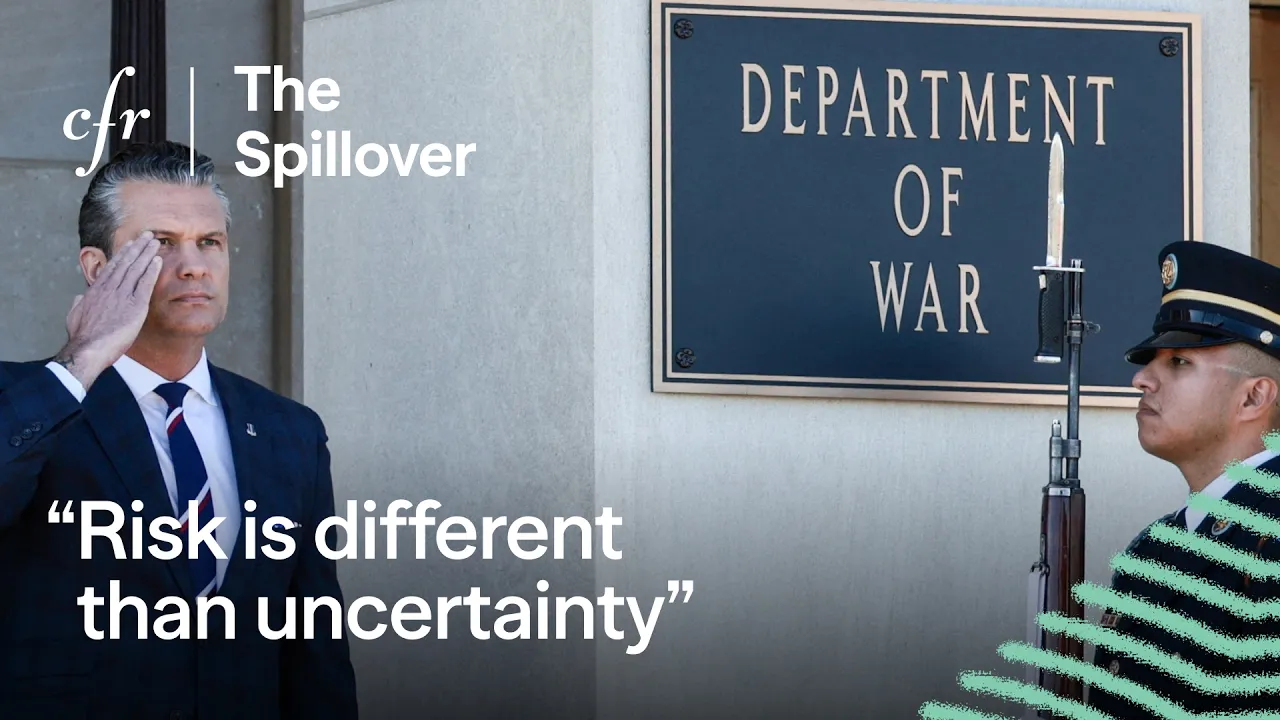
You know, one of the things that for me, years ago, coming home from Afghanistan, changed in the way that I thought about life, was that everything that I’d spent my civilian career, where I’d spent a lot of time on risk, thinking about as a risk, wasn’t risk. It was uncertainty. And what we need to do now is get much better at taking the right kinds of risks, process risk, financial risk, reputational risk, in case the thing doesn’t work, in an ethical, transparent way.
And then do that to avoid translating that kind of risk into real risk, which is risk, you know, for the soldiers, sailors, airmen, guardians, Marines, you have to fight a future war. That’s the thing that we have to do.
PATTERSON:
And that might be the hardest one, because that means culture change. That’s right. And that gets us back to humans, and humans don’t like change.
But I agree with you. And I love your line on risk is different than uncertainty. That resonates.
BECK:
Yeah. I think that, you know, we are really, really, really good in this country at doing that well when tragedy strikes, right? Pearl Harbor, COVID, even Sputnik.
We won’t have the time for that. We have to get better at taking the right kind of risks now.
PATTERSON:
Yes. And I would rather do it before the hopefully benign crisis happens. That’s right.
Doug, again, I could spend hours more going down so many more pieces of this with you, but it is late in London, and I want to let you get some rest. I appreciate so much you spending time with me and all our podcast viewers out there today, because I just think most people in the United States and the world have never heard of DIU. And yet the work that’s gone on there and continues to go on in there is so fundamentally important.
And all these things are connected. Again, they’re spillovers. So I really appreciate you taking the time to share your views, explain some of this stuff to me.
And I’m sure it’s going to be very helpful to everyone who listens to this. And hopefully there’s a few policymakers listening to this, too. So thank you very, very much again for your service to our country and for joining us today.
BECK:
Rebecca, thank you so much for having me. And since it’s actually almost Remembrance Day here in the UK, which is why I’m wearing my poppy, just to all the veterans out there, wherever they may be, and all the families out there, just a shout out to everybody for Veterans Day. And thank you for all of your service.
PATTERSON:
Thank you for saying that. Thank you. And I agree wholeheartedly.
Would you like to stay up to date on the latest episode of The Spillover? Please sign up to receive an email alert when new episodes drop at CFR.org/newsletters or click the link in our show notes. If you have an idea or just want to chat with us, please email podcast at CFR.org and make sure you include The Spillover in the subject line. Last but certainly not least, our episode today was produced by Molly McAnany and Gabrielle Sierra. Our video editor is Claire Seaton and our sound designer and audio producer is Markus Zakaria.
This week on The Spillover, host Rebecca Patterson and guest Doug Beck, senior fellow at Yale and former director of the Pentagon’s Defense Innovation Unit, discuss what the midterm results mean for national security as the Iran war continues and the Trump administration seeks a record $1.5 trillion in defense spending.
The recent midterm results hang over the budget debate. Patterson says “the recent midterms and rising U.S. debt have made this debate a lot more charged.” The midterm election “was an enormous sign of democracy winning,” Beck says, “because the United States Constitution functioned. We had a vote, it includes changes of power and control, and it all worked.” Still, he cautions that “it’s gonna take a long time to rebuild trust” and that U.S. allies are “going to have to hedge differently than they have before.”
On President Trump’s $1.5 trillion budget request, Beck says he “would be surprised if we saw major movement on defense funding by year end.” The more important question, according to Beck, is “how do you spend that money?” Despite ambitions to build what the White House calls its “dream military,” Beck says only “between one and three percent of the defense budget” is actually going toward innovation.
Patterson asks whether it’s concerning that the “human in the loop is being eroded,” when it comes to AI and drones. Beck says the shift toward autonomy is “inevitable,” and argues that the focus should be on quality of targeting, guidance, and rules of engagement. Patterson notes that “it’s very easy to get scared of robots going rogue.” Beck agrees and emphasizes his belief that “the decision to use lethal force needs to be a human.”
To close, Patterson asks what Beck would do if he were still in government. Beck’s prescription includes: “[reinforcing] what works,” “greater budget and scaling to places like the Defense Innovation Unit,” “transparency” between the Pentagon and Congress, and a reinforcement of the “partnership between major primes and the defense small guys” as well as U.S. allies. Beck says the Pentagon needs to get better at taking the right kinds of risks, meaning “process risk, financial risk, reputational risk in case the thing doesn’t work,” conducted in an “ethical, transparent way.” The United States responds well when tragedy strikes, he says, citing Pearl Harbor, COVID, and Sputnik, but “We have to get better at taking the right kind of risks now.” Patterson agrees: “I would rather do it before the hopefully benign crisis happens.”
Mentioned on the Episode:
Douglas A. Beck, “America’s Missing Military Revolution,” Foreign Affairs
This work represents the views solely of the host(s) and guest(s). The Council on Foreign Relations is an independent, nonpartisan membership organization, think tank, and publisher, and takes no institutional positions on matters of policy.
Producer
- Producer, Podcasts
Supervising Producer
- Director, Podcasting
Audio Producer
- Audio Producer & Sound Designer
More Episodes
 59:45Podcast
 52:27Podcast
 41:30Podcast
 35:24Podcast
 48:01Podcast
 47:25Podcast