Can the United States Lead Through Transactional Foreign Policy?
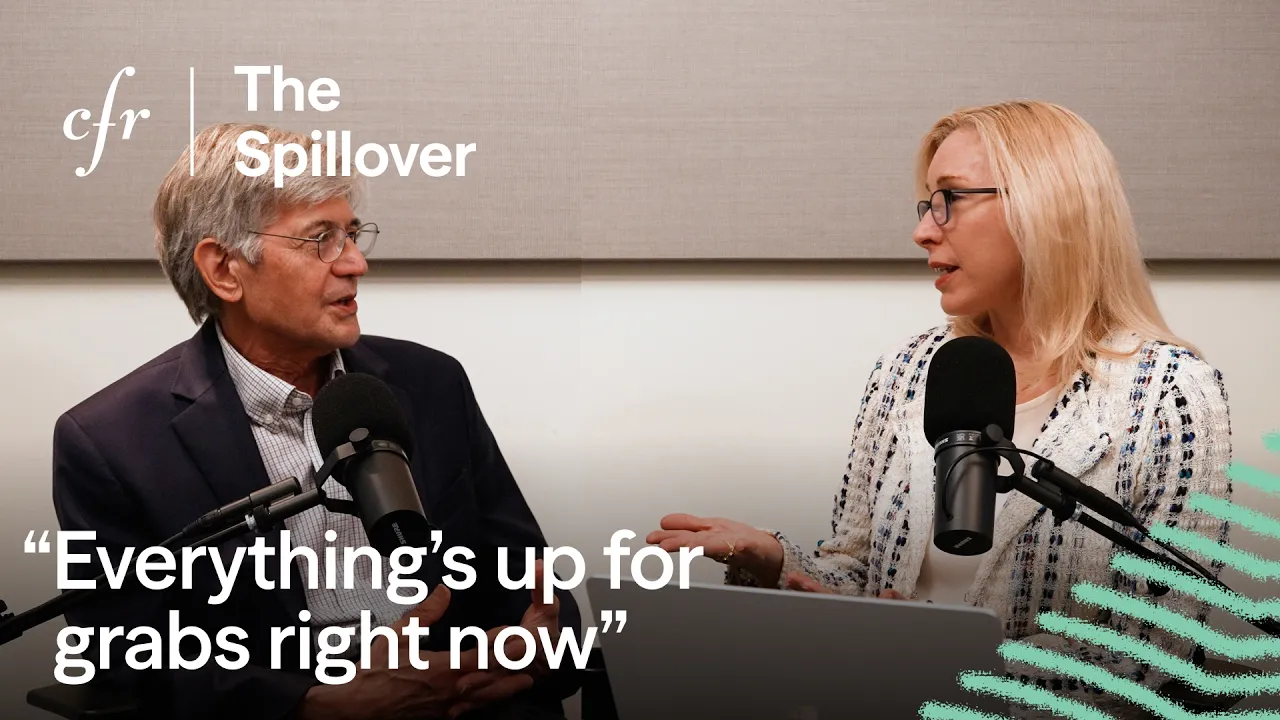
The Trump administration is pursuing a transactional style of U.S. foreign policy, leaving friends and adversaries uncertain about what Washington wants. This week on The Spillover, host Rebecca Patterson and Jim Steinberg, dean of SAIS at Johns Hopkins University, unpack how Washington’s deal-making approach is playing out in Ukraine, Taiwan, AI governance, and the Iran war, and what could replace the U.S.-led global order that has persisted for the past eighty years.
Published
Host
 Rebecca PattersonCFR ExpertSenior Fellow
Guest
- James B. Steinberg
[Video: https://youtu.be/nUg5LU8ZoGM]
Transcript
This week on The Spillover, Rebecca Patterson and Jim Steinberg, dean of the School of Advanced International Studies (SAIS) at Johns Hopkins University, discuss how the current transactional mode of U.S. foreign policy is reshaping relationships with China, Russia, Europe, and the Middle East, and what might replace the post–World War II order.
The world looks far less predictable than it did after the Cold War, and the shift in U.S. policy toward Russia is leaving even seasoned observers unsure of Washington’s motives. Patterson notes that “U.S. foreign policy has taken some unexpected turns so far this year with obvious economic and financial market spillovers.” She says she is “not even sure on a given day who we are considering our enemies.” Steinberg notes that President Trump has “a transactional view about the U.S. role in the world,” adding that “he takes each issue by itself,” and “doesn’t think about the long term.” Steinberg is doubtful that lawmakers in Congress can constrain the president, especially “if he’s determined to go in a particular direction.”
In Europe, war, a weakened political center, and lack of U.S. support are testing the region. Patterson poses a hypothetical: “If I’m sitting in any of the European capitals right now and I’m watching what the U.S. is doing vis-a-vis Russia, I’m probably thinking I’m on my own to support Ukraine in this military action. I can’t count on the U.S.” Steinberg says fear of Russia is “a factor,” but that “the Europeans don’t have the systems that the Ukrainians really need.” He adds that “we are seeing a tremendous hollowing out of the center” in France and Germany, driven by populism on the left and the right. Patterson argues that Europe is “moving to a tougher posture on China” while the United States softens.
On AI and Taiwan, the United States and China are locked in rivalries where each side’s pursuit of advantage makes cooperation hard. On AI governance, Steinberg calls cooperation between the United States and China “enormously important” but says “I’m pretty skeptical.” He notes that arms control worked because “you couldn’t win a nuclear arms race,” a belief neither side holds about AI. Steinberg argues that it will take both sides being willing to say, “it isn’t the most important thing in the world to be number one here, and that we need to find ways to focus on the risks of basically the equivalent of arms racing in AI, rather than the benefits of trying to win the arms racing in AI.” On Taiwan, Patterson wonders whether a thawing U.S.-Russia relationship could embolden Xi Jinping to think, “maybe the cost of reunifying with Taiwan wouldn’t be so great.” In contrast, she notes that China’s “purge of senior military leadership” raises the question of whether it could act even if it wanted to. Steinberg says Beijing may instead conclude that time is on its side. If China believes reunification will get easier to accomplish in the long run, he says, “it may lead [Beijing] to be a little bit more patient.”
In the Middle East, a war with no clear exit is reshaping both the region’s economy and the United States’ long-held position in the Gulf. “We’re looking at fertilizer [exports from] the Gulf going to almost zero,” Patterson notes, “and we’re going to see that feeding through to food prices.” Stressing the economic spillovers, Patterson asks, “Do you think we’re still at war in six months?” Steinberg says the administration is “stuck in a strategic cul-de-sac” and that the United States has been in the Gulf “continuously for 50 years,” a posture now in question.
Patterson closes by observing that “the post World War II order that we enjoyed for the last 75, 80 years is probably gone.” Steinberg outlines three competing models for what comes next: like-minded democracies, great power concerts, and middle-power coalitions. He predicts a hybrid outcome that focuses on allies but is not “purely in opposition to China and Russia.” “It’s going to be messy,” he says. He ends with a message for foreign policy students: “you have to have good ideas, because you’re not going to solve problems without good ideas, but they have to work in the real world.”
This work represents the views solely of the host(s) and guest(s). The Council on Foreign Relations is an independent, nonpartisan membership organization, think tank, and publisher, and takes no institutional positions on matters of policy.
Producer
- Producer, Podcasts
Supervising Producer
- Director, Podcasting
Audio Producer
- Audio Producer & Sound Designer
Video Producer
- Director of Video
More Episodes
 41:30Podcast
 35:24Podcast
 48:01Podcast
 47:25Podcast
 50:17Podcast
 47:25Podcast