The Nvidia Scandal Spotlights China’s Evasion of U.S. Chip Export Controls
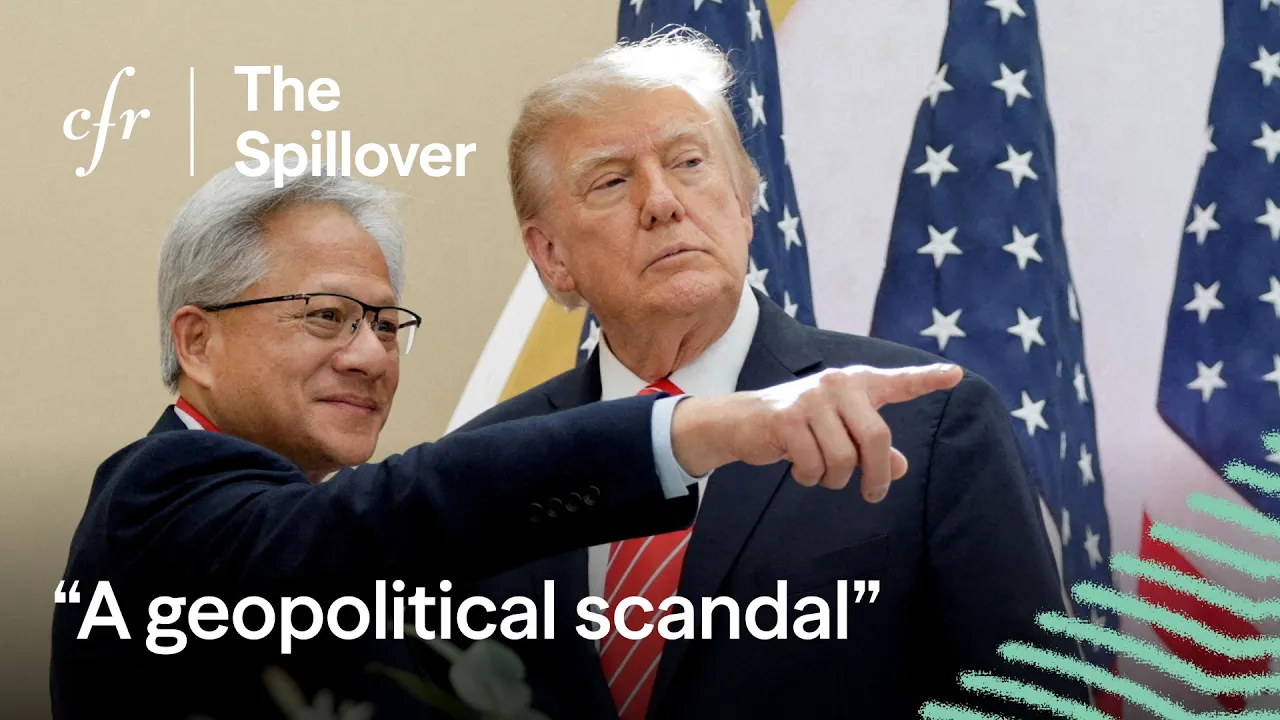
The resignation of Nvidia’s CEO Jensen Huang has put a spotlight on China’s ability to circumvent U.S. export controls on advanced AI chips. Although a new rule introduced by the U.S. Department of Commerce attempts to close some of the gaps that China has exploited, questions about enforcement remain. This week on The Spillover, Rebecca Patterson is joined by CFR fellows Eddie Fishman and Chris McGuire to unpack the loopholes and to discuss broader issues in U.S.-China relations and the Iran war.

Published
Host
 Rebecca PattersonCFR ExpertSenior Fellow
Guests
 Edward FishmanCFR ExpertSenior Fellow and Director of the Maurice R. Greenberg Center for Geoeconomics
 Chris McGuireCFR ExpertSenior Fellow for China and Emerging Technologies
[Video: https://youtu.be/EFHzk-U-v9U]
Transcript
This transcript was generated using AI and may contain errors.
PATTERSON:
In the last two weeks, we have had eight years worth of critically important macro events. At least it feels that way to me. Maybe it feels that way to you too.
Beyond the unexpectedly large blue wave in the midterm election, we had the CEO of NVIDIA, one of the world’s largest and clearly most important companies, forced to resign after relationships with three women surfaced, one allegedly providing information to the Chinese government, where the U.S. government knew in advance there might be an issue but didn’t do anything. And that’s not all. We had a global outage at Microsoft.
I’m sure everyone had fun with that. A U.S. ground stop for thousands of planes. And what seems like is a major pivot in the Iran war.
Yes, that was in two weeks. So we’re going to zoom in on two of these issues today, NVIDIA and the Iran war. NVIDIA is dominating the headlines as it should, but frankly, I think the Iran war, this potential pivot, shouldn’t get overlooked.
It potentially could be a very big deal as we go into 2027 and even beyond. Fortunately, I have two amazing CFR colleagues with me today who are both deep experts. Eddie Fishman, author of Chokepoints, of course, and a former State Department official who was focused on sanctions.
And Chris McGuire, a leading expert on U.S.-China tech rivalry and AI who served as deputy senior director for technology and national security at the National Security Council. There is so much to unpack here and even more implications to consider. So buckle in.
I’m Rebecca Patterson and this is The Spillover. Eddie and Chris, thanks so much for joining The Spillover today. Eddie here, you from New York with me at CFR and Chris, we’re waving to you in Washington, D.C. God bless technology.
FISHMAN:
Yeah. Thank you so much for having us here today, Rebecca. Great to be here.
PATTERSON:
Thank you. I just want to start with NVIDIA and all the different reasons that this company resignation of its founder and CEO are so critical for everyone listening today. And I assume our listeners know the basics already and are following this, but I think it’s worth running quickly, at least through three points.
First, just NVIDIA’s size and its role. You know, it was 1 percent of the entire S&P equity index three and a half years ago. As of the end of October, it was about eight and a half percent of the entire S&P index.
One company. That’s extraordinary. Until very recently, it was the world’s largest company by market cap.
In October, it reached I think it was five point seven trillion dollars in market cap, according to Bloomberg. Even now, after the selloff, it’s still worth about three point eight trillion dollars. Second, its equity dominance reflects its place in the A.I. build out boom. Right. So NVIDIA designs the chips and is fabbing the chips, too, and the systems that run A.I. And in recent years, it’s become a critical funder to the industry. We talk about circular financing.
This is a big part of what we’re talking about. NVIDIA has more than a billion, 100 billion, excuse me, 100 billion dollars equity portfolio. That’s investments.
And Chris, correct me if I’m wrong. If you hear me say anything, you’re like, no, no, no, you’re it got updated last week. But their equity portfolio has over 100 companies in it.
Beyond that, they have guarantees to let its customers borrow money to buy its chips. Again, the circular financing, some people call it Ponzi scheme. We’ll call it circular financing.
But you can say regardless that what happens to NVIDIA matters for the whole tech industry and what happens to the whole equity market. And ultimately, that matters for our economy. And that’s why I think some of the folks in Silicon Valley are now signing petitions to bring back Jensen Huang.
They think he’s too important to fire for their own businesses as much as anything. OK, third and finally, NVIDIA is a critically important example of the, we could say, questionable ties between individual companies and the U.S. government and how those ties are influencing national security and in this case, the U.S.‘s ability to stay ahead of Chinese AI. All right.
So, guys, let’s start working through the list. And I want to start with the advanced chips that NVIDIA designs. We know they’re the most important part of the AI ecosystem that China still doesn’t make at scale.
Right. So it needs American chips. They have the talent, they have the data, they have the powers, they have great open weight models.
So advanced chips are a leverage point for the U.S. and maybe we even could say a choke point for China. So I’d love to hear from each of you how big a deal you think this is. You know, did China’s ability to get advanced chips through Megaspeed in Singapore and other companies cut the U.S.‘s lead over China in AI? And by a lot or a little? You know, I always think China’s running a different race than the U.S. in AI. It’s about smaller, cheaper, open weight models.
It’s about getting adoption around the world quickly. It’s about physical AI. But you all are much deeper on this than I am.
So I’d love to get both of your views. Eddie, you’re sitting here next to me in New York. I’m going to let you kick us off.
And then Chris, I’d love you to jump in.
FISHMAN:
So I think this is a very big deal. If you are assuming that the U.S. and China are in an AI race and it actually matters who’s ahead, to your point, Rebecca, the one area where the U.S. does have something that China doesn’t have are these advanced chips. It’s really in the hardware component.
On energy, China’s ahead of where we are. On talent, maybe you say it’s a wash. So this really is our lead.
And this is why now several administrations dating back to the first Trump administration through the Biden administration had focused on denying China access to these high-end chips. And then I think even for the models you talk about, some of these open source Chinese models, if you look at the evidence, it does seem that they have been training their models on Western hardware. They’re not using domestically designed and produced Chinese chips to train their models.
So even the AI that China has today does depend on our chips. I would defer to Chris in terms of what that means in terms of, you know, six months versus 12 months versus two years. But it’s very, very clear that China wants access to these chips.
They need access to these chips to have any sort of any shot in the dark of competing with the United States in the AI race. And that’s why this is not just a scandal about one company or one individual in Jensen Huang. It’s really a geopolitical scandal.
PATTERSON:
All right, Chris, thoughts on that? And how much do you think our lead has shrunk because of this? And where is our lead today?
I hear every person I talk to has a different estimate. I don’t think it’s easy to have a clear estimate, but jump in.
MCGUIRE:
Yeah. So I think there are two reasons to say it’s actually hard to figure out exactly where the U.S. lead is. I would say it’s probably somewhere in the six to 12 month range.
But the first reason is a little difficult, is that it’s not that many people know where the U.S., where the frontier labs actually are, because keep in mind, we’re talking about the internal capabilities of those labs, which are nonpublic. So there’s only a few people who know. And the second thing is, it’s getting really hard to benchmark AI models.
It’s hard to actually say this one compared to that one is that much better just because it’s hard to evaluate them. They’re so sophisticated. But that said, I would say the U.S. lead is probably in the six to 12 month range over China. But I completely agree with the points that Eddie made, that if you look at the Chinese models, every single one is actually trained on U.S. chips. And we’re not talking about the chips that the Trump administration agreed to sell or older chips. It’s the most advanced U.S. chips. Most advanced Blackwell chips are what are used to train all their models. And the reason for that is because we know that there’s these big holes and controls that the Chinese are using to access chips, despite the restrictions that the U.S. have put on them. And there’s a variety of reasons for that that we can talk through.
But this actually is the choke point that we have. It is the kind of method that we have to slow the Chinese down. And if you actually did force the Chinese to rely exclusively on their chips as opposed to ours, they would be very far behind.
I mean, my estimates are that this year, China makes somewhere in the realm of two to four percent of the computing power that the United States does. It’s not close. The U.S. makes 25 to 50 times as much AI computing power as China. So I think it’s reasonable to say that’s the difference between a six to 12 month lead and an 18 to 24 month lead. And keep in mind, when you’re talking about how much AI compounds, if it’s improving in capabilities, doubling every four months, now probably even shorter, that’s a massive difference. That’s the difference between a lead that’s, you know, 8x, 12x, somewhere in there in terms of capabilities.
And then you’re like the 50x, 100x range. So I think that, you know, by not actually by allowing China to have access to these chips, you’re actually giving them a huge increase in capabilities as allowing them to actually kind of stay competitive as opposed to being far behind.
PATTERSON:
And that was the funny thing about this. Well, one of the many funny things, funny in quotes, about this scandal. So initially there were concerns about Jensen Huang, the CEO of NVIDIA, improper relationship with a woman who was buying the chips and in theory or allegedly passing some or many of them on to China and maybe giving information to the Chinese government as well.
Then you have the two employees he also allegedly has had relationships with. And some of the people defending Jensen Huang are saying, well, he didn’t break a law, but no, as CEO, he developed a conflict policy that included do not sleep with your employees, which he broke, which many boards would fire the CEO just for that. Forget about the Chinese possible spy situation.
But let’s put that aside to the national security issue, which is I think what we’re focusing on right now. Commerce wasn’t enforcing export controls that had been created. And then literally just this morning, we’re recording on Monday at noon.
You got this new document out from the government. So talk a little bit about the controls and then what happened today and why you think it’s so interesting slash unusual.
FISHMAN:
Sure. So I’ll start off with one framing comment and I’ll pass it over to Chris to go into depth on the controls that were released today. But I think something that’s important to note here is that some of this I think does represent very poor enforcement, maybe honestly, you know, non-enforcement of export controls on behalf of the Trump administration and the Commerce Department in particular.
But I also think there’s a bigger issue at play, which is that U.S. export controls really have not been up to grade if your goal really is to do what Chris and I have been talking about, which is to truly deny China access to these high end chips. So for instance, you know, I think the mental model a lot of us have is, well, China is trying to get these chips into China to build, you know, big data centers in China. Right.
And it’s very clear that for, you know, for years now, it has been illegal for U.S. companies to sell, you know, the most advanced chips to China. Right. But guess what has been legal?
You have been able to sell those chips to a neocloud in Singapore or Malaysia that then can actually rent out access to those chips to a to a Chinese lab. And by the way, you could even have Chinese labs rent out access to chips in the United States, which is quite remarkable. So there there are certain, I think, maybe, you know, poor enforcement that’s going on.
But there are also just major loopholes in our export controls policy that frankly predate the Trump administration.
MCGUIRE:
Yeah. And I completely agree with Eddie. Actually, it’s even worse in the United States right now.
The only place in the world where Chinese companies are legally able to not just rent access to but purchase AI chips directly is inside the United States of America. That’s preposterous. Right.
But that’s just because the way that this patchwork system has been created has been from scratch and not really implemented, you know, up to stuff. I think if you look at Secretary Bessent’s been bringing this point repeatedly over the weekend that I think is right, that if you look at how Treasury does sanctions implementation and enforcement, it is it is far more robust. And the knowledge standards and expectations of companies are much higher.
We hold companies accountable when they violate sanctions. You know, there’s all this controversy over the affiliates rule and export controls. But like the affiliates rule is actually just trying to bring export controls, one element up to the standard of sanctions, right, saying that if you have a subsidiary of a company that’s it’s also sanctioned.
That’s just implied here. But so there’s a bigger point on export controls writ large. And then specifically on this regime, that there are these these really significant controls, the these really significant gaps.
And that’s been the case for years. Now, the update today is very significant. It does close some of these gaps.
PATTERSON:
Chris, let me jump in for a minute. I want you to walk through what was actually in the document that came out this morning, that closes some of the loopholes on the advanced chips to China. But also, I want you to talk for a minute about your op ed that came out in The New York Times a few days ago.
I mean, you publicly called for Howard Lutnick, the Commerce Secretary, to resign over this. So and I think these two things tie together in this document. So walk us through that.
MCGUIRE:
Yeah, so I think it’s important to start with how egregious the export control enforcement has been, which is why I think we need new leadership at the Department of Commerce. To give you an idea, at the end of the Biden administration, there were these anti-smuggling controls that were put into effect that we saw that this was going to be a big issue, that you were starting to see Chinese companies buy AI chips in Malaysia and Singapore and Thailand and other places. There was a license requirement that was put into effect for these countries.
It would have disrupted a bunch of smuggling networks. There’s actually evidence of this in DOJ indictments in which they have communications from smugglers who say, oh, we have to get our shipments to Malaysia out before the new rule comes into effect. So this is very clear, actually.
But two days before that rule went into effect, the Commerce Department said they were not going to enforce it. They said they opposed it. And then they said that they were going to replace it with something else.
Now, keep in mind, NVIDIA strongly opposed this rule because it would have prevented them from selling to Megaspeed and other companies like Megaspeed, which are obviously a significant part of their business. So that has been languishing for 18 months. And what we’ve seen is that there’s been massive sales to these countries in particular, to Thailand, Singapore, and Malaysia, three small countries have received $60 billion of AI chips in the last two years.
That’s insane and way out of whack with the size of these countries. So we’ve seen this massive smuggling. We’ve seen the lack of enforcement.
And it seems like it increasingly, commerce has just outsourced not just rule writing, but also enforcement of rules to NVIDIA. There’s been reports that they have interfered with investigations that involve NVIDIA in order to shut them down. If that’s the case, that’s completely unacceptable.
So all of this culminates, as you noted, in this rule today, which is actually the first big step forward that I think the Trump administration has taken since April 2025 to strengthen controls on compute to China and actually close some of the loopholes. It’s interesting that in the press release for the rule, it actually says that it was done at the direction and written by the Department of the Treasury and by the National Security Council, which seems to highlight that there is still significant tension between commerce department vision of export controls, which seems mostly to be outsourced into the private sector, let them decide what a Chinese company is and what isn’t, versus Treasury and NSC and other people’s vision of export controls, which is that the US government has to play a role in vetting this because we obviously can’t trust the private sector to make these determinations because they’re just going to just value their bottom line the most.
But it does seem like the White House and the Treasury Department were successful. They did get this rule out. Just on a top line, the kind of three categories of things it does, and we can talk about it in more detail, is it does have restrictions on Southeast Asia in particular, requires a license for AI chips there, so unvetted companies can’t receive them.
It imposes some restrictions on remote access controls, like Eddie said, which was previously Chinese companies could just rent chips that they couldn’t buy. That is now restricted. And it also closes some loopholes that prevent AI companies from fabbing chips at TSMC and Samsung, which the Trump administration had created through some of their non-enforcement posture.
So these are all positives. There are important gaps here. There’s work still to be done.
But I do think this is the first actual, real, meaningful step forward in an effort to try to resolve this problem to at least a degree.
PATTERSON:
Thank you. And Eddie, Chris just made a point that I want to follow up on with you, which is what appears to be some tension even within the administration. You have Scott Bessent, the Treasury Secretary, saying we need a new leader for NVIDIA coming from outside.
We need an overhaul of NVIDIA. Very different verbiage from what President Trump is saying, that maybe we could reconsider Jensen Huang coming back in. And that’s a change in the last couple days.
Initially, it was like, no, we should go. Now, maybe not. And then you have the Treasury and Commerce tension as well.
To me, when I take a step back, I mean, those are important issues to that kind of tension within an administration, out in the public so much. But beyond that, there’s the issue of the interference and interconnectivity between the public and private sector. And it’s not just NVIDIA, obviously, that’s a player on this chessboard.
I mean, Elon Musk, we’ll never forget the picture of him with his son on his shoulders towering over President Trump as he’s at the Resolute Desk in the Oval Office. And we’re learning that Trump is joining, or sorry, Musk is joining Trump. Trump’s joining Musk on the trip later this week to China.
And maybe in a way, that’s a little thank you for the, what did he spend, about $445 million on Republican candidates in the midterm election. So how do we make sure, I mean, as someone who’s worked both within government and outside government advising, how do we make sure that, you know, we want the private sector and the government talking and collaborating on policy and on other things? But how do we avoid these conflicts?
There’s clearly a big conflict if NVIDIA, as Chris said, is helping to develop the guardrails that it will then have to use.
FISHMAN:
So look, I mean, economic statecraft is different from pretty much any other tool of U.S. foreign policy. Because the U.S. government sets the rules, it sets the policies, it says, we want to cut off Russia’s access to the dollar, or we want to cut off China’s access to frontier AI chips. But it’s actually the private sector that does the enforcement, right?
The private sector effectively is the frontline infantry in American economic warfare. The reason that U.S. sanctions are impactful is, of course, because we have this choke point, the U.S. dollar, which is the world’s most dominant currency. But beyond that, you also need something critical, which is the financial sector has to actually listen to the government.
It has to actually implement the policies that come out of Washington. And if you go back, Rebecca, to the early part of this century, banks, by and large, did kind of view sanctions as a joke. They would oftentimes violate U.S. sanctions, and maybe they would at most get a slap on the wrist, get a fine for a couple million dollars, and they would all go and have lunch together or something. Then what happened? In the late 2000s and the 2010s, we started seeing billion-dollar fines on banks. You saw HSBC in 2012 fined $2 billion for violating sanctions.
You saw BNP Paribas in 2014 fined $9 billion, which actually wiped out more than a full year’s worth of their net income. So all of a sudden, for banks, sanctions violations were no longer something you could write off as a cost of doing business. It became existential for their companies.
And so you saw banks invest billions of dollars into these incredibly robust compliance apparatuses that they do. And now, all of a sudden, any time the U.S. government comes out with a new sanction, it’s not just Wall Street that kind of complies right away. It’s the entire global financial industry.
If you’re a bank in London, a bank in Dubai, a bank in Singapore, you are going to comply with U.S. sanctions. We have done nothing like that for tech companies. Export controls really only became a major part of U.S. national security policy, at least in contemporary times. In 2018 and 2019, when we put ZTE and Huawei under export controls, I’d say it really came into the fore in 2022, when the Biden administration did this foreign direct product rule, which the goal was to really cut off China’s access to high-end chips more broadly. But we have not seen anything like these massive fines on tech companies that really have forced them to take export control seriously in the way that banks take sanctions seriously. So there’s a point where the U.S. government needs to crack down on enforcement and make clear to companies that they actually do need to comply with these regulations. But then I think there is a structural issue, and you sort of got at this in your comments earlier, which a couple of weeks ago, you said NVIDIA’s market cap was, what, $5.7 trillion?
PATTERSON:
Was that right?
FISHMAN:
So what kind of a fine would you need to have on NVIDIA to make it seem existential for them? Because whatever $9 billion was to BNP Paribas in 2014, what is that, $50 billion, $100 billion for NVIDIA today? So there’s, I think, maybe a challenge of, are these tech companies just too big for the U.S. government to actually inflect their calculus?
PATTERSON:
And I wonder how much their size, their political heft, I mean, again, talk about Musk’s donations in the midterm elections, and that’s not a political comment, that’s just what he did, right? The fact that you’re gonna have these meetings between Presidents Trump and Xi later this week in China, and everything I’m reading, and gentlemen, you guys, again, are in this 24-7, I’m not, I dip in and out, it sounds to me like it’s gonna be a Thanksgiving dinner with the relatives that you don’t agree with, right? Trump’s not gonna bring up export controls and advanced chips, he’s not gonna bring up Megaspeed, they’re gonna find some benign topic where everyone can enjoy their Thanksgiving meal and pass the gravy and have a glass of wine, Trump doesn’t drink, and they all walk away looking like winners, so maybe that’s extending the trade truce by another three months, but even with that, I think we’ve got issues, right? Because everything I’m seeing, China’s not giving us the critical minerals they said they would in the trade agreement, so I’m wondering, is it gonna be a happy Thanksgiving dinner with relatives who have different views, or could we be surprised and there’s actually some tension here, or does Trump just want everything to be kumbaya till his December summit, or G20 meeting, rather, in Miami? I don’t know, Chris, are you, what are you looking for out of the meeting?
MCGUIRE:
Yeah, I think this will probably be pretty similar to, frankly, the previous two summits involving Trump and, President Trump and President Xi, where we saw a lot of pomp and circumstance, but not a lot of material deliverables, and I don’t really think that’s accidental, I think that there’s a lot of frustration from the U.S. side that China’s not complying with the Busan agreement, that they’re not actually giving rare earths at the scale that they should, and also there are not, you know, from the beginning, there have not been any efforts to kind of change the structural issues that I think are causing the frustration on the U.S. side, the, you know, overcapacity issues, the theft of technology, etc., etc., that has been the case for many, many years, so I don’t think there, frankly, are that high expectations for getting anything, you know, big across the line, and it’s interesting, if you looked at some of the messaging from the National Security Council in advance of the meeting, there is an official that gave a background briefing that said, well, we’re not going to bring up, why would we bring up Megaspeed and all this stuff to the Chinese, because, you know, this is just trying to cut down on Chinese circumvention of export controls, and they’re telling us they’re not circumventing export controls, they’re not, you know, they’re claiming they’re not illicitly buying chips in diverting compute, even if that is legal, then they shouldn’t have a problem with this, and I think that’s kind of the approach that they’re taking on this issue, and meanwhile, I think on all the other trade issues, there’s significant, you know, concern that actually, this is an unresolved issue and a big area of tension, and the administration is not getting everything that they want, and I think that’s why you’re seeing the tough messaging from Secretary Bessent and from Ambassador Greer and others on the rare earth issues, and separately, the administration actually is taking a number of actions on the competitive balance sheet with China to do the things that I think they determine they need to do on the technology front, I mean, you have this action, which obviously is a start, and I think export controls have been slow, but it’s notable, the FCC has been taking numerous actions to kind of ban imports of certain Chinese technologies, you know, State Department has sanctioned firms, the DHS recently banned the import of certain Chinese biotechnology company equipments, so there’s actually a lot going on that I think the fundamental tensions between these two countries, and between their tech ecosystems in particular, are not really trying to get resolved at the leaders level, and as a result, both countries are taking actions to kind of move apart, the Chinese are also imposing many of their own export controls, and I think the result of this will be, like you said, a dinner where everyone kind of takes pictures, smiles politely, doesn’t really get along, and then goes their separate ways.
FISHMAN:
Can I just add one thing there, because I think that to the, you know, everything we’ve been discussing, I do think NVIDIA itself has had kind of an outsized role in shaping American export control policy during the Trump administration, but there is one other factor that we haven’t brought up, and that is Chinese retaliation, and if you go back to something Chris said earlier in our conversation, you know, one of the most glaring loopholes in American export controls is the fact that if you are a subsidiary of a company that is under U.S. export control, so let’s say Huawei has a subsidiary called Huawei, right, that subsidiary is not automatically under export controls, right, they could create a subsidiary that then you could sell controlled U.S. items including chips to, right, sanctions don’t work that way, right, if you are a subsidiary of a sanctioned Russian bank, it is up to the financial industry to figure out that you are a subsidiary and to block payments to you, right, whereas, you know, we’re trusting the Commerce Department to, you know, monitor the entire corporate ecosystem of the world and constantly update this list, it obviously doesn’t make sense, right, the Trump administration tried to update that, this is what the affiliates rule is, they introduced it in September of last year, where they said from now on, if you are a subsidiary of a company that’s under export controls, you are automatically also under export controls, and what happened, China responded and they said, okay, well, if you export any good that has more than 0.1% of the value of Chinese rare earths, you have to apply for a license to the Chinese government, something that could implicate 6.5 trillion dollars worth of trade, and what happened, the Trump administration said, okay, we’re going to get rid of the affiliates rule, and they came to Busan last October and they agreed basically for a suspension of the affiliates rule in exchange for the suspension of this Chinese policy, which by the way, I think was called announcement number 61, so you get to, you see these Chinese government regulations, they call them some creative stuff, but so I think that’s another factor here, right, which is that China has showed that it also has choke points, and I think that even someone like Bessent, who has been talking tough in the last couple days on export controls, he’s the one who’s been saying that this is a sort of Damocles that China has over us, and I think that that is also potentially going to put some limits in terms of how hawkish the Trump administration gets on China.
MCGUIRE:
Yeah, if I could just make one note on that, I mean, I totally agree with what Eddie said, I would note, I think there’s some disagreement about how much of the Chinese response was directly due to the affiliates rule and how much was due to the 150 percent across the board tariffs that the Trump administration was threatening to put on at the time, but nonetheless, the environment obviously was such that the Chinese perceived that they had to take a very kind of dramatic move, but I also think that what Eddie said is right, the endless doesn’t work because of the way it is implemented, it’s just a joke. So that also forced that, and also the Chinese practice of military-civil fusion forces the United States to move more on country-wide controls, and that’s why we have these country-wide bans on AI chips to China, because like we just can’t adjudicate between companies, both because we can’t implement and also because obviously we can’t trust when things go over there, but it’s a very difficult challenge.
PATTERSON:
So beyond the meeting in China this week, the ongoing saga with Jensen Huang, we also have two major, major, major events for two of the biggest tech companies in the U.S. We have Anthropic’s planned IPO, they’re hoping for a valuation of 1.4 trillion dollars, and we have NVIDIA earnings where you’re going to have Jensen Huang and the interim CEO Colette Kress talking. You know, I think we’re going to get a lot of questions from the investors on that earnings call for NVIDIA in terms of why did they stop reporting revenue from Singapore last year, suddenly, when in theory it was 20 percent-ish of their total revenue. You know, what does this mean for the AI build-out if NVIDIA slows down the amount of financing it’s doing for the whole ecosystem?
There are people on different sides of the fence in terms of what this means for the broader market.
MCGUIRE:
Yeah, there will be significant questions. I think that the biggest question that I think NVIDIA is really going to have to grapple with over the coming months has nothing to do with Jensen Huang’s affairs, but it does have to do with what did they know about chips going to China. And they obviously have an internal investigation into this.
The Trump administration has said that the DOJ is looking into it. Obviously, there’s a lot of press reporting on it. But if NVIDIA did know that Megaspeed was a Chinese company, that would be a very, very serious problem for them.
So those questions, I think, are going to be significant. I mean, it’s important to note, like you said, there’s been a lot of uncertainty about their billing to Singapore, and that’s disappeared. And one thing that the rule today does is it imposes a license requirement on Singapore, Malaysia, Thailand, Indonesia, and Brazil.
And especially those four Southeast Asian countries are big hubs for AI chip purchases. So NVIDIA stock right now is down 5% today. So we’ll see what the impact is going to be on that and what their commentary is on it.
But obviously, there’s going to be a lot more scrutiny to the chips that are flowing to this region. And it’s going to be a lot harder for these neoclouds that have been purchasing huge numbers of Chinese chips to buy them without U.S. government approval, which they’re not going to get.
FISHMAN:
So I know that this show, Rebecca, is called The Spillover. And so we’re focused not just on the immediate impact of any of these developments we’re talking about, but also what it could mean for second and third order consequences. And something that has been on my mind ever since this whole scandal broke is that there’s a lot of discussion about, are we in an AI bubble?
I think you mentioned that 8.5% of the S&P 500 was just NVIDIA as recently as a month or two ago. Are you worried that if NVIDIA does not recover from this, if it’s truly floundering now for quite some time, does that risk being the thing that actually pops this AI bubble and leads to an unwinding of the AI trade?
PATTERSON:
I mean, so the bubble question is a big question. I think there’s two ways this could go. I think we could have a painful, sharp unwinding of the bubble where people taking down their exposure to certain AI-related stocks gets its own momentum, especially as retail investors who maybe were investing with margin, so they had leverage, get margin calls and are forced to unwind.
So it gets momentum. That can get into the broader economy. And to watch if that’s happening, I would look at weekly jobless claims.
So every Thursday at 8.30 in the morning, Eastern time, we get a snapshot of the labor market, and that tends to be the canary in the coal mine. If you’re seeing a wealth hit from equities falling that cause less consumption, that lead companies to get more cautious, they’ll start laying off employees. So that would be one thing to watch.
The other thing I’d watch is any high-frequency data on retail sales and consumer spending and consumer confidence. If this is a sharp unwind of a bubble that is actually threatening the economy, that’s where you’re going to see it show up first. And I think it is a real risk.
What we’re seeing so far, and we’re early days in this AI tech sell-off, really just several weeks, is a rotation. And if this continues, largely every day is different, but if this continues, this would be the best case scenario for AI. So what I mean by that is you are seeing investors reducing exposure to some of the highest valued names, some of the names with the most debt on their balance sheets, including some of the neoclouds, and they’re rotating into tech companies with stronger balance sheets, more free cash flow, and to defensive sectors of the equity market.
So it’s noteworthy that even with the fall in the equity price for so many of these tech companies, the S&P 500, for example, is still up almost 10% year-to-date. So we’ve given back, but we’re still not that far from all-time highs in the stock market, and that’s the rotation. So people are saying, well, the US economy is still growing by over 3%, and we think AI is a long-term transformational technology, so we’re just going to move around our exposure, but we’re going to stay invested.
If that’s how this plays out, and the midterm election means a slightly slower build-out of data centers with a few more guardrails, and maybe the strength of NVIDIA on politics and setting the rules is diminished, but they survive, that actually could be a good thing, because what we don’t want to have happen is that the AI build-out is too much of a good thing, that you are seeing so much capital getting sucked into this AI black hole that there is no money left for residential construction to build homes. There is no demand left for other corporate bonds or government bonds, and that pushes yields up. Chairman Warsh of the Fed gave a speech just today on AI talking about the different ways it could play out.
So if AI can deflate slightly and take a little bit of the heat out of the economy and inflation, Fed doesn’t have to hike as much. So this could prolong the whole expansion of the economy and reduce the bubble risk. So I actually, not that I’m happy to see what’s happening to NVIDIA by any means, but if you have a slowly deflating bubble rather than a bubble pop, that could be awesome.
Like, we would all be thrilled if that’s the outcome. We don’t know yet, but those would be the two scenarios. And again, I just watched those two data points to see where we’re going.
Guys, I know we could talk for the rest of this episode on AI, but I want to spend at least five minutes on Iran. Look, President Trump last week, right after the midterm, came out and said, we don’t need a deal with Iran. I’m going to tell my vice president, J.D. Vance, to focus on domestic issues instead of continuing to lead talks with Iran. And that came right after Vance blamed the war for the midterm losses. Secretary of State Marco Rubio now says we don’t need any military action because the economic pressure is working. Although we’re still seeing bombing, right?
The U.S. is still attacking an island in the middle of the strait. Iran just this weekend launched an attack against Bahrain. So Eddie, you were involved with the Iran sanctions architecture when you were in government.
Do you think an economic approach solely is going to work in Iran? And where do we go from here? What worries me, getting back to the Fed and Kevin Warsh, is that even if oil is flowing through the strait again and oil prices are off their highs, that’s just Brent crude, the financial price, right?
We’re seeing still extremely expensive, refined energy products. We’re still seeing insurance costs, shipping costs very elevated. And it’s feeding into inflation in the U.S., which is causing the Fed to need to raise rates. So to me, what happens in Iran, it’s not just about the oil price and your gasoline price at the pump. It’s about broader inflation that could hurt the U.S. economy through what it means it at the margin makes the Fed have to do. So talk to me about how you’re seeing Iran economic pressure.
How does this resolve?
FISHMAN:
Yeah, so a lot. I know that’s a lot about some unprecedented things that we haven’t seen before, like, you know, the Commerce Department putting export controls in place and saying in the press release that this was written by the Treasury Department, which is truly something I’ve never seen in my career. Something else I’ve never seen in my career is the day after an electoral defeat, the U.S. vice president, the sitting vice president coming out and saying the reason we lost is the war, a war that is currently being fought by his own government. Yes. So clearly there is an acknowledgement at the very top of the U.S. government that the Iran war has been very bad for the Republican Party and that it is probably not a good idea to escalate it further. Is it possible that just doubling down on economic warfare is going to get the Trump administration everything it wants?
In short, no. Despite the fact that the Iranian government is effectively selling no oil right now, so the U.S. oil blockade is working, the most recent forecast I saw for Iran’s economic performance this year is a GDP contraction of seven and a half percent, which is bad, right? It’s bad.
But compare that to Venezuela in 2016, 17, 18, 19, 20, where every year they were contracting by 20, 30, 40 percent, right? I mean, this is not even close to the biggest peacetime contraction we’ve seen. And then add on that, what is the U.S. actually trying to achieve, right? We had a similar, by the way, contraction of Iran’s GDP in 2012, 2013 in the lead up to the nuclear deal. But at that point, the Obama administration was very clear. They were willing to remove that pressure if the Iranians were willing to accept constraints on their nuclear program.
Right now, the Trump administration has many more goals than that, right? It’s not just about Iran’s nuclear program. They also want the strait to go back to the status quo ante.
They also want Iran to get rid of its missile program. They also want, frankly, I think they still want regime change. And none of that, I think, is on the table.
So I think the likely area where we’re headed for this, Rebecca, at least the way I see it, is that the Trump administration is going to try to kind of, you know, push the Iran more to, you know, page two or page three of the newspaper, where it’s going to continue on at a low level simmer. And that the way that the Strait of Hormuz situation gets worked out, if you will, is that it’s going to be every nation for itself. The Saudis, the Emiratis, you know, Bahrain, Qatar, they’re all going to have to cut their own bilateral deal with Iran, their own protection money, frankly, that they’re paying to the Iranian government.
And this is going to be a huge source of revenue for Iran. They’re going to make a lot of money out of it. They’re going to get a lot of influence out of it.
And I think that certain governments that aren’t behaving, if you will, are going to get treated in the same way that the Houthis have treated Saudi in recent weeks, or the way that Iran, frankly, right now is treating Bahrain. So I think that that’s probably where we’re headed. And what it means is you’re not going to get a free and open Strait of Hormuz.
You’re going to get a Strait of Hormuz that is effectively run by a gangster regime in the Islamic Republic of Iran. And I frankly just don’t see any way out of that.
PATTERSON:
And to me, that’s the worst, it’s not the worst case scenario, but it’s pretty bad because it means some of the higher prices to get goods through the Strait are going to remain. Of course. Yeah.
FISHMAN:
And I mean, right now, sure, you know, we can be happy that, you know, Brent is what, 95, I think as we’re recording, which is still substantially higher than it was at the beginning of this year, you know, at 20% or so higher than it was at the beginning of this year. But that’s not factoring in to the extreme increase in insurance premiums or the increase in shipping costs. I saw that now, if you are a captain who’s willing to actually pilot a ship through the Strait of Hormuz, do you know what you get paid every month?
More than I get paid here. $100,000 a month. Not a bad job, right?
I mean, a lot of us at CFR would consider moonlighting as a Strait of Hormuz captain. So I think that those are additional costs that are being felt for the end consumer of oil, whether it’s a farmer in the Midwest who’s putting diesel in their tractor or whether it’s all those other commodities that are going through the Strait of Hormuz where the shipping costs and the insurance costs are facing similar premiums.
PATTERSON:
One last question, Chris, I want to hit you on Iran. You know, the AI trade has gone both in and out of the Middle East, especially in recent years, right? We’ve seen Amazon putting data centers in the Middle East.
We’ve seen a lot of capital flowing out of the Middle Eastern sovereign wealth funds directly and indirectly into American AI. And if Eddie’s right with his thesis, and I don’t know if I want you to be right or not, it depends on what the alternative is, but if this thing simmers for a while, how much does it put the capital flow into the U.S. at risk? How much does it threaten the Middle East’s plan in terms of diversifying its economies?
And frankly, you’ve got the U.S. Middle East relationship too. And does this signal to other countries? U.S. isn’t a trustworthy partner. Does it hurt the U.S.‘s place in the world writ large? Because it’s a data point to say they come in, they create havoc, and then they walk away if your thesis plays out.
MCGUIRE:
Well, first things first, does the Iran war broadly make the U.S. seem to be a less credible and less trustworthy partner? Undoubtedly, yes. Right.
Of course, you know, this is a war that I think many of our allies have significant questions about, that the viability of is very questioned. It has significant downstream negative effects. So this isn’t really a technology question.
It’s really a broader geopolitical strategy question. Like, yes, of course it does. And that impacts everything.
That said, what I would say with technology is the one thing that’s a little bit unique about AI is that there’s no one else to turn to. So yes, I think partners might feel more frustrated with the U.S. generally, but there aren’t Chinese chips for them to buy. The alternative to U.S. AI chips is not Chinese AI chips because China doesn’t make enough of them. They’re not exporting them. There’s not a single Chinese AI data center that exists outside of China. So the alternative to U.S. AI chips isn’t Chinese AI chips. It’s no AI chips. And until that changes, the U.S. will just retain significant leverage there. And yes, that will be a source of significant frustration for allies.
And this could bleed over into other elements of the relationships for sure. And this is going to get increasingly complicated as AI gets increasingly powerful and important. But the fundamental facts might not change for the foreseeable future.
The only other thing I’d say is with respect to the war, it has, though, significantly changed, I think, industry’s confidence in the build-out in the Middle East, because there have been significant damage to data centers in the UAE in particular and in Saudi Arabia. The Iranians have targeted them. And I think it has caused industry to question, do we want to place extremely expensive, multibillion-dollar facilities that are also extremely fragile within Iranian drone strike distance, especially if this conflict is going to continue?
That, I think, is going to have the biggest impact of the build-out in the Middle East than anything else, even more so actually than U.S. restrictions and regulations. The administration actually removed all of the license requirements on the UAE, which I think was a huge mistake. And right now, we have no visibility into chips going to some very critical places there.
But that said, I think the industry confidence is probably the most important driver here. And that makes sense, as this infrastructure is becoming more important and also more valuable. Companies are going to want to put it in places where they feel like it’s safe.
And if that’s not right across the street as the active conflict is simmering, then they will find elsewhere. And I think the restrictions also on Southeast Asia and others that cut down on some of these covert data centers, I think is actually going to push more capital to the hyperscalers and to others who are making these data centers that are really on the up and up to serve U.S. and allied interests and not to covertly serve the Chinese.
PATTERSON:
So, last final quick question for each of you. Eddie, I know you need to take off. And I’m sure, Chris, you’ve probably got a million journalists wanting your insights today, especially.
But between now and year-end, whether we’re looking at NVIDIA, the AI ecosystem, the bubble, Iran, are there one or two things you’re particularly focused on? Just if each of you could give me, again, for people listening to us today, what are the one or two things they should be focused on?
FISHMAN:
Sure. So, I think a lot of what we’re talking about right now poses risks to the U.S. economy and poses risks to prices and affordability, which clearly was a major concern in the election. I think one thing that I’m going to be watching, we’ve seen Scott Bessent already publicly effectively throw Lutnick under the bus on chips.
Something that hasn’t gotten as much attention is he’s sort of done the same on trade as well, where he said that we’re very close now to a trade deal with Canada and Mexico. And if it weren’t for the Commerce Department, maybe we’d have one, right? And so, I’m wondering whether we will see early in the new year a resolution of some of the U.S. trade tensions with our two biggest trading partners, Canada and Mexico, which might be a bright spot amid some of this other doom and gloom we’ve talked about.
PATTERSON:
All right. I love that. A bright spot.
Chris, do you have a bright spot or are you going to go dark again?
MCGUIRE:
I’ll go one bright, one dark. I’ll start with the dark. The first question is, people really have to run down how bad was the smuggling and the diversion to China, and what did people know?
How many chips were smuggled? And also, was NVIDIA aware? Were Supermicro or Dell or other OEMs aware?
I’m not implicating any of them in particular, but just the companies in the supply chain, what did they know? That’s going to be a significant question, I think, for Congress. And also, what did the Commerce Department know?
The Commerce Department sat on the Megaspeed entity listing for months. Megaspeed still is not entity listed. Why was it so slow to act?
Because while there were actions today, there have been tens of billions of dollars of chips that have flown to China because of their slow action, and there has to be accountability for that. It can’t just be swept under the rug. But the second thing I’d say on the more positive side is, who’s going to snap up this new compute capacity that is going to be revealed?
And the reason that I think I’m still pretty bullish on the AI trade and on the economy writ large is actually that everyone wants more chips. You have Andy Jassy, Elon Musk out there being like, I want as many chips as I can. I can’t get enough.
So it makes it all the more perplexing that actually there were all these chips that were being sold to China or to shell companies that were selling them to China, when actually all the leading US companies are all desperate for more compute. So if this rule actually does work as intended, it could also free up a significant amount of computing power for US labs and companies, obviously provided some of the additional loopholes like the trade in the US are closed. But that could have a significant positive impact on the AI ecosystem.
And actually, we might not see any kind of drops in the market. And if anything, there might be more capabilities that are given to US labs as a result. So hopefully, that’s how that plays out.
I think there’s a real reason to believe it could.
FISHMAN:
Just one quick thing on that, Chris. I think that there’s this Culper Research report, a short seller, who I think, you know, months ago, basically said that, you know, they’re bearish on NVIDIA because of this China exposure. I think their estimate was that 20% of NVIDIA’s revenues were ultimately tied to China in some way or another.
So Chris, to your point, if all of a sudden that goes down to 0%, you know, there’s going to be a lot of additional capacity that will open up for for US companies.
MCGUIRE:
NVIDIA has not lost a single chip sale so far due to US export controls. It’s just moved chips from that would be sold to China to elsewhere. And I think that will continue to be the case.
PATTERSON:
All right. Well, I want to end that on a happy note. Like, I didn’t expect us to end today on a happy note.
So I’m going to take the win. Gentlemen, thank you both so much for being with us today to unpack all this. I know we could speak for hours further.
But we’ll just have you back. And we’ll do an update at some point soon, because this stuff just keeps unraveling, doesn’t it? Every day is a new adventure.
Thank you very, very much for joining me on The Spillover.
FISHMAN:
This is great. Thanks a lot. Thanks for having us.
PATTERSON:
If you would like to stay up to date on the latest episode of The Spillover, please sign up to receive an email alert when new episodes drop at CFR.org slash newsletters, or click the link in our show notes. If you have an idea or you just like to chat with us, please email podcasts at CFR.org and be sure to include The Spillover in the subject line.
Our episode today was produced by Molly McAnany and Gabrielle Sierra. Our video editor is Claire Seaton. Our sound designer and audio producer is Markus Zakaria. Special thanks to Justin Schuster for engineering our episode today.
This week on The Spillover, host Rebecca Patterson and CFR experts Eddie Fishman, a former State Department sanctions official, and Chris McGuire, a former National Security Council technology official, discuss what the resignation of Nvidia CEO Jensen Huang reveals about the limits of U.S. export controls on advanced chips. As Patterson summarizes, “In the last two weeks, we have had eight years’ worth of critically important macro events.”
Advanced chips are America’s one clear edge over China. “This really is our lead,” Fishman says. McGuire agrees, noting that Chinese AI models rely heavily on U.S. hardware, and that “every single one is actually trained on U.S. chips.” McGuire also emphasizes lax enforcement on export controls, saying Malaysia, Singapore, and Thailand received “$60 billion of AI chips in the last two years,” calling it “insane and way out of whack with the size of these countries.” McGuire points to the Department of Commerce, which “outsourced not just rule-writing, but also enforcement of rules to Nvidia,” a company at the heart of the chips sector. A new rule released Monday from the Commerce Department to crack down on the loophole is, he says, “the first big step forward that I think the Trump administration has taken since April 2025.”
Fishman argues that U.S. export controls face two obstacles: weak enforcement at home and China’s leverage over other critical industries. Fishman notes that in the late 2000s and early 2010s, the banking industry was sobered by billion-dollar fines for evading sanctions, consequences that the tech industry has so far escaped. “We have not seen anything like these massive fines on tech companies that really have forced them to take export control seriously in the way that banks take sanctions seriously,” he argues. “China has showed that it also has choke points,” Fishman notes, but Washington’s leverage over Beijing has limits. When the administration tried to extend export controls to subsidiaries of restricted companies, China responded with new licensing requirements on rare-earth exports, and the United States suspended its rule. That standoff, he says, is “potentially going to put some limits in terms of how hawkish the Trump administration gets on China.” At the Trump-Xi meeting planned for later this week, McGuire says he expects “a lot of pomp and circumstance, but not a lot of material deliverables.”
Patterson and McGuire agree that the Nvidia fallout doesn’t signal the end of the AI boom. Patterson says the AI sell-off so far looks like “a rotation” rather than a collapse, with investors “rotating into tech companies with stronger balance sheets, more free cash flow, and to defensive sectors of the equity market.” McGuire adds that demand for chips remains strong and that the new rule from the Department of Commerce could “free up a significant amount of computing power for U.S. labs and companies.”
On Iran, Fishman says that Vice President JD Vance’s decision to blame the war for the midterm losses is telling. “There’s an acknowledgement at the very top of the U.S. government that the Iran war has been very bad for the Republican Party and that it is probably not a good idea to escalate it further,” he argues. When asked if economic pressure alone can deliver what the administration wants, Fishman replies: “In short, no.” The blockade is working, with Iran “effectively selling no oil right now,” but Fishman says the administration wants far more than a nuclear deal. “They also want Iran to get rid of its missile program . . . Frankly, I think they still want regime change. And none of that I think is on the table.” He expects the war to settle into a low simmer, with the Strait of Hormuz “effectively run by a gangster regime in the Islamic Republic of Iran.” Patterson adds that the costs reach beyond oil prices, with elevated insurance and shipping costs feeding inflation as the war continues.
Mentioned on the Episode:
Chris McGuire, “Howard Lutnick Has Got to Go,” New York Times
Edward Fishman, “How America Can Counter Chinese Coercion,” Foreign Affairs
Megan Cerullo, “After Nvidia Scandal, Commerce Department Moves to Curb Remote Access to AI Chips,” CBS News
Berber Jin and Corrie Driebusch, “Anthropic to Seek $1.3 Trillion Valuation in IPO,” Wall Street Journal
This work represents the views solely of the host(s) and guest(s). The Council on Foreign Relations is an independent, nonpartisan membership organization, think tank, and publisher, and takes no institutional positions on matters of policy.
Producer
- Producer, Podcasts
Supervising Producer
- Director, Podcasting
Audio Producer
- Audio Producer & Sound Designer
Videographer
- Associate Producer, Video and Audio
More Episodes
 59:18Podcast
 59:45Podcast
 52:27Podcast
 41:30Podcast
 35:24Podcast
 48:01Podcast