At the Trump-Xi Summit, China Will Have the Upper Hand
The meeting between the two major world leaders comes as the U.S.-led war against Iran generates further global instability, and China continues to secure its critical minerals dominance and credibility as a global energy supplier.
By experts and staff
- Published
 Rush DoshiCFR ExpertC.V. Starr Senior Fellow for Asia Studies and Director of the China Strategy Initiative
 Chris McGuireCFR ExpertSenior Fellow for China and Emerging Technologies
 Heidi E. Crebo-RedikerCFR ExpertSenior Fellow
 David SacksCFR ExpertFellow for Asia Studies
 David M. HartCFR ExpertSenior Fellow for Climate and Energy
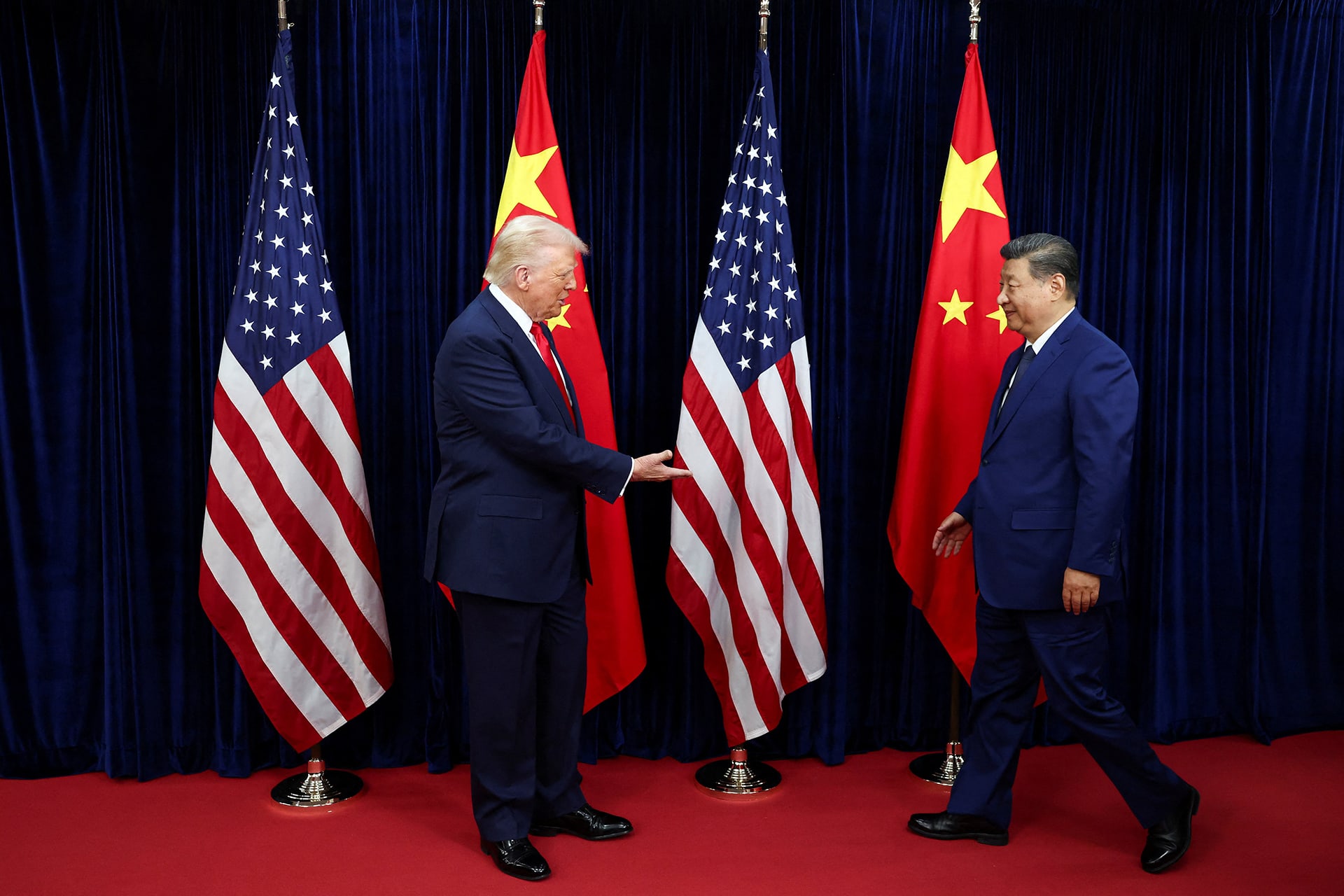
U.S. President Donald Trump and Chinese President Xi Jinping are slated to meet in Beijing on May 14–15, a summit that was delayed in March following the U.S. and Israeli strikes on Iran. It marks the first state visit to China from a U.S. president since 2017, when Trump was first in office.
Geopolitical tensions, particularly trade, Taiwan, the Iran war, and artificial intelligence (AI) loom over the upcoming meeting. Meanwhile, the global economy continues to feel the effects of soaring oil and gas prices from the Strait of Hormuz blockade and the fragile trade truce between the United States and China.
To unpack the latest developments, five CFR experts analyze different aspects of the U.S.-China relationship and what to expect from the upcoming summit.
The Trump-Xi Summit Gives Beijing a Chance to “Manage” Washington
Rush Doshi is the C.V. Starr senior fellow for Asia studies and director of the China Strategy Initiative at the Council on Foreign Relations.
When President Donald Trump arrives in Beijing on May 14, the summit will fall far short of his last trip in 2017. Then, Chinese President Xi Jinping staged a “state visit-plus,” which included a private dinner in the Forbidden City, a parade through Tiananmen Square, and a Great Hall ceremony unveiling $250 billion in business deals. Now, Trump will meet the Chinese leader convinced he is winning.
Xi has long told cadres that “the East is rising and the West is declining” and that “time and momentum” are on China’s side. His confidence further strengthened last year when he successfully beat back Trump’s unprecedented trade escalation, which pushed tariffs past 140 percent, by wielding China’s “break glass” tool of rare earth minerals and magnets. When Xi threatened to restrict those flows in April and October 2025, Trump folded rather than credibly threaten escalation. Beijing, meanwhile, has kept pressing—continuing to occasionally throttle rare earth and magnet supplies to the United States while expanding its anti-foreign sanctions arsenal, among other steps. The result has been an uneasy détente, albeit one favoring Beijing.
With these tensions as a backdrop, four issues will likely be central to the two leaders’ meeting. The first is the economic agenda. China’s aim is to buy more time to consolidate its technological and industrial position and reignite its faltering economy; the U.S. aim is probably to secure symbolic wins rather than more meaningful structural reforms to China’s economic model. Beijing is probably willing to buy Boeing aircraft and American soybeans for stability, and to announce the “Board of Trade” and parallel “Board of Investment” already sketched out in previous working-level talks. A headline Chinese investment commitment is plausible, but it may not ultimately be credible. The $83.7 billion West Virginia memorandum of understanding produced during Trump’s 2017 Beijing visit exceeded the state’s entire GDP and never materialized.
The second issue is Taiwan. Across the half-dozen Trump-Xi exchanges since January 2025, Trump’s readouts have centered on economic matters while Chinese readouts have increasingly centered on Taiwan. Chinese scholars suggest Beijing will press for a shift in U.S. declaratory policy—ideally an explicit statement opposing Taiwan independence rather than “not supporting” it—and for U.S. pre-negotiation on arms sales, both major changes to U.S. policy. The administration has already delayed a major arms package, and Trump has publicly acknowledged discussing arms sales with Xi.
The third issue is Iran. It is awkward that, as the leaders meet, the U.S. Navy is blockading the Strait of Hormuz and intercepting tankers bound for China—Iran’s largest crude buyer. Meanwhile, Beijing is providing political and possibly intelligence support to Tehran and could be seeking to renew flows of drone parts, air defense equipment, and missiles. Neither side is likely to make progress on this issue, but the fact that the summit appears ready to proceed despite this unusual situation is proof both leaders want the optics of stability even if its foundations are shaky.
The fourth issue is AI. The Biden-Xi summits in 2023 and 2024 saw the formation of a working-level AI dialogue and agreement not to connect AI to nuclear command and control. This meeting may build on that foundation with modest deliverables.
More meetings will follow this one. The two leaders will likely meet again at the Asia-Pacific Economic Cooperation (APEC) forum in Shenzhen, China, the Group of Twenty meeting in Miami, and a separate Xi state visit to Washington. Beijing may use these meetings to “manage” the United States, inducing Trump to put off necessary competitive steps for the sake of bilateral stability. That would in turn ratify the current détente on terms favorable to Beijing.
How Trump Should Approach AI Talks With China: Targeted Dialogue, Maximum Pressure
Chris McGuire is a senior fellow for China and emerging technologies at the Council on Foreign Relations. Read his full analysis of the upcoming U.S.–China AI talks.
President Donald Trump and President Xi Jinping plan to discuss AI when they meet in Beijing—as they should. AI is reshaping the global economy and the modern battlefield, and the most powerful AI models are doubling in capability every four months.
The two governments are reportedly considering establishing an AI safety dialogue, which China has long sought. The United States and China do have a shared interest in preventing the release of AI models with certain dangerous capabilities. However, the Chinese government’s actual willingness to make and abide by robust AI safety commitments is low. Beijing views these dialogues primarily as an opportunity to expand China’s access to U.S. technology and close the AI gap.
This dynamic was on full display in 2024, during the sole dialogue between the U.S. and Chinese governments on AI safety. The United States sent technical experts to outline shared risks; China sent diplomats to complain about export controls on AI chips. Chinese AI companies and government leaders have repeatedly stated that U.S. export controls are the single biggest constraint on China’s AI development.
The United States retains about an eight month lead over China in AI—a significant margin, but a gap that China believes it can overcome. As AI capabilities rapidly advance, Chinese AI-enabled cyberattacks and military operations may soon become the largest national security threat the United States and its allies face. The smaller the gap, the more China can hold the United States at risk and capture global market share. So long as China believes it has a chance of catching up with the United States in AI and does not fear reprisal from the United States for potential noncompliance, an effective U.S.-China agreement on AI safety is unattainable.
But if the U.S. lead expanded from eight months to eighteen or twenty-four—an eternity in AI development—Beijing would have strong incentives to negotiate, and to comply, fearing detection and reprisal enabled by superior U.S. models. It could achieve this by strengthening export controls that prevent China from making, buying, or renting U.S. AI chips, which China’s AI development is extremely dependent on.
Trump’s goal in Beijing should not be to reach an agreement with China on AI safety but to create the conditions for such an agreement down the road. If the Trump administration does establish a dialogue with China on AI—which could help lay the foundation for substantive negotiations—it should set clear expectations that the dialogue will be narrowly focused on safety issues and not cover export controls, and couple it with a “maximum pressure” campaign that closes all loopholes in U.S. export controls to expand the U.S. lead over China in AI as much as possible.
The alternatives are to give China the tools to catch up while hoping it operates in good faith and does not use these capabilities against the United States—or to wait for a catastrophe to instill a sense of genuine global responsibility in Beijing. Neither is a responsible option. Maximum pressure with dialogue not only preserves U.S. AI leadership, it’s also the best way to achieve long-term AI safety.
China’s Critical Mineral Dominance Makes Beijing Confident Ahead of Summit
Heidi E. Crebo-Rediker is a senior fellow in the Center for Geoeconomic Studies at the Council on Foreign Relations.
The mid-May summit between U.S. President Donald Trump and Chinese President Xi Jinping will unfold against a consequential shift in economic power since the two leaders last met at the 2025 APEC summit in Busan, South Korea. The center of gravity moved away from tariffs—long seen by Trump as the decisive lever—and toward something more structural: China’s control over critical minerals, rare earths, and the magnet supply chains that underpin modern military capability and advanced manufacturing.
Since the fragile October 2025 trade truce, U.S.-China tensions have cooled just enough to stabilize markets. But the United States heads to the summit facing an uncomfortable reality: Its rapid expenditure of advanced weapons systems in the Middle East and Ukraine will compound deep vulnerabilities in supply chains tied to rare earth elements and permanent magnets—inputs overwhelmingly dominated by China. Replenishing missile systems, precision-guided munitions, interceptors, and advanced electronics now depends on even greater access to materials processed or produced almost entirely within China’s critical minerals ecosystem.
For Beijing, this deepens the value of its strategic investment in critical mineral dominance. China’s control over midstream processing and magnet manufacturing becomes more—not less—central as global demand surges. The simultaneous rearmament of the United States, Europe, and Japan—coupled with expanding commercial demand for batteries, semiconductors, and consumer electronics—will further enhance China’s control over global supply chains. What was once a niche industrial advantage is now a systemic lever of geopolitical influence.
China’s Xi is likely to project calm confidence as he approaches the summit, reinforcing a message of stability and continuity. His objective will not be confrontation but control—allowing Beijing to maintain a managed equilibrium that advances its domestic priorities. Chief among these priorities is accelerating semiconductor self-sufficiency and further insulating China from Western technological dependencies under its dual circulation strategy—while also tightening the screws on foreign access to Chinese innovation and sharpening the country’s coercive economic toolkit.
The challenge is more acute for Washington. Although the United States and its allies are mobilizing investment into alternative critical mineral supply chains at pace, mainly in new mining and processing capacity, these efforts face years, if not decades, to realize.
The best outcome of the summit is a tacit extension of the current truce with some deliverables on agriculture, aerospace, and investment. This uneasy stability serves both sides: It buys China time to consolidate technological autonomy and further sharpen its economic security controls, and it gives the United States and its partners a narrow window to build some resilience into their own industrial bases.
But the underlying asymmetry will persist. In the emerging era of economic statecraft, control over critical materials—not just markets and technology—defines power. And on that front, Beijing arrives at the table with a decisive advantage.
Will Taiwan Be on the Menu at the Summit?
David Sacks is a fellow for Asia studies at the Council on Foreign Relations.
Chinese leader Xi Jinping likely sees a window of opportunity to secure changes to U.S. policy toward Taiwan during U.S. President Donald Trump’s visit to Beijing. Chinese Foreign Minister Wang Yi signaled as much, warning U.S. Secretary of State Marco Rubio that Taiwan “is the biggest risk in China-U.S. relations.” Wang urged the United States to “honor its commitments and make the right choice, to open up new space for China-U.S. cooperation.” In other words, adjustments to U.S. policy toward Taiwan are the price of securing Chinese cooperation on bilateral and global issues.
Trump’s ambivalence toward Taiwan has created, in China’s eyes, an opening to pressure the United States into changing its Taiwan policy. Trump does not believe that the United States is in a long-term strategic competition with China or that this era will be defined as a contest between democracy and autocracy—framing that highlights Taiwan’s importance to the United States. He has voiced skepticism about defending Taiwan and has blamed it for stealing the U.S. semiconductor manufacturing industry. In his second term, Trump denied a transit requested by Taiwan’s President Lai Ching-te to the United States and has reportedly delayed a major arms sale to the island.
Xi could press Trump to formally oppose Taiwan independence (a departure from the current U.S. policy that does not support Taiwan independence), support “peaceful reunification,” or even endorse Beijing’s “one China principle,” which asserts that Taiwan is a part of the People’s Republic of China. Beyond pushing for rhetorical shifts, Xi could also seek to convince Trump to limit arms sales to Taiwan and curtail security cooperation with the island. Xi is also determined to make Japanese Prime Minister Takaichi Sanae pay a price for describing a Taiwan contingency as a potential “survival-threatening situation”—language that could enable Japan to activate its collective self-defense provisions and allow Japanese forces to operate alongside U.S. forces. Xi could press Trump to distance himself from Takaichi’s position and urge Japan to stay out of Taiwan-related matters.
To make his case to Trump, Xi could try to leverage the recent visit of Chinese Nationalist Party (KMT) Chair Cheng Li-wun, who favors closer ties to China, to portray Lai as someone who does not represent mainstream Taiwanese public opinion. Through Xi’s framing, Lai is a reckless leader whom Beijing and Washington should jointly restrain. The Chinese leader could also attempt to trade the economic commitments Trump prioritizes—such as a pledge to keep critical minerals and rare earths flowing, commodity purchases, and potentially even investments in the United States—for Taiwan-related concessions.
Taiwanese leaders sense that these dynamics could place Taipei in a precarious position. “What we are the most afraid is to put Taiwan on the menu of the talk between Xi Jinping and President Trump,” a senior Taiwanese official told Bloomberg in a recent interview. If Trump were to adjust the U.S. approach to Taiwan in the face of Chinese pressure, it would fuel Taiwanese distrust of the United States, which would in turn undermine support within Taiwan for much-needed defense investments. While some may argue that less faith in Washington could spur Taipei to do more to take its defense into its own hands, it is confidence in the United States that gives Taiwan the political and strategic space to invest in its own defense. Taiwan has already made significant progress in overhauling its military, boosting defense spending, and investing in asymmetric capabilities. Changes to U.S. policy would undercut these efforts at precisely the moment Taiwan’s commitment to its own defense is growing.
China’s aim is to sow Taiwanese distrust in the United States as a means of undermining the island’s efforts to invest in defense and create the perception among the Taiwanese people that their only option is to unify with China. Adjusting the U.S. approach to Taiwan because of Chinese pressure would thus bring Xi closer to his ultimate goal of absorbing Taiwan. Trump standing firm is the best way to close China’s perceived window of opportunity to secure adjustments to U.S. policy on Taiwan.
The Iran War Has Weakened Trump’s Energy Card Ahead of Xi Summit
David M. Hart is a senior fellow for climate and energy at the Council on Foreign Relations.
“Dominance” is the central theme of U.S. President Donald Trump’s energy policy. He seeks to use the U.S. booming oil and natural gas output as geopolitical leverage. Chinese President Xi Jinping has a similar aim. He seeks to use China’s booming output of electricity-generating and -using technologies to advance its position. While both have racked up wins, Trump’s military gamble in Iran has fundamentally weakened his hand.
Like many Trumpisms, “energy dominance” is not an easy term to pin down. The second Trump administration keeps ancient money-losing coal plants afloat, even as it pursues a “renaissance” for nuclear power. It proclaims the artificial intelligence race with China is an existential contest, even as it seeks to cripple renewable and efficiency resources that would provide the fastest “speed to power” that major tech companies are begging for.
The purest expression of “energy dominance” is found in Trump’s trade deals. The European Union, Japan, South Korea, and numerous other partners have agreed to buy hundreds of billions of dollars’ worth of liquified natural gas (LNG) and other energy products in exchange for tariff relief for their exports to the United States. If fulfilled, these purchases will require long-lived infrastructure that U.S. producers can feed into the coming decades.
Beijing wants its trade partners to build a different kind of infrastructure that it can feed. China dominates the global production of solar panels, wind turbines, lithium-ion batteries, electric vehicles, and the materials and components that go into them. With its domestic markets saturated, Chinese producers are offering “electrotech” to the world at bargain prices.
Xi’s version of “energy dominance” is wrapped in a more benign package than Trump’s. The “electrostate” promises more rapid and secure economic development with fewer environmental effects than the “petrostate.” Although China is by far the world’s leading source of climate-altering emissions, its cleantech prowess, combined with Trump’s truculent denials, allows Beijing to make a credible case to be the world’s climate leader.
When the two leaders meet this month, Trump may ask Xi to resume purchases of U.S. oil and LNG. Any promises Xi makes are likely to be more show than substance. China’s strategy is moving in the opposite direction. Although China has had the largest volume of trade of any country disrupted by the blockade of the Strait of Hormuz, it has also built the strongest buffers against the energy shock by stockpiling reserves and diversifying imports. At the same time, China’s electrification moderates its oil and LNG consumption.
Indeed, the U.S.-Israeli war against Iran has bolstered the global prospects of the electrostate immeasurably. Chinese exports of energy goods are soaring. Dependence on China for the capital goods required to build out electricity infrastructure is more appealing to many energy importers than dependence on the United States, the Middle East, or Russia for fuels consumed continuously. Once that infrastructure is in place, the threat of a trade disruption to electrical goods is limited to slower future growth, rather than an immediate economic crisis brought by fuel shortages.
Each day the strait remains closed, China’s long-term position grows stronger. Yet, the marginal gains at this point are limited. Countries across Asia and beyond that have already suffered grave damage in the current crisis are unlikely to forget it. Ironically, Xi could use the summit to help reopen the strait, flexing China’s leverage over Iran. Trump needs this outcome more than Xi, which could enable China to emerge from the summit as a winner in both the short term and the long term.
Whatever its domestic appeal, “energy dominance” was never going to be a winning formula abroad. No country wants to be dominated. The sharpening electrostate vs. petrostate axis of international politics is putting Trump’s rhetoric to the test. China’s softer approach to wielding power and its cleaner technology are proving to be a winning hand.
This work represents the views and opinions solely of the authors. The Council on Foreign Relations is an independent, nonpartisan membership organization, think tank, and publisher, and takes no institutional positions on matters of policy.
Clara Fong edited this article.