Cabin Crew, Prepare for Surgery
On this episode of Why It Matters, we sit down with experts to discuss medical tourism, examining the forces that push patients to go abroad for care, the countries that have capitalized on demand, and the question of who bears the cost.

Published
Host
 Director, Podcasting
[Video: https://youtu.be/iXmO8G7wSqg]
transcript
Every year, millions of people go abroad for medical care.
The reasons vary a lot. Some people are chasing procedures they can’t get at home. Others want a cosmetic fix from a country known for their expertise. For plenty of Americans, it’s often cheaper and faster to go abroad for care.
And according to the CDC and other experts, this travel trend is on the rise. Governments are hopping on board, hoping to attract medical tourists - and their wallets - to their countries. AI is now in the mix, allowing medical tourists to set up appointments and do research with even greater ease. Social media allows international doctors and hospitals to advertise to potential patients across the ocean.
In theory increased access and options are a good thing. But since this is a global phenomenon, there is of course a flip side. For patients and for the countries they visit, there’s a lot of ethical gray area and a lot of open questions. What happens if something goes wrong? What global body is overseeing this process? And what does it mean when a country’s best doctors are treating foreigners who pay more instead of the local population?
I’m Gabrielle Sierra, and this is Why It Matters. Today, we’re looking at why more and more people are going abroad for care and what’s at stake. This is episode three in our series on the fragility of the global health system, and the vulnerable spot the U.S. finds itself in right now.
Grab your passport—here we go.
SIERRA: Okay you must answer questions about medical tourism all the time - how do you usually start explaining things to people?
CROOKS: So for me, when I’m talking about medical tourism, I’m talking about a patient self-initiating the decision to go abroad for privately funded medical care in another country.
I’m Valorie Crooks. I’m a professor at Simon Fraser University, where I’m also the Associate Vice President of Research. But in my own research as a health geographer for more than a decade now, I’ve been looking at equity and ethical issues related to medical tourism, all kinds of complicated questions, with a lot of work being done in the Caribbean region. But also this work has taken me to a number of countries in Mongolia, Colombia, South Korea, a really diverse grouping of countries that are involved in medical tourism in one way or the other.
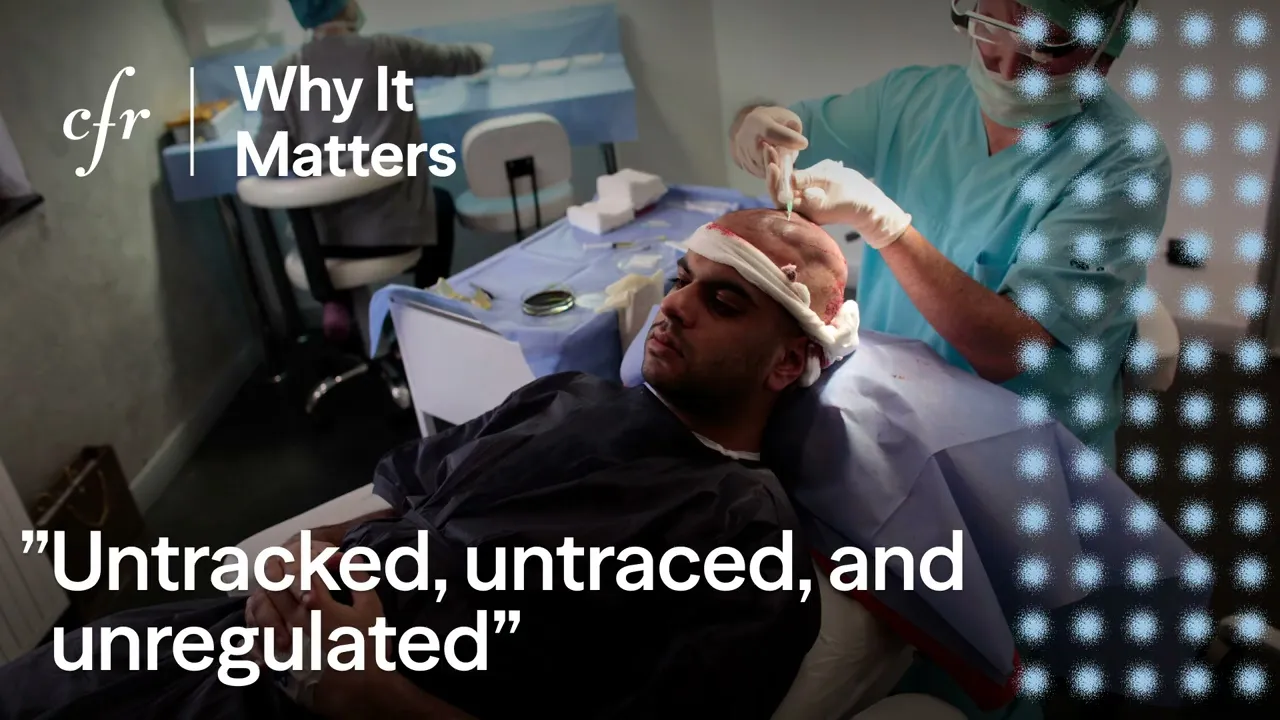
CROOKS: Medical tourism falls into what I call the triple U’s around global healthcare mobilities in that it’s untracked, untraced, and unregulated. So most of the information that we have that gives us any indication around trends actually comes from people that are involved in the sector already, usually when it’s beneficial for their business practice. But there are some parts of the medical tourism sector where sharing numbers outwardly around how many people are coming is not something that is actually sort of helpful for them. As well, there are no sort of national or global bodies that actually gather that information reliably. So what happens is that the kinds of information we get on where people are going, it’s very partial. If what’s being reported out are the number of procedures and not the number of patients, then it can seem very inflated in terms of the number of travelers. So therefore, when you report 10,000 medical tourists, it was actually 2,000 medical tourists who each had, you know, 15 tooth extractions or whatever it might be. And that’s true, not just in terms of the numbers, but also in terms of the geography.
Medical tourism is difficult to quantify, largely because so many countries are involved, and procedures are hard to track. But in 2007, a widely cited estimate from Deloitte noted that about 750,000 Americans a year traveled abroad for medical care, although I do have to add that other researchers think that guess was far too high. According to the American Association for Physician Leadership, that number has grown to around 1.4 million today. And globally, the Medical Tourism Association cites that approximately 14 million people travel across borders each year to receive medical treatment.
COHEN: There are actually lots of instances where tourism is combined with medical treatment. So for example, there were instances of what were called surgery safaris where you get for example cosmetic work done and go on safari in Africa. They’re often spa elements to some of these kinds of travels, but there’s also people who are traveling for something that is life-saving like a cardiac bypass, something that’s restoring function like a hip replacement, experimental therapy that’s unavailable, trying to get surrogacy. So it really is a very wide range of things.
COHEN: My name is Glenn Cohen. I’m a professor at Harvard Law School and I specialize in health law and bioethics.
SIERRA: Okay let’s get deeper into that wide range, what are we talking about here?
COHEN: We’ve got travel for things that are legal in the place you’re coming from in the place you’re going to. Hip replacements, cardiac bypass, Turkish hair. You know therapies also, you know stem cell therapies, peptides, very wide variety. Then we’ve got medical tourism of things that are illegal in your home country but legal in the destination country: travel for abortion, travel for assisted suicide, travel for surrogacy. We’re actually a big destination for surrogacy travel. And finally you’ve got travel for things that are illegal in both places but are more lightly monitored or surveilled where there’s a gray market in the latter and the best example of that is organ transplantation where we do have these markets for organs, even though it’s illegal in the places we’re going to buy an organ. Nonetheless, there is sort of a low-level mafia that is coordinating this kind of travel in this kind of trade and we do have sellers and buyers for kidneys, for example in places with transplantation happens.
CROOKS: So if you are abroad on a vacation or you’re abroad on an extended work stay and you have a trip and fall and you need to go to the hospital, you have to have treatment for a broken leg, maybe even have surgery for it, you’re not a medical tourist. You’re an ill or injured vacationer. And also another group that I don’t apply this definition of medical tourism to are people who are sent abroad by their home jurisdiction. And that does happen. So you could imagine, for example, I mentioned a few moments ago, I’ve done a lot of work in the Caribbean region. You get a number of very small countries that have health systems that may not be able to offer a complex surgical care, complex diagnostic care. And so it’s not uncommon for people as part of either their public insurance plan or their private insurance plan to need to go abroad.
COHEN: So there’s a couple things that probably motivates most people for medical travel. One is expertise. There are some things where expertise just much better abroad. Sex gender reassignment surgery in Thailand is a great example where for a long time it was viewed. There’s some actually I treatments that South America are done much better in terms of vision and stuff like that. So there definitely are things that they do elsewhere better than we do. So I don’t want to put that aside. But I would say the main reason people travel other than that is either cost or queuing and they’re related. In places like Canada where I’m from queuing is a major issue you may get the thing for free or covered by the government, but you’re gonna wait a long period of time and indeed, my mother was a medical traveler to the United States for her hip replacement both because there was a way of doing it that was not available in Canada at the time that had a shorter recovery period.
The U.S. International Trade Commission reports that about 100,000 to 200,000 people list health treatment as their primary reason for visiting the U.S.—though that number could be much higher. These patients generally come for high-tech, specialized treatments rather than low-cost care.
COHEN: But I think the main reason most people in the United States travel is cost and the cost again hard to get hard numbers on this but in many instances depending on where you go you may be basically paying 20 or 10 percent of the total cost you would pay in the United States than you would paying out of pocket. A lot of people who do this are uninsured or underinsured people who have full insurance tend to have that differential tends to be less impressive to them because they’re not the ones ultimately paying the full amount although with co-pays and deductibles and the complexity of the U.S. health care system they still end up paying a lot or they can’t forecast ahead of time what they’re gonna pay.
Let’s do a quick breakdown to see just how much medical tourists save.
A hip replacement that can run $40,000 or more in the U.S. might cost $5,000 to $8,000 in India. A heart bypass that can top $120,000 here is about $15,000 in Thailand. And a nose job that can run $10,000 or more in the U.S. might cost as little as $3,000 in Turkey or Mexico.
A report from Fortune Business Insights put the value of the global medical tourism market at $24 billion in 2023, with the figure expected to rise to over $100 billion by 2032.
SIERRA: I’m so curious since this is about travel, how long has this been going on? Does this go way back?
COHEN: Oh, yeah, absolutely. So I wrote a book on the subject in 2014 called Patients With Passports. But in fact this phenomenon goes way way back so you look at ancient Rome for example, you look at the Asclepia, you look at the Roman baths, you look at these kinds of periods of times people traveled in the ancient world. For health care travel was a lot harder than up until essentially the modern era where we’ve had actually people traveling to Mexico for example from the United States for a very long time. But I would say the last 20 years or so has had an uptick and increasing interest with social media’s increase as well as the ease of international travel.
CROOKS: There are all kinds of reasons why certain countries we hear about quite often, and a lot of that comes down to social media.
“We went to Prince Court Medical Center here in Kuala Lumpur. It was top notch, with beautiful facilities, excellent professional staff.”
“So now we can go to Turkey, go to this hospital, get the VIP full body checkup, top tier experience. But also, you’re in Turkey, and I don’t know if you guys have ever been to Turkey before, but this is one of my favorite destinations in the world. “
Social media is doing way more than just marketing these days. Get this...68 percent of medical tourists check social media, as either their primary or secondary source before deciding on healthcare abroad. That’s more than two out of three people! And it makes sense. If you’re about to fly across the world for surgery, you want to hear real patient stories, watch a walkthrough of the procedure, and meet your doctor before you book anything. Some doctors even answer questions live.
Add AI to the mix, and hospitals overseas can target specific demographics seeking trending treatments, and build real trust, not just glossy brochure trust.
CROOKS: Social media is now heavily used as a mechanism to share information about medical tourism and about destinations. When I was first involved in this research, I had never even heard the phrase “Turkey teeth.” And I knew that people were going to countries in Eastern Europe for dental care and for other procedures. But now this is a phrase that I could probably say in conversation with a number of different groups where I want to say, at least half the people would understand the reference without going, what are you talking about? What is Turkey teeth?
SIERRA: Or you know, BBLs or you know, anything like that...
CROOKS: This is exactly it. Yeah. Also the sector, it’s an entity. Think of it as a live organism. It’s looking also at what’s happening in terms of global trends and trying to respond. So that example of the BBL is perfect. That was not something when I was first looking at medical tourism over a decade ago that was really dominating the public discourse or popular conversation around medical tourism. Now it’s something where, again, within social media feeds, it’s become quite normalized. Then there are other aspects as well that you might think, “Oh, this is such a predominant destination” because you hear a lot about it. But yes, when you think about it in relation to those triple U’s, so untracked, untraced, unregulated, then you can understand why all information that you’re going to get is partial and that there is a lot of complexity to this practice that falls outside the scope of what somebody would really know from social media.
COHEN: If you browse Instagram, you might actually see a Turkish hair transplant or BBL facility advertising or more likely a patient who’s telling their story in a way that actually might also be the product of an agreement with the clinic for a discount they got or something like that to promote.
Similar to paid advertisements for protein powder or makeup, influencers are now doing partnerships with medical facilities and doctors abroad. One new trend is the full-body exam: MRIs, bloodwork, dental, the works. In Turkey, influencers chronicle how one clinic sends a driver to pick you up and bring you to what looks more like a boujee mall than a doctor’s office. Post after post features that same clinic, with influencer affiliate links and discount codes in the captions. The same thing can be seen happening in South Korea.
“I flew all the way to South Korea to get a facial fat graft and endoscopic browlift, and I filmed everything so you guys can see exactly what it’s like to get plastic surgery in another country. Full disclosure, my surgeries were comped for documenting the process. I always dragged my parents along for the ride...”
SIERRA: Okay let’s talk for a second about what this really is, which is increased tourism to a country which then brings in money, and customers for a private or state-owned business which brings in money. Are local governments and private medical practices actively trying to bring in medical tourists?
COHEN: So first of all say some of the largest hospitals that do this and there are some really great well-known centers like Bumrungrad in Thailand. They may have individuals in their employ including offices in places like the United States that’ll be involved with trying to recruit foreign patients and try to you know sell themselves to foreign patients in the United States and actually, you know it’s easy to be exceptional about this thing about U.S. patients traveling, but we are a huge destination for medical travelers. You look at the best hospitals in the United States—the most famous: Mayo, Mass General Brigham, for example, they recruit a lot of foreign patients to come to that. So one thing is that the hospital system itself might have advertising or might have patient recruitment opportunities.
Another is that we have some partnerships between some foreign hospitals and some U.S. based hospitals like the Mayo system for example and others and that might be a pathway a patient follows to get travel abroad or to come to the United States.
The third way is what’s sometimes called facilitators and these are a bit of a motley crew. They’re everybody from a travel agent who’s like doing this on the side to a medical doctor who’s retired and basically, their job is to reduce the friction between the patient and the ultimate destination. They’re there in theory to help you choose possible providers in a foreign country to help make sure you’re an appropriate candidate to share records to kind of vet and then on the back end to help coordinate follow-up care and the life. So that’s a third pathway.
That third path comes in a lot of different forms. Some companies run online platforms that match you with hospitals and doctors abroad, then help you book it all. Others are more hands-on: they’ll send an interpreter to your appointments, or even a dedicated companion who handles the logistics and personal care for your whole trip. And this isn’t a cottage industry. There’s a trade group, the Medical Tourism Association, that connects these companies to each other and to hospitals through summits and its own magazine.
COHEN: The destination countries themselves may be spending money to sort of advertise and to build up this sector because one of the advantages to some of these countries is the volume of a particular kind of patient may be too small to sustain that particular health care specialty in multiple regions in the country. And oh by the way even though this health care seems extremely cheap for American patients for the patients for a country like Thailand or India the dollars paid compared to a local citizen are extremely high. So there can be a lot of money here and indeed, you know I traveled to a bunch of different countries to learn about their industries and also to observe them firsthand and spend time in the different hospitals, which was fascinating. But one of the things I saw was that often the lead partner might not be the health ministry but the tourism ministry or the business ministry or some combination of the two. So for some countries, this has been a strategy to help shore up their health care system.
CROOKS: So I have done research actually with Canadian snowbirds, so older Canadians who winter in Yuma, Arizona, which is right on the border with Mexico, but right across the border is Los Algodones, Mexico, which is a very small community with an incredibly high density of dentists.
SIERRA: Wow.
CROOKS: It’s known as molar city.
“Rising up from the Mexican desert, an oasis for dental care. The self-proclaimed dental capital of the world.”
“As soon as you cross the border into Mexico, you’ll see dental clinic after dental clinic. Many catering to American patients, and most making promises of big savings on big procedures.”
CROOKS: That’s where, you know, the entire town really is there to provide low cost pharmaceuticals and also provide dental care heavily for Canadians and Americans, but also other international travelers who do come specifically there as medical tourists and so within the, the part of the city where the dental clinics are, you could imagine that that’s a very desirable place for street vendors to want to be because they’re actually, they’re actually going to get a lot of foot traffic. This is a city where you can actually park on the U.S. border side and walk into the city and so you get a lot of people that are traversing on foot, so you have in this city a huge amount of formal and informal policing, not necessarily done by police themselves, around the street vendor sector, around who gets to be able to sell goods to these medical tourists that are coming. You know, there’s one hotel in the town, you know, they serve lots of mashed potatoes, they serve lots of soft food for all of the people that are going to get their, their dental care done, but that, that reputational protection piece you know, around the street vendors, around the visibility, around what it means in the minds of those that are running these dental clinics to provide a welcoming environment, they, you know, try to instill that throughout this very small town.
If you google Molar City, the local website is the first thing that pops up. And right on the home page in big letters is “No. 1 Dental Tourism Destination.” On many of these sites, one of the first things you’ll read is how many thousands of people have gone there for dental care. And to top it off they throw in flight discounts and all-inclusive hotel packages to make your doctor’s visit feel like more of a vacation.
SIERRA: So there has to be a catch.
COHEN: So there’s a lot of catches.
SIERRA: Okay.
COHEN: Again catches don’t mean this is the evil empire don’t ever do this. It means we should look at it ethically legally also for personal choices with eyes wide open. So what are the kinds of things they tell people to think about them? We can talk about them in more detail. One is just the quality of the health care you’re gonna get. How do you know? What’s good quality? What’s bad quality? How are you gonna shop for it? Second is are you well enough to travel to go abroad to do this? Especially if you’re someone with a critical and that’s not going for BBL but for a cardiac bypass, for example, this is taxing on the body. Third is to say your experience as a patient abroad in the U.S. we understand a whole bunch of legal protections people have whether that’s malpractice something goes wrong whether it’s under discrimination law if you have a same-sex partner and you travel with that person are they gonna respect that person’s rights if you fall into a comb on what to have? Then there’s the question of the follow-up care. Are you gonna be in a good position to be able to coordinate the follow-up care on the way home?
Are you gonna be able to have a physician that’s willing to see you in your treatment? Are they going to be able to use the records that were provided by the foreign country’s hospital, for example, and then maybe finally so just talking about the legal stuff the legal stuff raises other issues. I would say a big issue is just the effect you’re having on the health care access as an equity matter of the place you’re going. So I often say as a traveler you should try not to leave places worse off than when you arrived and there’s a way in which as a dynamic this can be very helpful for a health care system abroad. It can help maintain doctors. It can help improve funding but there are other stories where in fact it’s competing with the access of local individuals to physicians and to surgeries and to treatments they need and are you distorting it? What is your net effect? And what can you do about it?
CROOKS: There are different ways in which medical tourism operates as a practice. So in some instances, you have existing hospitals that open up a wing where they’re trying to sort of attract higher paying international patients. In other instances, you’ll have a purpose built clinic or hospital from the ground up that’s trying to attract international patients. There are concerns around sort of cherry picking of health workers out of public health care systems in these destination countries and bringing them into medical tourism facilities that are going to be providing care for people other than those who are local. So human resources or health care workers, oftentimes there are some form of public subsidy of the education that they receive. And if you have that resource shifting and focus to higher paying international patients. If you lose the capacity of even a limited number of physicians or nurses where they will then be practicing within a medical tourism hospital or clinic, then it can actually cause in very small countries, such as, you know, some of the small island nations in the Caribbean, that can have a devastating ripple effect on the public health care system in ways that are really challenging.
So how widespread is this? Honestly, no one can say for sure. There’s no global tally of countries feeling the squeeze. But the same worry keeps surfacing in a few places.
According to the National Institute of Health, Thailand, one of the biggest medical tourism hubs in the world, has dealt with fears that doctors and nurses are leaving public hospitals for private ones that serve foreign patients, even though most Thais rely on the public system. Researchers have raised the same alarm across Southeast Asia. And in the Caribbean, places like Barbados, Jamaica, and the Cayman Islands are building hospitals meant to serve both locals and visitors, which is exactly the setup Crooks is describing.
CROOKS: We think of the care abroad in that hospital or clinic for a medical tourist as being part of the private health care system typically. There are oftentimes tax incentives to do these things. And so these tax incentives are really the public subsidizing this private practice around medical tourism. And there are lots of instances where, you know, there are international investors who are looking to open these hospitals and clinics. So ultimately, the money that is made does not stay local. In some cases, medical tourism is like an offshoring practice.
COHEN: A second piece of it is just this question about the ethics. Some of this is really shopping for price and the ability like I’m concerned for the person so it’s paternalistic. Others though have significant impacts on other people’s lives and how those lives go. So when it comes to organ transplantation, the buying and selling of organs, in my book I talked about some of the narratives of these people who sell their kidneys in this kind of low-level mafia, and you know they’re promised one price, they get a different price. They’re facing something like they are in indentured servitude or they’re in just abject poverty and they want to buy their way into a stall in a market for example. And this is their life hope of this will happen. And yet when you follow what happens to them after all of this they rarely achieve those goals and more importantly they may be actually now stigmatized from the scar we see from the kidney removal as somebody who sold a kidney and ostracized by their home community. It’s quite tragic. And just the people who coordinate this as I often say there are people who basically come from Bangladesh who are transported to South Africa or to Turkey where a doctor from another place will perform a surgery for a U.S. citizen so this idea that we’re coordinating this international kind of cabal of people often and in a way that is against the law and all the places where this is coming from requires the involvement of a lower-level mafia who might themselves use tactics of intimidation removing passports threatening people with violence holing up in hotels and the like.
In Bangladesh, buying or selling organs has been illegal since 1999. Yet no one has ever been prosecuted for organ trafficking, and the country remains a major source of organs for transplant tourism.
Egypt is on the flip side.
“What we want is to avoid Egyptian citizens becoming commodities, products, or spare parts for foreigners.”
It has passed laws banning organ trading, yet it’s still a major destination for transplant tourism. Part of the reason is cultural. Many people are uncomfortable with organs from deceased donors, partly out of a belief that a person will need their organs after death. Others feel indebted to whoever donates an organ.
Both countries rank among the palaces with the highest rates of organ trafficking in the world.
COHEN: Then on the reproductive side I think it’s just much more ethically fraught in that there are very strongly different attitudes towards for example recruiting women from lower socioeconomic strata to be surrogates for example is something that is liberatory and respecting women’s choices or as the incensed exploitative and kind of treating pregnancy into a commodified kind of function, and this is I think a very interesting I think we’ve fought kind of space and worth talking about. It has been interesting to see over time how the market for surrogacy in particular moves almost like a whack-a-mole game that first it was India and then basically the Indian government got a lot of flack about it began regulating it moved to another country. That country now regulates it a little bit more tries to discourage it but it seems as though both the demand and supply functions kind of continue to cross. They just keep crossing at different places.
SIERRA: If I go to Mexico or Turkey or you know Brazil to get something a procedure I come home and they it’s just it’s messed up. Can I sue them in the other country?
COHEN: So two questions. Can you sue in the other country? Can you sue at home believe it or not? They might both be tricky. Okay, so suing the other country usually in theory possible. In reality you’d have to find a lawyer in another country who’s willing to take your case. You’d have to look at what the equivalent of malpractice for the malpractice law in other countries are. You may have trouble finding an expert who’s willing to testify against a local doctor. All of these things are obstacles that might make it quite difficult to sue abroad. Could you bring the lawsuit to the United States? Well again in theory, you’d have to have a basis for asserting what’s called personal jurisdiction over the foreign hospital. Have they done things in the United States? Do they have assets here at the end of the day you win and you can enforce a judgment against them. What law will apply there’s a question it’s called the choice or conflicts of law because it may be that you’ll get Malaysian malpractice law and a U.S. court will have to apply Malaysian or Indian malpractice law. There’s other stuff too.
SIERRA: (38:42 - 39:04) Well, I’m curious, you know as we come to a conclusion, you know why does this matter you wrote a whole book about it, right? So I’m so if I’m sitting here, you know, we’re asking these questions right now. You know, you have to acknowledge that we are in the Council on Foreign Relations. Does this matter to someone, you know doesn’t matter to Americans? Does it really have that much of an impact on my life?
COHEN: So I think it matters a heck of a lot to the people who have to use it. So that’s the first group is to say when you are in a position where you’re having to consider flying thousands of miles for a hip replacement a cardiac bypass matters a lot to you. Even when you’re somebody not in dire medical straits, but instead like many of us tempted, you know especially in this world of social media where we’re constantly confronted with people who are incredibly beautiful and look perfect and we wonder what’s wrong with me. Why is my hair and you can see my hairline? Why is my hairline so low like this right for those people, it matters. Also to understand what are my options and if I’m thinking about this, how seriously should I take it?
SIERRA: Yeah.
COHEN: People who are injured after they do it it matters a lot to understand what their rights are and what kinds of things they can do ahead of time to avoid it and then I think it matters a lot because for talking two more reasons one is what it shines as a flashlight on the deficiencies in existing health care systems the motivations to move and what our responsibilities to war towards them. But the other is it matters a lot I think in the places where people are going and again tourism can be a huge engine of development. It can make the lives of people who live in some of the poorest parts of the world much much better but can also distort their local economies. It can cause clinicians who might be in short supply the doctors and nurses to move from a public sector hospital to this medical tourism possible in such a way that people will really face large obstacles to access of health care as locals. You can also caught expose corruption or incentivize corruption in terms of what gets built and for whom and where the money flows. So I think it’s a really worthwhile thing to think about from all of those ways and then finally and there’s not a bad thing it’s just really interesting that to me the human stories involved and the idea that this has developed and this is maybe going on for a long time without people really thinking about it as a distinct phenomenon is something worth thinking about talking about in and of itself.
Medical tourism shows what happens when people can’t find the care they need close to home, and what it costs the places that step in to provide it. But whether patients are crossing borders to fix a hip or get a new nose, they’re all after the same thing: more good years in the bodies they have. And that comes down to longevity.
From new drugs to innovative therapies, the goal of longevity science is to add healthy years to our lives, not just more. But who gets access to those breakthroughs might be the bigger question. More on that, next time on Why It Matters.
Want to keep up with Why It Matters? Sign up to receive an email alert when new episodes are available at cfr.org/newsletters or click the link in our show notes. If you ever have any questions or suggestions or just want to chat with us, email at [email protected] or you can hit us up on X at @CFR_org.
This episode was produced by Molly McAnany, and me, Gabrielle Sierra. Our audio producer and sound designer is Markus Zakaria. Our intern this semester is Abigail Breyfogle. Our theme music is composed by Ceiri Torjussen.
You can subscribe to the show on Apple Podcasts, Spotify, YouTube or wherever you get your audio. For Why It Matters, this is Gabrielle Sierra signing off. See you soon!
Medical tourism, a growing global industry serving patients who seek care abroad, spans everything from dental work and BBLs to hip replacements, surrogacy, and organ transplants. Driven mostly by cost, wait times, and lack of access, medical tourists bring money to local economies but can also strain destination health systems.
Read More:
“Medical Tourism,” CDC
“Medical Tourism to Witness Exponential Growth by 2034,” World Health Expo
“Decision-making about bariatric and cosmetic medical tourism from countries with universal healthcare: a rapid systematic review,” National Institute of Health
This work represents the views solely of the host(s) and guest(s). The Council on Foreign Relations is an independent, nonpartisan membership organization, think tank, and publisher, and takes no institutional positions on matters of policy.
Producer
- Producer, Podcasts
Audio Producer & Sound Designer
- Audio Producer & Sound Designer
More Episodes
 29:35Podcast
 26:04Podcast
 38:36Podcast
 31:35Podcast
 37:32Podcast
 32:26Podcast