Canada’s AI Playbook: How a Middle Power Can Rely Less on U.S. Tech Giants
Canada has traded comprehensive AI legislation for sovereign capacity, targeted laws, and issue-based coalitions. David Lametti, the permanent representative of Canada to the United Nations and former minister of justice, explains why—and what that approach asks of international cooperation.
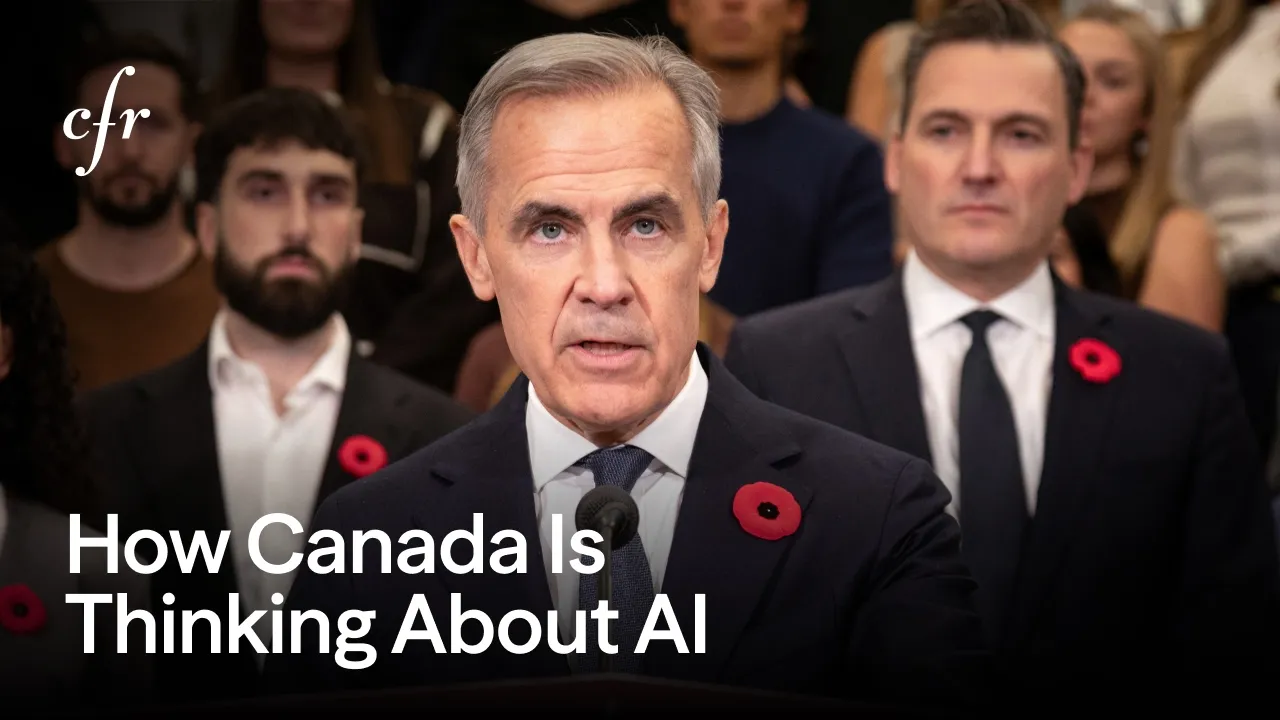

At the World Economic Forum in Davos, Switzerland, Canadian Prime Minister Mark Carney unveiled self-strengthening and engagement through “variable geometry” as the central tenets of his middle-power doctrine in response to the weaponization of economic integration. On AI, the goal is for countries to avoid being “forced to choose between hegemons and hyperscalers.” Few countries have higher hopes of driving this envisioned agency than Canada. Canada has demonstrated leadership on AI governance globally and has abundant energy, sovereign funds dedicated to computing power investment, a thriving research community that has produced talent and cutting-edge research, and partnerships to secure resources it doesn’t have at home.
On research, some notable contributions stand out: Geoffrey Hinton and other University of Toronto researchers demonstrated the viability of deep learning; Yoshua Bengio’s work with researchers at the University of Montreal improved the performance of neural networks through breakthroughs on next-word prediction and attention; and AlexNet [PDF], built by Hinton, Alex Krizhevsky, and Ilya Sutskever, demonstrated how much better neural networks trained on graphics processing units perform for image recognition. Those advances, among others attributable to Canadian institutions and researchers, helped enable a wave of AI innovation that led to the development of large language models.
Although Canadian research has been fundamental to modern AI, commercialization of those breakthroughs has been driven by U.S. companies, primarily through the acquisition of Canadian research ventures and intellectual property and the recruitment of Canadian-trained researchers to U.S. firms. The need to drive adoption and capture the economic value of Canada’s intellectual contributions, amid concerns about trust and safety, has been a common denominator across its AI governance approaches. An ongoing trade war with the United States and the Mythos kill-switch moment have added another dimension: managing interdependence with “hegemons and hyperscalers.”
The first country to produce a national AI strategy in 2017, Canada has changed course frequently. In 2022, the government tabled the Artificial Intelligence and Data Act, a comprehensive, risk-based framework that would have imposed obligations on high-impact AI systems but deferred the criteria for those systems to future regulation. It was, in the words of David Lametti, Canada’s ambassador to the United Nations, “edging more towards the European model.” [07:37] Tabled a few months before the release of ChatGPT, the bill was the subject of government amendments in late 2023 that sought to bring general-purpose systems within its scope. The bill was criticized for vagueness and a lack of public consultation in drafting, and died when Parliament was prorogued in January 2025, highlighting the challenges faced by comprehensive legislative approaches to an amorphously developing technology.
Canada has replaced this mindset with a theory of how a middle power exercises leverage over a technology developed by a few and deployed to many. Rather than a single, economy-wide AI law for a general-purpose technology, the government’s newest approach has three tracks: building sovereign capacity, legislating against specific harms, and forming issue-based coalitions. Its AI for All strategy, released in June 2026, seeks to protect Canadians from harms, spread adoption, build Canadian-controlled infrastructure, and scale domestic firms. Critics have voiced concerns about its largely voluntary nature, the lack of a designated actor charged with coordinating national security across its six pillars, and its underlying assumption of causal relationships between actions and objectives, such as AI literacy producing trust.
The first track, sovereign capacity, is a response to a changing geopolitical landscape. Lametti framed AI as an economic priority “in this post-Davos world.” [13:15] Canada, he said, does not “want to be reliant on hyperscalers that are south of the border.” [11:00] The central trade-off is between control and cost. Compute that Canada owns is harder for a foreign government or company to restrict, but it will be smaller and likely costlier than capacity rented from U.S. hyperscalers, and money spent building compute comes at the opportunity cost of investment in adoption. Lametti described “the real digital divide” as the gap in computing power between a handful of companies and every government, including the U.S. government. [18:03] The financial disparity is glaring: Meta [PDF] committed to investing C$13 billion in a single data center in Alberta, whereas the Canadian government committed to spending C$2 billion on sovereign compute over a five-year period. Canada does not seek parity: “You just need to have enough,” Lametti said, to build frontier models, diffuse the technology, and run testing. [18:40] The strategy still envisions buying where Canada cannot build, and Lametti conceded a level of integration with the United States that Canada “can never ignore.” [08:30] The goal is manageable interdependence, underlined by investment in the layers of the AI stack deemed critical to buffering against the weaponization of supply chains. Each aspiring middle power faces this calculus.
The second track, legislating against specific harms, is most evident in child protection online. In June 2026, the government tabled Bill C-34, which proposes to bar children under sixteen from social media platforms that are unable to demonstrate adequate safeguards and to require AI chatbots to mitigate the risk of harmful content. Legislating against a defined harm—in this case, the danger unrestricted AI access could pose to children—may prove easier to pass, and to align across borders, than regulating AI as a whole. At the Global Dialogue on AI Governance in July, child protection resonated across governments and stakeholders, who launched the Coalition for Children’s Rights and Protection in the Age of Artificial Intelligence. If global AI governance converges anywhere soon, it could well be here.
The third track, issue-based coalitions, reflects what Carney has called “variable geometry.” Asked what Canada needs from international cooperation, Lametti answered, “all of the above”: [20:44] AI safety work with France, Switzerland, the Group of Seven, and the Organization for Economic Cooperation and Development; partnerships to build compute capacity; and on adoption, “our current trade agreements, whether it’s with Europe or with Asia.” [21:53] In 2026 alone, Canada has launched a Sovereign Technology Alliance with Germany to accelerate AI commercialization and concluded negotiations on a digital trade agreement with the European Union.
Within that system of variable geometry, the United Nations’ role lies in convening. “It remains the only institution where 193 countries can talk to 5 big companies,” Lametti said. [32:02] Whether the United Nations can offer more than a meeting place will determine how much the Dialogue matters. Lametti and Canada have a vested interest in ensuring its relevance, having been chosen to colead the review of the mandate for the Dialogue and the Independent International Scientific Panel on AI. In Lametti’s appointment, the United Nations finally has an ambassador in a defining UN role on AI who is fluent in AI governance—and a country willing to stand up to a hegemon.
Across Canada’s approaches, the common denominator has been retaining the economic value of its intellectual contributions to AI, an imperative made more urgent by a trade war with the United States. Its governance journey has moved from a failed comprehensive framework to strategy with narrow legislation. A corollary of Carney’s speech requires a Canada that is driving investment in institutions to further global AI governance, as well as coalitions of like-minded states, to strengthen collective AI capacity. In reality, Canada has actively sought to deepen collaboration on AI with partners and has been given arguably the most consequential role in global AI governance. Its ability to self-strengthen at home and to lead globally will help determine whether AI middle powers become “une force de la nature” or remain a nebulous concept.
This work represents the views solely of the author(s). The Council on Foreign Relations is an independent, nonpartisan membership organization, think tank, and publisher, and takes no institutional positions on matters of policy.