China and Climate: China Continues Nuclear Power Expansion
July’s edition of China and Climate discusses China’s continued nuclear power expansion, ASEAN’s search for energy security, and China’s clean tech oversupply.
By experts and staff
- Published
- Research Associate, Climate and Energy
- Research Associate, Climate and Energy
- Research Associate, Climate Change Policy
The China and Climate primer series tracks and breaks down China’s engagement with energy and climate issues around the world.
China’s Nuclear Expansion Continues
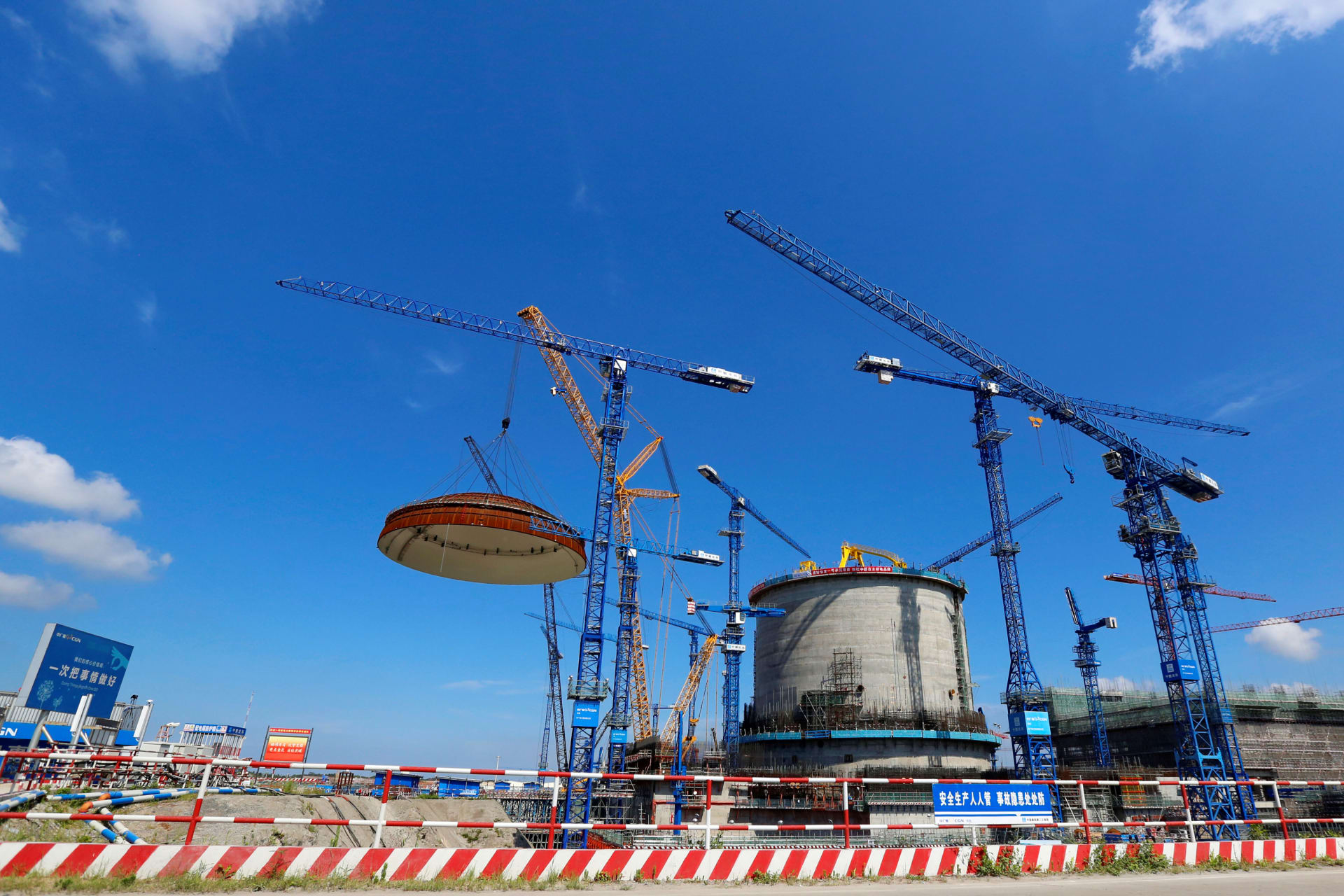
On Friday, July 31, China approved a $25 billion expansion for the development of eight new nuclear reactors. Once the projects are complete, each unit is expected to provide 1,217 megawatts of electricity—enough to power close to a million homes in China. The expansion comes as China seeks to overtake the United States and France as global leaders in nuclear power production. In its recently announced five-year plan for nuclear power, China set a target of 110 gigawatts (GW) by 2030, which would be a 76 percent increase from the end of 2024.
That approval highlights China’s focus on continuing its nuclear fleet buildout, yet construction at home is only part of the story. Chinese-designed reactors account for a major share of the global nuclear reactor construction, accounting for close to half of the sixty-three nuclear reactors under construction globally in 2024. Notably, however, China has failed to meet its previous two nuclear power growth targets, most recently falling short of its 2025 target of 70 GW, highlighting the continued momentum needed for China’s nuclear industry to stay on target.
ASEAN’s Search for Energy Security
As the closure of the Strait of Hormuz continues to disrupt the global energy market, China has taken steps to position itself as a trusted partner to the Association of Southeast Asian Nations (ASEAN), a region that has severely struggled to meet energy demands since the Iran war began. As CFR expert Joshua Kurlantzick has written, much of the challenge has been a lack of regional consensus on a coordinated energy strategy—a vacuum Beijing has begun to fill.
China’s presence in the region is not new, but the scale and nature of the relationship has recently shifted. In July, Chinese spokesman Lu Daliang announced China’s electricity exports to ASEAN totaled 2.39 billion kilowatt-hours of power in the first half of 2026, up by 42.9 percent last year. For context, 55 percent of crude oil imports and 17 percent of natural gas supply for ASEAN come from the Middle East, leaving about 28 percent and 3 percent of its consumption vulnerable to disruption, respectively. The increase in electricity flowing through Chinese-operated transmission lines creates a form of structural reliance that commodity trade does not. Switching suppliers can prove more feasible—be it liquefied natural gas, coal, or clean energy technology—as opposed to electricity, which is infrastructure- and contract-bound.
It was against that backdrop that discussions of energy security took center stage at the latest ASEAN Foreign Ministers’ Meeting in late July, where ASEAN met with each of its eleven dialogue partners, including the United States and China. Notably, Chinese Foreign Minister Wang Yi praised ASEAN, saying their relationship “continues to move forward smoothly and rapidly, and has achieved fruitful results that have benefited more than two billion people on both sides, while also making important contributions to peace, stability, and prosperity in the region and the world.” How ASEAN navigates this moment, between securing its energy supply and growing relations with China, will shape the region’s future energy security.
China’s Clean Tech Oversupply
On July 17, 2026, China issued a new consumption tax targeting certain mainstays of its clean tech industry, ending an exemption long enjoyed by those industries. Reuters reports that the move will impose a 2 percent tax on certain battery products, including lithium-ion batteries, beginning in September and on solar and photovoltaic (PV) cells beginning in April 2027, with the tax on both sectors increasing to 4 percent after about a year. Other, less common technologies, such as solid-state batteries and some types of PV cells, are temporarily exempt. The tax could help move the solar and battery sectors away from scale-oriented production to quality-oriented production.
The tax was announced during a slowing of China’s domestic solar market. New solar installations in China dropped over 65 percent in the first half of 2026, following a rush to complete installations before the industry transitioned its pricing mechanism. At the same time, the country is trying to curb its clean tech oversupply. In late June 2026, China released new national standards aimed at shrinking supply in its solar industry, setting limits on energy consumption and efficiency. Some, however, are questioning how effective those measures will be at solving the overcapacity problem. Regardless, even with a slower domestic solar market, China’s volume of solar exports continues to rise.
A Month of Typhoons
July brought the first three typhoons of 2026 to China’s shores. First, Typhoon Maysak, which made landfall as a tropical storm, struck Guangxi with massive amounts of rainfall. In Nanning, water breached the walls of the Liulan Reservoir and came rushing into the city, killing twenty-six people. As severe storms struck other parts of China, President Xi Jinping ordered an “all out” rescue operation. Second, Typhoon Bavi, a category 1 storm when it first made landfall, struck twice in Zhejiang Province, forcing the evacuation of over 1.5 million people. And third, Noul, the strongest typhoon of the three, hit Guangdong Province early in the morning on July 25. As with Bavi, mass evacuations occurred ahead of the storm. As of this writing, no deaths for either Bavi or Noul have officially been reported.
July is relatively early in the typhoon season, and against the background of a likely turbulent El Niño year, China could be looking at an abnormally active typhoon season. The central government was quick to announce funding for affected regions in several tranches: following Maysak, ¥80 million ($11.8 million) for disaster recovery efforts in Guangxi on top of a previous allocation of about ¥110 million ($16 million). After Bavi, the central government allocated ¥430 million ($63 million) in disaster relief to ten provinces. Of that sum, ¥150 million was allocated to Guangxi on top of the previous allocations to support relief efforts such as home repairs and temporary living. And for Noul, roughly ¥180 million (around $26.5 million) was reportedly pre-allocated to six provinces for disaster relief efforts. Those allocations do not represent the full scope of what has or will be spent to address the disasters, but they do showcase how China deploys its rapid disbursement mechanism for disaster relief funds.
This work represents the views solely of the author(s). The Council on Foreign Relations is an independent, nonpartisan membership organization, think tank, and publisher, and takes no institutional positions on matters of policy.