Model Citizens
The growing political visibility of recent African immigrants in the United States is a standing reproach to dated conceptions of belonging back home.
By experts and staff
- Published
 Ebenezer ObadareCFR ExpertDouglas Dillon Senior Fellow for Africa Studies
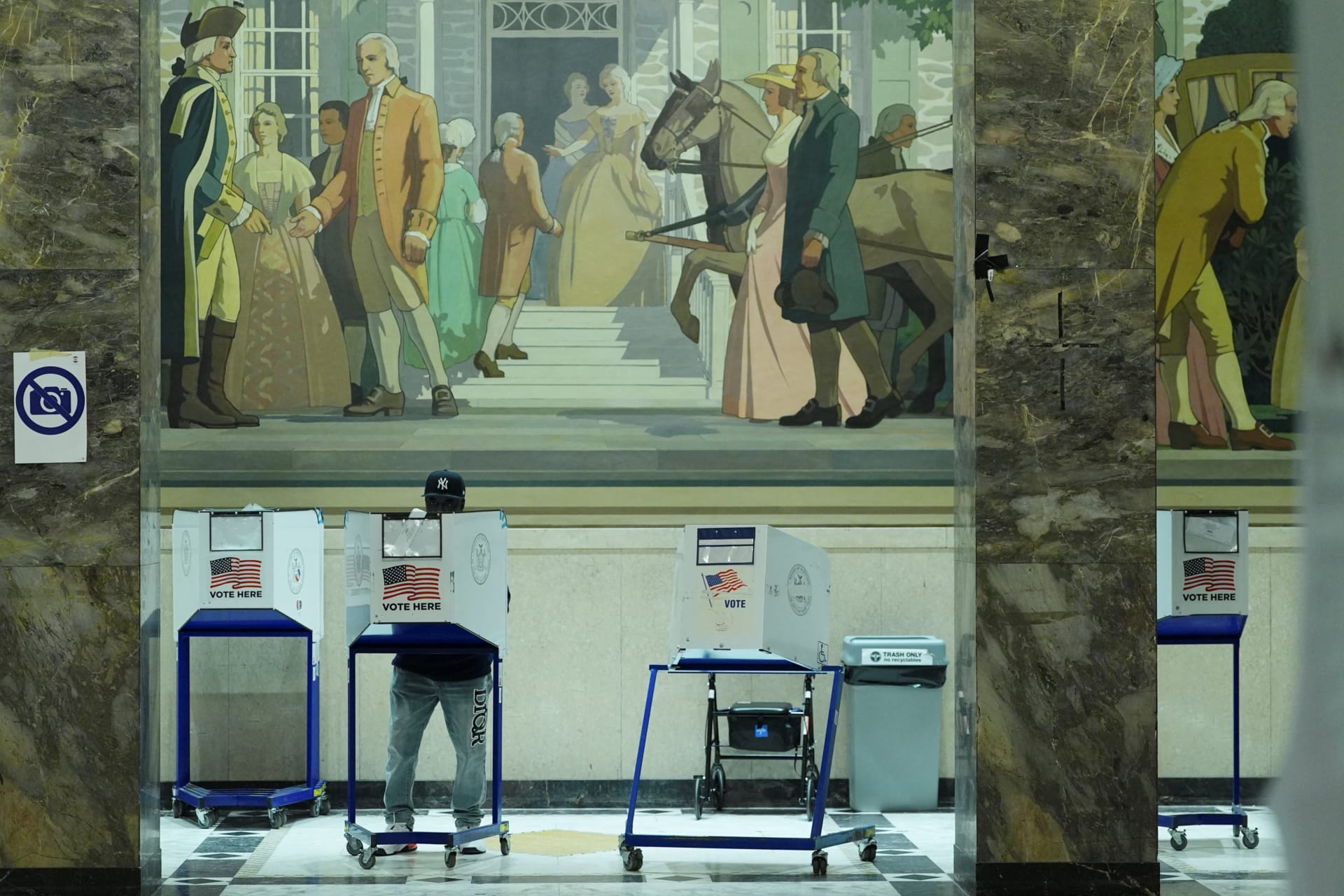
Members of the Democratic Party are not the only ones celebrating the party’s stunning victory in last week’s midterm elections. Across Africa, where the exploits of African-born Americans are closely monitored, the outcome of the elections has generated considerable excitement. The reaction in Nigeria to the success of fourteen Nigerian-Americans in various state-level elections—incidentally all on the platform of the Democratic Party—is typical. Nigerians in Diaspora Commission chairperson Abike Dabiri-Erewa went on social media to congratulate the victorious cohort, making sure to append a graphic vividly displaying their names, headshots, and respective constituencies.
In all, a record twenty-three African-born immigrants from at least ten African countries spread across thirteen U.S. states won their respective races to become lawmakers in various American federal and state legislatures, extending a run that had seemed to reach a highwater mark back in January when Ugandan-born Zohran Mamdani became New York’s youngest mayor in over a century.
The feeling of pride among Africans is both justified and understandable. For many, the fact that African-born immigrants are finding their feet and flourishing across various walks of life is a welcome rebuke to racial bigots of all stripes who equate blackness with underachievement. For such Africans, there is a special gratification in seeing recent African immigrants atop the totem pole across American industry, higher education, medicine, technology, and, not to forget, sports and entertainment. Recent African immigrants from Cameroon, Egypt, Ethiopia, Ghana, Kenya, Nigeria, and South Africa rank among the most educated and highest paid immigrant groups across the United States. The average Nigerian-born immigrant (immigration to the United States from Nigeria is heavily dominated by Yorubas and Igbos from the southern region of the country, but still) boasts more degrees than a thermometer. According to the Washington-based Migration Policy Institute, 61 percent hold at least a bachelor’s degree, “compared with 31 percent of the total foreign-born population and 32 percent of the U.S.-born population.”
Unsurprisingly, in the same way that they use the United States itself as a mostly favorable point of reference, Africans also use the success of recent African immigrants to the United States to call attention to yawning and recurrent gaps in everyday life across Africa on the one hand, and the delinquencies of African leadership on the other. For many, the fact that someone would have to leave Africa in order to find personal and professional fulfillment, taking all their talent and expertise with them, and the lack of urgency by African leaders in response to this ongoing hemorrhaging of human capital, is an indictment of the situation in a majority of African countries.
All things considered, the noted feeling of pride at the increased political visibility and general success of African-born Americans is tinged with not a little anguish that Africa basically continues to give away what it cannot afford to lose.
None of this is to downplay the enormous social challenges that recent African immigrants themselves continue to confront. The case of Deqa Dhalac, the first African-born female mayor who, earlier this year, announced that she would not run for reelection into the Maine (Portland) House of Representatives because, according to her, “Throughout my tenure, I have experienced persistent racism, harassment, and threats that reflect a broader national pattern targeting Black and Brown elected officials,” is a reminder that, for many, the path to political visibility can be quite rocky, and that, when it comes to full acceptance, it is definitely not yet uhuru.
That said, it cannot be denied that, in the final analysis, the United States continues to offer (political) possibilities that are not available to these recent African immigrants back home in Africa. The explanation for this is as follows: The conception of citizenship that prevails, albeit imperfectly, in the United States, is modern, vis-à-vis the regnant conception across Africa, which is predominantly static. Whereas, in principle, American citizenship is open to anyone who is born in, emigrates to, and is dedicated to the foundational tenets of the United States, citizenship in many African countries is still framed and invariably weighed down by the logic of autochthony. As President Trump stated during a naturalization ceremony in January 2019, echoing a belief that has served as a beacon to successive generations of Americans, “The beauty and majesty of [American] citizenship is that it draws no distinctions of race, or class, or faith, or gender, or background. No matter where our story begins, whether we are the first generation or the tenth generation, we are all equal. We are one team and one people proudly saluting one great American flag” [PDF].
Contra the American promise, quaint and often ridiculous markers, particularly regarding ethnicity, religious affiliation, caste, and gender, continue to animate politics across many African countries. The most profound—and, from a certain perspective, the most tragic—testament to this is the situation in South Africa (for anyone who may be interested, my three-part essay on the country’s struggles is available here), where the collective mentality lags behind a constitution whose liberalism ordinarily puts it on par with the Constitution of the United States. In Nigeria, the heartland of regressive nativism, social discourse continues to be dominated by demeaning and ultimately meaningless conversations about one’s “state of origin.” In different ways, both South Africa and Nigeria demonstrate the inflexibility of political identity in Africa.
Which should ordinarily change the level of concern if, say, your African citizenship, parsimonious as it is, secured you some benefits. Just the opposite. In the words of Cornell University political philosopher Olufemi Taiwo, “the non-responsive and non-responsible character of African governments” effectively means that “most nationals of African countries do not enjoy the most basic privileges of citizenship in their homeland: protection from the predations of their fellows and the overreaching of state functionaries; the provision of basic amenities for the citizens; a minimum standard of living that keeps them above subhuman levels with some luxuries thrown in for good measure; and the privilege of having a hand in the constitution of the government that rules them.”
The role played by this denuded form of citizenship in forcing African nationals to consider the exit option has been remarked. What could do with more attention is the opportunity that the modern form of citizenship affords for self-discovery and self-fashioning for the potential immigrant. As many immigrants to the United States understand, American citizenship opens up opportunities that would be otherwise permanently foreclosed, precisely because the United States is the one country where, at the end of the day, political modernity currently finds its fullest fulfillment. I know from personal experience that immigration advocates in the United States have little appreciation of this nonmaterial dimension of immigrant quest for the American dream, reducing immigration to the impact of climate change and whatnot.
In the meantime, what this means for diasporic Africans is clear enough. As we continue to redeem the promissory note of modernity across Euro-America, it is incumbent on us to affirm and invest in ideas and policies that advance and strengthen the same across Africa. The easiest and costless way to do that is to stop treating Africa and Africans, not as moral aliens, but as a region and people subject to the same rules and expectations of dignified treatment that apply to human beings everywhere. To refrain, as many do, from criticizing human rights violations in Africa under the pretext of not wanting to patronize African leaders is to assume that Africans are not mature enough to be approached and treated as adults. It is hypocritical to demand—as we should—access to the rights and privileges of modern citizenship across Western countries, while ignoring the entrenched violation of the same rights and privileges in Africa.
And for my African compatriots: It is not enough to celebrate the fact that Africans flourish outside of Africa. All of us must commit to the imperative of making Africa itself livable for anyone who desires to make a home there.
Imagine a time in the not-too-distant future when the mayor of Abuja is a Norwegian-born Nigerian, and the mayor of Johannesburg just so happens to be a Russian-born South African, both with equal and unfettered access to the respective bounties and prohibitions of Nigerian and South African citizenship.
Imagine that.
Nathan Schoonover contributed to the research for this article.
This work represents the views solely of the author(s). The Council on Foreign Relations is an independent, nonpartisan membership organization, think tank, and publisher, and takes no institutional positions on matters of policy.