Trump’s South Korea Move Fuels Growing Fears of U.S. Retreat From Asia
Trump’s abrupt rollback of joint military exercises with South Korea is the latest in a series of actions draining Asian allies’ confidence in U.S. security commitments—and hands China another opening to exploit.
By experts and staff
- Published
 Joshua KurlantzickCFR ExpertSenior Fellow for Southeast Asia and South Asia
Joshua Kurlantzick focuses on the growing global ties among illiberal states and their impacts on the world. He also examines the militarization of politics, China’s relations with Southeast Asia and other developing regions, China’s influence and information efforts, U.S.-China relations, and Southeast Asian politics and economics.
Over the past year, Trump administration officials have taken pains to assure increasingly skeptical partners and allies in the Indo-Pacific that the United States remains dedicated to their security, even amid economic tensions over trade imbalances and tariffs. At a recent foreign ministers’ meeting of the Association of Southeast Asian Nations (ASEAN), U.S. Secretary of State Marco Rubio emphasized the long-standing U.S. commitment to the Indo-Pacific, presenting the Trump administration’s approach as essentially a continuation of the so-called Pivot to Asia started by the first Obama administration and promising $2.5 billion in U.S. strategic investments in Southeast Asia. At the Shangri-La Dialogue in 2025, U.S. Secretary of Defense Pete Hegseth previewed Rubio’s promises, telling Asian leaders that the United States viewed the security threat from China as “real” and “imminent” and emphasizing that the region was a top U.S. priority.
Elbridge Colby, under secretary of defense for policy and chief architect of the Trump administration’s Asia strategy, has spent much of 2026 making similar reassurances to Asian partners. “America is definitely not disengaging from Asia,” Colby said in a speech in Manila this August, insisting the United States was instead “digging in” to its regional security guarantees and that U.S. interests were “more engaged than ever in the Indo-Pacific.”
Unfortunately, the Trump administration’s recent actions suggest the opposite: that the White House is shifting its priorities away from Asia, by necessity and choice. As a result, Asian allies and partners are becoming increasingly concerned that they can no longer depend on U.S. security guarantees, potentially leading them to move closer to China—or simply facilitating an intra-Asia arms race as they scramble to provide for their own defenses.
Recent U.S. actions have driven this point home. With little warning, President Donald Trump last weekend ordered the Pentagon to scale back joint military exercises with South Korea, just hours before the drills were due to kick off. The president’s reasoning for this shift was convoluted—he cited the cost of the exercises, claimed that North Korea had been “unthreatening” during his second term in office (which is hardly true), and complained that Seoul had refused to help with the U.S. push to denuclearize Iran. Of course, this sudden shift stood in stark contrast to Hegseth’s praise of Seoul just a few months earlier. South Korea tried to put on its best face, saying that the two governments were maintaining close coordination. The joint exercises are going forward, though in a more limited fashion.
But privately, South Korean officials were incensed, and the decision is almost surely going to add to negative views of the United States in South Korea, where Washington’s popularity had already been plummeting. Previously, the Pentagon also reportedly had been forced to pull Terminal High Altitude Area Defense missile defense interceptors from South Korea for use in the Middle East, which further rankled Seoul.
To be sure, the United States is embroiled in war in the Middle East, as well as a wide range of kinetic actions and blockades in the Western Hemisphere. A drawdown from Asia had already been previewed in the 2025 National Security Strategy, which made clear that the White House’s top priority is dominance of the Western Hemisphere—and which did not even mention China until page nineteen of its twenty-nine pages.
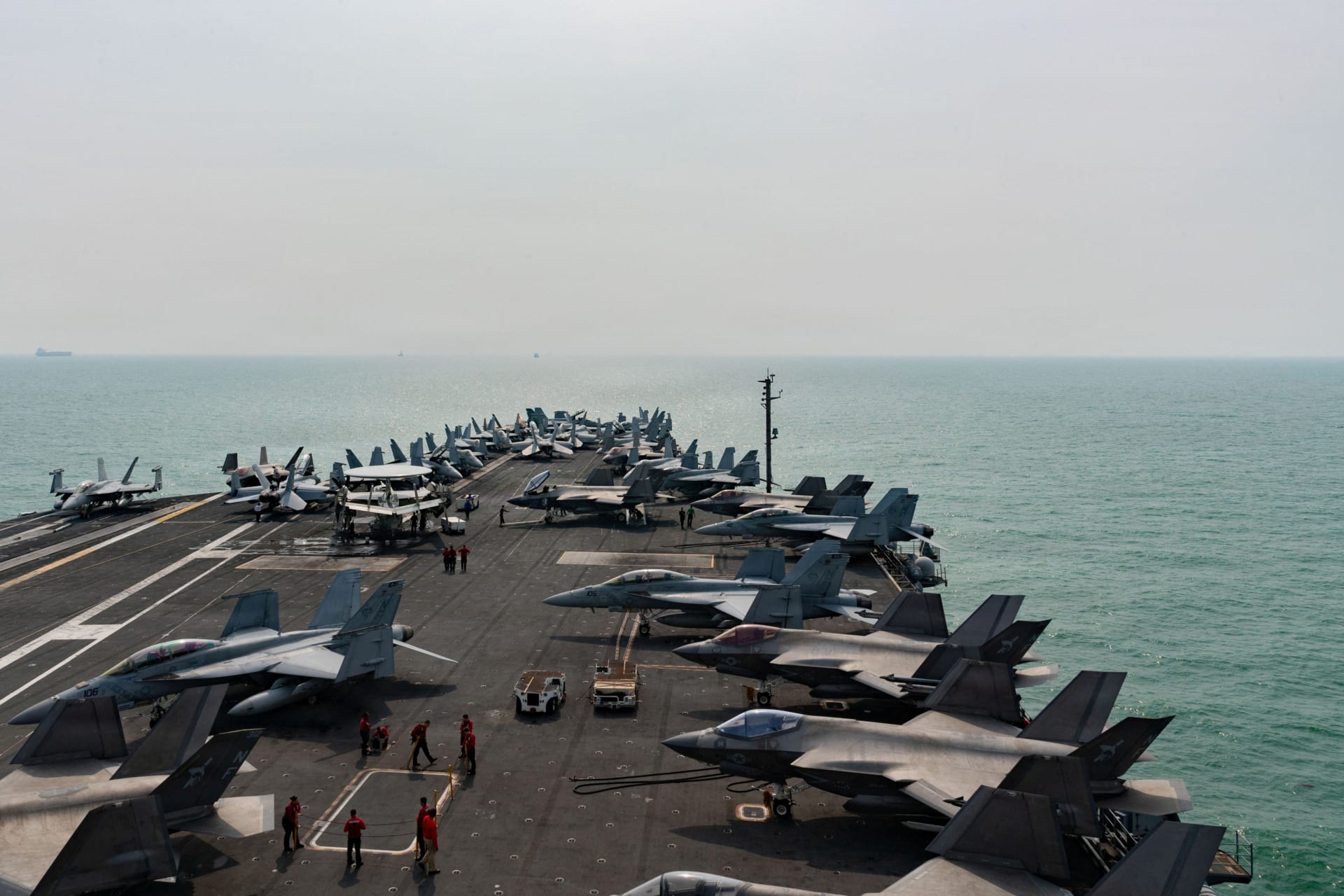
Beyond the reduction in exercises with South Korea, the Trump administration, in recent weeks, has also moved the last U.S. aircraft carrier in the Indo-Pacific out of the region for use in the Iran war to relieve a carrier that had been kept at sea past its normal time. The departure from the Pacific, however, is an important symbol. It means that for the first time in many years, there will be no U.S. aircraft carrier in the Indo-Pacific, even as China in recent months has intensified its campaigns to intimidate the Philippines and other countries in the South China Sea, as well as Japan.
At the same time, a Heritage Foundation study notes that the Trump administration has dramatically reduced U.S. transits through the Taiwan Strait. The number of transits in Trump’s second term appears to have fallen by about 50 percent from his first term, and 56 percent from the Biden era. Alongside the reduction in transits, Trump seems to have changed U.S. policy on Taiwan—discussing it directly with a Chinese leader, framing Taiwan as a bargaining chip in U.S.-China relations, and even characterizing the island as “indefensible.” The signal to many Taiwanese has been that the United States may not come to its defense in the event of a conflict.
Further worrying Taiwan and other Asian partners, Trump himself seems to be taking a softer line toward China overall, and Trump officials have largely stopped criticizing Beijing’s human rights abuses. (Last week, Colby called for an end to “moralizing speeches” about Chinese rights violations.)
This shift is not only unfolding near Taiwan. The Trump administration has also cut down the number of freedom of navigation operations (FONOPs) by U.S. warships in disputed waters in the South China Sea—important markers designed to show Beijing that Washington is committed to keeping the sea open to all. In Trump’s first term, U.S. vessels reportedly conducted at least seven FONOPs in the South China Sea, designed to deter China, each year. In the first six months of Trump’s second term, the United States reportedly conducted none.
The result is that even many of the staunchest Asian partners and allies are questioning the United States’ long-term commitment to the region. Shifting U.S. policies have not only made it easier for China to act in the region, but also to claim that regional neighbors have no choice but to abandon their hedging and align with Beijing, because the United States is untrustworthy.
Already, public opinion of the United States in Asia has plummeted. A June Pew Research Center survey of thirty-six countries, released earlier this year, found that favorable views of the United States dropped by double digits over the past year in both Indonesia and South Korea, and that across much of Europe and the Asia-Pacific, seven in ten (or more) people now rate the United States unfavorably. In longtime partner countries like the Philippines and South Korea, positive ratings are now at or near the lowest Pew has recorded since it began surveying in 2002.
Some countries in Asia (plus Australia) are stepping up military planning with each other, such as Japan, the Philippines, and South Korea, while others are exploring ways to boost defense budgets—not because of the United States, but despite it. As I noted in an article following the Shangri-La Dialogue in May 2026, “Vietnam’s President Tô Lâm, Australia’s Deputy Prime Minister Richard Marles, and Japan’s Defense Minister Shinjirō Koizumi all pushed back against Hegseth, arguing that the region’s real problem is a shortage of trust in Washington’s defense priorities and adherence to rules, not a shortage of arms.”
Ultimately, several states in Northeast Asia may even take the ultimate step, moving toward acquiring nuclear weapons as the maximum deterrent. But even without that possibility, which would create vast instability across the region, the fallout of declining trust in the United States, as well as Asian states’ beliefs that they may have to go it alone, creates a much more volatile environment—as well as yet another opportunity for China (and its autocratic partners such as Russia) to make further inroads in an important part of the globe.
This work represents the views solely of the author(s). The Council on Foreign Relations is an independent, nonpartisan membership organization, think tank, and publisher, and takes no institutional positions on matters of policy.