Can AI Help the U.S. ‘Grow’ Its Way Out of Debt?
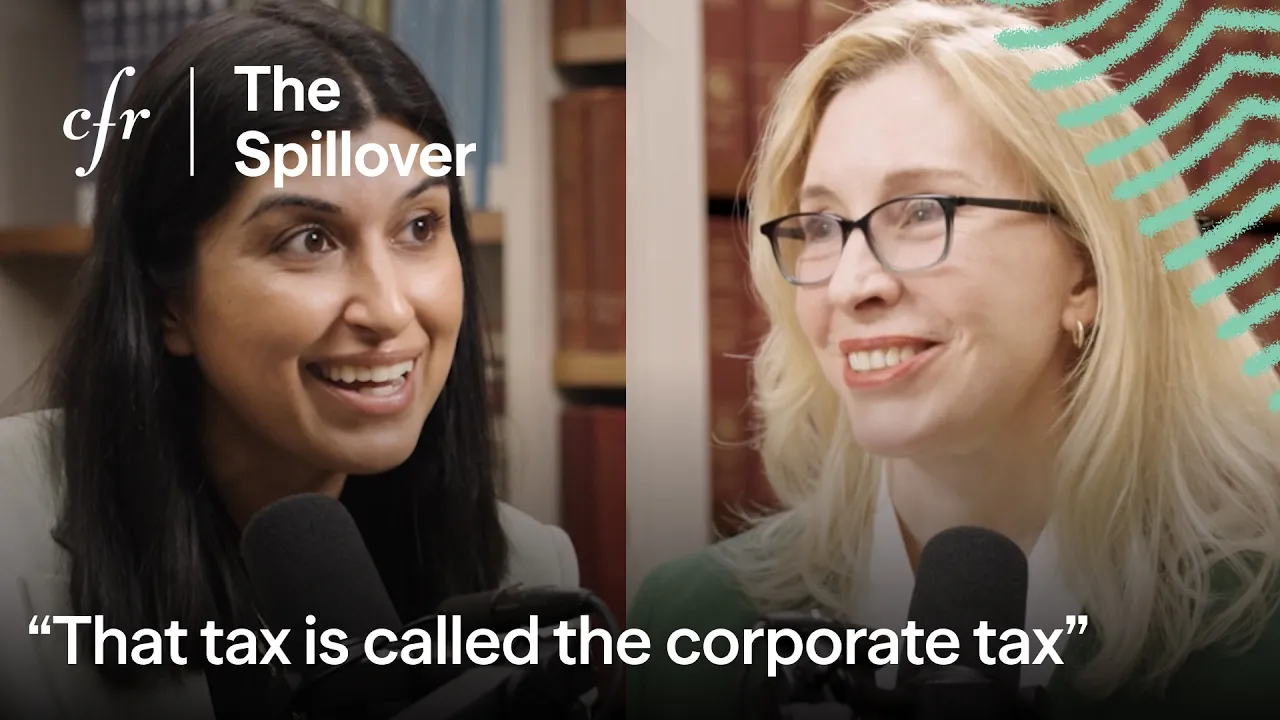
This week, host Rebecca Patterson speaks with Natasha Sarin, law professor and cofounder of the Yale Budget Lab, to unpack Treasury Secretary Scott Bessent’s claim that the United States can grow its way out of record debt, and whether AI can deliver the growth, jobs, and tax revenue needed to make that happen.

Published
Host
 Rebecca PattersonCFR ExpertSenior Fellow
Guest
- Natasha Sarin
[Video: https://youtu.be/fNkH_o7qGYs]
Transcript
This transcript was generated using AI and may contain errors.
PATTERSON:
Kicking off the recent Group of 20 meeting in North Carolina, U.S. Treasury Secretary Scott Bessent stated that the world is awash in debt and the only way for us to get out of this is to grow our way out. Well, growth is obviously not the only way to get out of debt, but it certainly helps. And at least in recent years, fiscal stimulus to drive growth has been the preferred path of both parties in the U.S. and recently in other countries as well, such as Japan. The hope appears to be that the pace of growth outruns the pace of debt costs. But can the hope become reality? Can the U.S. grow out of its debt? And is A.I. the magic bullet to give us that growth? Well, look, Sebastian Mallaby is on the road this week, but I am so delighted to be joined by Natasha Sarin, president and co-founder of the Yale Budget Lab, to explore Bessent’s plan and discuss a series of related spillovers from A.I. to jobs and growth and then from growth to taxes, from taxes to the U.S. fiscal position, and then, of course, to my favorite financial instrument these days, the U.S. Treasury market. I’m Rebecca Patterson. Welcome to The Spillover. Natasha, it’s so great to see you.
Thank you so much for coming on. I’m so delighted. Thanks for having me.
Look, school year is kicking off. You are not only the co-founder of Yale Budget Lab, but you’re also a law professor at Yale. So you have an extra busy schedule right now.
And for anyone not familiar, it’s important to know that the Budget Lab is a nonpartisan research center that looks at federal policy proposals for the U.S. economy. It’s definitely one of my go-to sources when I want to understand a range of economic issues. So again, thank you for coming on The Spillover.
SARIN:
Thank you for having me. I’m such a fan of yours, Rebecca, and of Sebastian. So it’s a real delight to get to be on with you.
PATTERSON:
Well, I want to thank you. I want to start with Secretary Bessent’s statement from that recent Group of 20 meeting about how the U.S. can grow its way out of debt, presumably through A.I. And I assume he’s talking mainly about the ratio of debt per GDP, the economic growth. And today that stands at around 100%, according to the Congressional Budget Office, CBO, and it’s on track to reach 120% over the next decade.
So these are record highs, obviously, which are pretty unusual in peacetime. We’ll get to the cost of debt later in my favorite bond market. But right now, let’s just talk about what it would take to slow that rising ratio, right?
And if we just want to bend the curve on that rising debt to GDP, and we want to do that through the denominator, the GDP, I think we can do some math, right? Hey, math. I like math.
So if you look at the primary budget deficit, so the deficit without net interest, right now it’s around 2.6%. We have a real interest rate around 1.4%, and GDP growth this year around 2%. Okay, we got three numbers. To hold debt GDP flat for the next decade, that would take us getting GDP growth, again, now 2%.
We have to double it every year for the next decade. So let’s just start. Have we ever done that before?
Is that doable?
SARIN:
So I am very pro-growth, as are you. We want the American economy to grow. We would be thrilled if we got massive productivity boosts from artificial intelligence.
PATTERSON:
Or anything else, right? Or anything else. Deregulation, maybe.
SARIN:
Great. Any sort of productivity growth that you can get is all good news from the perspective of the American economy. I am skeptical, because of some of the math that you were starting to lay out, Rebecca, that we can realistically expect to grow ourselves out of our fiscal challenges.
And in fact, my colleagues at Budget Lab have done some sort of estimation based on projections that people have of how much productivity growth you can get from AI. The moderate case that economists think is likely to happen, or could happen as a result of this technology, is that over the course of the next 10 years, we’re going to get productivity growth in the range of about 2.5% each year. That’s a pretty significant uptick relative to where we are right now.
We’re in the 1.8 range on average over the course of the last decade. It’s significant, but it’s not unprecedented in that in the decade after the internet revolution, we saw similar levels of productivity growth in the economy. So if we get something like that, great news from an economic perspective.
In order to get to a situation where you realistically are bending your curve from a debt to GDP perspective, you need annualized GDP growth in the fours. And that is what very, very optimistic technologist projections are in the range of that over the course of the next decade. But I think it is hard to expect that that is what you are going to see, or at least that that’s your base case.
You could see anything, but that’s your base case of what you’re going to see.
PATTERSON:
I actually went on to my Bloomberg, just curiosity, is anyone out there? Because Bloomberg gets all the different economists from Wall Street, independent shops, etc., and comes up with a consensus forecast, and it updates it regularly. What is the consensus forecast on growth for the U.S. looking ahead? Basically, it’s slowing. It’s not going up. Maybe that’s because it’s too soon to know what the AI impact will be.
But the bottom line is the consensus forecast is that the U.S. economy, the pace of growth is likely to slow, not increase over the next decade. And it’s primarily a function of the labor market. If GDP is productivity and labor, and we have fewer workers, partly because of demographics, partly because of immigration, at least as it stands today, you need a heck of a lot of productivity to get there.
So that was interesting. I checked the IMF. Also, slower growth.
The only forecast I found that had faster growth, I should make you guess.
SARIN:
It’s either coming out of the administration, or it is the technologists in Silicon Valley, or a combination.
PATTERSON:
Yes. See, this is why I had you on. I knew you would know every answer.
We didn’t plan that. So the Council of Economic Advisers, they see two years of 4% GDP growth, and then it drops as soon as this administration is done. No one else.
That’s it. So again, it doesn’t mean you said this. It doesn’t mean it can’t happen.
Of course it could happen, and we would be thrilled. But right now, it’s a hope, not a reality.
SARIN:
And one of the things that I think is important about what you just said, Rebecca, is that in some sense, you’re hearing these numbers, like 4% GDP growth. It doesn’t sound that extreme, and it particularly doesn’t sound that extreme when you have people like Dario Amodei, who runs Anthropic, saying that he expects GDP growth to be 5%, 10% over the course of the next decade as a result of this technology. But you really have to put it in some context of historically, what have we seen as a result of technological revolutions like this one?
And also, to your point about what some of the other pressures are in the American economy at the moment, where because of demographic challenges, we have a labor force that’s going to shrink. It is one where we have immigration policy that is pushing against the kind of labor force growth that you would need to get productivity increases. And by the way, that 130% debt to GDP figure that you had from the Congressional Budget Office, I think if anything, it’s understated relative to the trajectory you’re likely to see.
Why do you think that? I think there are at least a couple of reasons. If you look at what I think market participants think as a result of some of our fiscal challenges you’re already seeing, and we’re going to talk about those pressures in bond markets, I think they expect that the 10-year, 10 years out is likely to be significantly higher.
PATTERSON:
For anyone here who doesn’t live in this with us, 10-year, 10 years out, we’re talking about the 10-year U.S. Treasury bond yield. 10 years from now. 10 years from now.
SARIN:
Okay. And that, of course, is going to put pressure on debt-to-GDP ratios because it’s going to increase the cost of servicing our existing debt load. So that’s like one pressure that I think is under-reflected in some of those estimates.
Another is that I just speculate, and this is part of the challenge from the like grow your way out with AI, I speculate that as a result of, let’s say we get massive productivity growth. And by the way, alongside those massive productivity growth projections is also a projection of over the course of the next decade losing something like 10 million jobs.
PATTERSON:
All right. And we’re going to get there in one second.
SARIN:
Don’t go there yet.
PATTERSON:
Don’t go there yet.
SARIN:
But like the idea that you might have to as a result of a world that is increasingly uncertain, where we are facing a lot of pressure from our adversaries like China, where you might want to think about defense spending actually ratcheting up, not down, in a world in where you might have reasons like AI, where you need to spend more money on supporting aspects of your economy from a fiscal perspective. The idea that you might need to actually upward spend from the government’s perspective to meet the policy challenges of the day isn’t like a totally crazy one.
And that is also going to mean more government spending and more pressure to be able to support that. And so all that makes me like even more nervous about the fiscal situation and more convinced that the idea that you can’t, that you’re going to grow your way out as a result of AI is kind of overly hopeful relative to what our base expectations should be.
PATTERSON:
Okay. So I think we’re both on the same page here that Secretary Bessent is talking about an aspiration, not something that’s a given, that we’ll grow our way out. And to grow our way out, we either need very different demographics very soon or, and, or we’re going to need a huge sustained productivity boost.
I want to now like pivot a little bit, stay on AI and growth, but let’s focus on that labor market. You just touched on that briefly. You know, look, we know the U.S. economy is driven by consumption. Something like 68% of growth comes from consumers. God bless us all. We like to shop.
But if you don’t have a job and you don’t have income, it gets a little harder to spend. You can only use your credit card so much before they cut it off. So, so let’s go there.
There have been plenty of AI executives who talk big about productivity and growth, but also talk about massive unemployment, job disruption. And we had recently a monthly payroll number, the non-farm payroll number that was quite a bit better than expected. Three times better than expected.
Happy surprise. So the AI layoffs that everyone’s worried about, I don’t think we’re seeing them yet, but, you know, like the unemployment rate for new college graduates, people 20 to 24, 7.1% in July versus 4.1% for the overall jobless rate. That’s not an unusual spread, right?
There’s usually a higher unemployment rate for young people, but you have some analysis, I think, pointing to, we can see some early signs of the AI displacement. And certainly, look, I have, I have two kids in college now. I’m a little ahead of you.
And I hear stories like for a lot of kids, it is harder to find jobs. I know, you know, young people going to internships and there are 30 and 35 year olds in the internships now because they can’t get a job. So this is the best they can get.
That wakes me up as a mom. But look, I want to go back to Yale Budget Lab. I know your colleagues, including Martha Gimbel, track AI and labor markets very, very closely.
So do you think it’s just too early to know? Like we could still have AI job doomsday, but it’s too soon. What are you seeing in the data?
SARIN:
Okay, this is such a great question. And there’s so much there, Rebecca, that I want to sort of do. So I’ll just sit back and relax and you go.
Yeah, I want to do like different pieces of it because it feels pretty important. Like if you look at some of the projections that you’re getting from people like Dario Amodei or Sam Altman and his colleagues at OpenAI, they are saying things like over the course of some not that long horizon, you’re going to see like 50 percent displacement of white collar work, right? So like 50 percent of the jobs are no longer going to exist.
That is social unrest on steroids. And it’s just not possible. I mean, there are a bunch.
I also speculate that it’s like hard to imagine an economy that functions that way, especially on a short horizon in that. And Tyler Cowen has been talking a lot about this, the idea that even if the technology is at such... And we are experiencing it, right?
AI is like remarkable. I use it for everything. I love...
PATTERSON:
I mean, I am a huge Claude fan. I’m a super fan.
SARIN:
I am obsessed with Claude Code. If Claude Code had existed when I was a graduate student, part of why I am convinced you are going to see labor market effects, though as I’ll get to, you’re not actually seeing them yet, is fundamentally changing the way that I work, is changing the way that I work with my colleagues, is changing the nature of the tasks that I assign research assistants, or even if I have research assistants on projects.
And so the idea that that is going to be like writ large from the macroeconomic perspective, like an important transition moment or a hinge moment in our economy, like it seems like it obviously must be true. Right. But what’s really interesting is you aren’t actually seeing evidence of it yet in the data.
And my colleagues at the Budget Lab have done some really interesting work on these dimensions, where what they’re doing is they’re deploying data that comes from a lot of these labs themselves about the nature of how exposed different occupations are to potential displacement from artificial intelligence. And they’re saying in those occupations, you would expect to see different hiring trajectories after the introduction of, say, chat GPT a few years ago than you would in the less exposed parts of the economy. And you’re actually not yet seeing any difference along the most exposed occupations relative to the less exposed occupations.
You might wonder then, but we’ve heard about a lot of research that’s been done, research coming out of Stanford and their digital economy lab, led by Erik Brynjolfsson, where they have found that actually, as you’re pointing out, like young people are increasingly having a hard time getting jobs. And what’s my colleague Martha Gimbel often says, like, you know, it’s really unfortunate that Sam Altman introduced chat GPT at the same time that the Federal Reserve decided to be in a tightening moment, because there are other things happening in the macro economy where youth unemployment or youth lack of employment tends to be a leading indicator of the fact that we’re just starting to experience an economy that’s cooling.
PATTERSON:
So we can’t separate the two. We don’t know what is Fed tightening potentially versus AI necessarily. I mean, you can look at the tasks in the job that are replaceable by AI, but you still don’t know for sure.
You don’t really.
SARIN:
I feel like some of the timing is kind of suspect in that if you look at some of that work that finds that youth employment is actually down in particular sectors, in particular parts of the economy, it actually is the case that that happens like most of those losses happen basically immediately upon the introduction of chat GPT, which means it’s kind of we’re still grappling as an economy and firms themselves are trying to figure out like this technology is transformational, but exactly how do we use it in a way that is productivity enhancing? So the idea that it figured itself out immediately upon the introduction of some of these early stage LLMs like seems kind of hard to grapple with, but I agree it’s really hard to tell. And part of what my colleagues at Budget Lab and I have been sort of advocating for in some senses, we don’t actually have the data that we want right now to be able to understand the effect that AI is having on the labor force.
We’re doing the best that we can with respect to some of these exposure metrics and the idea of looking at occupations based on how exposed or not exposed they are, but actually there’s a difference between a certain job getting automated away and the nature of the job fundamentally changing because the tasks that you do do still, you human, are different now than they were a few years ago. We can’t tell much about that because we don’t know how people are deploying AI in their jobs. We don’t know about the types of tasks that it is actually currently supporting and the ways in which the job of, say, a law firm associate has fundamentally changed relative to a few years ago.
And so I hope that we get a better look at the data because I think it’ll inform a lot of really important labor market policies.
PATTERSON:
And what I hear you saying is that there is a risk that at some point in the future we wake up and say, uh-oh, it’s here, and we didn’t see it coming early enough because we didn’t have the granular level of data we needed to watch it in progress. Totally. Yeah.
So I want to go to the glass half, glass more than half full side. Mine is only half full and I’m thirsty.
SARIN:
So you can be here.
PATTERSON:
You take a sip and you’ll be half empty and I’ll be half full. I get to be positive for a change. So, look, there are a lot of people saying we should be grateful for AI because, look, we have a shrinking labor force.
We have the baby boomers retiring and manufacturing alone, something like 3.8 million jobs they need to replace in the next decade, largely because of demographics. So if AI can automate a lot of things, this is perfect. Now, I look at that and say, yeah, but, because are they the jobs that we need to replace?
And is it going to happen seamlessly at exactly the right time? We need to. Well, of course not.
Of course not. So can AI replace a reduction in immigrant labor in construction so we can get more homes built? Can they work in nursing homes?
I mean, I know Japan is getting robots in nursing homes. I’m not sure America’s quite ready for that yet. Although I was telling Sebastian last week, one of my daughter’s friends, he just leased a humanoid robot.
SARIN:
Wow.
PATTERSON:
So he has a robot in his home doing his laundry. So maybe we’re not that far away. I know that was new to me.
That was not on my bingo card.
SARIN:
It would ease a lot of spousal disputes in my home if we had a robot doing our laundry. There’s a lot of laundry with twin toddlers.
PATTERSON:
Fair. You need a humanoid robot. You can lease it.
You don’t have to buy. Anyway, just give me your two cents. Am I right or am I missing something that the seamless AI replacement of demographic worker loss will happen?
SARIN:
How I can say that you are right and we’re going to have seamless dealings with the displacement that could potentially be on the horizon. A lot of things push in the direction of life not being all that seamless. Actually, it’s very interesting.
I interned at the National Economic Council in the Obama administration in the aftermath of the financial crisis. One of the really pressing challenges at the moment, which I know I was the most junior level person, so I was there, but I was getting coffee, but listening to the challenges of the moment, challenge of the moment was you had prime age male workers who had been working in manufacturing and construction. Even before the financial crisis, manufacturing was really declining very substantially.
People attribute it to the China shock, but it actually was just a secular decline in manufacturing as a result of technology, a more open economy, all the things were happening. We had these people and they had historically worked in these parts of the economy. We were like, how do we figure out how to take them and encourage them to work in the sectors of economy that are growing, things like health, things like education?
It is actually an incredibly, incredibly difficult task. It’s incredibly difficult in part because they’re not actually trained to do those different types of jobs in different parts of the economy. By the way, historically, we’re not the best at figuring out how to train or upskill workers, but it’s also hard just like, and you can kind of understand why, kind of culturally, if you’re the type of person who has had one type of job in one part of the economy, be it you’re a computer coder or you’re in manufacturing, figuring out how to fundamentally like change the sort of ethos and professional identity of like writ large parts of the population is like a pretty daunting task. And what happened in the industrial revolution was that you had this group of hand loomers, these craftsmen who were displaced by the introduction of the automatic loom.
And the result of that was that they saw their living standards and real wages basically declined by half over the course of just a few years. And it took generations for them to recover. And the same thing happened as a result of the manufacturing decline in the U.S., at least in certain segments and in certain parts of the economy. And so I think you and I think that has real political ramifications that are super important.
PATTERSON:
Yeah. I want to keep going with our little connect the dots on AI and everything with the economy and go to everyone’s favorite topic, taxes.
SARIN:
Literally my favorite topic. I know, I know.
PATTERSON:
I love you for that because I’ve never been that good at taxes. I make my husband do our taxes. But how important, how, how important.
So, all right. So we are unlikely to double our GDP every year for 10 years in a row. We may have job displacement.
It’s too early to say. We’re not going to seamlessly replace workers with AI as much as we would like to. Okay.
So now let’s get to AI and labor and growth. What does all that mean for tax revenues? Because that’s one piece of this.
I mean, everyone’s talking about the jobs. Everyone’s talking about the growth. No one is talking about tax revenue.
Maybe it’s just too dry for most mortals. You’re not mortal. But look, you can have stronger GDP, but no tax revenue.
SARIN:
Totally.
PATTERSON:
And that’s going to be a big problem given our debt and deficit. So let’s start at a high level for the mortals like me. What are one or two of the biggest challenges when it comes to our current tax system in an AI world?
Yeah.
SARIN:
Our current tax system is really good at taxing workers and really bad. I know. Exactly.
And really bad at taxing owners of capital or owners of businesses. We just do not, or in general, at taxing capital income. We just do not have a tax system that is well-equipped for a host of reasons, in part because the birth of our modern tax system happened at a moment when capital income just wasn’t that important to the economy.
And so as a result of, in part because the tax system is so ill-equipped at capturing capital and gains from capital, you’ve seen over time there’s been more pressure and more of a wedge between our tax treatment of labor and our tax treatment of non-labor income. And I think this matters pretty substantially, in part because it could very well be one of the accelerants of the displacement we were just talking about, in that if you are like running a company and for using your labor, so for hiring workers to do work, you have to like pay payroll taxes and there’s social security, some portion of their social security taxes and all the like. And you have an agent who you don’t have to pay taxes on in any real way.
Obviously you’re incentivized to move away from the thing that causes you tax burden in favor of the thing that causes you not tax burden. And it matters from a broader macroeconomic perspective because you’re in a situation where even if you have massive gains, these corporations make gajillions of dollars as a result of doing all their automating as a result of this technological moment that we’re in. If the tax system has no way of capturing those gains, then you’re potentially in a situation where the government doesn’t actually, in our fiscal position, doesn’t reap the benefit of the productivity growth because all of the federal revenue, or 90% plus of federal revenue, comes in the form of tax collections.
PATTERSON:
So the revenue as a share of GDP just goes down, down, down, down, down. Even though productivity is going up, up, up. Okay.
So there’s a lot to unpack there. What I hear you saying is that in the world of AI, which we’re moving into whether we want to or not, we have to figure out a new way of approaching tax policy. So let’s start with our, you said gajillionaires or gajillions.
All right. So I’ll be really modest and we’ll just stick with billionaires and Elon Musk. So a trillionaire for a little while after SpaceX’s IPO.
So it, I mean, it is very hard to say that people making hundreds of billions or worth hundreds of billions couldn’t afford to pay a little bit more. Totally. And at the end of last year, I was just looking it up for our conversation today.
We had 935 billionaires who reside in the US and are citizens. So they have about $8 trillion worth of wealth. So that seems like a nice pool of money that we could tax.
The top 15 of those have more than a hundred billion each. So, okay. How could a government not look at it?
I get it. But then you have the question of what is the tax on that wealth that’s legal, that can’t be avoided by moving or through legal structures. I worked in wealth management for a while.
There are so many interesting, creative legal ways to minimize tax. It seems pretty darn hard. I mean, Jeff Bezos was Washington state.
Now he’s buying half of Miami, for example. So I guess my question is with these extremely wealthy, successful individuals. And I look, we want to have the American dream.
We if they’re tied to tech companies, they’ve made that money. What is the tax solution there? Is there a tax solution with our billionaires and trillionaire population?
SARIN:
There’s always a tax solution. So one that’s feasible. So I really agree with you, Rebecca, in that I have found that a lot of the discourse around the taxation of the ultra wealthy to be through the lens, of like, we need to raise revenue and how do we do it.
But instead, through this discussion about punitive taxation, there’s something wrong with people being Elon Musk. And there might be things wrong with Elon Musk. But the idea of the United States being the place where Fortune 500 companies are sitting in vast numbers, being the place where the leading AI labs are doing the development of these monumentally important technologies is something that is like fundamentally amazing about the American economy and is great.
And we should want there to be more billionaires and more millionaires. And we should want a system that encourages that sort of prosperity, not just because it’s like good for them, but because what happens when Elon Musk starts Tesla or starts SpaceX is that you’re employing all of these people and creating all of these subsidiary industries and sectors of the economy and contributing to their growth. And that like really matters.
That’s why the U.S. is what the U.S. is in large part. And so I like think it’s great. I also think our tax system is god awful at figuring out how even to ever tax the wealth of these people.
Because it’s not just that we like, you know, Mark Zuckerberg has most of his wealth in his share of Meta. And it turns out that until he decides to liquidate or sell shares, there is no taxable event from the government’s perspective. That’s one challenge.
But another challenge is that a host of opportunities exist that you’re super familiar with for Mark Zuckerberg to never get taxed, but also his heirs to never get taxed and to be able to continue to have a lifestyle that is allows a lot of consumption of a lot, but without ever giving the Fisk the opportunity to sort of take its part of that wealth creation in the way that it takes its part of our salaries each and every year automatically.
And so obviously that strikes people as a situation that is fundamentally unfair, and it should strike them as a situation that’s fundamentally unfair. We have a two tiered tax system in this country. We’re really good at taxing ordinary wage earners really bad at taxing people who accumulate wealth in some of these ways.
PATTERSON:
But if you even go there, then you’re accused of killing the American dream. So is there a compromise?
SARIN:
I really hate that in that. So a lot. So I yes, I think there’s a compromise.
And I think for some of the reasons that you started to describe, Rebecca, there’s like a lot of the sort of novel ideas that people have come up with in this space, the idea of things like wealth taxation. So if you remember some of this, just a two cent, three cent wealth tax in California is actually debating a version of it right now. I think as a law professor, unfortunately, given the composition of this Supreme Court, given precedents that exist in this space, I think you’re going to face real legal uncertainty associated with those types of tax instruments.
And ultimately, you might very well see them ruled unlawful, particularly by this conservative majority in this court. And so if you’re trying to think about, like, where do I spend my political capital and where how do I design a tax system that’s fit for purpose? I have tended to be in favor of and I have a new paper out with Kim Clausing that says is a title of which is essentially like 15 trillion dollars worth of revenue to raise in like ordinary ways to meet an extraordinary fiscal moment, because I think there’s a lot that you can do.
PATTERSON:
I know we try.
SARIN:
Yes, exactly. Taxes are sexy, but we try and it’s hard to sell people on ideas that feel like kind of like table stakes. You know, we should raise the capital gains rate.
We should end stepped up basis at death. We should think of death as a realization event. So Mark Zuckerberg can’t do that thing with his heirs.
We should get serious about a gift taxation, like lots of things that we can do that are in the bucket of like ordinary tried and true types of tax instruments. I find it really people do accuse you of then saying, oh, you’re anti. We wouldn’t have this innovation.
These companies wouldn’t start here if you were in that world where the capital gains rate was higher. And I find it to be kind of nuts, like the idea that Mark Zuckerberg was sitting in his Harvard dorm room and was like, oh, I might start Facebook. But if the tax treatment is too disincentivizing of me from the capital gains perspective, then I won’t like it’s not really.
It seems right. Obviously, not even though it’s true that the tax rate does matter and changes behavior, all the things. But the idea that there isn’t space here, particularly if you’ve seen massive gains attribute to large sectors of the economy feels obvious.
Yeah. And it also, by the way, pushes in the direction of not just thinking about taxing these individuals more aggressively, though we certainly should, but also about thinking about taxing their companies more.
PATTERSON:
All right. So let’s get to that. So so individuals, we shouldn’t throw away the idea, but we have to be cognizant that there could be some legal challenges, big ones, depending on how it’s formed.
So let’s think about the economic activity created by the companies. So we talked about Anthropic CEO earlier. You know, he’s he’s on the record saying that the unemployment could require new sources of tax revenue.
He even suggested like publicly that the government could put a three percent tax on revenue generated from models that get redistributed in some way. So tax. He’s saying you can tax me now.
Not everyone in his little sphere in Silicon Valley is agreeing with him publicly. Bill Gates called for a tax on A.I. tokens. Right.
So basically the unit of billing or the unit that people are looking at when they use A.I., he’s calling for a tax on robots. So, look, there’s definitely people in this world who understand there needs to be some redistribution. Otherwise, they risk losing popular support for A.I. They already are losing it a little bit, especially with data centers. So they realize they have to go on the offensive with PR and offering to give some of their money away is one way to do that. Congress is coming up with ideas. I was just using Claude, using my A.I., sorry, to to just see what bills have been introduced recently. And one of the most recent ones, bipartisan, by the way, it’s interesting. It’s a bifurcated tax. So you tax the value of the tokens or the tax revenue from A.I. services and related stuff, whatever gets you the highest number. So the highest amount of tax revenue and you apply the tax rate depending on the unemployment rate. So if job losses go up, the tax rate goes up. If the labor market’s fine, the tax rate goes down.
So it’s a little complicated, but intuitively I’m like, yeah, OK, that makes sense. And then, of course, good old Senator Elizabeth Warren, she thinks you should tax the A.I. companies based on their energy use through data centers. Bernie Sanders, Senator Sanders has the one time 50 percent tax to create a sovereign wealth fund.
I’m very skeptical on that one. But of all these different proposals. So many ideas.
I know. Well, at least there are ideas.
SARIN:
Right.
PATTERSON:
So they’re thinking this is good. Which of those or is there something else that you think if we’re going not after the people, but the economic activity to make sure we have enough revenue going in the government so we can afford government priorities like education, military, et cetera, and maybe help these displaced workers? What what economic activity would you tax?
SARIN:
You know, and the way I think about all of these policy ideas is through the lens of something we started to talk about just now at the individual level, which is it’s not just that I’m worried about the legal challenge. It’s also that I think there are I spent a lot of time when I was in with my colleagues at the Internal Revenue Service because one of my jobs in government was trying to make the case for why we need to adequately fund the IRS in order to be able to collect all these taxes. And right now, by the way, we’ve gone in the exact opposite direction.
Over the course of the last few years, they’ve lost something like 30 percent of their examination workforce. As a result, unsurprisingly, you’ve seen examination revenues go down by around 30 percent. And so we’re in a situation where I do not know how a lot of these new taxes ultimately get administered by an Internal Revenue Service that is struggling to keep the lights on, let alone think about let alone think about introducing and ultimately implementing all of these new tax regimes.
PATTERSON:
The IRS, I don’t want to go down on a big tangent, but short tangent. I’m I’m so with you on that because so many. Look, I appreciate that tax collection has become politicized in recent years.
It shouldn’t be. It shouldn’t be. And a lot of the taxes that are not being collected right now because the IRS has been seen as funding cuts so much, most of it, maybe all of it, hopefully all of it is legitimately owed.
So this is money that the government deserves to get. And it’s not getting just because we don’t have the bodies there to do it. Totally.
That’s nuts to me. It is bonker bananas. When I was in government.
Can we make that our tagline today? Bonkers bananas.
SARIN:
It is. When I was when I was in government, I had been an academic who had written about like why we should fund the IRS and like we can raise all this revenue. And to your point, it’s it’s much easier than introducing new taxes because this is collecting taxes that are already owed.
We are losing out on three percent of GDP, 700 billion dollars a year in owed tax revenue because we just do not have the capacity to collect it. Bonker bananas. It sounds like Greece.
And I thought it sounds like what’s so interesting, by the way, is separate type tangent on tangent. It’s really interesting because developing countries, not that Greece is a developing country, actually have more sophisticated tax administrators than we have in the United States. I’m thinking of pre 2012 Greece.
Yes. Yes. In part because they actually built their tax systems once computers existed.
So like the technology existed, whereas our tax system in this country is running on COBOL in the same way it was in the 1950s, such that it is incredibly expensive to maintain because we do not have the people in place who still learn COBOL. Like I it sort of feels like prehistoric to me, you know, and all that is to say that we people should rightfully be frustrated by this tax system. And when I got to government, I thought I was going to have the easiest job in the world because I was like, oh, let’s make the case for the importance of like investing in collecting taxes that are owed.
Who is going to be on the other side of that? But it turns out that there is it’s like this huge pressure against the idea of living in a system where we all pay like taxes are the price we pay for a civilized society. Turns out that set of rules applies to like most people, again, who are fully compliant with their tax obligations automatically because my taxes are withheld for my paycheck as are yours.
But if you happen to accrue income in these opaque ways, the rules don’t apply. And it’s crazy. And it’s a problem that is going to it’s part of why, as I look at a lot of these new tax tools, I’m trying to think about them from the perspective of their administrability, which I think is something that policymakers tend not to do because it’s sort of like boring and it’s requires like thinking about like, you know, thousands of pages of tax code and how they’re ultimately implemented.
But it’s really hard and definitionally super challenging to think about, like, what does a token tax actually look like? And if we do this 3 percent tax on labs, like who actually is subject to that? How do you define it?
How do you define it? What’s the universe like? And so the tax that I actually think we already have a tax tool that is super well equipped to figure out who is reaping profits from artificial intelligence and how to tax a portion of their.
OK, good. Tell us that tax tool is called the corporate tax, because it turns out that we have a corporate tax rate in this country of 21 percent currently. Yes, it is the case that is that puts us in a position where we used to have prior to the first Trump administration, 14 percent more tax revenue coming from companies.
PATTERSON:
OK, but back then you had corporates, not just tech companies, all over the map saying this is crazy.
SARIN:
They’re always competitive.
PATTERSON:
OECD average corporate tax rate is closer to twenty five percent. So we need to get it down.
SARIN:
Yeah.
PATTERSON:
So, OK, maybe we overshot.
SARIN:
So are you saying we overshot?
PATTERSON:
So we’re not going back to thirty four because I think you might get like hunted down if you say that on this podcast.
SARIN:
I’m not saying that we should do that. OK, let me look into the camera and tell them we do not need to do that in any way.
PATTERSON:
So how much do you think we need to go and how much do you think politicians even try to get?
SARIN:
I mean, so here is my pitch on the corporate tax. OK, which has many layers. One is that we can actually keep this 21 percent rate in place for ninety eight percent of companies.
All right. So I’m talking about a very narrow sliver of really giant, really profitable companies, many of whom are multinationals who are operating across jurisdictions and saying we need to increase your rate slightly and not back to thirty five percent. We need to increase your rate.
Let’s say we do a tiered corporate tax rate where the rate tops out at twenty eight percent. Turns out that we are going to raise a really substantial amount of revenue from doing that. And by the way, we’re going to be pretty good.
Part of my challenge with doing a bunch of these like let’s tax the labs type of approaches is we have really no idea where the profits from A.I. are likely to accumulate in the economy.
PATTERSON:
Right. Five years. Right now we know where they are.
But five years from now, A.I. will still be with us. But who’s making money off A.I.? No one knows.
SARIN:
No one knows. And if you design a tax system that is banking on the idea that these three companies are going to be the ones left standing, that’s not really meeting the challenge. Whereas if you design my tiered corporate tax rate, which Kim and I have proposed, I actually think you do because mechanically the ones that are profiting are the ones that are going to play the rate.
Importantly, though, this whole thing doesn’t work if you’re in a system, because like I’m saying, these are giant companies, many of them are multinationals. It doesn’t work unless you’re in a system where we have something like what the OECD agreement was and had been negotiated for a global minimum tax. So they don’t just go offshore to avoid it.
Exactly. Right. And that is going to require it.
We had a deal and we didn’t actually implement it in the U.S., though other countries have gone ahead. But it’s going to require a bit of work to get us to that type of a system.
PATTERSON:
OK, so the biggest, most profitable companies, taxes go up a smidge, not crazy. More than a smidge. More than a smidge.
SARIN:
By the way, they had something that I think is so interesting about corporate taxation in this country and the deal to lower the rate in the first Trump term is at the time Business Roundtable, which is one of these like groups, conglomerates of your listeners will know, one of these groups of leading voices, the CEOs of all these large companies, they had hoped aspirationally for a corporate tax rate of 25. I remember.
I remember. So we gave them more than they’d even asked for and dreamed of. And they said that was what you needed in order to be competitive globally, all the things.
So the idea that there isn’t space with respect to the corporate rate and the idea that entity level taxation isn’t the right way to think about how to deal with A.I. and its profits, both strike me as incorrect statements.
PATTERSON:
I think the one way this doesn’t get slammed immediately out of the gate is the fact that it’s tiered and whatever the number is, 98 percent of companies don’t see any change. That makes it maybe, maybe, maybe feasible, although I imagine the companies that would be taxed probably have pretty good lobbyists and they will be doing their best on the Hill to prevent that. But anyway.
SARIN:
But part of the thing about this approach, by the way, is that I just hope policymakers think about it as a framework in that they can play around with the lever, right? They can play around with what is the tax rate that everyone’s comfortable with. But the idea of thinking seriously at about corporate taxation as the tool to tax A.I. profits feels really important to me because otherwise I worry that we’re in a system where we’re ex-ante trying to guess who winners are going to be. And no one knows.
PATTERSON:
And no one knows. Including the A.I. labs themselves.
SARIN:
Yeah, of course they don’t.
PATTERSON:
Okay. I think we’ve beaten the tax horse enough for today. We can come back to it another time.
But I want to get to bending the curve back to it’s bend it like fiscal Beckham, maybe. Okay. So, you know, we don’t have politicians today in America and frankly, most advanced economies who are into austerity.
It’s kind of a bad word. I just saw this morning, I was so excited. The Washington Post had an article on Social Security and there’s a bipartisan bill to try to do something about it.
And I was like, okay, okay, there’s a conversation. But look, if we could fund IRS, raise the corporate rate a little more than a smidge for 2% of companies and make some common sense adjustment to Social Security, can we bend the curve and we get some productivity? So it’s a, it’s a cornucopia of policies and productivity benefits.
Is it, can we bend the curve? I think you can.
SARIN:
I think the thing that we haven’t really talked about that we started to gesture at it as we were talking about worker training is that in a world in which these productivity enhancements, like inherently, what do productivity enhancements mean? It means that companies are getting better at building or profiting with less human labor because that’s what the productivity gains are that are coming to them. In that world, I worry that there is going to be a need to think seriously.
And I not worry, I hope that there will be a need to think seriously about how to support populations that are being displaced by technology and its gains being unevenly distributed. And it’s part of why I’m so focused on tax instruments is like, I think you need to like, even base case, you need to raise a lot of revenue to deal with that challenge. And so that means that there’s less revenue that’s sort of left over for the idea of thinking seriously about deficit reduction and thinking seriously about even like, you know, going back to the 90s and having budget surpluses in this country, which feels like ancient history, but actually isn’t that long ago.
And I think that there, I too am somewhat optimistic though that the world is changing in that the challenge isn’t that the ideas aren’t out there that like, people don’t think about like, how do we reform social security? Or how do we think seriously about collecting taxes or all that? People are thinking about those things, have been thinking about those things, have been writing about those things, like the universe of ideas exists.
Sure, we can come up with some new ones, but like we have a lot. The challenge is like, where is the will from a policy perspective to actually think seriously about reckoning with our fiscal situation? And in recent history, like just has not existed.
My question, Curie, has always been, why did it exist in the Clinton administration? And like, what has happened since then that makes it exist less? And I think part of it is like, we haven’t quite had like exigency, like forcing action.
And you started to talk about social security. The next president is going to inherit a moment when the trust fund is going to be depleted on his or hers administration’s watch. That is going to be a forcing mechanism for a lot of these conversations that I hope pushes in the direction of actually dealing with the challenge rather than just saying, actually, we don’t have to figure out new ways to raise revenue, to pay social security beneficiaries, or think about like other types of changes to the program.
Instead, we’re just going to roll over and fund with general revenues. The other thing I think is that we had been living for a long time in this country with basically zero interest rates. And that moment has passed us by.
And I think a lot of the angsting about the treasury market at the moment is actually like secretly kind of good. Because I don’t really think any of the interventions, like the bond buybacks, like I think they’re problematic for ways we probably won’t get to, but like are problematic and not going in the direction of the type of policy I would pursue. But they show that Carville was right.
And the bond market’s disciplining capacities are unmatched. And that is going to push in the direction of thinking about our fiscal problems. Because people’s actual real interest rates that they pay on their home, that they pay on their student loan and their car loan are tied directly to this object that is the deficits that the government is running.
And policymakers understand that, even though regular people might not.
PATTERSON:
Yeah. I mean, to come full circle, we started with Treasury Secretary Bessent, we’re going to grow our way out. Part of what’s pushing up the 10-year treasury yield today is good news, right?
It’s the fact that the U.S. economy is pretty darn resilient, despite all the hits it keeps taking. And growth and growth expectations can lift yields. And that’s a good thing.
It’s a great thing. That’s a good thing. But we also have, as we’ve just spent quite a bit of time talking about, a world where, partly because, I will give Kevin Warsh some credit here, right?
It’s not that the Fed was trying to get the government to borrow more money. But when you have inflation that’s so low and monetary policy just cutting interest rates isn’t enough anymore, so you use quantitative easing, you push down yields at the long end of the bond curve, so you have low yields everywhere. It did create conditions that it was more attractive to borrow for everybody, right?
The government, private equity, private credit, everybody and everywhere. And that’s gone now. And so, yeah, maybe higher yields are a useful mechanism to wake people up and say, we need to do something about this.
And again, it’s funny, Sebastian and I, our very first episode of The Spillover, we talked about what we called the fragile four, U.S., U.K., France, and Japan. And I think you could add more to the list. But the idea is that we’re not alone.
There’s a number of countries in a similar place with all of the stuff we’re talking about today. And the crisis, if it comes, it might be Social Security, if it comes. It could be Japan.
It could be France. That is something that I think is so underappreciated today that what could cause that systemic shock that hurts financial markets, hurts our economy, causes the next 2008 moment might not start here, although it could. So there’s, yes, it all comes back to AI.
There’s a lot. There’s so much. But, you know, we could go on for a few more hours.
We’re not going to. But, Natasha, I want you to come back soon. We want to continue the conversation.
But I think it was so helpful to have you here today, spending those formative years of your youth inside the government, in the Treasury, in IRS, thinking about tax policy, applying it now to your wonderful law students at Yale and also the Yale Budget Lab. Again, what a great resource. I’m so glad that was created.
I use it with Claude. But thank you so much again for coming on today. Really appreciate it.
Thanks so much for having me. And I look so forward to many more conversations. Great.
Want to stay up to date on the latest episode of The Spillover? Sign up to receive an email alert when new episodes drop at CFR.org slash newsletters or click the link in our show notes. If you have an idea or you just want to chat with us, please email podcast at CFR.org and be sure to include The Spillover in the subject line.
This episode was produced by Molly McAnany and Gabrielle Sierra. Our video editor is Claire Seaton. Our sound designer and audio engineer is Markus Zakaria. And our video producer today is Justin Schuster. Research for the episode was provided by Liza Jacob.
You can subscribe to the show on Apple Podcasts, Spotify, YouTube or wherever you prefer to get your podcasts.
This week on The Spillover, Rebecca Patterson and Natasha Sarin, professor of law and cofounder of the Yale Budget Lab, discuss whether the United States can rely on economic growth to get out of its debt problem.
According to Sarin, Bessent’s plan is more aspirational than realistic. She argues that even a strong boost to productivity from artificial intelligence (AI) would not translate into enough overall growth to close the debt gap. In order to realistically “[bend] your curve from a debt-to-GDP perspective, you need annualized GDP [percent] growth in the fours,” Sarin adds, which is significantly higher than the “1.8 range on average” that the United States has maintained over the last decade. In addition, Patterson points out that the “consensus forecast is that the U.S. economy—the pace of growth—is likely to slow, not increase, over the next decade.”
The widely feared AI jobs collapse isn’t showing up in the data yet, but that doesn’t mean it won’t. Sarin dismisses the most dramatic projections from AI leaders such as Sam Altman and Dario Amodei that society is looking at a future of “social unrest on steroids.” She also observes that it is difficult to disentangle AI-related displacement from other forces, noting her colleague Martha Gimbel’s point that “it’s really unfortunate that Sam Altman introduced ChatGPT at the same time that the Federal Reserve decided to be in a tightening moment.”
The tax code is a “two-tiered system,” one that is “fundamentally unfair.” Sarin argues that the current U.S. tax system is “really good at taxing workers and really bad…at taxing owners of capital or owners of businesses.” At the same time, Sarin is wary of new proposals for taxing wealth from legislators such as Elizabeth Warren and Bernie Sanders, warning that “you’re going to face real legal uncertainty associated with those types of tax instruments and ultimately you might very well see them ruled unlawful.”
The most effective tool for taxing AI’s profits already exists, and bond markets may finally force Washington to use it. “That tax tool is called the corporate tax,” Sarin says. She proposes a tiered approach that leaves most firms untouched, noting that the United States “can actually keep this 21 percent [corporate tax] rate in place for 98 percent of companies” while raising it on the largest businesses, where “the rate tops out at 28 percent.” She adds that enforcement matters as much as rates, noting that “we are losing out on 3 percent of GDP—$700 billion a year—in owed tax revenue because we just do not have the capacity to collect it.”
Mentioned on the Episode:
Natasha Sarin, “No Wonder Everyone’s Rallying Around This Terrible Idea,” New York Times
“Scott Bessent Says US Can ‘Grow Our Way Out’ of $40 Trillion Debt—Economist Says ‘Not Feasible’,” TradingView
“The Budget and Economic Outlook: 2026 to 2036,” Congressional Budget Office
Rebecca Patterson, “What the Treasury’s Buyback Surprise Says About the Bond Market,” CFR.org
Want to keep up with The Spillover? Sign up to receive an email alert when new episodes are released.
The Spillover is a production of the Council on Foreign Relations. The opinions expressed on the show are solely those of the hosts and guests, not of the Council, which takes no institutional positions on matters of policy.
This work represents the views solely of the host(s) and guest(s). The Council on Foreign Relations is an independent, nonpartisan membership organization, think tank, and publisher, and takes no institutional positions on matters of policy.
Producer
- Producer, Podcasts
Supervising Producer
- Director, Podcasting
Audio Producer
- Audio Producer & Sound Designer
Video Producer
- Associate Producer, Video and Audio
Researcher
- Research Associate, Finance, Business, and Technology
More Episodes
 35:24Podcast
 48:01Podcast
 47:25Podcast
 50:17Podcast
 47:25Podcast
 48:40Podcast