The U.S. Is Good at Building AI, but Bad at Using It
Artificial intelligence has become the biggest variable in the U.S. economy, but is the country really positioned to win the global race for economic dominance in AI? This week, Rebecca Patterson and Sebastian Mallaby draw on Patterson’s new chapter for the book Geopolitics of AI to guess at an eventual winner. The pair weighs the inputs of talent, capital, energy, and public support, and question popular assumptions about inevitable American success.

Published
Hosts
 Rebecca PattersonCFR ExpertSenior Fellow
 Sebastian MallabyCFR ExpertPaul A. Volcker Senior Fellow for International Economics
[Video: https://youtu.be/xOTBuBznGxI]
Transcript
This transcript was generated using AI and may contain errors.
MALLABY:
In the United States, artificial intelligence is driving economic prospects. It’s the biggest variable in the performance of the stock market, the level of the capital expenditure, and it’s driving forecasts also for everything from worker productivity to the budget outlook for the government.
PATTERSON:
And it’s not just the U.S. feeling the effects. Other countries are either producing parts of the AI supply chain or are scrambling to consume AI so they can strengthen their economies too. So the question is, which countries are going to emerge as the economic winners of the AI race?
Or even if we can’t really answer that question today, how should we even frame it?
MALLABY:
Unfortunately, Rebecca, you are an expert on this very question because you’ve just published a book chapter on this topic. So in today’s episode, what do we need to watch to know who AI’s biggest economic winners will be? I’m Sebastian Mallaby.
PATTERSON:
And I’m Rebecca Patterson.
MALLABY:
Welcome to The Spillover. So, Rebecca, your chapter appears in a book entitled Geopolitics of AI, Power, Conflict, and the Future of the Global Order. So let’s start by, you know, you say a bit about your contribution to this book and how you got involved in the project.
PATTERSON:
Sure, sure. And I’ll shamelessly hold it up here. Ta-da.
Okay. So, you know, I was really, really thrilled to be asked to participate in this book by Hal Brands. He’s the Henry Kissinger Distinguished Professor of Global Affairs at Johns Hopkins School of Advanced International Studies.
Whew, that’s a mouthful. You know, a lot of the book focuses on the intersection between AI and national security, military, and defense. My chapter takes a slightly different tack.
I’m looking at where AI and economics meet. So specifically, I was tasked with trying to determine which countries are most likely to be the economic beneficiaries of AI. And I’ll tell you upfront, Sebastian, no one knows.
It’s just these things, as you and I both know, are changing so rapidly that to make a prediction like that would really be a fool’s errand. But I still think you can look at all the inputs that are going into which economy can get economic benefits out of AI and create a framework that at least you can track and debate.
MALLABY:
Right, right. And so let’s get right into it, because I think you have an interesting position on one of the questions which will be front of mind for a lot of our listeners, which is, you know, do we think the US will retain its current leadership in producing the AI?
PATTERSON:
Yes, it is a big question. And I do take a, I think, somewhat provocative stance. I think it’s premature to assume that the US will be the world’s AI economic winner.
I also think it’s premature to think the US will continue to be the world’s leader in AI development. You know, America’s leading AI companies, obviously, they’re incredibly powerful. They’re so impressive.
But when you step back and you think about the inputs required for them to continue to have this leadership role, it leaves me more open-minded. And let me just start with one of the inputs, which is talent. Building AI requires a lot of really smart people with the proper education and training.
And, you know, this is usually a big piece of the US versus China AI race narrative. When I started looking at all the data that would help me figure out who is winning this or what we should be watching, it’s just not very clear. You can get different outcomes depending on the metrics you use.
So I think, again, that’s where I have to be a little more open-minded. And I’ll just give you two quick stats to show you what I’m talking about. First, just this year, the National Bureau of Economic Research had a working paper, and they estimated that as of 2022, China was producing more than 35% of all research publications in top-tier journals, more than the US or the European Union, on this topic.
Second stat, China by far leads the world in AI-related patents. And, look, patents don’t guarantee impact, but it does, to me at least, illustrate the country’s focus on AI research development, which is going to be contributing to the leadership role.
MALLABY:
Yeah. And, I mean, there’s another stat in your book, which I think comes originally from an article in The Economist, which estimates that around 37% of the world’s top AI researchers now work in Chinese organizations, compared to 32% for US ones. So China is ahead by quite a lot, by five percentage points.
And then more provocatively, the article suggests that if the shift in favor of China that’s been going on over the past decade were to persist, by 2028, top Chinese-based researchers could outnumber American-based researchers by two to one, two to one, double the number, right? And, of course, maybe the trend doesn’t continue, but this is a projection that says in 2028, China will be that far ahead. So, you know, that kind of talent advantage for China could be a pretty tough obstacle for the US to overcome, if it does come to pass.
PATTERSON:
Right. And we could get into lots of conversations about skilled immigration, and, you know, are we getting the right people in the US to looking ahead to maintain a lead? But there’s so much to cover here.
So let’s move beyond talent and look at capital and infrastructure, two other obvious important inputs. You know, we are seeing exactly how capital-intensive AI development is. I mean, hundreds of billions, I think we’re now breaking into the trillions of dollars a year being spent into this, and that’s just in the United States.
You know, the US clearly has the world’s deepest, most flexible, broadest capital markets, and that’s a huge advantage over other countries, including China. That said, you know, you don’t want to ignore what China’s government is up to. So maybe we can rely on the private sector, they can rely more on the public sector, relatively speaking.
Their latest five-year plan from the government suggests they’re just going to keep doubling down on their AI focus, which is going to include a big budget line for those companies in China.
MALLABY:
I mean, I think on the CapEx side, I mean, the way I’ve looked at the numbers, at least, suggests to me that the US does retain a pretty significant lead. So I think it’s like 700, 800 billion of private company spending in the US this year on AI CapEx. China’s just over 150 billion, so you’ve got more than a 4x, maybe even a 5x delta there.
If you add in the government spending, I’ve read that to be 60 billion a year. So it’s moving the needle a bit, but not massively. But what I would say is that, even with that gap in CapEx, China may be way more efficient in what it gets out of the CapEx because of this phenomenon called distillation, where the US trains a new frontier model that’s very, very expensive.
You have to hire lots of expert PhDs in material science or whatever it is you’re trying to train your model on to make it really good at material science problems. And you’re paying those PhDs quite a lot of money, and it’s a big cumbersome project to get all that together. And then as soon as the model is out, the Chinese just show up and query the American model and effectively get an AI version of all those material science PhDs.
And so they can train way, way, way cheaper than the US can because of this reverse engineering of the frontier research in the US. So even though the CapEx gap appears to me to be really quite big still, when you adjust it for the efficiency of the expenditure, maybe the US lead is not quite so assured.
PATTERSON:
I think that’s such a great point, Sebastian. And I’m guessing that’s going to be something that comes up when President Xi Jinping and Donald Trump meet in September in some fashion, right? We definitely are seeing pressure from some of the leading US firms, especially Anthropic, to push back on China on the distillation on basically, in a way, intellectual property theft, I think is what they’re alleging.
And it can move the needle on the leadership to get back to our original point.
MALLABY:
I mean, I agree with you. And I think there could well be a government response or even just a private sector response from the US. I think Anthropic is currently working on technical fixes in its own models to try to deter and discourage Chinese distillation.
I heard some story about how, you know, they kind of have embedded sort of hidden pictures or something of Xi Jinping as a teddy bear or something. So that would embarrass the Chinese if they were to download that into their system. But any event, you know, if the question is really a technical one, can the US government or Anthropic or OpenAI manage to stop this distillation?
Or is it something where, you know, a bit like DVD piracy back in the day, it’s just really hard to clamp down on it. So that’s one variable. But you also mentioned earlier infrastructure, Rebecca.
And I think the big point there is that in terms of energy infrastructure, which of course is vital to make data centers function, China just has a huge advantage. I mean, I think it’s producing, you say in the chapter, twice as much electricity as the US. And a lot of that is coming from renewable sources.
PATTERSON:
Yeah. I mean, we’ve seen an example of how China has diversified and strengthened its power supplies during the Iran war that’s happening right now. I mean, they have reduced their purchases, their demand of fossil fuels and have been just fine.
And to your point, they’ve leaned a lot more on to other types of renewable fuels as well. And that does give them an advantage both in terms of cost and availability of power needed for AI. I mean, we could go on and on here.
There’s all these inputs. Again, I’ve tried to lay them out in the chapter and each input has multiple layers underneath it. But I think the main point is really when we’re talking about talent, capital, infrastructure, it’s not completely clear who the AI development winner is going to be in the next, call it three to five years.
And we’ve identified that there are at least some cases where China for now is in the lead. I think another important piece of AI development to consider, which I don’t think gets, well, it’s getting some press in some areas, but I think broadly speaking needs more attention is just public support. And I’m talking about both household support and government support.
We know both the U.S. and Chinese governments want AI to help them with national security, with economic growth. But what’s interesting to me is when I’m reading and researching about what’s happening in China, the government is proactively funding and organizing regular large-scale events to promote AI and get people excited about AI in the country. You know, the one that it’s AI tangent, but the AI powered robot fighting is one example that comes to mind, which is just kind of otherworldly to me a little bit.
But you don’t see that in the United States, at least so far. The government isn’t doing, I mean, we have combat in the U.S., but it’s not AI robots.
MALLABY:
It is ironic, by the way, that the way to get the public happy about AI is to showcase its belligerence.
PATTERSON:
Yeah, well, that’s, I mean, let’s not go there today, but yes, I hear you.
MALLABY:
But yeah, I mean, clearly you’re right. I mean, China, the public seems to be behind the idea of an AI rollout with less equivocation than in the U.S. And in the U.S., what we’re seeing in this chapter, your chapter mentions this Ipsos survey from early 2025, when respondents were asked for their view of AI and their economy over the coming three to five years. The most negative countries surveyed were the rich advanced countries.
And the most positive were the emerging economies. So China was the most positive towards AI in terms of public opinion. Canada was the most negative, but the U.S. was right behind it.
PATTERSON:
Yeah, I was surprised at this poll. And ever since I came across it, I’ve been trying to understand it. The poll doesn’t break out the reasoning behind the country responses.
But my sense, again, having time to think about it some more, is that the advanced economy pessimism versus the emerging economy optimism has a lot to do with how countries perceive gain versus loss, right? For some emerging markets, and we’ve seen this historically as well, a new technology is a way to grow faster or even leapfrog, right? You think about a lot of the economies that didn’t have landline phones and went straight to cell phones, and they were able to leapfrog.
I had a much better cell phone when I lived in Asia in the late 1990s, early 2000s, than I could get in the United States, for example. And so I think that sentiment might be there. And in the case of the advanced economies like Canada or the United States, I think households often are looking through a, my life is good now, don’t screw it up.
I have a glass half full, and I don’t want you draining it. And draining it might be electricity prices tied to data centers, the perception at least, could be worries about jobs. But they see they have more to lose where the emerging markets think they have more to gain.
But either way, if the public isn’t on board with this and doesn’t want to use it and adopt it, it’s going to slow down how much you can benefit from it.
MALLABY:
Right, right. And I think there’s a bit of a segue we could put off here in terms of covering another part of your analysis in the chapter. Because we’ve been talking mostly so far about who will be ahead in terms of building the AI, producing the AI, but then there’s also the deployment.
And obviously, public opinion matters a lot for the speed of deployment you’re going to be able to pull off. And I think you note in the chapter, another survey, this time from Microsoft, the Microsoft AI diffusion report, which ranked AI usage in different countries. And, you know, I wasn’t expecting this, but it seems like you’re reporting that UAE and Singapore are among the most enthusiastic AI users, while the US comes in, wait, 24th place.
Far from being an AI leader, it’s way down there. So, you know, it seems like, you know, there’s a big gap there. And by the way, Europe, kind of disappointing too.
There’s a different survey in your chapter. You see, I have read it carefully. European Central Bank asks more than 5000 European firms and it finds that 60% of these firms say they don’t even use it, or they use it just infrequently.
They’re just basically not on the map when it comes to trying it out and experimenting. So that’s not looking so great for Europe.
PATTERSON:
No, no. I, yeah, I mean, you know, I’m a big Europhile, but when I came across that poll, and there’s a lot of difference country by country in Europe. So if you look at a Romania, it’s very different than Denmark or France, for example.
But still, if country by country, Europe is definitely lagging there. And I think I’d add two more layers to this deployment or conversation. You know, it’s not just how many people in your country are using AI or companies are using AI, but it also matters how they’re using it and what roles are more likely to be augmented by AI versus automated or displaced by AI.
You know, I ask myself, is AI increasing worker productivity? Do you get more out of each unit of work, so to speak, thanks to AI? Does AI fuel innovation that can create new jobs for people who get displaced?
And you do hear about some companies trying to manage that, right? If we have a job displaced, we’re going to find new roles for people in the company. But overall, it’s an area that’s just too early.
We don’t know yet. And productivity itself, we’ve discussed this before, you know, you and I together and you with different guests, productivity is something you have to measure over several quarters. And it’s just way too early to know if any country is getting a big productivity lift yet.
And I guess on the jobs at risk, there’s also a lot of disagreement. I’ve seen, again, part of the work I did for this is just seeing what’s been created out there. And there’s lots of good surveys.
There’s lots of good data. Part of what motivated me to do this chapter is that there wasn’t everything in one place. And so if I can guide people to, okay, this company does a really good work on this aspect.
This university does good work on this aspect. People at least know where to go. It saves them some time and they can know what to track.
But there’s so much disagreement on the jobs that are going to get displaced. Some organizations have looked at roles that have the most repeatable processes and just say, okay, that role’s gone. Other work has looked more at the task in each role.
So fine, let’s say I’m an investment bank analyst and I’m just starting out my career. Some of the work I do can be automated, but there are other parts you still need me the human there. And so maybe that role’s not at risk.
Maybe it’s just going to be changed. And so understanding that level of detail, I think matters a lot to think about how AI will be deployed, what the outcomes will be. So that’s something else I’m trying to track day to day.
MALLABY:
Now, how are you tracking this? I think you mentioned a dashboard at one point. Is that something you’ve actually built?
PATTERSON:
I have the rest of August. I’ve still got a little over three weeks here and I have used Claude Code a bit. I’m trying to make sure I at least keep up, if not get ahead of AI technology.
So this is one of my to-dos for this month is to take the work from my own chapter, build a dashboard with Claude Code. And so then real time going forward, I can be tracking this and ideally write some more going ahead on where things stand. But I haven’t done it yet, I’ll be honest.
MALLABY:
Will you announce it on a future spillover when it’s ready? I think this will be big news.
PATTERSON:
I’m not sure about big news, but maybe we can share what the results are if there’s anything surprising.
MALLABY:
Okay. I think one more thing to mention, by the way, about the labor market is, and this came up a bit in COVID, is that there are different sort of company norms in terms of what you do when you’re hit by some shock. It could be COVID, it could be AI.
And in the case of the US, people often lose their jobs. In the case of Europe, there’s sort of more kind of cutting down of number of hours you work or various workarounds and sort of attempts to kind of retain the relationship between the worker and the company. And I think it cuts both ways.
It’s not clear which is better because on the one hand, the European method of not just firing people outright may mitigate the AI backlash. And that would be better for public opinion and therefore for both deployment of the technology and maybe even trying to produce some part of the supply chain. So that’s the good side about the European story.
But the good side about the US story is that when you have a big technological shift, you have to do radical things within the organization in order to kind of reap the productivity gains. And trying to kind of band-aid the whole thing just may slow you down and you wouldn’t get the productivity benefits.
PATTERSON:
Yeah, no, the US is definitely a higher beta labor market than Europe’s. And that, you know, it’s painful when you rip the band-aid off going into a recession or when you have some shock. But then you definitely tend to come back faster and with more force, whereas Europe is just kind of slowly truddling along.
So I agree with you. It depends on your time frame which one’s better. The one I don’t have enough clarity on, and maybe someone listening to us today can phone in or write us and share their thoughts, is China.
You know, we know the government is pushing hard to use innovation, including AI, to help lift growth through productivity. They have to, right? They have an aging population, they have a declining workforce, and GDP at the end of the day is units of labor and productivity.
So if your units of labor are going down, you need to offset that with productivity just to keep GDP growth stable. So in the case of China, they have to lean in on technology and AI hard. But it’s not clear to me exactly how they’re going to manage the potential for automation either.
I have been trying to follow what’s coming out of the Chinese press. There have been a couple of courts that have presented guidelines, and there have also been a few government statements suggesting companies have to balance any automation with protecting jobs. So they’re clearly aware of it, but I’m not sure where they fall in that spectrum kind of between the U.S. and Europe.
MALLABY:
Yeah, I mean, my own two cents is that there’s a couple of things here, right? So one is that I’ve heard people describe the way that individuals within companies, like a coder for example, has probably, you know, increased productivity thanks to AI a lot because you have a coding assistant and now one coder produces twice as much code. So that’s a 2x on that individual.
But organizations don’t increase their productivity anything like 2x. For the sake of argument, 1.1. Why is that? It’s because in an organization, there are bottlenecks and the whole organization moves forward at the speed of the slowest piece of it.
So let’s say you have lots of coders and they’re producing twice as much code and it’s really great, it’s really fast. But in order to actually ship the code, turn that into a product, let’s say it’s a bank and it’s some kind of consumer-facing thing on the website of the bank, which the retail customers will use, then you’re going to have a few managers, a few product managers, a few sort of relationship client, relationship managers, and all these people have to sign off on the stuff. And if the code is produced twice as fast, but the sign-off is at the old pace, you’re not going to get the benefit of the upside.
So what this points to is that to really unlock the benefit of AI, to win the race of deploying AI, if you’re a country, you need to be really quite radical about how you restructure your whole workflow inside a company. And so that’s why I’m a little skeptical of the European, oh, we’ll have it both ways, we won’t fire people, we’ll be gentle about how we adapt. No, no, no.
It’s quite hard to be gentle when the scale of adaptation is sort of just involves kind of completely rethinking your internal company. That’s one point.
PATTERSON:
Yeah, I agree with you 100%. And I’m hearing that anecdotally from different industries. And in addition to all the points you made, I would add the risk management layer, right?
Even if your coders are twice as productive, churning out great things that could revolutionize your company and increase your profitability, you also are reading about Mythos and Hugging Face and, you know, different things that give you pause. And at the end of the day, if you have a public facing AI component to your business, and something goes wrong, the trust you have with your customers is gone. And that’s an existential risk for companies.
So in addition to everything you said, which I agree, and I’m sure you know this, you just fell off your list, but I wanted to make sure we added it. Just managing the risk side of things, certainly is slowing down companies in terms of turning this into something that frankly, they can monetize.
MALLABY:
Yeah, yeah. And there are some companies which literally their role in life is to sort of be in a liability sponge, right? If you’re a law firm, advising the investment bank and doing kind of, you know, the detail of the contract on some IPO or something.
You know, you have to diligence every sentence in the document, because you are on the hook to be sued if there’s anything inaccurate in it. And so that’s where the kind of safety layer that kind of senior sign off on the document. So the document in the law firm example, could be generated super fast with AI.
But that won’t actually speed up the process, because it’s really, you know, so existential for the law firm not to have any mistake in the whole thing. And so they’re going to be diligent and slow about checking it. The other thing I was going to say there is, is that, you know, you were going back to China, and the way you said that the government, it’s existential for the government to drive productivity improvements, if they want to get to the growth rate that I think it’s double GDP per capita by 20 something 35.
PATTERSON:
Yeah, yeah.
MALLABY:
So that, you know, I can see that’s very important for the government, I can see that their legitimacy politically may depend on getting close to that. But it doesn’t mean that they’ll be able to do it, as you were saying, because it depends on your theory of like, how does innovation and productivity happen? Is it something where the government, you know, pushes the private sector to go in a certain direction?
Or is it and this gets to another question, is it kind of more of bottoms up thing where there is competitive pressure among companies. And so you know, a US chief executive and a US corporate board is paranoid that the two main competitors they have are going to go faster with AI and eat their lunch and leave them in the dust. And that competitive pressure, I think it’s something you referenced in parting in the chapter, but I just wondered whether, you know, that could actually be a sort of standalone factor in your framework, it probably could be.
PATTERSON:
And it’s, it’s an area, the competitive pressure between companies that just like AI is, it feels like it’s changing pretty dynamically. So after ChatGPT, you know, became a darling at the end of 2022. That following year, 18 months, it felt like companies were racing to show their shareholders to show Wall Street analysts how much they were using AI.
And when I had a chance to sit down with a group of chief financial officers, for example, I guess this would have been late 2024. They, you know, raising hands, how many of you use are using AI? What are your bottlenecks?
And some companies were actually threatening workers, they’d lose their jobs if they didn’t use AI. So there was this at that point, like, just use it. But then fast forward, and we get agents.
And, you know, an agent to me, versus a chat bot or an assistant, you know, it’s just a new layer of complexity, a new layer of sophistication, and it has a greater opportunity to change the game for a company, you can just do a lot more complex, interesting things with with agents. And so it was great, everybody go, you know, they called it, you know, this better than I do, but token maxing, right, which is basically how much can you do with your agent, you’re, you’re spending a lot of money. But now we’re getting the backlash from that.
And companies are saying, well, wait a second, we didn’t realize that using these agents would cost so much money. So now we’re in a new place where companies are trying to figure out, okay, we want integration, we need to keep an eye on our budgets, how do we balance these things. So this whole competitive landscape between companies on AI, I think it’s very much alive.
But how it’s working under the hood is changing, in part, depending on the cost structure, and what AI tools are available for companies. So it’s, it’s a super interesting space to me.
MALLABY:
Yeah. And this question about the cost of the models, the cost of the tokens, reminds me of the chat I had with Jordan Schneider on the spillover. I guess you were traveling that week, Rebecca, but I think you watched the episode.
But the point just being that, you know, some of the Chinese models, although not actually the most recent one, Kimi K3, which is quite big and expensive to use, but some of them are a lot cheaper. And so that’s another factor, another variable in this whole game to, you know, do companies always want to use the absolute best AI, the frontier, frontier model, the fable, which is pretty expensive? Or is there, you know, good enough AI that will actually get a much bigger market share?
PATTERSON:
And this wasn’t in my chapter, because I just saw the data in the last month or so, but if you go onto a website, OpenRouter, it tracks how individuals, companies are switching from one model to another model to manage costs. And, and it doesn’t track everything comprehensively, but it gives you a good directional flavor. And what it’s showing is that these cheaper, again, not Kimi K3, but some of the cheaper open models, often from China, are quickly taking market share, because of that competition and need to manage costs.
And that’s a whole nother episode. You and Jordan did talk about it. But I think there’s probably more discussion even to have about what does that mean geopolitically, economically, etc, for the big US models, but maybe we table that one.
MALLABY:
Yeah, but look, I mean, summing up on your book chapter, I mean, first of all, I think the big idea is very, very useful, which is, you know, don’t just sort of ask yourself the top line question of who’s winning, because that’s sort of by itself, it’s really hard to predict. But what you can do is take one derivative from that and say, well, what are the factors that might determine who’s going to win? And then you get to your list of, you know, is it talent?
Is it how much capital expenditure? Is it the, you know, energy infrastructure that you’ve got? We didn’t really get into the chips thing, but that’s a whole, you know, America has better quality chips.
On the other hand, it can’t build them without the rare earths, the rare minerals that China controls the supply chain for. So summing it all up, when you look at the second derivative, who do you think is in the lead really? Who would you put your money on?
PATTERSON:
Oh, boy. I mean, on development, the US I think is still in the lead, partly because even if market share is going more to open model Chinese, the amount of revenue the US is getting on its closed models is multiples bigger. So both in terms of global market share, the US still wins and on revenue from the market share, it has, even if it’s declining somewhat, is still much, much bigger.
So I think on development, the US is winning on deployment. Again, I’m less confident the US is winning on deployment for all the reasons we discussed. It’s definitely happening, but if I had to compare per capita with a Singapore, UAE, maybe even with China, I’m not sure the US is winning on that front right now.
So development, narrow win I’ll give to the US, but it’s not sure it’ll stay. Deployment, I think it’s a question mark if the US is winning. And my guess would be maybe we’re in the top three or five, but we’re not number one.
MALLABY:
Right, right. And by the way, I mean, the uncertainties extend beyond that. If you look at the question of, let’s say, innovation, how much sort of frontier real invention is going to take place.
And one of the big hopes was that AlphaFold, the protein folding system developed by DeepMind would really unlock drug discovery. When I speak to medical researchers, they do say they use it all the time and it is accelerating their work. But have we yet seen actual medicines being given to humans which relate directly to AlphaFold?
I’m not sure there really is a strong case yet. Maybe I’m missing something, but I don’t think so. And certainly it hasn’t been a kind of across the board change of the frame.
So, look, I mean, the reason AI is fascinating to all of us is that there’s a lot of uncertainty, but the consequences are enormous. And directionally, we know where it’s going, but the pace and who exactly wins and how it turns out is a thrilling mystery.
PATTERSON:
Yeah, no, I agree with you completely. It’s too important to say no one knows and give up. You have to do something to try to understand it and be able to forecast it.
It’s going to drive economies, it’s going to drive geopolitical leverage. And that’s something we probably should touch on very quickly today is, you know, some of the other economies here that might not be the big developers or deployers, but have choke points, so to speak, or have leverage. You know, we’ve talked a couple of times on the spillover about the Netherlands, for example, and ASML, which literally globally controls one piece of the AI supply chain.
I don’t think it translates anything for Europe generally, but curious what you think.
MALLABY:
Well, I think there’s a couple of problems with regarding ASML, this lithography company, as a sort of trump card for Europe. First is that there are periodic rumors that the Chinese are figuring out how to build their own version of that. And I’m not, I don’t know for sure how advanced that really is.
And maybe if they’re doing it, it’ll still be much less good than the Dutch one. But still, that’s a factor at some point, you know, somebody may threaten the monopoly. Second thing is that, you know, in a negotiation between the Netherlands and the United States, the Netherlands has the key lithography input, but the US has most of the rest of it.
And so there’s sort of still a kind of overwhelming advantage in the sheer muscle of the negotiating table, such that there was this kind of provocative paper, like about a month ago, circulating on the internet called, I think it was called Europe 31 or AI 31. It was basically a scenario of how the geopolitics of AI plays out between now and 2031. And in that scenario, it’s imagined that one fine day, the US wakes up and says, Hey, we would like a controlling equity stake in ASML, your lithography company.
And if you don’t give it to us, we will switch off all of the AI systems that are running your economy. Because guess what, you know, these are our models run on Nvidia chips, you know, in data centers, which are either in the US or maybe owned by Amazon in Europe. And Amazon is going to do what we tell them.
And so, you know, either hand over control of ASML, or we switch our economy off. And of course, the Europeans hand over ASML. So I think that’s an instructive thought experiment.
And I’d say kind of a little bit the same about Taiwan, in the sense that they have this very strong position in chip manufacture. And in some sense, that’s a bottleneck, like everybody depends on Taiwanese chips. And so people call this the silicon shield for Taiwan, nobody’s going to mess with Taiwan, because, you know, China won’t invade because it wants chips.
And America won’t neglect to defend against the Chinese invasion, because it wants chips. But is that really how it’s going to work out? It’s interesting that the US has been able to strong arm the Taiwanese into building semiconductor fabs inside the United States.
So TSMC is doing this in Arizona, and I think a couple of other places right now. And so, you know, why would Taiwan agree to that? If they really had a chokehold over America?
The answer is they don’t. And in the grand balance of that negotiation, the US is much stronger.
PATTERSON:
Yeah. And I see where you’re going with this. And certainly, as the US government gets more interventionist in some of these areas, I mean, who knows if the US would actually threaten another country to, you know, not give it access to cloud or other hardware or software.
But given where we are today in the direction, it’s not a crazy thing to think about. So I guess what I’m hearing is the more your country is seen as a chokepoint, especially in today’s environment, the more other countries are going to focus on either workarounds or that chokepoint could be threatened because other countries aren’t going to want you to have the leverage. You know, obviously, what we’re seeing in Iran right now with the Strait of Hormuz is a live example of that.
You know, will Iran lose its leverage? Will it do some deal to keep its leverage while their countries get something out of that? But what you are seeing, again, people saying, oh, my God, we didn’t appreciate the degree of this chokepoint.
We’re going to build new pipelines. We’re going to find new routes to get our products to market that don’t require us going through the strait. You know, maybe if I tie it back all to the economic beneficiaries, maybe two takeaways.
You know, first, I’d say the chokepoint economies, and I talk about this a bit in the chapter, could absolutely be short-term economic winners. I mean, ASML is basically driving the Netherlands stock market. It’s a huge source of revenue for the entire country.
But these chokepoints are not necessarily going to tell you long-term economic beneficiaries. And then I guess the second takeaway in my head is that AI is just happening at a time when countries still need alliances for supply chains. I think this technology, you know, even if China, for example, is trying to build its own lithography, that’s not going to happen fast.
Even if the U.S. wants to have more critical minerals, both mined and processed, that’s not going to happen fast. So this is a technology that necessitates alliances. And I think that makes it at least relatively different from past innovation breakthroughs of this magnitude that we’ve seen historically.
So I guess those would be two takeaways in it. If I step back from the entire conversation we’ve just had, you know, I think we know AI is highly likely to be a transformational technology innovation. It’s going to meaningfully shape the global economy.
It’s going to meaningfully shape financial markets. And in a world where countries are leveraging those economic and financial tools more for geopolitical aims, AI is going to be front and center in that. So, if you’re an investor, if you’re a business, if you’re a policymaker, it’s important to be thinking about what are the inputs driving these ultimate economic beneficiaries.
It’s all linked, right? At the end of the day, there’s lots of spillovers.
MALLABY:
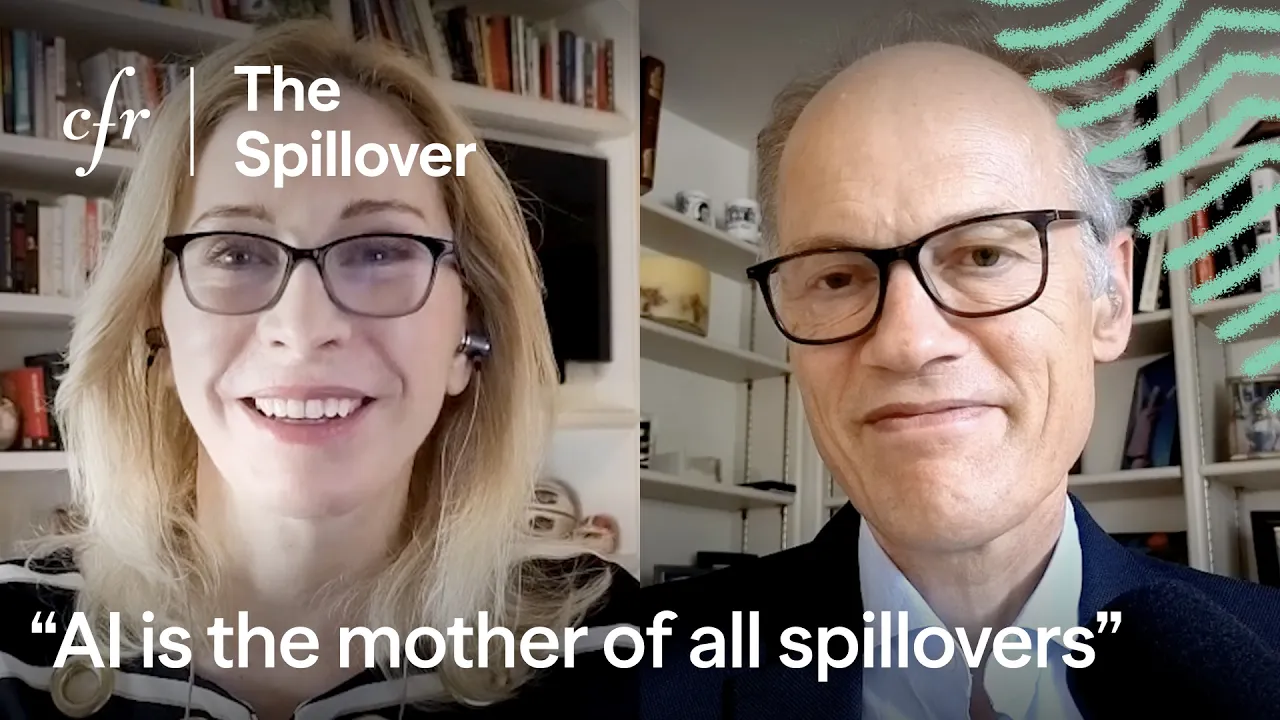
Yeah, yeah. AI is the mother of all spillovers. I think we can agree on that.
So, well, that’s a great wrap. My, you know, we always end, as listeners know by now, I think, with a sort of thing of the week that we mentioned, something we’ve noticed that’s amusing or interesting or whatever. Mine actually is almost a segue from what you were just saying about how ASML, you know, is driving the Dutch stock market and having these spillover effects for the economy there.
Because the same is true in Spain, it’s in South Korea. And, you know, these two memory chip producers, Samsung and SK Hynix, have just gone on an absolutely wild growth, both of their earnings and of their share price. And they had a big correction in the last month.
And this is like the seesaw that is disrupting everything that goes on in South Korea to the point where, you know, both the president and his advisors are talking about, well, we’ve got this bonanza of sort of super profits in one corner of the economy. How do we redistribute it? Or do we have a kind of national wealth fund, you know, so that all citizens can benefit?
This debate is quite active in South Korea. But the anecdote I wanted to share, which kind of brings this whole to light, which I read in The Economist, I think it’s actually kind of an apocryphal story from some South Korean TV show or something. But it does kind of sum up the zeitgeist.
And so there’s a scene where there’s a kind of a fancy store. And into this very fancy, elegant store, there walks a very scruffy man. And so the staff kind of turn their noses up and they figure, I don’t know whether it’s selling him designer clothes or Swiss watches or whatever it is.
But anyway, then they’re not happy to see this particular customer because he doesn’t look like a real customer. And then, you know, he takes his coat off. And underneath, there is a gilet that says SK Hynix.
And then they fawn all over him. So that’s the image I want to leave you with.
PATTERSON:
That’s awesome. That’s great. I yes, that that rings true.
Good one. All right. So I have I have two quick ones this week.
First, we’re just going through quarterly earning seasons in the U.S. And it jumped out to me that Robinhood, which is a financial services firm, it saw prediction market revenue soaring in the second quarter, more than tenfold up versus the previous year to about 156 million dollars for the quarter. Prediction markets were accounting for about 20 percent of their total trading revenue. And that was overtaking equity trading crypto revenue for the first time.
I mean, so prediction markets are just booming. And, you know, there were a lot of sport events in the second quarter. So I’m sure that contributed to it.
But I think there’s a bigger story going on with prediction markets and short term trading and betting in general. So it’s just something I wanted to highlight to keep an eye on. And my second very quick one, Sebastian, near and dear to my heart is Ted Lasso.
So August 5th, a new season begins. So for anyone out there who’s downtrodden with certain events in the world and just want a moment of levity and joy, there we go. Ted Lasso’s back.
MALLABY:
Fantastic. That’s almost as big of a deal as your forthcoming dashboard for tracking.
PATTERSON:
All right. All right. You’re not going to let me go on that.
I will build it. I will build it and you will come.
MALLABY:
Okay. Okay.
Want to stay up to date on the latest episode of The Spillover?
Sign up to receive an email alert when new episodes drop at cfr.org slash newsletters or click the link in our show notes. If you have an idea, you just want to chat with us, email podcasts at cfr.org. Be sure to include The Spillover in the subject line.
This episode was produced by Molly McAnany and Gabrielle Sierra. Our video editor is Claire Seaton. Our sound designer and audio engineer is Markus Zakaria. And research for this episode was provided by Liza Jacob.
You can subscribe to the show on Apple Podcasts, Spotify, YouTube, or wherever you listen to podcasts.
This week on The Spillover, Rebecca Patterson and Sebastian Mallaby weigh the competitors in the global artificial intelligence race, drawing on Patterson’s new chapter for the book Geopolitics of AI.
Patterson opens with a deliberately provocative stance: “I think it’s premature to assume that the U.S. will be the world’s AI economic winner. I also think it’s premature to think the U.S. will continue to be the world’s leader in AI development.” Her case begins with the inputs. On talent, she notes that as of 2022, China was “producing more than 35 percent of all research publications in top-tier journals,” and “by far leads the world in AI-related patents.” Mallaby adds a figure of his own: if current trends hold, “by 2028, top Chinese-based researchers could outnumber American-based researchers by two to one.” On capital and infrastructure, the picture is more mixed. Patterson grants that the U.S. “clearly has the world’s deepest, most flexible, broadest capital markets,” and Mallaby pegs U.S. spending lead at “more than a four-times, maybe even a five-times delta.” But he cautions that China stretches its money further through distillation, where “the Chinese just show up and query the American model and effectively get an AI version of all those material science PhDs,” and that China holds an edge in the energy that powers data centers, “producing . . . twice as much electricity as the U.S.”
If development is close, deployment is where the hosts see the U.S. falling behind. Citing a Microsoft diffusion report, Mallaby notes that “UAE and Singapore are among the most enthusiastic AI users, while the U.S. comes in . . . 24th place,” while a European Central Bank survey of firms found “sixty percent of [EU] firms say they don’t even use it or they use it just infrequently.” Patterson traces the advanced-economy pessimism to psychology. “In the case of advanced economies,” she says, “households often are looking through a ‘My life is good now. Don’t screw it up. I have a glass half full and I don’t want you draining it’” mentality. “And draining it might be electricity prices tied to data centers,” she continues, “could be worries about jobs, but they see they have more to lose,” whereas for emerging markets “a new technology is a way to grow faster or even leapfrog.” Even where adoption takes hold, Mallaby argues the productivity gains get bottlenecked, because “the whole organization moves forward at the speed of the slowest piece of it,” meaning that even if a coder doubles their output, project sign-offs could still run at a pre-AI pace. Patterson adds an additional risk layer, saying if “a public-facing AI component to your business” goes wrong, “the trust you have with your customers is gone. And that’s an existential risk for companies.”
The two turn to global AI chokepoints: the Netherlands’ ASML, Taiwan’s TSMC, and China’s grip on rare earths. Patterson’s read is that these positions confer leverage but not durable victory: chokepoint economies “could absolutely be short-term economic winners,” but “these chokepoints are not necessarily going to tell you long-term economic beneficiaries.” Mallaby offers a thought experiment on this fragility, in which Washington demands a controlling stake in ASML and threatens otherwise to “switch off all of the AI systems that are running your economy.” Patterson’s larger point is that AI “necessitates alliances,” since no country can quickly build every link in the supply chain alone.
As for the verdict, Patterson closes by saying, “the U.S. I think is still in the lead. I think it’s a question mark if the U.S. is winning . . . maybe we’re in the top three or five, but we’re not number one.” Or, as Mallaby puts it, “AI is the mother of all spillovers.”
Mentioned on the Episode:
Geopolitics of AI, Johns Hopkins University Press
The Spillover is a production of the Council on Foreign Relations. The opinions expressed on the show are solely those of the hosts and guests, not of the Council, which takes no institutional positions on matters of policy.
This work represents the views solely of the host(s) and guest(s). The Council on Foreign Relations is an independent, nonpartisan membership organization, think tank, and publisher, and takes no institutional positions on matters of policy.
Producer
- Producer, Podcasts
Supervising Producer
- Director, Podcasting
Audio Producer
- Audio Producer & Sound Designer
Researcher
- Research Associate, Finance, Business, and Technology
More Episodes
 35:24Podcast
 48:01Podcast
 47:25Podcast
 50:17Podcast
 47:25Podcast
 52:31Podcast