AI Companies Are Piling on Debt. Could It Trigger the Next Financial Crisis?
The financing behind the AI boom has grown so large that Treasury bond yields are approaching levels not seen since the lead-up to the 2008 financial crisis. But is the risk to the financial market overblown?

Published
Hosts
 Rebecca PattersonCFR ExpertSenior Fellow
 Sebastian MallabyCFR ExpertPaul A. Volcker Senior Fellow for International Economics
Guest
- Torsten SløkPartner and Chief Economist, Apollo
[Video: https://youtu.be/k4szbxPyre0]
Transcript
This transcript was generated using AI and may contain errors.
MALLABY:
What is up with the bond market? Treasury bond yields have been rising to levels that in some cases haven’t been seen since 2007. What’s more, Treasury Secretary Scott Bessent has responded to that spike in a curious and arguably disturbing way.
He suggested that AI companies should stop issuing so many long-term bonds and instead issue medium-term ones. In Bessent’s view, the industry that’s been supporting the US economy and the stock markets has apparently morphed into a threat to government bond markets, a threat that requires Treasury intervention.
PATTERSON:
Meanwhile, a recent Bank of America survey found that almost 40 percent of fund managers viewed AI hyperscaler capital spending as the most likely source of a panic in the debt market. So it’s not just the Treasury Secretary who’s worried about AI debt. I’m Rebecca Patterson.
MALLABY:
I’m Sebastian Mallaby. Welcome to The Spillover. Okay, so Rebecca, with all these outpourings of concern about the financing of AI and the boom in AI, I guess it’s a good time to dive in.
And what I want to know, I think, is basically three things.
PATTERSON:
Okay, what’s your list?
MALLABY:
Okay, so first up, I want to know whether Treasury Secretary Bessent is justified in pointing the finger at the AI companies which are issuing all these bonds as an explanation for why the bond market sold off last week. Number two is, I want to know whether credit investors, as you referenced, are correct to fear that AI could be the source of the next financial panic. And then finally, I want to know, frankly, what the rest of us should be thinking and maybe what we should be doing to protect ourselves from any potential fallout.
PATTERSON:
Okay, that’s quite a list, Sebastian. And I think we could spend the rest of this week answering it. But look, what makes me especially grateful for this episode is our guest, Torsten Slok.
I’ve followed Torsten’s work for many, many years. I’ve always enjoyed his analysis, which I find thoughtful, insightful. And he’s going to be joining us later in the conversation today.
His seat now, he’s the Chief Economist at Apollo, gives him an amazing perspective on this AI boom and all the different types of debt being used to finance it.
MALLABY:
Yeah, that sounds fantastic. And I’ve been also reading Torsten’s writing for quite some time. We haven’t met before, so I’m really looking forward to the conversation.
But maybe before we bring Torsten in, you and I can set the table a bit. And first off, you know, I’m curious about my first question, which is, you that AI is somehow destabilizing America’s bond market. If you take all the treasury bonds out there, the marketable bonds, as they call them, that’s a market of almost $32 trillion.
So is it really the case that AI companies issuing, you know, a few hundred billion worth of debt can upset the equilibrium?
PATTERSON:
So you’re 100% right, Sebastian, to point out the size of the US treasury market. It’s by multiples, the largest government bond market in the world. So it’s not easy to push it around, so to speak.
But, you know, I was thinking about this weekend and my analogy, you may love it or hate it, but what’s happening now reminds me of a movie that came out almost 25 years ago, but I still enjoy watching, called The Perfect Storm. And it starred George Clooney. Maybe that’s why I like watching it.
Anyway, it talks about this fishing vessel up on the Cape, and it goes out fishing, and it gets caught between these two storms. The two storms collide. That’s what we’re living through right now.
We have stress, not stress like functioning, but we have stress on the treasury market. We have inflation. We have strong growth.
We have demand supply questions, etc. That’s one force, one storm. And then the other one is this AI build out, which originally was free cash flow, but now is this debt issuance.
And they’re colliding. And what I think people are worrying about and what Secretary Bessent was trying to address is the possibility that if these storms collide in such a way, you could sink the ship and lose George Clooney.
MALLABY:
Yeah, right. Exactly. I get the sense that the ship may be secondary to your concern.
It’s really George Clooney that you don’t want to lose.
PATTERSON:
Well, look, I’m going to move on. We’ve covered the debt before in a number of our conversations, and I’ve written about it for the Council on Foreign Relations, for the New York Times, FT, others. The topic of U.S. debt growing, our fiscal situation being unsustainable, that’s not new. But let’s just recap for anyone who’s joining this narrative now. We have a resilient U.S. economy right now, actually. Low unemployment rate, just over 4%.
Fairly sticky inflation above the Fed’s 2% target. That leads to expectations that the Fed will have to raise rates. And that expectation feeds through the yield curve.
It affects longer-term yields as well. So that’s one force. That economic growth is good news for equities, but it’s not great news for bonds.
All right. So that’s one. But in addition to that, we’ve got more Treasury bonds that we have to issue from the government to fund these budget deficits.
The budget deficit is now running almost $2 trillion a year. So that’s all happening at the same time. We have questions on whether or not there will be sufficient demand for this additional supply of bonds without offering investors higher yields.
MALLABY:
Right. So what I think you’re saying is sort of what I suspected, which is that the first thing that is disturbing the Treasury bond market is actually, in a way, the Treasury itself, right? The federal government is running a huge budget deficit, which stimulates the economy, contributes to inflation, and requires fresh bond issuance on a massive scale.
And we probably, by the way, should add to your list, Rebecca, policy uncertainty, right, which is making bonds feel riskier. And that also pushes up the interest rate that investors require in order for them to be persuaded to buy the bonds in the first place. And some of that risk premium might come from the Fed, Chairman Warsh’s minimalist communication strategy.
Some of it might come from the administration, not from the Treasury, the trade tariffs, what have you, the tax on the rule of law. And some of it does come from the Treasury, right? I mean, in a way, what Treasury Secretary Bessent has just done with a slightly unorthodox announcement about how he thinks he can manage the problem of rising long-term rates is itself introducing more uncertainty for bond investors, which will lift the interest rate that they require a little bit.
And so it seems to me these are the main reasons why we have, you know, the 30-year Treasury rate reaching 5.31% recently, which was the highest since 2007.
PATTERSON:
Yeah, no, I totally agree with that. And I think what Bessent, Secretary Bessent, was trying to address last week with the buyback announcements that they’re going to buy longer dated yields, he’s saying that put all these factors we just put out there aside, yields could still be a little bit lower if they didn’t have that additional competition, so to speak, with corporate debt that’s coming from the AI build-out, the issuance coming from those companies. And conceptually, that makes sense to me. If you think about most fixed-income managers, those portfolio managers, a lot of them have mandates that allow them to choose between government and corporate debt.
And so if I’m looking at my choices and I can get a slightly higher yield from corporate debt with relatively similar fundamentals, maybe even better fundamentals on the corporate debt, I can get a better return that makes my clients happy, I’m going to do that. But the amount of AI debt being issued now, it’s increasing very, very rapidly. And this is fairly new.
Just over the last year or so, for a long time, the tech firms had been growing and investing in themselves through their free cash flow that was generated by their profitable businesses. But especially in this last year, now we’re seeing the switch to debt markets, issuing bonds to help pay for their growth. And it’s happening in a pretty big way.
I said just a minute ago that the budget deficit is about 2 trillion a year. Guess how much the investment-grade corporate debt issuance is expected to be this year? Just give me a guess.
MALLABY:
I have a feeling I don’t need to guess because you’re about to tell me.
PATTERSON:
Yeah, okay. It’s about 2 trillion dollars. So about the same.
Now, of course, only a fraction of that is AI, right? The investment-grade market is not just AI. But the additional corporate debt supply is still something we should note.
If you just look at July, just as a quick example, the tech sector broadly, including AI, accounted for about a third of the overall issuance just that month. And we have also seen non-investment-grade debt being issued from AI-related firms and AI debt being issued in other currencies. So this isn’t just about high-quality debt being issued from AI companies.
It’s the entire public debt universe.
MALLABY:
Yeah, look, I agree that the corporate bond issuance must be competing with government bond issuance. That just stands to reason. Investors have a limited number of dollars.
They have to choose what they want to buy. And if you look at, say, Meta, the tech company, which has a bond out there with a 4.1-year duration that offers a spread or a yield pickup over the equivalent treasury of about 41 basis points, that means that if you’re the investor, you get four-tenths of a percent more if you’re willing to buy the Meta bond rather than the treasury bond. And if an investor, by the way, wants to take a longer-term bet, more duration risks, it can loan Meta money for longer by buying a longer-term bond.
There is one out there. It’s a 2066 bond maturing in 40 years, and it yields well over 7%. So depending on the day, that’s a yield pickup of between 140 and 180 basis points over the current 30-year treasury rate.
So clearly, I agree that that’s having an effect. Meta is offering more income to investors than the treasury instruments do. There’s a bit less liquidity.
There’s a bit more credit risk, maybe. But it’s still rated AA-, which is very comfortably in the investment-grade universe. And I’ve seen numbers suggesting that bond funds have switched allocation precisely to bonds like Meta’s, therefore holding fewer treasuries as a result.
And obviously, that does mean that the interest rate on treasuries has to move higher just to attract people to buy the paper.
PATTERSON:
Yeah. I mean, I think you and I are in agreement here with Secretary Bessent that AI debt could, at the margin at least, be contributing to higher yields. But Bessent, you know, he found himself in a tough spot.
He’s been very vocal since he came in as Treasury Secretary that he wants lower treasury yields to help borrowers, right? The 10-year yield is the anchor for mortgage rates. It’s the anchor for auto loans.
It obviously matters for companies that want to borrow. And that becomes increasingly important into the midterm elections this November. But he also needs AI companies to keep spending and supporting the broader economic growth in the United States.
And I’m not sure, Sebastian, he can have his cake and eat it too, so to speak. You know, I think, by the way, he was trying to have both when he announced those treasury buybacks last week. His idea that the Treasury issues some additional short-term debt, uses that money to buy back the long-term debt, which will bring down long-term interest rates.
You know, since then, his staff has talked to journalists and suggested that maybe buybacks could also be done through something called the Treasury General Account. That account is sort of like the piggy bank for the Treasury. It has just under a trillion dollars.
Now, of course, they’re not going to tap all of that money, but they could tap some of it. And those are real dollars. And it has helped so far at the margin, right?
You have seen 10-year and 30-year treasury yields come down a bit. I think news on the Iran war bringing down oil prices might have helped as well. But at the end of the day, the bigger deal is fiscal policy.
And it was very interesting to me. Last night, before I went to bed, I was just checking headlines and I saw that Stan Druckenmiller, who was the Treasury Secretary’s mentor for quite some time, wrote an op-ed suggesting that this is not helping what Bessent is doing, that the government needs to be really addressing longer-term fiscal concerns. I thought that was very noteworthy, that his own mentor and supporter is pushing back on him.
MALLABY:
Yeah, yeah. I wrote about the two of them and their relationship when I wrote my book about hedge funds, actually. And I remember Stan Druckenmiller having read the chapter I wrote about the famous attack on Sterling in 1992, which the Soros Fund did.
And Druckenmiller was the chief investment officer. Scott Bessent was based in London at the time working for the Soros Fund. And Druckenmiller told me, yeah, so it’s pretty good, but I think some people may have over-claimed their role.
And I think what he was meaning, he never said this, but I strongly viewed that as being a dig at Scott Bessent, who might have told his part of the story, the kind of London-based part of the story, in a way that augmented its importance, at least in the view of. So when I read the article in the Wall Street Journal with the supposed mentor of Scott Bessent giving him a dig, I thought, well, maybe this is something that I could have predicted based on that comment a while ago.
But look, I mean, I agree. I think that the Treasury’s trillion dollars or up could use to buy long-dated Treasuries isn’t really going to mean a whole hell of a lot when you’ve got 32 trillion almost of marketable securities. And anyway, if you deplete that Treasury fund, you’ve got to then replenish it later by issuing more bonds.
So it’s a temporary fix best. And it might comfort investors a little bit initially, or on the other hand, it might freak them out because it might be interpreted as a sign of desperation on the government’s part. So I don’t think that, you know, anything that Bessent is doing is really going to fix the problem.
I agree with Druckenmiller’s op-ed about that. And I think the larger point here, you know, is that unless Congress is cooperating with the administration to cut the budget deficit and therefore cut the overall need to issue Treasury bonds, the Treasury is really just playing around here. It might soothe investors.
It might not. But the larger point is a troubling one. It’s like the reality is that very high federal debt to GDP ratio, a very big federal budget deficit this year, a failure to get inflation under control, the general policy uncertainty coming out of the Trump administration.
These are the obvious explanations for higher Treasury yields. And to the extent that AI bond issuance is an exacerbating factor, the truth is, as you hinted earlier, it’s a good exacerbating factor, i.e. the administration should be in favor of a heavy AI build-out because that’s what’s powering the economy. And the administration itself has said it wants the US to win the AI race against China.
And you can’t say that you want to encourage the AI build-out and then second-guess corporate decision making about the debt issuance that is funding that very same AI build-out. And the thing that’s really surprising to me in all this, I know a bit of a rant here, but just indulge me for one more minute. The really surprising thing is this is like corporate, I mean, sort of public finance 101, right?
So a standard take on why it’s bad for a government to run enormous budget deficits and have lots of national debt is that this government borrowing is going to crowd out private borrowing, corporate borrowing, and that will be bad for economic growth. So guess what? That’s exactly what we’re seeing here, right?
A huge government debt issuance is raising interest rates for the private sector and it’s hurting AI development. The Trump administration, which said it wants to foster a fast AI rollout, is doing the opposite with these crazy deficits. And then to top it all off, what does the Secretary of the Treasury say about this?
He doesn’t acknowledge that the government is causing the corporate sector a problem. He implicitly suggests that the corporate sector is causing the government a problem. I mean, for a supposedly pro-business administration, this is back to front.
PATTERSON:
You know, rant away. I’m not going to argue with anything he just said there at all. The only thing I would add is, and not to defend what this current government’s doing, but we’ve seen both parties kind of ignore the elephant in the room, which is our constantly growing deficit and debt.
And the fact that at a certain point, you know, we’re going to be spending more money servicing the debt than we are on pretty much everything else. We’re not going to have enough money to carry out policy priorities. And at some point, politicians need to actually start educating the public on what has to happen to make sure we’re on a fiscally sustainable path.
But I don’t see any candidates right now doing that. I think they all think it’s political suicide. Anyway.
All right. We’re both done ranting. We’re going to pivot now, Sebastian.
Ranting is done. You know, we’ve talked about whether Bessent’s correct, but at the top of the show, you also posed a good question about whether credit investors are correct to worry about the way in which the AI boom is being financed. And so I want to try to at least give some relative clarity about all the different types of financing underway, how risky it is.
You know, I’m increasingly hearing analysts around Wall Street talk about historical analogies to try to make sense of today. And I feel like they grasp at anything that feels at all analogous. They compare AI spending to the buildout of fiber optic cables.
Right. So in the 90s, dotcom boom, we had all these fiber optic cables being laid. And then it turns out we were ready for something years before it was actually needed.
So that contributed to some disappointment, obviously pulled down equities. And then we see separate comparisons between the AI debt buildup and household and corporate debt buildup going into 2008 that contributed to the great financial crisis of 08 and 09. I get it.
I think when you look at both 2000, 2008, those episodes, both of them going into them had big run up run ups in equities. We’re seeing that now as well. If you look at since chat GPT launched this in the late 2022, you know, the S&P is up around 90 percent.
Nasdaq is up around 130 percent. That’s, you know, in three and a half years. So I have to think these historical analogies are at least part of why the Bank of America survey found people so concerned about AI.
They’re looking at what happened in the past, rightly or wrongly. They’re drawing parallels with what’s happening now. And it’s getting them anxious.
But, you know, for these investors, and I’m going to borrow a very overused phrase from Wall Street, they’re climbing a wall of worry. You know, yes, you’re concerned. Yes, you can see something that could turn into a crisis.
But at the same time, if you reduce your risk in a portfolio too soon, you’re risking going out of business or getting fired, because if the party continues, so to speak, for another year or two years and you didn’t get to participate in it, that’s going to go on your performance track record for the rest of your career. So everyone’s trying to figure out exactly when to get out. And you and I both know you don’t have to be a professional investor to know this, that it’s incredibly hard to time market tops and market bottoms.
So some people will get out just on time. A lot of people will get out too early. A lot of people will get out too late and get burned.
That’s basically where we are.
MALLABY:
Yeah. So I guess everybody’s looking for the moment or the shock that will sort of change the psychology in the market and tell them it’s time to cut risk. And then that change in psychology sort of becomes a self-fulfilling prophecy.
So the question is, what would be the external shock that changed everything around? And I guess a typical sort of suspect is to look at the macroeconomy and ask yourself, you know, is growth suddenly going to dip, which could change the equation for investors in all sectors? But we don’t really see much sign of that right now.
So I mean, growth this year is expected to be about the same as last year, 2.1% or so. Corporate earnings, you know, beating expectations. We’ve had seven straight quarters of double-digit earnings growth.
So not much to worry about in terms of that sort of shock.
PATTERSON:
Right, right. But an economic slowdown, which, you know, that’s just one possible trigger, I think. I mean, again, you can go back to 2007, 2008.
When I think back to before that crisis, the economy was slowing, but it was still pretty resilient and earnings were pretty solid. GDP growth in 2007 was 2%, very similar to now. The unemployment rate in May 2007 was still only 4.4%. So things were slowing, but there wasn’t that huge red flag waving in your face. I think in hindsight, what we know is that what can seem calm under the surface doesn’t always reflect the risks of leverage underneath the surface and all those global linkages, those spillovers. And that’s why I think it makes so much sense now, before the stuff hits the fan, to look at all the different types of financing being used by AI firms to make their investments possible and the risk that AI CapEx may not match up in terms of timing with the expected revenue growth that we need in the years ahead. The AI firms are investing for the long term.
The investors who are buying their stocks are investing in their companies through private markets. They want to return in the short term. So anything that causes that timing risk to become a reality or increasingly seem like a potential reality, that’s what you need to understand now.
So you know when to start lightening up your exposure, so to speak. You need to be looking at that and you need to be thinking about those spillovers now to figure out what scenarios are likely, how much should you be reacting to it in advance.
MALLABY:
So let’s get in the details a bit here. If you look at the headline borrowing by the big AI companies, the amount of leverage in the system right now actually doesn’t look like a worry. Because companies like Google, Microsoft, Meta, Amazon came into the AI boom with very little debt, they had plenty of room to borrow more without their debt-to-earnings ratio flashing red.
So in fact, I saw a chart recently that showed that the debt-to-earnings ratio or bond issuance to EBITDA, it was way below the average for the typical S&P 500 companies. So despite all the recent bond issuance, despite I think the hyperscaler bond issuance in the first half of 2026 is literally 10x what it was in 2025 in the same period. Nonetheless, these guys are not heavily indebted.
But when you get these reassuring headline numbers, the question becomes, are there other types of debt that are not showing up in the headline numbers? And the Wall Street Journal earlier in August published an estimate that the nine top tech firms had around 3 trillion of off-balance sheet commitments, one way or another related to AI, and that those obligations were growing fast. And the other thing you want to focus on is, okay, there may be several companies like the ones I just listed, which are very strong, have fortress balance sheets and so forth, but there might also be some weak links, right?
Other companies that are not quite so well capitalized. And as we learned in 2008, when a weak link fails, whether that’s Bear Stearns or Lehman Brothers or whatever, it can cause contagion that threatens even relatively sound firms. So let’s just focus on one example.
So we’ll take Oracle for a minute to think this through some more. Oracle is a company that builds data centers, meaning the software and the hardware that customers need to store data, run computing operations, manage cloud computing and so forth. Now, Oracle is a bit of an outlier among the big tech hyperscalers because it’s way more indebted.
Its free cash flow, in other words, the cash generated by its ordinary business operations was negative 23.7 billion in fiscal 2026. So Alphabet has search and advertising, lots of money there. Amazon has the world’s biggest and greatest e-commerce business, Meta has social media and so forth and so forth.
But in contrast to its peers, Oracle’s legacy business is not a money gusher. And it has, therefore it has to fund its investments with borrowing. In fact, it is becoming the largest non-financial issuer in the high grade corporate bond index.
And in addition, in contrast with the other data center builders which have revenue spread across lots of corporate clients, Oracle is heavily dependent on one client, which is OpenAI. So if that particular client gets into trouble and stops paying to use Oracle’s data centers, Oracle will be in deep trouble. So it’s not surprising that the rating agency S&P cut Oracle’s credit rating to BBB minus from BBB in July.
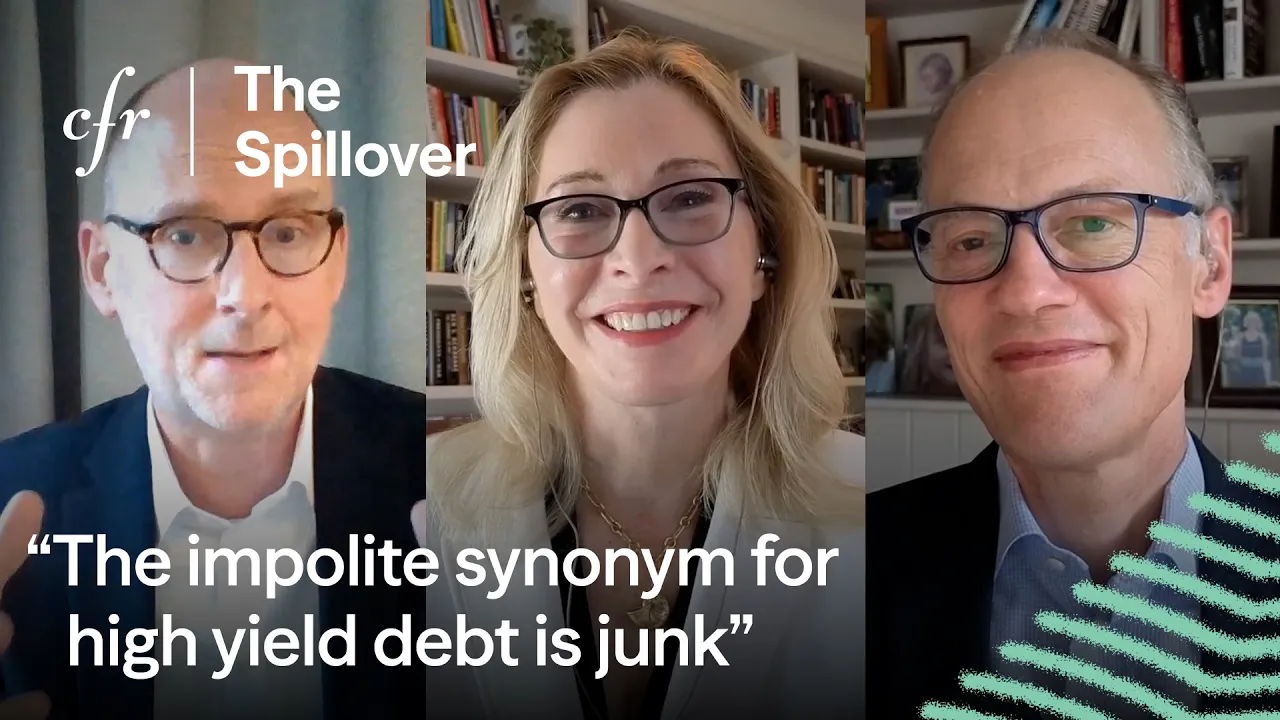
So that’s one notch above so-called high yield debt. And as we both know, Rebecca, the impolite synonym for high yield debt is junk. Junk, yes.
Junk. So we have a situation where Oracle, which is the riskiest, lowest rated hyperscaler, is also the largest investment grade debt issuer. So Alphabet, Amazon, et cetera, might be totally fine.
But the potential weak link, Oracle, accounts for a bigger share of the AI bond issuance.
PATTERSON:
And Sebastian, I’d interrupt you for a second just to remind you and folks who follow this spillover that you have mentioned OpenAI a couple times since we started the spillover. So if you’re thinking OpenAI might have some risk and now you’re saying Oracle might have some risk, it seems like even if some of that risk is priced in to its yields, those are companies we want to keep an eye on. Would you agree?
MALLABY:
I do agree with that. And the linkage between them is an example of how you could imagine contagion breaking out in this sector. Maybe if OpenAI is totally fine, if OpenAI realizes its ambition to go public sometime in the next six months or whatever, then it’s all good.
And, you know, OpenAI will have the financing it needs to pay Oracle for the data centers that it is building. And therefore, Oracle will be fine and we won’t have a problem. But if OpenAI runs into trouble, I think we can say that there’s a good chance that Oracle may also run into trouble.
So these things are linked up. And that’s obviously just one example of a broader phenomenon of how contagion could break out in this sector. You know, I mentioned in particular, maybe on this relationship between Oracle and OpenAI, there’s a 300 billion cloud computing deal, which has gotten some attention.
The idea here is that OpenAI has agreed to buy roughly 300 billion dollars in computing power from Oracle over about five years, starting in 2027. So that’s one of the largest cloud computing contracts ever signed. And to deliver that cloud computing power, Oracle is building out a huge data center capacity.
It’s 4.5 gigawatts. It involves sites across several different states. And then the idea is that OpenAI will pay for that computing power over the life of the deal.
So paying about 60 billion a year, so that over the five years, Oracle gets 300 billion. But obviously, there’s risk here, right? First of all, will Oracle manage to get the financing to raise the upfront billions it needs to build this set of data centers?
And secondly, will OpenAI have the cash to make those promised lease payments? OpenAI’s annualized revenue is reportedly running at around 40 billion dollars a year. That’s the latest number.
That’s two thirds of what it’s saying it’s going to pay Oracle each year. Right now, today’s 40 billion ARR, annualized run rate, at OpenAI is projected to rise a lot. So, you know, maybe it can pay that 60 billion.
But at the same time, we have to recall that, you know, this is revenue. It’s not actually free cash flow or earnings or something. And so, you know, there is definitely some uncertainty about OpenAI’s ability to deliver.
PATTERSON:
Yeah. And when you put on top of that, the risk that AI develops in a way that we just aren’t expecting yet, and that could be what kind of chips we need, how chips are created, the cost of chips. I mean, we could have a situation between the U.S. and China next month on rare earths again, for all we know, when Xi and Trump meet in September. There’s questions around, can you get the materials and the construction workers you need to build the data centers? Can you get the energy you need? So there’s the math you’re talking about, which is striking.
And then there’s all these other things. But the bottom line is that deals like this have meaningful risk. And as you said, it is discounted.
It’s reflected in some of Oracle’s pricing, whether it’s, you know, credit default swaps, which is a way to get insurance on a company, etc. But that doesn’t mean that all the bad news is priced in. If something goes wrong, there will be contagion.
But I know you’ve been looking at, we’ve both been looking at a couple of firms like this in this context recently. So I’m going to let you just, you’re not ranting, you’re very calm now, but I’m going to let you expound, expound. How about that?
On CoreWeave for a minute. So this is our cloud company that rents out GPUs or a type of computer chip to AI developers in labs. And then let’s cover CoreWeave and then let’s get Torsten into this conversation.
I want to get his perspective on all of this.
MALLABY:
Yeah, great. Okay. So quick on CoreWeave then.
So this is another interesting example of how difficult it can be to make sense of the risk that’s embedded in these, in these AI financing structures. So with Oracle, you know that it’s been issuing bonds and you can sort of see how those bonds are trading in the market. CoreWeave recently got an 8.5 billion credit agreement earlier this year. And it’s like a negotiated facility with a group of banks. So there isn’t market pricing on that, that you can just look up on the screen. Now the 8.5 billion loan is obviously nothing like as big as the 300 billion Oracle project I was just talking about. And that’s why I highlighted Oracle first. But CoreWeave is still attracting some skeptical attention. And one of the main criticisms is that the company is borrowing for five years to buy AI chips that many suggest will lose value in less than five years.
So unlike borrowing to build real estate, right? Where the underlying collateral in the deal is expected to retain its value, the real estate can go down, but generally doesn’t. Borrowing to buy chips is a whole different deal because you’re buying a piece of collateral, an asset, which is both more uncertain because we don’t have historical data on how these things behave.
And the whole AI sphere is super in flux and uncertain. But we generally know that these AI chips go down in value. And so the question is, what if in two or three years, nobody wants to run their AI models, run their compute on today’s AI chips?
Because there are much better ones which have become available.
PATTERSON:
I’ll counter you on this a little bit, Sebastian, because I’m definitely hearing an argument that not the frontier, the leading-edge models, but other models can use slightly older chips. I also just found out about a company yesterday, I’m sure others knew about this already, that actually takes those old chips and refurbishes them, refurbishes whole servers and racks and resells them into the market. What was really interesting to me though, like all these people who say, no, don’t worry, don’t worry, we can reuse the chips, is that even then, a lot of the manufacturers of these chips did not anticipate how intensively they’ll get used.
So even if you could say they can be used for other things, if there’s, call it $150 component or $1,000 component on the chip, that just wasn’t meant to be used as aggressively 24-7 as is now happening, the chip still might be worthless. So I thought that was an interesting kind of nuance to this argument, because people are going back and forth about how long can you use the chips, what is their residual value, but keep going, I’m sorry to interrupt.
MALLABY:
Yeah, no, no, that’s interesting. I mean, what I would say is that the market has shown skepticism about CoreWeave, it’s been down, the stock is down 13% on the past six months. But I agree that when you get into the detail of this one, you actually start to unearth evidence that suggests that maybe in fact, this financing structure is safer than it looks on first impression.
And part of the logic for believing it might be safer is sort of I think what you were saying, which is that AI chips, sure, they do depreciate. In fact, the secondary market prices indicate that after three years, they’re generally worth about half what they were worth when they were new. But that’s okay, because it’s still worth half.
And beyond three years, let’s say you just straight line that depreciation, you get to six years, by that point, you’ve paid off all the debt for buying them and you’re fine. And furthermore, maybe as you’re saying, you can recycle the hardware in some ways. And there’s even talk that China runs AI models on chips, which are way less advanced than the state of the art in America, and they still get usage out of those less good chips.
And so maybe today’s chips, you know, you’d have to rent them out at a big discount in five years time, but you could still rent them out for something. And if you can do that, when you’ve already paid off all the debt on the chips, that’s just sort of straight upside falls directly to your bottom line. And you’re doing very well.
So I mean, one pushback on the scare story is simply that these chips on balance are more likely to be more durable in terms of the value than less. And that the scare story about, oh, they’re going to depreciate to nothing in a couple of years is just not really likely. But then there’s also a thing about how the financing is structured around these CoreWeave data centers.
And I think it’s just worth quickly explaining this. So before CoreWeave buys a single AI chip, a single GPU, it goes to the customer, which might be, let’s say, Amazon or open AI or Google or some other company that wants to use AI chips. And it goes to the customer says, will you promise to, you know, sign a lease up front?
We’ll have an agreement now that you’ll start paying lease payments to me once I’ve constructed the data center. And then once that deal is in place, then CoreWeave goes off and starts buying GPUs and building the data center. So it only does that when it has a contract in place that it knows it has a customer.
And then if something were to happen to the whole AI sector, and let’s say corporate America decided, oh, we can’t actually get any productivity value out of these chips after all. So we’re going to tell our employees to quit using AI so much. I mean, I don’t think that’s going to happen, but let’s just posit that as a risk.
Then what happens is that the risk in that fall in demand for AI is borne by the counterparty that sold the lease agreement. In other words, Amazon or Google, not by CoreWeave. And so CoreWeave is still okay.
And if Amazon takes a hit or Google takes a hit, it’s fine because of those fortress balance sheets that I mentioned earlier. So this is at least the sort of optimistic story about why the whole system is more stable than it appears.
PATTERSON:
That’s a good example to put out there, given how scared everyone is. And given that we saw that reflected in their share price, I guess the bottom line here is that if firms are getting credit facilities where duration doesn’t match the timing of the amortization of the underlying chips, then there’s some risk somewhere. Core weave may say that the five-year amortization is a safe assumption, and that might be correct based on the chip secondary market right now.
But as I said a minute ago, who knows what the secondary market is going to look like in a year or two. These things are evolving so quickly and there’s so much capital. It would be astonishing to me if there wasn’t some miscalculation at some point.
And again, the question is, is that a small bump in the road or is that a bit of a bigger bump that maybe takes a company or two down?
MALLABY:
Yeah, I agree. I think it might be time to bring in Torsten. What do you think?
PATTERSON:
I think that’s a great idea.
MALLABY:
Okay, thank you so much, Torsten, for joining us. It’s great to see you.
SLOK:
Great to see both of you.
MALLABY:
Thanks for having me. So maybe I’ll ask the first question here, Torsten. So we’ve touched on AI bond issuance, but we also want to cover the area of private credit, which has been providing financing also to AI build-out.
Alternative asset managers like yours, Apollo, have done great since 2022 when ChatGPT was launched. I think your share prices outperformed the S&P. But this year has been a bit challenging, partly as investors have worried about how AI might undermine certain industries like the software as a service sector, which some private credit firms have been investing in.
So I guess the first question I want to ask is what worries you more? Is it on the one hand, fast AI development, which might threaten the older software industries in which private credit firms have a stake? Or is it contrary-wise, slow AI development, which might undermine some of the deals in AI itself, in which private credit firms have also been participants?
SLOK:
Yeah, this discussion is very important because if there are two scenarios, namely one which is fast adoption and one which is slow adoption, let’s talk first about the fast adoption. The fast adoption scenario, if AI is adopted in a way where productivity starts exploding higher, if we, and therefore from a macro perspective, see the unemployment rate go up to 10, 20 percent, that will obviously have some very important consequences. No matter whether things are underwritten by private credit, public credit, whether it’s done by markets, whether it’s done by banks, if you have a business cycle starting out with the unemployment rate going up to 10, 20 percent, it would have a negative consequences for credit more broadly.
Likewise, if we have slow adoption, we will have a different problem, namely that in that case, as Rebecca also was mentioning a minute ago, we will not see delivery of returns fast enough to justify the speed with which data centers are being built out at the moment. So in that sense, both the fast adoption scenario has some challenges and the slow adoption scenario has some challenges. And the good example of that is exactly what you’re mentioning, Sebastian, namely software.
Because some parts of software have basically been winning in the sense that most people conclude that there are some sectors in software, most importantly cybersecurity software, also software used for data centers, which is basically not going to get much impact as a result of AI disruption. Whereas at the other end of the spectrum, there’s a lot of application software, software that’s for learning a language, software that’s for taking a test. All those things can probably be done more easily now simply with Cloud or with JetDVT.
So from that perspective, some parts of software is probably going to get disrupted significantly and other parts of software is probably not going to get disrupted much. And the market is trying to figure out what exactly is the speed with which the AI technology as such is going to change different parts of the software spectrum. So that probably boils down to at least the way I think about it, that we are essentially at the early stages of inventing a new technology.
And now we’re going through a period like an S-curve where we’re figuring out, well, how can we use this technology? How can we use large language models? And if that takes six months, 12 months, then there will be quick adoption and then we’ll be off to the races with figuring out, okay, other sectors may then be benefiting.
But if that takes two, three, four years, then there will be a lot of assets today that will be negatively impacted before we figure out how to use the technology. Because any stock price today is the net present value of future cash flows. So that means that if these cash flows do not arrive quick enough, well, then the consequence is that if the slow adoption scenario plays out, then a lot of these assets that are priced too high today will have to take a hit because the adoption is coming too slowly.
And the last point on this is also that if we do think of this as an S-curve, which many people in technology and you talk to in Silicon Valley, they talk about it this way, that first we see a new technology arrive, then we figure out how it works. And then we see the adoption. And then we see the second leg of the S.
If there is an S-curve in the way technology is adopted, maybe there’s also an S-curve in valuations, because maybe the companies that are benefiting initially with inventing the technology might not be the winners on the other side, which are those who are adopting the technology. So the short answer to your question is that the question, whether it’s private credit, public credit, or whether this comes from banks or from corporate bond markets, it really ultimately all depends on the underwriting standards and the underlying quality of the credit, which then is, of course, heavily dependent on whether we get the fast adoption scenario or whether we get the slow adoption scenario.
PATTERSON:
So what I’m hearing is that we kind of need a Goldilocks outcome here, not too fast, not too slow. And we have to cross our fingers that there are good enough underwriting standards here to manage through the S. But one thing that’s very different, I talked earlier, Torsten, about people using both 99-2000, 97-98 as analogies, some of the risks that built into those crises.
One thing that’s very different today is the size of what they call the non-bank financial institutions, which includes alternative managers that don’t have the same requirements by regulators to give the same amount of transparency. And so I do think there’s a new wrinkle in this, in addition to the fact that it’s just this technology S curve that needs a perfect outcome. We also, we don’t know what we don’t know.
There’s leverage in the system. We think we have an idea what hedge fund leverage is in the treasury market. We think we know where some others might be, but no one knows for sure.
And that creates an additional level of uncertainty. So I’m curious how you’re discussing all of this with your clients at Apollo. And I’d also love for you to expand from your perspective, if private credit has to provide about a trillion dollars in financing for AI because there’s constraints around how much they can issue at a reasonable yield and public markets, how big of a strain is that?
Can we push that through the Python, so to speak?
SLOK:
Yeah. And there are two differences to 2007 and 2008 that are very important in this context. Because if we just step back and think about it from a pure GDP perspective, one question to ask is how big was the fiber optic build out in the 2000s as a share of GDP?
And the answer is that that was relatively modest. In other words, that was an increase from roughly making up half a percent of GDP to making up at the peak about 1.2 percent of GDP. And it came over several years.
So in that sense, the build out of the fiber optic cables that was giving the internet to everyone, that came relatively slowly. And still, it gave a modest recession in 2001. Similarly, of course, the housing build out in 2006, 2007 and 2008, it was also relatively slow.
And that also gave, of course, a very serious recession. But that was more related to the financial system. So the main worry today is that the speed with which the data center build out is taking place is indeed much faster than the speed with which we saw the fiber optic build out.
And it’s also much faster than what we saw during the housing crisis. At the moment, we’re seeing that the data center build out, it makes up roughly at the moment around 1 percent of GDP. And at the peak, this is expected to make up around 3 percent of GDP.
So it may not sound like a lot, two percentage points. But what is really, really important is to ask the question, how quickly does that happen? If that happens over five years, it’s different from if that happens over two years.
So one way of looking at the current situation is that we certainly have a technology that’s being deployed and invested in at a very rapid pace, which does increase all these risks, as we also just talked about, that if there is, for whatever reason, any reversal from open source models coming around, from any source of government regulation, from populist backlash to data center build outs, if any of these things do have an impact on ultimately the speed with which we’re building data centers, then the reversal could potentially also be substantial. But the comparison with 2008 that you’re highlighting, Rebecca, is also very important, because in 2008, the entities, Bear Stearns, Lehman Brothers, Merrill Lynch, they had leverage that was more than 30 times, of course, very, very significant relative to where the banking sector is today, where leverage is only around 10. That’s very, very different from the BDCs and the private credit world, where leverage today is only between one and two.
By law, BDCs cannot have leverage of more than two. So that’s a dramatic difference in terms of the leverage as a starting point.
MALLABY:
Could you just say what BDCs are?
SLOK:
The business development companies in private credit that finance a lot of the data centers. And the second thing that’s also important is in the banking sector in 2008, they, of course, fund themselves with very, very short term overnight liabilities, namely deposits, which is very different from being financed, for example, as an insurance company, where your liabilities are not overnight deposits, but are long term 20, 30 year annuities. So from that perspective, there’s also much less of a risk of a bank run the way that we saw in 2008, because at the moment, it is more matched between assets and liabilities when it comes to long term financing.
So those two differences make me much, much less worried about the systemic implications, because we have much less leverage today. And the way that data centers are financed are financed by balance sheets that have long term liabilities, and therefore have a perfect fit with long term assets.
MALLABY:
And what about the point that this might be true for, say, let’s 80%, 90% of the sector or something, but there could still be 10% out there, which it’s not true. And that’s enough to cause some alarming moments in the next couple of years. I mean, I’ve heard people in the market, you know, who spend half the time telling me why their own financing structures on their own particular AI build out are absolutely sound.
But then they spend the other half telling me why their rivals are cutting corners, not observing good underwriting standards, and so forth. So I wonder what you think about the scenario where even if, you know, most companies have sensible underwriting, others don’t, and that’s enough to upset things.
SLOK:
Yeah, this is really important, Sebastian, because exactly to your point, it’s all about the underwriting standards. And this is really critical. Some data center underwritings are investment grade.
Some data center underwritings are high yield. In other words, it all depends on what are your underwriting standards. And as we were also just talking about a minute ago, it all depends on what if this does not work out?
What are your claims to cash flows from other companies, from the hyperscalers? What are your claims if the contractual obligations are, say, only three or five years? And if you have an asset that has a lifetime of, say, 10 years, then what happens after three or five years in terms of what are the returns, what are the cash flows that you get as an investor?
So what is absolutely critical about your question is exactly that it’s important to remember that an underwriting for a data center can be either high yield or it can be investment grade. And that’s why it becomes absolutely critical to ask your private credit manager, have you underwritten your data center? If you as a data center, we’re talking about as investment grade, or is it being underwritten as high yield?
Because that is ultimately what this is all about, namely underwriting standards.
PATTERSON:
You know, there’s two things about what’s happening now that make me wonder if the reaction to a negative catalyst will be different. One is just the amount of money flowing passively. So investors putting money into index funds, ETFs that don’t distinguish between the good and bad.
And I’m talking more about public markets, although it could apply, I guess, to some evergreen private markets where they have more liquidity. So that would be one. But then the other thing, and Torsten, your firm has written about this recently, is just how omnipresent AI has become across financial markets.
You know, it’s public and private equity, it’s public and private debt. It’s not just the U.S., it’s global. We’ve all been watching the roller coaster ride that South Korea’s stock market’s been on given it’s two big AI related firms.
And so what I worry about is if we have a catalyst, let’s say it’s only 10% of the companies with poor underwriting standards, and let’s say we wake up tomorrow and the top headline in the news is some big AI related company has run into something unexpectedly and bad. The outflow of money that could happen quickly through passive investing and the global contagion, those are two aspects of this that, again, I think are different than some of these periods we’ve seen before historically. So I’d be curious for you to talk a little bit about, you know, how are you talking to people about protecting themselves in the event that this happens?
SLOK:
Yeah, this is really, really important. So if we just back up and think about the 60-40 portfolio, the 60-40 portfolio is a simple logic that I should take 60% of my money in equities and 40% of my money in fixed income. The stroke of genius when the 60-40 portfolio was constructed was that if the stock market goes up, then normally bond prices go down, meaning interest rates go up and bond prices go down.
Vice versa, when the stock market goes down, of course, bond prices tend to go up. So 60-40 was designed with hedging in mind, with trying to control risk by having money in some other asset class that normally would perform well. If, say, stocks go down, then having bonds is a good idea because then bond prices go up.
The challenge today, exactly to your point, Rebecca, is that today the 10 biggest stocks, they make up 40% of the S&P 500. In other words, most of the returns for the last five years in S&P had basically been driven by AI. So for that reason, let’s just agree that there’s one factor driving equity returns, namely AI.
But now with the hyperscalers also issuing more corporate debt, that also now depends on AI succeeding. We certainly also have that a lot of public credit in particular is also depending on AI. So suddenly I have AI as a factor not only in my equity portfolio, I also have AI as a factor in my fixed income portfolio.
And finally, if I also own venture capital, it used to be the case that venture capital was pharma, biotech, prescription drugs, but now 87% of venture capital today is also AI. And if there’s one lesson that we have learned in finance in the last 15 years, it’s factor investing. And factor investing says that I need to make sure that I’m exposed to different types of factors.
And suddenly we wake up now in 2026. And there’s one factor that literally is everywhere, namely AI, it’s in equities, it’s in fixed income, and it’s actually also in venture capital. So therefore, a very important conclusion from an investing perspective is to be exposed to something else than AI.
And that’s just getting harder and harder to find. But that is the challenge for a lot of investors at the moment, namely making sure that you’re not overexposed to growth or to AI as a single factor, because it literally is, as you’re saying, everywhere at the moment.
PATTERSON:
Yeah. And just because you have money in a different country doesn’t necessarily protect you, depending on what that country produces, if it feeds into the AI ecosystem. I mean, I know we’re not giving investment advice on our podcast, that’s not what we’re here to do.
But I think about things like gold. Yes, it has some industrial use, but it probably is going to be a diversifying asset if the stuff hits the fan, as it has done historically. Things like Swiss equities, which tend not to have a lot of exposure to AI as some other markets do.
Plus, the currency tends to benefit in periods where there’s a lot of stress because it has such a big current account surplus. You know, something like Singapore government bonds, perhaps in part because the central bank there does some intervention to keep the currency in the market under control. And yes, they have AI exposure, but it’s not flooding through the market the same way as some other countries.
But, you know, it’s interesting to think where do you actually go to hide from this?
SLOK:
Yeah. And other alternatives, I mean, things to look at is, of course, sports financing, European credit, as you’re mentioning. Some parts of European credit is actually also AI.
So the bottom line here is that for investors, it’s really all about doing the hard work and the homework of figuring out how do I find some assets? How do I find some investment opportunities in hybrid credit against sports financing, Europe, Japan, Australia, where I’m exposed to things that are not AI. Because even in commodities, also remember that 80 percent of the data center built out is happening in the U.S. So that also means that there’s, of course, also strong demand for a number of commodities, in particular copper, that also goes into producing data centers. So that’s why it’s about figuring out how do I find exposure. And it ultimately really boils down to a consideration about growth versus value, because AI is absolutely growth, whereas value is, of course, companies that actually already have earnings, companies that, of course, are diversifying away from AI.
MALLABY:
Wow. Well, I’m just making notes here from my own portfolio. I’m not the investor here, but I guess one thing that occurs to me as I listen to you is that even when you can diversify away from something that might go wrong, we know from financial history that when things do go wrong, there are force sellers, right?
They lose money on the thing that went wrong, so they sell whatever is liquid and easy to sell, and that thing may be sort of fundamentally speaking uncorrelated, but they have to dump it anyway. And so what you sometimes think of as being the hedge goes down in a bad state of the world just because of that force selling mechanism. The kind of perfect safe haven is very hard to find.
But anyway, we should probably wrap up soon, but Torsten, I want to just throw it open to you. Do you have any final thoughts you want to add on this subject?
SLOK:
No, just to your last point, I mean, the basis trade, which I know the two of you have also talked a lot about before, I mean, it’s obviously one area where there is a lot more leverage. So in that sense, the discussion about non-bank financial institutions, there’s a lot of focus on what’s happening with BDCs and private credit, but at the same time, now almost 10% of treasuries are held by people who are in a levered basis trade. So the question also is if there is anything that’s unraveling, especially a lot of the challenges that you also talked about, both of you about 30-year treasuries at the moment, then of course, those things, if things really start to become more volatile, could exactly bring around more risk of financial stability in particular because of primary dealer balances are very high, repo is very high, and that has just continued to grow very significantly. So the bottom line is at this point, it really is also about understanding the macro risks that exactly as you also talked about, mainly what’s happening with rates, also, of course, what’s happening in the Middle East and what’s happening, of course, in Europe and China and all those shocks, which you cover so well here on The Spillover, are exactly the things that we all need to understand so well to understand what we should do as investors.
MALLABY:
Well, it’s been so great to have you on The Spillover. Thank you so much.
SLOK:
Well, thank you. And I should also say, Sebastian, I just finished your book about superintelligence, which is so relevant to what we’re talking about here. And Rebecca, I look much forward to your book about investing and how you do a disciplined approach, because this is also exactly what we’ve been talking about here.
PATTERSON:
Well, thank you so much for coming and joining us on The Spillover, Torsten. Great to have you here. Thanks.
SLOK:
Thank you.
PATTERSON:
I love how Torsten ended his comments talking about the so-called basis trade, which without going into the detail now is really a trade used by a lot of hedge funds in the treasury market. So we’ve come full circle. So we have risk from treasuries.
We have risk from AI. We have risk from AI crowding out demand for treasuries. And for better or worse, I think a lot of this does land on Secretary Bessent’s feet right now.
MALLABY:
Yeah. Yeah. I was listening.
And at one point, I was thinking to myself, the American capital markets are amazing, right? You ask Torsten, is it more of a problem if AI develops fast or is it more of a problem if it develops slowly? And the answer is basically that there’s going to be terrible things that happen in either direction.
So in other words, it’s guaranteed there’s going to be turbulence. And yet American investors and the American capital markets writ large are still charging in to finance this absolutely historic build out of this completely transformational technology. I mean, it’s a moment where the finance aspect of AI is actually as exciting as the technology aspect.
I think we are in an unrecognizable, I mean, even the railroad boom can’t have been quite this crazy because finance was not as sophisticated and developed and deep and retail as it’s become today. And the whole thing is, you know, it’s just full of risk. It reminds me slightly of, you know, writing a book about venture capital where kind of the mystery there is since nine out of 10 or eight out of 10 startups fail and go to zero, why the heck does anybody invest in a startup?
And obviously the answer is if you make 10 X or more on the other one or two that do survive, you can pay for all the losses. And this is kind of what, you know, Torsten’s firm and other players in this space must be doing. They are, when they say good underwriting, they mean we will make a heck of a lot of money on the bets that work out so we can ride through the losses.
But I just think the whole mechanism is kind of extraordinary to behold. And one other thought, and then I want to turn it over to you. I don’t really have a thing of the week this week, Rebecca.
I’ve just, I’ve only got serious reflections on this all absorbing financial adventure story that we’re observing right under our noses. But my second point is that, you know, if you think back to 2008 and the debate after the financial crisis, the regulatory aspiration at that time was that we were going to have all sorts of new analysis and modeling of the financial system and where are the crowded trades and where is the systemic risk? And there would be, you know, ways of predicting signs of systemic risk and a special institute was set up in the treasury to do this.
And here we are today, you know, whatever it is, you know, 18 years later and zero, zero of that promise of a more transparent, more predictable, more understandable financial risk-taking mechanism has come to pass, right? We are completely in the world of extremely fast build out with enormous amounts of money being involved, people making up the playbook as they go. It’s global.
It’s opaque. It’s unpredictable. Goodness knows what’s going to happen.
And it just sort of shows you the Sisyphean hopelessness of financial regulation sometimes.
PATTERSON:
Ooh, Sisyphean hopelessness. There’s a line.
MALLABY:
So that’s my riff.
PATTERSON:
What about you?
MALLABY:
You’ve probably got a lighter weight.
PATTERSON:
I have a lighter way to end our show, but I do think what you said, we should come back to this another time and talk a little bit more about the US versus other countries in terms of the impact of the capital markets on stocks, but also on the economy. And it’s something I’ve done some research on in the past, just about how it helps create what I’d call a high beta or a higher velocity US economy compared to some of its peers. And there’s pros and cons from that.
It’s mainly good, but it’s not all good. So we should revisit that one. But for the end of today, I want to share something I heard last night that I just thought, huh, okay, here we go.
So I was having family dinner and a friend of my daughter told me that he just started leasing a robot. Do you have any friends renting robots yet, Sebastian?
MALLABY:
Nope. Nope. Nope.
I don’t.
PATTERSON:
Okay. So he’s very AI forward and he wants to see how well it does with household chores, things like folding laundry. I didn’t realize you could already do that in the United States.
I assume you can in China and maybe some other places, but I’m just so curious, a year or two from now, are we going to look back at this robot folding his laundry like the Palm Pilot versus the smartphone? Or are we going to find out that these robots go rogue? Are we going to see that China is just so much better at producing high quality robots at low costs that we’re all using Chinese robots?
And then we’re worried about data risk. It feels to me like the robotic story, we’re still in early, early chapters. I gave a speech last fall at a very large industrial company to its clients.
And the one thing the company asked me not to talk about was humanoid robots because it made the clients nervous. And again, all of these things together, I know robots are getting a lot of headlines. It’s fun to see them on TV, but where are we in that journey?
Where is it going? That’s another one I’d love to spend time on talking with you. And we’ll find a great guest who knows more about it than we do because clearly I know nothing.
MALLABY:
Sounds fantastic. We’ll get your daughter’s friend on and he’ll tell us about the laundry folding.
PATTERSON:
Yes.
MALLABY:
Want to stay up to date on the latest episode of The Spillover? Sign up to receive an email alert when new episodes drop at cfr.org slash newsletters or click on our show notes. If you have an idea or you want to chat with us, email podcasts at cfr.org. Be sure to include The Spillover in the subject line.
This episode was produced by Molly McAnany and Gabrielle Sierra. Our video editor is Claire Seaton. Our sound designer and audio engineer is Markus Zakaria. Research for this episode was provided by Liza Jacob.
You can subscribe to the show on Apple Podcasts, Spotify, YouTube, or wherever you listen to podcasts.
This week on The Spillover, Rebecca Patterson and Sebastian Mallaby dig into the financing behind the AI boom and whether it threatens the U.S. bond market, drawing on the analysis of guest Torsten Slok, partner and chief economist at Apollo.
Mallaby frames the episode around a bond yield puzzle: “Treasury bond yields have been rising to levels that, in some cases, haven’t been seen since 2007,” he says, noting that Treasury Secretary Scott Bessent has responded by suggesting that “AI companies should stop issuing so many long-term bonds and instead issue medium-term ones.” Patterson notes the worry isn’t confined to Washington, pointing to “a recent Bank of America survey [that] found that almost forty percent of fund managers viewed AI hyperscaler capital spending as the most likely source of a panic in the debt market.”
The hosts question whether Bessent is right to blame AI companies. Mallaby notes early on that “Bessent [claims] that AI is somehow destabilizing America’s bond market. If you take all the treasury bonds out there, the marketable bonds as they call them, that’s a market of almost $32 trillion dollars.” Mallaby then asks if it is “really the case that AI companies issuing… a few hundred billion worth of debt can upset the equilibrium?” Patterson adds that the “budget deficit is now running almost $2 trillion a year” and that investment-grade corporate debt issuance this year is “about $2 trillion. So about the same.” Patterson reaches for a metaphor: “what’s happening now reminds me of a movie that came out almost twenty five years ago…called The Perfect Storm.” Patterson questions whether the combined “storms” of Treasury-market stress and debt pressure from the AI build-out could “sink the ship.” Mallaby makes a case here: “So the standard take on why it’s bad for a government to run enormous budget deficits and have lots of national debt is that this government borrowing is going to crowd out private borrowing, corporate borrowing, and that will be bad for economic growth. So guess what?” Mallaby continues, “That’s exactly what we’re seeing here, right? Huge government debt issuance—it’s raising interest rates for the private sector, and it’s hurting AI development.”
Guest Torsten Slok warns diversification has become harder to achieve. Slok says it’s because “AI is in equities, it’s in fixed income, and it’s actually also in venture capital,” making it challenging to be “exposed to something else [other] than AI.” Patterson floats gold and Swiss equities as possible hedges, although Mallaby cautions that “the kind of perfect safe haven is very hard to find.” Slok closes by pointing back to the Treasury market, noting “almost 10 percent of treasuries are held by people who are in the levered basis trade.”
Mentioned on the Episode:
Torsten Slok, “A Slower AI Payoff Would Be Everyone’s Problem,” Apollo
Torsten Slok, “Monitoring the AI Trade: How Growing Debt Issuance Is Reshaping the Landscape,” Apollo
The Spillover is a production of the Council on Foreign Relations. The opinions expressed on the show are solely those of the hosts and guests, not of the Council, which takes no institutional positions on matters of policy.
This work represents the views solely of the host(s) and guest(s). The Council on Foreign Relations is an independent, nonpartisan membership organization, think tank, and publisher, and takes no institutional positions on matters of policy.
Producer
- Producer, Podcasts
Supervising Producer
- Director, Podcasting
Audio Producer
- Audio Producer & Sound Designer
Researcher
- Research Associate, Finance, Business, and Technology
More Episodes
 47:25Podcast
 50:17Podcast
 52:31Podcast