AI’s Economic Winners
The race for AI dominance often focuses on the United States and China, but other countries are key players—and winning depends on many factors.

Editor’s note: This article was adapted from the author’s chapter of The Geopolitics of AI: Power, Conflict and the Future of the Global Order, edited by Hal Brands, Johns Hopkins University Press, July 2026.
The last decade has seen economics and financial markets play increasingly center-stage roles in driving countries’ national security and geopolitical goals. Those with greater economic and market resources, both broadly and through narrow but critical points of leverage, had a greater ability to shape global power dynamics.
That trend has now collided with a separate structural change that is advancing at an incredible pace: the development of artificial intelligence (AI). The influence that AI has on different countries’ economic futures and resulting geoeconomic abilities will help define the global balance of power.
So who is most likely to see the greatest economic benefits of AI? It’s an impossible question to answer with much confidence, given all the unknowns about the speed and shape of AI’s future development as well as how countries and companies navigate the innovation.
That said, there are several variables that can help determine which countries are most likely to be able to capture AI in a way that most strongly supports their respective economies.
While developing frontier models can help drive economic “winners,” it is not the only path to faster economic growth. Put another way, the United States and China, leading the frontier AI model race, will not necessarily become the largest economic beneficiaries.
Equally important will be a country’s labor-market structure, fiscal capacity, financial markets, social readiness, and the interconnection between potential labor displacement and consumer demand. Winners in this race will also need to maintain strong relationships with supply-chain allies. In addition, there will almost certainly be countries that are not broad AI economic winners but still retain geoeconomic leverage thanks to dominating a key input required for AI to function.
Leading AI development: From chips to water to public perception
Much of the analysis around potential economic beneficiaries of AI starts with an assumption that countries leading this technology’s development have a significant inherent advantage. Countries with dominant companies that are producing frontier models, with the best researchers and with easy access to capital, are expected to be in a better position to build needed physical and digital infrastructure and ultimately commercialize the innovation. That, in turn, should support productivity- and capex-driven economic growth.
While true, each of those building blocks has a number of underlying, necessary components required to successfully develop AI, as technology companies and policymakers have increasingly come to appreciate, as illustrated and discussed in more detail below.
Talent: Strong education systems help produce innovative research and train creative AI scientists and engineers to build frontier models. This is one of the metrics that drives fierce debates over “United States or China” as the world’s AI leaders. The answer to who leads on talent is challenging because different metrics can support different conclusions. What seems reasonable to suggest, at least, is that the talent race is changing over time and that a sustained U.S. advantage should not be assumed looking ahead. Consider:
- Recent decades have seen China catch up to the United States in terms of research published in journals. A 2026 National Bureau of Economic Research working paper estimated that as of 2022, China produced more than 35 percent of research publications in top-tier journals, more than the United States or European Union.
- China has become the undisputed leader in AI patenting, accounting for nearly 70 percent of all global AI patent grants as of 2024–2025. While volume does not equal impact, it still reflects an increasing focus in the country to drive AI research and development (R&D).
- Around 37 percent of the world’s top AI researchers now work for Chinese organizations, compared with 32 percent for U.S. ones. If the trend over the last ten years persists, by 2028 top Chinese-based researchers could outnumber U.S.-based ones by two to one.
Capital: AI development is capital intensive—this is a space where the United States currently dominates. The combination of government support, along with various sources of private-sector capital flowing to AI, has allowed technology firms to make massive investments, both in R&D and infrastructure such as data centers and advanced chips. To illustrate the United States’lead, Stanford’s 2025 AI Index Report estimated that U.S. private AI investment exceeded $109 billion in 2024, nearly twelve times China’s $9.3 billion and twenty-four times the United Kingdom’s $4.5 billion.
While stark, these numbers should still be taken with a grain of salt. In the case of China, government investment plays a meaningful role in the country’s technology ecosystem. As the Council on Foreign Relations noted in 2025, China’s government spent an estimated $900 billion over the past decade on AI, quantum, and biotech. Further, China’s leaders are signaling that more will come. Their latest five-year plan includes increased investment in AI-related technologies as part of a continued drive for self-reliance, and productivity-led growth to help offset a declining workforce is a top priority.
Physical and digital infrastructure: Recent years’ supply-chain pressures and geopolitical tensions have increased public and private-sector leaders’ focus on the various inputs needed to lead in AI development. Nvidia exemplifies the challenge. The U.S. company dominates the global market for advanced semiconductor chips—AI inputs that China needs. But to make those chips, Nvidia also relies heavily on China, which in turn dominates the global market for key inputs such as critical minerals. Both countries’ governments are increasingly using their respective chokepoints to try to gain leverage for a variety of policy goals, often through export controls.
AI development also requires sufficient digital infrastructure, including data and computing systems. Further, it needs computer hardware that goes well beyond chips and land for data centers to store and process data, which in turn requires sufficient water to cool systems and energy to run systems.
As data center construction has exploded in recent years, especially in the United States, more public attention has been drawn to the availability of skilled labor, water, and energy. The International Energy Agency has forecast that global electricity consumption from data centers could more than double by 2030; the United States and China are expected to represent 80 percent of that growth. On the energy front in particular, China has the upper hand. It already generates twice as much electricity as the United States, with half of its electricity growth coming from clean energy sources such as wind and solar.
Supportive government and public: Development of AI is likely to proceed faster and more smoothly in countries with supportive governments and populations. That support, which is not simply about capital availability, is not guaranteed, looking between and within countries. China’s government regularly supports large-scale events, from expos to robot-fighting tournaments, to build public excitement and trust around new technologies. Meanwhile, in the United States, worries over the cost of living, job displacement, and the environment have become a bipartisan reason for some state governments to push back on new data-center construction. Indeed, in its race to build data centers, U.S. firms have increasingly looked overseas as well as at home.

Despite benefits from the technology, there are also concerns among some countries’ policymakers and households about nefarious uses of AI, ethics, and human development (the potential for people to lose critical thinking skills). These different issues can shape how quickly AI development occurs. Indeed, when U.S. company Anthropic announced its latest Mythos model in April, the firm’s concerns about the frontier model’s ability to be used for cyberattacks led it to provide a preview of Mythos to a group of organizations to test and refine defensive cyber capabilities, with the goal of sharing those learnings broadly.
A global survey by Ipsos published last year may have reflected some of the AI-fueled fears. When asked about their view of AI for their economy over the coming 3–5 years, the most negative of the countries surveyed were all advanced economies and the most positive were emerging economies. The caution within the United States was particularly striking given the wealth gains that AI-driven equity returns created for many households, which one might expect would boost support for this innovation. Between the end of 2022, shortly after ChatGPT was released, and the third quarter of 2025, Federal Reserve data showed that U.S. household wealth rose by a staggering 70 percent, in large part thanks to technology-led equity gains.
Part of the differential between developed and emerging economic views towards AI likely stems from workforce characteristics, with more advanced economies having a relatively greater percentage of AI-exposed roles that could be automated. Emerging economies may see AI, meanwhile, as a way to accelerate economic development. In addition, advanced-economy fears could reflect local populations’ broader use of AI, and an understanding that the so-called Internet of Things pervasive in daily life could become a meaningful threat in the event of cyberattacks.
Thinking through AI deployment
Development, as noted earlier, is just one factor (with a number of critical components) that determines which economies are more likely to benefit from AI in the years ahead. Deployment of the technology, often described as adoption or diffusion, is critical as well—and it is fairly independent of development. A country lagging in research but with sufficient internet connectivity, available electricity, data quality, interested households, competitive businesses, and supportive governments could still see rapid deployment and subsequent productivity-driven growth gains.
Microsoft’s AI Diffusion Report, which was released earlier this year, illustrates the point. The analysis tries to measure AI diffusion as the share of people using generative AI during a defined period. Globally, the report estimates that 16.3 percent of people in the countries studied used generative AI during the second half of 2025, up from 15.1 percent in the first half of the year. The United Arab Emirates (UAE) and Singapore were among the highest AI usage scores, with the United States in twenty-fourth place. Both the UAE and Singapore have invested heavily in digital infrastructure, including high-speed internet. They have also emphasized the importance of digital-skills training for students and workers.
The report notes a divide between high- and lower-income country usage, with wealthier countries, thus far, seeing relatively higher AI diffusion. Still, the UAE and Singapore examples suggest that government and private-sector resources and postures towards AI can make a big difference in diffusion.

While the widespread use of AI in a country is a critical step to seeing economic benefits, it also matters how the technology is used. To what degree does AI augment workers (that is, increase their productivity) versus replace workers and increase corporate efficiency? There is also a related debate around how quickly AI-fueled innovation can create new opportunities for labor, thus mitigating AI-related job displacement.
The “how” of deployment is a key reason MIT economist Daron Acemoglu has been only cautiously optimistic about potential economic benefits. Looking at U.S. growth in 2024, he wrote, “Using existing estimates on exposure to AI and productivity improvements at the task level, these macroeconomic effects appear non-trivial but modest—no more than a 0.66 percent increase in total factor productivity over ten years.”
As Acemoglu and others note, it’s hard to predict with confidence how this debate between augmentation, automation, and innovation will resolve. As BlackRock Chairman and CEO Larry Fink noted in a recent shareholder letter, “There is no consensus on what AI will mean for the labor market—particularly for entry-level white-collar roles. The truth is, no one knows with certainty.”
Even without certainty, one can consider what the different outcomes could mean for economic growth, both generally and in terms of specific beneficiaries.
Productivity: Optimists expect that AI will augment a large percentage of the workforce, raising worker output per hour. Anthropic, extrapolating from company research on its Claude model usage, estimated late in 2025 that the existing AI models could increase U.S. annual labor productivity growth by 1.8 percent over the coming decade. In theory, more productive companies could share some of the resulting profits with their employees, raising wages that in turn could reinforce consumption. Put simply, an AI-augmented workforce has the potential to create a positive economic flywheel where companies and workers both benefit.
Such an outcome, while certainly possible, especially as models become increasingly effective, isn’t likely to happen cheaply or quickly, however. Companies need to make substantial investments in AI, not just in the technology but also in workforce training and organizational adjustments resulting from new processes. Further, such productivity can take time to manifest. Not all employees will quickly embrace AI tools. In other cases, companies will only make small, incremental AI investments where resulting productivity gains are modest. In addition, some firms may prefer to delay investments given the quickly changing nature of the technology or may not have resources to make AI investments (the latter is especially true for smaller firms).
A European Central Bank (ECB) survey in late 2025 of more than five thousand regional firms illustrates a few of these different concepts:
- 27 percent of respondents were not yet using AI, 33 percent were using it infrequently, 31 percent moderately, and only 7 percent significantly;
- AI use and AI-intended investment rates were higher overall for larger versus smaller firms;
- Respondents primarily said they are using AI to augment business processes, though a smaller share said it was intended to reduce personnel costs; and
- Lack of AI skills was cited most frequently as the main barrier to wider adoption, followed by system compatibilities.
While both the ECB and a global study from Stanford University’s Human-Centered Artificial Intelligence (HAI) showed increasingly widespread AI usage, productivity gains resulting from use remain a hope rather than certainty. Former Federal Reserve Chairman Jerome Powell, in a March 2026 press conference, echoed this sentiment as he discussed the U.S. economy:
“We actually started seeing meaningfully higher productivity some years ago—four years ago, five years ago. And that’s not because of generative AI, it’s—it may—we’ll—we won’t know for years what it’s really due to. But it could be due to the kind of things that people did during the pandemic to economize and somehow become more productive, because there was an incredible labor shortage. I think economic forecasters are very skeptical of, of periods of high productivity, because they’re so rare, and they’re often revised away…. And we haven’t really started to see the effects of, of generative AI.”
Efficiency: Productivity gains are attractive to employers but can induce fear among workers. How much will AI, not requiring vacations or benefits, replace workers rather than augment?
Perhaps ironically, some of the job displacement fears have been fueled by AI executives themselves. Anthropic CEO Dario Amodei’s prediction last year that AI could result in the destruction of half of all entry-level white-collar jobs in the coming 4–5 years, with the unemployment rate rising as high as 10 percent or 20 percent, certainly focused minds on the trade-offs between society and corporate efficiency. It’s easy to imagine that if such a scenario started to emerge, social and political backlash, especially in democracies such as the United States, could result in steps that could slow development and/or deployment for some period of time.
So far, though, data suggest that AI-related job replacement is quite limited, both in number and industry. Research on the U.S. labor market from the Dallas Federal Reserve showed, for example, that while total employment grew by roughly 2.5 percent since ChatGPT’s late 2022 release, employment in computer systems design and related service-sector companies fell by 5 percent. Meanwhile, employment in the 10 percent of sectors most exposed to AI fell 1 percent over the period. The report also suggested no meaningful relationship since late 2022 between trend wage growth and AI exposure levels of different occupations.
If this current trend continues, where layoffs are largely limited to roles with more tasks replicable by AI, it would suggest examining which countries have relatively higher percentages of workers in these types of roles (with more AI-vulnerable tasks). Defining labor markets at this granular level seems likely to prove a useful input in understanding economic implications of AI for different countries.
It’s also worth noting that at least today, there is debate about the extent to which certain roles are at risk. Research from the Yale Budget Lab, for instance, suggests that while academics generally agree on which occupations are more exposed to AI, there is wider disagreement about how much an occupation is exposed (for example, the degree of AI-vulnerable tasks per role). That difference could prove meaningful for a country’s labor market and related economic growth trends.
Beyond exposure, how much automation occurs in a given country will depend, in part, on the characteristics of its labor market. The U.S. labor market is often described as one of the most flexible in the world: laws, regulations, and cultural norms allow firms to adjust their wages, hours, and number of employees rapidly when faced with changing conditions. That could suggest that in the face of greater AI diffusion through the economy, with firms investing in AI and looking to control expenses elsewhere, AI-related cuts and automation could be a relatively larger, negative force, at least for a period of time.
Countries with structures and cultural norms that put a higher weight on employment stability, meanwhile, might be slower to reap productivity gains but not risk as much labor-market volatility and related social instability. Europe may lag in development and diffusion, for instance, but it could do so with relatively less labor disruption along the way. Similarly, countries that have sufficient, effective training policies for displaced workers will likely be better positioned to mitigate the economic risks that could come with large-scale job displacement. This poses questions about who drives training (public or private sector) and how such training is funded. Many advanced economies today, with large and growing budget deficits, already struggle to finance policy priorities.
In addition, the broader economic impact of AI efficiency efforts will depend, in part, on how companies reducing employment costs use those savings. Do they reinvest in their businesses and create new roles? Or are savings used to strengthen corporate balance sheets or support share prices via stock buybacks? The answers to those questions would determine who could benefit from these AI-driven shifts. Do firms and their shareholders mainly enjoy efficiency gains, which could exacerbate “K-shaped” economic trends? Or are savings generally used by companies to enter new markets, in turn creating jobs and supporting growth?
This last potential path, towards creating new roles and businesses, segues into a third way AI diffusion will drive broader economic outcomes: innovation that can be successfully commercialized. To date, most known AI innovation is emerging primarily from countries that have leading AI models, scientists, and technologists as well as regulatory and cultural environments conducive to new business formation.
One of the most cited examples of this type of innovation is healthcare, and specifically drug discovery. The success of AlphaFold, an AI system developed by Google DeepMind that can predict the structure of most known proteins, earned David Baker, Demis Hassabis, and John Jumper the Nobel Prize in Chemistry in 2024. The technology allows for faster drug discovery and more targeted therapies for diseases such as cancer and Alzheimer’s.
Mapping out AI’s geoeconomic chessboard
History has repeatedly shown that developing and diffusing new technologies boosts economic growth, which in turn can reinforce global power. That means that the countries that most effectively reap the economic benefits of AI are likely to be better positioned to shape balance-of-power dynamics in the years ahead.
As explored above, the winners may be leaders in development or diffusion. And in this technological moment, more so than others in history, the prospective AI winners will be the countries best positioned to manage increasingly complex and globally dispersed supply chains. Indeed, we could see some AI winners where their respective economic advantage is narrow—a global dominance in just one irreplaceable piece of the AI supply chain. Similarly, a development winner may not win economically if chokepoints limit access to critical inputs.
The U.S. and China: Clear winners with critical vulnerabilities
The U.S. and China stand out as AI development leaders. Each has talent, capital, infrastructure, and government support. At the same time, each faces significant challenges that will shape the extent of broad-based economic gains from AI.
The United States benefits from the fact that it leads frontier AI model development, headquarters the world’s most valuable technology companies, designs many of the most advanced semiconductors, and controls a lot of the world’s software and cloud infrastructure. For now, countries around the world start with U.S. platforms and tools to develop and deploy AI, which creates a positive feedback loop also benefitting the United States.
That said, the United States also faces a number of challenges as a global AI development leader, first and foremost its reliance on China for critical building blocks of AI such as rare earths. China has learned it has an exceptionally powerful piece of geoeconomic leverage through export controls on these inputs. The U.S. government has to carefully balance U.S. corporate interests—especially where there are well-established, substantial revenues coming from China—with AI-related national security needs.
In addition, support for future AI development from the U.S. public is not assured. Recent opinion polls suggest more people in the United States believe domestic AI firms should not be allowed to continue innovating without some form of guardrails. Finally, AI development in the United States faces constraints in available skilled labor (especially for infrastructure construction) and energy.
Meanwhile, AI development in China benefits from large pools of skilled workers and data, as well as a quickly growing body of credible AI research. It has exceptional government support, and what appears to be public support as well. It enjoys diversified and ample sources of energy. What China lacks most is leading-edge chips—for now at least, this has slowed China’s ability to train frontier models at scale. China continues to be creative in looking for ways to close this gap.
Turning to deployment, both the United States and China clearly rank among the global leaders, but with a few notable differences. China’s government is explicitly focused on development, rapid diffusion, and AI-fueled innovation to support growth through productivity. It’s important to remember here that China set a goal to double per-capita GDP between 2020 and 2035, which would require average annual GDP growth of nearly 4.2 percent between 2026 and 2035. Such a goal is especially challenged with a declining workforce—the most likely path to success is productivity, with AI a notable component of that. China will benefit in that it will not need to pivot due to shifting political winds the way the United States might, given its electoral cycle.
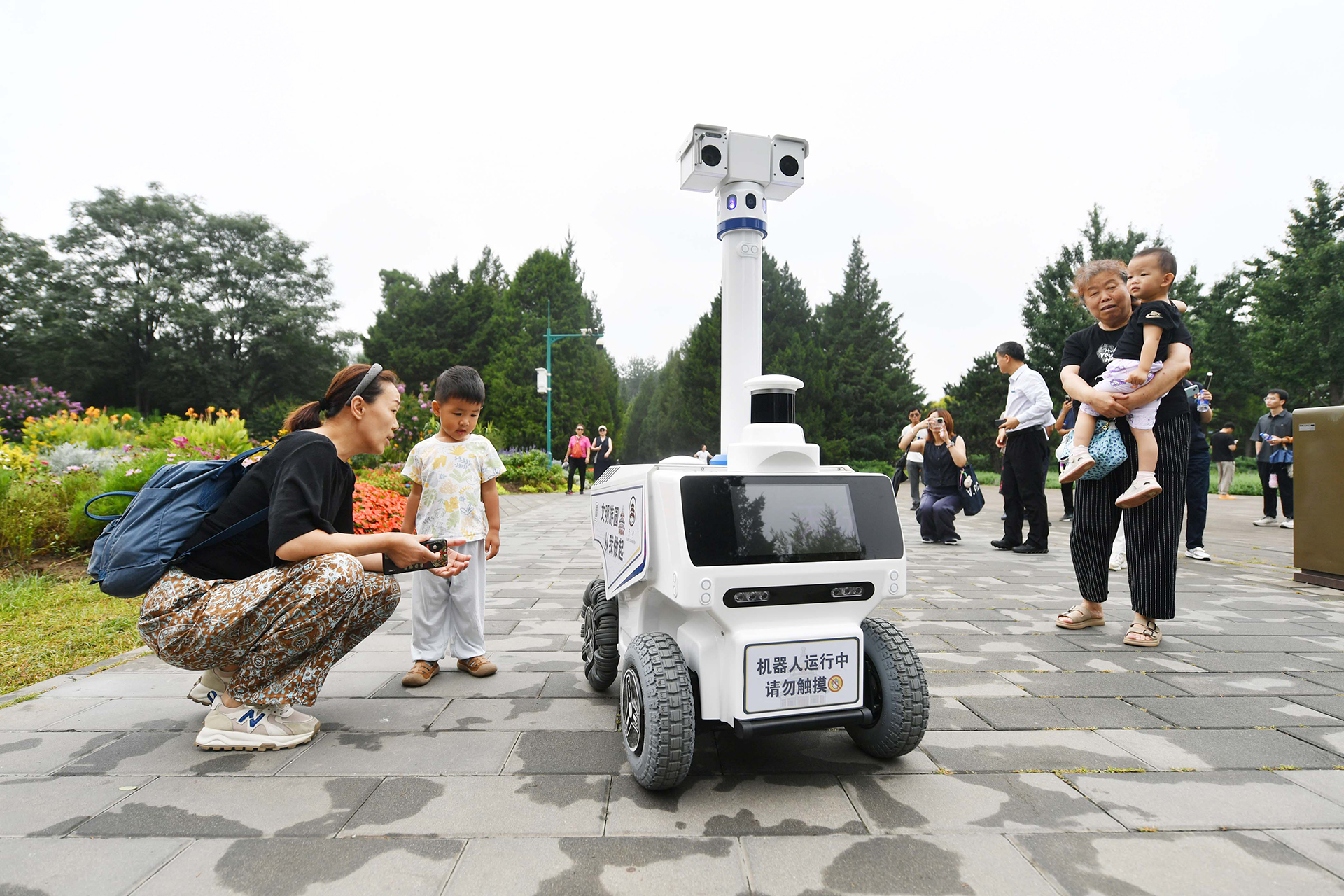
In the United States, deployment has been more private-sector led. It faces relatively greater risk in that a near-term corporate focus on efficiency could create painful job dislocation for some period. That in turn could further erode public support for AI, which could jeopardize government support (if policy follows political and popular trends).
For both countries, economic success will also depend on the degree to which the rest of the world adopts one country or the other’s platforms and standards. Global diffusion provides revenue for respective companies and training data for next-generation models. While the United States generally operates proprietary models (benefitting corporate profits and national security), China’s publicly accessible, often free AI systems allow global developers to easily fine-tune and locally host China’s models (often referred to as open-source or open-weight).
RAND published research in January 2026 examining the state of play. It analyzed website traffic data across 135 countries from April 2024 through May 2025 for site visits to major U.S. and Chinese large language model (LLM) platforms. It gauged market penetration, geographic adoption patterns, and the impact of China’s January 2025 DeepSeek-R1 model launch.
The work showed that while deployment globally has been increasing quickly, it has been the United States capturing the dominant market share. As of last August, U.S. models captured 93 percent of LLM visits—though DeepSeek’s model did lift China’s global market share by 10 percentage points to 13 percent in just two months, before stabilizing in August 2025 around 6 percent.
The RAND study also illustrated that adoption of U.S. and Chinese models, for now at least, is breaking along geopolitical and economic-development lines. During the study’s sample period, China saw the largest usage increases from Russia, the Middle East, Africa, and South America.
Importantly, the RAND study concludes with caution about the United States’ lead in global diffusion:
“U.S.-based LLMs continue to dominate in terms of global model use, likely because of a first-mover advantage and superior model capabilities. That dominance should not be taken for granted. The rapid shifts described in this section paint a picture of a fluid and volatile market. As DeepSeek-R1 has shown, competitive alternatives can rapidly erode U.S. market share. If the cost of switching between models remains low, which model is in the lead could change when performance, cost, or other factors better match consumer preferences.”
An additional factor worth watching that could erode the United States’ lead is geopolitics. While not uniform, some countries have reacted strongly to “America First” policies under President Donald Trump’s administration, including moving away from U.S. technology platforms. France, for instance, announced in early 2026 it would phase out some Microsoft products and other U.S. platforms used by government entities in favor of domestic alternatives as part of efforts to reinforce national technological sovereignty.
Chokepoint beneficiaries
China, beyond being a leader in AI development and diffusion, also benefits geoeconomically from its dominance in rare-earth mining and processing. But it’s not the only country holding this type of leverage.
While not in the race to be a globally leading AI developer, several countries dominate critical aspects of the AI supply chain. While both the United States and China are focused on reducing external dependencies, self-reliance or friendshoring supply chains will take years. For now, other countries can leverage their capabilities in an outsized way on the global geopolitical stage while capturing economic gains.
Taiwan is the obvious, most dramatic example of an AI winner punching above its economic weight to gain geopolitical leverage. The Taiwan Semiconductor Manufacturing Company (TSMC) makes the vast majority of the world’s most advanced chips, including many used to train and run frontier AI models. Some Taiwan policymakers have suggested that the chip industry amounts to a “silicon shield” that protects it from potential Chinese aggression, since China needs chips and wouldn’t want to undermine Taiwan’s economy. Meanwhile, since the United States also needs the chips, it is incentivized not to let China have control of the island and TSMC.
The United States, working to reduce this dependency, provided incentives starting in 2020 so TSMC would build fabrication plants (fabs) in Arizona. As of last year, TSMC’s investment (up to six fabs) reached $165 billion, reportedly the single largest foreign direct investment in U.S. history. Even with these efforts, the U.S. market share of leading chip manufacturing is still only expected to reach around 28 percent by 2032.
The Netherlands may get less attention than Taiwan, but it is equally important in the AI supply chain. ASML is the sole manufacturer of extreme ultraviolet (EUV) lithography machines, which are required for advanced semiconductor chip production. The company is the Netherlands’ largest by market capitalization and its revenue and R&D provide significant support for the country’s broader economy. As with Taiwan, the Netherlands’ unique place in the AI supply chain gives it geoeconomic power that could easily grow as AI development and diffusion increases globally.
Japan is yet another exceptional node in the AI supply chain, producing roughly 90 percent of the fluorinated polyimides (high-performance polymers) and photoresists (light-sensitive materials used to pattern circuits), which are both essential for chip manufacturing.
The Middle East has become an increasingly important contributor to AI’s global development in recent years. Initially the region—and specifically Saudi Arabia, the UAE, and to a lesser degree, Qatar and Oman—became sought-out partners for investments and for hosting data centers. They offered relatively inexpensive land and available energy, and supportive leadership. All have seen this technology as a way to diversify and grow their economies and deepen their positions as important global economic players.
Saudi Arabia’s efforts have included its Cloud Computing Special Economic Zone, launched in 2023, which provides tax benefits and streamlined processes to attract foreign investment. The kingdom also launched a $100 billion “Project Transcendence” AI initiative backed by the Public Investment Fund, a sovereign wealth fund, to help create its own AI ecosystem.
In early 2026, however, the region’s historically important roles as global energy and shipping chokepoint came to the fore, as the United States and Israel entered into war with Iran. Iran’s efforts to block ships from crossing the Strait of Hormuz quickly pushed up global crude oil, liquified natural gas, and shipping costs, stymying the global AI supply chain. The war also highlighted non-energy products used in AI that come predominantly from the Middle East and reach global customers via the strait—including helium, a byproduct of Qatari natural gas production, which is used for cooling and chip manufacturing.
What all these countries and their respective AI chokepoints have in common is that their strength can also be a vulnerability. Their interconnectedness in global trade requires stability and trust among economic partners. They have become more powerful thanks to AI and its geoeconomic implications for global dynamics, but as the 2026 Iran war has demonstrated, their ability to “win” economically from AI is not without risk.
The middle powers
Beyond the United States, China, and notable chokepoint economic beneficiaries, there are several countries that are not leading in AI development but are still in the race, in terms of development, diffusion, areas of relative strength, and their ability to at least incrementally shape geoeconomic outcomes through different means. Europe and India provide two useful examples of countries that will likely see economic benefits from AI, with the degree of benefit dependent on how the challenges are addressed.
Europe, for instance, appears hopeful it can position itself as a regional “smart second mover” on AI, knowing it will not lead in development but hoping to see material economic benefits from diffusion and innovation—the latter especially around robotics, healthcare and industrial automation. Its workforce, at least relative to the United States, is more likely to see roles augmented rather than automated, in part because of the region’s labor laws and cultural norms.
It also believes it can contribute significantly to AI-related thought leadership through its research and shape global governance and standards, in part as the United States and China will both want to benefit from the business opportunities presented by Europe. Of course there is wide disparity within the region, across all AI-focused metrics—from the Netherlands and ASML as a critical building block for AI with economic leverage, to some of the lower-adoption countries in the region such as Romania, which has one-eighth the business AI adoption rate of Denmark, according to Eurostat.)
India in recent years has been effective as an opportunistic ally, aligning itself with the United States and China at different moments on different issues. It enters today’s AI era with some structural strengths that could allow it to be a fast follower, with major economic benefits from diffusion: a skilled talent pool, a growing consumer economy, and especially an exceptional amount of data. Importantly, India’s government has created the so-called India Stack, layers of open, interoperable digital public infrastructure (DPI) that reaches across the population to provide a digital identity system, payments, lending, and digital commerce. The country has created what could be an efficient deployment infrastructure for AI. A young and growing entrepreneurial workforce could also see India garnering economic benefit from innovation in the years ahead.
At least three forces could constrain India’s economic benefit from AI. First, even though India enjoys a significant percentage of the world’s data, it has extremely limited data center capacity. In addition, the country requires massive investment to modernize its electricity infrastructure and ensure sufficient energy supply. As the country seeks investment and partnership to address these deficiencies, it could find itself facing a third challenge: continuing to successfully navigate relationships with the United States and China, each of whom will want India to commit to its AI platforms.
A global divide?
While this research focuses on potential AI economic winners, it is worth noting how the global balance of power could be influenced in the years ahead by the gap between the largest winners and losers.
The AI divide is already stark, as the World Bank noted in a 2025 report: “High-income countries account for 87 percent of notable AI models, 86 percent of AI start-ups, and 91 percent of venture capital funding—despite representing just 17 percent of the global population. High-income countries also dominate the physical backbone of the digital economy, hosting 77 percent of global co-location data center capacity as of June 2025. In contrast, upper-middle-income countries hold 18 percent, lower-middle-income countries just 5 percent, and low-income countries less than 0.1 percent.”
Can AI be a force to help narrow this gap—or will a digital divide, and economic differences, widen? Lower-income economies, in particular, need to address internet access, computing resources such as data centers, and basic digital skills. They can run parallel paths, however, deploying more affordable “small AI” applications that can provide incremental benefits. The World Bank highlights, as examples, AI tools that can help doctors analyze health data and small businesses more easily reach potential customers.
The hope is that with time and some challenges addressed, some of these economies can use AI to leapfrog developmental steps, supporting economic growth in the process. Whether the United States, China, other countries and/or multilateral institutions can support them and successfully strengthen their own global economic and soft-power footprints in the process, is worth watching closely. At a minimum, these emerging- and lower-income countries should indirectly benefit from an improvement in global economic growth that AI-fueled productivity and innovation is expected to bring.
AI and the future of geoeconomic power
Economic growth is just one vector through which AI will influence global power dynamics in the coming years, but it’s a critically important one. Stronger economies, bringing a measure of support for local financial markets, can provide countries with greater resources and geoeconomic levers that can be deployed to achieve different policy goals.
This AI era is similar to previous periods of technological innovation in that economic winners can be development leaders or fast followers that reap benefits from broad diffusion and innovation. Also like past periods of innovation, the way that AI is deployed, and the nature of the economies and policies it is deployed into, will shape which actors within an economy benefit. Will AI-led wealth be broadly shared or accrued mainly by the companies overseeing development?
At the same time, AI is strikingly different from the past in that no country can win economically on its own. Global economies are too interconnected and supply chains too complex for even the United States or China to excel without others’ collaboration. Several countries will have outsized leverage on the global stage thanks to their dominance in the AI supply chain. Put another way, coalition-building will remain necessary for economic gains and global power dynamics.
We simply cannot forecast today how quickly, or how much, AI will shape the global economy in the years ahead; the landscape is changing too quickly. That said, we can and should understand what building blocks are critical for a country to lead in development, diffusion, or innovation. They are numerous, complex, and often interconnected. Together with an understanding of the key AI supply-chain chokepoints and challenges faced by different parts of the world today, we can start to make sense of how AI will shape economies and global geopolitics in the years ahead.
Author’s note: Thanks to contributions from Amelia Frank.
This work represents the views solely of the author(s). The Council on Foreign Relations is an independent, nonpartisan membership organization, think tank, and publisher, and takes no institutional positions on matters of policy.