George Washington’s Farewell Address
The parting remarks of America’s first president were more about shaping who would succeed him in office than about advance a fundamental foreign policy principle to guide all future generations.
By experts and staff
- Published
 James M. LindsayCFR ExpertMary and David Boies Distinguished Senior Fellow in U.S. Foreign Policy
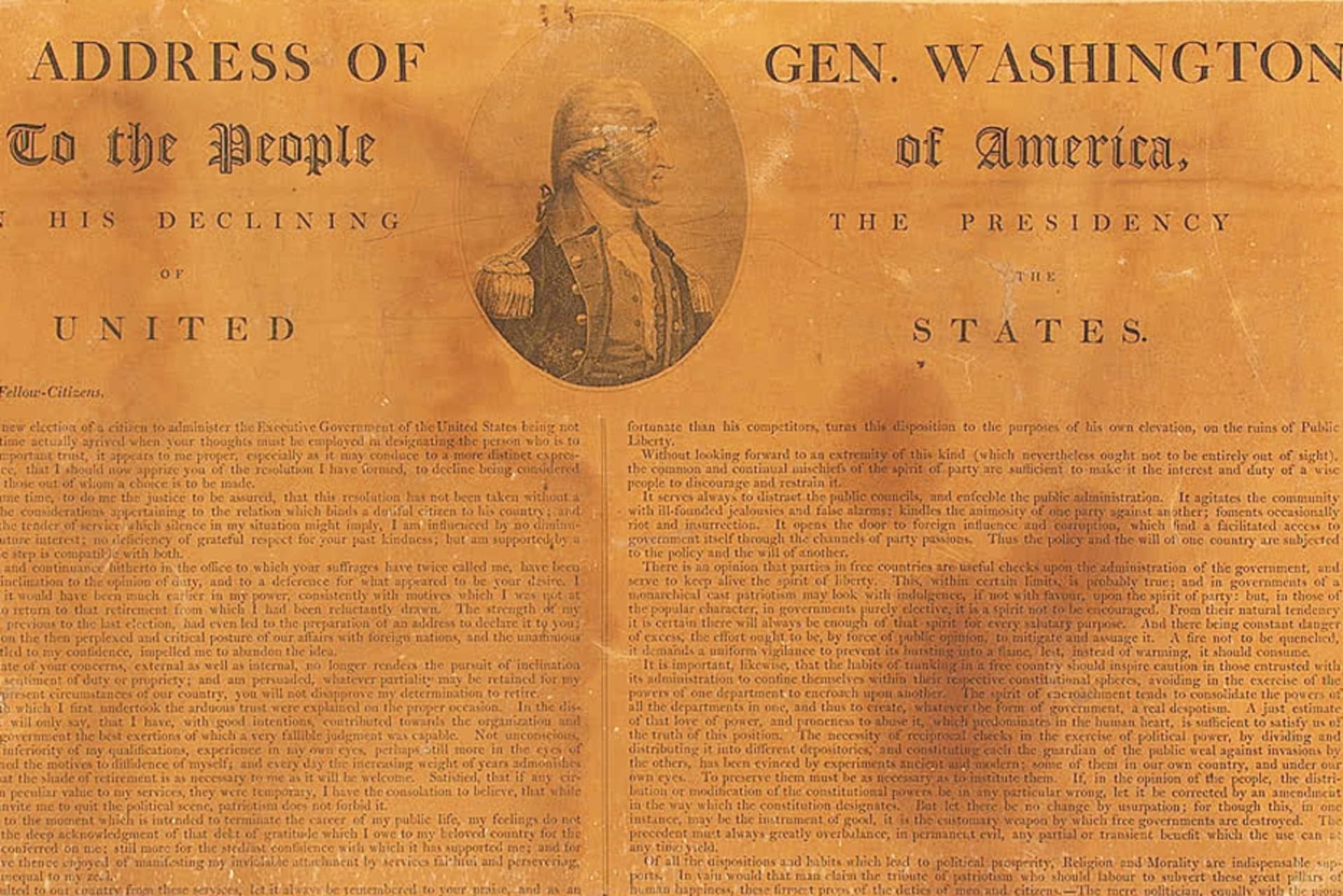
Today marks the 230th anniversary of one of the most consequential presidential statements in the history of U.S. foreign policy, “The Address of General Washington To The People of America on His Declining of the Presidency of the United States,” or as it is better known, “Washington’s Farewell Address.” It was published, not delivered in person, on September 19, 1796 in the Philadelphia newspaper, the American Daily Advertiser. (Why a Philadelphia paper? Because Philadelphia was the nation’s capital in 1796.) It best remembered for Washington’s injunction that the United States should have “as little political connection as possible” with other countries.
More than two centuries later, people across the political spectrum continue to invoke Washington’s so-called Great Rule of Conduct as the guiding principle for U.S. engagement with the world. But Washington’s address was less about laying down an unalterable foreign policy axiom than it was about shaping the debate over who should succeed him as president.
“Steer Clear of Permanent Alliances”
The Farewell Address summarized Washington’s advice to the nation based on his more than four decades of public service. Much of what he wrote warned against the dangers of partisan and regional strife, a warning that is worth remembering today. But the address is best known for what Washington said about foreign policy, namely, that the United States should keep its distance from European affairs.
The critical passage reads as follows:
The great rule of conduct for us in regard to foreign nations is in extending our commercial relations, to have with them as little political connection as possible. So far as we have already formed engagements, let them be fulfilled with perfect good faith. Here let us stop. Europe has a set of primary interests which to us have none; or a very remote relation. Hence she must be engaged in frequent controversies, the causes of which are essentially foreign to our concerns. Hence, therefore, it must be unwise in us to implicate ourselves by artificial ties in the ordinary vicissitudes of her politics, or the ordinary combinations and collisions of her friendships or enmities.
Proponents of a less interventionist or non-interventionist U.S. foreign policy have for more than two centuries invoked Washington’s injunction that “it is our true policy to steer clear of permanent alliances with any portion of the foreign world
Advice for Today or All Time?
That Washington warned of the perils of alliances is clear. But was he speaking to issues that consumed Americans of his day or providing advice that he thought Americans should follow for all time?
The balance of evidence suggests that the answer is the former. Rather than speaking to Americans who had yet to be born and whose world he could not know, his main purpose with the address was, as Robert Kagan has written, more “immediate and political”: to defend his foreign policy record against his critics and to warn his fellow citizens against a specific foreign policy choice he thought would endanger the young republic.
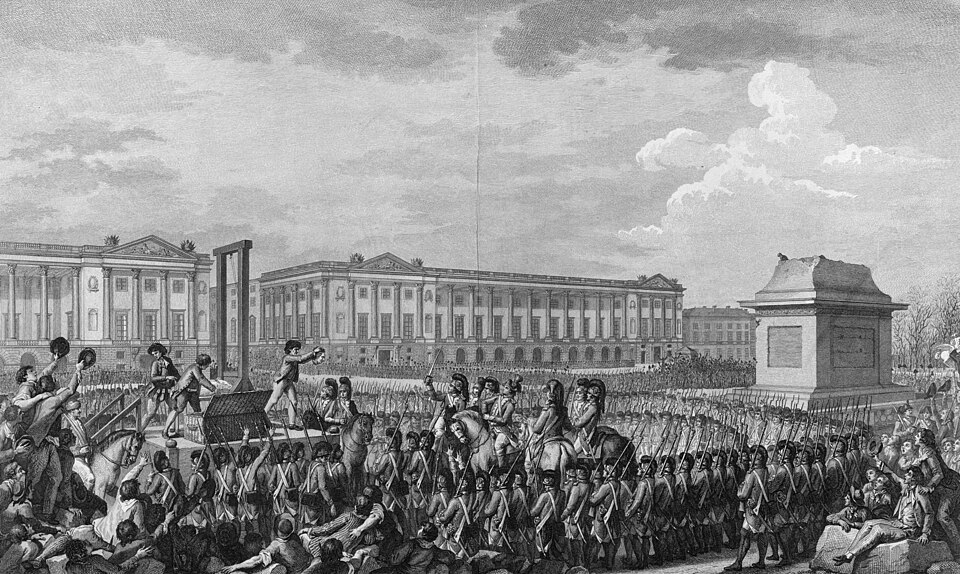
That foreign policy choice was support for France. The 1789 French Revolution had sent shockwaves through Europe by throwing into the question the right of the continent’s monarchies to rule. In early 1793, the French Republic, having just executed King Louis XVI and anticipating a British attack, moved preemptively to declare war on Britian. Many Americans, notably Thomas Jefferson and James Madison, favored the French cause. They did so partly out of revolutionary solidarity and gratitude for the pivotal aid that France had provided the colonists during the American Revolution. But they also feared that siding with Britain would deepen America’s economic dependence on its former colonial ruler and potentially encourage the return of monarchy to the United States.
Washington and Treasury Secretary Alexander Hamilton, however, thought that siding with France would be disastrous for the United States. They disliked the radicalism of the French revolutionaries, and they believed that U.S. interests required maintaining good relations with Britain. It posed the far greater military threat to the United States; it was also the young country’s main trading partner.
The Neutrality Proclamation
When news reached Philadelphia that Britain and France had gone to war, Washington declined to invoke the 1778 Treaty of Alliance with France. He instead issued the Neutrality Proclamation, which stated that the United States would “with sincerity and good faith adopt and pursue a conduct friendly and impartial toward the belligerent powers.”
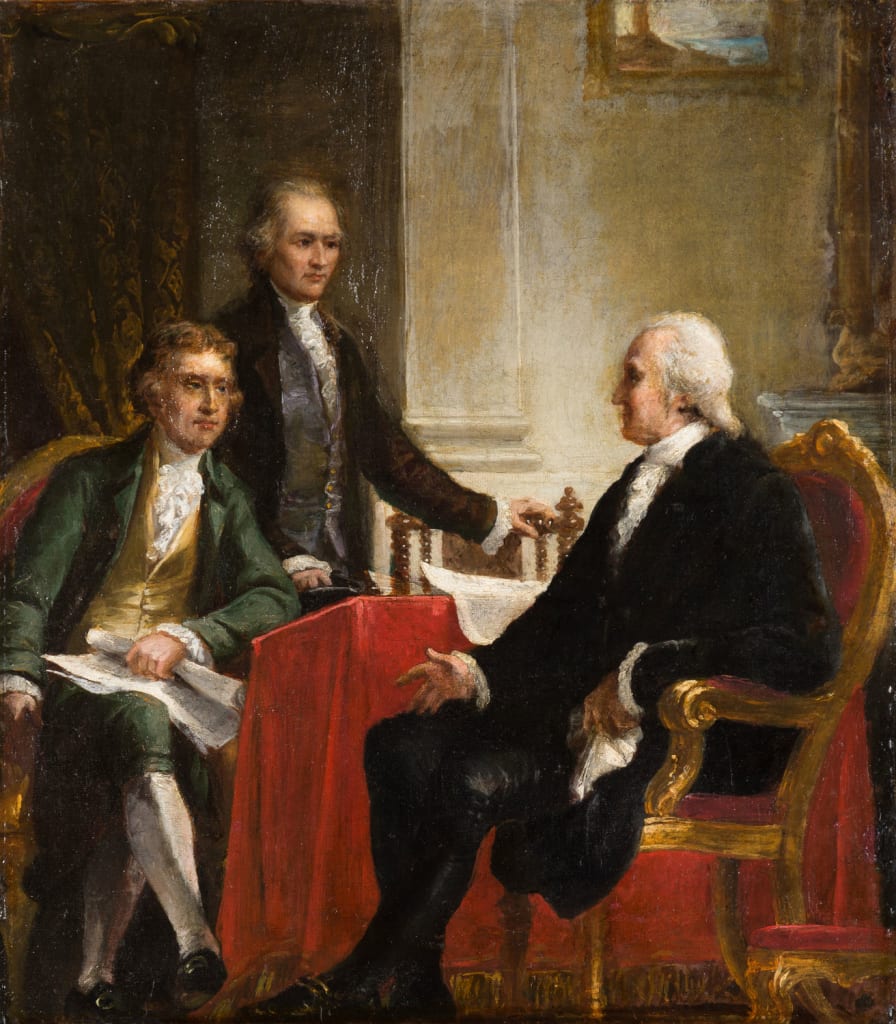
Proponents of siding with France lambasted Washington’s decision on both procedural and substantive grounds, accusing him of having exceeded his presidential authority and of making the wrong decision while doing so. Alienated by Washington’s preference for Hamilton’s advice, Jefferson resigned as secretary of state at the end of 1793. He and Madison spent the next several years working to undermine Washington’s presidency, and they encouraged their friends in the partisan press to accuse him of harboring monarchical ambitions and having committed treason.
Washington was deeply wounded by the accusations, and he knew who was stoking them. When Martha Washington later called Jefferson “most detestable,” she was likely reflecting her husband’s assessment. Washington’s anger at Madison, who had once been one of his closest aides, went even deeper. America’s first president refused to speak to his former aide during the final three years of his life.
Turnabout Is Fair Play
Despite seeing his reputation besmirched because of his refusal to throw America’s lot in with France, Washington refused to give ground. He told a political ally, “The people of this Country it would seem, will never be satisfied until they become a department of France: It shall be my business to prevent it.”
In Washington’s view, fulfilling that goal meant keeping Jefferson from succeeding him as president. To that end, he and Hamilton crafted the Farewell Address and released it two months before the presidential electors met. They knew that everyone reading the address would grasp the subtext and know who it was aimed at. Releasing it just weeks before the election maximized the political damage done to the man from Monticello.
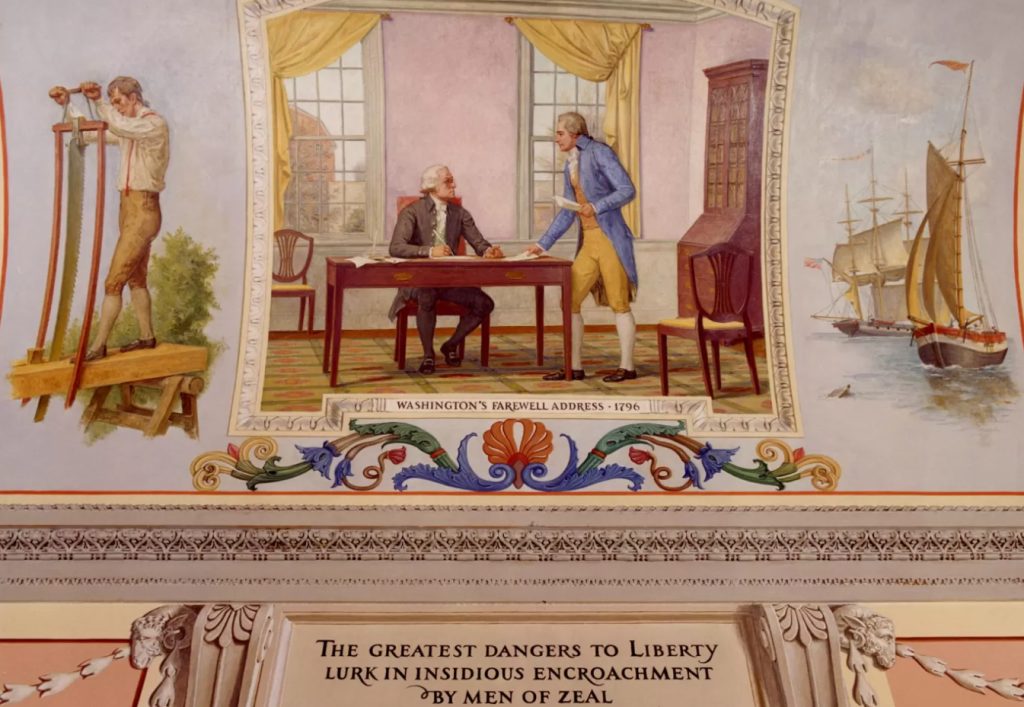
There is another reason to think that Washington never intended the Farewell Address to be a perpetual directive for U.S. foreign policy. His first draft stated unequivocally that the United States must “avoid connecting ourselves with the politics of any Nation.” Hamilton persuaded him to soften the claim to have “as little political connection as possible” with other countries. This formulation left the door open to potential alliances as events might dictate. And in that slight tweak, Washington and Hamilton signaled that no successful foreign policy could rest on rigid rules but must marry the country’s choices to the circumstances it faces.
Oscar Berry and Jack Patton assisted in the preparation of this article.
The United States celebrates its 250th anniversary in 2026. To mark that milestone, I am resurfacing essays I have written over the years about major events in U.S. foreign policy. A version of this essay was published on September 19, 2011.
This work represents the views solely of the author(s). The Council on Foreign Relations is an independent, nonpartisan membership organization, think tank, and publisher, and takes no institutional positions on matters of policy.