How Does Public Opinion Affect Foreign Policy? It’s Complicated
Public sentiment is something decision-makers must contend with, especially in democratic states. However, the extent to which public opinion shapes foreign policy varies. Three Council of Councils experts in France, India, and Nigeria reflect on how public opinion does—and sometimes does not—affect foreign policy decisions.
By experts and staff
- Published

In France, the Effect of Public Opinion Unclear
In France, foreign policy falls within what is commonly referred to as the president of the republic’s domaine réservé (reserved domain). Since taking office, President Emmanuel Macron has never openly acknowledged any influence of public opinion on his foreign policy. Instead, he has sought to persuade the French public of the relevance of his decisions, particularly on sensitive issues. It must be noted that opinion polls cannot demonstrate that policy shapes public opinion, nor, conversely, that public opinion shapes policy: correlation does not imply causation. Three examples illustrate the unclear link between public opinion and French foreign policy.
Let’s consider first the case of Ukraine: Macron was well aware that sanctions against Russia would weigh on his fellow citizens’ purchasing power and risk backlash. Nevertheless, he chose to uphold the policy, explained it publicly, and the French populace repeatedly expressed clear support for the sanctions, though that support eventually declined.
Another example is the Israeli-Palestinian conflict, which is arguably the most mobilizing issue in international affairs among the French public. Since the Six-Day War in 1967, a pro-Palestinian movement has emerged that has sought to influence French foreign policy.
Large demonstrations have accompanied every major outbreak of violence in the Middle East, including in the aftermath of the October 7, 2023, attack. For many years, numerous opinion polls have shown that a majority of French citizens support the creation of a Palestinian state. This leads one to ask if Macron ultimately yielded to public opinion when he recognized the State of Palestine in September 2025.
However, the reality is more complex. On the one hand, the president put forward other arguments to justify the recognition. On the other hand, at the time he announced his intention to proceed with recognition—while the war in Gaza raged and Israelis remained hostages of Hamas—a poll showed that only 22 percent of the French public supported immediate and unconditional recognition.
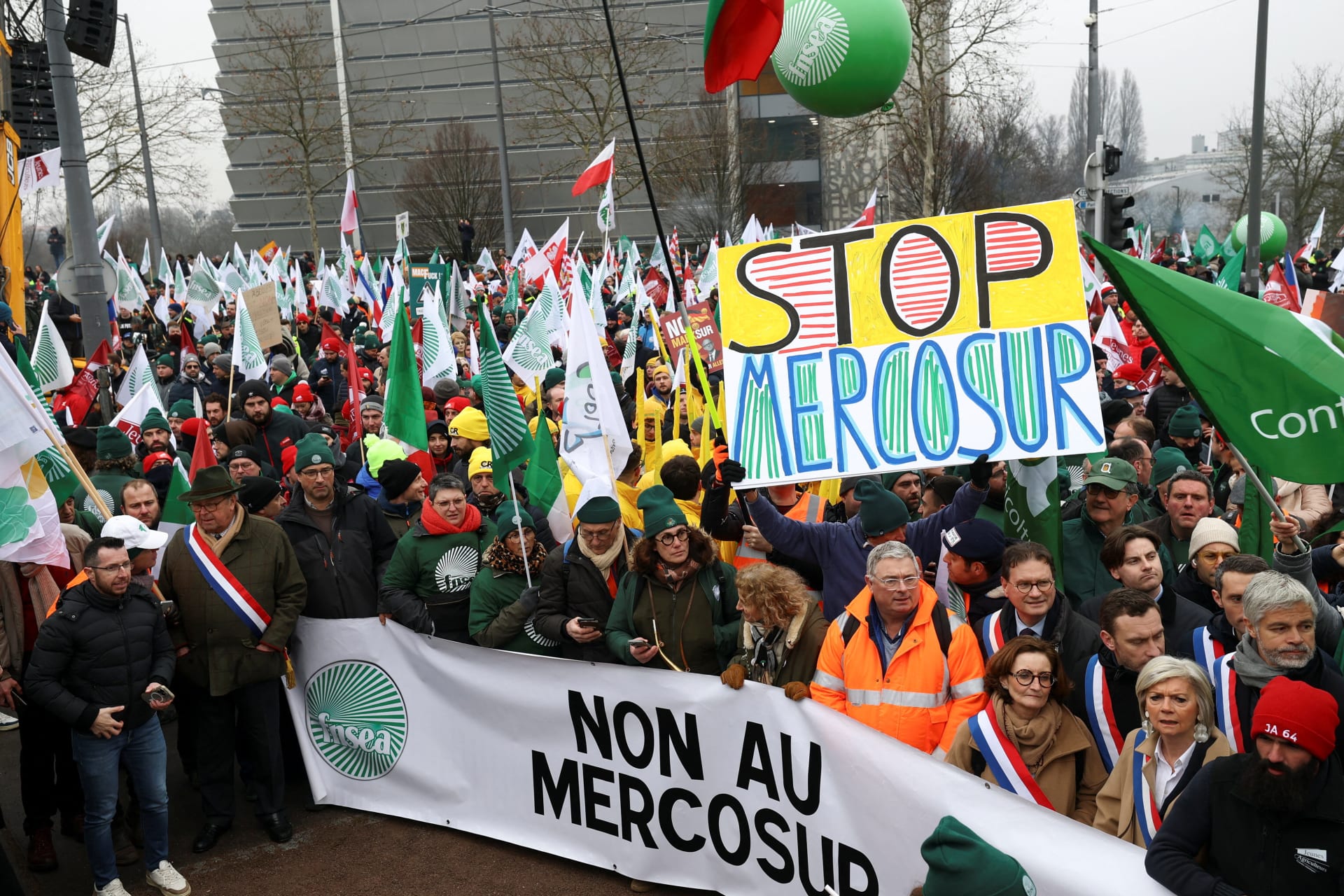
A final example deserves mention: France’s opposition to the free trade agreement between the European Union and Southern Common Market (Mercosur). The prospect of the agreement triggered farmers’ protests and generated widespread opposition among the French public. Macron’s position appeared to evolve over time. He sought to reach a more favorable agreement and succeeded in obtaining several concessions from the European Commission that negotiated on behalf of the EU Members States. Nevertheless, in January 2026, he decided to vote against its signature, citing “unanimous political opposition” in both the National Assembly and the Senate. In this case, only the French president can answer the question of whether he yielded to public opinion.
As Macron’s second and final term draws to a close in the coming months, it is not clear that his foreign policy choices have been significantly shaped by domestic public opinion. Other factors—a combination of national interests and values—have probably played a more important role in shaping the president’s stance on the international stage.

Public Opinion and Foreign Policy in Africa
Public opinion plays an important part in foreign policy agenda-setting and offers a useful barometer for gauging domestic acceptance and support for foreign policy postures. In Africa, the importance of public opinion has been weakened by long histories of authoritarian rule, accountability deficits, and the underdevelopment of public opinion polling as an instrument of policy. Afrobarometer, the leading cross-national opinion polling network, has continued to blaze the trail, but its overall impact on policy has yet to be proven.
However, as more countries become democratic, public opinion is becoming too important to be ignored. Public perceptions are distilled from views and opinions expressed in the traditional media (newspapers, magazines, radio, and television) and the more vibrant, interactive medium of social media, as well as those projected through protests and petitions. The foreign policy interface of this awakening has been demonstrably low, considering its focus on domestic issues that affect human security and livelihoods, and these issues also shape how the populace thinks about foreign policy.
In other words, people are more likely to feel strongly about global issues that resonate with local needs and challenges. Thus, issues of migration, immigration, foreign debts, security, climate change, and environmental justice have provoked debates and elicited strong opinions in support or opposition to government policies.
A case in point is the recent and ongoing xenophobic attacks on migrant Africans in South Africa that has forced the governments of Ghana, Nigeria, and Zimbabwe, amongst others, to adopt hardline positions on South Africa. Some countries repatriated citizens from South Africa and demanded guarantees of safety for those that chose to remain in the country, while Ghana canceled a state visit by the South African president. Pro-China policies across Africa have also received popular support because China’s assistance is seen as strategically preferable to that of more established Western allies, whose interventions have not yielded comparable infrastructural dividends.
Rising nationalism and the need to protect national interest and sovereignty have also shaped public opinion regarding African states’ relations with global superpowers. The Sahelian states of Burkina Faso and Mali, whose populist governments have broken long-standing ties with the United States and France, have provided inroads for China and Russia in the region. Strong criticisms of and opposition to American and French military bases on Nigerian territory in the media also discouraged the government’s contemplation of such moves.
Issues that are considered distant but which have consequences for domestic economies and political stability, such as the wars in Gaza, Iran, and Ukraine, have also provoked agenda-setting debates for governments. This was the case in 2023 when public opinion backed the South African government’s pro-Palestinian policy in Gaza, including charges of genocide against Israel at the International Court of Justice.
Overall, the importance of public opinion in foreign policy has increased across Africa, and governments are learning to balance domestic political imperatives with foreign relations in the face of growing geopolitical complexities, pressures, and vulnerabilities. They also now pay more attention to new media and engage in public diplomacy. But the greater focus on domestic issues and underdevelopment of public opinion polling as an instrument of policy have allowed governments and foreign policy elites to continue to hold outsized sway over foreign policy.
In India, Public Trust on Foreign Policy
Public opinion does not significantly constrain foreign policy in India, which remains governed by a careful view of long-term national interest. But successive rounds of the Observer Research Foundation’s (ORF) youth survey, conducted across thousands of respondents in cities and towns well beyond major metro areas, make clear that young Indians hold strong views on India’s foreign relations. The survey records sharp opinions on China, Pakistan, the United States, and trade, and shows that India’s young people increasingly expect their government to take their views into account.
Foreign policy is no longer an elite preserve, insulated from domestic expectations and debated only in closed rooms. The current Indian government notes early shifts in public opinion and increasingly seeks to engage these views even as they are being formed. On renewable energy, technology, connectivity projects, or specific country partnerships, government messaging has often built the consensus it is responding to, rather than simply following a mood already in place.
This awareness shapes how the elected government communicates its efforts, even when the underlying policy calculus is unchanged. The ORF Foreign Policy Survey 2025 showed trust in the United States falling from 83 percent to 56 percent, a shift sharp enough to register across the young demographic the survey tracked. This change informed, not constrained, the government’s messaging as it sought to rebuild ties with the Trump administration after last year’s loud disagreements. The substance of the relationship continued much as before, but the public framing around it visibly adjusted.
In the United States, opinion on the conflicts in Gaza and Ukraine has split policy down partisan lines; in Britain, the Brexit referendum still shapes the country’s options a decade on. Perhaps the difference between India and many other democracies is that the Indian electorate still trusts the state to make long-term decisions on foreign policy that preserve and extend strategic autonomy—a confidence earned through decades of steady, deliberate statecraft.
Indian policymakers draw strength from public opinion rather than being dominated by it. Elsewhere, public shifts often pull governments away from their strategic instincts, but in India government instinct and public opinion increasingly find common ground even if the process can seem unwieldy and loud to the outside observers.
This work represents the views solely of the author(s). The Council on Foreign Relations is an independent, nonpartisan membership organization, think tank, and publisher, and takes no institutional positions on matters of policy.