Why Won’t Europe Do More for Ukraine?
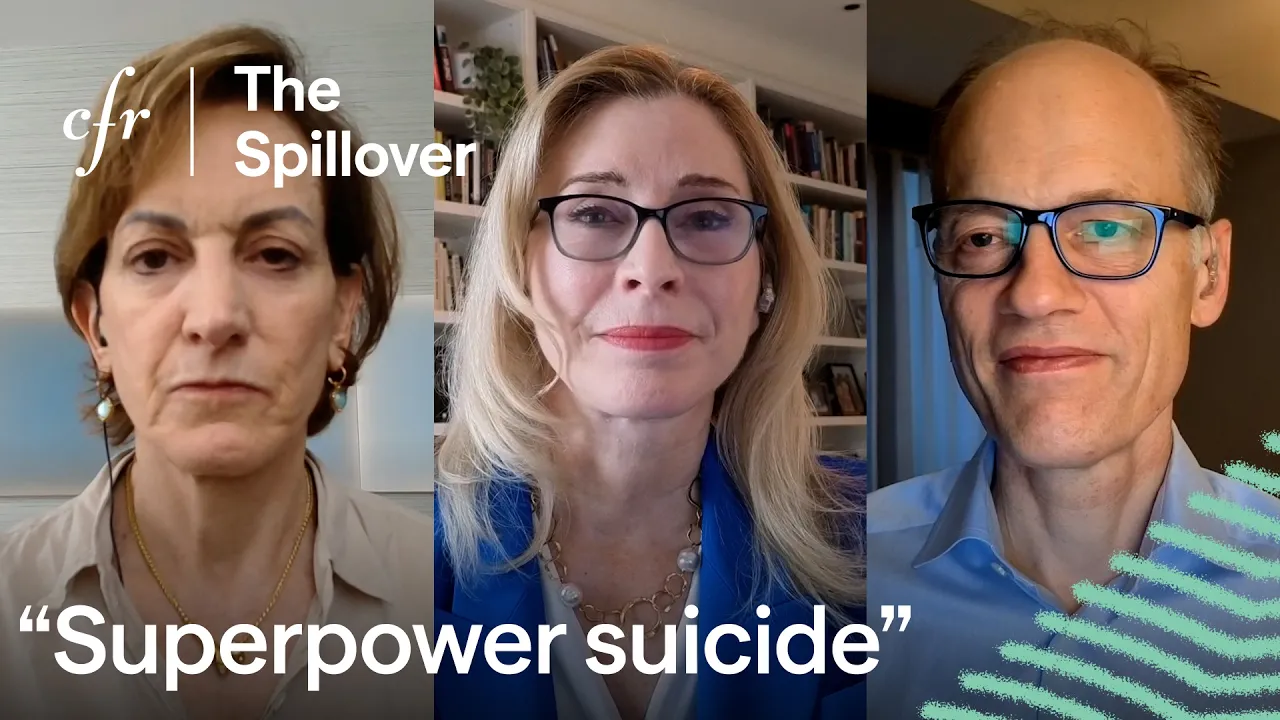
This week on The Spillover, hosts Sebastian Mallaby and Rebecca Patterson sit down with author and historian Anne Applebaum to discuss Europe, the ongoing war in Ukraine, and the escalating geopolitical headwinds the region faces.

Published
Hosts
 Rebecca PattersonCFR ExpertSenior Fellow
 Sebastian MallabyCFR ExpertPaul A. Volcker Senior Fellow for International Economics
Guest
- Anne E. ApplebaumStaff Writer, Atlantic
[Video: https://youtu.be/aYiJZ3QXhN8]
TRanscript
This transcript was generated using AI and may contain errors.
MALLABY:
You know, Rebecca, I really love our Spillover listeners.
PATTERSON:
Me too.
MALLABY:
You know which listener I love the absolute best?
PATTERSON:
Well, I feel as parents we should always say we love all our children equally, but who do you have in mind?
MALLABY:
Yeah, yeah, well, anyway, the listener that I love the best is the one who wrote in after our last show, after I said jalapeno, and then you corrected me and said I should say jalapeno. And praise be to this listener who wishes to remain anonymous, because after you corrected me for saying jalapeno, she wrote in and said that I was right and she corrected you, because the proper pronunciation is, in fact, not jalapeno, but peno.
PATTERSON:
Yes, I have to admit, you know, even though that listener thought your Brit accent sounded a little weird, it seems clear that you know more Spanish than I do.
MALLABY:
Yeah, and since you had the advantage of growing up in Florida, I thought this Spanish smackdown was a double victory.
PATTERSON:
You say tomato, I say tomato, or in our case, vice versa.
MALLABY:
Moving on.
PATTERSON:
Anyway, yes, moving on.
MALLABY:
I’m Sebastian Mallaby.
PATTERSON:
And I’m Rebecca Patterson. Welcome to The Spillover.
MALLABY:
Today on The Spillover, we have a special guest, Anne Applebaum. Anne is a staff writer at The Atlantic, the author of quite hard to count, but I think it might be nine books, including a Pulitzer winning one. She’s also a deep expert on Europe and on the process of both democratization and de-democratization.
And since she is a deep expert, and Europe right now is in deep trouble, we thought it would be fantastic to have Anne on The Spillover.
PATTERSON:
Yeah, welcome to The Spillover, Anne. Great to have you.
APPLEBAUM:
Oh, thanks for having me. Delighted to be here.
PATTERSON:
And Anne, this is such an important moment to be talking about Europe, because it seems to be confronting not just a major, but still increasing challenge. And frankly, it’s not clear.
Well, I think our thesis is they’re not doing enough to meet the challenge. And obviously, we’re talking about Russia’s aggression in Ukraine and the missile and drone bombing of Ukraine, which has stepped into higher gear recently. And frankly, the ruthlessness going after civilian targets.
I mean, it’s horrifying what we’re reading and seeing every single day. But Russia, as you know better than we do, is increasingly conducting gray zone operations in other parts of Europe. And those attacks seem to be getting more aggressive as well.
We just heard Ukraine President Zelensky at the United Nations warn that Russia could attack a member of NATO to prove the alliance’s weakness. And then just Thursday, the Financial Times reported that Danish intelligence said there was a low, but growing risk that Russia could try a limited military attack against a NATO member in the coming months, possibly including troops on the ground. So what we want to do in the show today is lay out the nature of this challenge.
You know, why is it in Europe’s interest to help Ukraine even more than it already is? We’re not saying nothing’s happening, of course. And then maybe look at some of the reasons that more isn’t happening.
And just to give listeners a quick preview, two main kind of channels we want to explore. One is the pressures in Europe from a fiscal perspective, which are getting tougher as interest rates are rising. And then second, you know, the rise of populism.
And it’s usually pro-Russian populism, especially in Germany, where, as we all have been following, the far right, AfD, recently notched up two wins in state elections. So, you know, you’ve got these things going on, I think, related to that, simply the matter that, you know, more of the people who lived or have memories from their parents of World War Two or grew up during the Cold War, those older voters are getting fewer in number. And so the broader population is saying, if governments are spending money, spend it on us as a priority relative to Ukraine.
MALLABY:
Yeah. So, Anne, go ahead. You’ve been in and out of Ukraine during the war.
Give us a sense of how you see the state of the war and the pressure on Ukraine right now.
APPLEBAUM:
So what we’re watching really is an acceleration of military development and technology of a kind we’ve never seen before or not recently, not in recent memory. Over the summer, if you’d asked me, I would have said Ukraine was pulling ahead. So the Ukrainians had a couple of really big advances.
They have built their own long-range strike system, which is not dependent on the U.S. or American technology or, as I understand it, even American intelligence. And with this, they are now able to strike deep into Russia. A few days ago, they hit refineries in the city of Moscow.
You could see orange skies and flames burning across the Russian capital. They’ve also developed a capacity to hit their what’s called medium-range drones, which enable them to hit military targets kind of beyond the front line. And what that means, just in layman’s language, is that there is now, along the front line, there’s a kind of 20- or 30-kilometer-wide strip into which nobody can go.
So the Ukrainians can see everything. If a Russian tank tries to enter, it’s taken out within minutes or, you know, hours at the most. The life expectancy of a Russian soldier who enters into this zone is something like 30 minutes.
So they have total coverage. They are beginning to hit beyond that. They can strike Russia.
And the upshot of that is two things. One is that the Russians can’t move forward. They’re not able to move the front line, so they’re not winning on the battlefield.
And the other is they’re now beginning to sustain a lot of economic damage. So we believe something like 30 or 40 percent of Russian refining capacity is out. And there’s a level above which that rise, maybe 50 percent, maybe more, when the Russians won’t be able to move troops around because they just won’t have the diesel fuel in the right places at the right time.
So I just wanted to start with the achievements of the Ukrainians, because this is a country that didn’t have a drone industry or not a military drone industry to speak of, not a real one, four years ago. And all of this has developed in the last, really in the last two or three years. The Ukrainians will make something like 10 million drones this year.
By comparison, U.S. will make something like 200,000. So this is a, you know, this is the transformation of warfare begun with Ukrainian technology. The change is that the Russians, unable to move forward on the front line, have begun, have shifted to terrorizing civilians.
And so they now have their military advances, that they have their Shahed drones, which were originally taken from Iran. They’ve added little jet engines to them and little cameras that enable them to be very precise. They now move faster than the previous drones that they were using to hit Ukrainian targets.
And they can hit people, they can hit buses, they can hit passenger trains. They can hit civilian factories. And this is what they’ve been doing for the last couple of months.
As I said, they don’t have the capacity to move the front line. You know, they, but they are able to destroy Ukrainian civilian infrastructure and really to terrorize people. I mean, you now have scenes where Kyiv in the middle of the day, I mean, is, there are drones circling overhead.
I’ve been going to Kyiv regularly since the beginning of the war. I think I’ve been there nine or 10 times since that, since February, 2022. And it’s always actually been surprisingly peaceful.
I mean, I’ve brought people there who were even slightly disappointed to discover that it was a normal city and people were living their normal lives and there were restaurants and so on. And that’s beginning to change. And that’s the, so what, so you’re seeing a kind of asymmetry.
You know, the Ukrainians have stopped the Russians at the front line. They can hit deep targets inside Russia, but Russia can terrorize Ukraine. The other tactic that you alluded to in, you know, a few minutes ago is that the Russians now understand that in order to win the war, and by the way, they’re still talking about winning.
For them, winning is still a conquest of Ukraine. You know, the idea that they would be, you know, if we just give them a few square kilometers of Donbass and then they’ll be happy, that seems to be untrue. So their goal is still the destruction of Ukraine as a country, the removal of Ukrainian sovereignty, the occupation of Kyiv and the destruction of the Ukrainian government.
And that remains, as I understand it, absolutely their goal. And they haven’t, they have never retreated from that. And their understanding of the war is that what they need to do, having, you know, you could, I mean, it wasn’t up to them, but having successfully helped to eliminate Ukraine’s most important defense partner, the United States, you know, through, you know, promotion of Donald Trump for a decade.
I mean, I wouldn’t say they’re the main reason for that, but they played a little role. What they’re now trying to do is make political changes in Europe to prevent Europeans from helping Ukraine. And here it’s also important to say that all of the support for Ukraine, all of the money, all the weapons, you know, all of it now comes from Europe.
There isn’t, and I should say a few others, South Korea and there are a few other allies around the world, but it’s all European. It’s, you know, the money is German, Danish, Polish, French, Italian, you know, that’s who’s, that’s who supports Ukraine. There isn’t any other, there isn’t, you know, the U.S. isn’t supplying anything, anything serious. There is some U.S. intelligence cooperation, as I understand, it’s less and less. I mean, or it’s less, not less and less, but less and less necessary because there are substitutes now for some of the things the U.S. was doing at the beginning of the war. So the Russians now understand that what they need to do is divide Europe and scare Europe and prevent the Europeans from helping Ukraine.
And so the second thing the Russians are doing, aside from terrorizing Ukrainian civilians, is they are, as you, as you alluded to, they are, they are conducting a campaign of sabotage and people call it a hybrid war, but it involves, you know, real stuff, you know, explosives, arson, assassination squads across Europe. There have been targets in Poland, in Spain, in UK, in Germany. There were drones at a German airport that were, that had they hit their targets might have created a lot of deaths.
There was an attack on a Polish passenger train that was thwarted, but might also have resulted in mass casualties. So they’re beginning to look for bigger, bigger targets. And my assumption is that the purpose of this is to scare those countries, you know, to increase support for pro-Russian or anti-Ukrainian movements or sentiment and to prevent those countries or limit those countries’ ability to help Ukraine.
And this, I mean, I, it’s not, it’s not exactly working in that you actually have heard recently a restatement of support for Ukraine from the French, from the German, from the Polish leadership, you know, so it’s not UK leadership. So it’s not working in that it’s not, it hasn’t caused anybody to drop out. But there is, for example, an issue of, for Europeans, of how much weaponry they can give Ukraine, given that they might need it themselves.
You know, given that there may be, you know, if there’s going to be an attack on Poland, then Poland will also need some anti, you know, anti-missile or, you know, anti-drone capacity. And so, those are the main vectors of the war right now. And we can go into more detail if you want.
MALLABY:
I’d like to bring in the amazing cover piece you’ve just did in the Atlantic, because you describe how American foreign policy has essentially been hijacked by a sort of, I don’t know, a corrupt deal-seeking, transactional posse of people who are absolutely not given by principle anymore. And so that point you just made about how West Europeans want to keep their weapons, not give all of them to Ukraine, because it might need those weapons and it can’t turn to the U.S., its NATO ally, to protect it with any reliability. So perhaps you could just talk a bit about how you see the changes within the U.S. worldview impacting on this conflict in Europe.
PATTERSON:
And when you do that, Anne, I’d love to get your two cents on Donald Trump’s invitation to Putin to the G20 in Miami later this year. I assume that’s all part of the same narrative. But do you think that’s just for show?
Would Putin actually go? So those are two different questions.
APPLEBAUM:
So, you know, the U.S. has really undergone a radical foreign policy shift, and it’s very different from anything that we’ve known from the United States, I would say, in the 20th century. I was about to say since the Second World War, but I think it goes back farther than that, in that the main purposes of American foreign policy, as it is actually, you know, playing out on the ground. I mean, let’s stick to Europe for the moment, the Middle East is slightly different, but is to support and encourage parties of the far right, which sort of the MAGA ideologues see as their civilizational allies, and which some of whom are indeed pro-Russian or linked to Russian through ties of influence or interest or sometimes even money.
And at the same time, to try to take advantage of whatever the situation is on the ground to make money for companies, you know, surrounding close to the president. And so we have the phenomenon of negotiations with Ukraine and Russia, led by Steve Witkoff and Jared Kushner. One of them is a real estate mogul, former partner of Donald Trump.
The other is Trump’s son-in-law. And we know that they are simultaneously, as they are talking to Russia and Ukraine, and I should say they’ve been to Moscow multiple times, Kyiv only once, as they are having these conversations, they are also negotiating business deals with Russian companies on behalf of American companies. I don’t have any, I’m not suggesting it’s on behalf of themselves personally, but that, you know, that’s a part of what they’re doing.
And that’s pretty unprecedented that a, you know, that the negotiator of the peace deal, who’s supposed to be a neutral figure or an expert, is also at the same time carrying on business interests. And I’m afraid that what that does, I mean, maybe I think, well, I should say what they think they’re doing is doing, playing carrots instead of sticks, right? So if you stop this war, we will give you these investments.
And it’s really a fundamental misunderstanding of how the Russians think. You know, the Russians aren’t interested in investments. What the Russians think they’re doing is offering the Americans investments so that the Americans don’t help Ukraine.
And so that’s a, anyway, it’s a, it’s a, it’s a, it’s a, it’s a real misunderstanding of what’s, of what’s going on. And so that means that the US is playing a peculiar role. I mean, they aren’t openly supporting Russia.
I’m not going to, I’m not going to say that, but they aren’t, they aren’t, they aren’t inspiring confidence in Europe or in Ukraine either. And you’re right that that has a secondary effect of making a lot of people wonder, rarely in public, but wonder in private, whether if there was some kind of more formal Russian incursion into Europe, and we can talk about what that could look like in a minute, would the United States help? And the answer is nobody knows.
You know, it depends what it would be. Would it be a missile strike? Would it be troops?
Troops seem unlikely to me, but maybe some small, you know, some rescue operation to help the Russian speakers of Latvia or something like that. But, but the, you know, there’s a lot of doubt and insecurity about the US role. There is lack of confidence in the US’s ability to negotiate.
And so, yes, you’re right. That creates in Europe, these added anxieties about their own weaponry and their own ability to defend themselves. And there are a lot of conversations going on, I mean, in every European defense ministry, I’m sure about, you know, gaming scenarios.
How do we, how would we play it out? I mean, they’re beginning to be a kind of, there’s a kind of, it’s not really an alliance, but it’s a sort of group within the alliance. You know, the Scandinavians, you know, Sweden, Norway, Finland, Denmark, the Baltic States, Poland, Germany, and, you know, different times of the UK.
Others, you know, there’s a group of countries who take the threat the most seriously and who see it as most likely to affect them, you know, who do spend a lot of time now talking to each other and talking about mutual defense and what would happen, you know, in, in case of a, in case of an attack. So it’s, you know, it’s not as if everybody is naive and things, you know, I mean, it’s true that Estonia cares more about this than Spain. You know, it’s true that the farther you are away from the conflict, the less worried about it.
You, you probably feel that doesn’t seem strange to me or surprising. But, but the, but yeah, the, the, the suspicion that the United States isn’t a reliable ally is one of the things that’s underlying a lot of the anxiety and the invitation to Putin. I mean, this just seems to be another example of this naivete, you know, that the Trump administration, Trump himself, maybe something worse than naivete, but anyway, continue to believe that if they are nice to Putin, if they include him in things, if they have him come to the G20, you know, if they offer his companies gas, oil and gas deals, that that will get him to stop the war.
And as I said, I think it’s just a fundamental misunderstanding of his view of the world right now. For him, the war is existential. And the, I really, I still believe the only thing that can stop it is either military victory of the Ukrainians or an economic collapse, you know, caused by either caused by what the Ukrainians call, you know, real sanctions, which means tax on their refineries or by, by US and European sanctions.
So it just looks to me like another gesture, you know, Donald Trump always sees the world, you know, he imagined that everybody in the world thinks like him, you know, he would like to be invited to big events, like he thinks it’s important to be included. And he thinks that’s important for, you know, his counterparts. He doesn’t have the ability to think like other people or to understand different framings or to see the world they do.
And I’m afraid neither Kushner or Witkoff does either.
MALLABY:
And I’d like to put together, you know, some of the things you’ve been saying and then come on to what I think is sort of pretty interesting question about European strategy and how you respond. So what you’re saying is that, you know, the US at the moment is something between naive about Russian intentions, and then maybe transactional as well. And so whichever mixture you would go for, in your interpretation, you’ll you end up if you’re Europe with like, not really being able to count on much from the US.
So at the same time, you’ve got the Russians who have done a combination of upping their technological game in terms of gesture heads and attack capabilities from the air. And they also seem to be more ruthless in their willingness to kill civilians and potentially spread the war beyond Ukraine. And so we’ve got we’ve got better technology, more ruthlessness.
And then the last thing is, they’ve got an incentive to attack countries around Ukraine, or countries that are supporting Ukraine, precisely to break the determination to stay with Ukraine. So putting all that stuff together, I mean, I think one interesting debate in terms of potential Western response, which I hear from time to time is look, isn’t there an obvious sort of escalation of ambition that the Europeans could consider? Which is to say, okay, we’re in a new era of terrifying drone warfare, there are two countries that are really, really good at this now.
Russia, which is clearly our enemy, and Ukraine, which is our ally. So shouldn’t we like double down on embracing Ukraine, and see them as the future source of West European security or Central European security? Because they know how to do this stuff.
And we don’t, we need them as much as they need us. And so there could be a tighter embrace of that alliance. Is there a problem with that argument?
How do you see it?
APPLEBAUM:
No. So some that is happening. It’s happening to different degrees in different countries.
You know, it’s not it’s not reflected in some formal documents. But I mean, the, you know, the Ukrainian drone industry now has factories producing stuff in other European countries. There are mutual, you know, technological exchanges between militaries, you know, sometimes this depends on the conservatism of the generals and how they think about and how they think about their operations.
But I mean, you know, absolutely, this is true. I mean, I am also aware of Ukrainian drone entrepreneurs. And for those who don’t know, the Ukrainian drone industry is a lot of companies, it’s not one thing, it’s not a state company, it’s multiple small, and sometimes less small, private companies that have been allowed to organically develop over the last couple of years.
And I have met some who are almost evangelical in their desire to show what they can do to the Baltic states to bring their technology to the neighbors to Romania, to Poland, and so on. And in some cases, they are work, they are already working closely with local, you know, with other with other European countries. So yeah, I think that’s, I think we’re moving in that direction.
I mean, I think the trouble is that the people who recognize this issue, which is often people in the military or people in intelligence, you know, sometimes in politics are a little bit ahead of public perceptions. And so the general public, I mean, surprised by how often I talk about Ukrainian drone capacity, and people don’t know about it yet. I mean, they haven’t, I feel like I’ve read and written like a dozen articles.
And but it’s, it’s not widely understood that there has been this technological breakthrough that Ukraine can do this stuff that nobody else can do yet. And, you know, so the the public needs to be brought along and have it explained. I mean, there is still there is still resistance in, I would say all European countries, there’s still a resistance to thinking of themselves as being at war.
They, you know, they they haven’t made the mental adjustment to the fact that war is going to be different now. And it can affect your, your airport or your supermarket. And that though, you know, there will be a war, there will be a form of airborne terrorism that we need to begin thinking about and preparing for.
MALLABY:
Yeah, you may not be interested in war, war is interested in you.
APPLEBAUM:
Yes, that’s the and the title of a friend of ours, new book, Gideon Rachman has just written a book called War is Interested in You. And he’s right. And he and it’s a, you know, and and that that mental shift hasn’t really happened.
I mean, I maybe in the Baltic states is the closest. But but in you know, but what is but it is still possible to make people afraid. And fear, of course, creates this backlash, it creates votes for the far right, it creates, you know, in Poland, there’s a there’s been a successful attempt to create some anti Ukrainian sentiment against Ukrainian refugees, and so on, you know, and so the fear that we are involved in something, and it’s going to drag us in, is now vying for, you know, is a kind of against the sensible outcome, which is, oh, the Ukrainians are our partners, and we need to embrace them and understand what they’re doing, and become part of their, you know, their military industrial complex, rather than them necessarily becoming part of ours. But the shift is the shift has happened, I would say, a kind of, well, you know, as I say, military intelligence, some political level, but it hasn’t really happened in the general public. And I think it, it could change over the next year, depending on what the Russians do.
I mean, remember, the Russians are also very good at stabbing themselves in the back, you know, attacking a German airport is pretty much a guarantee that you’ll make Germans really angry, you know, and say, oh, wait, okay, in that case, we need to support Ukraine more. I mean, you know, the psychology of it, I don’t think it’s going to work the way the Russians think it’s going to work.
PATTERSON:
But you know, we’ll see. That that was exactly the question I wanted to go into. So on one hand, they want to divide Europe, scare Europe enough that they want to end the war or just have this go away.
On the other hand, because their economy’s at risk, they’re running out of soldiers, they have their own constraints. They are starting to tiptoe into Eastern Europe and even Western Europe outside of Ukraine. The German airport example, if that had succeeded, to me, that could have crossed a line.
What’s the line that has to be crossed to get a NATO response of some sort? Maybe that’s a non-U.S. NATO response.
APPLEBAUM:
Well, the difficulty is knowing. I mean, you make the point. This is exactly the point.
What is the thing? Like, what does the invasion look like? Like, is it a bomb at a German airport?
Is it a missile hitting a city by accident? You know, is it some Russians crossing the border and raiding things and running back? I mean, you know, NATO is prepared mentally for, you know, when, you know, for an invasion, meaning a thing with soldiers and tanks, you know, marching over the border.
And that, maybe I’m wrong, that seems unlikely to me right now, if not least because Russian troops are still very much bogged down in Ukraine. But there could be a lot of kind of increasing escalating provocations. And the trouble for NATO is going to be deciding what is, when is it, you know, what constitutes an attack?
And then what’s the correct proportional response? Is it if a cruise missile lands on a European city, should we then send a cruise missile to land on a Russian city, for example? And, you know, those conversations, I don’t know the answer.
So the conversations are happening right now. I mean, I think the point is that it’s more, the problem is more diffuse. I mean, people want this black and white story about NATO will do X or Y.
But what the Russians are doing is not giving people black or white options. Again, I think if there were an invasion with troops and marching soldiers, and, you know, people flooding over the Polish border, then yeah, I think NATO would respond. And I don’t have that many doubts about it.
My question would be what if it’s something less than that?
MALLABY:
And how would you know, then I don’t know, you know, when we’re talking about potential cruise missile exchanges, it seems sort of second order or third order to bring up bond markets and the cost of all this stuff. But just humor us for a second. I mean, I guess as I was thinking about this show, I went through a bit of a sort of journey on what I thought about the possible spillover from the financial and economic outlook to the war.
I mean, I began by thinking, you know, Europe has a lot of public debt. It’s expensive to arm and to help Ukraine, if the public debt is more expensive to service, because global interest rates are rising sharply, as we’ve just seen again, this week with the US bond market going a bit nuts. That can’t be good for this situation, in terms of Western European or Central European support for Ukraine.
But when you actually look at it a bit more carefully, you realize that the most indebted troublesome countries, like economically troublesome, at the heart of the EU of France and Italy, and they actually don’t turn out to be the main military supporters of Ukraine. Instead, you’ve got Germany, by far number one, and Germany is a much stronger fiscal position. And then you’ve got as I see the numbers, Norway.
And Norway is a, you know, has a massive sovereign fund because of all its oil. And so is pretty much immune to changes in in debt service costs for the government. So I kind of came around to the view that actually, you know, what’s going on in Europe’s economy, the fact that the ECB recently said that, you know, inflation would average 3% this year, they’ve just raised interest rates, it felt at first glance like a problem.
Maybe it isn’t. Do you have a sense of that?
APPLEBAUM:
I mean, of course, it’s a problem. You know, it’s always a problem to tell people you need to spend money on weapons instead of hospitals. I mean, it’s not a new problem.
And, you know, and it’s probably exacerbated both by interest rates, but also by the high gas prices that we have and petrol prices that we have, because of the Iran war. I mean, the real source of imbalance is the Iran war. And that’s how most people in Europe see it.
And, you know, Donald Trump’s attempts to blame it on Ukraine, you know, I don’t think it’s sticking. I mean, I don’t know about his followers, but it’s certainly not in Europe. And so, you know, and that’s a, you know, that’s kind of out of everybody’s control.
I mean, I don’t see right now that it’s stopping either the, you know, Scandinavia, Poland, Germany. I don’t see that it’s stopping them from making these weapon investments, some of which were decided upon many years ago. So it, you know, it’s a problem in that the weakness, the other weaknesses of the German economy, you know, are part of why the AfD, why the German far right is doing so well.
And it’s possible that the government in, you know, in Berlin could be undermined by that. But it’s all these are all diffuse issues. I mean, I don’t think that specifically interest rates is the problem.
The high fuel prices, interest rates, you know, general dislike of the idea of spending money on weapons instead of something people can use. I mean, all those things build into some resistance inside, inside quite a lot of economies. But, you know, in the countries where people feel genuinely panicked or panicked is the wrong word, where people feel genuinely worried.
I don’t think it’s the main thing that will stop them. I mean, there’s another set of problems, which has to do with are people investing in the right things, which is another nerdy military technology conversation to have.
PATTERSON:
I keep thinking too about the rift that has grown, continues to grow between the U.S. and administration, whether it’s tariff policy or the U.S.‘s commitment to NATO. You know, I’m trying to picture what it would look like at the G20 in Miami if Putin showed up with a red carpet. And it was bad enough at the G20 finance ministers meeting recently when you got a Russian policymaker there and the European members said, no, we’re not taking a photo with them.
I mean, I could picture some European leaders saying, we’re just not even going. You know, it feels like America is taking increasing risk with the part of the world where, frankly, U.S. multinationals have the most business. The U.S. makes a lot of money out of sales in Europe. Look, this is superpower suicide.
APPLEBAUM:
This is, you know, this is America deciding that the source of its power, which is its deep alliances, which are trade, economic, you know, as well as security, aren’t valuable anymore, you know, that it doesn’t care about them, that it will try to overturn governments, you know, in countries with whom it is allied, you know, that it will try to break up the European Union, which is part of American strategy, or at least and certainly of some of the tech companies associated with the administration.
All of those things are alienating people and also leading to different kinds of economic decisions. I mean, you know, will you invest in the United States or will you invest in Canada? Well, maybe you’ll invest in Canada because it’s safer, you know.
Will you allow, you know, a big American company to build a nuclear power plant in your country? Well, maybe in the old days you would have because you want, you know, America provides security, so you’d want big American companies in your country. Maybe now you don’t.
Maybe you think better to have, you know, French or South Korean because they’re more reliable. So a lot of, you know, there’ll be kind of cascading decisions about how to use U.S. technology, about how to treat, you know, U.S., you know, U.S. requests for all kinds of other things that will be affected by this. And over time, it’s bad for American security, it’s bad for American power, you know, and it’ll ultimately be bad for the U.S. economy. And, you know, this has been explained to Donald Trump many times. It’s, you know, his followers should understand it, his, the people who work at the State Department should understand it, but it seems they’re, you know, these are ideologues. They’re committed to something different.
And so they seem to continue going down this road. I mean, look, Donald Trump in the 1980s went to the Soviet Union and came back and took out ads in, I think it was three American newspapers, and the ads were all about how the U.S. is wasting its money on NATO. So this is a theme he has been returned to again and again and again for 40 years.
So it is, you know, this is a, this is core to one of his beliefs, that allies are a waste of time, that we shouldn’t invest in friendship, you know, that foreign policy, like everything else, should be transactional. And, you know, it’s, he didn’t succeed in, you know, in his first term in making this policy reality, but in his second term, he’s doing it and people are listening. And no, it’s not good for the United States.
MALLABY:
Yeah, I really encourage people to read your Atlantic cover story. I mean, it’s such an important theme. Let me just try something else on you, Anne.
You know, we talked about one possible spillover from, you know, bond rates and the economy to kind of strategy on Ukraine. And we agreed that in this case, we can announce on the spillover that there wasn’t much of a spillover there, right? That that’s kind of second or third order.
There’s another possible sort of spillover, which is you’ve alluded to, but you know, the AfD elections, the two victories in state elections in Germany, these guys are far right. They are pro-Russia, explicitly pro-Russia. They want to, you know, restart gas imports from the Russians, as I’ve read.
And then in the, you know, the good news about Germany, of course, is that there’s no federal election, I think for another two years, maybe two and a bit. Whereas in France, the election comes up next year. And there the front runner appears to be Marine Le Pen.
She’s perhaps not very pro-Ukraine, but she’s not pro-Russia anymore, she used to be. But just talk a bit about how you see the interaction between European populism and the whole Ukraine-Russia challenge.
APPLEBAUM:
So you’re right to say it’s complicated and nuanced in every country, okay? You can’t make general sweeping statements. You know, the French far right has been a part of French politics since Vichy, okay, since the Second World War.
Marine Le Pen is not a new figure in French politics. You know, her father was there before her. Historically, the French far right is very anti-American, you know, so the sort of alignment with Trump that you see in some other places, you know, won’t be as strong.
She has taken money from the Russians in the past, and she has aligned herself with Putin in the past. Presumably, she’s now distanced herself because it’s unpopular in France. I would assume that would be the reason she and her deputy have made a statement, you know, distancing themselves.
MALLABY:
I read that she trashed a bunch of election pamphlets after the invasion in 2022, you know, she had them printed with pictures of her with Putin. And then, whoops, she had to pulp the whole lot because it would not have been popular.
APPLEBAUM:
I mean, but that is very different from the AfD, which is a new force in German politics, and which was partially created thanks to Russian money and Russian influence campaigns. You know, so the AfD is not, you know, doesn’t have, you know, hasn’t been there for 50 years. It’s a new thing, and it’s very closely aligned with Russia.
And so it’s a very different phenomenon. Although I would say, I mean, stepping back, I mean, what you can say generally about the European far right is that alongside arson and sabotage and so on, the Russians have for a decade, you know, maybe more than that, you know, have for a decade have also been using the loopholes in our information system, in social media, you know, using anonymous accounts, seeking to seed narratives, create fake websites, and seek to promote the, you know, in some cases, the far right, sometimes it’s the far left. Sometimes it’s separatist movements, there was a Russian link to the Catalan separatist movement in Spain.
They have been seeking to undermine European democracies, and actually, and of course, American democracy as well, for many, many, many years. And of course, it’s very hard to, for me to say how much that matters. But it’s certainly part of the story.
And the Russians, you know, the Russians understand how fear creates anxiety, which creates a desire for an authoritarian party, they understand how, you know, you know, there’s a there’s a there’s a market for an attack on elites, and on, you know, on NATO, and on big institutions, and on global institutions, international institutions, that that they can play into and make use of. And so part of, you know, part of their other the other story in Europe, as I said, is they’re also seeking to divide European countries to promote the far right to promote pro-Russian or sometimes anti-Ukrainian movements. And, you know, you can see them, I mean, less so in the UK, certainly in Germany.
There’s now a small political, a small far right party in Italy, which is challenging Meloni, which is, which is, which is explicitly pro-Russian. You even have an explicitly pro-Russian or certainly anti-Ukrainian political sentiment in Poland, which was not there four years ago, but has been, you know, massaged and developed in this kind of joint project of the Polish far right and the Russians. You know, so these are, you know, this is this is also a part of the story.
I mean, right now, at this exact second, there isn’t a, you know, well, I don’t know what will happen in France, but there isn’t there isn’t another national government that’s in danger of being taken over by a pro in a large country, I should say. You know, in Poland, it’s not imminent in Germany. It’s not imminent.
The AfD is not in a position to win a federal election, you know, in the UK and also not imminent. So, you know, right now we’re OK. But yeah, you’re right.
I mean, this is a this battle of ideas and this war over, you know, can we be unified? Can we be, you know, can we work together? Can we maintain the solidarity, the European solidarity that we need both to resist Russia and also to resist some of the influence from American tech companies?
Can we do it? This is a this is this is the central issue in all European countries for the next decade. You know, this will be politics will revolve around this story.
PATTERSON:
Where do you come down on that? I mean, I I’ve always been a big European fan. I was lucky enough to spend some formative years in the UK and France.
I had an internship, a stage at the Council of Europe in Strasbourg. You know, so I feel very lucky that I got to see that. And it made me appreciate the European project from a different lens.
And then I think, why is it with these risks, which aren’t just existential, they’re existential, but they’re also physical on their doorstep? Literally, what is it going to take for Europe to truly come together? I mean, the fact that the Capital Markets Union, which doesn’t seem that political, frankly, it’s been talked about for, what, 12, 13 years now, and they’re still talking about it.
You’ve got war on your doorstep. You have America you don’t have trust in anymore. If they can’t get it together now, should we just give up?
This is an ongoing story.
APPLEBAUM:
You know, it will be two steps forward, one step back. I can’t predict to you, you know, each one of these countries has their own, there’s its own political ferment and its own lines of polarization and its own internal arguments. I do see, you know, from a great distance, I see a lot of progress.
I see a Europe that’s much more clear about Russia than it was five years ago, or even at the beginning of this war. I see a Europe which understands how important it is to have its own technology, which it didn’t fully understand a few years ago. You know, I see a lot of European politicians working together behind the scenes, you know, to make plans and, you know, contingency plans in case of the worst things happen.
So I see a lot of things happening. I mean, you’re right. It doesn’t look like there’s a, you know, I don’t know, it doesn’t look like a World Cup final with everybody standing in the stadium and cheering, you know, it doesn’t look like that yet.
But it’s not, the story isn’t over and I don’t think it will be over. I mean, these are, you know, this is the political argument of our time that, you know, you have U.S. and Russian influence now seeking to raise the profile of the far right or sometimes help them in more concrete ways. On the other hand, you have, you know, politicians, you know, who do understand the threat from Ukraine, who are unified and working with Ukraine, and they’re making a different argument.
This is the central political argument that’s going on in each country in slightly different ways. I hope that it comes out well. They’re doing better than I thought they would.
I mean, if you’d asked me four years ago, will the Europeans be able to support Ukraine on their own? I would have said no. And now they do.
I mean, there is no U.S. support for Ukraine and, you know, so it’s a process. I’ll just finish with a joke on Capital Markets Union. I have an Austrian friend who says the problem with that is that no one likes capital, no one likes markets, and no one likes union.
So what we need is to call it something else.
MALLABY:
Okay.
APPLEBAUM:
And I understand that Ursula von der Leyen actually, she has come up with new names for it. But anyway, it’s a, but there is, you know, there’s ongoing work on that. But again, you have to get all kinds of people to buy into it.
And there are banking groups who don’t like it. And you know the story. But everybody is aware that it needs to happen.
And so the question is, you know, whether it will happen as an EU project or whether it will be just a few countries to start with. I think it’s moved, things are moving in that direction.
PATTERSON:
Well, PR is a big deal. What you name something matters. So God bless.
Let’s hope that works. And thank you so, so much for taking time to join me and Sebastian today to have this conversation. We’re so grateful for you, for all the expertise you bring from being a historian around this and spending so much time on the ground there.
And again, just highly recommending your latest Atlantic article. It’s sobering and it’s something people should read. So thank you again very, very much and go catch your train.
Thank you very much.
MALLABY:
Take care. Wow. So Rebecca, that was quite a discussion, but at least Anne ended on a positive note.
You know, it’s an ongoing process. Europe waking up, taking responsibility for its defence, thinking about a renamed Capital Markets Union. But it’s nice to end with some sense that, you know, there are people pushing in the right direction in Europe.
PATTERSON:
I agreed. You know, the thing that struck me the most that I hadn’t appreciated until this conversation was that part of why Europe might not be giving more weapons to Ukraine immediately is the increased fear that they might need them themselves. That was a sobering thing to hear.
But I agree with you. I like that we ended on a hopeful note. And look, Europe is a huge region.
When you put their different economies together, it’s as big, if not bigger than the United States. If we had one European, get the word out, unified bond market, it would be almost the same size as the U.S. Treasury market. So to the degree that Europe can move in that direction, the more political heft it has globally.
And it knows that. So it’s just a matter of getting the politics and bureaucracy out of the way.
MALLABY:
Yeah, absolutely. So I have a sort of concluding thing of the week I’d like to bring out, which sort of is a segue from what Anne was talking about. She said she was rushing off to take a train.
I’m actually not sure if she’s in Europe or in the U.S. You never know with her. But in any event, I was amused to discover recently, I think I read this in The Economist, that the Italians now have trains that run very much on time, contrary to historical stereotype. The Germans have trains which are hopelessly disorganized, late, chaotic, and generally a disaster.
That’s a second defiance of cultural stereotype. And the solution to this is a defiance of European stereotype, because basically the internal market in train services is coming into force. The good Italian train companies are bringing their expertise into the German market and setting up train services in Germany.
And that’s not the only example. Apparently, there’s a lot of cross-border train service provision between Spain and France. So there is more of an internal market and more of a kind of private competition in what might be a state utility historically than maybe people think about Europe.
PATTERSON:
Well, that is heartening to hear. You know, Sebastian, speaking about trains, I was on the Acela in the U.S. recently, going from New York to Washington. And lo and behold, the gentleman sitting next to me worked for Acela and was an architect and a designer engineer.
We started chatting, and it turns out the Acela trains can actually go significantly faster than they go, but they can’t because the tracks are antiquated. And the tracks, for them to update the tracks, you would need Congress to put that in a budget. So there you go.
We have our own issues here. The thing of the week I wanted to share, and I hate ending us on a sobering note, but I think it’s really important, and I want to make sure people are aware of this. There’s this annual global exam for 15-year-olds on math, reading, and science called PISA, and it stands for Program for International Student Assessment.
And the results just came out, and it showed, and I’m going to be very American-centric here, but America’s reading scores for 15-year-olds were the lowest point in 25 years. And they are suggesting that there are at least two reasons for that. One is the pandemic, which hurt everyone’s education for that period of time.
It just was disrupted. But I think more fundamentally, they’re pointing to people in this report to technology, and that is just reducing people’s attention spans, and they’re having a hard time focusing on things that are more than a tweet or TikTok long. So, you know, to the degree we’re talking about AI on this show, and people are listening to us on 1.5 speed, I would just hope they all also go and read long-form journalism or pick up a good book.
MALLABY:
Well said.
PATTERSON:
Do you want to stay up to date on the latest episode of The Spillover? Sign up and receive an email alert when new episodes drop at cfr.org slash newsletters, or click on the link in our show notes. If you have an idea or just want to chat with us, just email podcasts at cfr.org, and make sure you include The Spillover in the subject line.
Today’s episode was produced by Molly McAnany and Gabrielle Sierra. Our video editor is Claire Seaton, and our sound designer and audio engineer is Markus Zakaria. Research for this episode was provided by Liza Jacob. You can subscribe to the show on Apple Podcasts, Spotify, YouTube, or wherever you listen to podcasts.
This week, hosts Sebastian Mallaby and Rebecca Patterson speak with Anne Applebaum, Pulitzer Prize–winning historian and staff writer for the Atlantic, to unpack why Europe still isn’t doing enough to support Ukraine, and what a shifting Russian threat—driven by a new drone warfare arms race and the rise of pro-Russian populism—means for the continent’s future.
The war has entered a new technological phase, one that both sides are racing to shape. “Ukrainians will make something like 10 million drones this year,” Applebaum notes. That capacity has produced a startling frontline reality where “there’s a kind of twenty or thirty kilometer-wide strip into which nobody can go. . . . the life expectancy of a Russian soldier who enters into this zone is something like 30 minutes,” Applebaum says. Meanwhile, Russia, unable to move forward, has shifted tactics to “terrorizing civilians,” using Iranian-designed Shahed drones upgraded with jet engines and cameras to hit buses, trains, and factories.
Russia’s second front spans across Europe. Applebaum describes “a campaign of sabotage” that involves “explosives, arson, assassination squads across Europe,” with attempted attacks in Germany, Poland, Spain, and the UK. The goal, she argues, is political and intended to “limit those countries’ ability to help Ukraine.” When asked by Patterson, “what’s the line that has to be crossed to get a NATO response of some sort?” Applebaum concedes the ambiguity, noting that “people want this black-and-white story about NATO will do X or Y,” but “what the Russians are doing is not giving people black-or-white options.”
The economic backdrop matters less than one might expect, but the populist backdrop matters enormously. Mallaby lays out why rising European debt costs are not really a binding constraint, given that the biggest military supporters of Ukraine—Germany and Norway—are among the most fiscally sound. Applebaum agrees the real vulnerability is political, particularly in Germany, where the far-right AfD “was partially created thanks to Russian money and Russian influence campaigns.” Patterson connects this to the transatlantic rupture, noting that “the rift . . . continues to grow between the U.S. and Europe under the current administration, whether it’s tariff policy or the U.S.’ commitment to NATO.” Patterson continues, arguing that it “feels like America is taking increasing risk with the part of the world where frankly U.S. multinationals have the most business.” Applebaum’s verdict is stark: “This is superpower suicide. This is America deciding that the source of its power, which is its deep alliances, which are trade, economic, as well as security, aren’t valuable anymore.”
Applebaum expresses cautious optimism about Europe’s trajectory. She sees “a Europe that’s much more clear about Russia than it was five years ago,” one that increasingly understands “how important it is to have its own technology.” Patterson agrees, noting that “part of why Europe might not be giving more weapons to Ukraine immediately is the increased fear that they might need them themselves.” The question for the future, as Applebaum frames it, is whether Europe can maintain the solidarity it needs “both to resist Russia and also to resist some of the influence from American tech companies.” As she puts it: “This is the political argument of our time.”
Mentioned on the Episode:
Anne Applebaum, “MAGA Is Making the World Safe for Corruption,” The Atlantic
Want to keep up with The Spillover? Sign up to receive an email alert when new episodes are released.
The Spillover is a production of the Council on Foreign Relations. The opinions expressed on the show are solely those of the hosts and guests, not of the Council, which takes no institutional positions on matters of policy.
This work represents the views solely of the host(s) and guest(s). The Council on Foreign Relations is an independent, nonpartisan membership organization, think tank, and publisher, and takes no institutional positions on matters of policy.
Producer
- Producer, Podcasts
Supervising Producer
- Director, Podcasting
Audio Producer
- Audio Producer & Sound Designer
Researcher
- Research Associate, Finance, Business, and Technology
More Episodes

 52:31Podcast