Central Banks in a Bind
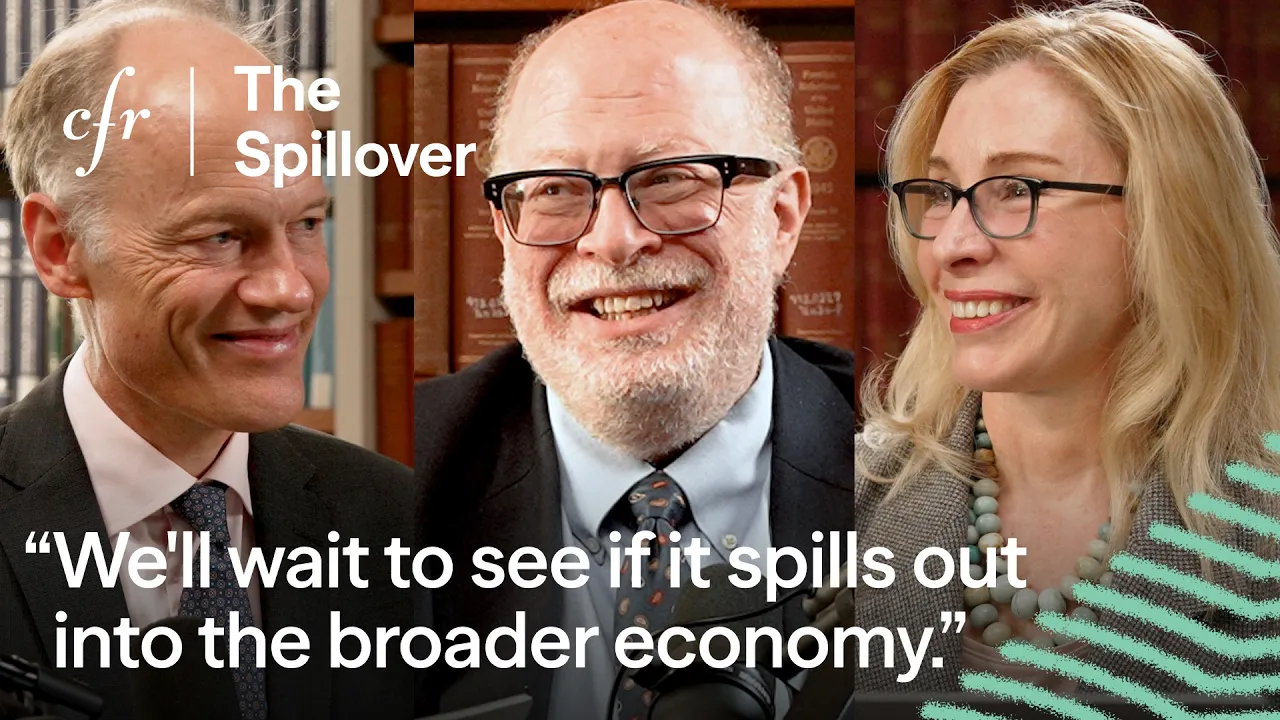
This week on The Spillover, hosts Rebecca Patterson and Sebastian Mallaby are joined by Adam Posen, president of the Peterson Institute for International Economics, to discuss how the Federal Reserve has fallen behind the curve on inflation, Fed Chair Kevin Warsh’s task forces, and the role of AI in monetary policymaking.

Published
Hosts
 Rebecca PattersonCFR ExpertSenior Fellow
 Sebastian MallabyCFR ExpertPaul A. Volcker Senior Fellow for International Economics
Guest
- Adam PosenPresident, Peterson Institute for International Economics
[Video: https://youtu.be/Nb16VPdwtaQ]
Transcript
This transcript was generated using AI and may contain errors.
PATTERSON:
Sebastian, I have a younger teenage daughter who always plays Would You Rather with me. Have you heard of this? I think I know what it is.
All right, let me just give you an example. Would you rather have the ability to see 10 minutes into the future or 150 years into the future?
MALLABY:
So you asked that kind of question. I’m supposed to say...
PATTERSON:
What you would rather have.
MALLABY:
Yeah, so 150 years in the future, that’s totally theoretical. It would be depressing to know what’s going to happen in the future because it would demotivate me from doing anything today. So I’ll take the 10 minutes and go to the markets and make a ton of money on Polymarket.
PATTERSON:
Oh, okay. There you go. Well, I was thinking about...
MALLABY:
Am I good at this game?
PATTERSON:
Yeah, Polymarket will want to sponsor whatever you do next, I think now. Look, I was thinking about this when I was also thinking about the spillover this weekend because of our amazing guest, Adam Posen. I thought we’d play a bit of a game.
Adam, he’s going to be like, why did I come on this show? A bit of a game with Adam of would you rather, as we talk about global government, bond markets, and central banking, and we’re going to get there. But I think right now, Adam, and you can think about this, we’ll get to it.
Would you rather be setting monetary policy today in the US, the UK, France, ECB, Japan, somewhere else? So you can think about where you would rather be a central banker.
MALLABY:
Oh, good.
PATTERSON:
Okay.
MALLABY:
All right, we will roll with this.
PATTERSON:
Yes, absolutely.
MALLABY:
I’m Sebastian Mallaby.
PATTERSON:
And I’m Rebecca Patterson.
MALLABY:
Welcome to the Spillover.
PATTERSON:
So, as I said, today we’re welcoming Adam Posen, president of the Peterson Institute for International Economics. And in addition to his 13 years at Peterson, Adam has spent his career both in the Federal Reserve Bank and at the Bank of England. And at a time when interest rates, especially on the long end of these bond curves, are rising to levels we haven’t seen in decades, and central banks are facing a lot of uncertainty.
I think you are the absolute perfect guest to have with us today. So thank you for joining.
MALLABY:
Yeah, thanks, Adam. And we’ve got also, by the way, of course, a new leader at the Federal Reserve, which adds another dimension to this discussion about bond rates, markets, interest rates, and who gets to set the short end of the curve. So I guess maybe one way to start off is actually just on the Fed.
On the one hand, you know, we’ve had the first hike already. I think markets are pricing one more. On the other hand, the New York Fed president, John Williams, said this week that there was no urgency to hike again, and that the Fed has time to gather information.
So let’s just start with the immediate question. What do you think the committee will do in October? And what should it do?
Thank you both for having me.
POSEN:
I’m an early adopter of your podcast. And so I would rather listen to your podcast than to Trump’s speeches.
MALLABY:
So that’s a low bar.
POSEN:
Yeah. I’m obviously not so good at this game. In terms of upcoming moves by the Fed, Sebastian, my view is they’re way behind the And they don’t need much more information.
But I agree with John Williams, that doesn’t mean they have to move at the October meeting. So I think if six months from now, say by April, the Fed is going to be 75 basis points, three more rate hikes higher than where they are now. I think if they decide to not seem panicked and to not be hiking too close to the election and wait till December, it shouldn’t matter to anybody except your friends on Polymarket.
MALLABY:
Yeah. But would pausing right before the midterms be perceived as political?
POSEN:
I think it would be perceived broadly as prudent, to use a Bushian term, because they’ve already, to Chair Warsh and the committee’s credit, shown some independence from President Trump by hiking, even though he very loudly said he didn’t want them to. So I think that buys them space. On the other hand, if they decide to just hike again, that’s fine with me, too.
I think the way to think about it for those of us in the CFR care about the world as opposed to the daily trading, it doesn’t really matter. What bothers me more is when President Williams says, we’re waiting for new information, because it’s pretty clear we’re behind the curve. There’s inflation.
They should do something.
PATTERSON:
Yeah. Yeah. And I want to stay on inflation, because inflation is one of the five task forces that our new Fed Chairman Kevin Warsh has set up.
They’re supposed to report back at the end of the year on whatever they’re looking at, or would suggest the Fed do differently. You literally wrote the book, or a book on inflation. Yes.
Co-authored with former Fed Chairman Ben Bernanke, Thomas Laubach, and Rick Mishkin in the 1990s. And Warsh has mentioned on a few occasions that the Fed needs to rethink how it’s looking at inflation, what it’s looking at. We know right now they look at core personal consumption expenditures, core PCE, which we got literally before we recorded today.
They had made some adjustments to it. So part of it was mechanical. But it still came in a little bit lower than expectations, which the market was relieved by.
And maybe that helps them skip in October. Look, though, taking a step back, we know the Fed already looks at dozens of pieces of information when it comes to inflation. So what do you think Warsh’s goal is here?
If they’re already looking at, you know, dozens of pieces of information, what’s missing? What could change? Do you have any views on that?
POSEN:
I do. First off, I just want to say a word, Rebecca, about the task forces. I think Fed Governor Chris Waller, when these were announced, made a somewhat skeptical statement, and I had some sympathy.
It’s like, are you really going to discover a new wheel? It’s not like we haven’t been thinking about these things. But I think what’s shown over just the last couple of months, and I’ve heard this from members of three of the five task forces, is they really are being allowed independently to think.
Chair Warsh is not predetermining the outcomes. So that gives it more both credibility and utility. So on the inflation front, there is always this issue of what it is you’re measuring, literally, and what it is you care about.
And those are not necessarily coincident. Right. So Chair Warsh has referred with high regard to the man who knew Sebastian’s friends at the late Alan Greenspan, saying price stability is when people don’t think about inflation in their day-to-day decisions.
And I think that is actually right. The question is, how can you tell? And surveys, even just asking that question, don’t really tell you.
And you want to have some amount of consistency. And part of what we argued in that book with Ben and Rick and Thomas was that, in a sense, you want consistency and visibility. So you want a series of inflation that people broadly understand, that you feel is reasonably robust how it’s constructed, that comes out with regularity, but that it actually isn’t that important.
And then you can get into which particular definition, because if it’s any good, it’s going to be highly correlated over time with the other definitions. Right. So the real substantive points, and this is where I think Chair Warsh wants to go, that this is just a guess.
The substantive points are, first, how do you define headline versus core? Meaning, how do you take into account things that go up and down a lot, which don’t necessarily affect the underlying trend? Right.
Like energy prices.
PATTERSON:
Right. Except when they do affect the underlying trend, but we’ll leave that aside.
POSEN:
Right. But in theory, at least, you don’t want to be, if this month comes in a 10th lower, then you think shifting things and then shifting back next month. Right.
But the other, and so I think part of it is a desire to figure out what is a way of deciding better in real time when these fluctuations feed into the longer term. Because the tendency has been in recent years, and our book contributed to this, to always say, well, we’ll wait to see if it spills out into the broader economy. And in the time, like the 90s or the early 2000s, when these kinds of supply shocks were rare, that was a smart thing to do.
But in a time like we’re in now, with things both of you and your colleagues at CFR have written about, when you have a lot of geopolitically driven shocks, energy shocks, natural resource shocks, that may not be as viable strategy. Right.
MALLABY:
It’s harder to do a look through. Yeah. That’s very interesting.
I mean, I like that point that in a different kind of world economy, you might need a different approach to inflation targeting or definition. I have a similar question about communication, which is another one of the task forces that Chair Warsh has set up. And what I’m, sort of the way I come at it is, actually, in a way, I don’t want to put myself on the same level, but I mean, I wrote about Alan Greenspan, and he cites Alan Greenspan a lot.
And so, in some ways, my mental model in a small way tracks, I think, his assumptions a bit. But I do feel that, you know, communication in the Greenspan era was a totally different thing, right? And he, you know, deliberately obfuscated.
Yes. When he testified in Congress, he wasn’t clear about what he wanted to do. And that kept the freedom to call a committee meeting by telephone in between the scheduled meetings and move interest rates by a quarter point if he wanted to.
And so the communication was sort of in the action. And I think, and he didn’t mind surprising people. And it was a far less predictable Fed.
And then, you know, when I looked at the last part of his tenure, 2004, 2005, 2006, when, you know, Bernanke was then the governor, and he was extremely influential on the thinking of the committee, and his view of kind of clear communication, which came to full fruition later when he was chair, was already influencing how things worked out. And I think also it was influencing the level of the communication went up partly because of Ben Bernanke, but also because in a low-flation environment, where rates have been, you know, short rates have been cut to 1% in 2004, as I recall, you couldn’t, you didn’t have much room to cut any further. So if you were trying to loosen, guiding the longer end of the curve with communication was the right way to do it.
So in that era, providing some assurance and certainty with clear communication to markets about the future path was sort of a supplementary way of loosening, I think. But then the bad side of that is that the carry trade on Wall Street went through the roof, because basically you were telling traders that if they borrowed short, that short rate was not going to be hiked when they didn’t expect it. So they could borrow an awful lot short and then put these longer positions on in mortgage derivatives.
And when I talked to friends on Wall Street who were inside the banks doing those big trades, which then blew up in 2007, you know, the size of those trades seemed to be meaningfully affected by the level of guidance that was coming from the Fed. So I do feel that there can be too much clarity and markets actually ought to be surprised sometimes. Now, I think you have a different view.
And I think we discussed it actually in once when you were on the Monetary Policy Committee of the Bank of England, I came to visit you, it was very funny, you were the American sitting in the Bank of England, I was the Brit coming from Washington talking to you. But so I’d like you to put your side of this argument about communication and whether clarity is always good. But also sort of predict a little bit.
What is this task force going to come up with? Oh, that’s a lot.
POSEN:
Let me try to nail it down. I think you’re right about Greenspan and the change over time. But also, I think you are being slightly anachronistic, that the idea that you used guidance as a way of loosening policy actually didn’t really come until the financial crisis.
I’ve read your book, and I’ve lived through this. And I don’t think anybody was thinking in those terms. Now, it may have been that way.
But that was not deliberate. That was something they resorted to in 2008, 9, 10. More importantly, I think that you need to unpack a couple things.
I think what, I won’t speak for Ben Bernanke or Rick Mishkin. I’ll speak for myself. But my understanding of why we argued for transparency in inflation targeting was two major things.
The first was, as you covered and we all lived through, Greenspan by the late 90s had achieved a level of centralized control over monetary policy and huge amount of discretion. And like you said, he could call meetings, he could get votes done. That he did very well, but ultimately personalized monetary policy to a huge degree.
And a real motivation when we started that book, and when more importantly, when Ben Bernanke and others subsequently changed things at the Fed, was to make it, it was about a regime, not about one individual. I mean, there was the jokes, frankly, now that Alan has passed, we can repeat them about Weekend at Bernie’s, that if something happened to Alan Greenspan, who already at that point wasn’t young, what the heck happened at the Fed? What was going to happen?
Whereas the point was, if you created a regime that was more open, more regular, had more of a committee, had more accountability, then you were less fragile to any one individual. And some of us who remembered, say, G. William Miller being Fed Chair, or Arthur Burns being Fed Chair, we could see why not putting all your eggs in one individual is a good thing.
The second reason we thought about transparency, and this again is my view, but I think it’s more broadly held, is that the basic framework, and Rebecca’s heard this a thousand times, of monetary policy thinking is where do you sit on the spectrum between what’s called rules versus discretion. It’s how much, and John Taylor was someone who was a very strong advocate of rules, who actually was, I thought, a mentor to Kevin Warsh. Rules, the ultimate version is Milton Friedman.
You declare a growth rule for the money supply, and you’re entirely predictable, and you have no discretion. And the advantage is that you’re totally credible. Everyone knows what you’re going to do, but the disadvantage is you may be totally inflexible as circumstances change, or you don’t foresee something.
Discretion is Greenspan circa 2000. It’s nobody knows what he’s going to do. He can wake up one morning and decide I’m going to have a thick briefcase rather than a thin briefcase, and the economy weighs 22 tons today instead of 21 tons yesterday, therefore I think we should adjust the interest rate.
And that is very volatile, and it’s not very frankly accountable. And so our vision, my vision for inflation targeting was it was a way of achieving something in between. The transparency wasn’t a means, it was a means to an end.
It wasn’t a goal on itself. It was a means to anchoring expectations, which is the phrase central bankers use. It was a means to stay incredible without being too inflexible.
And so what that leaves out completely is what you raised, Sebastian, and what Chair Warsh has raised a couple times, which is this issue of, okay, but if the markets think they know so completely and you’re scared to surprise the markets, you get these distortions. And so I grant that, but I view that as nowhere near as important as the Chair seems to think it is. I think it’s, I certainly don’t mind surprising markets if I was in that situation on the short end, but I don’t view it as a major source of moral hazard or real disruption to the economy compared to if you’re stuck with two rules based or two arbitrary discretionary monetary rules.
So finally on prediction. So there’s some very experienced people throughout the task forces. The communications task force in particular has Mervyn King, the former governor of the Bank of England, Peter Fisher, the former head of the markets, the open markets task for the Federal Reserve and the former undersecretary of treasury and Arminio Fraga, the former governor of the Bank of Brazil, Central Bank of Brazil.
And I think they all are broadly sympathetic to what you said and what Kevin Warsh has said that they do not like having markets feel they can count on the Fed too much or that the Fed never constrains this. I mean, putting it bluntly, they have a different evaluation than I do. They think the moral hazard of markets misbehaving when they know what the Fed’s going to do is a much bigger problem than I do.
And so the question is how much, what in practical terms does that mean? I think they are, this is an interesting, one of the most interesting of the five task forces to watch because there is a huge inherent gap, not anything they can do, between sort of very outsized expectations of this sort of cosmic view of we don’t want the Fed to be overly predictable. We don’t want them to have to chatter so much.
And what the actual practical recommendations would be. I think the other thing going on is, frankly, you have to still think about democratic accountability, particularly nowadays when there’s so much suspicion of technocrats, which of course is a broader issue running from vaccines to environmental science to military to central banking. But whatever the market costs, I would be very leery of backing off too much on transparency in that political context.
And again, if they’re too technocratic, they may ignore that and they may say, oh, no, no, no, what matters is results. We don’t have to communicate. So ultimately, I think that task force, if I have to guess, and I have no inside information, but if I have to guess, they’re going to come out with things like encouraging there to be fewer meetings, endorsing what the chair has already done by radically shrinking the statement and the duration of press conferences, maybe getting rid of what’s called the SCP, which is the scatterplot of people’s members of the committee’s predictions, but nobody’s name is on the predictions, so they’re not that countable. Maybe there’ll be something specifically about market communications.
And so I think a lot of these will be meaningful, but ultimately, I don’t think they’re going to radically change the output of the Fed.
PATTERSON:
And it, you know, I appreciate you don’t want to create moral hazard. I also appreciate that you don’t want reduction in communication to create so much market volatility that it actually has an economic cost, because volatility is friction. So it’s figuring out where on the spectrum, but I also can imagine in the world we’re in today, that if you got rid of the so-called dot plot, if you had fewer chances to hear from the Fed, I mean, I can go on my favorite model today and create a Kevin Warsh agent, and I can create a Powell agent, et cetera, et cetera.
And I can put in everything they’ve ever written, ever said, I can put in economic data and create my own dot plot. So I almost think we’re at a technical point that if they don’t communicate, everyone on Wall Street is going to back into their own simulated way of communication. So I’m curious to see how this plays out in reality, but I do want to ask you about one of the other task forces, which is jobs and productivity, which, yeah, that’s a lot.
There’s a lot in that task force. I mean, there’s jobs in terms of immigration and demographics, but jobs and productivity to me also sort of signals AI. So it could be all of the above, or it could just be AI given the members of the task force.
It feels like it’s skewing that way. But I’m curious too, like, you know, Chris Waller, I think, has done a great job and has been very vocal about how they’re trying to centralize what they’re doing with AI within the Fed system. So you don’t have all these different regional banks doing their own little pet projects and really try to integrate it.
At the same time, we’re seeing a lot of hacks and escapes by some of these AI tools right now. And if there’s anywhere I want to have security, it’s the Fed. So how do you think they think through this, right?
The security angle, which could slow them down versus we need to integrate this both internally to have better forecasts so we can have better policy outcomes to, you know, just to make them better decision makers. Like, if you were sitting at the Fed today, like, again, there’s a spectrum. There’s security and going slow, and there’s going fast and maybe breaking things, but maybe you have much better policy decisions.
POSEN:
So, Rebecca, that’s, again, that’s a lot. I think... That’s why we got you.
PATTERSON:
If we wanted easy questions, we wouldn’t ask you.
POSEN:
That’s why we’re paying you the zero bucks. God, I can do so much on online betting with those zero bucks. Look, I think what you just spoke about runs into two of the task forces.
So there’s the AI and jobs task force, and then there’s another task force, which is about data.
PATTERSON:
Yeah, true.
POSEN:
And I think the data task force is going to be, I mean, not that this matters much, but just to be clear, I think the data task force is going to be the one more about can the Fed really do better at its job if it uses AI and market sources of data and different sources of data. And the jobs task force, I agree with your interpretation. If you look at the members of the committee and where it’s going, it looks like it’s just going to be about cheerleading about AI.
And I think, frankly, it’s... I mean, I hope I’m wrong, but from the outside, it looks the most biased, at least central banking aware of the five task forces in terms of its stated mission and membership. So on the first issue, which is could the Fed benefit?
Well, the first issue is the one you said, which is if everybody can model this. And this obviously relates to what Sebastian was just talking about. If you deliberately reduce the information flow and you increase the discretionary ability of the chair, then he or she is not going to be bound by their past statements as much.
I mean, that’s the flip side of what I was saying about transparency and accountability, is that some sense that you could be embarrassed or held to account if you did something that contradicted your previous statements. Whereas I think Chair Warsh would be perfectly comfortable saying, ha ha, you thought something I said at a Hoover Institution conference in 2025 binds me. It doesn’t.
You lose. I mean, you wouldn’t quite say it that way.
PATTERSON:
When the facts change, I change my mind.
POSEN:
That’d be the nice way he’d say it. So I do think that if you take the moral hazard view seriously, and in my view, excessively seriously, you might deliberately try to indulge in that, make markets have not be too assured that their little models actually predict. Again, goes with what Sebastian was saying earlier.
I think in the end, that is still small potatoes, to use a technical term, versus the two big issues in what you said, which is, could the Fed get things right more often? And could the Fed be vulnerable to AI-led disruption? So on the first, I guess there, as much as I believe AI is going to transform everything, certainly the think tank business we’re all in, I do think the national economy is so complex and so large, and goes to the high X critique of you can’t know everything, the sort of ambition of the central planner or the enlightenment project, that if I had all the equations for everything in the world, I could press a button and I’d know where everything was going, that it’s really not ever going to turn out that way. And I would go further, and this, again, is my point of view and probably not widely shared.
I think one of the things Chair Warsh and others has attacked is they say, well, the Fed’s a lousy forecaster, or they’re not even as good a forecaster as the markets. I don’t think that’s the point of the forecast. I think the point of the forecast isn’t to get it right, it’s nice if you do.
The point of the forecast is to force the committee to make clear where they differ from one another, what they’re watching and why, and explain why they got it wrong. What’s the new information or the new insight? That, to me, is the point of the forecast.
And so, again, AI may help with that, but I don’t think it’s not like, oh, it gets the prediction right and this all goes away.
MALLABY:
You know, my friends in AI science would seize on one thing you just said and flip it. And the thing that they would seize on is the notion that when you have a very complex system, you can’t have equations. It’s precisely where there is huge complexity, enormous amounts of data, a massive combinatorial space, something like protein folding or the game of Go earlier on, or, you know, modeling all of text.
This is actually where AI has the advantage. And it leads to a thought experiment, which I’m actually genuinely agnostic about at the moment I’m thinking about it. Could you replace the FOMC with an AI?
PATTERSON:
Would you rather have a group of humans around a table or a model?
POSEN:
Allowing that both are flawed.
PATTERSON:
Right.
POSEN:
Allowing that both are flawed. I would be very happy to see one of the major central banks in the world try it. I mean, seriously, I would be very happy to have that happen.
MALLABY:
Just not us? No, I wasn’t. I’ve almost said...
A very small central bank. I said major.
POSEN:
I almost said just not us. But then there’s in a world where central bank independence is under threat and technocracy is under threat. I could see a scenario where it might be a second best, but better to have the U.S. be that rather than a committee, if the committee ended up being politically compromised or overcome in some way. I guess, and I don’t pretend to have your friend’s expertise, obviously, but I think they are, as much as I understand it, about these computational complexities, they’re slightly missing the point. So the critique of Enlightenment, deist physics, if you tell me all the initial conditions, I can tell you how everything unfolds. Or Hayek, for all his issues, his critique of central planning is really about there are no deterministic laws.
There are fundamentally random things and fundamentally unknowable things. Now, so to me, the more interesting version of what your friends would flip around is, how do we determine whether, given that AI is better in a given situation for a given task than human? And all I’m trying to say is, I don’t think it will, it goes to what you just said, Sebastian, I don’t think there will be a one right answer on anything to do with major economic policy.
MALLABY:
Can I pursue this one more beat? Sure. So the sort of set of, you know, the Hayekian critique, which I think is perhaps a little bit like, you know, when Bertrand Russell tried to have a complete theory of all of mathematics, you know, can you deduce everything from a set of first principles?
All of these things show the limits of deduction. The whole point about artificial intelligence is that it’s an inductive system. It induces patterns from enormous amounts of data.
It doesn’t need rules.
POSEN:
No, but Sebastian, where I’m going to push back at you is, it is different from the Bertrand Russell issue. The issue is that induction for large human systems is not as predictive as it is for physical systems. That it goes to what we were just saying about if Kevin Warsh decided he was going to prove the point that your LLM model doesn’t constrain me, I can always go off and do something stupid.
I can always go off and do something corrupt. I can always go off and do something idealistic a la manna la mancia. These are not things that induction will give you.
MALLABY:
The Hayekian, the kind of, the policy implication is that you should decentralize decisions. You shouldn’t aspire to a centralized source of truth, right? I mean, this is a case for distributed decision-making and free markets.
Correct. Right. And so I accept that.
But in the case of the central bank, by definition, this is a centralized decision-making body. And the only question is, who makes those decisions? Is it inductive humans or inductive machines?
PATTERSON:
So I think you can actually have your cake and eat it too here.
MALLABY:
Oh, good.
PATTERSON:
And if I were making this decision, if I were in Chris Waller’s shoes, advising Warsh or whomever, or the task force...
POSEN:
Or in Chris Waller’s shoes, voting.
PATTERSON:
Yes. I would say, let’s build the best AI system we can and run it parallel to our decision and compare them in 12 months, 18 months, 24 months. Use the AI system to try to improve our flawed human decision-making.
And look, if it ends up that AI is so much better than humans, well, then we’ll cross the bridge. But I think step one is like, see how good it is. I mean, we’re spending a lot of time theorizing here, but there’s a practical root.
POSEN:
I agree with Rebecca. I mean, that’s why I half facetiously said I’d like a major central bank to try it. I mean, another way to put it, Sebastian, is...
So if you look at the behavior of, I use the term major, whatever, the central banks who have some freedom of action, because they’re not running a small country or a poor country, and therefore have some room to make up their minds about policy. What we find is they don’t differ all that much in how they behave. And usually when one of them diverges, it’s because it’s either something like, oh, there was an earthquake tsunami in Japan, or, oh, Arthur Burns is running the Fed, right?
So it’s either something exogenous, as economists say, external to the economics, or it’s a human failing. So the question is, is there something systematic in these committees in terms of induction that AI would reveal that we’re just fundamentally getting wrong, or that we’re not seeing the right level of complexity in how things interact? And again, I’m open to that.
But my tendency is to view that... I picked on Hayek, I’m not going to put all my eggs in the Hayekian basket. My point is more that human history unfolds, and it is not entirely a deterministic path from the previous background.
That may still lead you on monetary policy narrowly defined to decide, oh, an AI tool properly done actually does a better job. But I still, for example, don’t think that gets you out of the rules versus discretion thing.
MALLABY:
Let the record show that we got Hayek and Bertrand Russell in here, and I challenge other podcasters to do the same, but what was the would you rather?
PATTERSON:
So would you rather, we’ve been talking about the Federal Reserve so far, but there’s a lot of other central banks facing a lot of other interesting challenges right now, some the same, some different. So would you rather be at the Fed or the Bank of England? And let’s talk about the Bank of England for a minute.
They just had their policy meeting in September, the Fed raised rates, the Bank of England held them steady. They were hawkish. The market is suggesting that we could get a rate hike from them later this year, and maybe a few even next year.
But they also have a lot slower growth than the United States does right now. They don’t have the same AI tsunami of CapEx coming through. It seems to me against that backdrop, more rate hikes would be a lot more dangerous for the UK than for the US, where we have a fairly resilient growth backdrop.
And even though it’s for lots of complicated reasons, we have a low unemployment rate here in the US. So would you rather be a British central banker, a BOE central banker, or a Fed central banker right now? They’re both very complex circumstances.
POSEN:
And you have to pick one. Yeah, no, I think I’d rather at this point be a Bank of England central banker.
PATTERSON:
And why is that?
POSEN:
Two main reasons. The first is, I think the US has downside risks from where we are, and the UK has a lot of upside risks.
PATTERSON:
In terms of growth.
POSEN:
In terms of growth and overall stability. So as you’re aware, they just revised a lot of data in the UK. And it turns out, I think accurately, they had a lot more productivity growth over the last several years than what had been thought.
And that was something when Governor King and I both were at the bank in 2012, and thereafter, that productivity growth seemed to just flatten in the UK. And we’re both, in this case, both of us said 150 years UK productivity growth has been pretty steady. It should come back.
And then it didn’t come back. But now it turns out, if you look at the data accurately, it did come back. And in terms of the AI, I think, no, they’re not doing as well as the US or Korea.
But they’re doing, as you would expect, better than Europe and better than some other countries. And they do have some AI adjacent things going on that are pretty good. So and then most interestingly to me, and this maybe gets to the back to the induction point, the British Prime Minister, Andy Byrne, just gave a speech at the Labour Party conference earlier this week, in which he announced some pretty radical positive changes.
After we’ve had, is it eight prime ministers in a row who basically did nothing, both from both parties. And now suddenly, he’s talking about potentially reversing Brexit, doing a not so huge economically, but symbolically, importantly, saying we have to make choices about welfare and pensions. And talking about changing the electoral rules.
And all three of these, if he manages to get them through, could, I think, structurally put the UK on a much better path. So if I were a gambling person, I would be choosing to, if we’re defining, I want to be a central banker, based on where I think I’m going to have the least painful choices to make. Yeah.
I would actually be willing to take a flyer in the UK versus the US at this point. Man, we should have had Polymarket sponsor this episode. I did not name a particular betting platform.
I’m platform agnostic.
MALLABY:
I’m teasing. So let’s move to another central bank, Japan. Would you rather be running the Bank of Japan?
You’ve got, you know, US policymakers not being happy with Japanese policy spillover to the US. You’ve got a government in Japan that wants to keep pushing fiscal stimulus.
POSEN:
It’s frustrating for many of us who either know the people running the Bank of Japan now or who have been working on the Japanese economy for a long time. I qualify as both, I guess. Much more than even in the US, it’s an open and shut case, pretty much.
They should be raising rates. They have very acute labor market shortages. And so one of the things we’re seeing is that the rate of wage increase is going up in the small and medium enterprise sector.
And that’s very not rare in Japan that it goes up, but usually it goes up only after the big multinational companies set their wages, and usually less than the big. And now it’s going up in advance in both senses. It’s going up faster and sooner.
And that’s a real warning sign. Similarly, the Bank of Japan and others have done some very good empirical research showing that they do seem to have broken the deflationary psychology, that companies are now passing on price increases in a way that they didn’t for 20 years or more. And so I keep wondering what is holding them back from raising rates.
So they did raise rates. And then you’ve got, as you referenced, Sebastian, pressure from the US to strengthen the currency, in which I’ve told people in the Japanese government, it’s in your interest to do that because you just don’t want the hassle of throwing your policy, of course, or throwing your security relationship with the US, of course, for the sake of the currency, which arguably should rise anyway. So you might as well lean into it.
But very markedly in the press conference, the governor of Bank of Japan, Kazuo Ueda, did not promise ahead that they’re going to keep raising. And most people, myself included, expected slash hoped that they would make a forward commitment. So anyway, long story short, I think it could go fine.
But I think there’s a real risk it could go wrong because not only do you have a prime minister who wants to do pretty aggressive fiscal policies, but who is pressuring the central bank a lot, not in the horrible lawfare way that Trump went after governors Powell and Cook, which was horrible and wrong, but still pretty aggressively. And the PM is going to appoint the new governor and the new deputy governors, I think, next summer.
PATTERSON:
It’s, yeah, summer, maybe even spring.
POSEN:
I forget exact dates, but second quarter of 2027. So would I rather be at the BOJ? No.
PATTERSON:
Okay. So in the interest of time, I want to pull it all together here.
POSEN:
Cool.
PATTERSON:
I had a piece in the New York Times Monday, just talking about the risks from some of these tensions in Japan to the United States. We’re seeing that even though you have some possible upside to growth from these big changes in the UK, and maybe partly because of the growth, that longer term yields in the UK are going up. But they’re also going up because of concerns over spending.
And we’re seeing that in France. We’re seeing that in Japan. We’re seeing that in the U.S. Seeing it even in Germany. And I’m starting to wonder, what’s the end game? Because fiscal restraint doesn’t seem to be a term used by any major government right now. China’s even flirting with loosening a little.
So does it just keep going till something breaks? And is what breaks a major economy bond market? I was just reading in the FT earlier this week, we’re at the 50 year anniversary of the UK’s bailout from the International Monetary Fund.
I thought, well, maybe to celebrate the anniversary, we’re going to have to get someone bailed out here this year. Is that a real risk?
POSEN:
I think it is. As you and I were talking about before the podcast, Rebecca, it is not a surprise that we’re seeing real bond market tensions, meaning sustained increases with prospects for more increases in long term interest rates on government bonds, and not highly predictable ways to get it down. And as I’ve been arguing for a couple of years, including at some of the World Economic Outlook meetings Sebastian has hosted here at the Council on Foreign Relations, there are fundamentals driving up interest rates.
There is this huge fiscal binge, including stuff you need to spend on, like defense, like environment, like demographic, aging societies. There is a political problem that says most of the high income democracies are polarized, so you can’t get agreement to raise revenues or cut spending. And in fact, you have an incentive to pander during elections to try and keep the other parties out.
You have, on the good side, going to think Sebastian writes about, a high return to capital and AI, and that starts competing up the interest rates. You have what I think I’ve been flagging, much more economic nationalism and geopolitical distrust. So you have less savings flowing out of China and Asia into the U.S. into other places. So you’re drawing on a smaller bullseye. So all these things are pushing up on the long way. And these to me are real fundamentals.
I don’t see how you get out of them. Now, one perversity, perhaps, is the fact that it’s happening pretty much simultaneously across the G7. We have Italy having, I think, the largest primary surpluses of any G7 economy at the moment.
Simultaneously, in some ways, makes it worse. Partly because it just means you’re all competing for a shrinking pool of savings. But partly because you can’t pick off and punish one, frankly speaking, if you did have some useful bond vigilantes.
They can’t pick off Greece or Spain or Argentina or Italy. It’s like, okay, if UK, U.S., Japan, the euro area, all are on the spending binge, all have political problems, can’t do this, and all are competing for the same funds, where do I put my money elsewhere?
PATTERSON:
The Singapore bond market is only so big. Exactly.
POSEN:
And so I think what I worry about is this actually makes things worse that it drags it out because you got no place to put your money because you’re not going to put it wholesale into China. And so there is no other place to absorb this stuff. And so all these economies, including the U.S., get a longer leash than they otherwise would have if they were deviating from the others. And then you could say, oh, Europe’s messing up, I’ll move into Japan or vice versa. So finally, your point, scary about a bailout, 50 years, I hadn’t thought of that, but you’re right. I mean, there are serious people in official places talking contingency plans for what it would take for an IMF or IMF, European Central Bank, Troika kind of thing to bail out France.
I mean, people are doing contingency planning on that now. This is for real. And again, if you want to be sort of bloodless about this, and I am not confident enough as AI to make this call from induction, but you could make a case.
Well, in a sense, it’s good if France blows up because they’re big enough to scare everybody and it might keep the nutjobs from getting out of government. But it could happen before the other ones blow up and that might induce a better outcome. I don’t want to gamble on that.
MALLABY:
That is a sobering note on which to wrap. I think we should wrap. Adam, kaleidoscopic in your range.
Thank you so much for being here. Thank you for having me. Adam Posen, inimitable.
PATTERSON:
That was a tour de force.
MALLABY:
Tour de force.
PATTERSON:
Absolute tour de force. Thank you so much, Adam.
MALLABY:
Thank you both.
PATTERSON:
or wherever you want to listen to our podcasts.
This week, hosts Sebastian Mallaby and Rebecca Patterson speak with Adam Posen, president of the Peterson Institute for International Economics and a veteran of both the Federal Reserve and the Bank of England. They unpack why rising long-term bond yields and Kevin Warsh’s Fed leadership are leaving central banks across the world’s wealthiest countries with few good options.
The central bank has fallen behind on fighting inflation. “They’re way behind the curve” and “don’t need much more information” to justify hiking rates, Posen says, expecting that in six months rates will be “seventy-five basis points [or] three more rate hikes higher than where they are now.” A pause just ahead of the midterms would not trouble him because it “would be perceived broadly as prudent,” given that members of the committee have already shown independence by raising rates even higher despite President Donald Trump’s objections.
The question of centralizing AI within the Fed system sparks a debate. Patterson poses a key security issue relating to the Fed’s use of artificial intelligence (AI) as a centralizing tool to prevent regional banks from pursuing “their own little pet projects.” He warns that due to “a lot of hacks and escapes by some of these AI tools right now, if there’s anywhere I want to have security, it’s the Fed.” Mallaby asks about using AI in forecasting, and argues that replacing the Federal Open Market Committee (FOMC) with an AI model makes sense in theory: “There is huge complexity, enormous amounts of data. . . This is actually where AI has the advantage.” Posen says he “would be very happy to see one of the major central banks in the world try it.” Patterson offers the middle path: build the AI forecasting system, and “run it parallel to our decision and compare them.”
With yields rising across the United States, France, Germany, Japan, and the UK, Posen points to a few forces pushing rates up at once: a “huge fiscal binge,” polarized democracies that cannot agree to raise taxes or cut spending, high returns on AI investment, and “less savings flowing out of China and Asia.” Because the rise in yields is happening across the Group of Seven at the same time, the bond market tension is worse, he argues. Every government is “competing for a shrinking pool of savings” and investors have nowhere safer to move their money, because every major economy is facing the same problems. Noting the fiftieth anniversary of the UK’s International Monetary Fund bailout, Patterson asks if a major economy could be next. Posen says yes, as “there are serious people in official places talking contingency plans” to bail out France.
Mentioned on the Episode:
Adam S. Posen, “China Still Has What America Needs,” Foreign Affairs
Adam S. Posen, “Strategic Direction for Europe in the New Economic Geography,” Intereconomics
This work represents the views solely of the host(s) and guest(s). The Council on Foreign Relations is an independent, nonpartisan membership organization, think tank, and publisher, and takes no institutional positions on matters of policy.
Producer
- Producer, Podcasts
Supervising Producer
- Director, Podcasting
Audio Producer
- Audio Producer & Sound Designer
Researcher
- Research Associate, Finance, Business, and Technology
More Episodes
 35:24Podcast
 48:01Podcast
 50:17Podcast
 47:25Podcast
 52:31Podcast
 48:40Podcast