The China Drug Dependency
What the United States and Europe Can—and Can’t—Do
- Tim RühligSenior Analyst for Global China, European Union Institute for Security Studies
Introduction
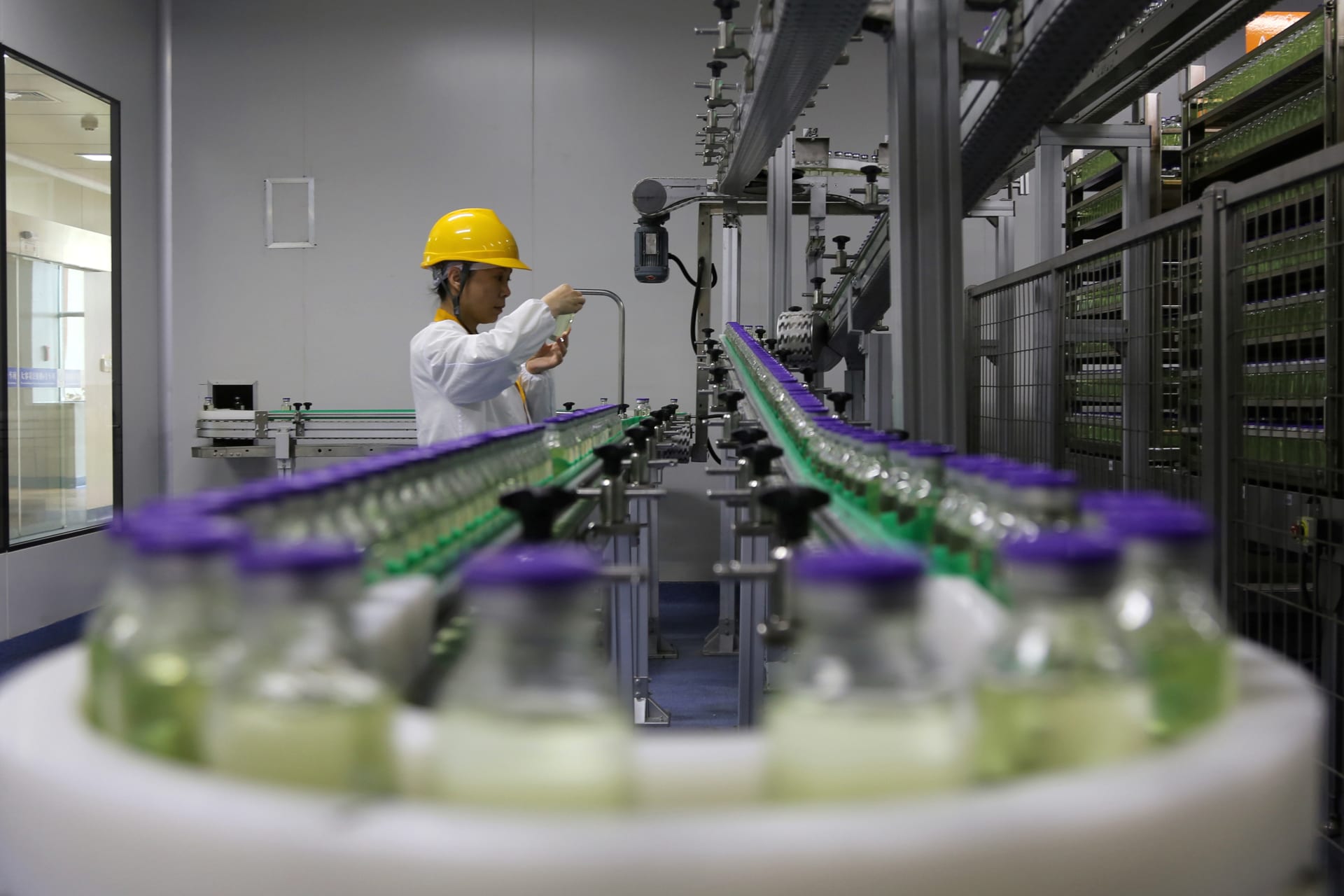
In the spring of 2025, eleven EU health ministers described Europe’s dependence on Chinese medicines as the weak point in Europe’s defense. The warning was accurate but largely ignored. For twenty of fifty-six active pharmaceutical ingredients (APIs) that German regulators classify as essential to supply, enough of the world’s production sits in China that a disruption there would leave European patients without ready alternatives [PDF].
The more troubling dependency lies one layer down. An ingredient made in India or Europe is still made from something, and those chemical building blocks are more heavily concentrated in China than the ingredients themselves. For metformin, a widely prescribed diabetes drug, roughly one-third of supply is exposed to a disruption in China at the ingredient stage. Count the building block that ingredient is made from, and the figure surpasses four-fifths. The antibiotics amoxicillin and cefpodoxime follow the same pattern. Europe can buy its ingredients from non-Chinese manufacturers and remain dependent on China all the same.
Europe inflicted this damage on itself. These dependencies are the result of decades of cost containment in European health systems, which squeezed margins on generic drugs until production left the continent. China, in turn, undertook an equally deliberate industrial policy to build the capacity Europe had shed.
In April 2026, Washington put additional pressure on the EU by announcing tariffs of up to 100 percent on imports of patented medicines and their ingredients, with European products capped at 15 percent. Generic drugs are exempt for now but will be subject to a review due within a year. Europe therefore faces a strategic question with a short fuse: whether to build resilience alone or with partners—and if with partners, on what terms. Partnership is the stronger choice, but on terms that leave Europe’s own pricing, procurement, and regulatory decisions untouched.
Cooperation and Its Limits
Three features of the drug dependency problem make a transatlantic answer more compelling than a purely European one. First, the exposure is shared, and it sits upstream. The U.S. Commerce Department’s investigation found that only around 15 percent of patented APIs by volume are made in the United States. On antibiotics, the concentration is even starker: China supplied roughly 70 percent [PDF] of U.S. antibiotic ingredient imports by volume in 2024, reversing the position of European producers, who held three-quarters of that market in the early 1990s. Neither Europe nor the United States is dealing with a national vulnerability. They are dealing with the same chokepoint, at the same layer of the value chain, in the same molecules.
Second, Europe holds assets that other regions do not. The last large-scale, fully integrated penicillin production site in the Western world is in Austria; the United States has no domestic capacity for making penicillin ingredients or their core precursor. In biologics, or medications that come from living organisms, Europe, along with North America, dominates not only the manufacture of biological ingredients but also the wider production system behind them: the engineered cell lines that produce the drug molecule, the nutrient mixtures those cells grow in, and the chemical solutions that keep the product stable while it is purified. Chinese and Indian producers are still catching up in that segment. Europe can therefore approach Washington as a supplier or co-supplier of security, not a supplicant for it.
Third, unilateral onshoring on both sides is self-defeating, and the current U.S. measures are counterproductive. Europe is the only ally with the penicillin capacity Washington lacks. Tariffs on European medicines raise costs across that base. Extending the regime to generic drugs, which the pending review could do, would reach the most fragile part of European production, where every plant closure is a market share transfer to China. The political effect is worse than the commercial one. Each coercive measure against Europe drains support in European capitals for the transatlantic option and strengthens the argument that resilience should mean autonomy from everyone. If the United States’ objective is an allied answer to Chinese dominance, current instruments are producing the opposite result.
The terms of cooperation matter from Europe’s perspective as well. A strategy that trades one dependency for another is not resilience. Several instruments now on the table in Washington would do exactly that: tariff relief conditioned on relocating production to the United States, drug-pricing commitments negotiated company by company under tariff pressure, and procurement rules with extraterritorial reach [PDF] that determine which suppliers European firms may use. Europe should cooperate on capacity, information, and standards, while retaining sovereign control over pricing, procurement, and regulatory decisions. Any proposal must meet a simple test: if the partnership broke down, Europe must still be able to supply its patients.
Recommendations
Europe and the United States should begin where cooperation costs nothing politically. They could start by fixing their lack of visibility into their own upstream flows of key starting materials. Joint mapping, which builds on the work of the Health Emergency Preparedness and Response Authority and its U.S. counterparts, is a technical exercise that produces shared information and nothing else. It changes no tariff, no procurement rule, and no market access, so neither side has to concede anything to take part. They should also undertake joint stress-testing on a shared methodology that measures not just how much production sits in China but how long replacement would take if production stopped. In particular, NATO should incorporate the defense-relevant subset of the stress-testing—demand for antibiotics, analgesics, and anesthetics under mobilization conditions—into its resilience work.
Europe should also lock in the existing carve-out under the 2025 United States-European Union Framework—which already grants near-zero treatment to generic medicines, their ingredients, and chemical precursors—and press to make it permanent, including for biosimilars, the lower-cost follow-on versions of biologic drugs whose patents have expired, before the U.S. review of generics concludes.
Europe should legislate its own rules on sensitive biotech and health-data cooperation with China rather than importing American ones through contractual reach. But the U.S. approach warrants careful study. In principle, a plurilateral critical-medicines arrangement modeled on the allied approach now emerging for critical raw materials would make sense. That would include giving preferential treatment to ally-produced ingredients and precursors, mutually recognizing the validity of the other side’s inspections, and establishing common resilience criteria in public procurement. The United States and Europe should establish such a framework with India, Japan, South Korea, Switzerland, and the United Kingdom, among others. The idea would be to coordinate demand: agreeing to long-term purchase commitments that give investors enough certainty to finance new Western production. The binding constraint on that capacity is not technology but price, with European ingredients running up to 40 percent more than Chinese ones. Only guaranteed demand closes that gap. Currently, however, transatlantic relations lack the trust required for such a comprehensive plurilateral arrangement.
Conclusion
The United States’ and Europe’s dependency on Chinese pharmaceutical ingredients was built over decades, and it will not be undone quickly. Europe should start with what can be done now: mapping the upstream flows neither side can currently see, testing how long replacement would actually take, and locking in the generics carve-out before the review closes it. None of that requires trust that does not exist. All of it would make a larger arrangement possible later, if the politics allow.
What Europe should not do is trade away control over its own pharmaceutical market to gain access to America’s. The purpose of reducing dependence on China is to widen Europe’s room to maneuver, not to narrow it again from a different direction. Washington should recognize that each tariff on European medicines cuts against the very alliance it says it wants.
Acknowledgments
This report was informed by a Council on Foreign Relations (CFR) meeting convened in cooperation with the Mercator Institute for China Studies (MERICS) as part of a project on transatlantic cooperation on China policy. The author thanks the members of the Council on Foreign Relations working group on transatlantic cooperation for the discussion from which this brief emerged, and Martin Catarata, David Francas, Jasmina Kirchhoff and Fearghal Raison, his coauthors on the underlying study. That study, Strategische Abhängigkeiten bei wichtigen Arzneimitteln von China, was conducted at the German Economic Institute and commissioned by Pro Generika, the German generics association. The views expressed here are the author’s own.
About the Author
Tim Rühlig is the senior analyst for global China at the European Union Institute for Security Studies.
This work represents the views solely of the author(s). The Council on Foreign Relations is an independent, nonpartisan membership organization, think tank, and publisher, and takes no institutional positions on matters of policy.
 Report
 Report
 Report
 Report
 Report
 Report