The Trump Coalition
What Do the President’s Voters Think About Foreign Policy?
Overview
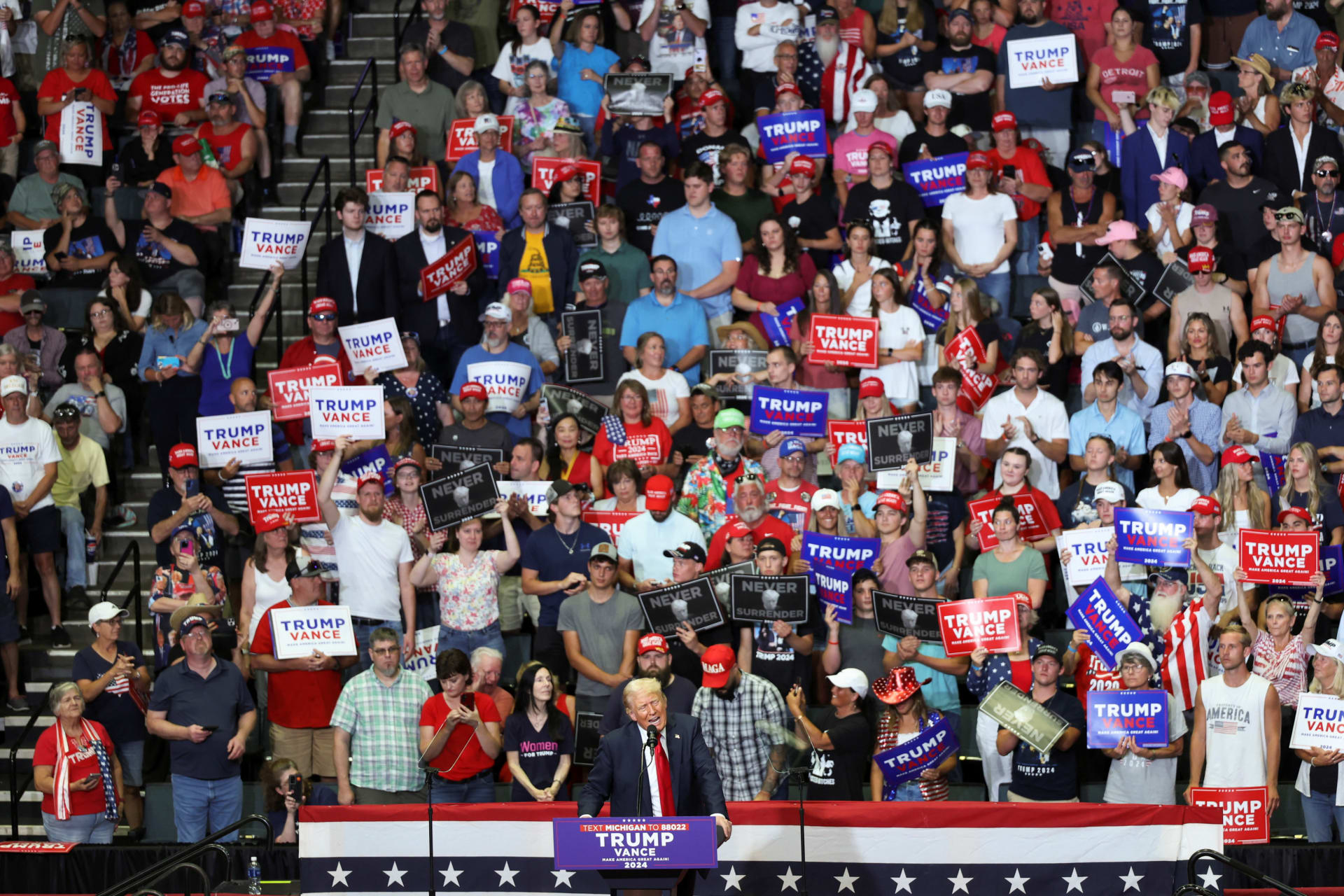
The coalition that elected President Donald Trump in 2024 included significant percentages of Black, Hispanic, Jewish, Muslim, white working-class, and evangelical voters. A CFR study group convened experts to address what explains that coalition, whether it will hold in 2026 and 2028, and what it means for U.S. foreign policy.
 Elliott AbramsCFR ExpertSenior Fellow for Middle Eastern Studies
Executive Summary
A Council on Foreign Relations study group convened scholars and political analysts to examine the foreign policy views of several groups of 2024 Donald Trump voters: Hispanic, Black, Jewish, Muslim, evangelical, and white working-class Americans who supported Trump in that year’s election.
The group found that Republican voters still support U.S. global leadership and military strength, as defined by the party since the era of President Ronald Reagan, though they are more wary of alliances and of democracy promotion.
For white working-class voters, religion was key: evangelicals were much more likely to vote for Trump in 2024 than non-evangelicals. They did not consider foreign policy a central issue but one mixed with economic security matters, and they widely believe that immigration takes jobs from Americans, leading them to support lower immigration levels and a closed border. Spending overseas (on foreign aid, for example, but also on military involvements) is also unpopular due to the fear that it takes funds away from the safety net here at home.
Jewish voters were a minor part of the Trump voting coalition; 29 percent of Jewish voters supported him. In future elections, more Jewish Americans may become swing voters due to growing antisemitic actions in the United States and growing hostility to Israel in parts of the Democratic Party coalition.
Muslim voters were unique among all cohorts the study group examined: foreign policy was their primary concern. When asked whether a candidate must share their views on an issue to earn their vote, Muslim voters said no on most issues—but yes on U.S. foreign policy in the Middle East. The American Muslim community is religiously and socially conservative, which might favor Republicans, but anxious about its security and inclusion, which might favor Democrats.
Latino voters have historically favored Democrats, but in 2024 they split evenly between Kamala Harris and Trump—a sharp departure. Whether that shift will prove durable is the central political question. Many Hispanic citizens have relatives who are undocumented or living under temporary protection, making immigration policy—the very tough enforcement actions of the Trump administration—the one issue related to foreign policy that is most likely to move Hispanic voters.
Immigration was also the top foreign-policy-linked concern among Black Trump voters, who were mostly male. The historian Christopher Shell told the study group this was connected to a “growing nativist impulse” among some Black Americans, one that Trump appealed to with the claim that undocumented immigrants are “taking Black jobs.” For Black working-class voters in particular, the issues of economic security and immigration have become intertwined.
The study group concluded that even voters who are “not foreign policy voters” often have strong views on issues related to foreign policy, and choices they make will affect U.S. foreign policy in the coming years. The coalition of voters who supported Trump in 2024 is very unlikely to be reassembled in the 2028 election, and foreign policy issues are among the keys to how voters will swing in that contest.
Introduction
The coalition that elected President Donald Trump in 2024 was, like many presidential election coalitions, new. It included higher-than-usual percentages of Black, Hispanic, Jewish, and Muslim voters, alongside consistently high percentages of white working-class and evangelical voters.
Over the past year, a study group at the Council on Foreign Relations brought together scholars and political analysts to examine that coalition. The discussions addressed what explained it, whether it will hold in 2026 and 2028, and what it means for U.S. foreign policy. Specifically, they considered whether foreign policy was a key factor in how those groups voted and whether their views will shape future elections and U.S. foreign policy. What follows is an amalgam of those views.
Foreign Policy and the 2024 Presidential Election
The voter coalition that delivered Trump’s 2024 victory was unique—distinct from his 2016 coalition and unlikely to be replicated by the Republican presidential candidate in 2028. The primary political question is whether voters who switched to Trump—particularly Black male, Hispanic, and Muslim citizens—will support Republicans in 2026 or 2028, or whether those “switcher” votes were highly personal and contextual, with little bearing on the party’s future prospects.
On foreign policy, Republican voters broadly still support the traditional approach—U.S. global leadership and military strength, as defined by the party since the era of President Ronald Reagan. A Vandenberg Coalition poll in March 2026 found that 96 percent of MAGA conservatives and 90 percent of Trump voters overall have confidence in American military power. Vandenberg’s January 2026 poll found that 89 percent of Trump voters thought it was important that “the United States, as opposed to China, Iran, or Russia, remains the strongest country in the world,” and 91 percent agreed that “the world is a safer place with strong, principled American leadership.” The 2026 Reagan Institute Summer Survey similarly found high Republican support for American international engagement—71 percent overall and 76 percent among MAGA Republicans.
A 2024 Pew Research Center analysis found that 83 percent of Americans wanted President Joe Biden to focus on domestic rather than on foreign policy, compared with 14 percent who prioritized foreign policy.
So, even though rhetoric about foreign policy has changed, with terms such as America First and national interest now commonly used to describe desired foreign policy approaches, the substance of Republican foreign policy preferences appears largely unchanged. Certainly, isolationism has no strong support. As Patrick Ruffini of the strategic research firm Echelon Insights told the study group, today’s Republican coalition “looks 80 percent like the Republican Party of old.”
As to why minority voters and working-class whites switched to Trump, Ruffini pointed to economic and status anxieties, and a “ruptured sense of economic security” in the wake of COVID-era disruptions.
Some skepticism about international engagement and expenditures is a result: when family budgets are squeezed, foreign aid expenditures become a symbolic grievance. Trump’s foreign aid cuts are popular among his voters, fitting a broader narrative about elites neglecting ordinary Americans. These voters are not isolationist, but they tend to define national interest through the lens of their own cost of living and to support U.S. military strength more than alliances or democracy promotion, both of which have stronger backing among Democratic voters.
That said, most Trump voters—like most Americans—were not primarily foreign policy voters. A 2024 Pew Research Center analysis [PDF] found that 83 percent of Americans wanted President Joe Biden to focus on domestic rather than on foreign policy, compared with 14 percent who prioritized foreign policy—a stronger domestic tilt than in 2019, when the split was 74 to 23 percent. That pattern holds unless the country is at war or in a dangerous crisis. Still, the 2024 voting pattern offers some useful clues about voters and foreign policy.
White Working-Class Voters, Evangelical and Non-Evangelical
We define white working-class voters as noncollege white voters. That group has changed vocationally over time. Once associated primarily with factory or construction work, they now are more likely to be found in service industries, small businesses, or gig work.
Republicans have long won that group, but Trump exceeded previous margins. Reagan won 56 percent in 1984 and Mitt Romney 57 percent in 2012; Trump reached 62 percent in 2016 and 66 percent in 2024.
More striking than those numbers is the split among white working-class voters between evangelical and non-evangelical voters. In 2024, Trump won roughly 90 percent of working-class (i.e., noncollege) white evangelical men and about 83 percent of women. But he won only about 52 percent of non-evangelical white working-class men and 38 percent of women.
Those large differentials suggest that evangelical identity, more than economic or social status, explains much of the vote. Beyond that central divide, the 2024 returns reveal several additional patterns. Trump improved his showing slightly among white working-class evangelical voters over 2020, while among non-evangelical white working-class voters he gained among men but lost among women (40 percent voted for Trump in 2020, compared with 38 percent in 2024). He also gained among nonwhite working-class voters—among Hispanic men and women, and among Black men, though majorities still voted Democratic.
On the question of whether labor unions affect the voting patterns of white working-class voters, political scientist John DiIulio reminded the study group that only 6 percent of private-sector jobs are now unionized and that many union members are college-educated, female, and nonwhite. He noted that 70 percent of working-class Americans approve of unions even though they are not members of one and suggested that for many voters “union as a concept mainly signals secure, decent, benefit-rich jobs.” Issues related to economic security affect many voters’ foreign policy views, as discussed below.
For white working-class voters, as for many Americans, foreign policy is usually a minor issue in voting—and overall, those voters are “only modestly different” from other groups, DiIulio concluded. But they are more supportive of Trump policies that they believe directly affect their lives. Among working-class white Americans, 60 percent favor higher trade barriers, versus only 38 percent of college-educated white citizens. Of working-class white voters, 52 percent favor less immigration, versus 34 percent of college-educated white voters.
They are also more likely to favor higher military spending and less likely to endorse U.S. support for Ukraine. Those gaps should not be interpreted as a form of isolationism but rather as support for Trump policies that such voters believe affect their economic security. More than college-educated voters, they believe immigrants take away jobs, leading them to favor lower immigration levels and higher border security.
Voting data since 1980 shows that white working-class voters are up for grabs: since 1980 they have favored Democrats for president three times and Republicans by two points or fewer three times.
Voting data since 1980 shows that white working-class voters are up for grabs: since 1980 they have favored Democrats for president three times and Republicans by two points or fewer three times. Foreign policy issues they perceive as affecting their economic security—namely immigration and costly interventions such as helping Ukraine that they fear may divert attention from economic priorities—could influence which way they go in 2028. That is a repeated pattern.
On foreign policy, the historian John Fea suggested that even without a “rich foreign policy tradition,” evangelical Americans had for decades three main concerns: support for Israel, which was historically the top priority; religious liberty, the defense of persecuted Christians, and human rights; and humanitarian relief and aid. But that has changed. In the Trump era, support for humanitarian aid spending and soft power more broadly has declined sharply, replaced by a clear shift to America First policies and populist instincts. Arguments for an America First approach therefore find fertile ground—though they may also conflict with some previous emphases. In the era of President George W. Bush, evangelical Americans took a more globally engaged, humanitarian approach; they led the effort, for example, to change U.S. policy toward Sudan, whose regime was persecuting Christians and committing genocide in Darfur.
Evangelical Christians who supported Trump, Fea suggested, included a loud, dedicated minority who defended all his behavior: hardcore MAGA evangelical Americans. But more evangelical people, he thought, were reluctant Trump voters who disapproved of his character and rhetoric but supported him for policy reasons: a transactional vote for conservative judges, opposition to a liberal abortion policy, and similar priorities. Within that broader group, a division emerged between those who remained enthusiastically committed to Trump—often charismatic and Pentecostal believers—and a larger contingent that grew uncomfortable with his behavior.
Foreign policy does not play a central role here. Economic and cultural issues matter far more, and Fea suggested that many evangelical voters still feel looked down upon by elites they associate with the Democratic Party. There is, in his view, no coherent “Trump Evangelical supporter foreign policy.” According to Fea, MAGA and conservative evangelical individuals do not think deeply about foreign policy beyond the three categories mentioned above, and they tend to view those matters through a theological lens—prophecy, mission, evangelism—rather than through policy frameworks of the kind that emerge from think tanks. Those voters do not accept the cosmopolitan stance of some other voting groups; Public Religion Research Institute data ranked them the group least likely to describe themselves as a “citizen of the world.”
Jewish Voters
Jewish voters make up just over 2 percent of the U.S. population and were a small part of the Trump coalition; they typically lean 70 to 25 toward the Democratic presidential candidates. Trump improved on that, winning 29 percent of Jewish voters. Those who voted for Trump skewed heavily Orthodox: 87 percent of Jewish Americans who voted for Trump in 2024 identified as Republican, and the Orthodox community (roughly 10 to 12 percent of all Jewish Americans) skews 64 to 23 Republican over Democrat. The largest denomination, Reform (37 percent of Jewish Americans) is heavily Democratic. By contrast, the Conservative denomination (17 percent) may offer Republicans the greatest opportunity for gain—and Democrats their greatest risk of loss—because 95 percent of Conservative Jewish Americans say caring about Israel is essential to their Judaism.
Although foreign policy ranks low on most voters’ priority lists, two groups are significant exceptions: Jewish Americans and Muslim Americans, whose concerns are much sharper and more unified. Among Jewish respondents, there is widespread criticism of many Israeli policies, though 85 percent describe themselves as “pro-Israel.” There has also been a dramatic shift from previous generations’ near-unquestioned support for Israel to more divided views; a majority of Jewish Americans, for example, did not approve of U.S. military action against Iran despite the strong support from the Israeli government and close U.S.-Israeli military collaboration against Iran.
Measuring what Jewish voters think is complicated by the question of who counts as Jewish. For some who answer “yes” when asked by a pollster, Jewish identity is central to their lives—their religion, their community, their connection to Israel. For others, answering “yes” may be the only act of Jewish identification; they have no active religious affiliation or community involvement. Predictably, foreign policy—meaning support for Israel—is an important political matter for those in the first group but not for those in the second. A June 2026 AP-NORC Center Poll [PDF] found that 58 percent of those who answered that they were Jewish in some way said Israel was important to them personally, while 40 percent said it was not. As the poll found,
About 3 in 10 Jews in the U.S. identify as Jewish ethnically, culturally, or by family background even though they report being agnostic, atheist, or unaffiliated when asked about their religion. . . . Religiously affiliated Jews tend to feel more connected to Israel than secular Jews. Forty percent of religious Jews feel very or extremely emotionally attached to Israel compared with only 11% of secular Jews. Forty-five percent of secular Jews do not feel connected to Israel at all. While 48% of religious Jews say supporting Israel is a key part of their Jewish identity, only 12% of secular Jews agree.
For decades, foreign policy (including support for Israel) ranked low among the concerns of American Jewish voters. That was partly because some of those counted as Jewish by pollsters were disconnected not only from Israel but also from their communities and their own Jewish identities. It was also because in recent years both parties broadly supported the U.S.-Israel relationship. Concern about Israel would not necessarily have suggested voting for Reagan or Walter Mondale in 1984, Bush or John Kerry in 2004, or Biden or Trump in 2020. Jewish Americans told pollsters that support for Israel was “very important” to them yet still ranked it—along with other foreign policy issues—below the usual economic concerns that drive most voters. Jewish voting patterns in that regard, including the roughly 70 to 25 Democratic advantage, have long been stable.
Jewish people were a part of the Trump voting coalition, though a minor one—29 percent of Jewish voters supported him.
The question is whether Israel and other issues of concern to the Jewish community will remain so low in importance in future elections. In other diaspora communities (such as Australia, Canada, France, and the UK), there has been a shift to the right when left-of-center parties adopted increasingly anti-Israel positions and when antisemitism grew.
Whether the Democratic Party will follow the Australian Labor Party and British Labour Party in taking an increasingly critical stance toward Israel—and, if so, how Jewish voters will respond—is an especially difficult question to answer given the Democrats’ current antipathy toward both Trump and Israeli Prime Minister Benjamin Netanyahu. Growing fears of antisemitism could lead Jewish Americans to reassess their votes, at least once Trump and Netanyahu are no longer in the picture. Repeated expectations of a mass shift to the Republican Party have for decades been frustrated by countervailing events or unattractive candidates, but those elections did not coincide with rising fears of anti-Zionist and antisemitic activity within the Democratic Party.
Jewish people were a part of the Trump voting coalition, though a minor one—29 percent of Jewish voters supported him. In future elections, more Jewish Americans may find themselves politically homeless, becoming swing voters as concerns about their own standing in the United States and the U.S.-Israel relationship grow more acute.
Muslim Voters
Muslim voters constitute about 1 percent of the U.S. population, though estimates vary and the U.S. Census does not track religion. The Muslim population is highly diverse, with African, African American, Arab, Hispanic, and South Asian components and no single dominant group. It skews younger than the U.S. population overall, though younger Muslim respondents are as likely as older ones to say that religion is “very important” to them. It is also predominantly an immigrant community: about 75 percent are immigrants or the children of immigrants.
After showing considerable support for Bush in 2000, Muslim voters shifted sharply left: in the 2016 election, 78 percent voted for Hillary Clinton and two-thirds identified as Democrats. That number seemed to dip in 2020, with exit polls suggesting one-third of Muslim citizens voted for Trump in 2020 and two-thirds for Biden.
But then came Gaza. Many Muslim voters opposed the Biden administration’s support for Israel, and data from the Institute for Social Policy and Understanding (ISPU) suggests that in 2024 the Democratic vote fell to 50 percent, while Trump’s share held steady at roughly one-third and protest votes for Green Party candidate Jill Stein reached 12 percent. The shift away from Kamala Harris was pronounced among Arab, Asian, and white Muslim voters but not among Black Muslim voters: 76 percent of that group supported Harris, compared with only 38 percent of white Muslim voters. A significant gender gap also emerged: Trump won 42 percent of Muslim men but only 17 percent of Muslim women. Overall, the ISPU data showed that only 55 percent of Muslim Americans who voted for Biden in 2020 reported voting for Harris in 2024.
Polls by the political scientist Youssef Chouhoud found that Muslim voters ranked U.S. foreign policy toward the Middle East as their top issue, with U.S. foreign policy toward the rest of the world also in the top three. Domestic concerns such as jobs and the economy mattered, but less so. Thus, Muslim voters were unique among all cohorts the study group examined: foreign policy was their primary concern. When asked whether a candidate must share their views on an issue to earn their vote, Muslim voters said no on most issues—but yes on U.S. foreign policy in the Middle East.
An experiment by Chouhoud reinforced that conclusion. All else being equal, Muslim voters were 14 percent more likely to vote for a Muslim candidate, 12 percent more likely to vote for a candidate who favored banning LGBTQ+ materials in schools, and 50 percent more likely to vote for a candidate who supported freezing all aid to Israel. The ISPU polls also found that “the war in Gaza is a shared top policy priority across Harris, Trump, and third-party Muslim voters.”
That leaves Muslim voters without strong confidence in or alignment with either party. When asked which party better aligns with “Muslim values,” a plurality said “neither” or “both the same.” Among those who chose between the parties, more picked Republican—but when asked which party is more concerned with the well-being of Muslim Americans, more picked the Democrats. Chouhoud captured the community’s ambivalence in a pithy formulation: “Democrats are against Islam, but Republicans are against Muslims.” The American Muslim community is religiously and socially conservative, which might favor Republicans, but anxious about its security and inclusion, which might favor Democrats.
The Israeli-Palestinian conflict is clearly the top mobilizing issue today, though it registers more strongly among immigrants and their children than among Black American Muslim voters who are descendants of enslaved people. Less clear is whether that will result in permanent or long-lasting alignment with the Democrats or will fade in importance over time. That question, and the related divide between nonimmigrant Black American Muslim and immigrant Muslim communities, is a key analytic issue in future elections.
Hispanic Voters
Latino voters have historically favored Democrats, who won their votes by a twenty-five-point margin in 2020. In 2024, however, they split evenly between Harris and Trump—a sharp departure.
The 36 million Hispanic or Latino voters (the terms are used interchangeably here) constituted nearly 15 percent of all eligible voters in 2024. About 54 million Latino people are U.S. citizens, and the electorate is young: 1.4 million new Latino voters enter the electorate each year by turning 18 or becoming naturalized citizens. The Latino electorate is almost evenly divided among first-generation (foreign born), second-generation (U.S.-born children of immigrants), and third-or-higher-generation voters (born in the United States of parents also born here). The community is about 70 percent native born and 30 percent foreign born, and approximately 60 percent Mexican, 10 percent Puerto Rican, 10 percent Central American, 4 percent Dominican, 4 percent Cuban, and 7 percent South American in origin. Intermarriage rates suggest relatively quick assimilation: about 28 percent of Hispanic people ages 18 to 35 are married to a non-Hispanic spouse, and among third-generation-or-higher young adults, that figure rises to 58 percent.
Latino voters have historically favored Democrats, who won their votes by a twenty-five-point margin in 2020. In 2024, however, they split evenly between Harris and Trump—a sharp departure. Whether that shift will prove durable is the central political question, one that is difficult to answer because many Latino voters are young and their partisan identities may not yet be firmly established.
Latino voters do not seek to influence foreign policy, particularly toward their countries of origin. Even among first-generation immigrants, ties to their home countries decline steeply, and recent arrivals pay limited attention to home-country politics. By the time of naturalization, attention to politics means attention to U.S. politics. By the second generation, many Latino Americans report little or no attention to their parents’ countries of origin. Remittances sent “home” might seem to contradict that conclusion, but those payments go to family members or communities of origin, not to national governments.
Of course there are exceptions. Migrants from Cuba, Nicaragua, and Venezuela pay more attention to their home countries—but their political impact is limited by their concentration in South Florida, where they may shape state politics without meaningfully influencing U.S. foreign policy, particularly as Florida moves from purple to red. On balance, Latino voters, like most Americans, do not prioritize foreign policy, and interest in any one country—Cuba, Nicaragua, or Venezuela—is unlikely to shift overall Latino voting patterns nationally.
Immigration and domestic enforcement constitute a partial exception, as a foreign-policy-adjacent issue that directly affects Latino families and communities. Many Hispanic citizens have relatives who are undocumented or living under temporary protection (through the Deferred Action for Childhood Arrivals policy, temporary protected status, humanitarian parole, or with asylum claims) who fear deportation. A Pew Research Center survey found that “52% of Latino adults say they worry a lot or some that they, a family member or a close friend could be deported” and “19% say they have recently changed their day-to-day activities because they think they’ll be asked to prove their legal status in the country.” Those who are directly affected by that unsettled status cannot vote, but their citizen relatives and neighbors can. Immigration policy thus remains the one issue most likely to move Hispanic voters.
Apart from immigration, foreign policy is not a top concern for Latino voters, and its salience appears no greater than for most other Americans. Partisan identity is a far better explanation of Latino positions on issues such as the war in Ukraine, the Israeli-Palestinian conflict, or China than ethnic background. Even where cultural distinctiveness persists, partisan identity and the primacy of domestic concerns will tend to pull Latino political behavior toward the American mainstream. Immigration is the issue most likely to slow that convergence: aggressive enforcement by the Trump (or any Republican) administration against Latino people in the United States will push Latino voters toward the Democratic Party. Thus, despite being the largest group examined by the study group within the 2024 Trump coalition, Latinos’ impact on U.S. foreign policy is, and will likely remain small—immigration aside.
Black Voters
Black voters have historically supported Democrats by margins of about 90 to 10, with a historic high for President Barack Obama. In 2024, Trump received about 15 percent of the Black vote—nearly double his 8 percent share in 2020, and the largest Republican share since Richard Nixon in 1960. That shift, however, did not reflect a mass partisan realignment. Trump’s larger percentage owes more to depressed Democratic turnout among 2020 Biden voters and to new or previously ineligible Black voters than to wholesale defection. A significant gender gap was also evident: Trump won the votes of roughly 10 percent of Black women and 21 percent of Black men. Foreign-born Black voters (from Africa or the Caribbean) showed greater propensity to support Trump than did U.S.-born Black voters or U.S.-born children, a reminder of the diversity within the Black community that immigration since 1965 has produced. In 2024 preelection surveys, 30 percent of foreign-born Black men reported supporting Trump, compared with 11 percent of U.S. born and 10 percent of their second-generation children.
As with nearly all voters, domestic issues—particularly the economy and health care—ranked highest in importance. According to a 2024 Carnegie election poll, however, immigration was the top foreign-policy-linked concern among Black Trump voters.
The historian Christopher Shell told the study group this was connected to a “growing nativist impulse” among some Black Americans, one that Trump appealed to with the claim that undocumented immigrants are “taking Black jobs.” For Black working-class voters in particular, economic security and immigration have thus become intertwined concerns. On the question of whether undocumented immigrants should be permitted to remain in the United States, Black voters showed a substantial partisan gap—31 percentage points separated Black Harris voters (more permissive) from Black Trump voters (more restrictive)—yet Black Trump supporters were less restrictive than white Trump supporters, and Black Harris voters were more restrictive than white Harris voters. Roughly a third of Black Trump voters favored a path for undocumented immigrants to stay in the United States.
When it comes to the top foreign policy issues of 2024, the same pattern is also visible. On Gaza, Black supporters of both Harris and Trump clustered near the middle: roughly half of each group favored applying more pressure on Israel.
The median Black voter may be more centrist on those issues than the voices of outspoken activists suggest. A similar pattern holds on China: Black Trump and Harris voters showed relative consensus, with roughly half of each group favoring close U.S.-China cooperation on trade, climate, and security matters.
On Ukraine, two broader concerns emerge: the sense that foreign wars divert resources from domestic needs (the guns-versus-butter trade-off) and sensitivity to Black casualties in the conflict. Black Harris voters are consequently less supportive of aid to Ukraine than white Harris supporters. Overall, according to an election poll by the Economist, 59 percent of Black Americans disapproved of Trump’s Ukraine policy in late 2025 polling, and only 14 percent approved.
Shell noted a long-standing skepticism of U.S. military intervention abroad within the Black community, rooted partly in economic insecurity, partly in the influence of the Black left, and partly in the fact that although Black Americans constitute 14 percent of the U.S. population, they make up roughly 30 percent of the enlisted ranks in the military. Shell suggested that these tendencies are deeply rooted and likely to persist, especially among descendants of enslaved people. Whether they will characterize the views of newer African and Caribbean immigrants and their descendants remains an open question—and a reminder that, as with other minorities, the Black community is more diverse than observers sometimes acknowledge.
A Fluid Coalition
When looking at the Trump coalition of 2024 from the foreign policy perspective, domestic issues—especially the economy—were far more important in determining how most voters cast their ballots. That is typically the case in national elections, and in that sense the composition of the 2024 coalition may say little about future influences on U.S. foreign policy.
Of all the groups examined, foreign policy matters the most to Muslim voters.
But there are lessons to learn. First, the coalition is especially fluid, in part because Trump himself will not be on the ballot in 2028. Presenters noted repeatedly that many voters wanted strong leadership, believing it beneficial to the United States and conducive to foreign policy success. A feedback loop operates here: foreign policy victories (or events that can be presented as such) can persuade voters to conclude that the president is a strong leader.
Second, Trump achieved notable gains among Hispanic and Black voters, particularly Black men. But those gains do not represent permanent partisan realignments, and his successor as the Republican nominee cannot count on repeating them. The Hispanic electorate is young, and its partisan commitments are not yet fixed. The greatest threat to Republican efforts to attract Hispanic voters on economic or cultural grounds is immigration enforcement: although Latino voters’ interest in their countries of origin fades quickly, concern about the millions of Latino people facing possible deportation remains a live issue. More broadly, as immigrants assimilate, their foreign policy views tend to reflect broader partisan identifications rather than the priorities of their demographic group.
Third, the clearest exceptions to the general rule that foreign policy does not determine votes may be two religious groups: Jewish and Muslim Americans. Of all the groups examined, foreign policy matters the most to Muslim voters. Where a candidate stands on the Israeli-Palestinian question and on aid to Israel is one of the rare foreign policy positions capable of determining a vote. Muslim Americans are a small share of the electorate, but their concentration on that one issue and their geographic clustering in a handful of states (including Michigan, New Jersey, and New York) give them potential leverage over Democratic candidates’ foreign policy positions, and perhaps over policy itself when those candidates take office.
Foreign policy has not been highly salient to Jewish voters, owing largely to their long-standing loyalty to the Democrats and to decades of bipartisan support for Israel. But that may be changing. Trump’s 29 percent among Jewish voters may not be the high-water mark if the two parties diverge sharply and permanently over support for Israel. Jews are just over 2 percent of the U.S. population, but in several states they could be influential swing votes—if they are in fact available to swing in future elections. That will depend on both U.S. and Israeli policies and leaders and remains unpredictable.
The phrase that became a political touchstone in 1992—“It’s the economy, stupid”—is still an excellent guide to voting patterns. But for some groups of voters, and for many more voters when foreign policy is seen as a success or failure, it is not only the economy.
Fourth, foreign policy is not always easy to define as a voting issue. For many voters it encompasses the effect of overseas commitments on federal spending and family economic security. For Black Americans and working-class white Americans in particular, U.S. involvement in foreign crises raises two distinct fears: that such spending will reduce the ability of the government to provide a safety net and that their communities—disproportionately represented in the U.S. military—will bear the human cost.
The study group examined whether the groups that constituted the 2024 Trump coalition held foreign policy views strong enough to determine their votes and to shape U.S. policy. Those questions extend to 2028 and beyond: whether Muslim voters, still a small percentage of the overall electorate, will move the Democratic Party on Israel—and if so, whether that will shift Jewish voting patterns; and whether immigration enforcement will turn Hispanic voters into loyal Democrats—or whether a growing Hispanic electorate will reshape those policies. The only firm conclusion is that the 2024 coalition was fluid, and 2028 will look substantially different. Foreign policy is not most voters’ primary concern, but it remains on the ballot.
Acknowledgments
The findings of this report are the product of a CFR study group. We would like to thank the participants and the following speakers for their time and contributions: Professor Geraldo Cadava of Northwestern University; Professor Youssef Chouhoud of Christopher Newport University; Professor John DiIulio of the University of Pennsylvania; Professor John Fea of Messiah University; Professor Michael Jones-Correa of the University of Pennsylvania; Karl Rove, former White House deputy chief of staff; Patrick Ruffini, founding partner at Echelon Insights; Professor Leonard Saxe of Brandeis University; Dr. Christopher Shell, fellow at the Carnegie Endowment for International Peace; and Dr. Herbert Weisberg, professor emeritus at Ohio State University.
This work represents the views solely of the author(s). The Council on Foreign Relations is an independent, nonpartisan membership organization, think tank, and publisher, and takes no institutional positions on matters of policy.
 Report
 Report
 Report
 Report
 Report
 Report