Who Will Be the Next UN Secretary-General?
Seven candidates are vying to succeed António Guterres as the United Nations’ tenth leader since 1946. Who are they, how are they selected, and what challenges will they face in the role?
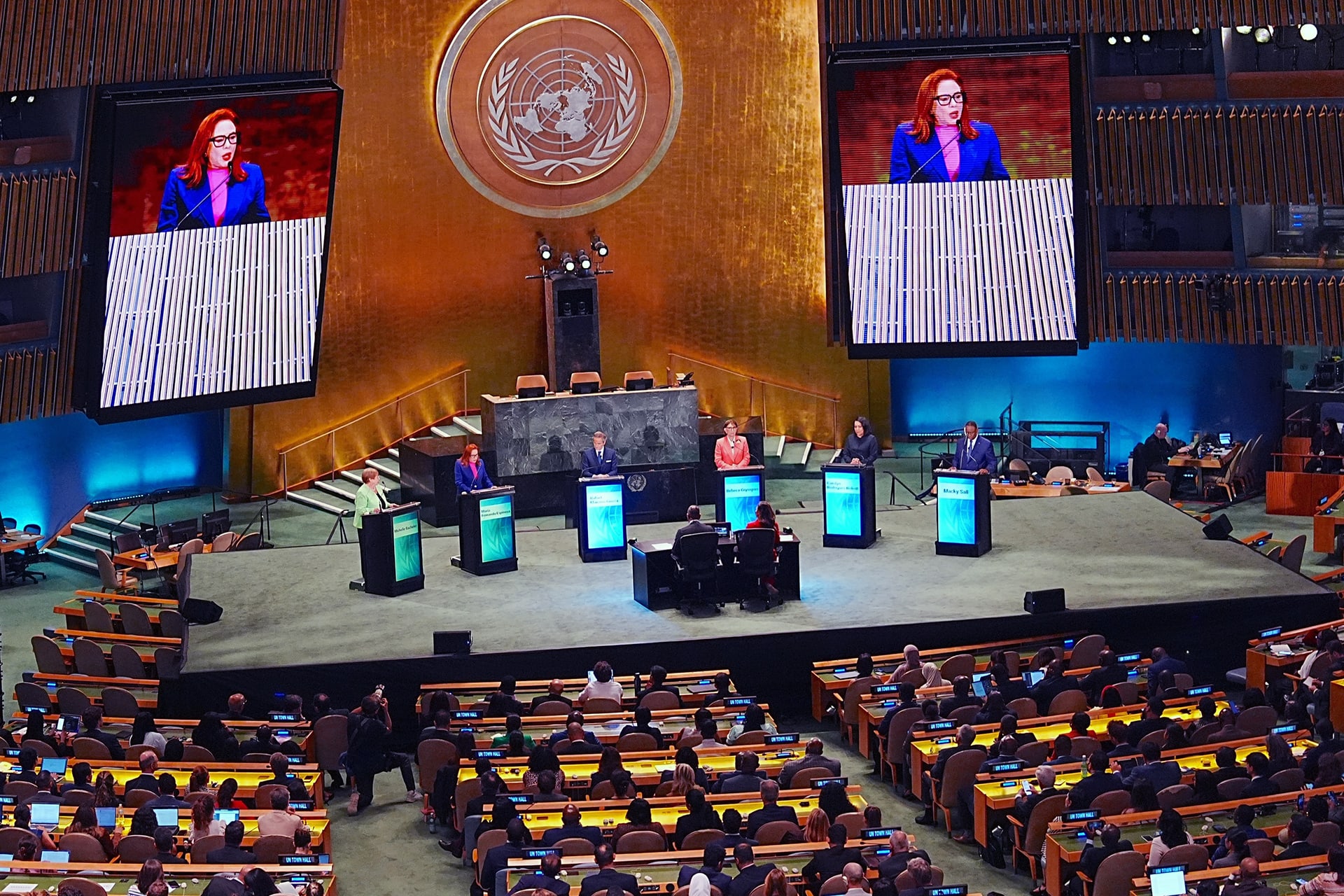
The race to become the next UN secretary-general is well underway. The winner, who is typically chosen and appointed between October and December of the current officeholder’s final year, will become the United Nations’ tenth secretary-general. They will take office on January 1, 2027, succeeding incumbent António Guterres.
This year’s secretary-general selection could be of particular significance because the United Nations may choose its first-ever woman leader—seven candidates are currently in the running, four of whom are women. Based on the United Nations’ informal regional rotation, there is also a strong possibility that a candidate from the Latin American and Caribbean region will be selected.
However, regardless of who takes the helm of the United Nations come January, experts agree they will be responsible for steering the eighty-one-year-old organization through multiple critical challenges, including internal reforms, severe funding shortfalls, worsening climate change, the proliferation of artificial intelligence (AI), and escalating geopolitical tensions.
Who is the UN secretary-general?
The secretary-general serves as the United Nations’ chief administrative officer and de facto head of the UN system. The role, which is described as being “equal parts diplomat and advocate, civil servant and CEO,” was created with the adoption of the UN Charter in 1945. The first appointment, Trygve Lie, took place in 1946.
“On one hand, it’s a remarkably powerless position, and yet it’s also a highly influential position,” Richard Gowan, program director for global issues and institutions at the International Crisis Group, told CFR. “But the reason[s] that it’s influential are a little intangible,” he said, pointing to the secretary-general’s ability to use the pulpit they have, the willingness of member states to buy into their agenda, and the role of global public opinion.
Beyond describing the role of the secretary-general, the UN Charter says nothing about the qualifications, desired qualities, tenure, or selection process for the position. Given the lack of detail, the United Nations has established criteria over time through resolutions and other documents.
“As is the case with any major leadership job, it will depend on the individual,” said Esther Brimmer, CFR’s James H. Binger senior fellow in global governance. “A lot of the conversation about the selection of a secretary-general will be about what qualities are needed to address the crises and issues that we’re facing.”
The secretary-general retains broad discretion in how they approach the role, and secretaries-general have expanded the scope of the position in different ways. Some, like Dag Hammarskjöld (1953–1961) and U Thant (1961–1971), served as more of a mediator, while others, like Kofi Annan (1997–2006), were considered more of an activist.
Who are the candidates for UN secretary-general?
There are seven candidates running to become the next secretary-general. They are:
Ivonne A-Baki. A former Ecuadorian ambassador to several countries, including the United States, France, and Qatar, A-Baki says the United Nations needs “not another caretaker, but a peacemaker.” Her vision statement for the role emphasizes preventing and ending wars, reforming the Security Council’s membership, and rebuilding institutional trust from within the organization.
María Fernanda Espinosa Garcés. The former president of the General Assembly and former foreign minister and defense minister of Ecuador has centered her candidacy around five pillars: peace and security, development, digital and energy transformation, closing the delivery gap, and rebuilding the United Nations’ credibility.
Rafael Mariano Grossi. Grossi has been director general of the International Atomic Energy Agency (IAEA) since 2019. He was formerly the Argentine ambassador to Austria, as well as the Argentine representative to the IAEA and other Vienna-based international organizations. Grossi advocates for a more effective and results-driven United Nations, noting in an April interview with CFR that his experiences leading the IAEA have prepared him well for the secretary-general role, particularly when it comes to handling complex emergencies.
Rebeca Grynspan Mayufis. The former vice president of Costa Rica is currently secretary-general of UN Trade and Development. A renowned economist, she says the United Nations is confronting simultaneous political, legitimacy, and operational crises, and that she will focus her tenure on restoring confidence in the organization, rebuilding “the foundations of international security” by prioritizing peacemaking, and delivering results.
Olara Otunnu. A veteran diplomat, Otunnu served as UN under-secretary-general and special representative for children and armed conflict under Kofi Annan. He was also previously Uganda’s ambassador and permanent representative to the United Nations and its minister of foreign affairs. His candidacy pitch centers on bringing about an “age of hope and faith” by revitalizing the United Nations’ moral authority, mobilizing development resources, and deepening cooperation between the United Nations and regional organizations, among other actions.
Carolyn Rodrigues Birkett. Rodrigues Birkett has served as Guyana’s current permanent representative to the United Nations since 2020. Before this position, she held several roles in the Guyanese government, including minister of Amerindian affairs, minister of foreign trade and international cooperation, and minister of foreign affairs. In her vision statement, she focuses on reasserting the United Nations’ core principles, centering human rights, and advancing global development efforts.
Macky Sall. The former president of Senegal and former chairperson of the African Union advocates for a more streamlined and modernized United Nations, to include better coordination between the General Assembly and the Economic and Social Council, and for “realistic and consensual reform” of the Security Council to strengthen its membership and legitimacy.
| Candidate | Country | Recent role(s) |
| Ivonne A-Baki | Ecuador | Former Ecuadorian ambassador to France and Monaco, the United States, and Qatar |
| María Fernanda Espinosa Garcés | Ecuador | Former president of the UN General Assembly; former foreign minister and defense minister of Ecuador |
| Rafael Mariano Grossi | Argentina | Director general of the International Atomic Energy Agency |
| Rebeca Grynspan Mayufis | Costa Rica | Secretary-general of UN Trade and Development; former vice president of Costa Rica |
| Olara Otunnu | Uganda | Former UN under-secretary-general and special representative for children and armed conflict |
| Carolyn Rodrigues Birkett | Guyana | Guyana’s permanent representative to the United Nations |
| Macky Sall | Senegal | Former president of Senegal; former chairperson of the African Union |
How does the selection process work?
The process to select the UN secretary-general is set out in Article 97 of the UN Charter, which simply states that the secretary-general “shall be appointed by the General Assembly upon the recommendation of the Security Council.”
In reality, the process is complicated and often takes more than a year to complete from start to finish. To be considered for the position, candidates must first be nominated by at least one UN member state or groups of member states. Upon their nomination, they are required to provide a vision statement, curriculum vitae, and campaign financing disclosures for member states—and the general public—to view online. (New candidates can be nominated at any time until a secretary-general is formally selected.)
Early in the vetting phase, candidates participate in town halls and public interactive dialogues, presenting their vision statements and answering questions from UN member states, UN staff, and civil society. This stage was introduced in 2016, ahead of the appointment of Guterres, after the General Assembly passed procedural reforms amid calls for greater transparency during the selection process.
In the months leading up to a final recommendation, the fifteen-member Security Council usually holds straw polls—informal, anonymous polls in which members indicate whether they encourage, discourage, or have no opinion about each candidate. (The results of these polls are often leaked to the public.) The council then conducts a formal vote. A candidate must receive at least nine votes, with none of the five permanent members—the United States, China, France, Russia, and the United Kingdom—casting a veto to be recommended to the General Assembly. If the General Assembly fails to accept the recommendation, the selection process stalls while the Security Council reconvenes to submit a new candidate.
Will the 2026 selection process be different?
No, the 2026 selection process to choose the next UN secretary-general will largely be the same as in 2016. However, as was the case the year Guterres was selected, there are growing calls for a woman to take the helm of the United Nations. While the UN Charter does not specify a gender requirement for the role, all nine previous secretaries-general have been men. The United Nations itself acknowledges this shortcoming, with a September 2025 resolution including a clause that “encourages member states to strongly consider nominating women as candidates.”
With multiple woman candidates in the running, “there’s a real sense that it would be great to have a woman as secretary-general. But ultimately, the first thing you’re picking is an excellent secretary-general, who may happen to be a woman,” said CFR’s Brimmer. “I think what is encouraging is that [the selection process] has encouraged highly qualified women to step forward, and it’s a reminder that there are talented people from many different parts of the world who have really useful experience,” she added.
Many experts also believe that it’s time for an individual from Latin America and the Caribbean to assume the role of secretary-general under informal regional rotation customs. Previously, only one person from Latin America, Javier Pérez de Cuéllar (1982–1991), has held it.
“The principle of regional rotation is something that member states have respected for quite a long time, and there is a strong sense among a lot of the regional groups that if you dishonor Latin America’s claim this time around, then that’s going to come back to haunt you next time,” Gowan told CFR. He added that the regional rotation tradition was disrupted in 2016, when Guterres was selected, despite the expectation that the next secretary-general would be from the Eastern European regional grouping, which has never held the position.
What major challenges will the next UN secretary-general face?
Experts agree that the next UN secretary-general will have to contend with multiple critical challenges, including a changing geopolitical landscape marked by escalating conflicts and great-power competition, worsening climate change, emerging global health crises, and the rise of AI and other digital technologies.
Compounding these issues is the United Nations’ own internal strife—notably structural reform efforts via the UN80 Initiative, a growing liquidity crisis, and persistent institutional deadlock. In an August interview with the Financial Times, Guterres himself warned that the Security Council is “practically paralyzed,” as permanent members of the council, primarily the United States and Russia, have used their vetoes to block resolutions from passing.
As for the funding shortfall, the United States has historically been the single largest donor to the United Nations, but it has significantly cut funding to the organization under the second Trump administration. “UN officials had hoped that China could step in with money, that the Europeans could come back in with more money, but they haven’t,” said Gowan. “I think privately, quite a lot of UN member states, whatever they say about U.S. policy in public, actually quite like the fact that Trump is forcing some austerity on the organization.”
As the number of conflicts grows, countries are also increasingly grappling with how to balance national security and domestic spending with funding for cooperative mechanisms like the United Nations. “I think for a lot of governments, what the United Nations is saying and doing doesn’t feel directly relevant to their most immediate needs,” explained Gowan. “The highest priority in their hierarchy of needs is security.”
Regardless of who is selected as the next secretary-general, they will be stepping into “an incredibly difficult job for which there are very few specifications and no thanks,” said Brimmer.
This work represents the views solely of the author(s). The Council on Foreign Relations is an independent, nonpartisan membership organization, think tank, and publisher, and takes no institutional positions on matters of policy.