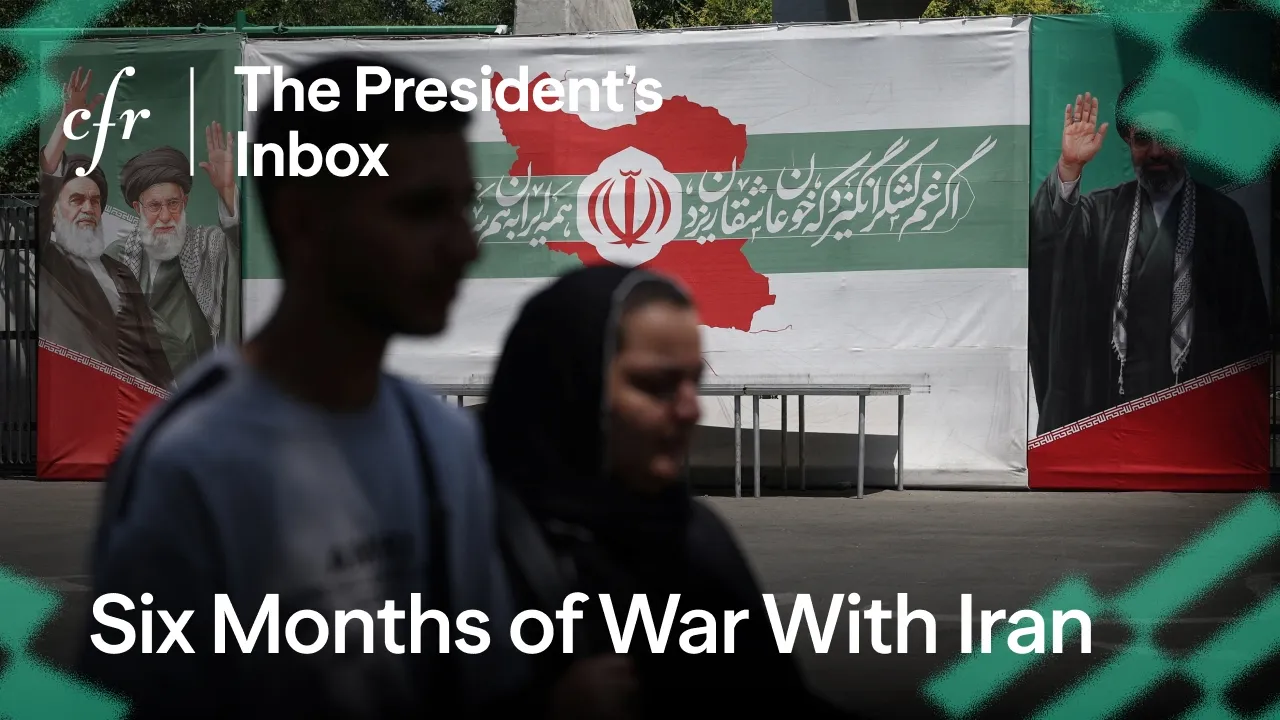
Six Months of War With Iran, With Steven Cook
This episode unpacks the current state of the U.S.-Iran conflict, broader dynamics in the Middle East, and the shifting U.S. role in the region.
Published
Host
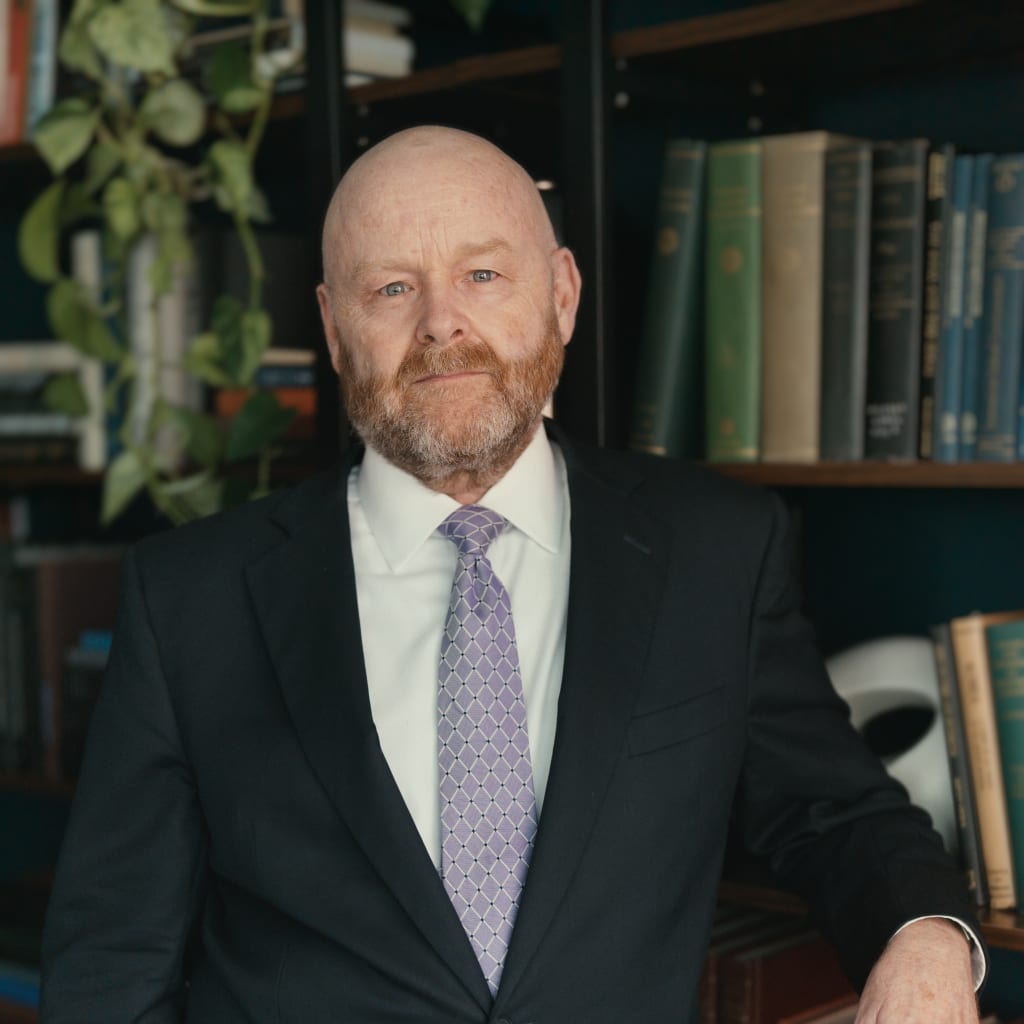 James M. LindsayCFR ExpertMary and David Boies Distinguished Senior Fellow in U.S. Foreign Policy
Guest
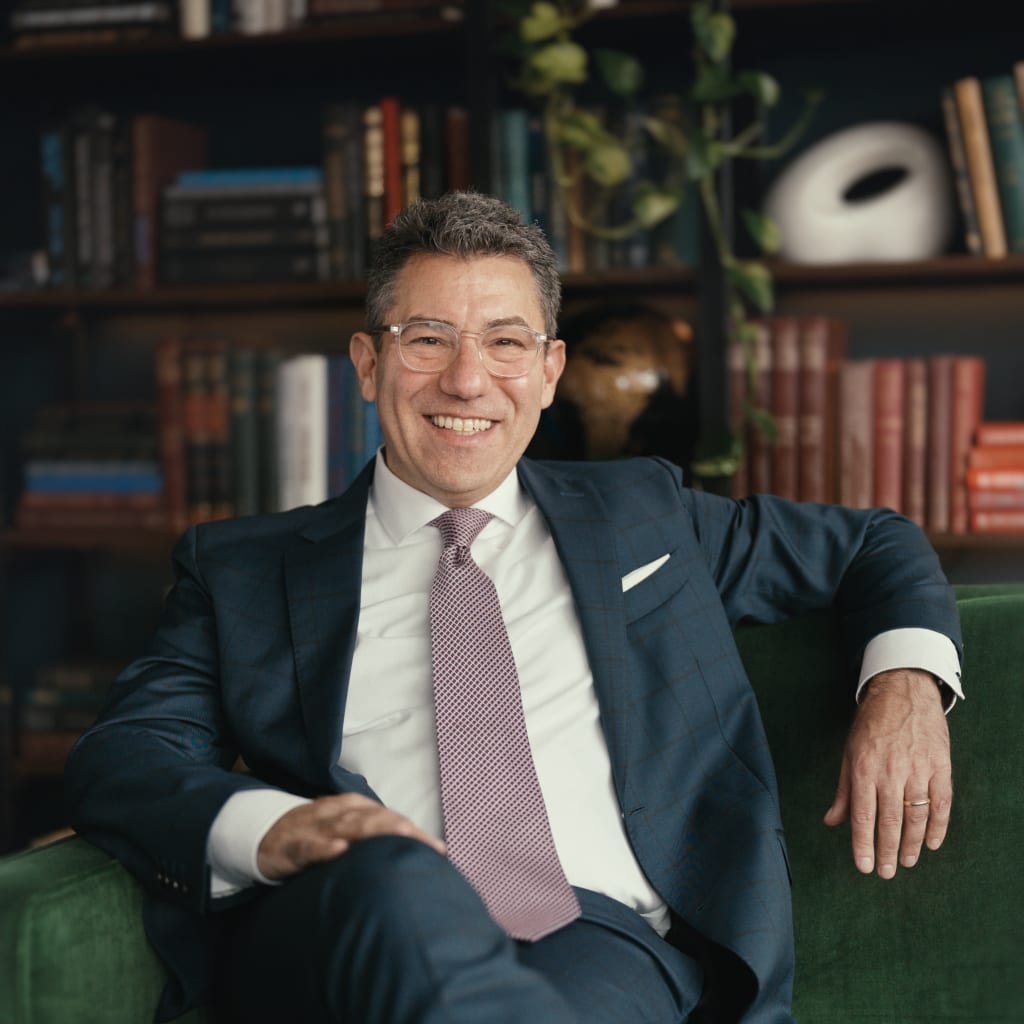 Steven A. CookCFR ExpertEni Enrico Mattei Senior Fellow for Middle East and Africa Studies
[Video: https://youtu.be/Asykfcte8ZM]
TRANSCRIPT
COOK:
In general, we agree that the end of the American order in the region is upon us, and I think it’s a function of the fact that the president went to war based on a feeling.
LINDSAY:
As the war with Iran reaches the six-month mark with a shaky ceasefire continuing to hold, President Donald Trump has approved plans to unleash what he calls an economic D-Day on Iran.
CNN:
It is part of a U.S. strategy shift nearly six months into the war, temporarily pausing strikes in favor of economic pressure.
LINDSAY:
Iranian leaders have vowed to strike their Arab neighbors if they cooperate with the intensified U.S. effort to isolate Iran. Meanwhile, the United Arab Emirates has cut trade ties with Iran, while Saudi Arabia has announced the Mecca Joint Defense Agreement with Pakistan and Turkey. Will intensified economic pressure deliver the victory that has thus far eluded the United States?
Is renewed fighting in the Gulf likely? Or has the United States already lost the war and forfeited its dominant position in the Persian Gulf? From the Council on Foreign Relations, welcome to the President’s Inbox.
I’m Jim Lindsay. Today, I’m joined by Steven Cook, Senior Fellow for Middle East and North Africa Studies here at the Council. As always, Steven, it’s great to have you on the President’s Inbox.
COOK:
Thanks for having me on, Jim. Good to see you.
LINDSAY:
So let’s sort of start with the big picture. A lot has happened in recent weeks in the Gulf. Give me a sense of where things stand now.
Who, if anyone, is winning this war?
COOK:
Yeah, it’s a great question. But it seems to me that if you take a step back and look at everything that has transpired over the course of this six months, on February 27th, the day before the war began, there was freedom of navigation through the Strait of Hormuz. The Iranians had not attacked and didn’t feel like they could attack at any time their neighbors across the Gulf.
And they didn’t really have as much incentive to make a dash towards a nuclear weapon. All of those things have changed as a result of the war. There is no freedom of navigation through the Strait of Hormuz.
I understand that there has been more shipping that has gone through the southern route of the Strait, which is under U.S. guidance. But it’s nothing like it was.
LINDSAY:
What I’m reading is maybe five million barrels per day compared to 20 million barrels.
COOK:
Whatever it is, it’s nothing compared to the way it was prior to the war. The Iranians have crossed a line in terms of their ability to menace their neighbors to the west across the Gulf. Previously, they had relied solely on their proxy forces to sow chaos around the region.
Now they’ve proven that they can use ballistic missiles, cruise missiles and drones to cause significant physical damage to their neighbors.
LINDSAY:
Is there any Arab neighbor in the Gulf they have not attacked?
COOK:
No, they have attacked everybody in the GCC. Oman has been spared, but Oman has taken hits because of the relationship between Oman, which was startling that in March that they in fact attacked Oman. They were targeting, the Iranians were targeting American facilities there.
But still, there’s not a country in the Gulf that they have not attacked. And of course, if you’re an Iranian decision maker, if you’re at the top of the IRGC and you look around and you see that the North Koreans have nuclear weapons and there was no Operation Epic Fury on the Korean Peninsula, it lays out every incentive for you to make that dash towards weaponization, despite what they’re saying.
LINDSAY:
On that point, though, Steven, do we have a sense of how much the United States has set back Iran’s nuclear program?
COOK:
We don’t really know. Look, the president said in June 2025 that we had totally obliterated the program. They did go after the nuclear program throughout the February 28th through the high intensity conflict through early April.
But we still don’t know what the extent of that damage is. One can infer by the way in which the Iranians have responded to Operation Epic Fury and the Israeli, also under the Israeli code name, Rising Lion, or this one’s Roaring Lion, the previous one was Rising Lion. The Iranians saw that nine month window as a way to prepare for the next round.
How much of what was left of the nuclear program was distributed, was moved to other places, just like they use that nine months to prepare and figure out how they would respond to another round of fighting between the United States and Iran and Israel and Iran. So I think we can’t say with any confidence. And I think that given the investment that the Iranian state has made in developing its nuclear program, given the fact that every time, from their perspective, they sit down to negotiate with the Trump administration, they’re attacked, that they have every incentive to move forward with whatever is left of their program.
LINDSAY:
You mentioned the IRGC. And at the start of the war, there was a lot of talk about how this war was intended to produce regime change. I don’t know to what extent President Trump started from that vantage point.
Certainly appears the Israelis did. And there was clearly a decapitation attack against the Iranian leadership. We saw the Ayatollah being killed.
Many members of his family as well. But it seems that we haven’t gotten regime change in the sense of changing the character of the governing cohort. But we have gotten leadership change.
The IRGC seems to have come to power. Is that a fair assessment of where things stand?
COOK:
Oh, absolutely. Look, and I think the president was on board with regime change, at least by the video he released at 2 a.m. on February 28th. He called upon the Iranian people to rise up, that, you know, freedom was within their grasp.
Of course, this is a president who keeps his options open and maneuvers as the situation develops. There was also a sense that he was looking for someone within the regime with whom he could work, sort of a Venezuela, a Persian Delcy Rodriguez. And obviously, the Israelis had different plans.
And the president admitted himself that the people he had in mind were killed within the first minutes of the war. But what essentially has happened was this large decapitation strikes that were supposed to lead to, or at least help create the conditions for regime change. But I think people underestimated.
I think the Israelis underestimated. I think the president underestimated. I think people who were supportive of this regime change operation underestimated that the regime is a system and that you can lop off 40 people and another 40 people will emerge who have been within the system, whose livelihoods are dependent upon the system and who are ideologically consistent with the regime.
So, yes, we’ve had a leadership change. The IRGC really has come to the fore. The Islamic Revolutionary Guard Corps really has come to the fore and is essentially in charge.
There is Ayatollah Mojtaba Khamenei, the son of the now deceased Ayatollah, who had been in power since 1989. But there’s been no proof of life. There have been statements issued on his behalf, but no one has seen him.
LINDSAY:
Most accounts are he was badly hurt in the attack that killed his father.
COOK:
Members of his immediate family were killed as well. But what we know publicly is the hardest of the hardliners are now calling the shots in Tehran. The Iranian president, Masoud Pezeshkian, has called for an end of the war and to preserve Iran’s victory and its dignity and its honor without doing more damage to the economy.
But he seems to have been ignored.
LINDSAY:
Well, let me ask you, there’s been a lot of talk recently about a split between the hardliners, which I take to be the IRGC, and the so-called realists. I don’t know if realist is quite the right label here, but do you sense there is a division within the Iranian leadership or is that just something that Westerners make up because it makes it more intelligible to us?
COOK:
Yeah, I’ve always been skeptical of the moderates versus the hardliners. Of course, there’s many, you know, Iran analysts who firmly believe that there are moderates versus hardliners. What has struck me over the years is that the so-called moderates were sort of the more acceptable interlocutors with the West for the West that would just kind of soften the edges of Iranian policy.
But I think it’s clear from the statements of the Iranian president as well as the Speaker of the Parliament that there are differing views of people in positions of power in Iran. What we do know, however, is despite their statements about ending the war and preserving what they can of the Iranian economy and moving forward, they’ve been overruled. The hardliners within the IRGC have said, as you pointed out in your opening, any country that participates with the United States in trying to isolate Iran economically will be a target of the Iranians.
So it does not seem that the idea that they should come to some sort of negotiated solution with the United States is one that at the very top of the Iranian state is not something that they’re willing to do.
LINDSAY:
So let’s switch capitals. Let’s talk about Washington. Help me understand what the Trump administration strategy seems to be right now.
I ask that because for much of the summer, the president was threatening to unleash major attacks on Iran to force the issue. He chose not to. A lot of speculation that was because critical stocks of U.S. munitions had been depleted. Some of the president’s more recent comments suggest that he is focused on waiting out the Iranians, that he’s going to sort of turn us into a battle of wills. And he thinks eventually the Iranian leadership is going to collapse because of economic problems. And that takes us to this announcement of Operation Economic Outcast, which is supposed to be an economic D-Day for Iran.
Is that a correct summary of what the administration?
COOK:
I think it’s entirely accurate. I think the president is now back to regime change. He had started with regime change.
He said it was regime change, but it was leadership change. They were pragmatic. There was going to be a negotiated solution.
We’re going to do business with them. And now we’re back to regime change because the president has not gotten what he’s wanted, which was essentially Iran’s unconditional surrender. Each side here wants the unconditional surrender of the others.
So now the president is back to regime change. And the theory of the case is if the United States can isolate Iran and force the collapse of the Iranian economy, it will encourage Iranians to come out into the street and bring an end to this terrible regime. I understand it.
It makes sense in a conference room in Washington, D.C. But someone needs to explain to me, what does economic collapse actually look like? Yes, the rial is trading at, you know, two million rial to the dollar. People are buying food on credit.
It is very, very tough economic times for Iranians. The American physical blockade of Iranian ports is making it very, very hard for the Iranians. Yet, we don’t see the kind of political activism from Iranians that we saw in December 2025, in January.
Well, there’s a good reason for that, I would think, which is they go to the streets, they’re going to get shot. That’s my next point. And that whatever economic difficulties that the Iranian leadership is confronting, they have still and they have maintained since December the ability to use overwhelming force against people who are engaged in anti-regime activity.
They have continued to kill and arrest and repress people throughout the six months since Operation Epic Fury began, in addition to the thousands that they killed in December and January. So they have demonstrated to the Iranian people that the cost of protest is extremely, extremely high. And then if you’re, so if you’re an Iranian and you hate this regime, you want to survive, live for another day, perhaps, but going out into the street now is almost assuredly going to get you arrested or killed.
And then the very people who said that they were coming to the rescue have toggled between negotiating with this regime, giving it a lifeline to now trying to strangle it economically. I wouldn’t trust anybody who said that they were coming to help. So the Iranian regime can collapse and the regime can hang on.
LINDSAY:
Yeah. So help me understand the theory by which Operation Economic Outcast is going to work. And I ask that because I’m old and I can remember when the Clinton administration put on the toughest sanctions ever seen in Iran and the George W.
Bush administration.
COOK:
It was Iran and Iraq, dual containment. Dual containment.
LINDSAY:
But it seems like we’ve sanctioned a wide range of things. And there are certain things we haven’t done because the cost of doing so were too high. And I will note that Secretary of Treasury Scott Bessent, I believe, said that some of these sanctions they’re talking about might blow up the international financial system, which seems to be a deterrent to actually using the weapon.
COOK:
Right. And again, you have to discount some of the kind of administration’s bluster. Bessent gave a press conference and you can be sure the president was watching it.
And so the president likes that kind of bluster from his cabinet secretaries. You’re absolutely right. I mean, I’m old enough to remember all of the sanctions on the Iranians going back even before the Clinton administration.
This is one of the most sanctioned countries on the face of the earth. I think, you know, North Korea, Cuba, and then Iran must be the, it must be the top three sanction. What the administration is claiming is different this time is not only are they continuing to lay on sanctions on individuals and entities within Iran and trying to shut down branches of Iranian banks that operate outside of Iran, but that they are going after what they call the enablers of the Iranian economy.
And that would mean that you would have to go after the United Arab Emirates, which has said that it cut off all trade with Iran. And when they did that, when they made that statement last week, it was a restatement of policy. Yet there had, at the same time, the Emiratis had been engaged in an effort to reach out to the Iranians, more manage the Iranians while at the same time.
LINDSAY:
But it was a significant trade relationship.
COOK:
$38 billion. That’s serious money. Serious money.
And so in this kind of lull in June, July, that trade continued. Now the Emiratis are saying they’ve cut it off. You have to go after China, which buys a lot of oil from the Iranians.
They buy it illicitly.
LINDSAY:
80, 90% of Iran’s oil production. Right.
COOK:
And that actually goes back to the first Trump administration, when there was economic pressure, maximum pressure on Iran. And the Chinese came in and essentially helped to refloat the Iranian economy. The deal was that they would get discounted oil, and they’re getting $10 billion worth of trade in oil.
And it’s not going through official channels.
LINDSAY:
And I’ll note next month, President Xi is scheduled to come to the White House.
COOK:
So the question is, and then there are other players, India, but India’s greatly reduced its purchasing of energy from the Iranians, Turkey, Pakistan. A lot of that goes though overland, which is really, really hard to control. But those are all countries that are aligned with the United States, except for China.
And is the president willing to blow up the summit with Xi?
LINDSAY:
Well, China also has lots of other ways to make the American economy feel pain. I recall not too long ago, they threatened to cut off access to critical minerals, which caught the administration’s attention.
COOK:
Right. So the question is, is much of this bluster in order to be seen to be doing something? It strikes me that the thing that is hurting the Iranians the most is actually the American blockade that was put on again after they failed to come to some sort of agreement recently.
LINDSAY:
How is the American blockade hurting the Iranians? Is it preventing the Iranians from shipping?
COOK:
Well, it is preventing the Iranians from trading oil, although oil is getting out illicitly and other critical inputs that are part of their supply chain from getting in, which is a big problem. It’s much harder to do this for the Iranians without access to their ports, to their points to keep their economy afloat. So look, there is a theory here that you isolate the Iranians, you make things difficult.
There’s pressure, there’s now, you know, processing remittances is going to be difficult, but that’s only going to hurt the Iranian people, not necessarily the regime. Remember this from the oil for food program with Iraq. It only hurt Iraqis.
It didn’t hurt the regime, which continued to build palaces and so on and so forth. So to use one of the president’s favorite phrases, we’ll see. But the idea that there is a causal relationship between economic isolation and regime collapse, I think is very, very uncertain.
Look at Cuba.
LINDSAY:
Right. Well, it’s because the ruling regime can basically impose the costs on the people and keep the people down and punish them if they choose to rise up. Use the word bluster, Steven.
And this sort of takes me back, forgive me, to graduate school and thinking about what political scientists would call signaling and cheap talk and the rest. Is there a cost to the United States is being seen as blustering? I take your point that the president likes it when his cabinet members go on TV and talk tough.
He likes to talk tough on truth social. Are there costs to that for American foreign policy? How is it being viewed by the Arab capitals in the Gulf?
COOK:
It’s a really interesting question, because I remember, I mean, going back to grad school and then more recently, there was debates about American credibility. And we had to do things. And there are some analysts who said the idea of American credibility is overblown.
And there are others that say there are costs to not following through. This was over the Obama red line issue in Syria. I think with the president having said any number of times that he was going to end Iranian civilization, the most powerful attacks on, unleashed the most powerful attacks on Iran since World War II, et cetera.
And the Iranians just don’t believe it. You can see from their own social media responses and their own bluster that they in fact have said they don’t believe the president’s bluster. I think there is a cost.
I think it has left America’s partners in the region wondering about American credibility and American commitment to their security, which was something that I think was up in the air before. I think one of the manifestations of that is the Mecca agreement. The Saudis who have always looked to the United States as a source of security, had negotiated with the Biden administration about an actual security pact, had said, write it down because they no longer believed in the gentleman’s agreement between the United States and Saudi Arabia.
Now seem to be quite worried and looking around to try to how to secure themselves. I’m not sure the Mecca agreement is necessarily to counter Iran as it is to create some sort of strategic depth for the Saudis that they don’t believe is there any longer with the United States.
LINDSAY:
What does the Mecca joint defense agreement actually stipulate? To the best of my knowledge, we have not seen the text of the agreement.
COOK:
That’s clearly on purpose.
LINDSAY:
And it’s, I’ve heard it described as an article five type commitment. And of course, type may be doing a lot of work there, but article five is all for one, one for all, which seems to be an odd pledge to make in the middle of a war because it would seem to obligate Pakistan and Turkey to go to war now. So help me understand what it is that we think has happened.
We haven’t seen the text of the Mecca agreement.
COOK:
We also haven’t seen the text of the Saudi Pakistani security accord that was signed not too long ago as well. The leaks from the document suggest, as you point out, that there is an article five like agreement that if one country of the signatories is attacked, the others are obligated to come to their defense. Within 48 hours of the signing of that agreement, the Houthis attacked Saudi Arabia and the Turks and the Pakistanis didn’t send the cavalry to help.
That may be a function of the fact that in the agreement that we haven’t seen, the Saudis have to ask for that kind of assistance and didn’t ask for it, knowing that it wasn’t going to come. When I wrote about this, I think too many people are making too much of this article five like type thing. The symbolism and political importance of the Mecca agreement is what we really should be focusing on.
And I think what it speaks to is one, the fact that the Saudis in particular no longer trust that the United States is going to be a provider of their security and not that Pakistan and Turkey are going to replace the United States, but that the Saudis are looking for ways to kind of shore up their security absent a firm commitment from the United States. And it’s important in terms of the Mecca agreement reflects regional divisions. It is no way of looking at this as sort of a competitor to the Abraham Accords.
There was this belief that the region would be ordered by the United States through the Abraham Accords and coming to terms with Israel and a lot of plans coming from that, including the India, Middle East, Europe Economic Corridor. Now the Saudis, the Turks, and the Pakistanis have other plans. And there’s an alternative to the Abraham Accords and an alternative to an American-sponsored order in the region.
And that’s a Saudi, Turkish, and Pakistani one.
LINDSAY:
Okay. I will note that the Mecca joint defense agreement does not include the United Arab Emirates.
COOK:
Correct.
LINDSAY:
Which shares a border with Saudi Arabia, has been attacked by the Iranians.
COOK:
More than even Israel.
LINDSAY:
But even at the time it has an extensive economic relationship with Iran. So just sort of quickly help me understand why it is that we’re not seeing Abu Dhabi and Riyadh shoulder to shoulder, Pan-Arab solidarity, at least Gulf solidarity.
COOK:
There’s significant beef between the United Arab Emirates and Saudi Arabia. And this predates Operation Epic Fury. If you go back to December 2025, the Emirati allies in Yemen made a big bid to take over the southern part of the country and declare their independence.
The Saudis bombed the Emirati’s allies and demanded that the Emiratis get out. There’s big differences between them over how to handle the situation in Sudan. The Emiratis allege that the Saudis have advocated that the United States sanction the Emirates for supporting terrorism and genocide in Sudan.
The Saudis deny this. There’s big differences between them over Israel’s recognition of Somaliland. There’s a whole host of things that are going on between those- And the UAE is part of the Abraham Accords.
And the UAE is huge.
LINDSAY:
So is this a personal beef, a family thing, or is this a strategic disagreement between the two countries?
COOK:
I think it’s both. I think it’s both. And you have two very important, charismatic leaders in the region, Crown Prince Mohammed bin Salman of Saudi Arabia, Saudi Arabia is a huge country, really the big dog in the Gulf.
And then you have the United Arab Emirates, Mohammed bin Zayed, the president of the UAE, also charismatic, a leader in the region, but a much smaller country. But there’s significant, I think, personal differences between the two of them that have both fueled and are a reflection of their different views on how to handle these different issues in the region. The Emiratis have wanted to be much more aggressive in terms of the Iranian threat, despite their trade ties.
The Saudis have wanted to be, have been searching more for diplomatic solutions to the crisis with Iran. So it was no surprise that the Mecca Joint Defense Agreement would leave out the Emiratis. And like I said, it is in ways an alternative to Abraham Accords in which the Emiratis are at the center of and have decided as a result of all of the crises in the region to invest in the Abraham Accords and invest in their relationship with the United States as well as Israel.
It’s important to point out that the Israelis came to the defense of the UAE. When the Iranians were attacking the UAE relentlessly, the Israelis sent an Iron Dome system. Israelis were sharing real-time intelligence with the Iranians.
There was Israeli crews in the Emirates operating that Iron Dome system. So, and the Emiratis have said, look, we remember who came to our help and our brotherly Arabs did not.
LINDSAY:
So should I take it from the split between the countries aligned with the Abraham Accords in the Mecca Joint Defense Agreement that the idea that Riyadh is going to sign on to the Abraham Accords and formally recognize Israel as a pipe dream?
COOK:
I mean, this is a tick in Washington and Jerusalem that there’s this, you know, it’s something that’s going to happen that the Saudis are going to drop their requirements of the Israelis and sign the Abraham Accords, or that those requirements aren’t real requirements. And the requirement is a negotiation that leads to the establishment of a Palestinian state. Now you could make the argument that that was not the requirement prior to October 7th and even in the immediate months following October 7th.
But as Israel’s operations in Gaza unfolded, the Saudis under pressure, they have a public opinion, had to up the ante for the Israelis. And there’s no indication that the Israelis are going to move in that direction. In fact, the opposite is happening with the annexation of the West Bank, which is happening before our eyes without anybody saying it very, very quietly, foreclosing the idea of a Palestinian state.
So why people continue to talk about normalization between Saudi Arabia and Israel under present circumstances and anything in the foreseeable future seems to me just, as you said, a fantasy, a pipe dream.
LINDSAY:
So I want to ask you, Steven, where are we headed? And I ask that against the backdrop, you have written a piece, let me get the exact title here, the US-led Middle East order is over. Marc Lynch, a respected scholar, has written a piece for Foreign Affairs titled The End of the American Middle East.
Bob Kagan at the Brookings Institution has written in the Atlantic that this war is over in Iran is one, it’s going to displace both the United States and Israel as a leadership position in the Persian Gulf. What am I to make of this?
COOK:
I have tremendous respect for and like Marc and Bob, and I’m happy to associate myself with and be in conversation with Marc’s Foreign Affairs article about the end of the American order. I think we’re thinking, I think there’s differences in detail and what we think might happen next. But I think in general, we agree that the end of the American order is in the region is upon us.
And I think it’s a function of the fact that the president went to war based on a feeling. That is a quote from his spokesperson that he had a feeling and that we have in ways as Bob has hinted at or said as much that we have empowered the Iranians. Now, I don’t know if the Iranians are gonna order the region, but it does strike me that one, given the direction of travel of our politics here in the United States, no one is going to want to spend the billions and billions of dollars that’s gonna be required to rebuild American facilities in the region which the Iranians have targeted rather effectively.
The president came to office suggesting that countries in the region needed to do more for their own defense. And he in fact welcomed the Mecca joint defense agreement. So what I think is likely to happen is that when this crisis comes to an end, if it comes to an end anytime soon, there will be a significant diminution of the American military presence in the region and governments in the region looking to a variety of countries and a variety of different groupings to establish their, to maintain and ensure their security.
So I think, yes, I go back to what I started saying at the beginning, we have empowered Iran, the United States, no one looks at the United States as a provider of security and stability any longer. It’s been so variable through this, out this crisis, but even before, as I pointed out in my piece, it’s not just this crisis. You know, we go from 180 in our policies in the region.
We have a JCPOA, we’re out of the JCPOA, we’re promoting democracy, we’re not promoting democracy, we’re promoting peace in the region. We’re not, it’s very, very hard for governments in the region to plan on this. And plus there have been things that we have done that our partners in the region believe have empowered the Iranians and that Operation Epic Fury is just the latest example of one.
They can give you 30 years of examples of this. So I do think it’s over. And I think that the region, newer leaders in the region have declared that they have agency and they’re going to try to order it themselves.
LINDSAY:
So let me ask you though, is that necessarily a good thing? I can argue both ways. As you know, for a number of years, people have been arguing that it’d be great if the United States would diminish its role in the Gulf, in the Arab world, Middle East, more broadly and focus on other things while either at home or in other parts of the world.
At the same time, if you’re talking about the United States ceding a role in the region, that means things are going to happen in that part of the world that may not work to America’s interest. Top of that list might be Iran getting a nuclear weapon.
COOK:
Well, you know, Jim, I wrote a book trying to work out these arguments because I can make them.
LINDSAY:
What is the title of your book, Steven?
COOK:
The End of Ambition, America’s Past, Present, and Future.
LINDSAY:
Always be selling.
COOK:
Yeah.
LINDSAY:
Always be selling.
COOK:
I wrote a book trying to work out in my head those two arguments, which I can make them as well. And where I came down was that an American presence in the region was a good thing, but we had to be realistic about what we wanted to achieve. And in fact, I counseled against going to war with Iran as much as I felt that the JCPOA, the Iran nuclear deal that President Obama negotiated was deeply flawed.
But in the sense that both of those things gave a lifeline to a terrible regime and that the best thing that we could have done was contain and deter the Iranians in the hopes that the Iranian people take matters into their own hands.
LINDSAY:
But we didn’t go down that road.
COOK:
We didn’t go down that road. And so I agree with you. I think bad things can happen.
Look, as the United States talked for 10 years about withdrawing, retrenching, reducing in the region, the Saudis took matters into their own hands and intervened in Yemen’s civil war. It didn’t work out very well for the Saudis or the Yemenis. So there are things, there are drawbacks to it.
My point that I’ve made both in this most recent piece and another piece is that I don’t think that it is wise. I think it’s too radical a solution for the United States to withdraw. I just think the politics of it right now in the United States would suggest that there is going to be a diminution of the American role in the region.
And as a result, actors in the region are going to try to order the region itself. Iranians, the Saudis, the Turks, the Israelis, others are going to try to order the region best, that best serves their interests. And there’s the possibility for continued conflict and chaos as a result.
LINDSAY:
On that note, I’ll close up this episode of The President’s Inbox. My guest has been Steven Cook, Senior Fellow for Middle East and Africa Studies. Here at the Council on Foreign Relations and the author of The End of Ambition.
Steven, as always, thank you for joining me.
COOK:
Always a pleasure, Jim.
LINDSAY:
Today’s episode was produced by Justin Schuster with Head of Production Jeremy Sherlick, Senior Video Producer Grace Raver and Director of Podcasting Gabrielle Sierra. Oscar Berry provided research assistance.
We Discuss:
- Who, if anyone, is winning the six-month war with Iran, and how freedom of navigation through the Strait of Hormuz, Iran’s ability to menace its neighbors, and its incentives to pursue a nuclear weapon have all evolved.
- Why the extent of the damage to Iran’s nuclear program remains unknown, and why Tehran now has every incentive to dash toward weaponization.
- How the war’s decapitation strikes produced leadership change rather than genuine regime change, leading to a situation in which the Islamic Revolutionary Guard Corps and the hardest of Iran’s hardliners now call the shots in Tehran.
- Whether the supposed split between Iranian “moderates” and “hardliners” is real or a Western construct that makes the regime more intelligible.
- What President Donald Trump’s “economic D-Day” is meant to achieve, and why it remains uncertain that economic isolation will lead to regime collapse.
- Whether U.S. bluster carries real costs, and how doubts about U.S. credibility have pushed Gulf partners to look elsewhere for their security.
- What the Mecca Joint Defense Agreement between Saudi Arabia, Pakistan, and Turkey actually signals, and whether it represents an alternative to an American-sponsored regional order rather than a true Article 5-style pact.
- Why the United Arab Emirates was left out of the Mecca agreement, and what the rift between Abu Dhabi and Riyadh reveals about fractures within the Gulf.
- Where the region is headed as the U.S.-led Middle East order comes to an end, and whether a diminished U.S. role and greater regional agency is a good thing.
Mentioned on the Episode:
Steven A. Cook, The End of Ambition: America’s Past, Present, and Future in the Middle East, Oxford University Press
Steven A. Cook, “The U.S.-Led Middle East Order Is Over. The Mecca Agreement Proves It.,” Council on Foreign Relations
Steven A. Cook, “After Iran, It’s Time for the United States to Leave the Middle East,” Foreign Policy
Marc Lynch, “The End of the American Middle East: Iran and the Last Gasp of a Failed Order,” Foreign Affairs
Robert Kagan, “Iran Unleashed,” The Atlantic
This work represents the views solely of the host(s) and guest(s). The Council on Foreign Relations is an independent, nonpartisan membership organization, think tank, and publisher, and takes no institutional positions on matters of policy.
Associate Producer, Video and Audio
- Associate Producer, Video and Audio
Head of Production
- Director of Video
Editorial Director and Producer
- Director, Podcasting
More Episodes
 38:03Podcast
 33:42Podcast
 36:05Podcast
 41:07Podcast
 39:26Podcast
 35:04Podcast