The Battle Over Mail-in Voting May Disrupt the 2026 Midterm Elections
President Donald Trump’s effort to change voting rules two months before Election Day awaits a legal greenlight that would throw a curveball into the midterm elections.
By experts and staff
- Published
 James M. LindsayCFR ExpertMary and David Boies Distinguished Senior Fellow in U.S. Foreign Policy
Election Day is two months away. But four states—Minnesota (the 18th), Virginia (18th), Vermont (19th), and Illinois (24th)—begin voting this month. North Carolina will begin sending mail-in ballots to military members and overseas voters tomorrow.
Things will pick up quickly after that. By October 14, another seventeen states will have begun early voting. By October 29, voters in all but three states—Alabama, New Hampshire, and Mississippi—will have the opportunity to cast their ballots.
Early voting means that House and Senate candidates are running out of time to win over undecided voters faster than talk of Election Day suggests. It also means that events close to Election Day may have less impact on election outcomes than one might think. Many voters will have already cast their ballots.
This, of course, assumes that early mail-in voting goes forward as scheduled. That may be an unwise assumption.
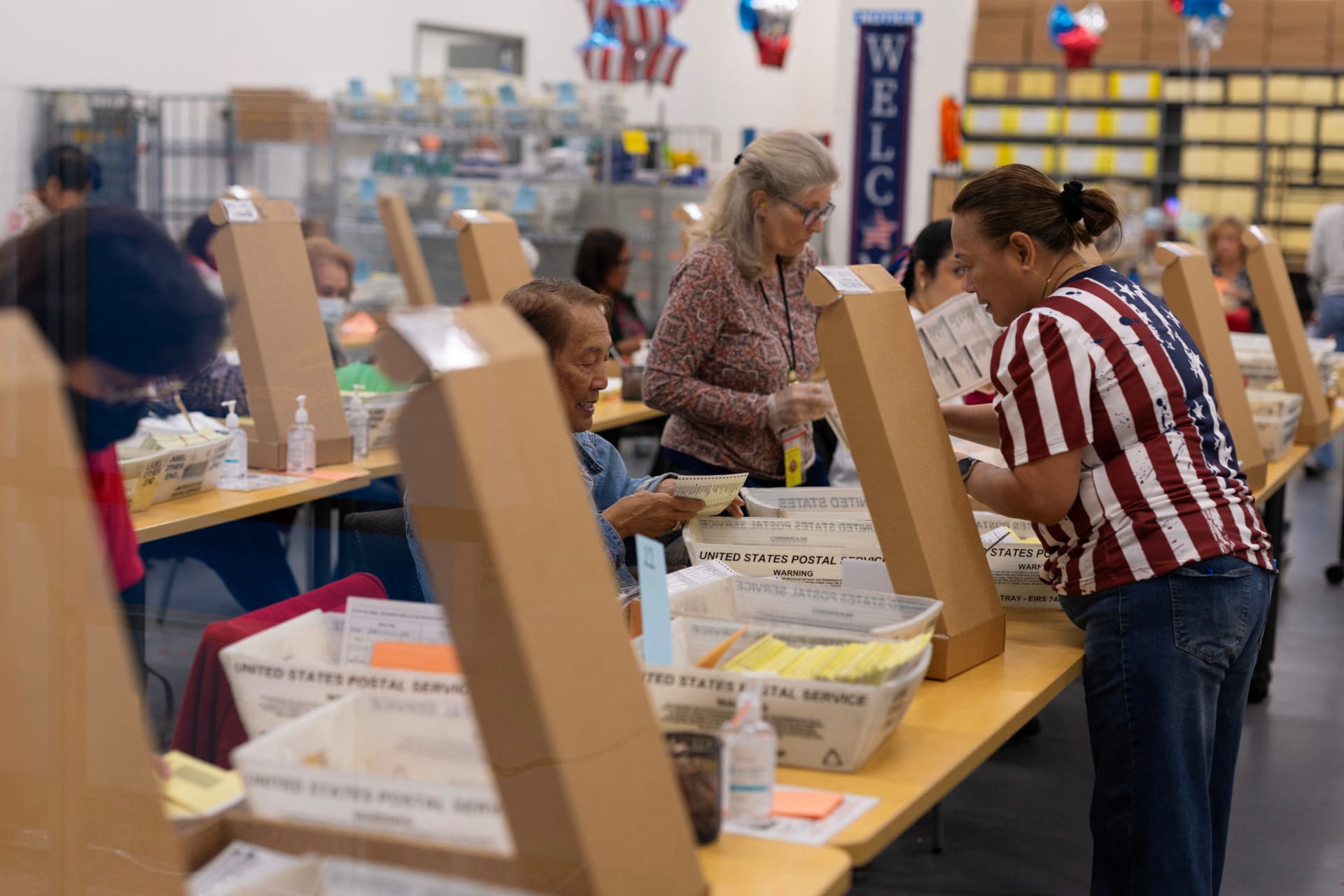
Last week, the U.S. Supreme Court issued an unsigned opinion that lifted an injunction a federal district court judge in Massachusetts had imposed barring the U.S. Postal Service from implementing nation-wide restrictions on voting by mail as President Donald Trump directed in March.
The Court’s decision turned on procedural considerations, namely, that the plaintiffs, twenty-three states plus the District of Columbia, had filed their lawsuit prematurely because they had not yet suffered any concrete harm. In the view of the Court’s majority, that harm would occur only if the Trump administration imposed the new limits. By the same token, the Court stressed that it was not ruling that Trump can impose national standards on mail ballots: “The Court’s disposition of this application does not mean that any measure taken by the Government to implement the Order will necessarily be lawful. On that score, time will tell.”
The nine justices could face that substantive question soon. The Postal Service late last month unveiled its “Final Rule” on mail ballots. Among other things, states must submit lists of voters approved to receive ballots to the Postal Service through the Federal Ballot Mail Portal and print ballot materials that meet specific design standards. If these and other requirements are not met, ballots would not be mailed or processed.
For now, other injunctions bar the Postal Service from implementing its Final Rule. Should those injunctions be lifted, the Court might settle the question at the heart of the challenges to Trump’s effort to restrict mail-in ballots: Can the president use the Postal Service to regulate voting when the Constitution expressly lodges power over elections to the states and Congress?
Some legal experts fear that the Court will neither answer that question nor stop the Postal Service. As Steve Vladek, a professor at Georgetown Law, puts it:
The shadow looming over all of this is the “Purcell principle,” the idea that, as election day draws nigh, federal courts should stay their hand rather than issue coercive orders changing the rules for when and how people vote. Purcell is the source of significant controversy and criticism, almost all of it deserved. Among the charges are that (some of) the justices are ruthlessly inconsistent in when they do and don’t apply Purcell—leading to the worry that an injunction against the USPS Final Rule might be deemed “too close to the election,” and stayed under Purcell. That’s a genuine concern, and given the Court’s own repeated transgressions of the Purcell principle earlier this term in Texas, Louisiana, and Alabama, to hide behind it to allow the USPS Final Rule to go into effect would be as indefensible and anti-democratic a ruling as the Court has handed down in a very long time.
In short, after ruling in August that it was premature to decide the constitutionality of Trump’s actions, the Court could hold in September or October that it is too late to decide. A legal Catch-22.
Whether the Court would be right to invoke the Purcell principle—and law professors with impeccable credentials would no doubt stake out rival positions on the matter—the practical result would be a national debacle. Many state ballots do not currently meet the new design standards. State and local election officials would need to learn what the new regulations are, understand how they intersect with their state’s existing laws and procedures, update both printed and digital materials explaining the voting rules to voters, and repeatedly revise approved voter lists as new voters register before the election.
The Postal Service has a mixed record handling mail ballots and no election management expertise. While likely unintentional, several states have seen their rejection rates for mail ballots rise in the past year because the Postal Service delivered completed ballots late to election officials. Michigan, for example, rejected 10,000 primary election ballots last month because they arrived after the deadline, twice as many as the state rejected in 2024. Just this week, a federal whistleblower alleged that the Postal Service plans to select ballots at random for validation; if the chosen ballot fails to match the voting register, all the ballots in that batch will be rejected. Finally, the Postal Service has yet to set up the Federal Ballot Mail Portal on which its entire plan rests.
All of these challenges explain why critics see changing voting rules now as akin to rebuilding a plane’s engines on final approach. It might be doable, but it seems highly inadvisable.
Of course, this is all hypothetical for now. As the Court would say, “time will tell” if worrying about how things could go wrong is a waste of a good imagination—or not.
Numbers to Note
Which party would be hurt more by restrictions on voting by mail is difficult to predict given the uncertainties around the Final Rule, whether it would be applied evenly across the country, and how voters might respond to restrictions on mail-in voting. Nearly one in three Americans voted by mail in 2024, though that percentage may not accurately describe a midterm election with substantially lower voter turnout. More Democrats than Republicans vote by mail, but many Democrats live in states where mail balloting is universal or in urban areas where it might be easier to use election drop-off boxes or vote in person. Conversely, restrictions on voting by mail could place the greatest burden on older voters and voters in rural areas given the potential difficulties they face in getting to a polling place or an election drop-off box. Older voters and voters in rural areas vote disproportionately Republican.
An average of national polls has 38.6 percent of Americans giving Trump a thumbs up today, a 0.4-point increase from where he stood on August 3. In comparison, 57.7 percent give him a thumbs down, a drop of 1.1 points from last month’s number. Trump’s net approval rating now stands at -19.1 points. His lowest number so far this year was the -20.6 points he recorded last month.
The Democrats’ lead over Republicans in an average of national polls on the generic congressional ballot stands at 6.4 points, the same as on August 3. The high point so far for Democrats in 2026 was a lead of 7.1 points.
August brought Republicans some good news as gas prices leveled out. The average price for a gallon of gas today stands at $4.09, which is down a penny from last month and is substantially lower than the peak average of roughly $4.50 a gallon earlier this year.
Higher gas prices may be among the economic headwinds taking their toll on Republican voters. The University of Michigan’s consumer sentiment survey found that Republicans’ consumer sentiment fell 9.5 points from July to August. This is one of the biggest monthly drops in the survey’s history, and it outpaced the overall decline in consumer sentiment of 8 percent.
The latest projection by Larry Sabato’s Crystal Ball has twenty-two House seats as toss-ups, up two from last month. Seventeen of those seats are or were held by Republicans, and five are held by Democrats. Both the new seats in the toss-up column were previously “leans Republican.”
On the Senate side, the Crystal Ball rates five Senate seats as toss-ups: Alaska, Maine, Michigan, Ohio, and Texas. Texas is the new addition to the list. Like Alaska, Maine, and Ohio, it is a Republican’s seat to lose. Overall, the Crystal Ball has forty-seven seats in the blue column and forty-eight in the red column. With these numbers, both Democrats and Republicans can see a path to claiming Senate control next January 3.
Two more Democratic representatives lost their primary elections in August, bringing the total in this cycle to seven. The last time House Democratic incumbents had this many primary losses was in 2012. The tougher time Democratic incumbents have faced in the primaries is not necessarily a dark omen for Democrats in November. In 2012, House Democrats gained eight seats in the 2012 general election.
The latest primary results bring the minimum number of new faces in the next Congress to eighty-five. As of today, thirteen senators and seventy-two representatives have either declined to run for reelection, cannot run for reelection, or lost their primary election. That’s 16 percent of all congressional seats. The number of new faces could grow higher before Election Day. Three states—New Hampshire (September 8), Rhode Island (September 9), and Delaware (September 15) have yet to hold their primaries. And the number will definitely grow on Election Day.
Worth Reading
Lawfare’s Molly Roberts examined claims that Democrats could win a majority of seats in the November midterm elections and still be denied majority control come January if the clerk of the House—an unelected official responsible for helping a new House organizes—recognizes Republicans who lost their seat rather than the Democrat who won them. Robert dismisses the likelihood of this happening four months from now but acknowledges that “one reason to take the rogue clerk concept seriously is that something like it has happened before.”
The Republican National Committee released the schedule for the first-of-its-kind Republican Midterm Convention, which will be held next Wednesday and Thursday in Dallas, Texas. Vice President JD Vance will give a keynote address on Wednesday night, and Trump will give a keynote address on Thursday night.
Oscar Berry assisted in the preparation of this article.
Other posts in this monthly series:
This work represents the views solely of the author(s). The Council on Foreign Relations is an independent, nonpartisan membership organization, think tank, and publisher, and takes no institutional positions on matters of policy.