Taiwan Explained: Why China Claims It, and Why the U.S. Is Involved
Updated
Differences over Taiwan’s status have fueled rising tensions between the island and mainland China. Taiwan is the likeliest potential flash point in U.S.-China relations.
- The People’s Republic of China, established in 1949, has never governed Taiwan but nonetheless views the island as a breakaway territory that must be “unified” with the mainland—by force if necessary.
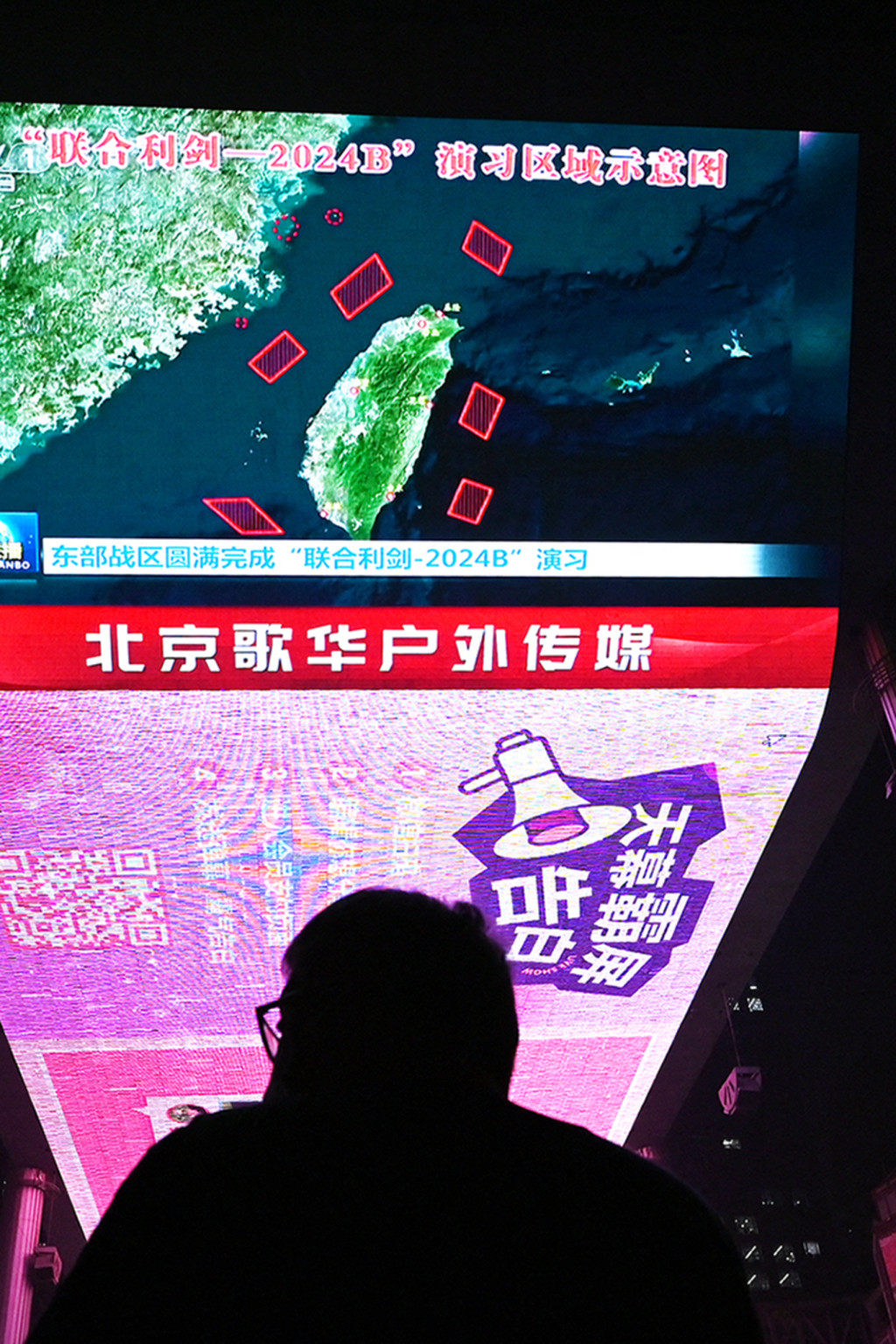
- Since the return of the Democratic Progressive Party to power in 2016, Beijing has ramped up political and military pressure on Taipei, including a December 2025 war game—the largest around the island since 2022.
- In his second term, U.S. President Donald Trump has levied tariffs on China and Taiwan while pursuing a $11 billion arms deal with Taipei, to Beijing’s disapproval.
Introduction
Taiwan, officially known as the Republic of China (ROC), is an island separated from China by the Taiwan Strait. Mainland China, officially the People’s Republic of China (PRC), is under Chinese Communist Party (CCP) rule and asserts that Taiwan is an integral part of its territory, though it has never governed the island.
The PRC views the island as a renegade province and vows to eventually “unify” Taiwan with the mainland, preferably by peaceful means but by force if necessary. In Taiwan, which has its own democratically elected government and is home to approximately twenty-three million people, political leaders have differing views on the island’s status and relations with the mainland.
Cross-strait tensions have escalated in recent years as China has rapidly ramped up its military capabilities and conducted more intrusive operations near the island. Meanwhile, Taiwan’s most recent presidents have hailed from a party that does not view the island as part of a unified China, a departure from the view of the previous Nationalist or Kuomintang (KMT) government. Many foreign policy analysts fear a Chinese attack on Taiwan could draw the United States into a destructive and costly war with China.
Is Taiwan part of China?
In the first half of the twentieth century, China entered a civil war between the ruling Nationalist government and the insurgent Communists. During World War II, the Nationalists, led by Chiang Kai-shek, were an important U.S. ally. Following the end of the war, the United States backed Chiang in his fight against Mao Zedong’s communist forces. The Communists won that conflict, seizing control of mainland China in 1949 and forcing the Nationalists to retreat to Taiwan, where they set up a government in exile and maintained their claim to the mainland. Today, Beijing, led by the CCP, asserts that there is only one China and that Taiwan is part of it. Beijing seeks Taiwan’s eventual unification with the mainland.
Beijing argues that productive cross-strait relations can only occur under a “One China” framework, which has taken form under the 1992 Consensus, an understanding reached by the two sides of the Taiwan Strait. However, the two sides don’t agree on the content of this so-called consensus, and it was never intended to address the question of Taiwan’s legal status. For the PRC, as Chinese President Xi Jinping has stated, the 1992 Consensus reflects an agreement that “the two sides of the strait belong to one China and would work together to seek national reunification.” For the KMT, it means “one China, different interpretations,” with the ROC standing as the “one China.” The KMT opposes Taiwan’s independence and has consistently called for closer ties with Beijing. But in the face of recent election losses and the 1992 Consensus’s lack of popularity, KMT leaders have discussed whether to adopt a new platform on cross-strait relations.
The platform of the Democratic Progressive Party (DPP), the KMT’s chief rival, has long claimed Taiwan as a sovereign, independent country under the name of the ROC, and therefore does not need to declare independence. The DPP rejected the 1992 Consensus, but then-President Tsai Ing-wen attempted to find another formulation acceptable to Beijing. In her 2016 inaugural address, Tsai pledged to “conduct cross-strait affairs in accordance with the Republic of China Constitution” and other relevant legislation, which contains a One China framework. Beijing, however, rejected this and cut off official contact with Taiwan.
In a 2019 speech, Xi reiterated that Taiwan be incorporated into the PRC under the formula of “one country, two systems.” This is the same model Beijing pledged to Hong Kong when the former British colony was handed over in 1997, guaranteeing the region’s ability to preserve its economic and political systems with a “high degree of autonomy.” Such a framework is deeply unpopular among the Taiwanese people. Pointing to Beijing’s recent crackdown on Hong Kong’s freedoms, Tsai and even the KMT rejected the “one country, two systems” framework.
During his 2024 presidential election victory speech, President Lai Ching-te from the DPP called for reopening dialogue with China to “replace confrontation” and pledged to maintain the “cross-strait status quo.” On Taiwan’s 2024 National Day, Lai asserted that “the People’s Republic of China has no right to represent Taiwan” but called for “healthy dialogue” between the two sides. In response, the PRC’s Taiwan Affairs Office claimed Lai’s “provocations in seeking ‘independence’ are the root cause of trouble to peace and stability in the Taiwan Strait,” pointing out his previous claim as a “pragmatic worker for Taiwan independence.”
Although Taiwan is not an official member of the United Nations, it has member status in more than forty multilateral organizations. Most of these are regional, such as the Asian Development Bank and Asia-Pacific Economic Cooperation forum, as well as the World Trade Organization. The island holds observer or other status on several other international bodies.
Only eleven states and the Holy See have official diplomatic ties with Taiwan. In March 2023, Honduras severed ties with the island and established relations with China; in January 2024, just days after Taiwan’s presidential election, the Pacific island nation of Nauru did as well.
Will China invade Taiwan?
China has ramped up a variety of intimidation tactics short of armed conflict in the past decade, activities commonly known as “gray zone” coercion. Some U.S. analysts believe the objective is to wear down Taiwan and prompt the island’s people to believe that their best—or only—option is unification with the mainland, allowing the PRC to achieve reunification without resorting to force.
In 2016, China suspended the authoritative cross-strait communication channel with the main Taiwan liaison office, restricted tourism to Taiwan, and pressured international travel corporations to list Taiwan as a Chinese province. Taiwan’s security bureau has reported that mainland Chinese hackers targeting its government agencies with cyberattacks have been on the rise. China has also intimidated countries that have ties with Taiwan: in 2021, China cut off trade with Lithuania for opening a Taiwanese representative office in its capital. Following President Lai’s October 2024 National Day speech, China launched a round of large-scale naval drills and war games near the Taiwan Strait, which served as a “stern warning” against “separatist acts of Taiwan independence forces,” according to its military.
U.S. security analysts have expressed concerns that China’s growing military capabilities and assertiveness, paired with a deterioration in cross-strait relations, could spark a conflict that leads to a U.S.-China confrontation. As China’s military continues to modernize, it has remained focused on Taiwan. China hasn’t ruled out using force to achieve reunification, and the United States hasn’t ruled out defending Taiwan if China attacks.
However, experts disagree about the likelihood and timing of a Chinese invasion. In 2021, the top U.S. military commander in the Indo-Pacific warned that China could try to invade Taiwan within the next decade [PDF], but some experts believe that such an invasion is further off. Others believe 2049 is a critical date since it will mark the PRC’s centennial, and Xi has emphasized that unification with Taiwan is essential to achieving what he calls the Chinese Dream, which sees China’s great-power status restored.
Russia’s invasion of Ukraine in 2022 reignited the debate, with some analysts saying that Moscow’s moves could embolden Beijing to similarly invade Taiwan. The U.S. military operation to depose Venezuelan leader Nicolás Maduro in January 2026 sparked similar fears of action from China, but the CCP has not yet made a move against Taiwan.
Regardless, the People’s Liberation Army (PLA)—the CCP’s military arm—has made preparing for a Taiwan contingency one of its top priorities, and Taiwan has been a major catalyst for China’s military modernization. In a draft government work report submitted in the 2026 annual session of the National People’s Congress, China pledged to resolutely combat Taiwanese separatist forces and oppose external interference in cross-strait relations. Taiwan likely doesn’t have the capabilities to defend against a Chinese attack without external support, analysts say.
Even though Taiwan has prioritized increasing defense spending in recent years—Lai committed almost $20 billion in 2025—China’s defense spending is still estimated to be around eleven times that of Taiwan. During China’s 2026 National People’s Congress meeting, Beijing committed to increase its defense spending by 7 percent by the end of the year, bringing its total budget to about $277 billion.
Does the United States recognize Taiwan?
The United States had a mutual defense treaty with Taiwan for more than twenty years (1954–79), during which it also considered the ROC the rightful Chinese government. However, the Richard Nixon administration pushed to normalize ties with the PRC in the 1970s, seeking to exploit the Sino-Soviet split and put more pressure on Moscow.
In 1979, the Jimmy Carter administration followed through on this policy, severing diplomatic relations and its mutual defense treaty with the ROC and establishing formal diplomatic relations with the PRC. At the same time, Congress passed and President Carter signed into law in 1979 the Taiwan Relations Act, which governs the United States’ unofficial relationship with the island. Since its passing, the United States has maintained a robust unofficial relationship with Taiwan and continues to sell defense equipment to its military, making Taiwan one of the United States’ top arms buyers in the past seventy years. Beijing has repeatedly urged Washington to stop selling weapons to and cease contact with Taipei.
The U.S. approach is governed by its One-China policy [PDF], which is distinct from China’s One-China principle. It is based on several documents, such as three U.S.-China communiqués reached in 1972, 1978, and 1982; the Taiwan Relations Act; and the recently declassified Six Assurances, which President Ronald Reagan conveyed to Taiwan in 1982. These documents lay out that the United States:
- “acknowledges the Chinese position that there is but one China and Taiwan is part of China” and that the PRC is the “sole legal government of China” (some U.S. officials have emphasized that the use of the word “acknowledges” implies that the United States doesn’t necessarily accept the Chinese position);
- rejects any use of force to settle the dispute;
- maintains cultural, commercial, and other ties with Taiwan, carried out through the American Institute in Taiwan;
- commits to selling arms to Taiwan for self-defense; and
- will maintain the ability to come to Taiwan’s defense, while not actually committing to doing so—a policy known as strategic ambiguity.
The United States’ chief goal is to maintain peace and stability in the Taiwan Strait, and Washington has encouraged both Beijing and Taipei to maintain the status quo. Through its policy of strategic ambiguity, the United States has for decades provided extensive military support to Taiwan but not clarified as a policy matter whether it would come to the island’s defense in the event of an attack by China. In February 2025, the State Department removed wording in its factsheet on Taiwan that explicitly said Washington does not support “Taiwanese independence,” a move that sparked criticism from Beijing and praise from Taipei.
How has the U.S. approach on Taiwan changed under Trump?
During Trump’s first administration, the United States deepened ties with Taiwan, including by selling more than $18 billion in arms and unveiling a $250 million complex for its de facto embassy in Taipei. Trump spoke with President Tsai by telephone ahead of his inauguration, the highest level of contact between the two sides since 1979. He also sent several senior administration officials—including a cabinet member—to Taipei, and, during his last days in office, the State Department eliminated long-held restrictions governing where and how U.S. officials can meet with their Taiwanese counterparts.
The Biden administration continued arms sales and affirmed the Trump administration’s decision to allow U.S. officials to meet more freely with Taiwanese officials. Biden was the first U.S. president to invite Taiwan’s representatives in Washington to attend the presidential inauguration. Congress passed and Biden signed into law legislation to strengthen U.S. military support [PDF] for Taiwan. This included allowing Taiwan to take loans and grants to purchase U.S. arms, and obtain up to $1 billion annually in U.S. defense stocks—the latter of which is a privilege granted to only one other country: Ukraine.
U.S.-Taiwan trade also deepened under the Biden administration. The two passed the 21st Century Trade agreement to enhance collaboration on regulatory practices, and Congress and Biden signed into law the CHIPS and Science Act, aimed at revitalizing the U.S. semiconductor industry.
In his second term, Trump has shifted his foreign policy focus to deprioritize partners in the Indo-Pacific. According to CFR Asia Studies Fellow David Sacks, the 2025 National Security Strategy “relegates geopolitics to a supporting role, while positioning economics as the ‘ultimate stakes.’” Meanwhile, the National Defense Strategy makes no mention of Taiwan.
He has proposed tariffs on both China and Taiwan—a hallmark of his administration’s foreign policy since returning to office—straining U.S. relationships with both Beijing and Taipei. Most of Taiwan’s exports to the United States will see a 15 percent tariff. At the same time, Trump’s administration continues to sell arms to Taiwan and pushed forward the sale of the largest arms package between the two countries: $11 billion that includes HIMARS rocket systems, Javelin anti-tank missiles, howitzers, and more. However, his desire to strike a trade deal with China has delayed U.S. arms shipments to Taiwan. Days after the announcement, Beijing launched several maritime and airstrike drills around the island, named “Justice Mission 2025.” Although Trump has not committed to come to Taiwan’s aid if China invaded, he has pressured the island to increase its defense spending through increased sales of U.S. arms.
Do Taiwanese people support independence?
Most people in Taiwan support the status quo. A small number support immediate independence, according to a long-running opinion poll conducted by the Election Study Center at National Chengchi University, a leading public research institution in Taipei. Even fewer express support for Taiwan’s unification with the PRC. An overwhelming majority reject a “one country, two systems” model, a sentiment that has grown as Beijing has cracked down on Hong Kong’s autonomy.
An increasing number of Taiwanese people feel more closely tied to Taiwan than to the mainland. Nearly 63 percent of the island’s residents regarded themselves as exclusively Taiwanese, a June 2023 survey by National Chengchi University found. By comparison, around 31 percent identified as both Taiwanese and Chinese, down from 40 percent a decade earlier. Only about 3 percent considered themselves only Chinese, a view that has become less popular since 1994, when 26 percent identified that way.
Why could Taiwan’s semiconductor chip industry be a global flashpoint?
Taiwan is the world’s top manufacturer of semiconductor chips, which are found in most electronics, including smartphones, computers, vehicles, and weapons systems. Its largest contract chipmaker, Taiwan Semiconductor Manufacturing Company (TSMC), is one of two companies in the world with the technological know-how to make the smallest, most advanced chips, and it manufactures more than 90 percent of them. TSMC is the top supplier for Apple and other U.S. companies. Taiwan’s central position as a semiconductor producer makes the island’s economy a critical part of the global technology supply chain.
However, Taiwan’s economy—the twenty-second largest in the world—continues to rely on trade with China. Their bilateral economic relationship has evolved in recent years, partly due to Beijing’s pressure on the island and Taiwanese officials’ growing concern about its overreliance on trade with China. Although Taiwan’s exports to China reached a three-year low in 2024, exports in the following year increased by 13.2 percent.
Under President Ma Ying-jeou (2008–2016), Taiwan signed more than twenty pacts with the PRC, including the 2010 Cross-Straits Economic Cooperation Framework Agreement [PDF], in which the two parties agreed to lift barriers to trade. China and Taiwan resumed direct sea, air, and mail links that had been banned for decades. They also agreed to allow banks, insurers, and other financial service providers to work in both markets. The DPP, on the other hand, has attempted to diversify Taiwan’s trade relationships, especially as the island’s semiconductor manufacturing continues to thrive globally.
U.S. concern of overreliance on Taiwan’s chips led the Biden administration to strengthen the U.S. chip industry; in August 2022, Congress passed a $280 billion bill to encourage domestic chip manufacturing, including subsidies for TSMC to build a chip plant in Phoenix, Arizona.
In March 2025, Trump announced a $100 billion plan for TSMC to invest in new chipmaking facilities in the United States. The deal came after Trump threatened up to 100 percent duties on chip imports. By the end of 2025, the United States became Taiwan’s largest export market for the first time in more than two decades, accounting for 30.9 percent of the island’s total exports. In 2026, Taiwan surpassed China in monthly imports to the United States for the first time in decades—a milestone fueled by U.S. chip imports amid a decrease in trade with China.
Tsai had some success boosting trade with and investment in countries in Southeast Asia and the Indo-Pacific through its New Southbound Policy. Trade between Taiwan and the eighteen targeted countries nearly doubled between 2016, when the initiative was unveiled, and 2022. In Lai’s May 2024 inauguration speech, he emphasized broadening Taiwan’s economic policy to develop the island’s artificial intelligence, military, surveillance technology, semiconductor, and communications industries.
Meanwhile, China has pressured countries not to sign free trade agreements with Taiwan, and only a handful of countries have: New Zealand and Singapore are the only developed economies on the list. Beijing has also pushed for Taipei’s exclusion from multilateral trading blocs, including the Comprehensive and Progressive Agreement for Trans-Pacific Partnership (CPTPP) and the Regional Comprehensive Economic Partnership (RCEP). China is included in the RCEP but not in the CPTPP, and Taiwan is part of neither.
Recommended Resources
CFR Fellow for Asia Studies David Sacks unpacks what the U.S-Taiwan Reciprocal Trade Agreement means for Washington’s relationship with Taipei.
This 2023 report by CFR’s Independent Task Force Program analyzes the status of U.S.-Taiwan relations and the threat posed by a more aggressive China.
CFR’s Jonathan Masters and Will Merrow visualize how much U.S. military support is going to Taiwan.
This immersive by CFR’s Sacks dives into why China would struggle to invade Taiwan.
This CFR timeline explores more than seven decades of U.S.-China relations.
Former Director for Taiwan Affairs at the National Security Council Marvin Park and CFR’s Sacks argues in Foreign Affairs that Washington could make trade deals with Beijing without jeopardizing Taipei autonomy.
Colophon
Expert Reviewers
 David SacksCFR ExpertFellow for Asia Studies
Staff Writers
- Lindsay Maizland
- Clara Fong
Additional Reporting
Eleanor Albert and Surina Venkat contributed to this Backgrounder. Will Merrow created the map. Header image by Greg Baker/AFP/Getty Images.
 Backgrounder
 Backgrounder
 Backgrounder
 Backgrounder