“Eyeball to Eyeball”—Cuban Missile Crisis, Day Nine
President John F. Kennedy’s hopes rise and then fall that the naval quarantine of Cuba will quickly end the missile crisis.
By experts and staff
- Published
 James M. LindsayCFR ExpertMary and David Boies Distinguished Senior Fellow in U.S. Foreign Policy
President John F. Kennedy was beginning to feel the pressure on Wednesday, October 24, 1962, the ninth day of the Cuban Missile Crisis. The U.S. naval quarantine of Cuba formally went into effect early that morning. Kennedy’s response to the letter that Soviet Premier Nikita Krushchev had sent the day before had been delivered to the Kremlin. There was nothing to do but wait for the Soviet response. Kennedy did not know whether at day’s end he would be breathing a sigh of relief or on the road to war.
“I Would Have Been Impeached”
The U.S. Navy initially proposed to intercept Soviet ships when they came within eight hundred miles of Cuba. Navy officials had chosen that distance in good part to keep U.S. warships beyond the reach of Soviet fighter planes operating out of Cuba. Ironically, one of the ships enforcing the quarantine line was the USS Joseph P. Kennedy, a destroyer named after JFK’s older brother, a Navy flier who was killed during World War II.
At the suggestion of the British ambassador, Kennedy ordered the quarantine line to be reduced to five hundred miles. That put off the moment that any Soviet vessels in transit to Cuba would reach the quarantine line and gave the Soviets more time to ponder their options, and hopefully, reverse course.
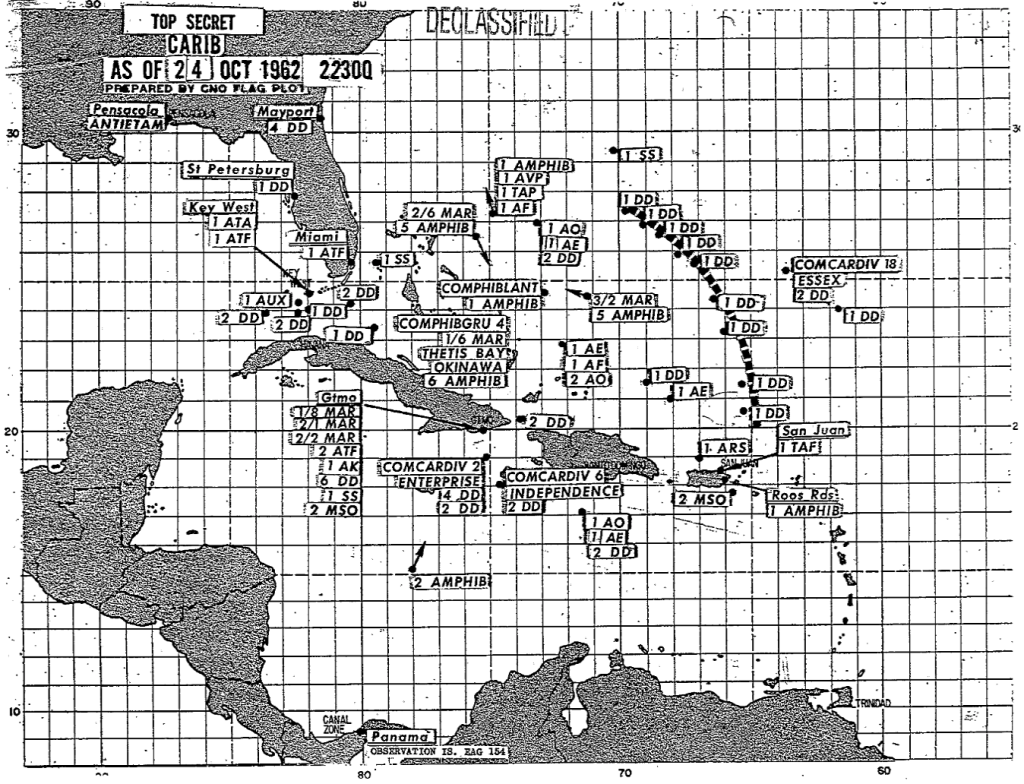
But moving the quarantine line only delayed the inevitable. The U.S. Navy expected that the first Soviet ships would cross the quarantine line late in the morning of October 24. Then Kennedy would have a decision to make. Would he let the Soviet ships pass or order the U.S. Navy to fire on them? The former decision would likely doom his effort to force the Soviet missiles out of Cuba. The latter decision might set the United States on the course to nuclear war.
As JFK prepared to attend the 10:00 a.m. ExComm meeting, he lamented to his brother, Attorney General Robert Kennedy, that he had been forced to impose the naval quarantine. “I just don’t think there was any choice,” RFK assured him, “and not only that, if you hadn’t acted, you would have been impeached.” JFK’s response was succinct: “That’s what I think—I would have been impeached.”
“The Other Fellow Just Blinked”
The morning’s ExComm meeting began with an intelligence briefing, followed by Secretary of Defense Robert McNamara sharing photos confirming that the Air Force had responded to the president’s earlier directive to disperse U.S. aircraft from their bases in the southeastern United States. At 10:25 a.m., a staffer delivered a note to CIA Director John McCone. The note contained the message that Kennedy and his advisers had been hoping for: Soviet ships in transit to Cuba had stopped dead in the water.
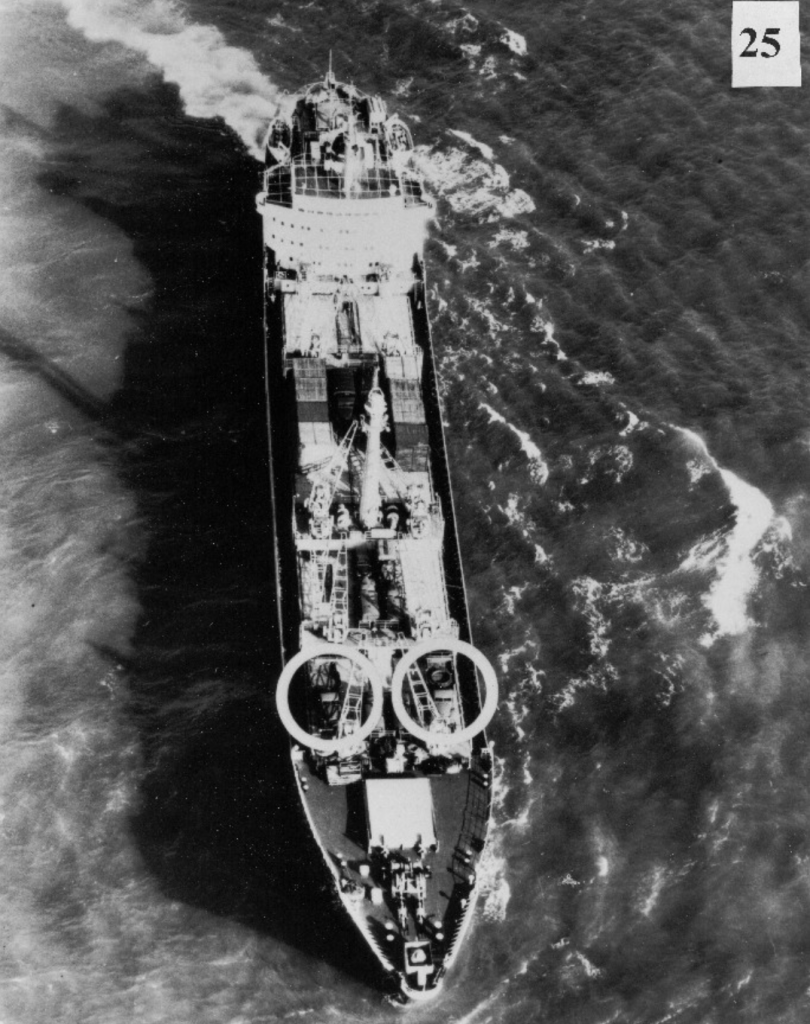
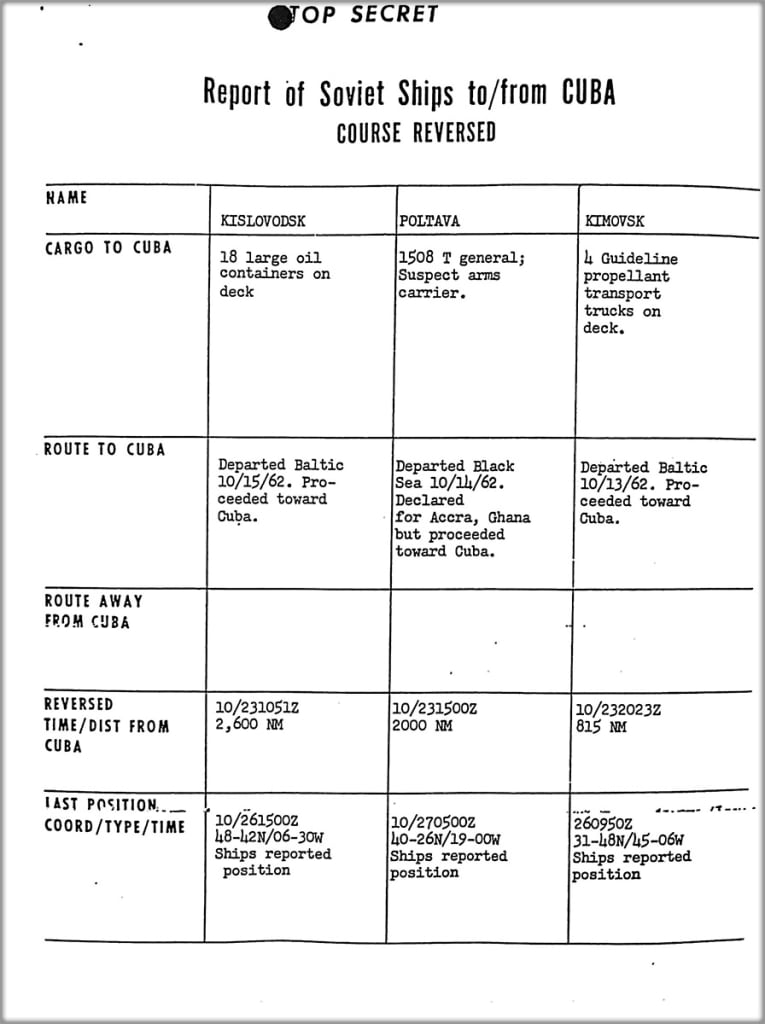
Unbeknownst to the group at the time, shortly after Kennedy’s nationwide television address Soviet Premier Nikita Khrushchev had ordered Soviet ships outside the quarantine line to turn around. “We’re eyeball to eyeball,” Secretary of State Dean Rusk whispered to National Security Advisor McGeorge Bundy, “and I think the other fellow just blinked.”
Rusk’s comment captured the White House’s mood. But it was misleading in a critical way. It implied that U.S. and Soviet ships were in close proximity if not actually steaming straight for each other. The men gathered around Kennedy that morning certainly thought that was the case; McCone even recorded a note later in the day that a U.S. Navy vessel had confronted a Soviet ship at virtually the same time the intelligence bulletin reached the White House. The incident never happened. In fact, the two closest Soviet ships were more than five hundred nautical miles from the quarantine line when they reversed course and headed back to the Soviet Union.
Khrushchev’s Second Letter
Rusk’s whispered aside also captured the White House’s belief that the crisis had peaked. Kennedy discovered that night, however, that it was far from over. Khrushchev had sent a second letter. Despite having privately ordered Soviet ships to return home, he told Kennedy the exact opposite. He rejected the U.S. “ultimatum” and insisted that the Soviet Union would not respect the quarantine:
Mr. President, if you coolly weigh the situation which has developed, not giving way to passions, you will understand that the Soviet Union cannot fail to reject the arbitrary demands of the United States. When you confront us with such conditions, try to put yourself in our place and consider how the United States would react to these conditions. I do not doubt that if someone attempted to dictate similar conditions to you—the United States—you would reject such an attempt. And we also say—no.
The Soviet Government considers that the violation of the freedom to use international waters and international air space is an act of aggression which pushes mankind toward the abyss of a world nuclear-missile war. Therefore, the Soviet Government cannot instruct the captains of Soviet vessels bound for Cuba to observe the orders of American naval forces blockading that Island. Our instructions to Soviet mariners are to observe strictly the universally accepted norms of navigation in international waters and not to retreat one step from them. And if the American side violates these rules, it must realize what responsibility will rest upon it in that case.
Khrushchev had thrown down the gauntlet. Kennedy would have to decide how to respond. The elation of the morning’s news that Soviet ships had turned around gave way to new fears. The Cuban Missile Crisis was not over. Indeed, its most dangerous days still lay ahead.
Oscar Berry and Jack Patton assisted in the preparation of this article.
The United States celebrates its 250th anniversary in 2026. To mark that milestone, I am resurfacing essays I have written over the years about major events in U.S. foreign policy. A version of this essay was published on October 24, 2012.
Other Posts in This Series:
- “Andrei Gromyko Tells a Lie at the United Nations,” September 21, 1962
- “Major Richard S. Heyser’s U-2 Mission Discovers Soviet Missiles in Cuba,” October 14, 1962
- “The United States Discovers Soviet Missiles in Cuba,” October 15, 1962
- “JFK Learns That Soviet Missiles Are in Cuba—The Cuban Missile Crisis, Day One,” October 16, 1962
- “John F. Kennedy Solicits Dwight D. Eisenhower’s Advice—The Cuban Missile Crisis, Day Two,” October 17, 1962
- “Soviet Foreign Minister Andrei Gromyko Lies to President John F. Kennedy—The Cuban Missile Crisis, Day Three,” October 18, 1962
- “John F. Kennedy Campaigns While the ExComm Debates—The Cuban Missile Crisis, Day Four,” October 19, 1962
- “President John F. Kennedy Fakes a Fever—The Cuban Missile Crisis, Day Five,” October 20, 1962
- “President John F. Kennedy Prepares to Tell the Nation About Soviet Missiles in Cuba—Cuban Missile Crisis, Day Six,” October 21, 1962
- “President John F. Kennedy Tells the World That Soviet Missiles Are in Cuba—Cuban Missile Crisis, Day Seven,” October 22, 1962
- “Soviet Premier Nikita Khrushchev Warns President John F. Kennedy of “Catastrophic Consequences”—Cuban Missile Crisis, Day Eight,” October 23, 1962
This work represents the views solely of the author(s). The Council on Foreign Relations is an independent, nonpartisan membership organization, think tank, and publisher, and takes no institutional positions on matters of policy.