Adlai Stevenson Dresses Down the Soviet Ambassador to the UN—Cuban Missile Crisis, Day Ten
The U.S. Ambassador to the United Nation delivers a victory in the courtroom of world opinion as the dangers of the Cuban Missile Crisis grow.
By experts and staff
- Published
 James M. LindsayCFR ExpertMary and David Boies Distinguished Senior Fellow in U.S. Foreign Policy
U.S. Ambassador to the United Nations Adlai Stevenson had a reputation for preferring conciliation over confrontation. Indeed, in the early days of the Cuban Missile Crisis, President John F. Kennedy worried that his man in New York did not have what it took to present the U.S. position on Cuba forcefully to the world.
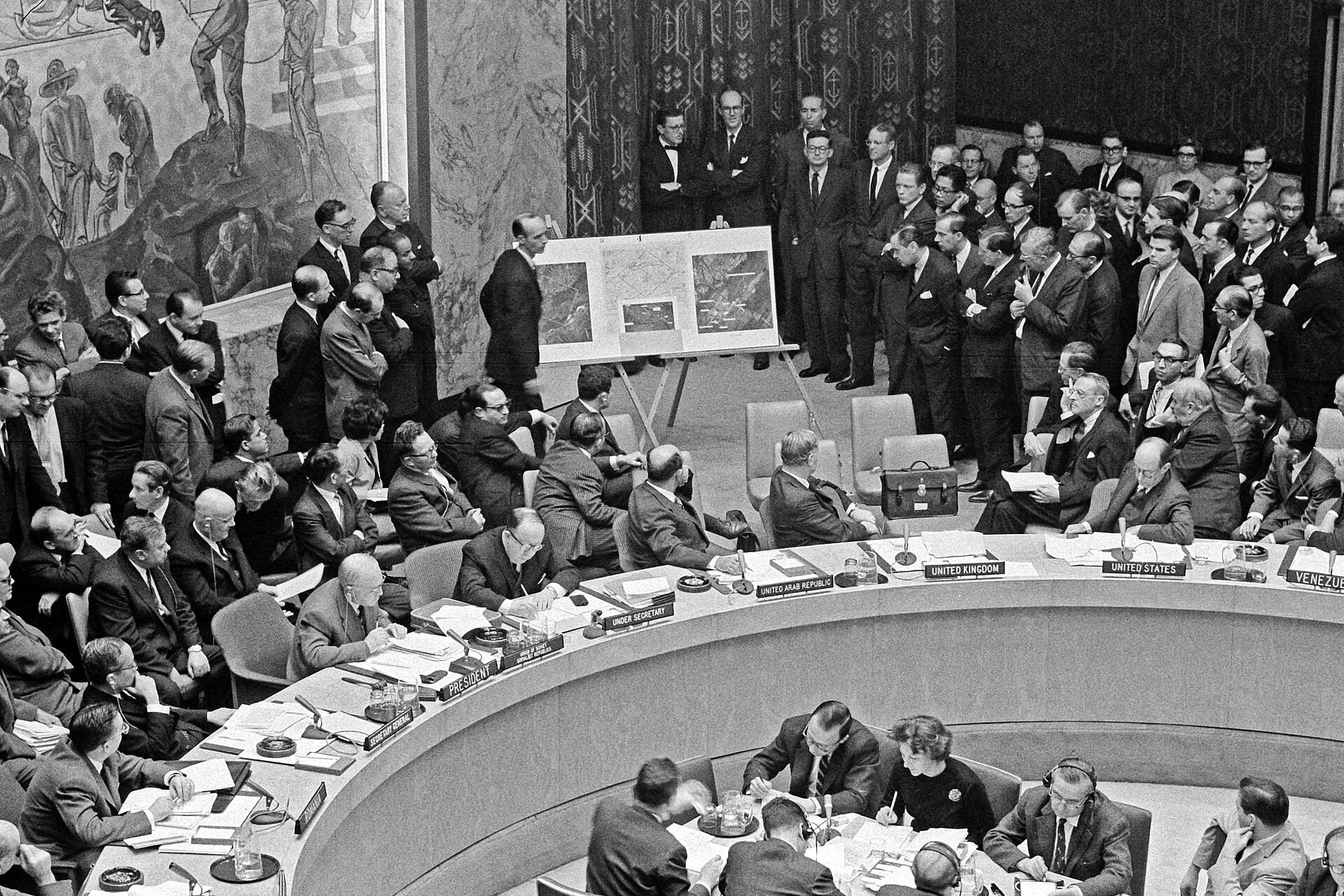
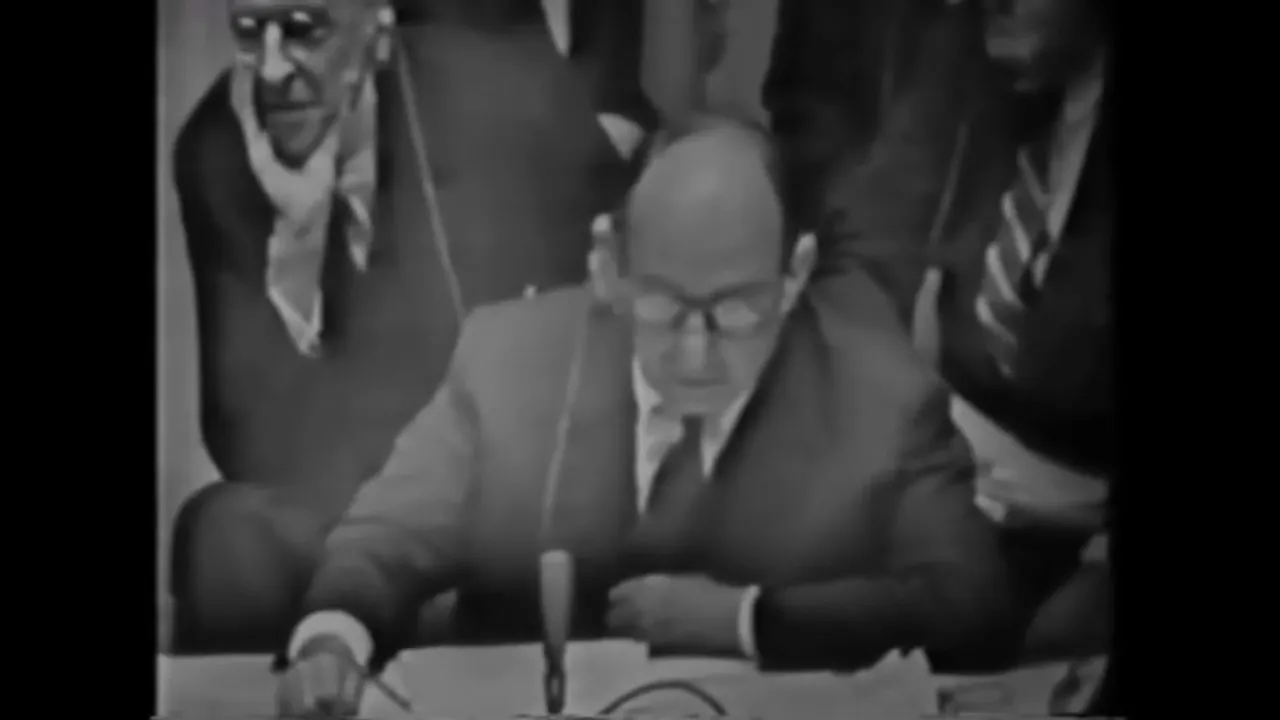
On Thursday, October 25, the tenth day of the crisis, Stevenson showed that he was in fact made of sterner stuff than Kennedy thought. The former governor of Illinois and two-time Democratic presidential candidate dressed down the Soviet ambassador to the UN, Valerian Zorin, at a Security Council meeting as Americans watched on television.
“You Still Do Not Appear to Understand”
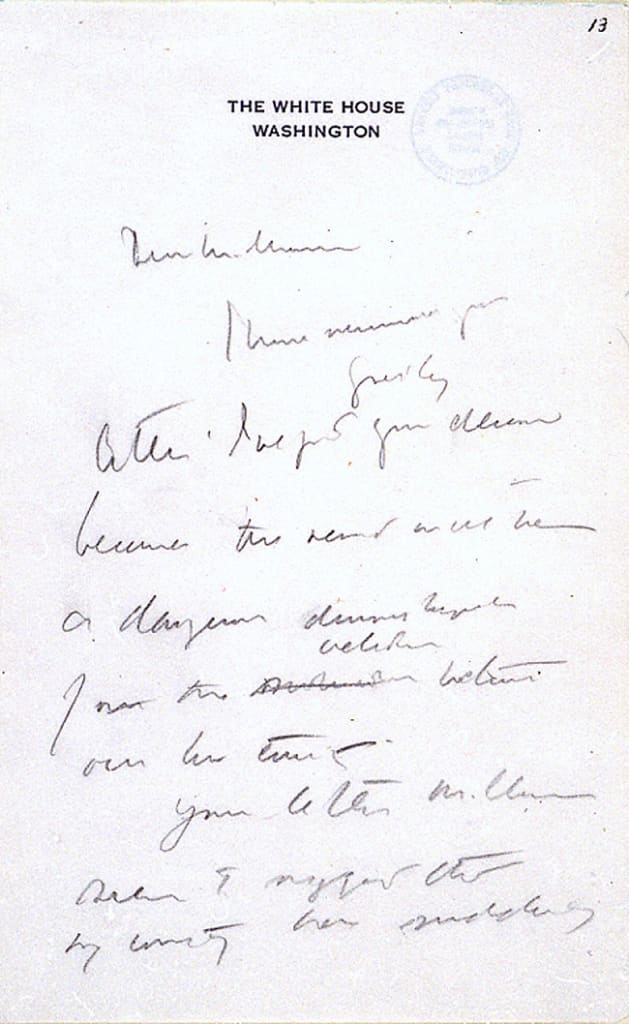
Stevenson’s dramatic moment came that afternoon. But much happened before he took the microphone. At 1:45 a.m. (8:45 a.m. in Moscow), the State Department handed the Soviet embassy in Washington a letter from Kennedy. It responded to the letter he had received from Soviet Premier Nikita Khrushchev the day before. Whereas Khrushchev’s letter had struck an indignant tone, Kennedy’s response was cold and to the point: “I regret very much that you still do not appear to understand what it is that has moved us in this matter.”
The concluding sentence in Kennedy’s letter made it clear that he was not offering any concessions: “I hope that your Government will take the necessary action to permit a restoration of the earlier situation.”
U Thant’s Proposal
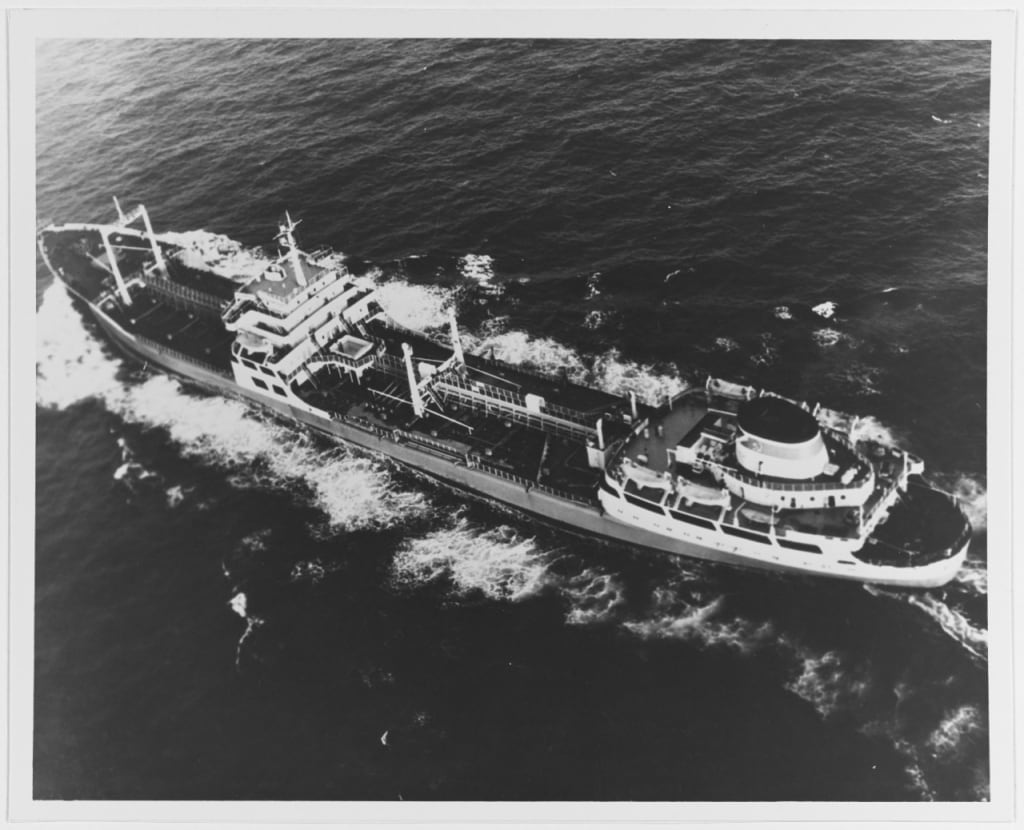
At the morning ExComm meeting, Kennedy directed that the Soviet tanker Bucharest be allowed to cross the quarantine line. (One of the ships enforcing the quarantine line was the USS Joseph P. Kennedy Jr., which was named after JFK’s older brother, a Navy flier who was killed during World War II.) U.S. intelligence had determined that the Bucharest was carrying ordinary petroleum products; the ExComm agreed that the first Soviet-bloc ship the U.S. Navy stopped should be one carrying missiles or missile parts.
Kennedy and his advisors also discussed how to respond to a proposal that acting UN Secretary-General U Thant had made the day before. He had urged the United States and the Soviet Union to halt both the quarantine and arms shipments pending negotiations.
Khrushchev accepted the proposal. Kennedy, however, saw it as equating the U.S. response with the Soviet provocation. So he ignored the proposal. In his response to U Thant, he wrote: “The existing threat was created by the secret introduction of offensive weapons into Cuba, and the answer lies in the removal of such weapons.”
“Your Talent for Obfuscation”
The UN Security Council met that afternoon in an emergency session. Zorin assured his fellow delegates that the Soviet Union had not placed missiles in Cuba: “Falsity is what the United States has in its hands, false evidence.” The United States, he argued, was manufacturing a threat that could have “catastrophic consequences for the whole world.”
Stevenson listened impassively as Zorin berated the United States. When it was finally Stevenson’s turn to speak, he dispensed with the standard diplomatic niceties. Instead, he went immediately for the jugular:
I want to say to you, Mr. Zorin, that I do not have your talent for obfuscation, for distortion, for confusing language, and for doubletalk. And I must confess to you that I am glad that I do not!
Stevenson denounced the Soviets for lying and demanded that Zorin acknowledge the truth.
All right, sir, let me ask you one simple question: Do you, Ambassador Zorin, deny that the U.S.S.R. has placed and is placing medium- and intermediate-range missiles and sites in Cuba? Yes or no—don’t wait for the translation—yes or no?
Zorin refused to answer the question, likening Stevenson to an American prosecutor browbeating a defendant. Stevenson nonetheless pressed on.
You are in the courtroom of world opinion right now and you can answer yes or no. You have denied they exist. I want to know if I understood you correctly. I am prepared to wait for my answer until hell freezes over, if that’s your decision. And I am also prepared to present the evidence in this room.
With Zorin still refusing to answer, Stevenson’s aides produced large photos of the Soviet missiles in Cuba. The delegates in the room, and everyone watching on television, saw the Soviets unmasked as liars. Zorin could only simmer. The mild-mannered Stevenson had scored an enormous political and diplomatic victory for the United States.
[Video: https://www.youtube.com/watch?v=eNmDXvWkdOc]
The Stakes Increase
As dramatic as Stevenson’s tongue-lashing of Zorin was, it did not solve Kennedy’s fundamental problem—the Soviets showed no sign of removing their missiles from Cuba. And more bad news was coming. As that evening’s ExComm meeting was ending, CIA Director John McCone informed the group that their greatest fear was confirmed: some of the missiles in Cuba were operational. The stakes were now even greater.
Oscar Berry and Jack Patton assisted in the preparation of this article.
The United States celebrates its 250th anniversary in 2026. To mark that milestone, I am resurfacing essays I have written over the years about major events in U.S. foreign policy. A version of this essay was published on October 25, 2012.
Other Posts in This Series:
- “Andrei Gromyko Tells a Lie at the United Nations,” September 21, 1962
- “Major Richard S. Heyser’s U-2 Mission Discovers Soviet Missiles in Cuba,” October 14, 1962
- “The United States Discovers Soviet Missiles in Cuba,” October 15, 1962
- “JFK Learns That Soviet Missiles Are in Cuba—The Cuban Missile Crisis, Day One,” October 16, 1962
- “John F. Kennedy Solicits Dwight D. Eisenhower’s Advice—The Cuban Missile Crisis, Day Two,” October 17, 1962
- “Soviet Foreign Minister Andrei Gromyko Lies to President John F. Kennedy—The Cuban Missile Crisis, Day Three,” October 18, 1962
- “John F. Kennedy Campaigns While the ExComm Debates—The Cuban Missile Crisis, Day Four,” October 19, 1962
- “President John F. Kennedy Fakes a Fever—The Cuban Missile Crisis, Day Five,” October 20, 1962
- “President John F. Kennedy Prepares to Tell the Nation About Soviet Missiles in Cuba—Cuban Missile Crisis, Day Six,” October 21, 1962
- “President John F. Kennedy Tells the World That Soviet Missiles Are in Cuba—Cuban Missile Crisis, Day Seven,” October 22, 1962
- “Soviet Premier Nikita Khrushchev Warns President John F. Kennedy of “Catastrophic Consequences”—Cuban Missile Crisis, Day Eight,” October 23, 1962
- “‘Eyeball to Eyeball’—Cuban Missile Crisis, Day Nine,” October 24, 1962
This work represents the views solely of the author(s). The Council on Foreign Relations is an independent, nonpartisan membership organization, think tank, and publisher, and takes no institutional positions on matters of policy.