President John F. Kennedy Prepares to Tell the Nation About Soviet Missiles in Cuba—Cuban Missile Crisis, Day Six
JFK and his advisors wordsmithed the speech he would give revealing the escalating Cuban Missile Crisis to the public for the first time.
By experts and staff
- Published
 James M. LindsayCFR ExpertMary and David Boies Distinguished Senior Fellow in U.S. Foreign Policy
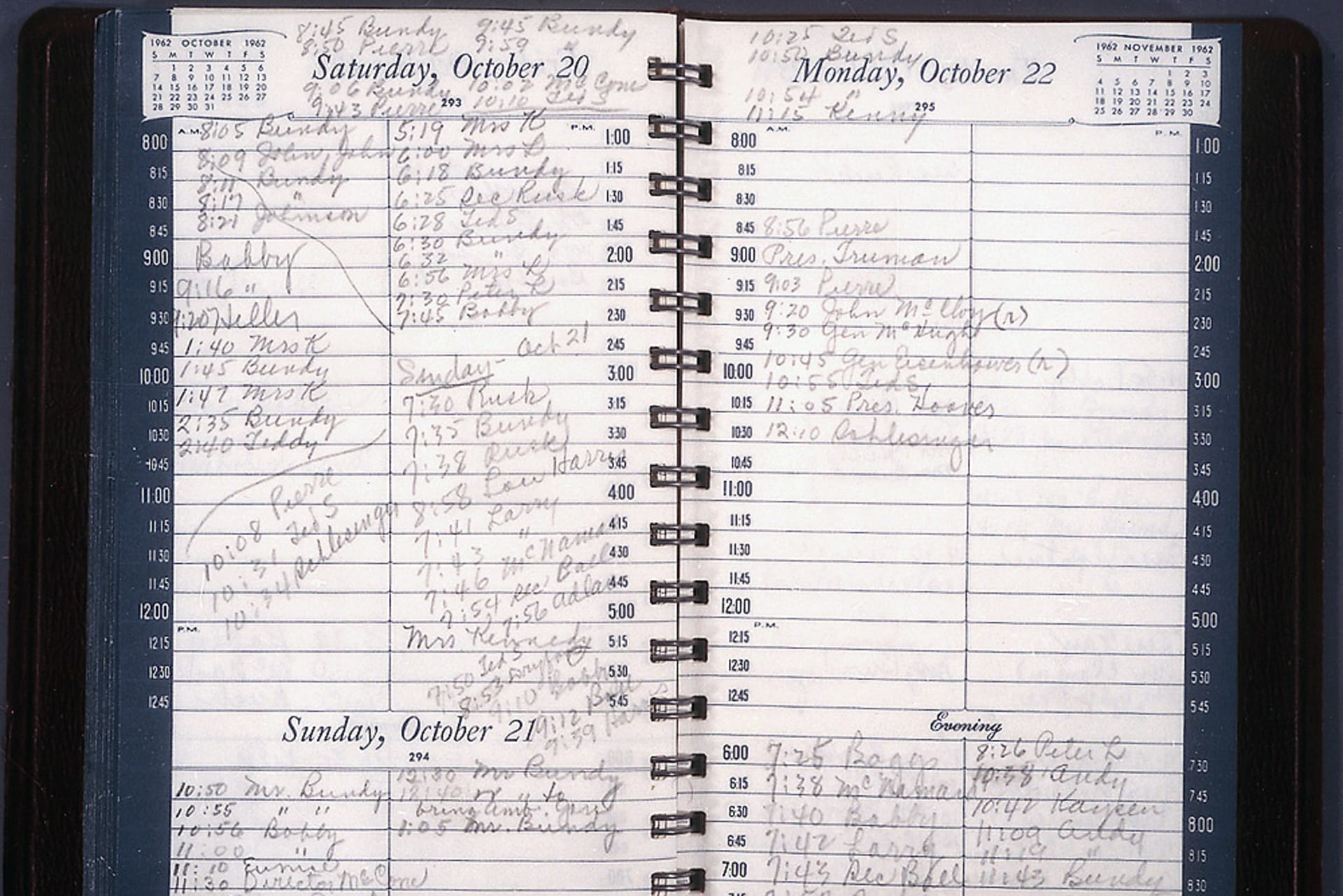
Sundays are usually the one day of the week that gives presidents a break from their frenetic daily schedules. That was not the case for John F. Kennedy on Sunday, October 21, 1962, the sixth day of the Cuban Missile Crisis. He spent the day in meetings and discussions, honing what he would tell the nation and the world the next day about the Soviet missiles discovered in Cuba.
Mass Then Meetings
Kennedy began his Sunday by attending 9:00 a.m. Mass at St. Stephen’s Church with the First Lady as he usually did. After returning to the White House, he met with Attorney General Robert F. Kennedy, Secretary of Defense Robert McNamara, Secretary of State Dean Rusk, and the Chairman of the Joint Chiefs of Staff General Maxwell Taylor. During their discussion he reaffirmed the decision he had made the day before to impose a naval blockade on Cuba.
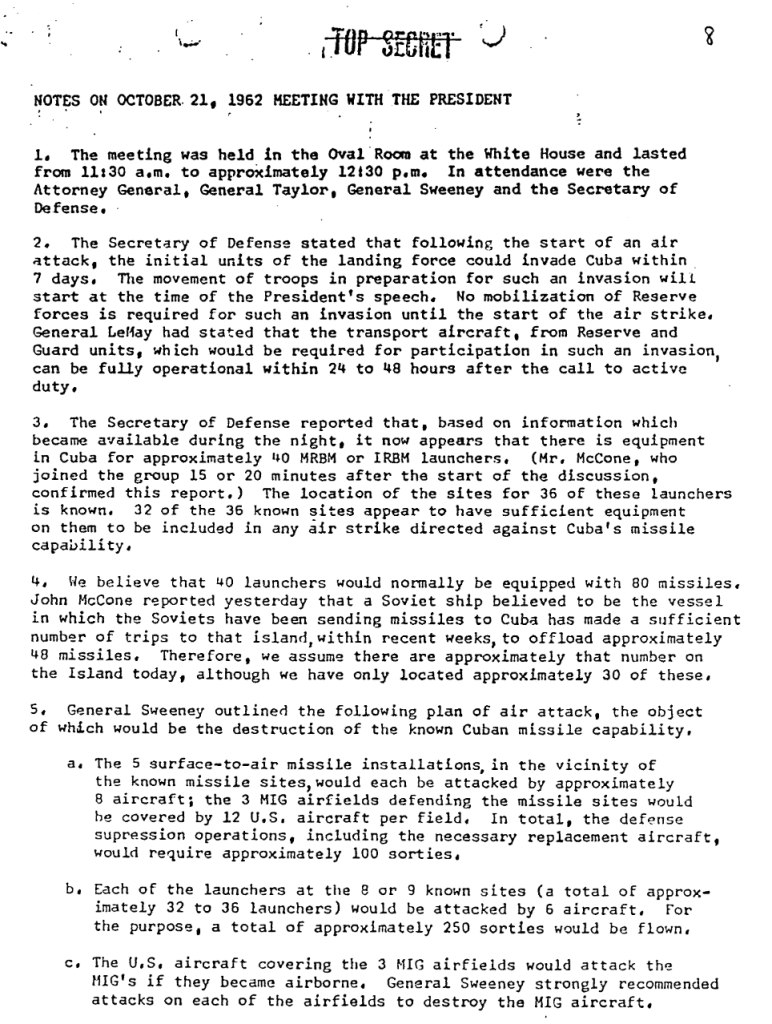
General Walter Sweeney, the head of the U.S. Air Force Tactical Air Command, joined the meeting. He confirmed a point raised in earlier discussions that an air strike would reliably destroy at most 90 percent of the Soviet missiles. So when the planes completed their mission, some Soviet missiles would still be pointed at the United States.
A Blockade or a Quarantine
After lunch, Kennedy convened a meeting with the full ExComm. The group went line-by-line through the speech that Ted Sorensen had drafted for him to give to the nation the following night, weighing the diplomatic and political consequences of every sentence.
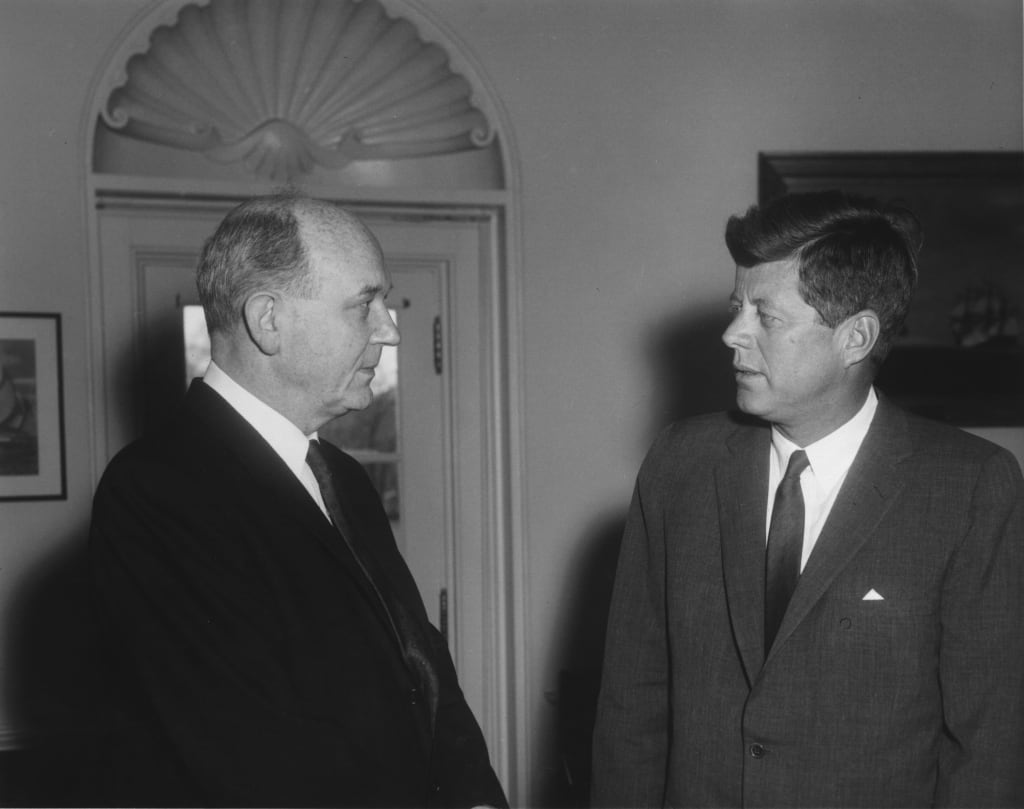
One issue was how Kennedy should describe the military operation he was about to order. Was it a “blockade” or a “quarantine”? Rusk noted that the two words were indistinguishable as a matter of law—stopping ships on the high seas was an act of war under international law regardless of what Washington called it. However, in his view, “quarantine” was the preferable term because it allowed the United States to avoid unflattering comparisons to the blockade that the Soviets had imposed on Berlin in 1948. Kennedy accepted Rusk’s point and directed that the term “quarantine” be used.
The ExComm also debated whether the United States should impose the quarantine to block the shipment of all Soviet military equipment to Cuba or just “offensive military equipment.” Kennedy opted for the latter, narrower objective, while reserving the right to impose a broader quarantine if events warranted.
War and Diplomacy
When Kennedy was satisfied with the speech, the discussion turned to what the United States should do if the quarantine failed to force the Soviets to remove their missiles from Cuba. McNamara and Taylor presented the details of two different invasion plans. Both plans envisioned that the first U.S. ground forces would land in Cuba seven days after the air strikes began and eventually grow to as many as 90,000 troops. The week-long delay between the start of the air campaign strikes and the landing of ground forces troubled Kennedy. He directed the military to look for prudent ways to close the gap.
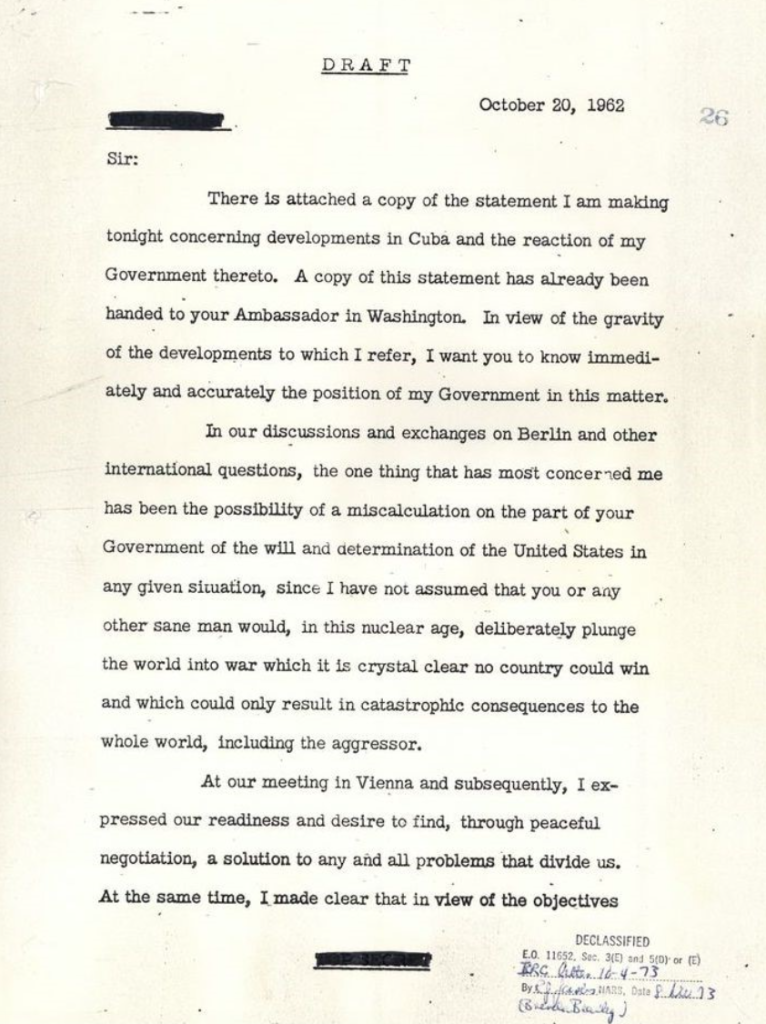
As Kennedy and his advisers were working through several other issues that the impending quarantine raised, State Department officials were busy drafting letters from Kennedy to forty-three world leaders, including Soviet Premier Nikita Khrushchev, British Prime Minister Harold Macmillan, French President Charles de Gaulle, West German Chancellor Konrad Adenauer, and Indian Prime Minister Jawaharlal Nehru. The letters, which U.S. embassies would deliver the next day, explained what the United States had found in Cuba, why the Kennedy administration needed to act, and what it was looking to achieve. Kennedy hoped that the letters, combined with his speech, would convey his determination to Khrushchev without being excessively provocative, rally U.S. allies around his decision, and minimize criticism from countries more skeptical of Washington’s intentions.
The Quiet Before the Storm
The American public knew nothing of Kennedy’s hectic Sunday schedule. Careful readers of the Washington Post might have suspected something was up; the paper had reported that morning on unusual activity at U.S. military bases in the southeast. The story concluded that “the sudden appearance of the Marines and their equipment [in Key West] sparked wide speculation as to their ultimate objective in this Cuba-conscious city just 90 miles from Havana.” But for most Americans, October 21 was a typical fall Sunday full of family, friends, and football. Nothing seemed out of the ordinary. That was about to change.
Oscar Berry and Jack Patton assisted in the preparation of this article.
The United States celebrates its 250th anniversary in 2026. To mark that milestone, I am resurfacing essays I have written over the years about major events in U.S. foreign policy. A version of this essay was published on October 21, 2012.
Other Posts in This Series:
- “Andrei Gromyko Tells a Lie at the United Nations,” September 21, 1962
- “Major Richard Heyser Discovers Evidence of Soviet Missiles in Cuba,” October 14, 1962
- “The United States Discovers Soviet Missiles in Cuba,” October 15, 1962
- “President John F. Kennedy Fakes a Fever—The Cuban Missile Crisis, Day Five,” October 20, 1962”
This work represents the views solely of the author(s). The Council on Foreign Relations is an independent, nonpartisan membership organization, think tank, and publisher, and takes no institutional positions on matters of policy.