JFK Learns That Soviet Missiles Are in Cuba—The Cuban Missile Crisis, Day One
President John F. Kennedy learned that the Soviets were installing nuclear missiles in Cuba and sought to project a sense to the world that nothing was amiss.
By experts and staff
- Published
 James M. LindsayCFR ExpertMary and David Boies Distinguished Senior Fellow in U.S. Foreign Policy
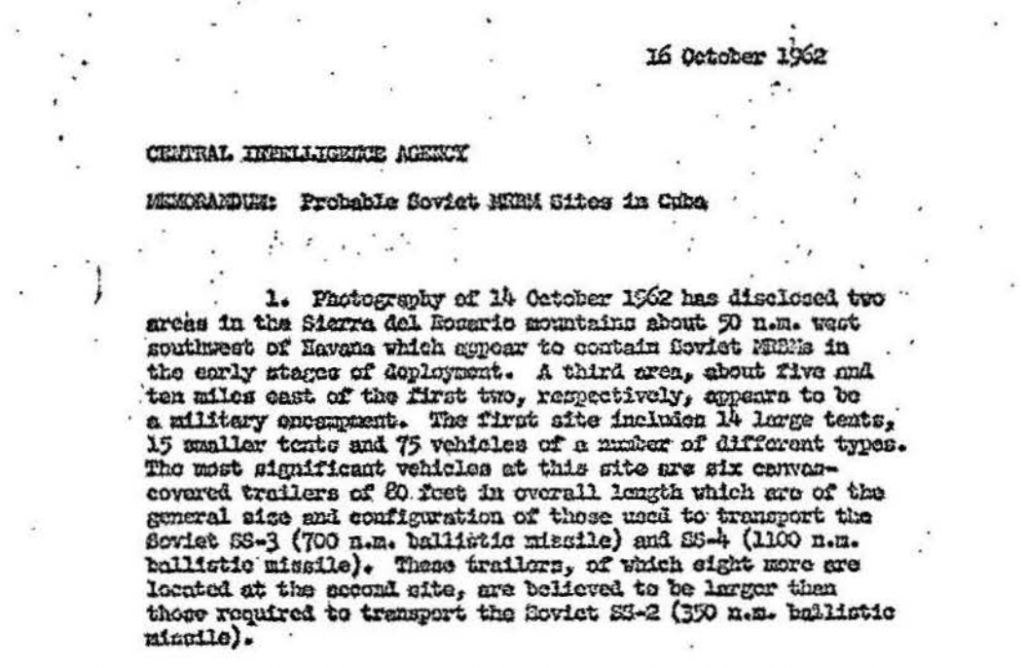
Hillary Clinton famously ran a political attack ad during the 2008 primary campaign saying that a president had to be prepared for a 3:00 a.m. phone call about a breaking international crisis. For President John F. Kennedy, the 3:00 a.m. phone call came in the form of a visit from his national security advisor at 8:45 a.m. on October 16, 1962. The pajama-clad president was sitting in his bedroom reading the newspaper when McGeorge Bundy knocked on the door with the news that reconnaissance photographs had shown that the Soviet Union was doing what it had repeatedly and publicly denied doing: installing nuclear-armed missiles in Cuba. The Cuban Missile Crisis had begun.
A recent survey I conducted with members of the Society for Historians of American Foreign Relations ranked JFK’s handling of the Cuban Missile Crisis as the tenth-best foreign policy decision in U.S. history.
Caroline Kennedy’s Ponies
Kennedy took the news that the Soviet leaders had lied to him and the world about their actions in Cuba calmly. He made a quick decision: he would stick to his morning schedule while Bundy arranged for him to meet with his national security team shortly before noon. Less than forty-five minutes after learning that he faced the greatest crisis of his presidency thus far, JFK made his way down to the Oval Office.
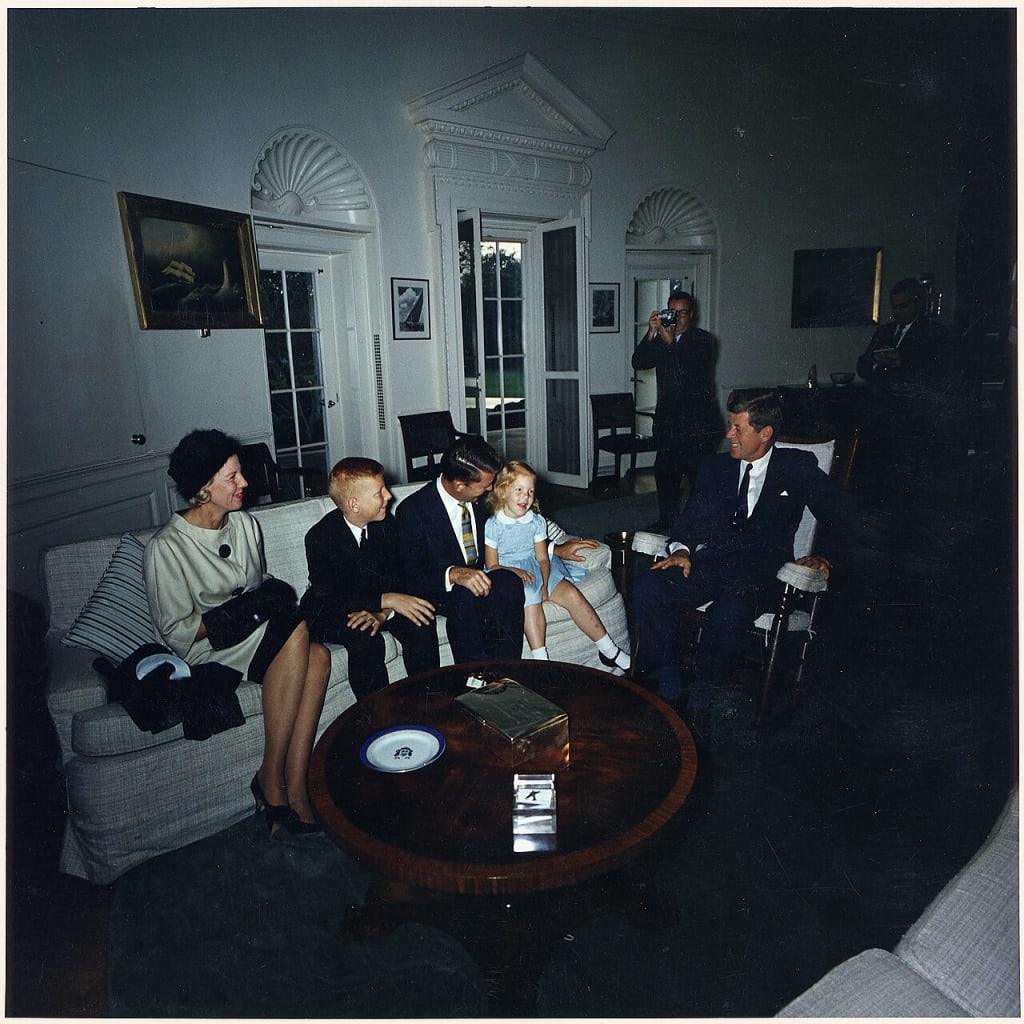
At 9:30 a.m., Kennedy met with astronaut Wally Schirra, who had just orbited the Earth six times as part of Project Mercury, along with his wife and two young children. Playing the gracious host, JFK took the Schirra family to see Caroline Kennedy’s ponies. Kennedy then moved on to private meetings with several members of Congress followed by a meeting with members of the President’s Panel on Mental Retardation.
The ExComm Meets
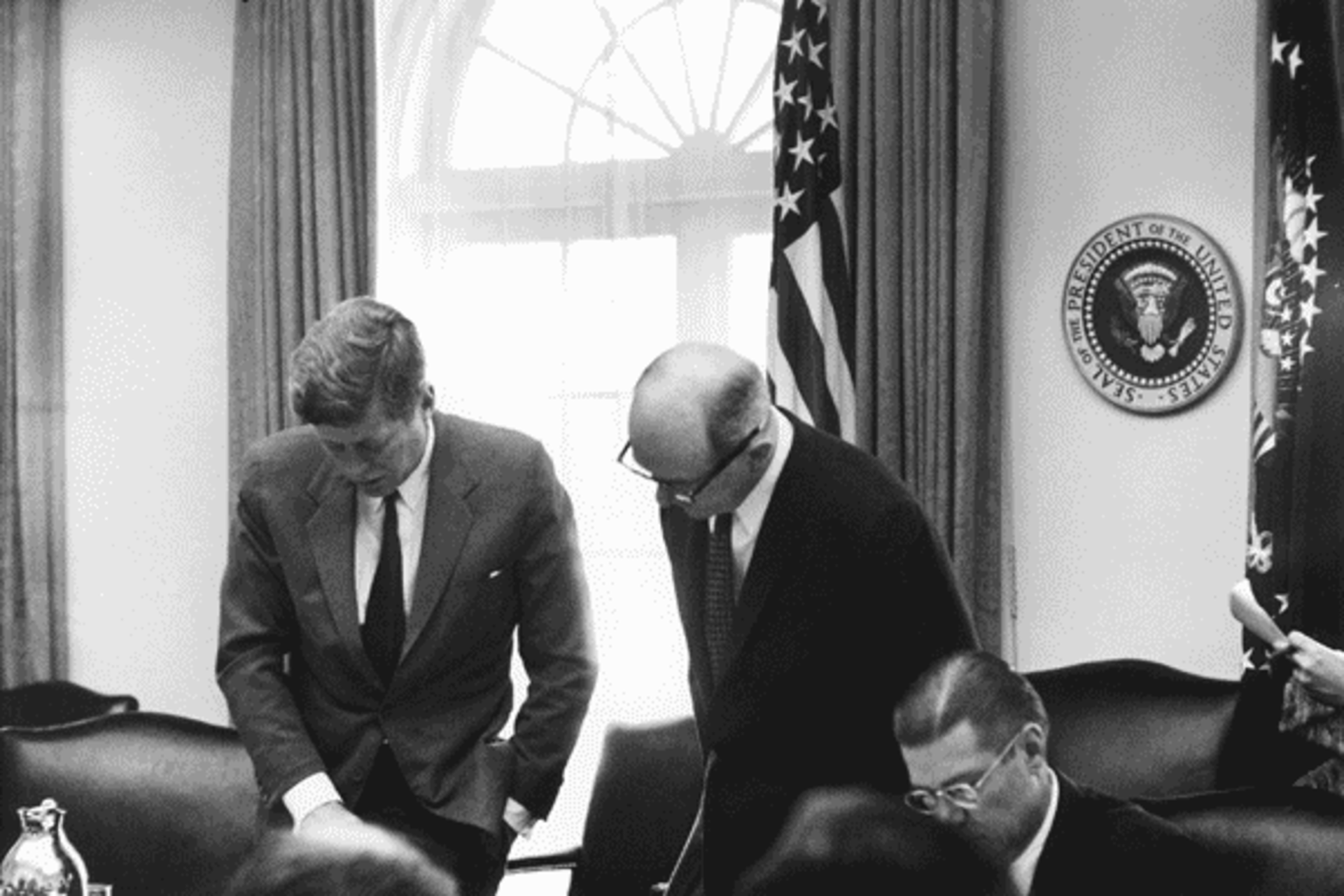
With his morning obligations finally finished, Kennedy met in the Cabinet Room with his national security team, which days later he would officially call the Executive Committee of the National Security Council. Better known as the ExComm, it formally consisted of a dozen members, including the vice president, the secretaries of state, defense, and treasury, their deputies, and the attorney general. The ExComm would also include other government officials, past and present, in its deliberations.
Arthur Lundahl, the head of the CIA’s National Photographic Interpretation Center, began the meeting by briefing everyone on what the photographs taken by Maj. Richard S. Heyser on his U-2 reconnaissance flight two days earlier. The photographs showed that the Soviets were not just building air-defense sites to defend Cuba, as they had claimed, but were also installing the launch pads for medium-range ballistic missiles that would put at least a third of the continental United States at risk.
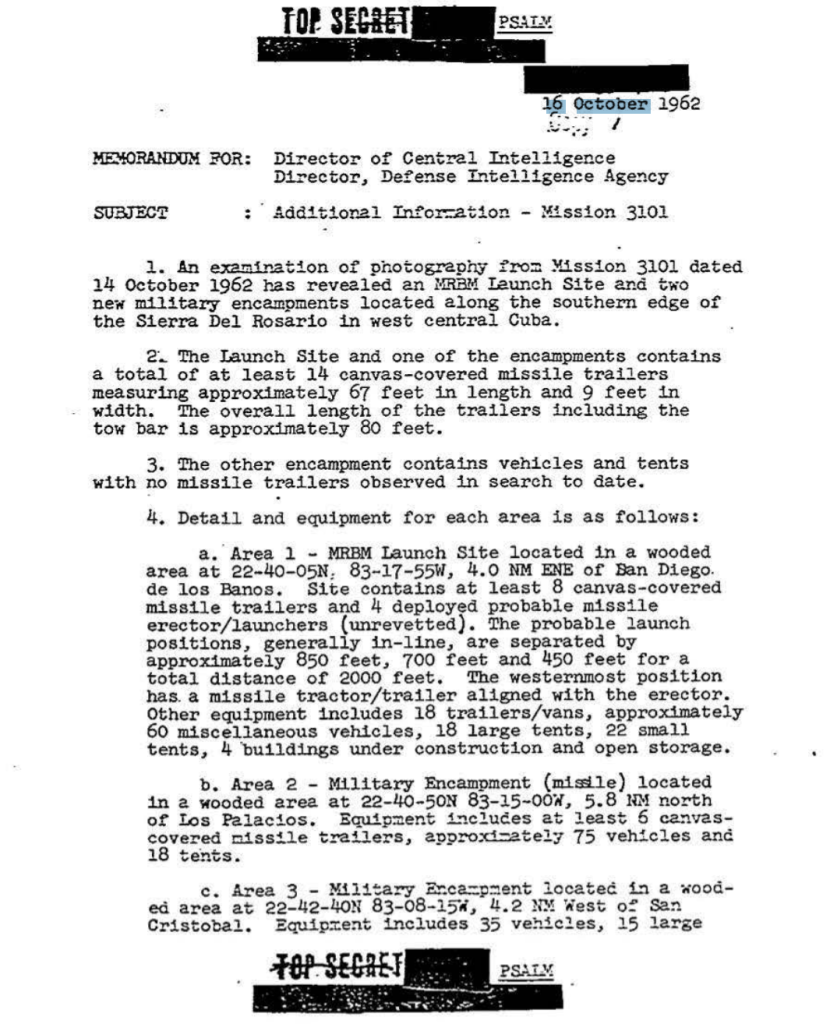
A decision was quickly made to order more U-2 reconnaissance flights over Cuba. The discussion then moved to how the administration should respond. (Kennedy had his White House discussions secretly taped. You can listen to excerpts from the conversations here.) Secretary of State Dean Rusk offered two options:
one, the quick strike; the other, to alert our allies and Mr. Khrushchev that there is an utterly serious crisis in the making here, and that Mr. Khrushchev may not himself really understand that, or believe that, at this point. I think we’ll be facing a situation that could well lead to general war. Now with that we have an obligation to do what has to be done, but to do it in a way that gives everybody a chance to pull away from it before it gets too hard.
Secretary of Defense Robert McNamara raised the possibility of blockading Cuba,. Much of the conversation, however, gravitated to possible air strikes against the missile installations. The fact that the United States might resort to a preemptive military attack troubled Attorney General Robert Kennedy. He passed a note to his brother saying, “I now know how Tojo felt when he was planning Pearl Harbor.”
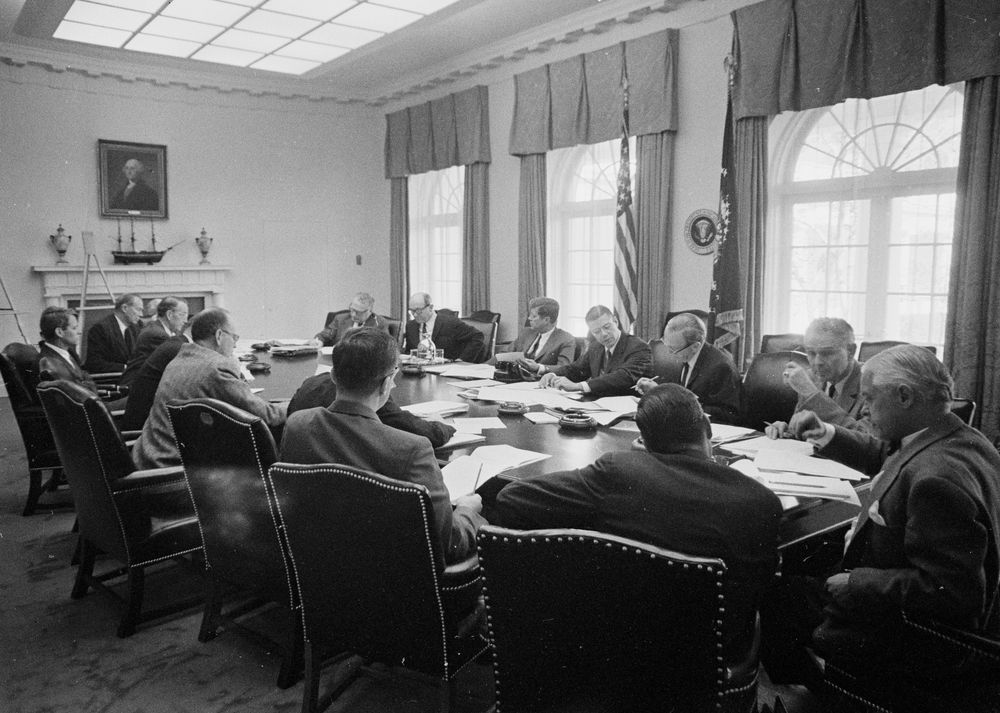
The meeting wrapped up with an agreement to reconvene later that afternoon. Kennedy was seriously considering an air strike to eliminate the missile sites. He directed McNamara to begin drawing up plans for such an attack.
The Diplomatic Stakes
Kennedy decided immediately that the removal of the Soviet missiles from Cuba would be the non-negotiable objective of U.S. policy. Though he hadn’t yet decided on how he would respond, he said firmly that “We’re going to take out these missiles.” He recognized that the placement of Soviet ballistic missiles just ninety miles from the U.S. mainland would cut the warning time of a Soviet nuclear attack to less than ten minutes, increasing the pressure he and every other president would face to order a retaliatory launch at any sign of an attack.
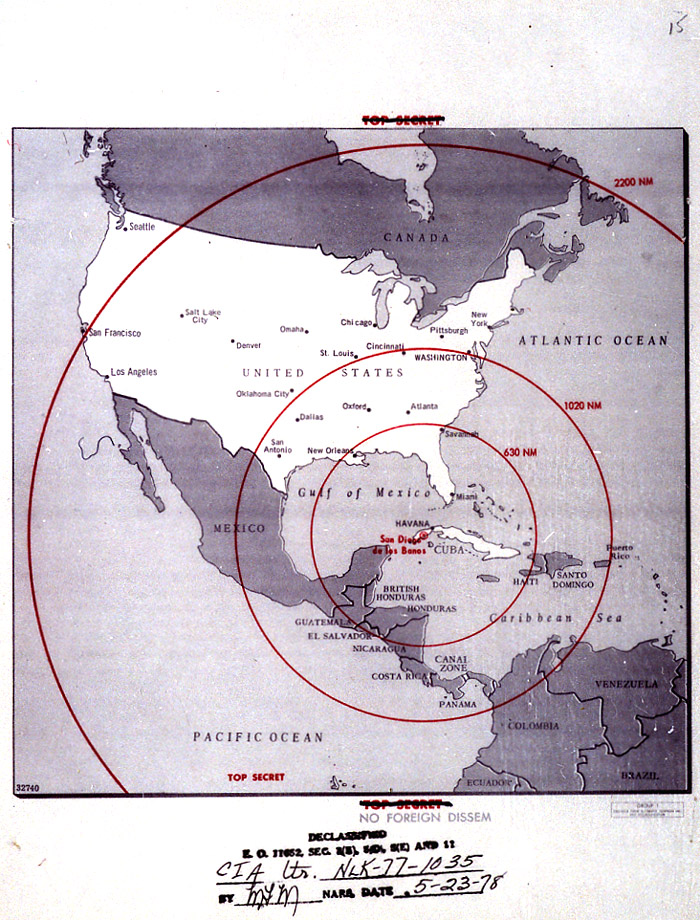
Kennedy also calculated that doing nothing about the missiles would be a massive strategic mistake. Soviet officials had repeatedly and publicly said they were not installing offensive weapons in Cuba. Accepting the Soviet’s duplicity would send a signal of weakness that would embolden the Kremlin and shake the confidence of U.S. allies. With tempers already flaring with the Soviets over Berlin, such a decision could invite another confrontation with Moscow that could potentially be even less advantageous to the United States.
The Political Stakes
The missile crisis also had consequences for Kennedy’s domestic political standing. He had come to office criticing the Eisenhower administration for allowing Fidel Castro to seize power in Cuba and vowing to take a tough line against the Soviet Union and the broader Communist world. In his January 1961 State of the Union address, he had warned that the United States was drawing “nearer the hour of maximum danger.”
During his first twenty months in office, Kennedy had not backed up with initial tough talk with action. The April 1961 Bay of Pigs Invasion turned into a debacle. A disastrous summit meeting with Khrushchev in Vienna left Kennedy telling a journalist that Krushchev “savaged me.” Two months after that, the Berlin Wall went up. Kennedy recognized that these were failures that had cost him politically. When he heard that journalists were discussing whether to write a book on the first year of his residency he quipped, “Who would want to read a book on disasters?”
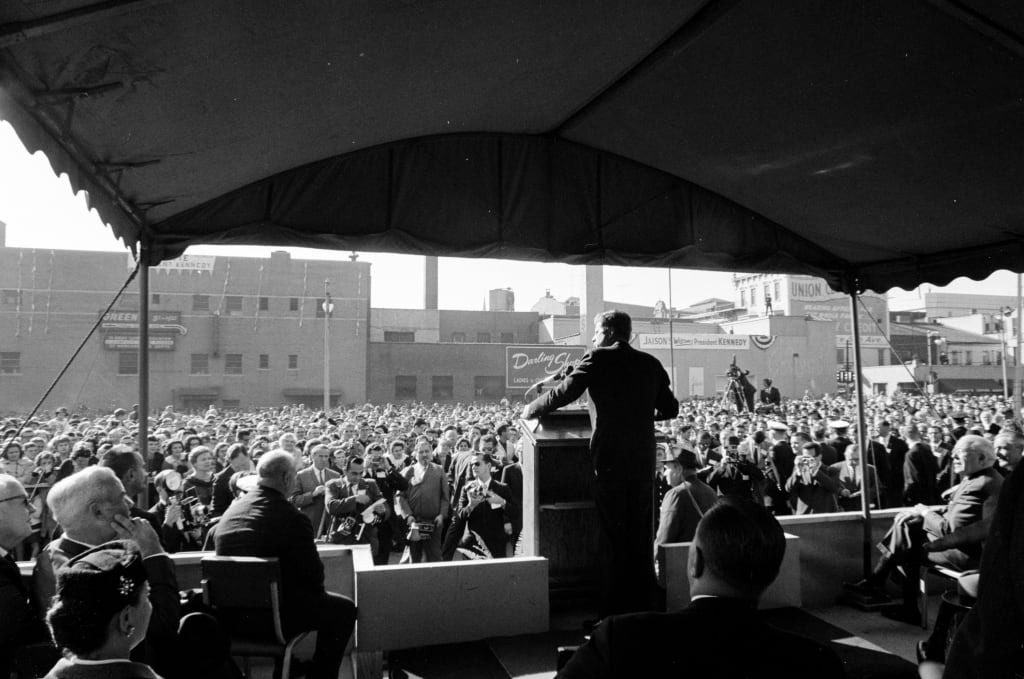
JFK’s political troubles were also not lost on Republicans. They had been criticizing him for months for failing to translate his tough words into commensurate deeds. Worried by news of the Soviet arms buildup in Cuba, they began calling in August 1962 for Congress to formally declare U.S. opposition to any Soviet actions in Cuba that threatened the United States. Rather than risk the political damage of fighting this push by Congress, and hoping to temper the resolution’s language to avoid aggravating U.S.-Soviet tensions or tying his hands diplomatically, Kennedy agreed to support its passage.
In late September, Congress overwhelmingly passed the “Cuba Resolution.” Kennedy signed into law on October 3. It stated:
The United States is determined:
(a) to prevent by whatever means may be necessary, including the use of arms, the Marxist-Leninist regime in Cuba from extending, by force or the threat of force, its aggressive or subversive activities to any part of this hemisphere;
(b) to prevent in Cuba the creation or use of an externally supported military capability endangering the security of the United States
With the midterms three weeks away, Kennedy knew that his presidency rested on getting the Soviet missiles out of Cuba at a price that Americans would find acceptable.
The ExComm Reconvenes
As Kennedy’s advisers scattered to their various offices and agencies to issue orders, demand information, and mull over options, Kennedy left the Oval Office to attend a 1:00 p.m. lunch for the Crown Prince of Libya, His Royal Highness Sayyid Hasan al-Rida al-Mahdi as-Senussi, who was making his first visit to the United States. In his toast to the Crown Prince, Kennedy joked that “the Shores of Tripoli” were well known to most Americans. (If you aren’t familiar with the reference, it is a line in the Marine Corps Hymn, and refers to an attack by Marines on what is now Derna, Libya, in 1805.)
At 6:30 p.m., Kennedy met once again with the ExComm. His brother Bobby reiterated his concern that the United States could not justify starting a war with Cuba. He wondered if there might be some way to provoke the Cubans or Soviets into using force first, saying:
one other thing is whether we should also think of whether there is some other way we can get involved in this, through Guantanamo Bay or something. Or whether there’s some ship that…you know, sink the Maine again or something.
The meeting broke up without deciding on a U.S. response. Kennedy, doing what he could to project a sense of normalcy that would keep White House watchers from asking questions and thereby give himself more time to deliberate, went to a farewell dinner for Charles “Chip” Bohlen at the home of famed columnist Joseph Alsop. Bohlen, one of the State Department’s leading Sovietologists, was about to take up his duties as the U.S. ambassador to France. Kennedy asked Bohlen to delay his departure, but the ambassador pointed out that doing so might raise questions the president would prefer not to answer.
A Secret—For Now
The American public, of course, knew nothing of such conversations, or even that the country faced an imminent peril. Many Americans, or at least those who liked baseball, were focused instead on Game 7 of the World Series between the New York Yankees and their former crosstown rivals the San Francisco Giants. Ralph Terry, the goat of the 1960 World Series for giving up the series-ending home run to the Pittsburgh Pirates’ Bill Mazeroski, pitched a 1-0 complete game victory, inducing Hall-of-Famer Willie McCovey to line out with men on second and third and two outs in the bottom of the ninth. It was one of the most thrilling games in baseball history.
Few senior officials in the Kennedy administration noticed Terry’s heroics. Their thoughts were elsewhere.
Other Posts in This Series:
- “Andrei Gromyko Tells a Lie at the United Nations,” September 21, 1962
- “Major Richard S. Heyser’s U-2 Mission Discovers Soviet Missiles in Cuba,” October 14, 1962
- “The United States Discovers Soviet Missiles in Cuba,” October 15, 1962
Oscar Berry and Jack Patton assisted in the preparation of this article.
The United States celebrates its 250th anniversary in 2026. To mark that milestone, I am resurfacing essays I have written over the years about major events in U.S. foreign policy. A version of this essay was published on October 16, 2012.
This work represents the views solely of the author(s). The Council on Foreign Relations is an independent, nonpartisan membership organization, think tank, and publisher, and takes no institutional positions on matters of policy.