Coups and Other Irregular Leadership Changes
Crisis Response Playbook no. 2
Overview
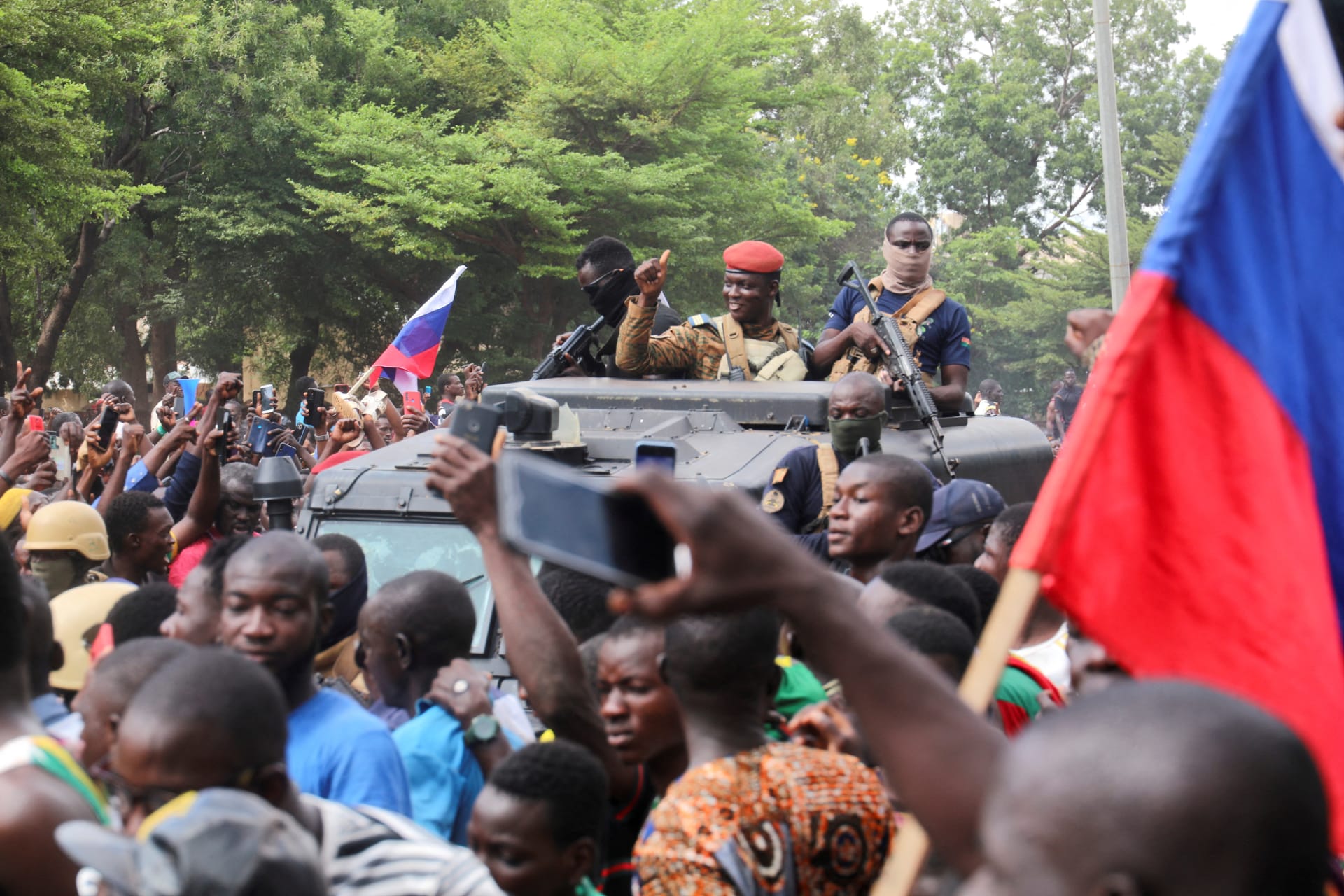
When a coup, leadership succession battle, or other irregular transfer of power occurs abroad, U.S. policymakers have little time to formulate, communicate, and execute a response strategy. Preserving and promoting U.S. interests—whether countering terrorism, checking adversaries such as Iran and Russia, upholding global human rights norms, or maintaining diplomatic and economic relationships—depends heavily upon the early hours of a crisis. Policy planners should therefore prepare for the unexpected, set clear objectives, emphasize interagency coordination, and counter foreign disinformation efforts in vulnerable regions.
- Director, Research and Operations, Future of American Strategy Initiative, Council on Foreign Relations
Executive Summary
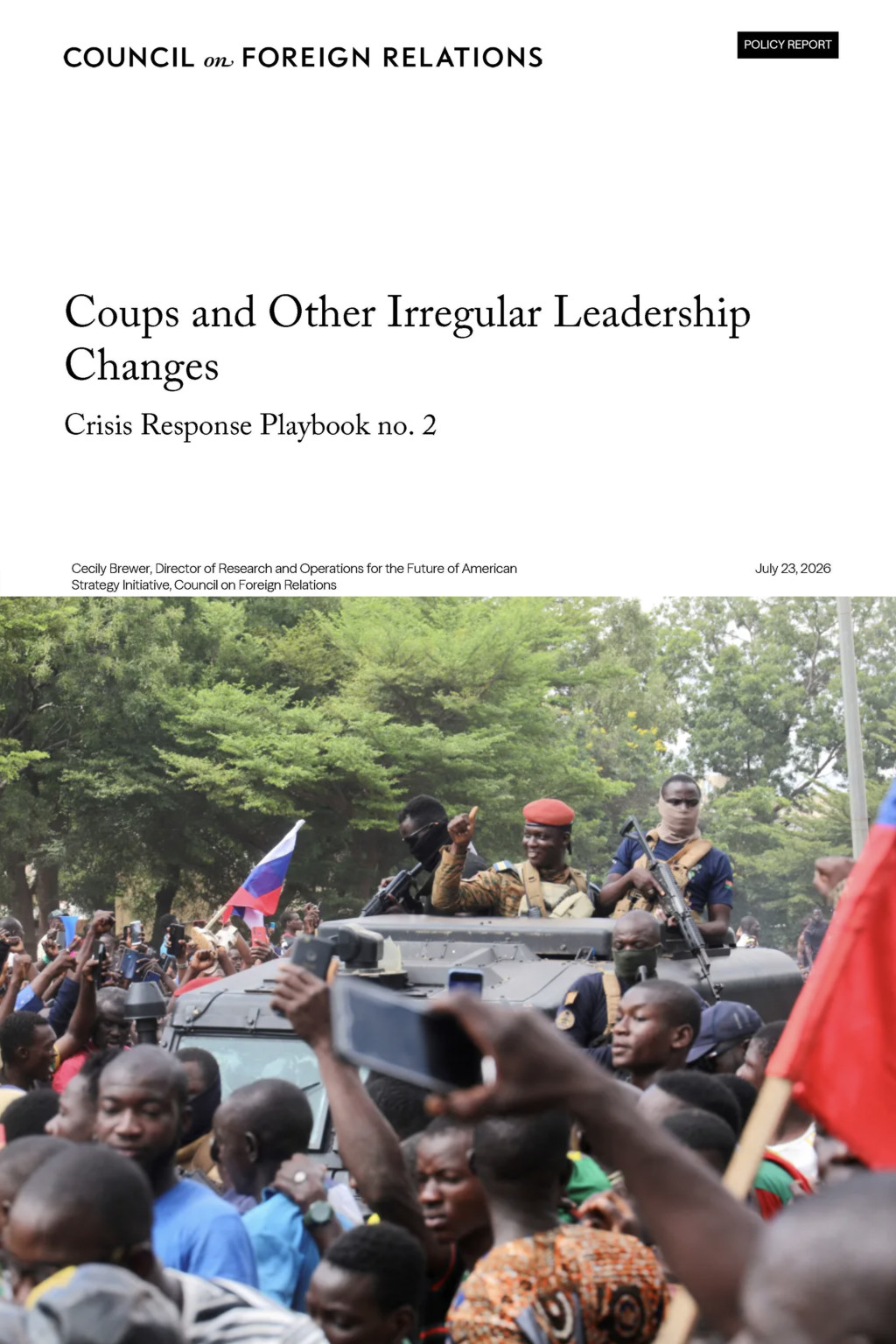
With more than 490 failed and successful coups d’état [PDF] around the world since 1950, coups have been a persistent challenge for U.S. foreign policy across decades and continents. Although coup leaders often cite legitimate grievances and can have strong popular backing, coups rarely produce promised gains. Instead, they tend to beget more coups. Coups and other leadership crises involving a challenge to a country’s chief executive from within (i.e., from the state apparatus rather than from external actors or popular revolt) often happen suddenly. The shift to illegitimate, unconstitutional, or contested governance can expose the contradictions among competing U.S. priorities. These dynamics often force policymakers to respond quickly and with incomplete information. U.S. inaction or silence in the wake of a crisis also sends a signal. With the emergence of alternative security and economic partners for many countries, such as China and Russia, the U.S. playbook from past decades no longer produces the same results, making it essential to reexamine U.S. strategic aims, approaches, and tools.
Beyond acting immediately to ensure American citizens’ safety, U.S. policymakers should assess the context, likely crisis trajectory, and U.S. interests at stake to devise an effective response. The United States should consider the following four strategic approaches, each with trade-offs and risks:
- Monitor. Take a wait-and-see approach—aim to preserve flexibility by assessing the situation, communicating U.S. views, and evaluating the risks of escalation, but not taking concrete actions to alter the outcome.
- Contain. Work within the post-coup status quo—aim to shape the terms and outcome of the transition.
- Restore. Reject the leadership change—aim to reinstate the pre-crisis status quo.
- Transform. Leverage the opportunity for change—aim to foster the creation of a new political structure.
The initial policy decision is often whether to attempt to reverse the coup, weighing the associated risks. Past experience shows that success often requires quick and decisive action and depends on the extent of support and control the original leader retains. Once a leadership change is consolidated, policymakers face a difficult choice: whether to prioritize employing punitive measures to pressure a transition or maintaining favorable relations to preserve U.S. access and influence. Integral to any response is determining whether and how Section 7008 of the U.S. State, Foreign Operations, and Related Programs Appropriations Act applies and whether to invoke a national security waiver. This law prohibits providing direct foreign assistance to governments whose leaders have been overthrown by military coups or decrees. Invoking Section 7008 and declaring a coup too early can turn an unstable attempt into a fait accompli, whereas a delayed declaration (or no declaration at all) can signal acceptance and undermine the norm against coups. Because U.S. policymakers will tend to weigh U.S. objectives differently, prioritization, communication, and consultation—especially with Congress—are essential to effective implementation.
This playbook draws on past cases and data-driven academic research. Several key lessons emerge:
- Act before the crisis. U.S. leverage is strongest during early signs of democratic erosion rather than after a coup, when juntas can exploit competing external partners and nationalist narratives to neutralize outside pressure.
- To shape a transition to democracy, engage the de facto leaders. Fears of legitimizing coup leaders through negotiations are most warranted before they consolidate power. Indeed, isolating coup leaders is essential to reversing a coup (a “restore” strategy). Once coup leaders have consolidated power, however, the goal shifts to shaping the transition’s terms and outcome (a “contain” strategy). This stance requires engaging the de facto authorities and preparing to make concessions. Policymakers should pair calibrated pressure with direct engagement, benchmarked incentives, off-ramps, and clear conditions for restoring cooperation.
- Recognize that U.S. security interests are served by both good governance and good relations. Decision-makers often frame U.S. coup responses as prioritizing either democracy or security. Yet U.S. security interests frequently depend on partnership with governments whose populations view them as legitimate and effective, an interest undermined by repeating coup patterns. At the same time, U.S. security interests also rely on access to military bases, overflight, and security and intelligence partnerships, which require cooperation with de facto authorities. The policy trade-off is usually between employing coercive tools versus maintaining good relations, rather than between democracy and security.
- Treat the information arena as an operational battlefield. Perceptions can drive outcomes. Narratives, propaganda, and false information—further enhanced and disseminated by artificial intelligence—can undermine support for legitimate leaders and bolster putschists within hours. As adversaries work to spread anti-American and anti-democracy messages, policymakers should envision the information domain as an arena of competition, not merely a communications space, and invest in the tools and capabilities to compete in it.
In a more contested world, U.S. policymakers cannot rely on a one-size-fits-all playbook to respond to coups and other leadership crises. U.S. policymakers will increasingly confront the limits of U.S. leverage and should therefore act early to prevent coups when possible; set prioritized and realistic objectives when they do occur; harness U.S. and partner leverage—both coercive and attractive—to achieve those objectives; manage unavoidable trade-offs; and focus on long-term outcomes while preserving flexibility to adapt as circumstances change.
1.0 Situational Assessment
1.1 What Is the Source of Concern?
Leadership crises such as coups d’état (failed, contested, or consolidated), palace coups, self-coups, and succession crises present major policy challenges: they unfold inside existing governing institutions and security structures, creating ambiguity about who is exercising power, what they want, and whether the seizure of power will succeed. With more than 490 failed and successful coups [PDF] recorded since 1950, such crises remain a recurring feature of international politics. Policymakers often need to act before the outcome is clear and with limited leverage, requiring realistic goals and concerted strategies to maximize impact and minimize backlash. Analyzing the type of crisis and its likely trajectory is the first step on which subsequent decisions depend. The table below summarizes the main categories.
Typologies
| Coup d’état: An illegal and overt attempt by the military or other elites within the state apparatus (with military backing) to unseat the sitting executive. Targets can include duly elected leaders, autocrats, or prior coup leaders. In “endgame” coups, the military takes control of a state already buckling under violence or protest. Note: The coup provision (Section 7008) of U.S. foreign assistance appropriations law applies when a duly elected head of government is deposed by military coup or decree. | Consolidated: e.g., Gabon 2023; Niger 2023; Burkina Faso 2022; Guinea 2021; Mali 2020 and 2021; Sudan 2019 (endgame coup); Egypt 2013 (endgame coup) Contested: Sudan 2021–23 (nonelected leader); Myanmar 2021 Failed: Turkey 2016 Reversed: Benin 2025; Haiti 1991 |
| Palace coup: An illegal and overt attempt by one faction within the ruling group to displace another faction within the ruling group, often in a nondemocratic system. | Failed: Russia 2023 Consolidated: Qatar 1995 |
| Leadership succession crisis: A period of potential instability following the death or departure of a chief executive, when leadership is contested, vacant, or unclear. | Consolidated: Chad 2021 (also considered a military coup) Elite bargain: China 1976 |
| Self-coup (autogolpe): A leader who came to power legally attempts to stay in power illegally—by dissolving the constitution, dismantling institutions, or refusing to concede an electoral loss—with or without military intervention. | Consolidated: Tunisia 2021 Failed/reversed: Senegal 2024; Peru 2022; Gambia 2016–17 |
1.2 Anticipating and Preparing for Potential Crises
Positioning for the Unexpected
Rather than trying to anticipate or expecting advance warning of a coup, U.S. policymakers should prepare broad contingency plans for places where a leadership crisis would most affect U.S. interests (see Section 3.2). Further, policymakers should act in advance—for example, building a broad base of relationships with political and civic leaders beyond the ruling elites, which will help position the United States to respond to an unexpected leadership change.
Pre-Crisis risk factors
Experts can identify certain risk factors ahead of a crisis. Some are historical or structural characteristics of states, increasing the likelihood of an irregular transition in general; others indicate rising risk observable in real time. Most scholars agree that a history of coups is the structural factor likeliest to increase the chance of a future coup (the “coup trap”). Past coups normalize military intervention in politics. Further, executives take measures to insulate themselves—sidelining powerful military figures, creating competing security forces or presidential guards, and narrowing the decision-making circle to loyalists, as well as anti-democratic moves such as repressing the opposition or skirting term limits—that can instead raise the odds of a challenge to their power. Other risk factors and indicators of increasing tension are less conclusive but still useful as prompts for deeper scrutiny of a specific case.
Essential Information for Pre-Crisis Assessment and Planning
| Structural factors | |
| Coup history and military structure | Does the country have a history or pattern of coups? Does it have a history of, or does it generally accept, military intervention in its politics? Has a government taken actions such as restructuring the security forces, dismissing powerful military officials, or narrowing the decision-making circles that could engender resistance? Is the military internally divided or structured into competing factions? |
| Weak civilian institutions | Is the political system highly personalized? Does it lack ways to legally or politically resolve disputes? |
| Lack of agreed-upon succession plan | In a personalized power structure, does a disagreement or lack of clarity exist over who should succeed the ruler or the process by which to choose a successor? Is the ruling circle jockeying for position? |
| Indicators of increasing risk | |
| Military discontent | Have key military officials been fired or sidelined recently? Are there coup attempts, mutiny attempts, or coup rumors? Have important military officials defected or resigned in protest, particularly over political decisions such as integration of former adversaries into the military, salary cuts, or forced retirement of senior officers? |
| Popular discontent | Does the population desire change or accept that the country cannot go on as it is? Is there a spike in poverty, unemployment, spreading insecurity, corruption, or deadlocked governance? Is there a major corruption scandal? |
| Anti-democratic actions | Is a leader amending or ignoring the constitution to extend their term? Were elections canceled or fraudulent? Has a main political opponent been jailed, killed, or forced into exile? Is a leader saying the state is under threat and invoking martial law or emergency status or violating the constitution? Is the executive undermining or dismissing other branches of government, such as the legislature or judges? |
1.3 Assessing Crisis Situations
During a leadership crisis, U.S. strategy should be informed by what type of crisis is occurring and its likely trajectory. In the early hours and days, information gathering should help assess whether the situation is one of
- rapid consolidation, in which the challenger is likely to prevail;
- failed attempt, in which strong opposition will likely defeat the challenger;
- contestation, in which factions form, violence is possible, and the outcome remains uncertain; or
- leadership vacuum, in which the military could intervene to establish control of the state.
Essential Information for Crisis Response Planning
| Clarity of control | Who is actually calling the shots, whether from behind the scenes or outside of the country? Who has control over weapons? What do they care about? Whose backing (both internal and external actors) will they look to for support? What is the location and status of the original/legitimate leader? Does the person still have an active support base? Who will that leader look to for support? How is the power grab being justified? For self-coups: Has the leader attempted to override the constitution and its checks on executive power, invoking emergency powers or martial law? |
| Consolidation of power | Is the situation trending toward consolidated power shift or divisive conflict, and are key actors more concerned about violence or illegitimate power transfer? Are security forces unified or divided, and who controls pivotal locations of power such as the presidential palace, national broadcast center, government offices, major infrastructure, or the airport? Do elites and/or the broader public support the power grab? Are they unified or divided? Are there signs of mass mobilization? What are their means of influence? |
| Institutional checks on individual decisions | To what degree will institutions restrict the power grab? What does the constitution say about power transfers? Are those laws being followed? |
| External actors | What are neighbors, regional heavyweights, and/or the regional organization doing, saying, or planning? Do they have a military standby force, a chartered commitment to reinforcing democracy, or a history of intervention? What are other important U.S. partners and adversaries doing, saying, or planning? Which external actors have the most to lose/gain from the potential power transition? |
2.0 Assessment of U.S. Interests
2.1 Proximate U.S. Concerns
Policymakers should consider the following immediate concerns when assessing U.S. interests:
- Safety of and risk to U.S. government personnel, major U.S. assets, and U.S. citizens. This includes the viability of evacuation routes, roadblocks, airport access, and commercial flights, as well as escalation risks (e.g., increased violence, weapons of mass destruction (WMD) use or contested control, or the killing of legitimate leaders), which could suddenly shift the security landscape.
- Access to strategic assets. Assessments should weigh the harmful consequences of losing access to strategic assets (e.g., embassies, military bases, natural resources, or technology) against the potential cost of developing alternatives, and should identify redlines for continued U.S. presence and access.
2.2 Strategic Interests at Risk
A leadership crisis can suddenly undermine U.S. interests, create openings to advance them, or pull them in competing directions. U.S. policymakers should confidentially evaluate each crisis’s likely consequences in terms of magnitude and priority—assessments that will vary by country, context, and administration priorities. When executive branch officials disagree on priorities, the lead decision-maker (usually the president or secretary of state) should weigh competing views and decide.
Coups and other leadership crises often implicate the following U.S. strategic interests:
- Security and counterterrorism. U.S. security interests—partnerships, base access, overflight, intelligence sharing, and weapons sales—depend on working with a country’s de facto leaders. Yet those interests are often best served by partnering with a government seen as legitimate, particularly in countering terrorism and insurgencies. Research has repeatedly shown that iron-fist repression alienates populations and drives support toward armed groups—a lesson recent coup leaders have ignored by turning to the heavy-handed Russian Wagner Group/Africa Corps in a so far unsuccessful bid to suppress jihadi and insurgent groups.
- Geopolitics. The expanding influence of U.S. adversaries (China, Iran, North Korea, and Russia, among others) has led the U.S. government to de-emphasize democracy and human rights, especially when juntas turn to Russian partners in a way that negates continued U.S. military presence. By offering alternatives, these security partners decrease U.S. leverage to successfully shape post-coup political outcomes.
- Democracy. Coup leaders often frame their putsch in terms of fighting against the deposed executive’s erosion of democracy, a narrative that, combined with economic and security grievances, frequently generates initial popular support. A tiny subset of coups—the so-called good coups (e.g., Turkey’s in 1960, 1971, 1980, and 1997, which complied with its constitutions at the time; Sierra Leone’s palace coup of 1996; Ghana’s in 1981; and Mali’s in 1991)—have restored democracy for a time. But most coups beget more coups: they fail to improve political, economic, or security outcomes, and they disrupt democracy consolidation in a country, often for decades. Coup leaders often promise to relinquish power after a transition period, but most end up delaying elections or using them to consolidate their power, especially if they perceive no exit from office other than death or imprisonment—a fate some constitutions dictate for coup leaders. U.S. policymakers can end up in the awkward position of opposing a coup to defend democracy when the country’s people widely support the coup. But that initial support often fades as juntas fail to deliver on their promises. Policymakers should be clear-eyed about juntas’ false pledges and weigh the trade-off between short-term regime influence and the long-term costs to democratic governance.
- Broader democracy trends. Debate continues over whether coups are contagious, but evidence suggests that democratic backsliding in one country can influence others and shape global trends. Countries without a history of coups or other structural vulnerabilities may be less susceptible to contagion. Still, recent West African coup leaders have banded together to learn from each other’s experiences and consolidate their power.
- Dislodging adversarial rulers. Coups or military putsches that remove leaders hostile to U.S. interests can open a window of opportunity. That said, few such cases have initially produced a major reorientation. Enduring state interests, elite power structures, institutions, and political culture tend to constrain new leaders. Scholars have cautioned against expecting a leadership transition to advance U.S. interests in China [PDF], Iran, or Russia.
- Stability. Leadership crises can spiral into civil war or widespread unrest, with attendant human rights abuses, mass atrocities, and displacement. U.S. military support to one side could prove decisive—or fail, or prompt an adversary to back the other side, intensifying a conflict that now directly involves the United States.
2.3 Decision Timeline: Essential Tasks
- 0 to 12 Hours: Assess the crisis. Identify location, status, and degree of support for the original leader; the degree of control and consolidation of power of the coup attempt; and the initial posture of other actors. Assess the likeliest trajectory of the leadership challenge (failed, contested with risk of violence, or consolidated). Assess U.S. interests. Determine immediate threats to U.S. personnel, facilities, and civilians, including evacuation routes, as well as what U.S. interests are at risk and the ranking of U.S. priorities. Assess escalation risk. Consider what scenarios would escalate the crisis in ways that put major U.S. interests at risk. Plan to evacuate commercial or U.S. military assets, if needed. Put out placeholder public messaging and a security alert to U.S. citizens.
- 24 to 72 Hours: Execute evacuation or other security measures, as needed.Pulse allies, key regional organizations, and neighboring states for their assessment and initial policy inclination. Determine initial U.S. strategy, consulting with potential partners and regional actors. Decide whether the United States or a partner will attempt to restore the leader or negotiate for that person’s release or exile, and devise a strategy to do so.Use public messaging to signal U.S. policy stance and actively counter false information. Catalog U.S. foreign assistance to the government. This will support a memo to legally determine whether Section 7008 coup restrictions apply and what assistance is affected. Map U.S. channels of influence. This could include past U.S. military training, embassy contacts, congressional relationships, back channels, or partner lines of communication with key power centers including the deposed leader, the coup leaders, and any opposing factions.
- 72 Hours to 7 Days: Consult with Congress. Examine evacuation operations, response approach, strategy and leverage, Section 7008 applicability, and waiver authorities. Draft memo to the secretary of state. The memo should convey the likely trajectory of the crisis and the U.S. interests at stake, and propose a strategic approach, a desired outcome, and a plan to harness U.S. and partner leverage to achieve it, including whether Section 7008 restrictions apply and how they will be implemented. Develop U.S. diplomatic talking points. These points could be used with coup leaders, the original leader, or fence-sitting military officials. Identify communication channels for talks with the deposed leader, if deemed beneficial for the U.S. strategic posture. Issue a public message signaling U.S. strategy. Do so without closing doors, unless the chosen policy route warrants it.
- 7 to 30 Days: Release public messaging that defines the U.S. strategy and view of the events, including how the Section 7008 coup restrictions apply. Execute strategy while continuing to reevaluate escalation risks. If using a “contain” strategy, consider sending a civilian-led and military delegation from Washington, DC, to discuss/negotiate U.S. priorities with officials in the country.
- 30+ Days: Manage and plan for second-order consequences. Rewrite important strategies altered by the leadership change/contestation or the loss of a partner, identify alternative options to advance U.S. goals if the leadership change disrupts them, and assess long-term methods of managing a protracted crisis.
3.0 Policy Formulation
3.1 Relevant Policy, Operational, and Legal Guidance
Key legal authorities and standing frameworks governing U.S. responses
- U.S. Foreign Aid Appropriations law, Section 7008 (P.L. 118-47 Division F). The law prohibits U.S. foreign assistance to a government when a “duly elected head of government is deposed by military coup d’état or decree or . . . in which the military plays a decisive role.” Calling a military overthrow a coup does not itself trigger restrictions unless the State Department determines the deposed leader was duly elected, but the term signals U.S. views. Section 7008 restrictions do not apply to democracy and elections assistance or to third-party-implemented programs such as humanitarian aid, and the law includes exemptions for certain categories of aid and specific countries “notwithstanding” legal restrictions. Section 7008 generally covers State Department foreign assistance, but is silent on Defense Department appropriations, although train-and-equip programs are generally included. Once invoked, Section 7008 can be lifted only if the secretary of state certifies to Congress that a democratically elected government has taken office; the law sets no timeline to determine. U.S. coup-related restrictions are currently in place for Niger (since 2023), Burkina Faso (2022), Myanmar (2021), Mali (2020), and Sudan (1989).
- Section 7008, national security waiver. Following a fiscal year 2023 amendment, the secretary of state may waive Section 7008 funding restrictions on a program-by-program basis by certifying the waiver is in U.S. national security interest. The waiver has been used once, in 2024, to provide maritime security assistance to Gabon.
- Regional organizations and other groupings. These entities often have their own laws, definitions, and approaches regarding leadership crises:
- African Union (AU). The AU’s Lomé Declaration of 2000, the African Charter on Democracy, Elections and Governance (which is legally binding), and the 2001 Economic Community of West African States (ECOWAS) Protocol on Democracy and Good Governance all broadly define unconstitutional changes of government and trigger state suspension, targeted sanctions, and/or the threat or use of force. Perpetrators have six months to restore constitutional order—including through elections in which they cannot participate—or face targeted sanctions (e.g., travel bans, asset freezes, and prosecution).
- Organization of American States (OAS). The OAS Inter-American Democratic Charter of 2001 broadly defines unconstitutional interruptions of the democratic order but prescribes no automatic response, instead calling for a political process that can recommend diplomatic pressure, suspension, and/or sanctions.
- The North Atlantic Treaty. The treaty affirms a commitment to democracy but contains no coup provision (Article 5 covers external threats only), and NATO did not act during coups in member states Greece and Turkey.
- UN Charter. The UN Charter generally treats coups as internal matters unless they threaten international peace and security, and the General Assembly tends to condemn “unconstitutional changes in government” without dictating action.
3.2 Policy Framework and Parameters
To determine how much a leadership crisis matters to U.S. interests, policymakers should consider whether the country is any of the following:
- a major U.S. rival, adversary, or ally, especially if the change in leadership is likely to shift the country’s foreign policy orientation toward the United States;
- central to a key element of U.S. foreign policy, economy, or national security;
- not readily replaceable by another country, for example, as a counterterrorism partner, an ally in a major war, a host of a vital U.S. military base or overflight route related to a major economic chokepoint (e.g., the Panama Canal, Suez Canal, Strait of Hormuz, or Red Sea), or a provider of a natural resource (e.g., oil, gas, critical/rare-earths mineral, uranium, or advanced semiconductors) vital to the U.S. economy and/or military means;
- a nuclear weapons state, especially if a leadership crisis risks triggering nuclear proliferation or weapons use; or
- a significant source of displacement or irregular migration to the United States.
3.3 Broad Strategic Options
Drawing on the evolving assessment of the crisis trajectory, prioritized U.S. interests, and available leverage, policymakers should establish a strategy that defines what the United States is trying to accomplish given the risks and trade-offs. Four potential approaches are listed below.
Policy Options: Strategic Orientations
| Monitor (e.g., Russia’s 2023 failed palace coup) | Posture: Take a wait-and-see approach and avoid decisive U.S. action to shape the trajectory. Continue diplomacy, public messaging, and evaluating the escalation risk and whether Section 7008 applies. Consult regional actors who can wield influence. Driving assumptions: This approach assumes that U.S. interests are low or not tied to a specific outcome, that the United States has little ability to influence the situation, that the crisis has an unclear trajectory, and/or that other actors are better positioned to address the situation. Theory of change: By using diplomatic engagement without decisive intervention, the United States can assess the situation, conserve leverage, and maintain the ability to adapt its response as the crisis unfolds, prioritizing agility over a specific outcome. Trade-offs and risks: Current or future leaders in the crisis country may view inaction unfavorably. Leadership crises are often most pliable immediately after they occur (the “Golden Hour” concept), and if the United States misses that window, it may lose the ability to effect change later. Failed coups can also trigger an executive backlash that weakens institutions (as with Turkey in 2016). |
| Contain (e.g., Gabon in 2023; attempted in Niger in 2023 and Mali in 2020) | Posture: Rather than trying to reverse a coup or stabilize the status quo, engage coup leaders as de facto authorities and use U.S. leverage to negotiate terms for the transition period and outcome. Negotiation terms could include safety or release of the original leader, civilian control during transition, a fixed transition timeline and benchmarks, a bar on coup leaders from running in subsequent elections, and incentives or penalties tied to road-map implementation. Alternatively, negotiate redlines to prevent major violence or civilian casualties during the transition. Driving assumptions: Coup leaders have already consolidated power and/or the original leader is no longer viable. U.S. interests are best served by shaping the future trajectory rather than attempting to undo the actions that led to the crisis. U.S. leverage and/or interests are insufficient to restore the pre-crisis status quo but sufficient to shape the transition period constructively and/or enforce redlines. Theory of change: By engaging the de facto authorities and applying leverage, the United States can shape the transition, reducing the risk of violence or improving prospects for return to constitutional governance while preserving some U.S. access and influence in the country. Trade-offs and risks: Engaging a junta or self-coup leader over transition details risks being interpreted as rewarding illegitimate governance. U.S. leverage could be limited due to foreign assistance restrictions and/or alternative security or economic partners. A failed transition road map could leave the United States with little access and influence in the country, ceding ground to competitors and potentially encouraging future coup attempts in other countries. |
| Restore (e.g., Benin in 2025, Gambia from 2016 to 2017, and Haiti from 1991 to 1994) | Posture: Restore the pre-crisis status quo by reversing the coup and returning the original leader to power, or undoing a self-coup consolidation of power. Develop a strategy that harnesses U.S. and regional leverage to generate the desired outcome. Assumptions: Restoring legitimate leadership outweighs the inherent risks of intervention. The original leader still retains legitimacy and support, and U.S. and/or regional power can plausibly restore that leader without triggering a nationalist backlash that would undermine the effort. External actors will not counter U.S. action decisively. Theory of change: By rapidly deploying diplomatic, economic, and, if necessary, military pressure (alone or through partners), the United States can induce coup leaders to abandon their attempt to obtain power and restore constitutional governance, reinforcing norms against unconstitutional seizures of power. Trade-offs and risks: This approach is often high risk, high reward. Misalignment with key external countries (U.S. allies or adversaries) could cause it to fail. Policymakers should weigh the advantages of acting quickly before power consolidates against the hazards of acting with imperfect information. Intervention risks interfering in a situation that could have failed on its own, while potentially drawing in opposing actors, fomenting civil strife, or backing a losing side. Even a successful restoration could leave the U.S. government at odds with powerful domestic factions within the country such as members of parliament, youth movements, or popular opposition. |
| Transform (e.g., Sudan in 2019) | Posture: Use a leadership crisis to shape a political arrangement more favorable to long-term U.S. interests. Actions could include backing a coup against an autocrat; intervening to pick a winner in a leadership succession (potentially to prevent major violence); or brokering a new political structure. Assumptions: The stakes are high for U.S. interests, and the risks associated with U.S. intervention to alter the status quo are legal, manageable, and worthwhile. U.S. leverage is sufficient to reshape or change the country’s governance trajectory without provoking popular pushback or revolt. Theory of change: By using its leverage to support certain actors, alter institutions, and/or broker outcomes, the United States can leverage a moment of fluidity to shape a more favorable political order. Trade-offs and risks: This approach can be high risk, requiring deft diplomacy and significant leverage, and often a long-term commitment. It could provoke backlash as foreign meddling or draw in adversaries, and ultimately fail or lead to sustained instability. |
3.4 Tools and Resources
Achieving the strategy in question requires aligning U.S. leverage with the incentives and constraints facing foreign leaders. This list is not comprehensive, instead focusing on lessons, innovations, and lesser-known tools relevant to leadership crises.
Diplomatic
- Negotiation of transition road map. Negotiating transition conditions requires a concerted strategy backed by sticks and carrots sufficient to secure coup-leader commitments on a transition timeline, U.S. conditions, and redlines. Overusing broad punitive measures can backfire, allowing the junta to easily scapegoat external, intervening actors. Even with Section 7008 restrictions, a “reciprocal approach” to negotiations with coup leaders can employ incremental diplomatic, economic, or assistance incentives to urge progress toward civilian rule and elections, though this approach has yielded mixed results with recent coups.
- Diplomacy with regional organizations. Many regional organizations wield important tools and leverage, including military standby forces and the ability to close air and land borders. The United States can often benefit from leading from behind and supporting these regional organizations’ positions. That said, the U.S. government should consider if the regional organization’s approach complements its own policy goals and use diplomacy to navigate any disagreements.
- Off-ramp strategies. Coup leaders often face a binary choice: consolidate power further or risk jail or death if they step down. U.S. facilitation of immunity or exile can ease their exit but may conflict with regional democratic charters or the country’s constitution. Rewarding coup leaders also risks creating moral hazard, incentivizing future seizures of power.
- Differentiated messages and messengers. Signaling disapproval of illegal seizures of power while keeping channels open to de facto leaders can benefit from differentiated voices. Members of Congress can deliver tough messages while executive branch officials continue diplomatic negotiations.
Military and intelligence
- Military threats and action. A credible military threat is frequently essential to the success of a restored or transformed strategy, but past cases suggest threats succeed only when backed by action, often deployment of ground forces. A request from the legitimate leader for external military support reduces the risk that the country’s population will see U.S. or other external intervention as a violation of its sovereignty. A multilateral or regional force is generally better received than direct U.S. action. A failed operation to reverse a coup is often the worst-case outcome.
- Military-to-military diplomacy. Although civilians should lead negotiations with coup leaders, current or former defense officials can contribute through preexisting relationships built during training, knowledge of schisms within the armed forces, and soldier-to-soldier engagement.
- Security assistance, training, and military sales. These are integral to U.S. leverage and a major draw for security partners. The U.S. military has trained promising young officers who later led coups. Although challenging to defend to Congress and the public, coups are not a reason to halt such training, which includes key modules on civilian control of the military. That said, U.S. security programming such as training elite counterterrorism units can produce well-armed, highly capable forces that upset power balances within the military and between civilian institutions and the armed forces. Further, countries with a history of coups may have “coup-proofing” measures in place that reduce the military’s ability to seize power but also reduce military effectiveness and drain resources. Decision-makers should weigh all of these dynamics when designing and scaling U.S. programs to each context.
Economic
- Targeted versus blanket sanctions. Economic statecraft research suggests that targeted sanctions—travel bans, asset freezes, visa denials, arms embargoes, or prosecution—used as part of a broader diplomatic strategy are generally more effective and politically sustainable than broad embargoes—border closures, blockades, or trade embargoes—which can harm and anger populations. Leverage is greatest with a credible threat to impose sanctions or a credible promise to lift them if specific conditions are met. Yet personal financial sanctions provide leverage only when coup leaders have assets in the international financial system, which is rarely the case in coup-prone countries.
- Programs to support democratic transitions. Where they exist, U.S. programs strengthening democratic institutions and processes—party platform development, independent journalism, or election administration—are permitted under coup-related restrictions and can improve the conduct of future elections. Ideally, they are deployed preventively, before a leadership crisis occurs.
- Punitive measures for external coup backers. Recent coup leaders have received diplomatic and security support from external backers. To counter this trend, the United States can impose costs on those who back illegitimate transfers of power, which run counter to regional charters and stability goals. Such costs could be both reputational and financial, including naming and shaming, curtailed U.S. security or economic cooperation, constrained access to U.S. markets and financial networks, and targeted economic sanctions under the Global Magnitsky Act and the Global Fragility Act.
Legal and Judicial
- U.S. foreign assistance coup restrictions (Section 7008). Although researchers credit coup restrictions with periods of decreased coup activity, Section 7008 presents several implementation challenges: declaring a coup too early can turn an attempt into a fait accompli, while failing to declare can underplay the event’s significance; restrictions apply differently to duly elected and non-duly-elected leaders, and parsing the dividing line between those categories can be distracting; alternative security partners such as China and Russia can fill the void left by suspended U.S. assistance; and coup leaders often exploit nationalist sentiment against external pressure.
3.5 Stakeholders and Partners
U.S. Government Stakeholders: Executive Branch
| Role and Equities in Leadership Crisis | Actor |
| Set policy direction | U.S. president (with input from the national security advisor/National Security Council and relevant national security departments and agencies) or as delegated—often to the State Department |
| Coordinate policy implementation | National Security Council (via interagency policy process) and the State Department |
| Assess situation and likely trajectory | Intelligence community, national security departments and agencies, and U.S. embassy in country |
| Determine Section 7008 applicability | The State Department, often with input from regional and functional experts and legal analysis by the office of the legal advisor |
| Manage and coordinate evacuation | State Department Operations Center, often in close coordination with the Pentagon and relevant combatant command if using U.S. military assets |
| Diplomacy and coordination with other countries | State Department, U.S. embassy in country, and U.S. Mission to the United Nations, with support from other national security departments and agencies |
| Public communications | White House Communications Office and Press Office, National Security Council Communications Office, State Department Office of Public Affairs, U.S. embassy (in-country press), and press offices of other relevant national security departments and agencies |
| Foreign assistance coordination | White House Office of Management and Budget and the State Department undersecretary for foreign assistance, humanitarian affairs, and religious freedom |
| Sanctions | Treasury Department (for financial and trade restrictions and asset freezes, excluding actors from the U.S. financial system as specially designated nationals) and the State Department (for visa restrictions, arms embargoes, and statutory designations such as foreign terrorist organizations or state sponsors of terrorism) |
| Foreign assistance and security program restrictions (some programs may be suspended, terminated, or held out as leverage) | Executive branch departments and agencies that may have programs in country: for example, the Departments of Agriculture, Commerce, Defense, Energy, Justice, State, and Treasury, and the U.S. Forest Service; the office of the U.S. trade representative; the Export-Import Bank of the United States; the U.S. International Development Finance Corporation; and the Millennium Challenge Corporation |
Congress
Congress—particularly the House Foreign Affairs, Senate Foreign Relations, Appropriations, and Armed Services committees—shapes U.S. responses to leadership crises both through broad legislation in place before the crisis and through oversight, appropriations, signaling, sanctions, and diplomacy during a crisis. Congressional pressure has at times pushed administrations toward tougher democratic positioning (as with Myanmar in 2021 and Egypt in 2013), while Congress has also carved out exceptions or revised authorities when strategic interests conflicted with coup restrictions (e.g., in Egypt in 2013 or the national security waiver in Gabon). Members of Congress have served as key negotiators (as in Haiti in 1994), and congressional engagement can bolster U.S. credibility. Widely divergent executive-legislative branch positions, however, can undermine it. Thus, policymakers should consult primary elements of Congress early and often during a leadership crisis.
4.0 Implementation and Operational Considerations
4.1 Operational Design
Alongside decisions on policy, strategy, and resources, the U.S. government needs to decide how to organize its internal response.
Operational Questions and Options
| Operational Question | Option / Example |
| Who leads interagency coordination and integrates implementation? | Given the political nature of leadership crises, the State Department is usually the lead implementing agency, although in cases such as the 2023 coup in Niger where U.S. military assets, bases, and personnel are major considerations, the Defense Department will play a strong supporting role. |
| What structures foster coordinated interagency implementation? | National Security Council–led interagency meetings clarify policy and drive coordinated implementation. When departments and agencies have different priorities, the National Security Council staff can present options to senior leaders for decision that then drive policy clarity and implementation. In the case of a complex evacuation or operational crisis response, a State Department Operations Center task force coordinates operations. In addition, when multiple leadership crises occur simultaneously (e.g., the Arab Spring), an intra–State Department policy task force or tiger team can coordinate policy across the relevant regional, functional, legal, and assistance entities. |
| What steps are needed with Congress? | To waive coup-related assistance restrictions program by program, the secretary of state must certify and report to the Committees on Appropriations that such a waiver is in U.S. national interest and follow regular notification procedures for those funds. To lift Section 7008 assistance restrictions, the secretary of state must certify and report to Congress that a democratically elected government has taken office. |
4.2 Coalitions and Partners
- The UN Security Council and General Assembly can build consensus for military action and issue statements condemning coups and other illegitimate transfers of power.
- Regional organizations and mini-lateral groups—such as the OAS, Caribbean Community, African Union, ECOWAS, EU, Group of Twenty, or Group of Seven (where relevant)—often play a prominent role in political crises; coordinating with them can serve U.S. interests well. Some, such as ECOWAS, maintain a standby force deployed in leadership crises.
- Neighboring states are often instrumental, given their proximity and cross-border ties.
4.3 Strategic Communications
Information battlefield
Narratives, propaganda, and false information—often amplified by artificial intelligence—can undermine support for legitimate leaders, bolster putschists, or denigrate the United States within hours. Juntas have spread harmful rumors about French actions and amplified pro-junta and pro-Russian messages. China and Russia are the leading sponsors of Africa-wide disinformation campaigns targeting democratic processes and stoking narratives of state sovereignty and noninterference. Russian networks helped “prime and promote” recent coups in West Africa, and Russian broadcaster RT has spread anti-democratic messaging across Latin America. The United States has some tools to counter such operations but often lags woefully behind. Policymakers should enhance capabilities to detect and refute false and anti-U.S. information and expose perpetrators.
Appendixes
Appendix A: Illustrative Leadership Crisis Cases
Military coups
- Benin 2025 (reversed): Soldiers attempted to overthrow President Patrice Talon, but he escaped capture and loyalist forces retained control of key institutions. At Talon’s request, Nigeria conducted air strikes against putschist positions while ECOWAS readied standby forces and French President Emmanuel Macron engaged in diplomatic coordination as his country provided intelligence support to the government. The coup collapsed within hours.
- Gabon 2023 (consolidated): General Brice Oligui Nguema seized power and placed President Ali Bongo under house arrest after he was declared the winner of a disputed election. The coup ended the Bongo family’s fifty-six-year rule. The United States imposed Section 7008 restrictions while preserving limited maritime security cooperation, using national security waiver authority for the first time. Nguema later won the 2025 presidential election by a wide margin, and the United States lifted coup restrictions.
- Niger 2023 (consolidated): General Abdourahmane Tchiani overthrew President Mohamed Bazoum and placed him under house arrest. The United States delayed declaring a coup while attempting to negotiate transition terms and continued cooperation with the junta, applying Section 7008 restrictions after seventy-six days. ECOWAS imposed strict sanctions and threatened military action to restore Bazoum, and Nigeria closed the border—drawing public criticism from Niger’s population. The junta instead deepened ties with Russia, forcing the withdrawal of U.S. forces, and repeatedly delayed elections.
- Burkina Faso 2022 (consolidated): Military officers seized power and detained President Roch Marc Christian Kaboré. The United States delayed declaring a coup for twenty-five days while preserving some programming initially under notwithstanding authority in an attempt to incentivize a transition timeline and retain some security cooperation. Eight months later, Captain Ibrahim Traoré carried out a coup within a coup and installed himself as president, repeatedly delaying elections.
- Sudan 2021 (contested): Military leaders dissolved Sudan’s transitional government, and, in 2023, competing security factions turned against each other, plunging the country into civil war. The United States maintained existing coup-related restrictions and shifted focus toward evacuation and diplomatic efforts to end the war.
- Myanmar 2021 (contested): The military overthrew the elected civilian government and detained civilian leaders, triggering mass protests met by military repression. The deposed civilians joined with armed resistance groups, leading to civil war. The United States quickly imposed sanctions and coup-related assistance restrictions while providing diplomatic and other support to those opposing the coup, but not substantially altering its trajectory or ending the civil war.
- Guinea 2021 (consolidated): Special Forces Unit Captain Mamady Doumbouya overthrew President Alpha Condé after Condé attempted to amend the constitution to seek a third term and violently repressed subsequent protests. Doumbouya won the December 2025 election handily amid criticism over the electoral process. The United States publicly congratulated Doumbouya, and ECOWAS and the AU lifted their sanctions.
- Mali 2020, 2021 (consolidated): After weeks of popular protests against President Ibrahim Boubacar Keïta, military officers captured him and forced his resignation on national television. ECOWAS and the United States imposed sanctions and suspended assistance, but the junta delayed elections and expanded ties with Russia, undertaking heavy-handed security operations. Later, a coup within a coup consolidated military officer Assimi Goïta’s rule.
- Sudan 2019 (consolidated/altered): After months of antigovernment protests, Sudan’s military removed President Omar al-Bashir. The United States and others did not fully accept military rule and used diplomacy, economic incentives, and backing for a road map toward elections and international reintegration to incentivize the military to accept a transitional arrangement with civilian groups—which was eventually upended with the 2021 coup.
- Turkey 2016 (failed): Mid-level military officers attempted to overthrow President Recep Tayyip Erdoğan but failed to secure broad military backing or detain him. The U.S. response was complicated by Turkish calls to extradite the U.S.-domiciled alleged coup backer. Erdoğan subsequently used the failed coup to justify mass purges and centralize executive power.
- Egypt 2013 (consolidated): Amid mass protests against democratically elected President Mohamed Morsi, the military under General Abdel Fatah al-Sisi removed him from office and consolidated power through repression and constitutional change. The United States avoided formally determining whether a coup had occurred in order to preserve the broader security relationship, while temporarily suspending some military cooperation. The case led to the addition of the national security waiver option in Section 7008.
- Haiti 1991–94 (reversed): A military coup ousted elected President Jean-Bertrand Aristide, and immediate U.S., French, and Venezuelan negotiations secured his safety and release into exile. A high-level U.S. negotiation led by former President Jimmy Carter, General Colin Powell, and Senator Sam Nunn returned him to power three years later. The junta agreed to an off-ramp that included amnesty and exile just as U.S.-led multinational forces prepared to enter Haiti.
Palace coups
- Russia 2023 (failed): Wagner Group leader Yevgeny Prigozhin launched a brief rebellion against Russia’s military leadership but halted the advance after failing to secure broader elite or military support. The United States avoided direct involvement, signaled to the Kremlin that it was not involved, and publicly characterized the crisis as an internal Russian matter.
- Qatar 1995 (consolidated): Crown Prince Hamad bin Khalifa Al Thani seized power from his father in a monarchical palace coup that consolidated quickly within the ruling family. The United States treated it as an internal matter and maintained relations with the new leader. After a subsequent failed countercoup attempt reportedly backed by Saudi Arabia, the UAE, and Bahrain, U.S. criticism remained muted, likely to avoid tensions with key Gulf partners.
Self-coups
- Senegal 2024 (failed/reversed): In February 2024, President Macky Sall postponed scheduled presidential elections shortly before voting, prompting widespread criticism that he was attempting to extend his rule unconstitutionally. Senegal’s Constitutional Council overturned the delay, and opposition protests intensified. The United States and others called for a timely return to the constitutional electoral process. Elections were held in March 2024 and opposition candidate Bassirou Diomaye Faye won decisively.
- Peru 2022 (failed): Facing impeachment, President Pedro Castillo attempted to dissolve Congress and rule by emergency decree, but the vice president, key cabinet members, military, judiciary, and political elites rejected the move, and he was arrested within hours. The United States and regional actors called for restoration of constitutional order.
- Tunisia 2021 (consolidated): President Kais Saied suspended parliament and later enacted constitutional changes concentrating power in the presidency. The United States and European countries urged a swift return to constitutional order, later linking aspects of aid and engagement to governance and rights conditions, but Saied’s seizure of power was gradually consolidated.
- Gambia 2016–17 (reversed): President Yahya Jammeh refused to accept electoral defeat and attempted to retain power through emergency measures and legal challenges. ECOWAS threatened military intervention and deployed its standby force while regional and international actors backed President-elect Adama Barrow. Jammeh ultimately accepted an off-ramp of exile.
Leadership succession
- Chad 2021 (military consolidation): After President Idriss Déby was killed in combat against insurgents, and amid fears of state fragmentation and conflict, the military suspended constitutional succession procedures and installed his son, Mahamat Déby, as interim leader. The United States did not impose Section 7008 coup-related sanctions, likely reflecting the law’s application only to duly elected leaders and concerns that a contested succession could further destabilize Chad and the surrounding region. Mahamat Déby later won a contested election marred by violence.
- China 1976 (elite bargaining): People’s Republic of China founder Mao Zedong’s death triggered an internal succession struggle within the Chinese Communist Party that was resolved when security and military elites backed politician Hua Guofeng against the Gang of Four faction. External actors, including the United States, retained a hands-off approach during the opaque transition.
Appendix B: Major Leadership Crisis Response Lessons
- Plan ahead. Rather than attempting to predict leadership crises, identify where such crises would most affect U.S. interests, prepare contingency plans, and ensure the United States will be well situated should the crisis occur.
- Act before the crisis. U.S. leverage is strongest before a leadership crisis—during early signs of democratic erosion (e.g., term-limit extensions, jailed opposition leaders, erosion of checks on executive power, or delayed elections)—rather than after a coup, when juntas can exploit competing external partners and nationalist narratives.
- To reverse a coup, act quickly and decisively, but only if power is not yet consolidated. Reversing a coup often requires that the original leader retains elite, military, and/or external backing and retains control of many significant locations of power. In some cases, quick and decisive action, potentially by the United States or partners willing to deploy ground forces, can reverse a coup attempt before power is fully consolidated, after which external leverage is weaker. This approach holds major risk, however, such as failing to reverse the coup, generating violence, losing military personnel or assets, engendering a backlash, or withdrawing forces.
- To shape a transition to democracy, engage the de facto leaders. Fears of legitimizing coup leaders through negotiations are most warranted before they consolidate power, whereas once they are in charge, advancing U.S. interests usually requires direct bargaining. Isolating coup leaders is an essential element of reversing a coup (a restore strategy). Once those leaders have consolidated power, however, the U.S. goal shifts to shaping the transition’s terms and outcome (a contain strategy). This stance often requires engaging the de facto authorities and preparing to make concessions.
- Do not overestimate punitive leverage in the face of alternatives. Once a coup is consolidated, policymakers often face a trade-off between employing punitive measures to pressure a transition and maintaining good relations to preserve U.S. access and influence. An isolation approach alone rarely produces transition outcomes and can impede U.S. access and influence, especially if a U.S. rival offers regime protection, arms, or disinformation support. Policymakers should pair calibrated pressure with direct engagement, benchmarked incentives, off-ramps, and clear conditions for restoring cooperation.
- Recognize that U.S. security interests are served by both good governance and good relations. U.S. security interests, particularly counterterrorism, frequently depend on partnerships with governments whose populations view them as legitimate and effective, an interest undermined by repeating coup patterns. At the same time, security interests rely on access to military bases, overflight, and security partner training, which require cooperation with de facto authorities. Policymakers should recognize the security benefits of democratic legitimacy while accepting that strategic interests may sometimes require engagement with illegitimate authorities.
- Balance tailored short-term responses with consistency in long-term aims. Advancing U.S. interests in leadership crises often requires context-specific responses given the distinct mix of circumstances and U.S. interests in each case. At the same time, policymakers should aim to reinforce constitutional governance aims consistently across cases to preserve anti-coup norms and U.S. credibility. In practice, this balance can require crisis responses tailored to each case but consistent in their goal of delivering constitutional governance over time.
- Do not expect immediate change from a leadership succession crisis. Immediately after severe political shocks, such as the death of a longtime ruler (as with China in 1976 or the Soviet Union in 1953), elites often broker consensus around a transition process, avoiding the more extreme outcomes of ushering in a new governance system or resorting to major violence. Though the seeds for systemic change may be planted during the crisis, meaningful change is often slow to manifest.
- Treat the information arena as an operational battlefield. Perceptions can drive outcomes. As adversaries work to diminish U.S. access and influence, policymakers should recognize the information arena as an operational battlefield, not merely a communications space, and invest in the tools and capabilities to compete in it.
Appendix C: Studies and Sources on Leadership Crises
Coup scholarship
- “Africa’s Coups Are Part of a Far Bigger Crisis,” The Economist, October 3, 2023.
- John J. Chin, David B. Carter, and Joseph G. Wright, “The Varieties of Coups d’État: Introducing the Colpus Dataset,” International Studies Quarterly 65, no. 4 (December 2021): 1040–1051.
- Gregor Ferguson, Coup d’état : A Practical Manual (New York: Sterling, 1987).
- John B. Londregan and Keith T. Poole, “Poverty, the Coup Trap, and the Seizure of Executive Power,” World Politics 42, no. 2 (1990): 151–183.
- Edward Luttwak, Coup d’état : A Practical Handbook, (New York: Alfred A. Knopf, 1969).
- Jonathan Powell and Clayton Thyne, “Global Instances of Coups From 1950–Present,” Journal of Peace Research 48, no. 2 (2011): 249–259.
- Jonathan Powell, Tracy Lasley, and Rebecca Eileen Schiel, “Combating Coups d’ État in Africa, 1950–2014,” Studies in Comparative International Development 51, no. 4 (2016).
- Philip Roessler, “The Enemy Within: Personal Rule, Coups, and Civil War in Africa,” World Politics 63, no. 2 (2011): 300–346.
- Naunihal Singh, “The Myth of Coup Contagion,” Journal of Democracy 33, no. 4 (October 2022).
- Nina Wilén, “Contagious Coups in Africa? History of Civil–Military Imbalance,” African Affairs 123, no. 491 (April 2024): 243–261.
External actors and coups
- Christopher M. Faulkner and Raphael Parens, “Russia in Africa: Private Military Proxies in the Sahel,” Georgetown Journal of International Affairs, March 24, 2025.
- Paul Nantulya, “China Widening Its Influence in Africa Through Expanded Security Engagement,” Africa Center for Strategic Studies, June 10, 2025.
- Nate Reynolds, Frances Z. Brown, Frederic Wehrey, and Andrew S. Weiss, eds, “Russia’s Role in Southern Africa and the Wagner/Africa Corps,” Carnegie Endowment for International Peace, February 2026.
- Joseph Siegle, “Africa’s Coups and the Role of External Actors,” Africa Center for Strategic Studies, December 17, 2021.
U.S. foreign assistance restrictions—Section 7008
- Alexis Arieff and Nick M. Brown, “Coup-Related Restrictions in U.S. Foreign Aid Appropriations,” Congressional Research Service, September 19, 2025.
- Sarah Harrison, “The Complexities of Calling a Coup a Coup,” International Crisis Group, February 23, 2022.
Policy approach
- Frances Z. Brown and Thomas Carothers, “The U.S. Needs a Global Anti-coup Strategy,” Just Security, June 1, 2022.
- Thomas Carothers and Frances Brown. “Democracy Policy Under Biden: Confronting a Changed World,” Carnegie Endowment for International Peace, February 6, 2024.
- Judd Devermont, “On Coups,” Post Strategy Substack, January 15, 2026.
- Todd Moss, “What About the Golden Hour? ” Eat More Electrons Substack, August 6, 2023.
- Julian Pecquet, “U.S. State Department’s Molly Phee Lays Out ‘Challenge’ of Dealing With Putschist Regimes,” Africa Report, March 8, 2024.
- Jonathan Michael Powell and Rebecca Eileen Schiel, “Combating Coups d’etat in Africa 1950–2014,” Studies in Comparative International Development 51, no. 4 (2016).
- Clayton L. Thyne, “Supporter of Stability or Agent of Agitation? The Effect of United States Foreign Policy on Coups in Latin America, 1960–1999,” Journal of Peace Research 47, no. 4 (2010): 449–461.
Information operations
- “Mapping a Surge of Disinformation in Africa,” Africa Center for Strategic Studies, March 13, 2024.
- Joseph Siegle, “Winning the Battle of Ideas: Exposing Global Authoritarian Narratives and Revitalizing Democratic Principles,” National Endowment for Democracy, February 2024.
- Steven Lee Myers and Edward Wong, “Trump Officials Try to Fight Foreign Disinformation They Once Dismissed,” New York Times, April 3, 2026.
Future leadership change contingency planning
- Liana Fix and Maria Snegovaya, “Leadership Change in Russia: Contingency Planning Memorandum,” Council on Foreign Relations, February 2024.
- Suzanne Maloney, “After Khamenei: Planning for Iran’s Leadership Transition: Contingency Planning Memorandum,” Council on Foreign Relations, February 2026.
- Richard McGregor and Jude Blanchette, “After Xi: Future Scenarios for Leadership Succession in Post-Xi Jinping Era,” Center for Strategic and International Studies and the Lowy Institute, April 2021.
For country-specific leadership crisis cases, see hyperlinks in Appendix A.
This report was made possible by the generous support of the Andrew Carnegie Foundation.
 Report
 Report
 Report
 Report
 Report
 Report