Madagascar Military Claims Power
By experts and staff
- Published
- CFR Editors
Welcome to the Daily News Brief, CFR’s flagship morning newsletter summarizing the top global news and analysis of the day.
Subscribe to the Daily News Brief to receive it every weekday morning.
Top of the Agenda
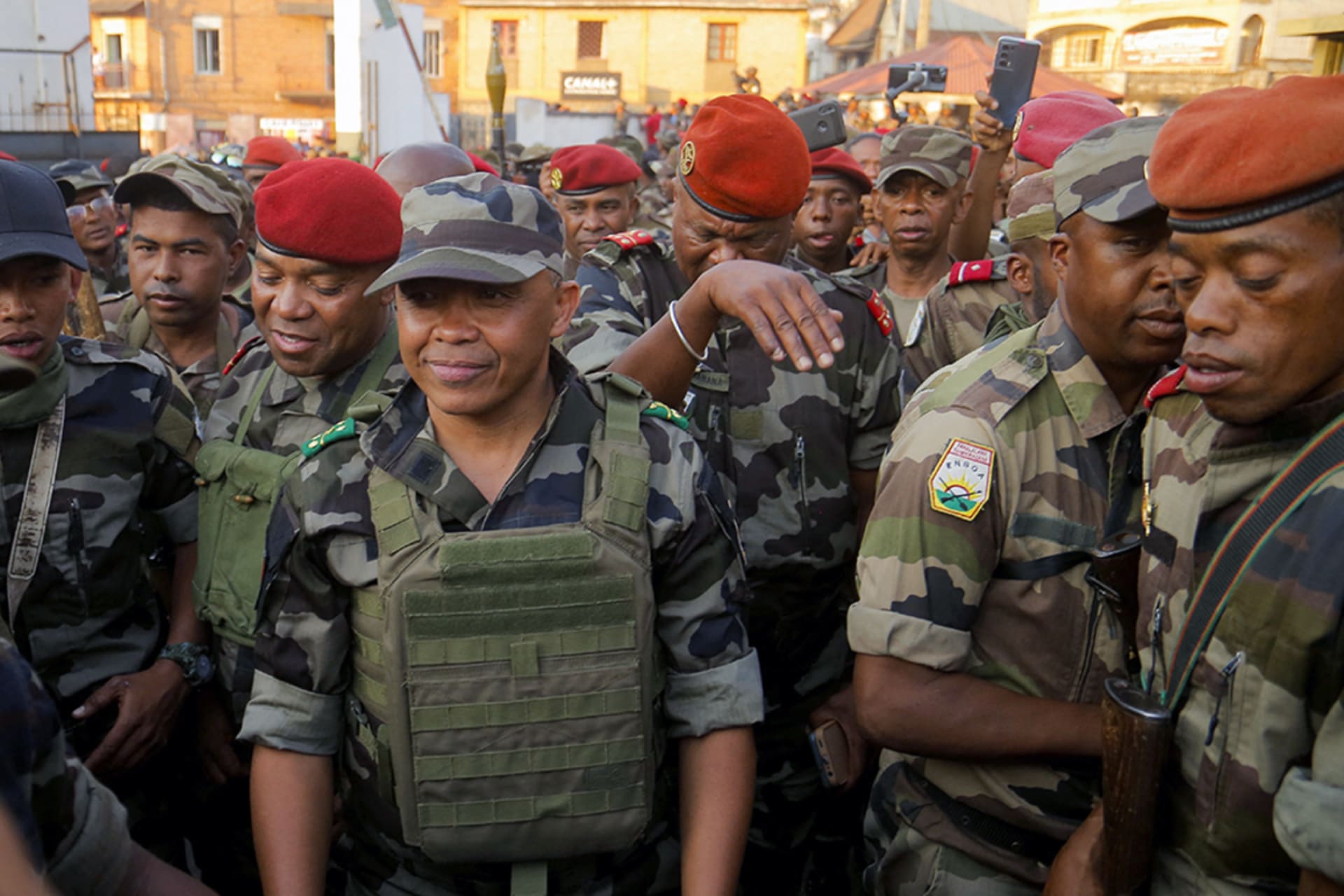
A Madagascar army commander said yesterday the military would manage a transition of power after President Andry Rajoelina fled the country following widespread anti-government protests. The announcement came after the country’s lower house voted to impeach Rajoelina yesterday despite an order from Rajoelina to dissolve the body. Madagascar’s High Constitutional Court said it asked Army Colonel Michael Randrianirina to assume the position of head of state. Madagascar is the latest in a string of countries to be shaken by youth-led protests in recent weeks.
What comes next. Randrianirina said he was suspending state institutions including the country’s senate, High Constitutional Court, and national electoral commission, though not the lower house of the legislature. He said that a military-led committee and a civilian government would manage a transitional period of up to two years before the country’s next elections. In a video statement from an undisclosed location yesterday, Rajoelina claimed he remained in office despite the coup attempt.
The political context. This is the first time a youth-led movement has carried out continued mass protests across Madagascar, activists in the country told The New York Times. Demonstrations started in late September over a lack of reliable water and electricity and grew to encompass broader dissatisfaction with the government. Rajoelina first took power in a coup in 2009 and later won two elections, though many opponents claimed the most recent vote was unfair. Poverty has remained high in the country since its independence from France in 1960, and the economy faced multiple weather-related shocks in recent years.
“Youth-dominated societies that have become more urbanized and digitally connected are ripe for political upheaval. Madagascar is the latest example…The grinding poverty urban Malagasy experience in cities is amplified by their front-row seats to the lifestyles of elites, and their access to information from abroad that can both enhance a sense of relative deprivation and provide inspiration to mobilize for change.” —CFR expert Ed Husain, The President’s Inbox
Across the Globe
Tensions in Gaza. Hamas returned the bodies of four dead hostages to Israel last night, hours after Israel threatened to reduce aid flowing into the territory and accused Hamas of being too slow to hand them over. Israeli authorities said that one of the bodies did not belong to a known hostage. It was not immediately clear Wednesday whether the country would follow up on its aid threat. Meanwhile, Trump said yesterday that Hamas had communicated it would disarm, but warned that if it does not, “we will disarm them…quickly and perhaps violently.”
U.S. aid for Argentina. Trump suggested yesterday that a $20 billion financial support package for Argentina is contingent on President Javier Milei’s party performing well in midterm elections later this month. “If he wins, we’re staying with him, and if he doesn’t win, we’re gone,” Trump said. Argentina’s bonds fell in value following the comment. U.S. Treasury Secretary Scott Bessent had previously pledged support for Argentina saying that the success of Milei’s reforms was of “systemic importance.”
U.S. strike in the Caribbean. The U.S. military killed six people in a boat off the coast of Venezuela that was allegedly carrying drugs, Trump said yesterday. He claimed that intelligence revealed the vessel was associated with “narcoterrorist networks” but did not provide further details. It is at least the fifth such deadly strike in recent weeks. Venezuela’s Nicolás Maduro administration did not immediately respond; it has previously accused the Trump administration of trying to drive it from power.
Pentagon press restrictions. At least thirty news organizations are expected to lose access to the Pentagon building today after rejecting a new Defense Department policy restricting communication with sources. The policy threatens to revoke credentials from and deem a security risk journalists who gather information the Pentagon hasn’t authorized for release, even if it’s unclassified. Major broadcast networks said in a joint statement this would restrict the “ability to keep the nation and the world informed of important national security issues.” A Pentagon spokesperson has said that access to the building is “a privilege, not a right.”
IMF adjusts growth forecast. The global economy is expected to grow 3.2 percent this year and 3.1 percent next year, down from 3.3 percent in 2024, the International Monetary Fund (IMF) said yesterday. Echoing a recent report from the World Trade Organization, the IMF said the impact of U.S. tariffs on the world economy has so far been smaller than expected. The United States is set to grow 2 percent this year, less than the world average. That’s a decrease from 2.8 percent in 2024.
Response to Chinese mineral curbs. Beijing’s announcement last week of sweeping new rare earth export controls is prompting pushback beyond the United States, where Trump retaliated with a 100 percent tariff. Group of Seven countries will discuss the restrictions at a meeting this week, the European Union (EU) economy commissioner said. Meanwhile, a Taiwanese economic official said the country will encourage companies to recycle and refine rare earths. India plans to create a rare earths stockpile and discuss the minerals with the United States in trade talks this week.
France delays pension reform. Prime Minister Sébastien Lecornu announced that he supports suspending President Emmanuel Macron’s flagship pension reform until after France’s next presidential election in 2027. The reform was approved in 2023 without a legislative vote and sparked mass protests across the country. Lecornu’s concession came as he faced a no-confidence vote later this week amid congressional opposition to the reform.
EU tech transfer stance. The EU is considering policies that would require Chinese companies investing in the bloc to transfer their technologies to local firms and use set amounts of EU goods and labor, Bloomberg reported. A European Commission spokesperson said no final decision had been made but that steps “to foster a strong, competitive, and decarbonized European industry” were under consideration.