A Conversation With Prime Minister Sheikh Mohammed bin Abdulrahman Al Thani of Qatar
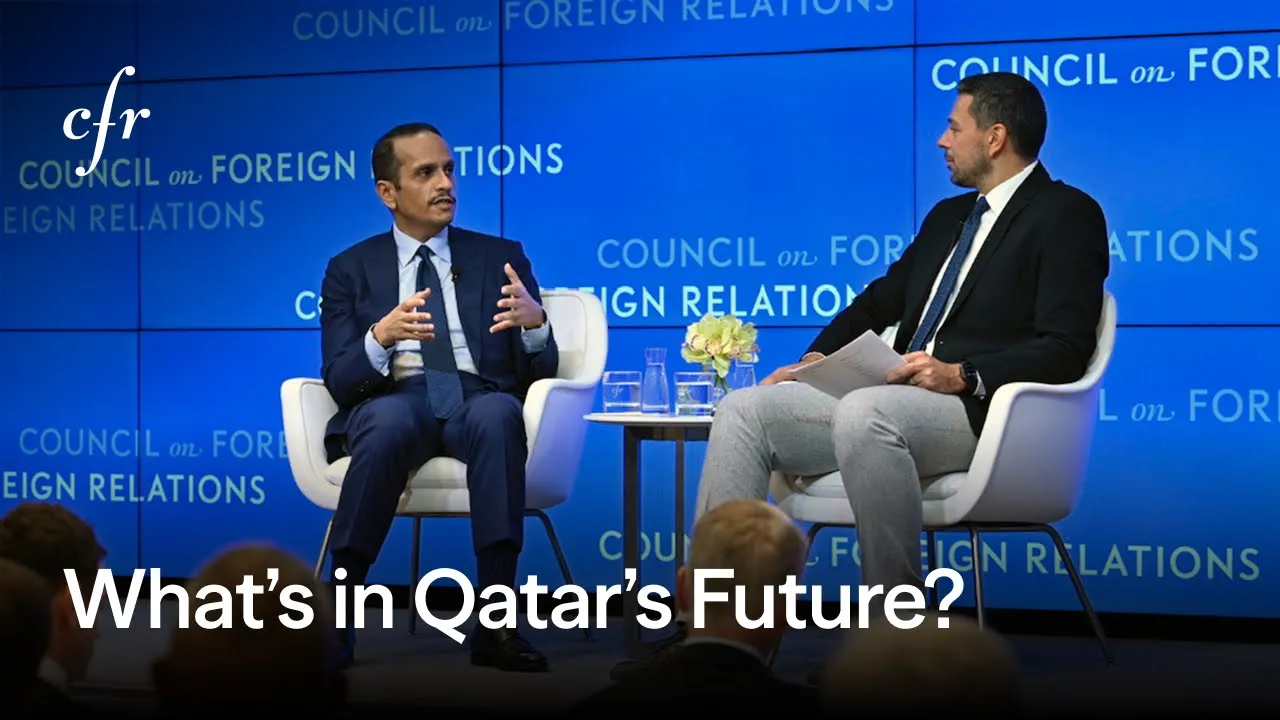
Event date
Speaker
- Prime Minister and Minister of Foreign Affairs, Qatar
Presider
- Co-Host, The Weekend: Primetime, MSNBC; CFR Member
Qatari Prime Minister Sheikh Mohammed bin Abdulrahman Al Thani discusses Qatar’s regional role, including its mediation efforts in Sharm El Sheikh and its response following the Israeli attack in Doha.
MOHYELDIN: Good morning, everyone. Welcome to the Council on Foreign Relations. My name is Ayman Mohyeldin. I’m the host of The Weekend: Primetime on MSNBC.
I have the distinct privilege and honor of moderating this conversation with His Excellency Sheikh Mohammed bin Abdulrahman Al Thani, someone who I’ve gotten to know well over the last couple of years. We’re very lucky and very fortunate to have managed to squeeze in hopefully an hour of his very busy schedule, one of the busiest people, I think, currently in—(laughs)—on the world stage.
Your Excellency, it’s great to have you here. We really appreciate it.
This is an on-the-record conversation. I’m going to moderate the first part of it with a few questions, and then I’ll open it up to the floor and some of our virtual members for questions in the second half.
So really, really appreciate you making time for us. I wanted to start—and I know we’re going to talk about Qatar’s role regionally and the mediation efforts, but I thought maybe I can start with the past twenty-four hours. We’re seeing what is being described as a tenuous ceasefire being challenged. And maybe if you can just give us a read of what has happened in the twenty-four hours. Do you believe the ceasefire is still holding right now? What have you heard from your counterparts as to their commitments in making sure the ceasefire holds?
AL THANI: Well, first of all, thank you, Ayman, for having me. And I would like to thank the Council for having me and giving me this opportunity here today.
In the past twenty-four hours, I believe that everyone was watching the challenges that we were facing in Gaza and the violations that hampers the ceasefire. Maybe because it’s been, like, something—like, a significant event that took place yesterday that brought up to the media and to—and to that level. But this is like something that—expected throughout the ceasefire. And this experience we had at the same time also in the last—in the previous ceasefire.
We’ve been engaging in a—in a very intensive way with both parties in order to ensure that the ceasefire holds. And the U.S. engagement, of course, was key in that. And I believe that what happened yesterday was a violation, and what—we were expecting that this violation also will be—there will be a respond force. But you know, fortunately, I think, like, the main parties are—both of them are acknowledging that the ceasefire should hold and they should stick to the agreement.
MOHYELDIN: You’re using the word “violation.” Could you tell us, who do you believe violated the ceasefire?
AL THANI: Well, look, if we start to describe the violations, it will be—this will be an open-ended—an open-ended question. But what happened yesterday, the attack on the Israeli soldiers, that’s basically a violation by the Palestinian party.
Now, Hamas has put a statement that those—they are not in communication with this group. We don’t know yet. We didn’t have any verification if this is true or not. We remain focused on making sure that the ceasefire itself holds. And also, there were, like, some—we heard some discussions about that Hamas are trying to delay the bodies, and we made very clear for them that this is part of the commitment that we needed to be fulfilled.
Now, looking from our perspective, since the start of this—since October 7 until today, if you look throughout the process we’ve been—like, we went through a lot of challenges, a lot of obstacles, and it wasn’t an easy road. It was a very bumpy road. And basically, we tried our best to navigate and to make sure that, you know, we achieved the first one—the first ceasefire, the second one, and now the ceasefire that hopefully will last.
And throughout this process and throughout all the ceasefires that we have, we had a lot of violations that’s been taking place. Maybe many of them not be reporting—reported in the media because they were not as significant as the one that happened yesterday, but yesterday event was honestly something that very disappointing and frustrating for us to see that it’s happening. And we were trying to contain it, and we mobilized right away after this in full coordination with the United States, and we have seen that the U.S. also is committed to the deal.
MOHYELDIN: So the ceasefire still holds as of—as of now.
AL THANI: Yes.
MOHYELDIN: I think there’s been a sense that the first phase of the ceasefire was always going to be the easiest one because it was a very—kind of clear terms of what was expected by each side. The second and potentially ultimate phase of the ceasefire was the one that people are really concerned about. Do you believe that both sides have a clear understanding of what happens next? Because there’s a question as to whether or not the Israelis expect Hamas to disarm and then, ultimately, no longer be involved in any governing structure of Gaza, and yet Hamas officials continue to say they will be part of a postwar governing structure and have no intention of releasing their—or, giving up their arms unless the Palestinian people tell them to do so.
AL THANI: Well, look, this is—this is a very—like, it’s a very complex war and it’s a very complex solution for it. So, for us, the approach that we took from our side when—since October 7, we had two priorities. One is to bring the hostages back, and to the war and the suffering of the people of Gaza. And if you look throughout the last two years, we were the—like, the main stable player and factor in that formula trying to mediate to bring this to the finish line. And I believe what we have achieved in Sharm El Sheikh, bringing this conflict to the finish line. And our job today is to protect, and to safeguard, and to make sure that it holds, and then also make sure that it’s implemented.
It will be a complicated process. It will not be an easy process to go through disarmament and the decommissioning, but it’s part of the agreement.
Now, I don’t see that the governance will be a challenge because this is something that we’ve been—we’ve been very clear with Hamas, and Hamas respond was—also was very clear to us that they are willing to give up the governance. The weapon question, from their perspective this is—this is an obligation on every—on all the factions, not on Hamas only. And basically, we are trying to push—to push them on in order to get to a point where they acknowledge that they need to disarm and they need to move on to the—to the next stage. And we need to make sure that the Palestinians are safe and the Israelis are safe. That’s, I think—that’s the whole purpose of the decommissioning and the disarmament, and creating a political horizon for the Palestinian people and creating the Palestinian agency that will be able to be the sold holder of arms.
MOHYELDIN: Do you see right now—I mean, I’m not sure if you had the chance to see, but in a recent 60 Minutes interview Steve Witkoff and Jared Kushner both suggested that there was a development plan that has been in the works for two years. Some have said it kind of models the Berlin style, where there is—the Israelis will control one part of Gaza and whoever’s on the other side will control the other. And the concern is that it will split Gaza, Israel retain a certain control. Do you believe that there will be at some point, if the decommissioning and the ceasefire holds, a full Israeli withdrawal from the Gaza Strip?
AL THANI: Well, this is actually—you know, when you look at President Trump plan, the twenty points, it has—you know, the major themes are ending the war, no occupation, and no annexation. These are, like, three key principles that’s been highlighted in the proposal.
Now, the first redeployment to implement the first stage of this deal allows the Israelis to stay in Gaza within these lines. But ultimately, they need to—they need to—also to withdraw, once also the international stabilization forces come into place. And then the process of decommissioning starts. Then the Israelis should withdraw from Gaza.
But we need to go also to address the issue of the root cause itself. We need to create the political horizon and the political environment, the right environment for the Palestinians and for the Israelis in order to reach an understanding and an agreement for coexistence. That’s what we are looking for. We are looking for a two-state solution that will put an end for the suffering for both sides.
MOHYELDIN: And do you think that is still attainable given the political makeup of the current Israeli government, which is talking about annexation and saying resettling Gaza?
AL THANI: It will always be attainable because, look, I mean, whatever the rhetoric that you are—you are hearing now from the politician, at the end of the day I believe there are enough, you know, wise people who understand that you cannot have—you know, you cannot have two people treated differently under one state. And the Palestinians to have their own state, this is their right. And our peace initiative has actually laid a plan for Israel to normalize with the region in exchange of the statehood of—for the Palestinians and providing Israel with the guarantees.
Now, we understand that after October 7 there are a lot of complications and a lot of trauma that happened within the Israelis’ community that made, maybe, two-state solution unattainable at this stage. But the moment will come where we will have—we will bring, you know, all the parties together and everyone will recognize that that’s the only way forward. And I believe right now, with the U.S. engagement—and we have seen how the president, the vice president, the Special Envoy Steve Witkoff, Jared Kushner, all of them, they are heavily engaged, and the secretary of state heavily engaged, in making sure that the ceasefire holds and making sure that we are crossing the line to the next stage, which is hopefully rebuilding—you know, rebuilding the trust, rebuilding—and then rebuilding Gaza, and then also creating a political horizon for the Palestinian people.
MOHYELDIN: Let’s go back to the morning when Doha was attacked. And I wonder if you can talk to me, just reflect on that specific moment how much of a gamechanger you felt in the dynamics of the region when Israel carried out a strike in Doha—what that meant for the state of Qatar, how Qatar decided that it was still going to remain engaged even though it had just been attacked by one of the parties that was supposed to at least respect the mediator’s role.
AL THANI: Well, look, Ayman, this attack was a shock. It wasn’t a shock only for us in Qatar; it was a shock for the entire world. And if you look at where the attack happened and how it happened, how it took place, it happened in a neighborhood, in a residential area where it’s, like a well-known location, that this was the location where the negotiations are taking place. And also, there are schools/embassies around these buildings. And the trauma that they created for the Qatari people actually is also something—was something, like, affected them significantly.
Yet, we still have a responsibility as a country to protect our citizen, to ensure that there are enough security assurances and security guarantees for them, and actually also ensuring that our role in—will remain adding value to—pertinent for the conflict, and it will not be affected. We always—if you look at the pattern of our policies, Ayman, in the last ten years, we always take the high road. We always try to pursue diplomacy over any other options. We went through all the legal channels, the diplomatic channels in making sure that this attack is not repeated, and making sure that Qatar and the people of Qatar are protected. And then we resumed the talks.
But what the people don’t know, actually, is that on the day after the day of the attack, and when His Highness—His Highness was speaking with President Trump, and President Trump was telling him that this might represent an opportunity for us to put an end for the war in Gaza, His Highness was very much positive on that. Although we have halt all the communication with the Israelis at that time, we remained engaged with the U.S. in order to make sure that we can get to a solution.
MOHYELDIN: This might be a bit of a—you know, a difficult question, but there were some questions as to whether or not the United States knew about the attack. Does Qatar have an assessment as to whether or not? I mean, I know the administration came out and said that they didn’t know about the attack, they were notified about the attack, but I imagine that it’s a difficult situation for you and your leadership in the sense that on one hand if America did know about the attack and they didn’t warn you that would be a breach of trust. If they didn’t know about the attack, what does that mean that America’s closest ally in the region, which receives billions of dollars, can carry out an attack against a very close American ally?
AL THANI: Well, I think the attack has affected, like, the heart of the security architecture of Qatar and the security architecture of the region.
MOHYELDIN: Interesting. How so?
AL THANI: Because when you look at—this is for the first time that an Israeli strike kill someone from the GCC. And it killed a Qatari citizen who was just, you know, serving as part of the security details in that location, and he used to serve in the American embassy before that, so. And everyone was shocked. Everyone in the region was shocked. I have seen the leaders from the region, from different countries. They were coming to Qatar, the summits that took place in Qatar. This has shaken, like, the entire understanding of what kind of security we have.
Now, on the U.S. side, we—of course, you know, the relationship that Qatar has with the U.S. we deeply appreciate and we deeply value. And what we hear from the president and the vice president and the secretary of state, they were very clear that they have no knowledge about the attack. And of course, we respect what they are saying and we understand that this is a decision that’s being taken solely by the Israelis. But the concept itself to feel betrayed, that you are attacking, you know, a mediation while it’s ongoing—at the same time, on the day of the attack there were the Colombians negotiating, and just, you know, hundreds of meters away from that location. We had the Rwanda and DRC negotiations ongoing. And having this attack in Qatar on 9 of September has actually shocked the world that a country that doing all these kind of mediations being attacked. This is never being thought of. And I think that the same shock we heard from the U.S. and from the president himself, that he will not allow this to happen again and he will make sure that all the assurances that we will require will be in place for us.
MOHYELDIN: Yeah. I’m going to ask you about some of those mediation efforts in just a second. But just to close this out, how did the momentum then change after that? You said that President Trump spoke to His Highness and said this could be an opportunity. How did we get from, then, September 9 to the ceasefire? Did something change in the calculation of the Americans, saying we’re willing now to put leverage on Israel to bring them to sign this deal, in a way that we hadn’t seen before?
AL THANI: Well, I think that the attack itself has shown the U.S. that there are all the red lines being crossed now in the region. And you know, Qatar is a country that host 10,000 U.S. soldiers, and we have the largest U.S. airbase outside the United States that we are hosting in Doha. Having an attack from a U.S. ally is out of the equation for us and it was never calculated in our defense formula.
And, look, if you look at, like, throughout the history of Qatar, we’ve been attacked three times. One—the first time was by Saddam Hussein; it was Scud missiles which fall in the desert in the ’90s. The second time was with Iran when they were responding to the U.S., and we intercepted most of the missiles. One of them has reached the target in our base, actually, in our side of the base also, not the U.S. side of the base. This attack was different because it killed one of our citizens.
And basically, you know that how—you know, how emotional we were at that time. But His Highness, when the president mentioned that to him, he stood up for it. He stood up for his region and he put the region’s interest ahead of his own interest. And this is—we know that this is something that will bring stability to the region without, you know, compromising the rights of our people and the rights for our country to be protected.
MOHYELDIN: Do you think—because you said that it brought the GCC a little bit closer and other countries in the region saw that if Qatar can be attacked this way they too certainly can be attacked. Did that change the calculation? Do you have any insight whether it changed the calculation of other countries in the region as to how they perceive Israel and whether or not a country like Saudi Arabia would go ahead with the Abraham Accords?
AL THANI: Yeah. Oh, definitely, actually. It affected—it’s affected the—how the GCC looking at Israel now, because they see the attack—an attack on one of the countries—you have seen, like, the first one, the first leader who visited Qatar was Sheikh Mohamed bin Zayed, the president of United Arab Emirate(s). And then the next day—the next day we have the summit and we have the crown prince of Kingdom of Saudi Arabia. And we have defense ministers coming together a couple of days after the attack in order to coordinate and to recalibrate our defense—our defense formula. This attack was a shock but was a gamechanger for the entire region. The entire—like, the entire GCC started to rethink where the threats will be coming from.
Now, we have—we have seen—you know, we have witnessed a lot—a lot of conflicts and we have mediated in a lot of conflicts, and we went through a lot of, you know, unfortunately—unfortunate events throughout these mediations. But you know, attacking the mediator was, like—
MOHYELDIN: Unprecedented.
AL THANI: —unprecedented and it was out of any calculation.
MOHYELDIN: Speaking of your mediation roles, you were talking about some other ones. I think you’re mediating currently seven, maybe eight conflicts around the world that Qatar is involved in. Why? Why do you—why do you want to—(laughs)—why do you want to take on the headache of—negotiating one is fine, but then negotiating eight around the world, why take on that responsibility and put yourself in a situation where you constantly are in these high-stakes talks?
AL THANI: Look, you have—you know, if you are a state, you have between two choices. Either you are passive and just, you know, stay there and doing nothing (about it ?)—I am a small country; thanks, God, I am blessed with resources, I have a small population, and I can just, you know, focus on my country and my country development, and this is our priority for. But the region that we are living in, it’s not—like, it’s not—it’s not an easy region. It’s a region that has a lot of history, has a lot of, you know, baggages that came from this—from this history. And also, you know, you see proxies, ancient wars, like, everywhere.
We found out that Qatar ability to move in a discreet way, below the radar, in making sure that conflicts can be resolved, even sometimes can be prevented beforetimes, and can be resolved in quiet rooms. And we proved—like, we proved that successfully. Qatar became, like, a responsible player in that field. And mediation, actually, is something that—enshrined in our constitution, and since the founder of the country, Sheikh Jassim. He’s someone who was always calling for peace, always calling for engagement, for dialogue. And this is just, you know, a heritage that we have, and we—and we are happy that we are—today we are defined as global mediator, not only for the region. But this trust that we have built throughout the years in our mediations in the region made our mediation becoming more global, and we see that it’s going all the way from Latin America to Africa to Asia. And that’s basically what we are doing.
MOHYELDIN: Are you making progress on any of the other ones that you feel will be resolved? I mean, you talked about Colombia. You talked about Rwanda. There’s—which one are you most optimistic about?
AL THANI: All of them—all of them are ongoing right now. Honestly, I cannot distinguish one from another. Like, but for example, with the recent conflict between Pakistan and Afghanistan, we hosted a round of talks that led to a ceasefire. Now the second round of talks to extend the ceasefire has been ongoing in Turkey in the last few days. And this is something which we—which we are hoping that will see a result as soon as possible.
But then DRC and Rwanda, it’s also a very complex issue. We tried to make sure that progress in the right direction, and we—and that we have, like, enough understanding in order to propose for them meaningful solutions.
MOHYELDIN: OK.
We can open up some of the questions now to members of the Council. And I think we also have some people online. So I think if there’s anyone that has a question, please raise your hand, and we can start in the back and work our way up front to this lady right here. Yeah.
Q: I’m Alexandra Starr with International Crisis Group.
I was wondering if you could speak about the role Qatar has played in mediation with Venezuela, and in particular whether the current actions of the United States in the Caribbean are impacting those talks.
AL THANI: Regarding our efforts with Venezuela, we started this during President Biden administration when there was an engagement between the two governments. And this engagement actually has led to a release of some Americans back—to be back home.
Now, with President Trump we’ve been reengaging with them. If they are—if the U.S. are still interested in engaging in finding a solution with Venezuela, we are—we are ready to mediate and to help to facilitate that. But currently there is—nothing solid is ongoing.
MOHYELDIN: Actually there was one—another lady that was here, and then if you have—right here. Right here.
Q: Your Excellency, my name is Rina Amiri, the former special envoy for Afghan women, girls, and human rights. It’s good to see you again.
You noted your efforts in Afghanistan with the Afghanistan-Pakistan conflict, but Qatar has been involved for quite a long time working on Afghanistan and trying to move the Taliban towards a more moderate approach. Yet, despite your efforts they are increasingly becoming hardline. They have shut down the internet for two days. They continue to crack down on a wide range of groups, have continued to deprive women of education. What do you see as the pathway towards moving Afghanistan towards greater inclusivity and stability? And what should the role of the international community be? Because we’re seeing Afghanistan completely disappear from the attention of the broader international community. Thank you.
AL THANI: Well, of course, we didn’t expect after the agreement and Taliban took over the governance over there that we will have a smooth transition or we will have a(n), you know, Afghanistan that, all of us, we are aspiring to see.
But also, it didn’t go as bad as it was expected. And we know that there are a lot of challenges over there. Now we need—when we look at it from our understanding, that there are—there are some of the Afghan leaders who are trying to—you know, to put this agenda forward, with all these restrictions. But there is also another camp within Afghanistan who wants to see Afghanistan opening up with the world and having a better relation with everyone around them.
And I believe that what will prevail at the end are the ones who want to build a state that has a normal relationship with the international community. And basically, the efforts to change this situation in Afghanistan should be carried out by the international community in a way—in an incentivizing way, instead of a penalizing way. Our approach is, instead of saying that because you are doing that I’m going to sanction you, should be the opposite when it comes to Afghanistan. If you are going to do this, I’m going to reward you by that. So I think that this mindset needs to be changed by the international community. Then we can get maybe Afghanistan on the right track.
MOHYELDIN: We have a virtual question that we can take, and then—OK. Well, let’s take one more from the room here. This gentleman right here.
Q: Your Excellency, my name is Andrew Gundlach. I’m the CEO of Bleichroeder.
I have an easy question for you. You come to the city of New York on the eve of electing our first-ever Muslim mayor. It is also—
AL THANI: Is it tonight? I don’t know.
Q: No, no. (Laughter.) I mean, not the actual eve. A week away.
AL THANI: OK. (Laughs.)
Q: It’s not a surprise. He’s run an absolutely great campaign. And the Muslim population in New York, mostly Bangladeshi and Pakistani, has doubled over the past thirty years. The Jewish population is flat. It has brought presidential attention. It has brought in claims of funding of the Muslim Brotherhood of Qatar. But it is the most important Jewish city in the world. And it’s also a merchant city, not unlike Dubai or Doha, where the merchant class has always run the city from its founding. And we’re looking for governance from the center. At least all the great mayors have been from the center. So I’m curious what it means for you, as a Muslim, as an important mediating country, to have the most important city in the world, with the biggest press, run by a Muslim. And if he were here with us today, what would you be asking from him to help bring peace to your region and to the conflicts, where he can bring attention that no other mayor in no other city can?
AL THANI: Well, I think, for me—as for me, as I stated, it doesn’t make any difference who will be elected, to be a mayor of New York, or, you know, any other city. I’m sorry to say that, because—(laughter)—but, you know, people are, like—unfortunately, became, you know, very obsessed that Qatar is trying to project influence everywhere and trying to fund this and that. And they are the ones behind him, because he’s Muslim. And I think that we just need to take a step back and think about it. What would be a Qatar interest in doing such a thing? I mean, my interest is to have—to build a strong relationship with the United States. I have a strong economic partnership with them. I have strong security partnership with them, and in defense. I have a strong energy partnership with them.
So this combination of partnerships that has multiple sectors I need to safeguard and to protect it. That’s my whole focus, is how to protect the relation between Qatar and the United States because United States matters to me as a country, and I matter for United States, as I’m hosting their largest airbase. And, you know, when it comes to the energy sector, we are—we are, like, the two biggest suppliers in the world for LNG. And, you know, the election of New York and all those claims, unfortunately, it’s for me—I love New York as a city. Whoever is the mayor, I mean, it’s the American people’s choice.
MOHYELDIN: The traffic could get better one way or the other, that could impact you. (Laughter.)
AL THANI: I mean, that’s maybe—that’s the only thing what I would be happy about. (Laughter.) Other than that, I have—honestly, I have no idea, no relation with any one of them—with any of the candidates.
MOHYELDIN: This gentleman right here.
Q: Thank you. Your Excellency, Bob Diamond. I was the former chief executive of Barclays.
And one comment and one question. The comment is just to say that when we look back at the financial crisis of 2008, people generally point to Warren Buffett as being a brilliant investor when he invested in Goldman Sachs and Bank of America. And most people don’t realize that it was the Qatar Investment Authority in Qatar that put six billion pounds into Barclays that allowed us to buy Lehman Brothers’ U.S. business at a very attractive rate. I personally know the return you got on that. I won’t announce that right now. But I do want to say that of all the things that Qatar has done, they don’t get the credit they deserve for Qatar Investment Authority being the astute investor they are.
Apropos of that, and apropos of banking, the question I have for you, Your Excellency, is, given your ties to the U.S. and the dollar, do you have any worries about the role of the dollar as the reserve currency?
AL THANI: No, actually, look, we have—we have a lot of confidence in the U.S. economy. For us, it’s a fact. U.S. today is dominating the world economy. And I—to be—like, for our currency to be pegged to the dollar, it’s because it is a stable currency. And our main production is the oil, which is dollarized. Now, to have an alternative, this always, like, should be any state Plan B, to have an alternative reserve of gold and other currencies. But for us, I think that even with the current circumstances, the U.S. economy is resilient, and will just—you know, we’ll get through this period, and we’ll move on.
MOHYELDIN: This gentleman—actually, let’s take one virtual question. Then I’ll come back to you. Sorry. Virtual question.
OPERATOR: We’ll take our next question from Nick Schifrin.
Q: Hi, there. Sorry about that. Hopefully you can hear me this time, Mr. Prime Minister. Thank you so much.
I want to go back to where you guys began this conversation and where it started. So just to—just to put a point on what happened over the last twenty-four hours, the Americans have made it clear to the Israelis that they want Israel to respond to any Hamas violation, within reason. And so can you judge Israel’s response to Hamas’ violation? Palestinians are saying more than a hundred people were killed in these airstrikes. And just in general, can you give us insight into how you spoke to or how the mediator spoke with Hamas yesterday to try and ensure that the single violation from yesterday did not continue into today? Thanks.
AL THANI: Thank you. Well, look, I think if you look at it from an outsider perspective, you know, it’s at the end who started the violations and who, like, then the respond will be, like, a reaction to this violation. Yesterday the situation was complex. And there was a violation that—by a Palestinian group. Now, we heard also a conflicting statements from Hamas itself that we need—we need the clarifications, and we need an answer from them on that. But statements mentioning that this group is—they lost communication with, and they don’t know what they are doing. And other response from them that what happened is by a group which are not related to them. It doesn’t matter for us who did what. What matters to us is that how we make sure that we safeguard the agreement. We make sure that this event or this occasion doesn’t affect or, you know, make this agreement collapse, and making sure that we are back on track. And us and the U.S. and Egypt and Turkey, all of us, we are focused on that direction only.
MOHYELDIN: I’ll go back here. This lady right here.
Q: Thank you, Your Excellency. Camille Massey with Synergos.
Would you be able to take us into some of those quiet rooms under the radar where these mediations happen? We live in a world with such a trust deficit that to see the role that you’re playing and that your team are playing in so many conflicts in the world gives hope. It would be interesting just to hear you talk about the attributes you seek for members of your team, and what some of the lessons you’ve learned, with this responsibility that emanates from the constitution. Thank you.
AL THANI: Thank you very much. Well, look, we try to handle every mediation differently. First of all, we need to have a clear understanding on both parties and their requirements, their dynamics, and what they are able to do, and what they are not able to do. And have a full understanding of that, and trying to provide solutions and bridge the gaps between them. That’s basically our role when it comes to mediation. Now, the nature of the mediation and the way the mediation is conducted is different. Whereas you have a situation where, like, for example, in the negotiations between U.S. and Taliban, it was direct negotiations between the two parties, and Qatar was facilitating between them, making sure that every gap is bridged, making sure that whenever the talks collapse that we bring them back together, and we put them back on track.
But if you talk about, for example, Israel and Hamas negotiations, they’ve never been in the same room across each other from the table and talking to each other. And this is making our life very more challenging and more difficult because we are the messengers between both. And we are trying to present solutions, genuinely thinking about it as a solution that satisfy both parties. So when I’m wearing the hat of the mediator, I don’t look at what will be, like, my interest as a country. I look at the interest of the parties, I look at the interest of the region where the conflict is. And I put that ahead of any other interest. And this is—this is how we do this.
And, look, I—if you will ask me, like, what is distinguishing our mediation and why people are reaching out to Qatar? I think number one is trust, and the trust that we have built through friendships around the world has, of course, boosted Qatar in that role. And also, the transparency that we are dealing with. We are not—we are not conveying, trying to convey, like, long messages between the party—(coughs)—between the parties to achieve success. But we are trying to be very clear with them, and proposing for them solutions that’s adoptable by both parties. And that’s how we work.
I just give you an example on the recent—like, the event of Gaza throughout the ceasefires that we had. In many occasions, we were talking to both parties, taking their concerns into consideration. And, you know, also, like, our position, for example, that—with Israel is not—like, is not the best position, because for us they are still occupying an Arab land. And they are not giving the Palestinians their right. But we never dealt with them in an unfair way. We’ve been always listening to them, understanding, and trying to put ourselves in their shoes, and also proposing solutions that are adoptable by them, that they can do it. Not proposing for them impossible solutions.
And carrying this with you as a genuine mediator, I think this is—this is what distinguish Qatar from the others. We try not to, like, mask things and, you know, sugarcoat them in order to appear nice, and then we—when we reach to the final stage of the agreement everything collapse, or even sometimes when we reach the agreement ceremony we celebrate today, and the next day everything collapse. So our—I think our main focus is how to ensure that our credibility and our—and the trust that we have built never be affected.
MOHYELDIN: Has there been a mediation effort somebody asked you to do that you said, I’m not touching this. We don’t want to be involved in this one?
AL THANI: Oh yeah.
MOHYELDIN: Really? (Laughter.) You want to tell us who it is?
AL THANI: No, I don’t want to—(laughter)—
MOHYELDIN: I thought I would try. We have one more virtual question.
OPERATOR: We’ll take our next question from Jane Harman.
Q: Thank you and good morning. Let me thank the government of Qatar again for your enormous effort to reach for 85,000 refugees coming out of Afghanistan, following the chaotic exit that our country made, and to do DNA testing and try to unite them with their families. It really was a heroic effort and you deserve enormous praise.
My question is about governance, both in the Palestinian Authority and in Israel. I don’t think you’ve addressed this, but what are the chances that with Mahmoud Abbas’s advanced age and the corruption of his government, and with Bibi Netanyahu’s far-right coalition, that we might see a transition in both—in both areas, and that that might lead to a quicker resolution of certainly what many of us support, which is a path to two states?
AL THANI: Thank you very much. First, thank you for your kind words and thank you for your question. It’s very important, because today when we are looking at the situation in Gaza one of the main questions are—is the governance, how the governance will be identified. And how, also for us, from an Arab perspective, how we make sure that Gaza will never be separated from the West Bank and they will be always dealt with as one unit. And this is also when I was talking about the understanding of the parties, because of our understanding of the dynamics, whether it’s on the Israeli side or on the Palestinian side, we came up with this formula, together with our partners in Egypt, to have this independent Palestinian committee as a temporary solution until the reforms of the PA are taking place. And then, bringing them together under one umbrella.
These efforts are carried out in terms of reforming the PA—carried out by many countries in the region, but led by the Kingdom of Saudi Arabia. And it’s been progressing. And we are working very closely with them. I think that the Saudi-French plan that been announced during the United Nations General Assembly have put clear milestones for the reformation that the Palestinian Authority needs to do. And I hope that this will follow course. And even within President Trump’s twenty-points plan, we have that the governance will be—the governance of Gaza will be temporary until the PA reforms and become ready to have—to be—to resume their role and assume their role in the Gaza Strip.
MOHYELDIN: OK, can I follow up on that real quick and ask, why doesn’t Israel release Marwan Barghouti, somebody who Palestinians agree could be a force for change, a catalyst for change, somebody who is well-regarded? They’ve released people who have much more—longer prison sentences, much more, you know, quote/unquote, “blood on their hands,” as they say, about Palestinian prisoners. But why would they not release somebody who can be a catalyst for the change that could herald in a new era of governance? And maybe just a quick follow up on that as well, is why would Arab countries, Gulf countries, help rebuild Gaza or help rebuild the West Bank, if Israel can come in every couple of years with impunity and bomb it, and no accountability?
AL THANI: Well, you asked two important questions. First of all, regarding Marwan Barghouti, and why they don’t release him, I think this question needs to be asked for the Israeli government. But there are tens or maybe hundreds of Marwan Barghouti in the Israeli prisons that’s been prosecuted, and tortured, and, like, mistreated. And no one is talking about it. And we know. We’ve seen it. We’ve heard all—like, all the reports that’s coming out of these prisons that those—some of them are being imprisoned without even a trial. And they need to be released. But the Israelis, they have their own calculations when it comes to their reason.
For example, when the hostage deal was reaching to the finish line, I remember my conversation with Steve and Jared, both of them, they were telling me the list of who would remain, this is an easy thing that we will finish it in two hours. I told them that you guys don’t know the two parties, actually. Last time we spent days, like, continuously, working twenty-four/seven, in order to get the consensus around the names of the prisoners who will be released. So Israel will never allow for, like, symbolic name to be released, or maybe this name has, you know, another, like, complications. And there are, like, plenty of humanitarian situations—like, there are some of the prisoners who spent maybe forty years in the Israeli prison right now. Either they are stage four cancer, or they are blind, or they are not able—like, they are not able to walk, or they are not—like, they are paralyzed. And yet, they are still there in the prison and not allowing them to be released because of the symbolism of their names.
I think this is something that needs to be addressed. And I think also Israel should be held accountable for what’s happening in their prisons with the Palestinians. I don’t know if any of you are here watching the videos that what Minister Ben-Gvir is doing for the prisoners over there, is very inhumane in a barbaric way. And I think that this should not—it should never be acceptable for anyone in our today’s world.
What’s the second?
MOHYELDIN: About bombing—why would Arab countries, Gulf countries, and European countries—
AL THANI: Ah. Well, this is also, you know, another very important part. Look, from my perspective, as state of Qatar, I’m telling you, like, we took this commitment on ourselves since October 7th to bring everybody back home from the Israeli side, and to end the war on Gaza. And that was our focus. That was our mission. We focused on that, and making sure throughout the process that even when we reach the destination, there is a smooth transition. And a smooth transition means that this transition needs to be safeguarded in order for us to make sure that our money will not be also wasted in another war. That means that Israel should stop provocation for the Palestinians, and the Palestinians, Hamas namely and other factions, needs to stop also intimidating and threatening the Israelis, and shooting missiles on them.
I think once we reach the formula of the confidence-building measure between the—between the two parties, and making sure that this will not be repeated again, and making sure that, you know, the U.S. also stay focused on that. And with what I’m seeing right now, and what I’m experiencing with the current administration, with both Steve and Jared, and also Admiral Cooper from the CENTCOM, we’ve seen them—like, they are heavily involved and committed to the process, making sure that it’s holding up. And we are working together with them closely on a day-to-day basis. And we told them that, for us, we did our part, but we will always remain there helping you and supporting all the efforts of the reconstruction, of moving on to the next stage, and hopefully to get for the Palestinian statehood at the end.
MOHYELDIN: Hi. This gentleman right here.
Q: Thank you very much. Joe Gasparro, Royal Bank of Canada. Your Excellency, thank you again for being here.
You launched Enterprise Qatar, a really great initiative to develop startups and small- and medium-sized businesses in your country. Love to get your sentiment on the current entrepreneurial ecosystem and kind of mindset in your country. Thank you.
AL THANI: Well, thank you, Joe. I didn’t expect that, for a start. (Laughter.) Thank you very much, actually. You know, you made my day—(laughter)—because, like, whenever I’m on a stage everyone is interested about conflicts and wars, not about those, you know, positive stuff. But, yes, that’s right, actually. I was honored, back in 2009, to establish what’s called Enterprise Qatar, and to look at the ways how to enhance small and medium enterprises, and making them a vital part of our economy. Of course, since that time until today, there are a lot of changes has happened. And we have seen the contribution and the growth in the small and medium enterprises sector in Qatar is growing in a significant way. And we have seen that, even if you look at our growth reports in the last—in the last year. It’s all led by non-hydrocarbon sectors, and mainly most of them are small and medium enterprises.
Now we are trying to also—to make sure that we are taking them throughout the journey, and taking them from being small and medium, to internationalize them, and creating them as national champions for us, as other national champions that we have created as the government. And this, we are trying—we are now in the process of developing some instruments within the government that brings those companies to the next level. At the end of the day, Qatar is a small country with a small population. We have a small market. But when we look at ourselves, we don’t look at only inside and how to serve our market. We are surrounded with, like, almost, you know, I don’t know India population how, how big it is, but, like, I calculate, just, you know, the adjacent countries, we are around 600 million, when you look at Iran, and Pakistan, and all the other countries in the Gulf, India—with India, probably two billion, so within a radius of three to four hours flights, or the shipping in a very short—small number of days. So this is something that we want to capitalize on. And we want to bring our companies to help them to serve those markets.
MOHYELDIN: This lady right here.
Q: Hi. Nayeema Raza. I’m a journalist.
MOHYELDIN: One second. Take the microphone, please.
Q: Yes. Sorry. Hi. Thought I was so loud. Hi. Nayeema Raza here. Journalist and podcaster.
One country that it’s—I don’t have a question about Qatar economic development, unfortunately, but I was going to ask you about Iran, a country that actually hasn’t been mentioned for the last hour or so. Obviously, before the September 5th attack there was the Iranian attack on a U.S. base in Qatar. I’m curious why it hasn’t come up. Do you think the Iranians are less relevant now, since U.S. strikes? Or are they not playing a critical role in the region going forward, from your perspective?
AL THANI: I didn’t get the question.
Q: The question is about Iran.
AL THANI: Yeah, but—
Q: And what role they play in the future of the region.
AL THANI: Ah, the future of the region.
Q: And why it hasn’t really come up in the last hour. Are they less relevant? There’s a theory out there—
AL THANI: No, no, no.
MOHYELDIN: I’m responsible for the questions—
Q: No, no, no. I mean, from all of us—that’s from all of us, actually.
MOHYELDIN: So that bias is on me, but—
AL THANI: Well, but, first of all, you know, just very, like, brief geography lesson. Qatar is, like, almost 150 miles away from Iran coast. So it’s nothing. Iran is my neighbor. I share with them the largest gas field in the world. And I own the majority of this gas field. For me, the stability of Iran is key. It’s not a luxury that, you know, I’m just looking for. It’s a necessity. For me, it’s very important that Iran to be stable. And to be stable, we need to think about it in a diplomatic way, how we reach a solution through diplomacy, while, you know, we ensure that our region is a nuclear-free region, there is no nuclear race, and Iran has the right to develop their peaceful nuclear program for power generation or whatever, within the international law.
And it’s concerning for us to see, you know, sometimes—and to hear this rhetoric that’s coming out from Israel or from Iran on the escalation. And we are trying to engage with the U.S. and with the Iranians to make sure that the talks come back on track between the two countries, because I believe once we have the talks started between Iran and the U.S. in a serious way we can achieve—we can achieve an agreement, we can achieve a deal. That will be better for everyone, for us in the region, for Iran, and for the United States.
MOHYELDIN: Sorry, we’ve run out of time, and I know the prime minister has a very busy schedule. Your Excellency, thank you so much. I just want to remind everyone, this will be online. (Applause.) The transcript and recording will be online for anyone who wants access. Thank you so much.
(END)
This is an uncorrected transcript.