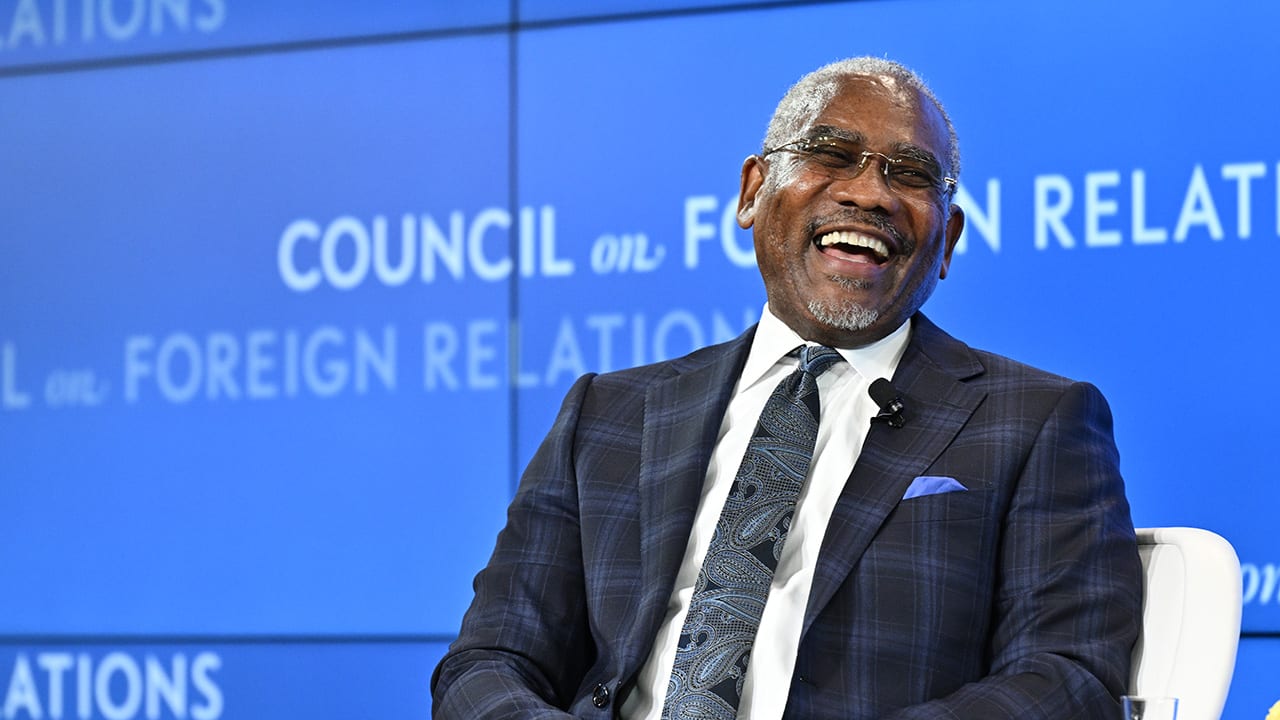
A Conversation With Representative Gregory Meeks
Event date
Speaker
- U.S. Representative From New York (D); Ranking Member of the House Foreign Affairs Committee
Presider
- Michael FromanCFR ExpertPresident, Council on Foreign Relations
Representative Gregory Meeks discusses the Democratic vision for the future of U.S. foreign policy.
FROMAN: Well, good evening, everybody. You know, who the real hardcore CFR members are who are here in late July. (Laughter.) So it’s great to see you all. And it’s a real pleasure to be able to represent—to invite here Gregory Meeks with us, our representative from the Fifth District of New York, which includes JFK Airport. So you’ve all spent a lot of time in this district. Ranking member of the House Committee on Foreign Affairs, former and perhaps future chairman of the Committee on Foreign Affairs.
MEEKS: I like that future. (Laughter.)
FROMAN: And we’re really delighted to have you. So thank you for taking the time. Lots to discuss here. We’ll talk for about thirty minutes, or twenty-five minutes or so, and then open it up to questions. And the congressman has a vote he needs to get back to, and so we’ll try to be very respectful of his time as well. As you know, the Council—first of all, Congressman Meeks is a new member of the Council on Foreign Relations. So welcome. (Cheers, applause.) Delighted to have you. Nominated by Alice Albright, here in the front row. She came to make sure she didn’t make a mistake, you know, in nominating him. (Laughter.) But look, we are—as you know, we’re a nonpartisan organization. We really focus on the consensus around foreign policy wherever possible. Tell us where you think the bipartisan consensus is on American foreign policy these days, and what are the sort of prospects and limitations to it.
MEEKS: Well, if I’m going to be transparent, it has changed some—
FROMAN: By the way, this is on the record.
MEEKS: I’m on the record. (Laughter.)
FROMAN: Just—you know. But please be transparent.
MEEKS: It’s on the record. In the last six months. There’s, I think, plenty of things that we agree upon, at least with me and a number of individuals on the committee. But I don’t see the votes to follow that. And unfortunately, on the committee itself, we’ve not had many hearings where we had individuals from the administration come in so that we can do the work that we’re supposed to be doing in a bipartisan way. So we’ve only had two members of the administration, one being Secretary Rubio who had a mandatory requirement to appear. That was very brief and short. And then this last week, a deputy secretary. So I would say we are in still formation. We haven’t traveled together in a bipartisan way yet. So I look forward to maybe doing that sometime soon with Chairman Mast. I will say that the bipartisanship of dialogue and conversation between me and Mr. Mast is there. We are having talks back and forth.
We’re trying to make sure on agreement in regards to how the committee moves forward together. We differ on various issues thus far, as you can see with reference to what recently happened with over 1,300 people being dismissed at the State Department, and the dismantling of USAID, and the rescissions of over $8 billion dollars, you know, primarily all in foreign aid. So those are where we’re having differences where we had previously—you know, when you look at the recissions, the money that had been appropriated for various entities was done in a bipartisan way. And the vote to take that money away was done along party lines. We wanted to continue that agreement because it was done in a bipartisan way, and the other side, and particularly led by the president, decided that that should not take place. And so they grabbed it back.
So I am hopeful that, because it’s really important, I believe, for the United States—you know, we used to—that we travel together. Because I think that when we do that we can see collectively what is in fact happening on the ground and have mutual conversations, because we’re trying to make sure that is not politics that’s playing and taking a role in foreign affairs. So I would hope that we start taking the lead of what you do here at the Council, because it is a bipartisan organization, which is why I’m proud to be now a lifetime member of it. Because foreign affairs, foreign relations, and working with our friends particularly, and trying to compete with our adversaries, should not be a political issue. It should be something that is so important to the American people. And I think it would help us overall, because the American people, I think, get confused about foreign affairs. And when they see us bickering in this regard, it hurts them understanding the significant and importance, particularly of soft power.
FROMAN: Well, let’s talk about a couple of the issues. And we’re going to come back, I think, to soft power and the American public. This has been an interesting week, last week or so, when the president seems to have lost patience with President Putin, opened the door to Europe drawing down their weapons and replenishing them by purchasing American weapons. At some point, that $61 billion package that Congress approved during the last administration for Ukraine is going to run out. Do you anticipate that Congress is going to be asked and would approve another package of direct aid to Ukraine? Or is this sort of way of going through Europe buying it on Ukraine’s behalf the more likely outcome?
MEEKS: Well, I certainly hope that we would approve additional funds to Ukraine. I will tell you that from the very first time that I visited Ukraine, before Russia’s invasion, what the Ukrainians said is: If you just give us what we need, we will fight. We don’t need any American troops. We don’t need anything else. Just give us what we need. And I remind people often, a lot of individuals thought that Russia would wipe out Ukraine in a week or two, a month at most. And here we are, almost three years later. And as long as we were giving them what they needed, they, in fact, were pushing back and winning. And it got to a point where I think that Russia was just trying to wait things out. And unfortunately, we gave in and stopped giving them what they needed. And that has changed the balance of the war.
And so I am hopeful that the president and the rest of my colleagues in Congress—I know at least twelve of my Republican colleagues want to give Ukraine more money. So I would hope that—
FROMAN: This is twelve Republicans on the committee?
MEEKS: On the—not on the committee.
FROMAN: More generally.
MEEKS: More generally. I know of three on the committee. And actually, if it was on the floor I think just about every Democrat would vote for it, and all we would need would be is three so that we can pass it. But it’s significant for Ukraine, and I think it’s significant for our allies also, who are all together, collectively, standing for Ukraine and looking for the United States leadership in their end. Because they are now doing all that they can. But they can’t do it without the United States and our leadership and us participating. So I would hope that we step up, and do, and work collectively with our allies.
FROMAN: Let’s talk a little bit about the Middle East, where the security situation has changed fundamentally since October 7th. We had the recent attacks, the bombings in Iran—of Iran. Do you expect there to be a negotiated agreement at this point between the U.S. and Iran? If so, what does that look like? And if not, are we likely to see more bombing in the future if Iran continues to try and build out its nuclear capacity?
FROMAN: It is my hope that we do and utilize diplomacy. I don’t think that we can be successful, ultimately, without diplomacy being a huge part of that. I understand, and that—you know, and we all agree—that we could not allow and do not want Iran to ever have a nuclear weapon, because that would change everything for almost everyone. That’s why, with our allies—and in this case, at least previously with the JCPOA, even some of our adversaries—we’re all together, because that is something that is in everyone’s interest, is to make sure that Iran doesn’t have a nuclear weapon. And as we can see from this initial strike, which, you know, we didn’t want to jump for joy and say it’s over, that there’s still questions of where some of the enriched uranium may be, and how much is it, and what it could be utilized.
So really to resolve all of those issues, to make sure that they don’t have a have a nuclear weapon and will not get one, it has to be dialogue, and conversation, and diplomacy that takes place. You know, I was one that was in favor of the JCPOA because of that fact. It wasn’t the United States alone. It was us and our allies, as well as China and Russia, that was working together. And the most important thing was that we had the IAEA, who had eyes inside of Iran, so that we could check and verify what was or what was not going on. And I think that’s the way that we need to move now. So the threat of utilizing force is always there, if necessary. But I believe that if we do not engage diplomatically also that we will never get to where we really want to get to.
FROMAN: Do you think for an agreement to pass Congress it has to eliminate any enrichment program in Iran? Or can Iran still have the possibility of enriching for peaceful uses?
MEEKS: Well, you know, and that’s a good question, because what I’m doing with some of the members of the—at least the Democrats on the committee, is talking to some nuclear scientists to see where we are with reference to at what level of enrichment the uranium has to be so that you can have access. Some say 60 percent and higher. Some say it could be lower. So I want to go through that. I understand that we’ve got to know that Iran should have energy, but it’s got to be where we have someone that’s there watching, knowing what is being produced, where it’s being produced, getting rid of—as a part of the JCPOA had a number of things that was removed from Iran so that they would not have access to it to enrich. So I think that we should still move in that direction, not just—you know, because it’s always, as President Reagan said, trust but verify. And we’ve got to be in a position to do that, to make sure that they could only utilize it for some civilian purposes.
FROMAN: Let’s jump to Asia. How concerned are you and your colleagues about the potential for China ultimately to invade Taiwan, and about the possibility of them taking actions quite a bit short of invasion, but could still basically force Taiwan to reunify with China?
MEEKS: I think that Congress in general is very focused on it. I think that President Xi is observing what we do now. I think that is—he’s looking at what’s taking place with Ukraine, for example, and how much we will stand behind Ukraine, to get a temperature of where the United States is in regards to protecting Taiwan. I think that one of the things that our—that President Biden did do that was substantial, not only in Europe but in Asia, the Pacific, was to get our allies there together and working together.
I mean, it was a big deal, for example, getting South Korea and Japan to talk and work together, and thereby also understanding the threats to Taiwan, and then having the other countries in the region all working together, when you’ve gone to the Shangri-La Defense Council, that they listen to the talk to what was taking place, and the opportunity that I had in speaking to the various defense ministers, substantial. And they all are together to counter the threat of China, either to themselves, going all the way to Taiwan.
FROMAN: Yeah. You’ve been long involved in trade issues, when we first got to know each other. Let’s talk a little bit about China though, and economic security. What role do you see for export controls, and foreign investment constraints, and industrial policy going forward? Do you feel like there’s a balance to be struck? Where do you think we are in how we use these tools to ensure that we’re achieving national security through our economic tools?
MEEKS: There’s definitely a balance to be struck. I think that, you know, again, you don’t go to one extreme to the other, but there’s a balance that you can do because we want to be competitive with China. At the same time, we’ve got to make sure that we protect our own national security, and so that we’re not giving away things that would endanger us. And I think that there’s a way of which we’re doing it now that we need to continue. I don’t think—you know, there was a chip just last week where the president decided to waive trying to get a trade agreement. The chip may not be substantial, but I don’t want us to use tariffs or to get a trade agreement to put our national security at risk. And we’re giving away something that could sustain us and keep us protected. So I think it’s got to weigh—we got to weigh that balance.
And I think that it’s got to be that dialogue and conversation that we have. You know, I look—and we have this competition, to a degree, on chips between the Foreign Affairs Committee as well as the Financial Services Committee, which I sit on both. And it will take—and I think, you know, both sides—and when I say both sides, Democrats and Republicans—you know, having these deep dialogue and conversation. Some of it, you know, in a classified manner, because of our national security interests, so that we can make sure that we’re making and keeping that right balance to be competitive, to be cooperative in certain areas, as far as how we move forward with technology in the future. But also making sure that we preserve our own national security.
FROMAN: The president’s laid out a strategy using tariffs in large part to try and drive remanufacturing and reindustrialization in the U.S., including in some of these critical areas like semiconductors and others. Do you think tariffs alone can do the job? Or does it need to be accompanied by industrial policy? And what sectors—if so, what sectors do we think we should be applying industrial policy towards?
FROMAN: I think tariffs, the way the president is trying to utilize it, is devastating. And I don’t think that it will work. And I think if you talk to most economists, they agree. Because tariffs basically just is a tax on the American people and causes, the way he’s utilizing it, uncertainty to our various companies around the world. No matter where I travel, I recently was in the U.K. and Denmark, where I spoke to both American companies that were there as well as some of our foreign allies who had businesses there. And they’re all up in arms and don’t understand, because they look like—they feel like the tariffs are being utilized as a weapon against them.
FROMAN: Right, but there is a theory there that says if you put up these tariffs you’re going to be incentivizing companies to move their production to the U.S. And if you do it surgically, so whether it’s semiconductors or critical minerals or other things that we really need to have from a national security perspective—
MEEKS: But I think that you do that from public policy, but not by the tariffs. I think that you can do that without—because if you just think that tariffs is going to make that happen, number one, it could not happen overnight. It’s going to take years because of the infrastructure. I’m a—quite frankly, the way I look at many of my thought patterns, I’m a multilateralist. I think that the world has shrunk. And I think that the interconnectedness of us and other countries, and trying to figure out how we work together in that regard, is tremendously important—maintaining, as I said earlier, our national security interests, and knowing where those are. And driving back, you know, those companies, based upon our policies that we put forward, which is what, I believe, gives incentives for individuals to come back to the United States of America.
When you look at those individuals who are our hard-working American citizens, and if you look at their ability to get a job done in a timely fashion, and the quality of the work that they put together, I think that when we do that, that incentivizes individuals to come and make sure that we are manufacturing in the United States. But I also recognize that some of the parts, some of the critical mineral that is needed, is not here. So you’re going to have to get some things from someplace else. And that’s why you got to try to work collectively together to figure these things out, because sometimes if you don’t then you will cut off your nose to spite your face. And so you’ve got to make sure that we’re working collectively in that regard, having that understanding, as we move forward.
FROMAN: You call yourself a multilateralist. When you go back to your district and you’re having town halls, you’re meeting your constituents, how do you—how do you explain to them why it’s important for the U.S. to be engaged internationally, and this interconnection between what goes on abroad and what goes on at home? And why do a lot of elected politicians seem to have difficulty bringing their constituents along with them on that issue?
MEEKS: Well, I think that you have to show them how it affects them at home on a day-to-day basis. And there’s a number of ways that you do that. First is, we share the planet. So if we’re not working collectively together, then the planet can be destroyed when you’re talking about environmental concerns. So I talk to them in that regards. I talked to them about various food, and the interconnectedness of opening channels, you know, when you’re talking about trade and moving forward in that regard. I talked to them about not having to use, and how it is more expensive, if we have to use hard power as opposed to soft power. So therefore, by having more consulates and more diplomats on the scene, it is better and less expensive for them if we had to have the military.
And recently, for example, I point out that what is happening here, you know, even though the country is now going into greater debt—$3.3 trillion or 3.4 (trillion dollars), depending upon who you talk to—the money has increased on the defense side substantially, and decreased on the soft side. And yet, it is important to ask—you know, when you ask the everyday American how much money do you think of the national budget is spent on foreign policy and foreign aid, when, you know, most will tell you 25 percent, 30 percent. You know, very few say 10 percent. But when you tell them it’s less than 1 percent, that the return on their investment for the safety, the concern, and the wellbeing of the planet, we get more than that. And so it is important for us to not be afraid to talk to our constituents.
Look, in rural America—for example, I’m an urban area, because this is good for rural as well as urban America. For rural America, look at the farmers and how they are relied upon selling their products to places all over the world. Look at the number of individuals who give and get food to some of our humanitarian organizations to feed people all over the world, so that we can make sure that they understand. That’s why I am so dishearten about the—what was happening to USAID. People used to see, from the American people to the world. And that made them look up to us as Americans and made them proud to be our friends and allies, and that we cared about them. So it is absolutely important to convey that, and to talk, and to bring it up—not to be afraid to bring it up to our constituencies throughout, because whether you’re in urban or rural America there’s a benefit at home as a result of what we do around the world.
FROMAN: But USAID has been disbanded. Millennium Challenge Corporation, MCC, is under significant pressure. What do you think the future of U.S. development policy should look like? Do you think the pendulum is going to swing all the way back and we’re just going to reestablish those institutions? Or do we need a new, innovative way of thinking about our role in development and humanitarian assistance?
MEEKS: I believe that there’s always room for change and improvement, but not the complete dismantlement that we’ve seen taking place. There’s ways, you know, with reference to whether it’s technology, with reference to what’s going on and relationships that we have with various countries. So there’s—you know, I never say you stand pat. I never say that you don’t make any changes. I never say that you don’t look at and evaluate the programs that you have. I believe we should do that, but not eliminate USAID in its entirety, just basically shutting it down.
FROMAN: But that’s where we are. What’s next?
MEEKS: And I think that it’s going to—it’s going to hurt us as a nation. And it compels other countries to start looking elsewhere. I got to tell you, so even right here I was talking to, actually, what I call, you know, countries that share the same hemisphere that we do, countries in the Caribbean, countries in Central and South America. As we pull away and not engage in the way that we have, with USAID and other forms of diplomacy, and helping them, they now are starting to look at China. And they will look elsewhere to see what they can get from someone else and not be dependent upon the United States of America. Because they are thinking about what their need is.
You know, I always give this story. When I first got elected in a special election to Congress, it was the last year of the presidency of William Jefferson Clinton. And I knew at the time that I wanted to be on the Foreign Affairs Committee, and talking a large part to the late great Charles B. Rangel, who helped get me on. But so at that point I remember going up—I had the opportunity, almost unbelievable to me at the time, to go to the Oval Office to talk to Bill Clinton, because he really wanted me to go to China to see about, you know, trade with China at the time, et cetera. But I asked him, they gave me the opportunity, what surprised him the most leaving his presidency than it did when he first came into the presidency.
And he said something that has stayed with me for my entire career. He said that I found we get more from countries when we treat them with respect, when we try to work with them—no matter how big or how small they are—than when we just try to overpower them. He said, we got the power and we need to use it if we have to, but you get a different reaction when you treat them with respect, and let them know that their culture and their history is important. And so that’s how I have tried to view myself also, and think that that is the appropriate and proper way to move.
FROMAN: Before I open it up to the floor I’ll ask one more question. In the last week or so, the president had five African leaders come to the White House. How do you assess our engagement with Africa right now, particularly given what we’ve just talked about in terms of the reduction of our soft power assets? And what more could we do right now to ensure that we can pursue our strategic objectives vis-a-vis Africa?
MEEKS: Yeah, I think that, you know, when I was the chair the first—one of the first things I wanted to do was to put Africa and other countries that really had not—well, other countries on the continent, and other countries even in Central and South America that were not on the front burner, I wanted to put them to the front burner so that we could start having that dialogue and conversation with them. On the continent of Africa, the youngest and the fastest-growing continent, with all of the minerals and things that we vitally need. And so we need to continue to do what we have been doing, but we also need to make sure that we’re trading with them. Because if you talk to many of them, they say they want trade, not aid—just aid. We need to move forward. So one of the first things that we need to do with them is to reauthorize AGOA, for example. I think that’s tremendous for us not to have done that yet or at least move forward so that we can get it done. That is something that has to be very high on our list.
And they’re looking at what we do or what we don’t do in that regard. I think that we need to engage, you know, with various other entities to help give the structure so that they’re ready to do trade with—like with DFC, that is strong to move forward, to deal with the Millennium Challenge, that is strong so that we can deal. That puts them, and they were all trying to be—a number of those countries. That helps them with their government, because good government, et cetera, and building, and gets in those programs. It helps them with trade, it helps with development. It helps us, you know, have a back and forth with the continent and the countries that they’re on. So I think those are the directions that we need to continue to move forward.
I hope—you know, I put into law when I was the chair the African Summit, to make sure that it would be a biannual time that we meet with the African countries, so that we can talk about what we do and what we’ve committed to, and other opportunities, and bring the private sector involved also because I think they need to be more invested and involved, the private sector on the continent. Most of the countries that I talked to, they’re just asking, can we meet some of the private sector so we can figure out how they can be engaged? So I think that’s the, you know, way that we can better—have a better relationship with the continent, and thereby have a better future for all of us.
FROMAN: Terrific. All right. Let me have Will, third row.
Q: Thank you, Mike. Will Davis with the United Nations Office here in Washington. And, since we’re on the record, I did not plant your question about justifying multilateralism, but I thank you nonetheless. (Laughter.)
Congressman, thank you for you and your staff’s leadership in making sure that the U.S. engagement at the U.N. remains robust over so many years. I’ve got a little bit of an inside baseball question for you, though. When I’m up on the Hill I hear talk about the committee producing an authorization bill, and this is no small thing given the chairman has talked about narrowing the number pieces of legislation coming out of the committee. And you cited the reorganization the State Department. Anyway you can give us a preview of that legislation? (Laughter.)
FROMAN: This would be a really good opportunity to make news. (Laughter.) You got Hans Nichols there in the back row right ready to write it up.
MEEKS: Well, you know, as all things are things, a lot of it is closely held, because I do not know what’s important, actually, to the chairman. There’s this process that is taking place now that we are all putting in suggestions and ideas in a portal, and he has been actively trying to get Democrats to participate and to put our suggestions and ideas in the portal, so we now then have those discussions. Hopefully we’ll find out soon what their priorities are. We can easily articulate some of what our priorities are on the committee. And then we’ll have a negotiation. But I do think State authorization is really, really important.
I have concerns because of the cutbacks that I’ve seen that the chairman is for. You know, and it looks as though—and when I hear him talking about the State Department, you know, sometimes it seems as though he doesn’t have the thought pattern to understand how valuable it is, to look at its assets as opposed to just saying we’ve got to take this away, that this is corrupt, this has not, you know, been done correctly. This program is—so I would hope that he is looking—going to look at it in an objective way so that we can move forward and have a balance of moving State authorization.
I think that State authorization is so important. You know, we, when I was the chair, was able to—for the first time to pass a State authorization in over twenty-some-odd years. But I think that we should get to a point, just as we are with NDAA, that State authorization and its budgets are just as important, and I think should be on its own merit. We shouldn’t have to go through NDAA to get a State authorization passed. It should stand on its own merit and have that kind of debate therein. It is tremendously important.
And I think that if we did that, I think that it would also further us having the conversation with the American people for them to understand why foreign aid and the State Department is really important. If we lifted it to that level, I think that helped lift it to the level of also for the American people. If we don’t look at it that way, then how can you really expect the American people to do it?
FROMAN: Here in the second row.
Q: You have a background in working on drug issues. One of my concerns of what has gone on in the State Department is the dismantling of efforts to fight fentanyl and other narcotics, and of following the money. And that should also be an issue that resonates with your constituents. So that the counter—the terrorism database, which included narcoterrorism, has been abolished. The funding for the Mediterranean, where the cartels are hiding their money, has been abolished. Is this some point in which one could engage with the Republicans, who have made fentanyl such a priority, to work together on reconstituting some of these efforts?
MEEKS: Well, absolutely. I think that it should be. And I think that we saw previously, especially when you were dealing with China and some of the fentanyl was coming—there was agreements. We were talking to governments. And from what I understand, many of those agreements China has lived up to. So if we want to, you know, fight it. So I would hope that—you know, that Congress—you know, I think it is tremendously important for Congress to be that separate but equal branch of government, and not just wait to get a demand from the executive branch and then move forward wherever it goes.
For all of my career, other than the last six months, we would stand to fight to say that we’re going to stand to be that separate branch of government. And so I would hope that we’re having that conversation. You know, instead of using fentanyl as an excuse to strike tariffs—which the president is utilizing saying that there’s an emergency and fentanyl coming across the borders of Canada or Mexico or wherever, and so therefore we should issue tariffs on them—we should be really negotiating to make sure that we’re stopping the fentanyl from coming in, as well as going to deal with some of the products that causes or that creates the drug. And that’s manufactured in places like China. That’s what we should be focused on collectively. And I would hope that as we get past 2025, and it becomes an election year, that our constituents, Democrat and Republican, will start speaking up. And then we can get back to having that dialogue and conversation, as we once had, to try to really have a result that is beneficial to the American people.
FROMAN: Right here in the front row. There you go. If you could stand and introduce yourself too.
Q: Thank you. Yes. My name is Raul Gallegos. I’m here from Morgan Stanley.
I had a quick question about the Western Hemisphere. I wanted to get your assessment as to how you foresee this administration, or what steps do you see them taking to counter or to act against the influence of China in the Western Hemisphere, over what remains of this term? And also, you know, one of the hotspots has been Venezuela, where oil licenses have been, you know, eliminated. I wanted to get your sense of what, in your view, is the end game and, you know, where do you see that evolving? Because so far, you know, oil production remains the same, and the regime is still in place. So, you know, just in those two points, you know, what your thoughts are. Thank you.
MEEKS: Well, thank you. I’m very concerned about some recent activities with Central and South America, because I think we’re driving them toward China. I don’t agree with anything that Nicolas Maduro does in Venezuela. I think that in Venezuela we—and we were doing this at some point—we we’re having dialogue and conversation. I was part of that, to be quite frank with you, in trying to see if we can get and remove Nicolas Maduro, have an election where the people of Venezuela will truly have a voice, and move forward in that regards, and figure out—you know, let him go somewhere else, or whatever it is, so that the voices of the people of Venezuela is finally heard. Because their voices are not heard at all right now. And we need to focus on getting it done that way.
And I thought that—at one point that we were moving in that direction. I have not seen that kind of dialogue and conversation taking place recently. I would hope that we do get engaged there. And I think that it’s important, because you look right next door to Venezuela and, again, I don’t agree with some of the policies that Colombia and President Petro is putting forward right now, but I do know that they are cooperating with us in regards to narcotrafficking and various information in that regard. But that relationship seems to be getting a little shaky. And so we can’t afford to have that break off. And we can’t keep threatening Brazil who, because of their local politics and how they want to deal with their president, to say that’s why you’re going to get 50 percent tariffs, if you don’t do something in regards to their former president and what they’re looking to do there. That’s not the way to go.
And I think that a number of those—of other countries there are not satisfied with how—and the people, when you start taking away TPS status of individuals that are here, that is noticed by some also. So we’ve got to—we’ve got to change moving in that direction, in my estimation. I think that, quite frankly, I do see some dialogue and some movement starting to take place, with some—especially with the TPS, and talking about Venezuela, and the Venezuelans, because it affects Florida in a very big way. And so I—you know, I’m starting to hear that. I intend on talking to some of my Republican allies who have been strong supporters of Colombia. And they have an interest, because Colombia, to me, is a hugely important ally in South America, and helps us with Venezuela, and helps us with now—you know, because they’ve had fair governments back and forth, both left and right. So that’s important, to make sure that democracy is maintained, the election is coming up. So I think that we need to promote and help with that.
I think that, you know, there is an opportunity, and I would not disagree with it, that I hear that the administration is trying to find a bigger role and to work and to empower the OAS some more. I think that would be important. Again, you know, working on—people that have expertise and comes from the hemisphere, to work with them. And I think if—I would encourage that to happen, so that we are talking and having dialogue with them. So we’re not off the cliff with them yet.
There’s opportunities that I see. I think that, you know, again, when I was the chair, I wanted them to be on the front burner, because we share this hemisphere. So we do not need them starting to reach out to China, or Russia, or Iran, or any of our adversaries in that regard, who are looking for ways to get in on our hemisphere in that regard, to take advantage of whatever break that we have with any of those countries. So we should be trying to solidify those relationships even tighter and make them—make us more interdependent, in that regard, so that we can lock out and won’t have them encouraged to look elsewhere for where they can get the kind of support that they need for their various countries, in that regard.
FROMAN: Let’s take a question from our virtual audience.
OPERATOR: We will take our next question from Alexandra Bell.
Q: Thank you so much for speaking with us.
As may have been reported, the entire Office of Multilateral and Nuclear Affairs was RIFed last week. And it sort of was not as covered as some of the human rights and democracy cuts. You know, these were people responsible for efforts to ban explosive nuclear testing, the production of weapons-grade fissile material, people working on nuclear disarmament verification, experts that simply cannot be replaced. So I was hoping to hear a little bit about what Congress is planning to do to help those, and, of course, the others who are RIFed, but particularly make it clear to Secretary Rubio and the State Department in general that the United States is still supportive of multilateral nuclear risk reduction. Thank you.
MEEKS: I am absolutely devastated about the firings, those who were RIFed in the State Department, particularly around nuclear weapons. We are losing patriots who love this country, who made sacrifices for this country. You know, I am—and I did ask Secretary Rubio when—the one time that he came before our committee. And I asked him, what happened to Senator Rubio? (Laughter.) Senator Rubio respected the men and women of the State Department. Senator Rubio traveled, as I did, and saw the work that they were doing on the ground. Any member that really traveled, and they went out and they saw what the State Department and USAID were doing on the ground, they all came back with admiration.
We talked about it. They were proud. Senator Rubio was proud. In fact, you know, I thought that some of them would be spared, because I did share with a number of the emails and the texts that I was receiving from many of those that did not know whether they were going to be RIFed or not, who are stuck all around the world. They were in their missions, did not know what was going to happen, families someplace told to stay home. Some did not know how they would get home, because they didn’t have money to do it. So I’m devastated. And I’m hoping, because at this point, that somehow Senator Rubio comes back and advises and tells the President of the United States that this is a mistake.
It is horrendous. I mean, I could use another word, but what is taking place in that regard. There’s no—look, even for the future, here’s what—I’m worried. When you think about the talent that we’ve lost, those 1,300 people—the talent that we lost, even if we have some new people come in and down the road, who’s going to train them? Who’s going to give them the knowledge that they need? Who’s going to mentor them? They’re gone. We have lost valuable members of the United States citizenry who made sacrifices, who love this country—whether it was a Democratic president or Republican president, no matter what the administration. Each administration, and rightfully so, have their priorities. And these men and women took the priorities of the president of the United States and carried them forth faithfully.
And for them to be treated the way they were, there’s just no excuse for it. And I’m devastated about it. And I know, for me, on the committee, ranking Democrat of the committee, I’m going to do and speak out, because that’s the one thing that I know I need to do. I need to speak out and stand up and tell everyone about it, so that we can hopefully stop some of the hemorrhaging. Because that’s what I’m focused on right now, is to stop the hemorrhaging. And that’s why these rescissions that we voted on last week, you know, is causing more blood to be lost. Because I look at our continent, our hemisphere, and in Africa—on the continent of Africa right now, unbelievable to me, China probably has more consulates than we do. That’s a problem. That’s what we supposed to be competing, over the health, welfare, being of Americas. That’s supposed to be our values.
So, I mean, I’m with you, caller. We got to fight. We got to stand up. We can’t be afraid. Because I think that’s part of it also. Because one of the tactics that’s being utilized is not to be afraid to speak up. And I think that that’s not a partisan issue. We need both Democrats and Republicans and independents, everybody to just speak up. Because what we’re talking about is not politics. We’re talking about the best interest of the United States of America and this globe—on this globe, in this world that we share with everybody else.
FROMAN: Let’s go way in the back. Hans Nichols, also a recent new member of—
Q: Thank you. Hans Nichols with Axios. Mike, thank you for doing this. I want to say thank you, Mr. President. (Laughter.)
But to the congressman—
FROMAN: Only my children are required to call me—(laughter)—your excellency, yes.
Q: To the congressman, I think you’ve just sort of adequately described some of the anger that’s coursing through your caucus. You mentioned State Department authorization. You talked about the need to fight. I was wondering if we could talk about the appropriations process, and if you think the anger is such that it will force—it’s more of a Senate question, but let’s pretend you’re in the Senate—it’s more, will the anger be such that Senate Democrats will force a government shutdown, which would include losing funding for some of the key priorities that still remain? And if you could just give us a general sense of just how hot the caucus on both sides of the House, both sides of Congress, are? And do it with all Queens earthiness. (Laughter.)
MEEKS: While I can’t speak for the Senate, you know, we had come close to that previously when there was negotiations in regards to appropriations. And to a degree, the House and the Senate was on different accords. I think that there is now this continuing dialogue between the two that whatever we do, we’re going to be united. And, you know, still try to talk to our Republican colleagues so that we are part of the process in appropriations. You know, previously—understand, when you are in the minority that you’re not going to get everything that you want. But there’s still a negotiation and there’s an agreement. So whether it’s the Democrats in the majority or Republicans in the majority, there’s some negotiation. You know, oftentimes here we don’t even know what’s in the appropriations bill till the last second. But I know that we’re going to continue to talk together. And I know that we do have to, at some point, you know, make some hard stands.
Q: (Off mic.)
MEEKS: Well, I’m not going to say here what we will or will not do. But I will say that everything’s on the table.
FROMAN: Let’s take the next question from the online audience, and then we’ll come back to the room.
OPERATOR: We will take our next question from Mahesh Kotecha.
Q: Thank you very much, Mr. President. Hello. And Congressman Meeks. Very, very impressive discussion.
I want to focus on Africa, and come back to soft power issue that was mentioned in the opening remarks. We are losing soft power, as you—as is implied in the discussions we had. And I wonder if we’re going to turn to be mercantilist, as some of the discussions with the African leaders seem to have been moving, you know, in those directions—trade deals, investment deals, et cetera. Could we turn this around to an opportunity where we actually take measures which are powerful measures to actually incentivize American investments in Africa in a much larger fashion, with tax incentives, with political risk insurance, with double tax treaties, et cetera, the issues of that we have there? That there’s a ton of opportunities one could consider. So if you could address if you can make the ship kind of sail in the direction we want, notwithstanding the sails are, you know, facing the wrong directions of winds. We can sometimes tack and make work.
FROMAN: Thank you.
MEEKS: I couldn’t agree with you more. I think we can. And I think that’s something that we should be able to do in a bipartisan manner. I think that to incentivize—and I think that we have, like, as I talked about, DFC and others, they’re working with the African Development Bank, they’re working collectively in that regards, they’re working with the African Free Trade Agreements, intercontinental free trade on the continent of Africa, working with them collectively, creating incentives for business to move forward. This is something that should be a no-brainer, I think, on behalf of even the administration when, you know, they have certain interests. And I think that, you know, clearly, though, it should not just be the president by himself having the profits of doing what he’s doing there, trying to get things individually, in my mind.
But our American businesses, our American companies, are critical for the continent of Africa and critical for the world. And I think that we got—you know, doing more joint venture deals, public-private deals, and having more American companies investing, they’re asking. You know, no matter which president that I talked to, they’re asking to bring American businesses there. That’s what I hope would happen with the African Leadership Summit, that from what I’m hearing will take place, or I hope that it continues to take place, in New York in September, during UNGA. But so that we can bring people together and those companies so that there is investments in making those connections, because I couldn’t agree more. And I think that that’s in everybody’s interest. So the private sector is absolutely key. And to incentivize doing business there, I think those governments were willing to do it. And that’s something I’m for in a very big way.
FROMAN: Last question, here in front.
Q: Thank you so much. Reed Kessler with the House Armed Services Committee. And I’m a new term member here.
The question for you, Ranking Member Meeks, there’s bipartisan support for FMS reform. And that’s badly needed to get our allies and partners what they need when they need it—shore up the DIB, make sure we don’t lose out to competitors and sales. At the same time, we’re seeing some of the worst humanitarian catastrophes in the world that touch on some of our partners and customers. So could you speak with some specificity to how you see we should be reforming FMS, and where is the right red tape to cut, versus what you might see some of your colleagues eyeing that worry you? Thank you.
MEEKS: So you touched on something that keeps me up at night, because I’m one of the four corners that deal with FMS. And to make a determination who should or who shouldn’t, you got to take all of that in consideration—
FROMAN: Foreign military sales, right?
MEEKS: Right.
FROMAN: Just for those of you aren’t—(laughter)—
MEEKS: To be quite honest, sometimes it’s kept me up at night. I mean, especially, for example, when you’re dealing with some that you want to work with. You know, I’ve got this problem right now with the—I’m on the record so—well, it’s OK—(laughter)—the UAE. You know, on one side I need them. I want to make sure that they’re working with us. And they’re part of the Abraham Accords, which I think is important in regards to Israel. On the other side, what I see taking place in Sudan. So, you know, you got to still strike a balance and figure out what’s the right thing.
So for me, the humanitarian devastation Sudan says I can’t. So how do you—I mean, so where is—I don’t know if you can set an exact line where anything is, you know, just at a point whereas you say, well, this is where you give and this is where you don’t. And I don’t know if—I don’t know how I—I’m just asking my—you know, thinking myself, how would I do that? I got to—I agonize over it. I bring in individuals from the Pentagon. I talk to people. I talk to some of the humanitarian groups. I have conversation with them, because sometimes that’s where the battle is. You know, you’re going back and forth there. I think about the general welfare of our nation. And I talk to my colleagues, so that you can make a—make a decision, because it is vitally important. And I think that is one of the most critical decisions that you make in Congress, and that I make on the Foreign Affairs Committee. So it is agonizing.
So I can’t say to you, this is what I think absolutely. You know, I’ve got to take it by the circumstances of which we have to deal with it, and just try to get as much information that I can to try to make a determination. And then talk to my other three corners and see if we can come up to an agreement on what we will and what we will not do.
FROMAN: We’re extremely fortunate to have Congressman Meeks as a leader in foreign affairs in the Congress, and as a member of the Council on Foreign Relations. Please join me in thanking him for making the trip. (Applause.) Thank you. There will be a video and transcript of this on the website soon. And for those who can, please join us for a reception afterwards. Thanks very much.
(END)
This is an uncorrected transcript.