China in the Middle East: December 2024
In December 2024, Iran’s foreign minister visited Beijing and announced a “golden year” in relations between Tehran and Beijing. His counterpart, Wang Yi, took the opportunity to articulate a framework for China’s engagement in the Middle East dubbed the Four Respects. In other parts of the region, the UAE and China held defense talks and launched a new bilateral economic cooperation mechanism. In addition, a new ambassador to Israel was announced; in one of his first engagements with the Israeli public, he published an article on Taiwan in the Jerusalem Post.
United Arab Emirates
Defense meetings: In mid-December, the air force commander of the United Arab Emirates (UAE) met with the head of China’s Cooperation Department at the Equipment Development Department of China’s Central Military Commission. As can be inferred by its name, the Cooperation Department manages China’s international cooperation related to military equipment and technology, facilitating and coordinating partnerships with foreign entities, managing technology transfers, and overseeing joint development projects involving military hardware and defense technology. Exactly what the Chinese and Emirati sides discussed beyond abstract defense collaboration remains unclear; however, it is probable the conversation included the potential acquisition of advanced Chinese fighter jets—most notably, the fifth-generation Chengdu J-20 stealth fighter—as the UAE seeks alternatives to the US F-35.
New economic cooperation mechanism: Building on a memorandum of understanding (MoU) signed by Chinese President Xi Jinping and UAE President Mohammed bin Zayed in May 2024, Beijing and Abu Dhabi launched a new bilateral economic cooperation mechanism on December 12 dubbed the “UAE-China Joint Investment and Economic Cooperation Working Group.” According to the Emirati readout, the group aims to increase coordination on “the new economy, entrepreneurship, tourism, aviation, and logistics services.” The inaugural meeting, cochaired by senior officials from both sides, underscored the robust and growing bilateral economic relationship. In the first half of 2024, trade reached $42.4 billion, a 3 percent increase from the previous year and a total trade value of $86.7 billion in 2023, up 12.1 percent year on year.
Abu Dhabi Finance Week: A new UAE-China Investment Summit launched in early December, on the second day of the Abu Dhabi Finance Week. Hosted by the bank HSBC in collaboration with Abu Dhabi Global Market (ADGM)—a financial services center in the Emirati capital—the summit “brought together leading policymakers, sector experts, investors, and business leaders to discuss opportunities for collaboration in trade, investment, sustainable finance, innovation, technology, and infrastructure development.”
On the sidelines of the summit, the Emirates Family Office Association announced an MoU with Wind Information, a Chinese financial data provider. Wind Information will give UAE clients a greater window into Chinese investments.
In another sideline MoU, ADGM signed a strategic partnership with Beijing Financial Street Service Bureau to increase collaboration, “particularly in the areas of international development and industry promotion.” ADGM also announced it will conduct a roadshow across major Chinese cities in 2025.
China-UAE ETF: In mid-December, the Milan-based Azimut Group and China Universal Asset Management (CUAM) signed an MoU in Abu Dhabi to explore establishing a “China-UAE ETF Link” between the Shanghai Stock Exchange (SSE) and the Abu Dhabi Securities Exchange (ADX). To deepen cooperation between China and the UAE’s financial industries, the agreement seeks to have Azimut launch an exchange-traded fund (ETF) on ADX to invest in CUAM’s CSI A500 Index ETF listed on SSE, while the Chinese firm plans to launch an ETF on SSE to invest in Azimut’s ETF on ADX. If it came to fruition, the initiative would strengthen Shanghai’s and Abu Dhabi’s positions as international financial centers and provide new investment opportunities for Chinese and Middle East investors.
Building economic ties with Hong Kong: The Hong Kong Monetary Authority (HKMA) and the Central Bank of the United Arab Emirates held their second bilateral meeting in Hong Kong on December 20. The two sides signed an MoU to agree to greater connectivity between their debt capital markets and related financial market infrastructures. The deal seeks to facilitate cross-border debt securities issuance and investment activities, further deepening financial sector collaboration between Hong Kong and the UAE.
New routes: China-UAE trade was made much easier in December as Pakistan launched a multimodal trade route connecting China to the UAE through the Khunjerab Pass. The new trade framework will streamline customs procedures and cut the journey of goods from thirty days (via sea) to just ten days. The Khunjerab Pass will also now be open year-round, positioning the route as a reliable, consistent gateway for Chinese goods. The development marks a major operationalization of the China-Pakistan Economic Corridor, a key component of China’s Belt and Road Initiative.
A new Saturday flight between China’s Shenyang—the capital of the Liaoning Province—and Dubai opened on December 28 via China Southern Airlines.
UAE embassy celebration: On the first day of December 2024, the UAE’s ambassador to China, Hussein Ibrahim Al Hamadi, led a UAE National Day celebration at Abu Dhabi’s embassy in Beijing. Attended by Shohrat Zakir, a vice chairman of China’s Standing Committee, the event included both Chinese and Emirati cultural performances.
Chinese telecommunications in the UAE: China Unicom, a state-owned telecommunications firm, launched in Dubai in the first few days of December 2024. As part of China’s digital infrastructure plans for the greater Middle East, the company will support digital infrastructure development in the Arab country as affirmed by the China Unicom’s chairman and CEO, Meng Shusen, during the event.
New economic center: On December 6, the China-United Arab Emirates Economy and Trade Exchange Center was launched at the China Pavilion in Expo City Dubai. The center will provide services including “operational management, event planning, exhibition design and construction, logistics, and promotional support.”
New deals: In early December, Chinese Xiamen Jihong Technology and Emirati Venus Trading agreed to invest $136 million and launch a joint venture in the Dubai International Finance Center to build packaging plants over two years. The partnership aims to expand Jihong’s cross-border business footprint and capitalize on the growing demand for Chinese exports in the African and Middle Eastern markets.
On December 6, Uber announced a new partnership with Chinese autonomous vehicle company WeRide to offer robotaxis in the UAE. Although taxis hailed in the UAE will initially come with a human driver, the companies aim to transition to full self-driving vehicles by late 2025.
In mid-December, the UAE approved the country’s first commercial license for drone deliveries to Keeta Drone, a subsidiary of Chinese technology firm Meituan, to deliver food and medical services in Dubai. That action marked the launch of the Middle East’s first operational drone delivery service.
In late December, Abu Dhabi University signed an MoU with the Bank of China to enhance students’ skills in finance and marketing through internships, joint research, and practical training programs.
Saudi Arabia
Budding Hong Kong ties: In early December, the Saudi Arabian Monetary Authority (SAMA) and the HKMA met to engage on potential avenues of collaboration and, according to an HKMA press release, discussed “financial infrastructure development, supervisory technology adoption, global investment outlook and opportunities, and experience in economic research.” That meeting built on recent developments between Hong Kong and Riyadh: following a July 2023 meeting between the SAMA and HKMA, in November 2023, Hong Kong launched CSOP Saudi Arabia ETF to track Saudi equities—the first in Asia. Then, in June 2024, China approved two fund managers to invest in CSOP Saudi Arabia, increasing ties between China’s and Saudi Arabia’s capital markets. In September 2024, two Saudi firms launched the region’s first ETFs, which tracked equities in Hong Kong. In October, a Saudi bank launched the largest ETF in the Middle East to track Chinese stocks listed in Hong Kong. In November, Saudi Arabia’s sovereign wealth fund, the Public Investment Fund, and HKMA signed an agreement to raise $1 billion in foreign direct investment via Hong Kong.
Saudi Arabia imposes tariffs: Riyadh imposed two sets of tariffs on Beijing—its largest trading partner—in December 2024. Early in the month, the kingdom announced antidumping duties on Chinese and Russian imports of sulphonated naphthalene formaldehyde—an admixture used in construction to enhance concrete strength and durability. Two weeks later, Saudi Arabia announced duties on Chinese and Korean PVC-coated textile imports. Although the tariffs signal Saudi Arabia’s willingness to protect its industrial base, they target narrow product categories and are unlikely to disrupt broader China-Saudi economic collaboration.
ACWA aims to invest $50 billion: A senior executive at Saudi Arabia’s state-owned water and power company, ACWA, announced in early December 2024 that the company planned to invest $50 billion in China by 2030, with projects focused on renewables, green hydrogen and desalination projects. In the last few days of the month, ACWA announced it secured one thousand megawatts of solar and wind projects in China.
New deals: One of Riyadh’s giga-projects is the $62 billion transformation of Diriyah into a major cultural and tourism center. In mid-December, Public Investment Fund–backed Diriyah Co. gave a $200 million contract to China Harbour Engineering Company, a subsidiary of majority-state-owned China Communications Construction Company, to begin a massive excavation of the site, launching the second phase of the project.
Health tour: On the first day of December, Saudi Arabia’s health minister, Fahad al-Jalajel, led a delegation to China to enhance “cooperation in the health sector.” Al-Jalajel oversaw two MoUs signed by the Saudi National Unified Procurement Company and Chinese genomics company BGI Group. He also met with Huawei and facilitated two more MoU signings with the Chinese technology firm on healthcare innovation: one with the Saudi Health Holding Company and the second with Saudi National Unified Procurement Company.
On the sidelines of Saudi-Chinese Business Council meetings, al-Jalajel oversaw another twenty-four agreements between Chinese and Saudi investors in healthcare and biotechnology. On December 6, he signed yet another MoU with China’s Minister of the National Health Commission, Lei Haichao, to boost collaboration in the healthcare sector.
China at COP16: Riyadh was home to the sixteenth Conference of the Parties (COP16) from December 2 to 13. China boasted the second-largest pavilion during the summit, focused on desertification. Dubbed “Cross-Century Green Great Wall, China’s Restoration in Action,” the pavilion showcased China’s experience with land restoration, complementing Beijing’s expanding green finance partnerships with countries in the Middle East.
Meetings: In late December, Saudi Minister of Economy and Planning Faisal Alibrahim met with Chinese Ambassador to Riyadh Chang Hua to discuss the bilateral economic relationship.
Chinese film nights: In the last three days of December, Jedah audiences were shown six Chinese films during the series “Chinese Film Nights.” The event built on the “Saudi Film Nights” held in China back in October.
China’s lawyers enter the kingdom: On December 4, Chinese-based DeHeng Law Offices launched a joint venture in Riyadh with Saudi DSH Law Firm, marking the first Chinese law firm presence in Saudi Arabia.
Iran
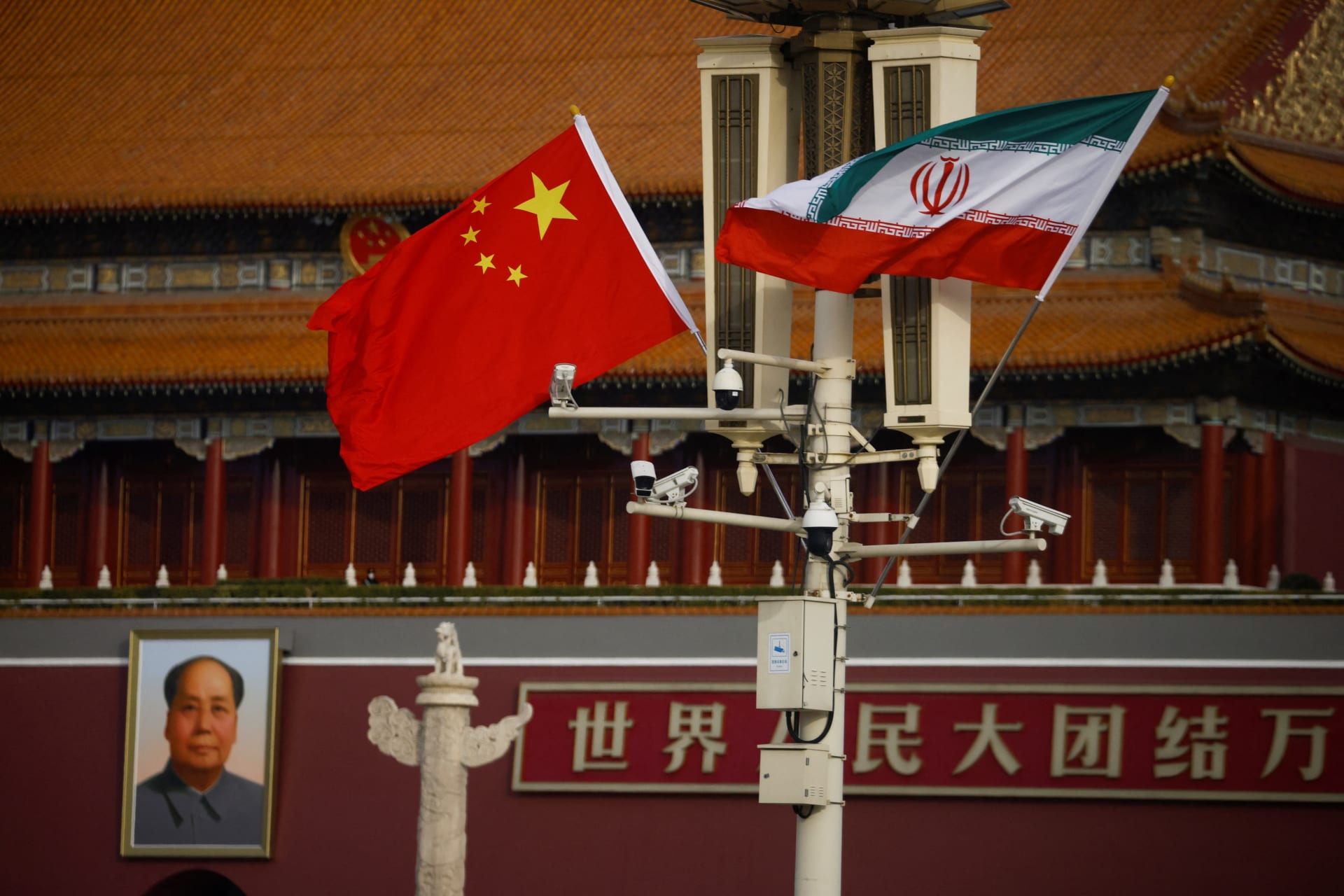
Araghchi visits Beijing: Iranian Foreign Minister Abbas Araghchi’s visit to Beijing from December 27 to 28 came at a moment of uncertainty for Iran, following the collapse of President Bashar al-Assad’s regime in Syria and setbacks for Hezbollah. On the day of his arrival, Araghchi published an article in the Chinese Communist Party’s People’s Daily and wrote, “The next golden 50 years of Iran-China relations will demonstrate that this visit marks the beginning of a new chapter of strategic cooperation between the two countries.” In a post on X, Araghchi described the partnership as “ironclad,” founded on “cultural & civilizational bonds and rooted in shared values & interests.” According to readouts, both sides reaffirmed the “comprehensive strategic partnership,” highlighted the importance of deepening ties, stressed their commitment to BRICS and the Shanghai Cooperation Organization (SCO), and jointly called for regional stability and a ceasefire in Gaza.
However, there were some slight but notable differences between the Iranian and Chinese readouts of the visit. Iran’s statements highlight the twenty-five-year cooperation agreement as a “solid foundation for developing relations in various fields” and frame the relationship as robust and mutually beneficial, with Iran presenting itself as a vital partner for China’s regional ambitions. Per Iran’s readout, “For his part, the Chinese foreign minister acknowledged the Islamic Republic of Iran’s significant status as an active and influential power in West Asia.”
The Chinese readouts, while echoing the language of partnership and alignment, stress multilateralism through the BRICS—a bloc of nations including Brazil, Russia, India, and China—and the SCO, “to better safeguard the common interests of the Global South.” Beijing’s statement also highlights China’s expectation that Iran “abides” by the One China principle and supports China’s position in Xinjiang, in Tibet, and on human rights—points entirely absent from Iran’s accounts.
Araghchi also met with Secretary-General of the Shanghai Cooperation Organization Nurlan Yermekbayev.
Wang’s four respects: During Araghchi’s visit to Beijing, Chinese Foreign Minister Wang Yi articulated a framework for China’s engagement in the Middle East dubbed the Four Respects. As enumerated by the Ministry of Foreign Affairs, they were as follows:
- respect for the sovereignty and territorial integrity of Middle East countries
- respect for the legitimate and reasonable concerns of Middle East countries
- respect for the choices independently made by Middle East people
- respect for the historical and cultural traditions of Middle East countries
As put by Emanuele Rossi in Times of Israel, “Framed as a constructive alternative to Western interventionism, the ‘Four Respects’ present China as a partner that prioritizes dialogue over dominance.”
Zhang visits Iran: Chinese Vice Premier Zhang Guoqing visited Iran in early December. The Chinese leader met with Iran’s first vice president, Mohammad Reza Aref, and with the country’s president, Masoud Pezeshkian. In a meeting with Pezeshkian, Zhang reaffirmed China’s “firm support for Iran in safeguarding its sovereignty, security, territorial integrity, and legitimate rights,” echoing China’s October 2024 comments after Israel’s attacks on Iran. As reported by the South China Morning Post, “Pezeshkian said Iran stood ready to expand ties with China and Russia to counter ‘unilateralism’ from the United States, which he accused of being ‘totalitarian’ in international affairs.”
During Zhang’s travels, Iran’s Deputy Foreign Minister Kazem Gharibabadi visited Beijing and met with Vice Foreign Minister Ma Zhaoxu to discuss bilateral relations.
U.S. sanctions increase oil prices: On December 4, the United States announced sanctions on “35 entities and vessels that have transported Iranian oil,” driving up logistics costs and tightening shipping capacity. As discussed in November, Iran exports 90 percent of its crude oil to China. As prices increase for Iran’s energy, Chinese imports are likely to decrease.
Cultural exchanges: Iran has launched a third Chinese location for its “Glory of Ancient Persia” exhibition. After being shown in Beijing and Shanghai, the exhibit—which includes over two hundred artifacts from four Iranian museums—will now be in Urumqi, the capital of Xinjiang. The showcase speaks to the appeal to each country’s ancient civilizational identity often included in official communications between the two.
New MoU: On the sidelines of the Indian Ocean Rim Development Cooperation Forum, Iran’s deputy minister of economic affairs and finance and the deputy director of the China International Development Cooperation Agency signed an MoU. The agreement covers the implementation of two unspecified projects in Iran to be funded by China’s South-South Cooperation Fund and the Global Development Initiative.
Israel
New ambassador: China announced a new ambassador to Israel in late November. Xiao Junzheng has held positions across the Middle East and focused on the region while working in the Ministry of Foreign Affairs. Most recently, he was Beijing’s ambassador to Athens. Xiao has hard work ahead as China seeks to improve relations with Israel since the October 7, 2023, attacks. As of December 2024, China refused to explicitly condemn Hamas’s terrorist attacks and had given rhetorical support to Iran during its bouts with Israel.
Xiao made his mark in his first Jerusalem Post op-ed, published in the last days of December, “One-China Is an Indisputable Fact, and Israelis Must Know This.” In the piece, Xiao lays out the PRC history of tensions between the mainland and Taiwan and describes the United States as “still lost in delusions of hegemony and trapped in a Cold War Mindset.” The piece ends with the following quote:
We hope the international community, including Israel, will be vigilant and resist the separatist forces of ‘Taiwan independence’ who are trying to disrupt the situation in the Taiwan Strait and create division and confrontation, abide by the one-China principle, handle Taiwan-related issues appropriately, and understand and support the Chinese people’s just cause of opposing the secession for ‘Taiwan independence’ and striving for national reunification.
Training Palestinians in search and rescue: The South China Morning Post reported in mid-December that China’s Blue Sky Rescue team invited six officers from Palestinian Civil Defence to Changshu—in the Jiangsu Province—to provide lessons in urban search and rescue. The Blue Sky Rescue team, China’s largest nongovernmental organization dedicated to humanitarian causes, taught the Palestinian officials “how to shore up collapsed buildings, cut through walls, search for victims and safely evacuate survivors,” skills critical to rescue efforts as Israel continues to bombard the Gaza Strip.
Israel’s ambassador meets with Chinese envoy: In late December, Israeli Ambassador Irit Ben-Abba Vitale met with China’s Middle East envoy Zhai Jun. Against the backdrop of Gaza and heightened tensions, the two sides discussed their respective positions and concerns regarding the crisis in Gaza.
Qatar
Doha Forum: From December 7 to 8, Qatar hosted the Doha Forum, focused on the Innovation Imperative. Chinese Ambassador for China-Arab States Cooperation Forum Affairs Li Chen attended the forum alongside 4,500 official, media, academic, and business representatives from over 150 countries. On the sidelines of the summit, Li met with Qatar’s acting director of Asian affairs, Yousef Fakhro.
New oil deals: On December 2, QatarEnergy, a state-owned gas company, signed an agreement with Shell to supply about 3.3 million tons of liquefied natural gas (LNG) to China annually starting in January 2025. In 2023, Beijing overtook Japan as the world’s largest LNG importer. The length of the deal’s term was not specified; however, Qatar’s similar agreements with Total in France, India’s Petronet, Eni of Italy, and Shell itself, hold a twenty-seven-year duration.
More ships: As part of its goal to build 128 LNG vessels, state-owned QatarEnergy awarded new contracts to Japan’s Mitsui OSK Lines Ltd. and Chinese state-owned COSCO Shipping LNG Investment in mid-December. Those agreements would have the east Asian companies own and operate six new ships to be built by a subsidiary of China State Shipbuilding Corporation. The ships have been valued at $2 billion.
Stock exchange deal: In the middle of December, the Qatar Stock Exchange signed an MoU with the SSE “to further strengthen business cooperation and communications between their capital markets.” The agreement mentioned a focus on initiatives related to sustainable development as well as opportunities in ETF products, data, and index products. Though concrete projects and timelines have not been detailed, the agreement signals ambitions for deeper cooperation between the two countries and serves as a foundation for ongoing partnership.
EVs: In the middle of December, Yutong, a leading Chinese bus manufacturer, partnered with Qatari state-owned Mowasalat and the Qatar Free Zones Authority to establish an electric bus assembly facility at the Um Al Houl Free Zone just south of Doha, Qatar. Construction was scheduled to be finished by the end of January 2025, with the potential to scale up to meet local demand and export to international markets across Europe, the Middle East, and North Africa.
In late December, Jetour Auto—a subsidiary of state-run Chery Holding Group—debuted its first hybrid model in the Qatari market.
Turkey
BYD investment: In the first few days of December, Turkish media reported that Chinese automaker BYD and Turkey’s Investment Office were nearing finalization of a $1 billion investment.
Two Ports, One Road: Turkey’s ErkPort and Chinese Yantai Port Group, two port services firms, signed an agreement—dubbed Two Ports One Road—on December 16 to increase transportation between Yantai Port, in the Yellow Sea, and Istanbul’s largest port Haydarpaşa.
Partnerships abroad: A Chinese-Turkish consortium secured a $5.6 billion contract to build Dubai’s Metro Blue Line. Scheduled to be built by the fall of 2029, the thirty-kilometer line seeks to support the city’s “20-minute city” urban planning vision.
Across the Region
Al-Assad toppled: As rebels took over Syria’s capital, Damascus, leading to the downfall of al-Assad, China’s foreign ministry made cautious statements, saying Beijing, “hopes that relevant parties will bear in mind the fundamental interest of the Syrian people and find as soon as possible a political settlement that will restore stability in Syria,” and that “the future of Syria should be decided by the Syrian people.” In addition to the foreign ministry’s remarks, Wang referenced Syria in conversation with Egypt’s foreign minister during the latter’s visit to Beijing. Though al-Assad and Xi signed a strategic partnership in September 2023, those few instances represent China’s relatively muted response to the turmoil in Syria.
Abdelatty travels to China: As China-Egypt cooperation ramped up, Cairo’s foreign minister Badr Abdelatty traveled to Beijing in mid-December and met with his counterpart, Wang Yi. The two cochaired the China-Egypt foreign ministers’ strategic dialogue and discussed instability in Gaza, Lebanon, and Syria. According to the Egyptian readout, the two officials also discussed Egypt’s new membership in BRICS.
Twenty Arab leaders travel to Beijing: In late December, Wang Yi met in Beijing more than twenty diplomatic envoys from Arab countries. According to Chinese readouts, Wang declared, “China-Arab relations have entered the best period in history under the guidance of the leaders of China and Arab countries.” The same readouts said that China supported a permanent ceasefire in Gaza; the removal of troops from the strip; a two-state solution; the preservation of Lebanon’s sovereignty, security, and territorial integrity; and the inclusion of all parties in a political settlement in Syria.