The Future of the Summer Road Trip
This is a limited excerpt from the Climate Realism Initiative Newsletter. Sign up to receive monthly insights from the initiative’s fellows and staff, including articles, videos, podcasts, events, and more.
Two Roads Diverged
June marked the official start of summer, the season when Americans pile into their cars for that classic warm-weather break: the road trip. Eighty percent of Americans will take a driving vacation in the next few months, and whether that conjures up an image of a classic muscle car eating up lonely desert miles or an overstuffed station wagon en route to Disney World, there are few more indelible icons of an American summer.
Increasingly, however, the talismanic gas-guzzlers of the U.S. interstate system are out of step with the rest of the world’s roads. More than seventeen million electric vehicles (EVs) were sold globally last year, making up more than 20 percent of all new car purchases.
Astute readers might accurately infer that the other 80 percent of purchases were traditional, internal combustion engine vehicles. But it would be inaccurate to conclude that conventional engines will continue to dominate in even the medium term.
Traditional car sales peaked in 2017, and are on pace to decline by more than a third by the end of this decade. Beginning in 2028, the share of conventional cars in the global fleet will begin to fall.
The future of global mobility is increasingly electric.
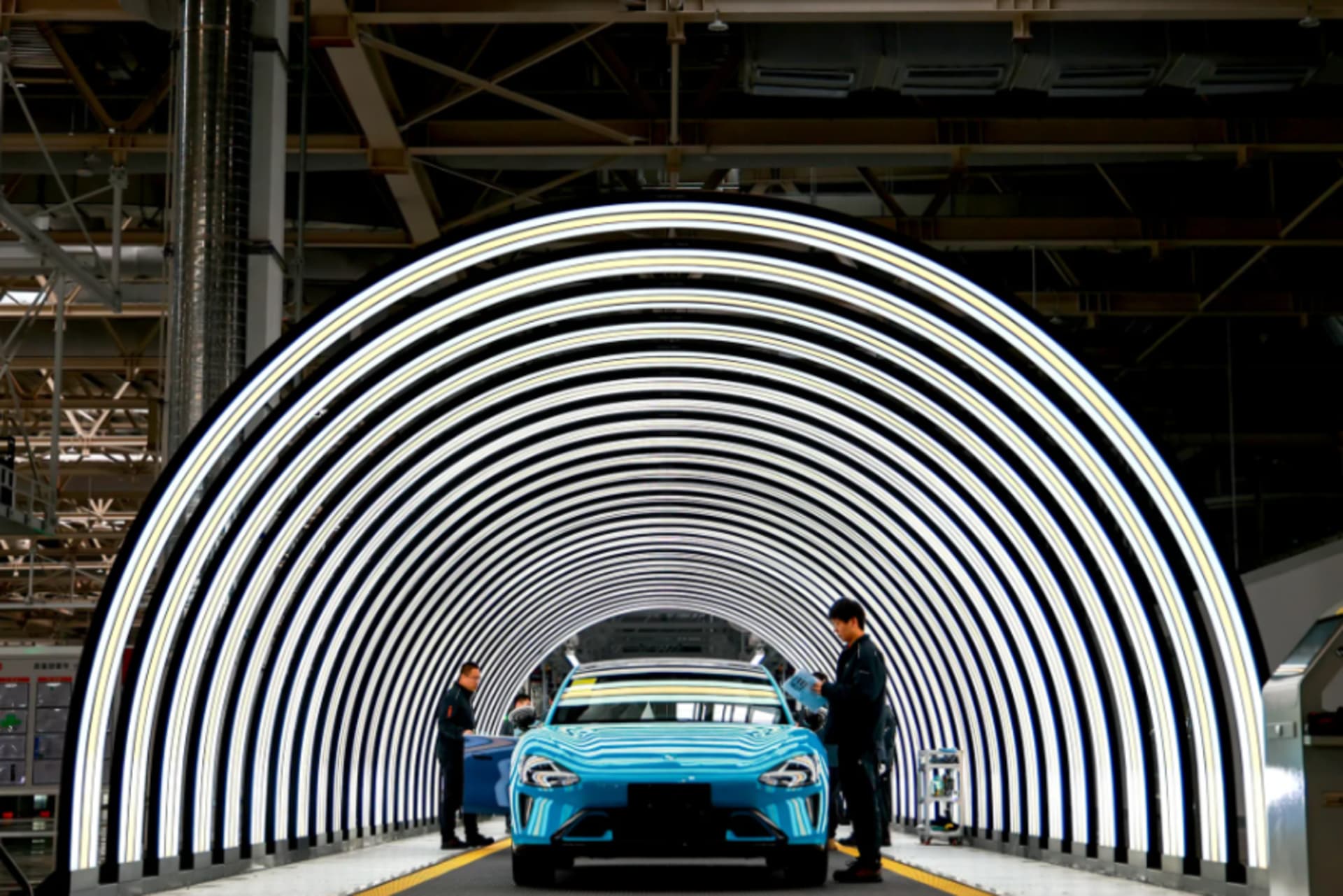
This is good news for the world’s climate; 15 percent of global emissions come from transportation, and electrification will substantially reduce that figure. Yet too little of this electric future is being made in the United States. Of the seventeen million EVs sold last year, eleven million were sold in China, and virtually all of them were from Chinese-owned companies like BYD, Wuling, Li Auto, and Geely. Only one American brand—Tesla—ranked in the top ten.
Nor is this situation limited to China. In Brazil, the largest EV market in Latin America, Chinese marques accounted for a whopping 85 percent of all EVs sold last year. In Thailand, the largest EV market in Southeast Asia, it was 78 percent. And, in May, BYD for the first time sold more EVs in Europe than Tesla—a watershed moment in a region where the American company has historically been a leader.
Beijing’s nascent market dominance is not an accident. Since 2009, China has invested more than $230 billion across the EV industry. This state assistance—ranging from support for basic research to funding for charging infrastructure and subsidies to bolster domestic demand—was designed to build globally competitive companies in a strategically important sector.
Whether Chinese companies would be as competitive without such extensive public support remains a subject of intense debate. But, discourse aside, the net effect of China’s efforts is an electric vehicle fleet that’s sleek-looking, fast-charging, and tech-savvy, all with a price tag as low as $10,000. Perhaps that’s why, in 2024, 60 percent of the world’s EVs were made in China.
American consumers have been almost completely walled off from these developments by policy decisions made by presidents of both parties. President Joe Biden’s administration quadrupled the first Donald Trump administration’s tariffs on Chinese electric vehicles, from 25 percent to 100 percent, and later imposed an effective blanket ban on EV imports from China.
The Biden administration paired those actions with initial steps to help the U.S. auto industry develop a domestic EV market—historically a prerequisite to global competition—including investments in the lithium-ion battery supply chain, tightened fuel efficiency standards, funding for charging infrastructure, and tax incentives for certain EV buyers. But few of those efforts bore fruit before the end of Biden’s term, and President Trump and the 119th Congress are working to repeal them.
For would-be U.S. EV buyers, this is a bummer. But for the U.S. auto industry, these combined actions are a catastrophe. Without a robust, competitive domestic market, U.S. automakers will have little incentive to make better EVs, leaving them further and further behind in the global race. Speaking recently at the Aspen Ideas Festival, Ford CEO Jim Farley called China’s EV industry “the most humbling thing I have ever seen.”
“We are in a global competition with China, and it’s not just EVs,” Farley continued. “And if we lose this, we do not have a future Ford.”