Hostage and Prisoner Release in Gaza Ceasefire
By experts and staff
- Published
- CFR Editors
Welcome to the Daily News Brief, CFR’s flagship morning newsletter summarizing the top global news and analysis of the day.
Subscribe to the Daily News Brief to receive it every weekday morning.
Top of the Agenda
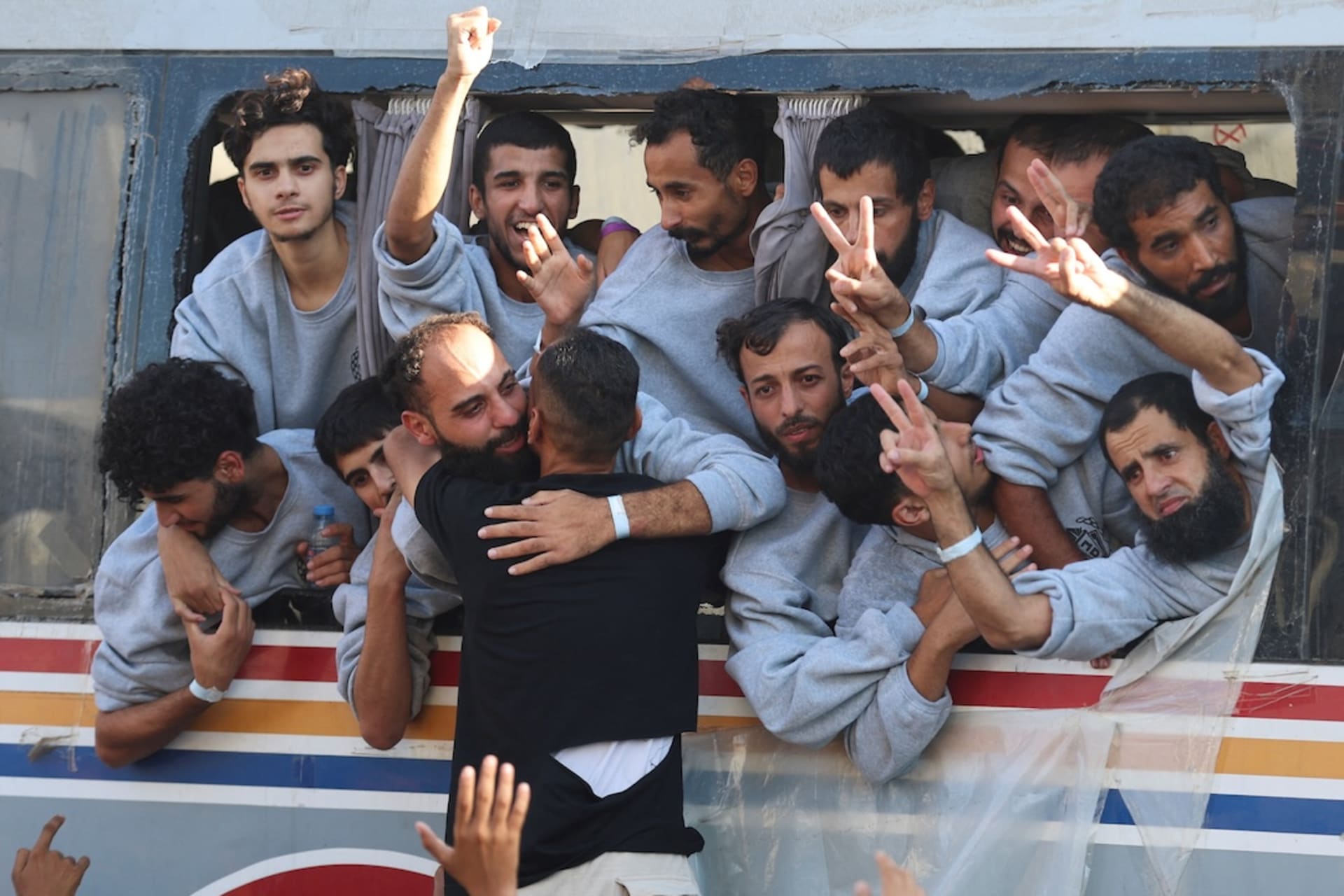
Hostage and prisoner releases advanced the implementation of a peace plan for Gaza after two years of war, with world leaders due to meet with U.S. President Donald Trump in Egypt today regarding the truce. Hamas released the last twenty living hostages taken on October 7, 2023, and Israel has commenced the release of almost two thousand Palestinian prisoners. Trump arrived first in Israel as part of his efforts to shore up the ceasefire. Addressing the Knesset, he said that Israel “won all that can be won by force of arms” and that now is the time to work toward “peace and prosperity for the entire Middle East.” Israeli Prime Minister Benjamin Netanyahu said that he is “committed to this peace.”
The truce unfolds. Hamas released the remaining living hostages in two groups, while a forum of hostage families said they learned that bodies of only four deceased hostages will be returned today. In addition to initiating the release of Palestinian prisoners, Israel allowed more aid to flow into Gaza, the UN humanitarian agency said. Tents, food, and cooking gas entered the territory yesterday. Gaza’s civil defense agency said Saturday that more than five hundred thousand people have returned to Gaza City since a ceasefire began Friday. U.S. forces will help monitor the truce, Vice President JD Vance said yesterday.
The peace summit. Some twenty world leaders—including those of France, the Palestinian Authority, Qatar, Turkey, and the United Kingdom—are expected to attend today’s peace summit in Sharm El Sheikh, Egypt. Netanyahu will not attend due to a Jewish holiday, his office said. Leaders are expected to discuss more advanced elements of Trump’s plan for Gaza, including its call for the establishment of a stabilization force in the enclave. Though the plan seeks no political role for Hamas in Gaza, the group has been asserting itself over rivals within the strip in the wake of the ceasefire.
“It is important to underscore that, even under the most optimistic scenario, we will not be looking at peace. It will be extremely hard to move beyond a limited deal...Hamas can be denied a formal role in Palestinian governance but it will still have influence, possibly more than any other actor. Moreover, Palestinian leadership otherwise remains weak, while Israel is a country not ready to make meaningful concessions for peace no matter who is in charge.” —CFR President Emeritus Richard Haass on Substack
Across the Globe
Trump’s threat of China tariffs. China said that it would retaliate with “corresponding measures” after Trump on Friday announced new 100 percent tariffs on Chinese goods beginning November 1. Those new tariffs respond to broad Chinese export controls announced the previous week. Trump and Chinese President Xi Jinping are due to meet in person before the tariffs take effect. Trump appeared to soften his tone over the weekend, writing on social media late yesterday that the United States “wants to help China, not hurt it.”
U.S.-Ukraine military coordination. The United States might send Ukraine long-range Tomahawk missiles if Russia does not settle the war soon, Trump said yesterday. A Kremlin spokesperson called the prospect of the provision one of “extreme concern.” Separately, the Financial Times reported that the United States has stepped up intelligence support for Ukrainian long-range strikes on Russian energy facilities in recent months.
Afghanistan-Pakistan border clash. Both countries said their security forces killed dozens of each other’s combatants in the worst border hostilities in months. The fighting began Thursday following explosions in Afghanistan that the Taliban blamed on Pakistan. Islamabad did not confirm or deny carrying out strikes in Kabul, saying that it carried out “a series of retribution operations.” Pakistan has accused Afghanistan of harboring members of the Pakistani Taliban.
Madagascar’s political crisis. President Andry Rajoelina’s office claimed a coup attempt is underway and said that Rajoelina will address the nation later today; it was not clear if he remained in the country. An elite army unit joined anti-government protesters over the weekend and claimed it took control of the country’s military command. The same unit had helped Rajoelina seize power in a 2009 coup.
France’s new old government. Sébastien Lecornu announced a new cabinet yesterday after President Emmanuel Macron reappointed him as prime minister on Friday—just days after Lecornu resigned amid political deadlock. The new government includes new defense and interior ministers, while Macron’s foreign minister is staying on.
Seychelles election. Opposition leader Patrick Herminie won the country’s runoff presidential election with 52.7 percent of the vote to incumbent leader Wavel Ramkalawan’s 47.3 percent. The Seychelles is one of Africa’s richest countries by GDP per capita in large part due to luxury tourism, though opposition to a major project by a Qatari company may have turned voters against the governing party ahead of the election.
Economics prize. This year’s Nobel Prize in Economics went to Philippe Aghion, Joel Mokyr, and Peter Howitt for research on how innovation and technological progress drive sustained growth. A member of the Nobel committee said today their work underscored the need for society to focus on factors that generate growth, such as commitments to science and innovation.
Qatari military in Idaho. Qatar will build an air force training facility in Idaho, Defense Secretary Pete Hegseth announced Friday. The facility is intended to boost interoperability between the two countries, host Qatari F-15 fighter jets, and train Qatari pilots. It comes after Trump issued a security guarantee to Qatar last month via executive order.
What’s Next
Today, the International Monetary Fund and World Bank begin their annual fall meetings in Washington, DC.
Tomorrow, Argentine President Javier Milei is expected to meet with Trump in Washington, DC.
Tomorrow, the U.S. and China are due to start collecting fees on vessels visiting each others’ ports.