Reflections on the Protests in Iran
CFR President Michael Froman analyzes the Trump administration’s approach to Iran.
Sign up to receive CFR President Mike Froman’s analysis on the most important foreign policy story of the week, delivered to your inbox every Friday afternoon. Subscribe to The World This Week.
Just when you thought President Donald Trump had enough on his plate—between Russia and Ukraine, Gaza, Venezuela, Greenland, and the ongoing challenge of China—Iran rears its head as well.
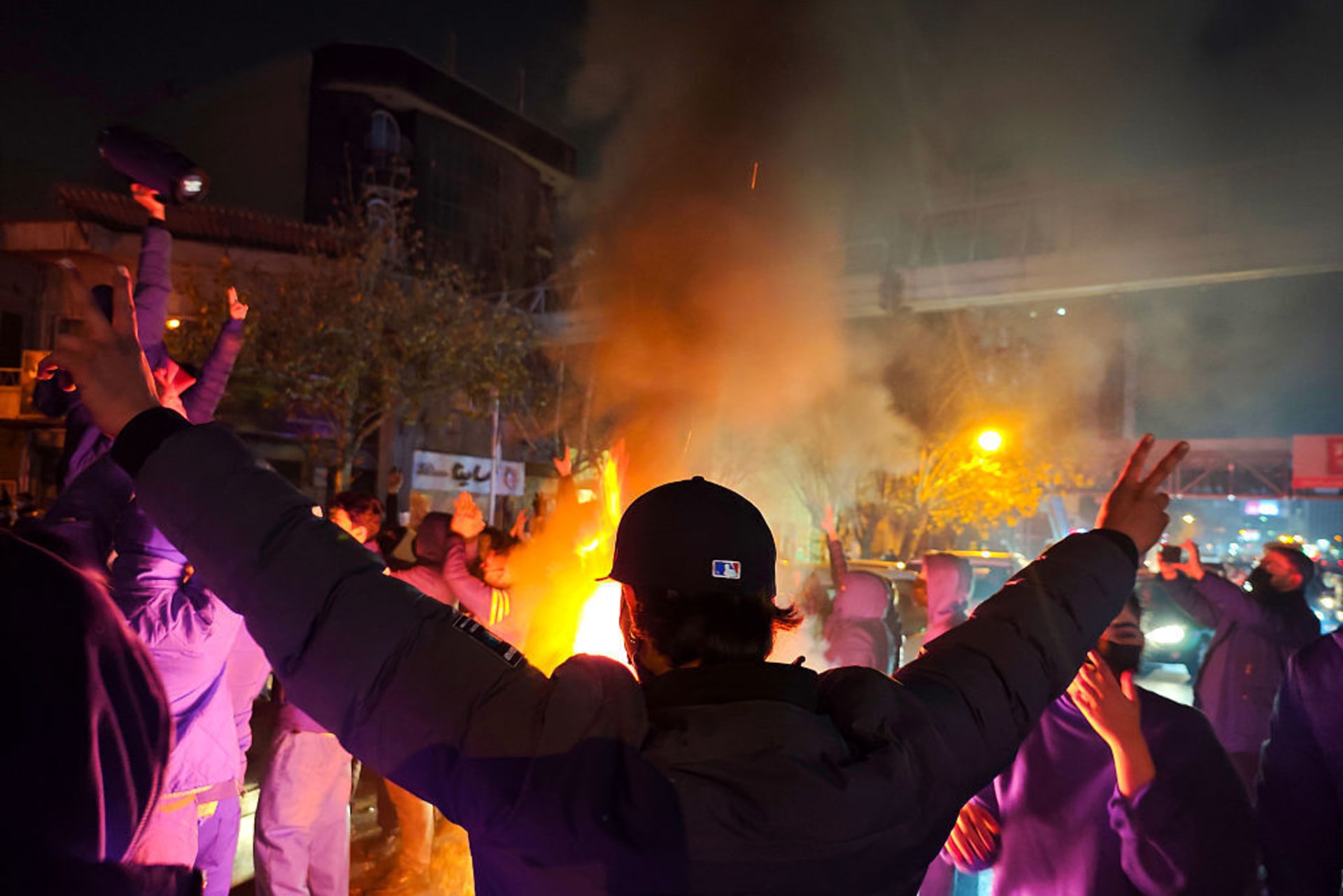
An estimated 2,000 to 12,000 people have been killed thus far in the protests that first broke out at the end of December. That’s a broad range of casualties which underscores how little reliable information we have about what’s going on in Iran, given the regime’s crack down on journalists, the internet, and cell phone networks.
Iran is no stranger to protest movements, which have erupted periodically under clerical rule, most recently in 2022 following the death of Mahsa Amini—who was detained by the regime’s so-called morality police for allegedly violating Iran’s mandatory hijab laws and later died in custody.
But the current wave of protests, in their vigor and scale, rhyme more closely with the last great cataclysm in Iran: the 1979 overthrow of the shah. And just as merchant strikes in Tehran’s storied Grand Bazaar helped catalyze mass mobilization in 1978 and 1979, they have once again emerged as a critical spark in the current wave of demonstrations, against the very theocracy they backed some five decades ago. What makes these protests in Iran different from recent uprisings is the combination of an economic crisis at home, disillusionment with the foreign policy choices made by the leadership, mismanagement of the country, and the growing aspirations of its people.
Iran is experiencing some of the world’s worst inflation (more than 50 percent across the board, 70 percent for food), and its currency has fallen more than 80 percent against the dollar in the last year. Tehran is also running out of water, and some parts of the city are sinking as rapidly as twelve inches per year.
At the same time, Iranians are confronting the consequences of their government’s failed foreign policy, which, at tremendous cost and with limited long-term success, bankrolled an array of regional proxies, built up a nuclear and missile program, and invited international economic isolation.
Iran is weaker than any other time in recent memory. The power projection capabilities of its regional proxies, namely Hamas and Hezbollah, have been decimated, as have its air defenses. Israeli and U.S. strikes dealt a significant blow to Iran’s nuclear program and ballistic missile capabilities. Several senior officers and officials were killed by Israel in targeted strikes, and Iran’s “axis of the aggrieved” partners in Moscow, Beijing and Pyongyang have proven feckless in providing much support—all raising questions among the Iranian people whether the resources that could have gone to addressing significant domestic needs were wasted on the regime’s foreign policy misadventures.
The Iranian regime will do everything it can to shut down these protests as they have in the past. In doing so, though, will Tehran more closely resemble Tiananmen or Timisoara? As Brenda Shaffer, an expert in the region at the U.S. Naval Postgraduate School, told me, there is a question whether the violent suppression of the demonstrators will succeed in quelling them or only incite further anti-regime activity. The massacre at Tiananmen Square succeeded in decimating the anti-regime protests in China in June 1989. By contrast, six months later, Nicolae Ceausescu’s violent crackdown of demonstrations in the city of Timisoara ended up pouring fuel on the fire of the protests and hastened the demise of the Communist regime in Romania.
CFR’s Ray Takeyh wrote for the Wall Street Journal with Reuel Marc Gerecht, the “Trump administration should assume that the theocracy will suppress this eruption absent outside intervention.” The question of outside intervention is a tricky one. I recall that during the 2009 Green Movement protests in Iran, the Obama administration worried that if the United States embraced the protests, they would taint the uprising as an American plot. Counterfactuals are fraught, but as former President Barack Obama told Pod Save the World in 2022: “In retrospect, I think that was a mistake. Every time we see a flash, a glimmer of hope, of people longing for freedom, I think we have to point it out. We have to shine a spotlight on it. We have to express some solidarity about it.”
President Trump seems determined not to repeat that mistake, much to his dismay of some of his supporters who oppose U.S. intervention in the internal affairs of other countries and efforts to engage in regime change. That said, the question now is what form such outside intervention might take.
Two weeks ago, Trump warned the Iranian regime that U.S. forces were “locked and loaded and ready to go,” if it continued to kill protestors. Earlier this week, Trump posted on Truth Social that “HELP IS ON ITS WAY” and urged protesters to keep demonstrating. He’s since said that he has information from “very important sources on the other side” that protesters won’t be executed and told the media “we saved a lot of lives.” It’s possible that Iran stepped back from plans to conduct specific mass public hangings, but it seems unlikely that the regime has decided to step back from cracking down on the protestors altogether, even if that requires lethal force. Given the internet blackout, reliable confirmation is hard to secure.
A U.S. response could take a number of forms, depending on whether the goal is to deter the Iranian regime from cracking down on the protestors or to make it more difficult for them to do so.
First, if Trump accepts the assurances he has received that protestors aren’t being killed, he could declare victory, “mission accomplished,” and forgo further action. The protestors would be entitled to feel rather disappointed, however, given how far out on a limb Trump has gone in assuring U.S. support for their cause.
Second, short of military action, there is the threat of additional sanctions or tariffs on third countries. Earlier this week, Trump imposed sanctions on individual Iranian officials deemed responsible for the crackdown and announced that nations doing business with Iran could face an additional 25 percent tariff, a move intended to pressure countries such as China, India, Iraq, Turkey, and the United Arab Emirates to rein in Tehran. That said, little is known about how such a policy would be implemented in practice or how effective it might prove and over what period of time.
Third, there is the option of helping restore internet access to enable greater communication and coordination among the protestors, and to facilitate the transmission of messages from the outside world into Iran. The United States played a critical role in bringing connectivity back online in Ukraine in 2022 through Starlink and could try to do so here.
Fourth, Trump could reach for the military option of cyberattacks, kinetic strikes, or both. A cyberattack might target the regime’s command, control, and communications capabilities, and a kinetic strike could hit ballistic missile assets, intelligence facilities, ammunition depots or high-ranking Islamic Revolutionary Guard Corps (IRGC) personnel. Reporting by the Wall Street Journal suggests that Trump is not inclined to strike, at least for now, because the proposed operations could not guarantee the collapse of the regime.
When it comes to the military option, the trade-offs in U.S. strategy are coming clearly into focus. Trump’s latest threats against Iran come at a time when he’s focused on the Western Hemisphere, consistent with his administration’s new National Security Strategy. In 2025, when the United States struck Iran’s nuclear program, the U.S. had two carrier strike groups—the USS Nimitz and USS Carl Vinson—positioned in the region. Currently, there are none, although the president has ordered the USS Abraham Lincoln carrier strike group to move from the South China Sea to the Middle East. We might not need these assets in theater to launch strikes, but they have proven critical in mitigating Iran’s retaliatory capabilities against U.S. assets in the region and Israel.
Then, of course, is the question of what or who comes next. Geopolitical traders on Polymarket have the Supreme Leader of Iran Ali Khamenei out of power as a coin flip by the end of the year. He’s eighty-six years old and reportedly not in great health, so the end of his reign could well come as a matter of the actuarial tables. Whether he’s forced out by the protesters or just the passage of time, the regime will have to reckon with a question of what its future looks like without Khamenei at the helm. The blossoming of a Jeffersonian democracy is extremely unlikely, though some type of secular pluralistic government could emerge. It’s also possible a new ayatollah could be appointed, an IRGC junta of sorts could take power, or the state itself could fracture, leading to factional and sectarian conflicts.
And then there is the late shah’s exiled son, Crown Prince Reza Pahlavi. As part of the Council’s long tradition of hosting influential foreign and political leaders, Pahlavi appeared at CFR in October of last year for a discussion on Iran’s future—one which he hopes to help lead. He told attendees that he envisioned “in tomorrow’s free Iran and secular Iran, those rights and guarantees—the same liberties of Iranians that had to seek asylum in countries that offer them that liberty—would like to be able to have the same liberties back home. And that’s exactly what we’re trying to do. The very same liberties that we enjoy here we should be able to enjoy there, back in Iran itself.” The Crown Prince might well be the most visible opposition figure, and he has made clear that he has “trained all [his] life to serve [his] nation.” But how much support he has across Iran is uncertain. He may struggle to distance himself from the dynasty of his family, which brutally repressed ethnic minorities and restricted civil liberties in pre-revolution Iran.
In any event, in the words of my colleague Steven Cook: “Even if the regime does not fall, the country will be different from what it was like on December 28, 2025, the day the protests began.” The same was true after Tiananmen and Timisoara.
Let me know what you think about the protests in Iran and what this column should cover next by replying to [email protected].